
Published: October 2025 | Last updated: May 2026 | Editorial review and quality control: Martina N.
A positive STI test landing in a long-term marriage feels impossible. Nobody broke any vows. Neither partner has noticed symptoms. The wedding paperwork is years old. So how did this happen?
Most of the time, the explanation is biology rather than betrayal. Some sexually transmitted infections sit quietly in the body for years, sometimes for life. Standard checkups rarely cover all of them. By the time a positive result appears, the infection is often older than the relationship itself. This guide walks through how that happens, which tests usually get skipped, and what to do next, with as little blame as the situation allows.
Key takeaways
- Dormant infections like herpes, HPV, and syphilis can persist in the body for years without symptoms, so a positive STI result during marriage often points to an exposure that predated the relationship rather than recent infidelity.
- Most pre-marriage testing is a partial panel. Unless one of you specifically asked for blood, swab, and urine tests covering each infection, your 'baseline' before the wedding may have left obvious gaps.
Why an STI showing up in marriage isn't always betrayal
Marriage doesn't change biology. It changes who you have sex with going forward, but it can't retroactively scrub anything that was already in either body. Public health researchers have made this point for decades: monogamy works as a prevention strategy when both partners enter it without an undetected infection, and the partner pool before the relationship was small enough to keep that probability high.
That's a tall order. Studies of testing patterns show that most adults who say they've been 'tested for STIs' actually got a partial panel, often just HIV or whatever the clinic ran by default. According to CDC screening recommendations, full coverage requires specific tests for chlamydia, gonorrhea, syphilis, HIV, and (depending on risk factors) herpes and trichomoniasis. Few people get all of those before settling down with one person.
So when a positive result arrives during marriage, the most useful first question is often 'what didn't either of us know going in?' rather than 'who cheated?' That reframe doesn't fix anything, but it usually fits the actual timeline better than the betrayal narrative, especially for infections known to lie dormant for years.
Monogamy works as STI prevention only when both partners entered the relationship genuinely infection-free. That requires comprehensive screening before the relationship, not just a single HIV test or a pap smear. Partial pre-marriage panels are the norm, which leaves a real probability that a dormant infection from a previous partner came along for the ride.
The dormant infection problem: what was there before the wedding
Some STIs can stay in the body for years without producing a single symptom. That isn't a quirk of specific pathogens; it's central to how they spread. An infection that announces itself with pain or rash gets treated. An infection that does nothing visible can move quietly between partners for a decade.
Herpes simplex virus is the textbook example. Most people with genital herpes have never had symptoms severe enough to recognize, and asymptomatic viral shedding can transmit the infection to a partner. HPV behaves similarly. Cervical cells can host the virus for years before any abnormal pap result appears, and most low-risk strains clear on their own without anyone knowing they were ever there.
Bacterial infections can also play this game. Untreated chlamydia frequently produces no symptoms in people without penises and can persist long enough to cause pelvic inflammatory disease later. Syphilis has a true latent stage where the body harbors the pathogen for years between active phases. Even gonorrhea, usually thought of as symptomatic, can run silent in cervical or pharyngeal sites.
The practical point: if either of you had a sexual partner before the relationship and didn't have a comprehensive screen at that time, an existing infection could have entered the marriage on day one without either of you noticing.
| STI | Can it be dormant? | Typical asymptomatic window | Commonly symptom-free? |
|---|---|---|---|
| Herpes (HSV-1 and HSV-2) | Yes | Lifelong with periodic shedding | Yes (especially HSV-1) |
| HPV | Yes | Months to years before any sign | Yes |
| Chlamydia | Yes | Months to years if untreated | Often |
| Gonorrhea | Sometimes | Weeks to months | Sometimes |
| Syphilis | Yes (latent stage) | Years to decades if untreated | Yes (in latent phase) |
| Trichomoniasis | Yes | Months in some cases | Often (especially in men) |
Why no symptoms doesn't mean no infection
The most common mistake here is treating absence of symptoms as evidence of absence of infection. They're different things. The CDC calls chlamydia a 'silent' infection precisely because most infected people have nothing to feel. Gonorrhea symptoms are present in some men but frequently absent in women. HPV produces no warning at all in most people; the only sign is an abnormal pap or a wart, and many strains never trigger either.
Public health agencies recommend periodic screening even for adults in long-term, exclusive relationships, particularly when the early days of the relationship overlapped with previous partners. The reasoning is straightforward: a screening program that only catches symptomatic cases misses most actual infections. The gap between infections detected and infections present in the population is large, which is why CDC guidance on STI testing emphasizes proactive screening rather than waiting for symptoms.
A pattern that comes up in primary care: a routine prenatal screen flags trichomoniasis in someone who has been married for years. The husband had never been offered a trichomoniasis test in routine care, and trichomoniasis in men is often asymptomatic for months or longer. Neither partner had outside contact during the relationship.
An asymptomatic infection is biologically active but produces no symptoms you'd notice without a test. Many STIs spend most of their natural history in this state, which is why screening (rather than symptom-watching) is the standard public health approach for sexually active adults.
What routine STI testing usually skips
A common assumption: the bloodwork at your last physical 'checked for everything.' Almost never true. Standard primary care visits don't include STI testing unless you specifically request it, and what gets tested depends on your stated risk factors and what the clinic stocks. Pap smears in particular are not STI tests; they screen for cervical cell changes, most often caused by HPV, but they don't tell you whether you have chlamydia, gonorrhea, herpes, syphilis, HIV, or trichomoniasis.
Even when STI testing is ordered, herpes is usually excluded unless you ask. The CDC does not recommend routine herpes serology for asymptomatic adults because the test has known specificity issues, but that means most people don't know their HSV status. HPV testing in men is not done at all in most clinical settings because there's no validated screening test approved for use outside cervical or anal cytology. Trichomoniasis testing is more available now than it used to be, but many male partners of infected women never get tested for it.
The implication for couples who tested before marriage: unless one of you sat down with a clinician, listed prior partners and sexual practices, and asked specifically for blood plus swab plus urine samples covering every relevant infection, you almost certainly didn't get a full baseline. Disclosure: this article is published by stdrapidtestkits.com, which sells the at-home lateral-flow STI kits linked below. We recommend kits based on fit-for-purpose for the reader's concern, not commercial benefit.
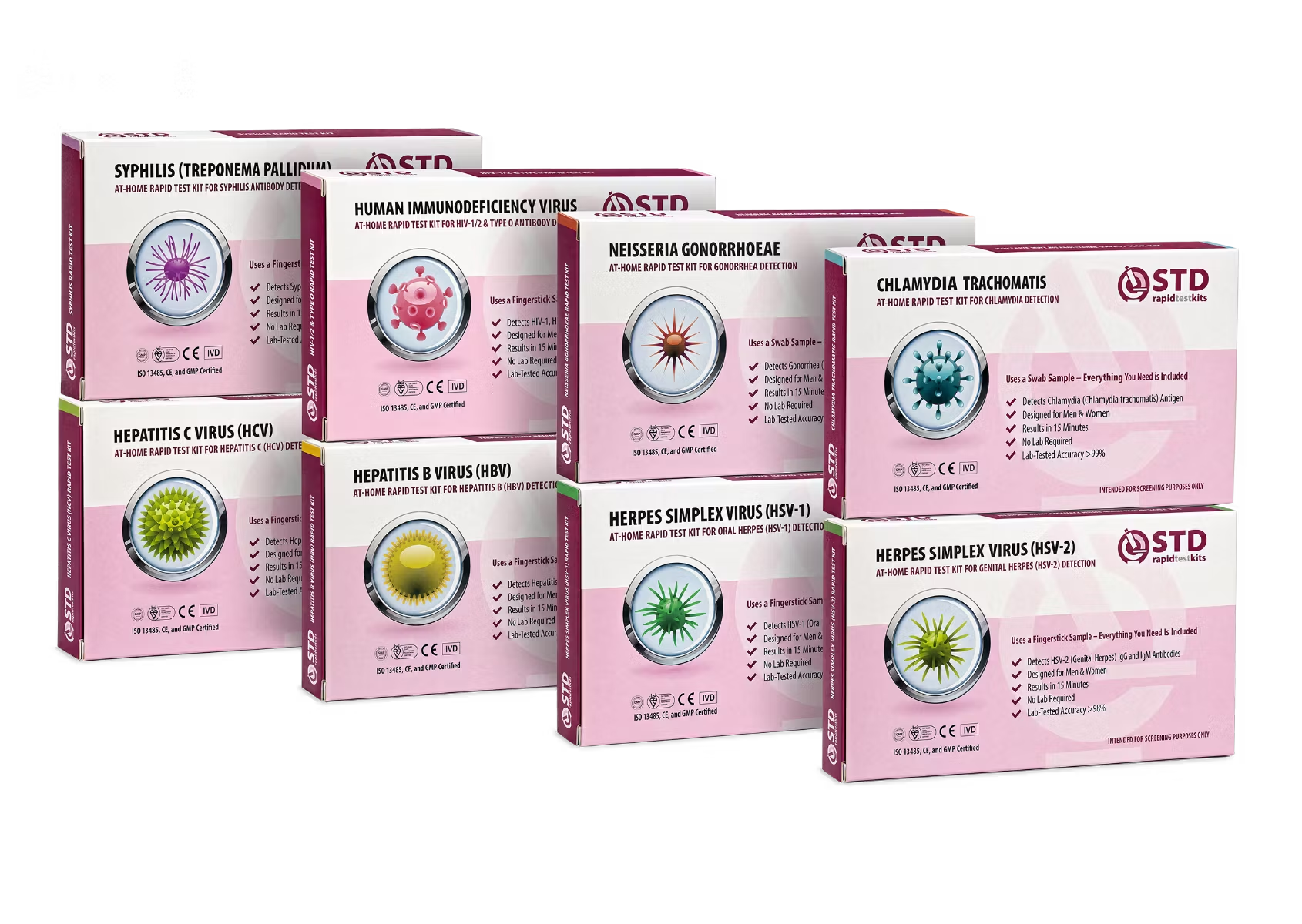
Window periods: when a test can actually detect what it's looking for
Window period is the time between exposure and the earliest reliable detection on a given test. Testing too early produces false negatives, which is one of the most common reasons couples get blindsided later. The CDC publishes window periods for each major infection, and they vary by test type as well as by infection.
If you're testing because of a known recent exposure (a confessed slip-up, a partner's positive result, a partner from before the relationship who just disclosed), the timing matters. The standard approach is to test once at the early window, then retest at the conservative end of the window to catch anything that hadn't seroconverted (produced detectable antibodies) at the first test. The table below summarizes the ranges that CDC HIV testing guidance and the broader STI screening recommendations cite for the at-home and lab-based tests most adults use; specific assay performance can be slightly tighter or looser depending on the manufacturer.
| Infection | Earliest reliable test date | Best time to test | Retest recommended? |
|---|---|---|---|
| Chlamydia | 7 days after exposure | 14 days after exposure | Yes if tested early |
| Gonorrhea | 5 to 7 days | 10 to 14 days | Yes if symptoms appear later |
| HIV (Ag/Ab combo) | 18 to 45 days | 4 to 12 weeks | Yes at 3 months |
| Syphilis | 3 weeks | 6 to 12 weeks | Yes if exposure was recent |
| Trichomoniasis | 5 to 10 days | 2 to 4 weeks | Sometimes |
| HPV | Not routinely screened in men | Often detected via pap smear in women | No clearance test in men |
If you both tested before the wedding, what could have happened?
Three things, mostly. First, timing inside the window period. If one of you tested within days or weeks of a recent prior exposure, the infection might not have been detectable yet. People who 'test before getting serious' often test too early to catch the most likely source.
Second, partial panels. Most pre-marriage testing is a subset of what would actually clear both partners. If you didn't ask for HSV serology, trichomoniasis, or any HPV-related screening (where available), you didn't rule those out. The bloodwork at a wellness visit and a urine sample for chlamydia and gonorrhea is a defensible baseline for low-risk adults, but it isn't comprehensive.
Third, infections that aren't classically sexual but show up on STI panels. Hepatitis B and C can transmit through shared razors, non-sterile tattoo or piercing equipment, and rare household exposures. Mother-to-infant transmission of HIV, HBV, and herpes happens despite modern prophylaxis. These routes aren't common, but they explain the occasional case where neither partner ever had risk factors that fit the standard screening checklist.
If you're holding a positive test result and trying to fit it to a betrayal timeline, consider that none of those three explanations require anyone to have lied.
Timing. One partner tested inside a window period and got a falsely-negative result before the wedding.
Coverage. The pre-marriage panel skipped HSV serology, trichomoniasis, or HPV screening, leaving an infection undocumented.
Non-sexual route. A small fraction of cases trace to shared razors, non-sterile tattoo equipment, or vertical transmission at birth.
How to bring up testing in your marriage without it blowing up
There's no neutral way to ask a spouse to get tested, but there's a less inflammatory way. Lead with what you read, not what you suspect. Try: 'I was reading about how routine checkups don't actually screen for most STIs unless you ask. I think we should both do a full panel, just so we know.' That sounds different from 'I want us to get tested,' which lands like accusation regardless of how you mean it.
If you've already tested positive and need to disclose, focus on what you know and what you don't. The honest version of that conversation is some combination of: 'I tested positive for X. I don't know how long I've had it. The window for that infection is up to Y, which means it could predate us. I want us both to get the right tests and treatment.' Framing it that way keeps the conversation factual rather than confessional, because there is genuinely nothing to confess to yet.
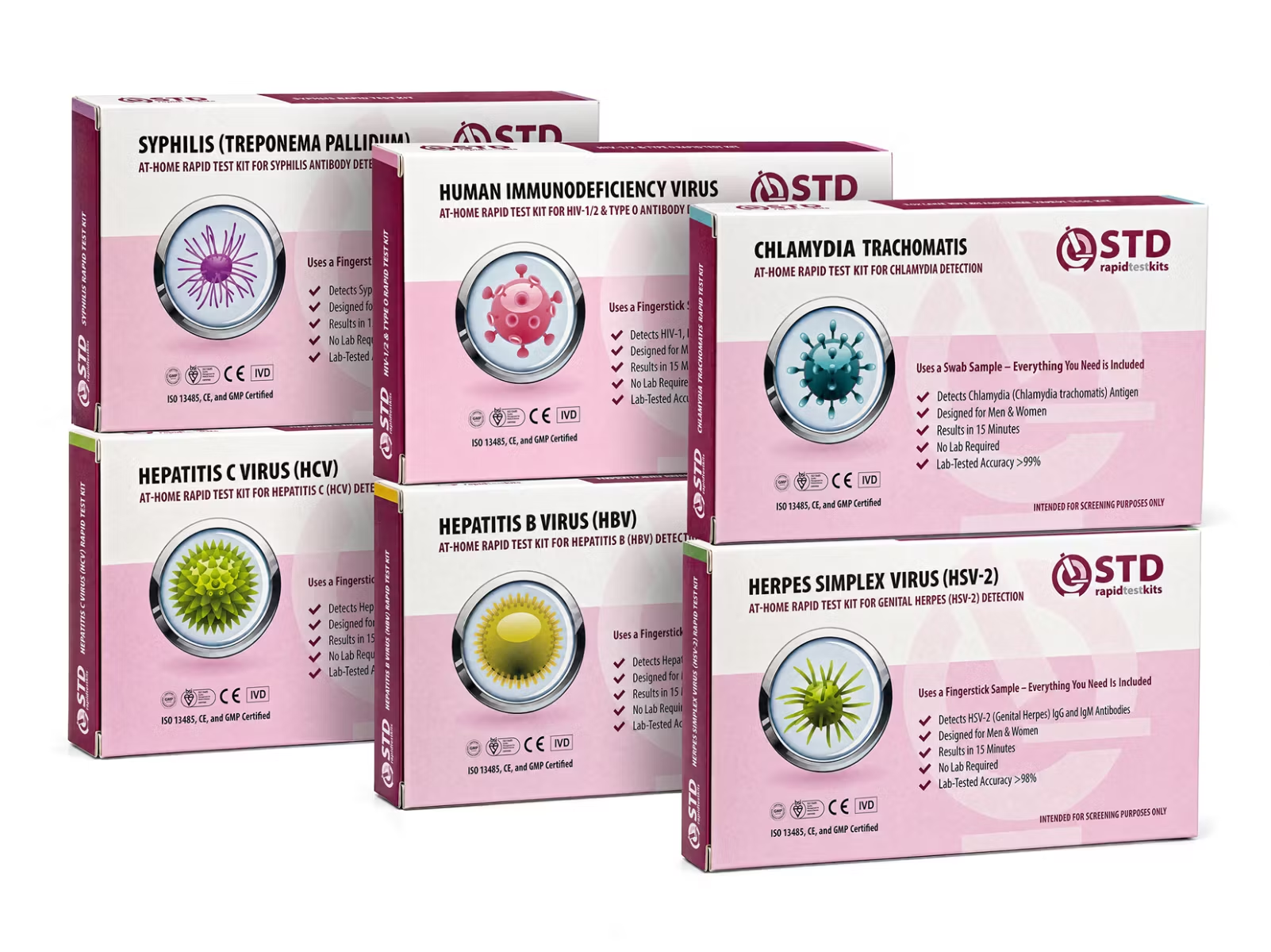
Some couples find it easier to start with at-home kits, since the testing logistics happen privately. Once both partners have results in hand, the next conversation tends to be calmer, partly because there's less abstract anxiety in the room and partly because both people have already shared the same logistical step before any disclosure.

Retesting, reinfection, and the ping-pong problem
Bacterial STIs (chlamydia, gonorrhea, trichomoniasis, syphilis) require both partners to be treated at the same time. If only one partner takes antibiotics and you resume sex before both are cleared, the untreated partner reinfects the treated one. Clinicians call this ping-pong reinfection, and it's a leading reason a 'cured' couple keeps testing positive. The fix is simple in principle: treat together, abstain during treatment, and retest at the recommended interval to confirm clearance.
For viral STIs (herpes, HIV, hepatitis B), treatment is suppressive rather than curative for most cases. Hepatitis C now has well-tolerated direct-acting antiviral cures available; the long-tail antibody response is the part remaining tests detect. Suppressive therapy reduces transmission risk dramatically, especially for HIV: an undetectable viral load on consistent antiretroviral therapy (ART) means effectively zero sexual transmission, the U=U principle the CDC and WHO have publicly endorsed.
Standard retest intervals: 3 weeks after antibiotic completion for bacterial infections, 3 months after exposure for HIV (to clear the longest tail of the window period), and 6 to 12 weeks after potential syphilis exposure depending on the assay. If symptoms appear after a 'clear' result, retest sooner regardless of the calendar.
Privacy when you just need answers first
At-home testing exists partly because clinic visits aren't always practical. Small towns where the receptionist is a neighbor, marriages where the conversation is impossible to start without a result in hand, work schedules that don't allow daytime appointments. At-home rapid kits ship in unmarked packaging, return results in roughly 15 to 30 minutes for the lateral-flow products, and let you handle the logistics privately before deciding what to share.
For couples who want to do this together, ordering one combination kit per partner, taking the test on the same day, and swapping results is the cleanest approach. Both partners have the same baseline information, and both have done the same private logistical step before either of you has to disclose anything.
At-home rapid tests use lateral-flow chemistry. They are useful screening tools but have lower analytical sensitivity than the lab-based NAAT (nucleic acid amplification) tests clinics use. A positive at-home result should be confirmed with a lab test before any treatment decision. A negative result outside the window period is reassuring; a negative inside the window period needs a retest at the conservative end of the window.
Testing positive: what to do in the first 48 hours
Most STIs are treatable, several are curable, all are manageable with current medicine. A positive result is a medical condition with a clear set of action items, not a moral indictment.
Hour 0 to 24: confirm the result. If it was an at-home rapid test, schedule a lab confirmation. If it was a lab test, ask your provider what the recommended confirmatory test is for the specific infection. HIV uses a standard sequence of antibody-then-antigen-then-RNA tests; syphilis uses a treponemal-then-nontreponemal sequence; chlamydia and gonorrhea are usually confirmed by NAAT.
Hour 24 to 48: read up on the specific infection from NHS or CDC root pages. Most STIs have well-documented treatment regimens, and knowing the typical timeline of treatment and follow-up testing reduces the panic part of the next conversation.
Within the first week: tell your spouse. Useful language: 'I tested positive for X. The window period for X is Y. Here's what I know and don't know.' Then schedule whichever follow-up testing or treatment your clinician recommends. Many people find it helpful to also reach out to a therapist or peer support group; the medical part of an STI diagnosis is usually solvable in weeks, but the emotional part can take longer.
Most people who have chlamydia have no symptoms. If you do have symptoms, they may not appear until several weeks after you have sex with an infected partner.
FAQs
- How can someone get an STD without cheating in a long-term marriage?
- Most often through dormant infections. Herpes, HPV, and syphilis can stay in the body for years without symptoms, sometimes predating the relationship. Standard pre-marriage testing usually doesn't cover every infection, so a positive result during marriage often points to something that was already there, not something that happened recently.
- We both tested 'clean' before marriage. Why am I positive now?
- Window period timing is the most common explanation. If either of you tested within days of a previous exposure, that infection may not have been detectable yet at the time of the pre-marriage panel. Full panels also routinely exclude HSV serology, trichomoniasis, and HPV screening unless you specifically ask, so 'tested clean' often means 'tested for some things, with timing that may not have caught everything.'
- Is it worth testing if we've been together for 10 years and feel fine?
- Yes, especially if neither of you had a comprehensive panel before the relationship. CDC screening recommendations call for periodic STI screening for sexually active adults regardless of relationship structure, partly because of dormant infections that can cause complications years after initial exposure (chlamydia and pelvic inflammatory disease, HPV and cervical changes).
- How do I bring this up without my spouse thinking I'm accusing them?
- Lead with what you read, not what you suspect. Try: 'I was reading that routine checkups don't actually screen for most STIs unless you ask. I want us to do a full panel, just so we know our baseline.' Frame it as a shared health task rather than a response to a specific concern, even if there is one.
- If only one of us tests positive, do we both need treatment?
- For bacterial STIs (chlamydia, gonorrhea, trichomoniasis, syphilis), yes. Both partners need to be treated at the same time, even if the second partner's test is negative, because they may be early in the window period. Otherwise, the untreated partner can reinfect the treated one as soon as you resume sex (the ping-pong cycle). For viral STIs the calculation is different and depends on the specific infection and current viral load.
- Can STIs really be transmitted non-sexually?
- Some can, in narrow circumstances. Hepatitis B and C can transmit through shared razors, unsterilized tattoo or piercing equipment, and rare medical exposures. Mother-to-infant transmission of HIV, HBV, and herpes happens despite modern prophylaxis. Herpes simplex (especially HSV-1) can transmit through household contact in childhood. These routes account for a small minority of cases but explain occasional positives that don't fit any sexual exposure timeline.
- How often should monogamous, married couples get tested?
- After both partners have a comprehensive negative baseline, no routine retesting is required unless something changes (a new outside partner, a known exposure, symptoms). For couples who never had a thorough baseline, a single complete panel for both partners closes the gap. Open or polyamorous arrangements typically use a 3 to 6 month testing rhythm regardless of how careful individual encounters are.
- Are at-home STD tests reliable enough to act on?
- Yes for screening, with confirmation. FDA-cleared at-home rapid tests have well-documented sensitivity and specificity for the infections they cover. A positive result should be confirmed with a lab test before treatment, and a negative result inside the window period should be retested at the conservative end of the window. Used correctly, at-home tests give you the same screening information clinics use; the lab confirmation step is what makes treatment decisions defensible.
- U.S. Centers for Disease Control and Prevention. STI prevention overview, including transmission, screening, and risk reduction.
- U.S. Centers for Disease Control and Prevention. STI screening recommendations from the 2021 STI Treatment Guidelines, including which tests are routine vs. on-request.
- U.S. Centers for Disease Control and Prevention. STI testing overview: why, who should be tested, and how (including at-home and self-collection options).
- U.S. Centers for Disease Control and Prevention. HIV testing overview, including window periods for antibody, antigen-antibody, and RNA assays.
- Mayo Clinic. Sexually transmitted diseases (STDs): diagnosis and treatment overview, including confirmatory testing pathways for the major infections.
- NHS. Sexually transmitted infections (STIs): symptoms, testing, and treatment overview for adults.
