

Published: November 2025 | Last updated: April 2026 | Editorial review and quality control: Martina N.
Yes. You can get an STD from a virgin. The word feels like it should be protective, but several common infections do not care about the technical definition of virginity. Herpes and HPV travel through skin-to-skin contact and need no penetration. Gonorrhea, chlamydia, and syphilis can transmit through oral sex. A few infections move through routes that have nothing to do with sex at all. The more useful question is when a partner was last tested, and for what. Virgin status alone does not answer that.
This article walks through which infections sidestep penetrative intercourse, why oral sex is the biggest blind spot in how people think about STI risk, and what to test for after intimate contact with a new partner. The goal is to replace assumption with information you can act on. Most people who arrive at this question are doing the right thing by asking it; the answer is just more nuanced than a simple yes or no.
Can you get an STD from a virgin?
Yes. Herpes (HSV-1 and HSV-2) and HPV spread through skin-to-skin contact and do not require penetrative sex. Gonorrhea, chlamydia, and syphilis can be transmitted through oral sex. Hepatitis B and HSV-1 sometimes travel through entirely non-sexual routes such as childhood exposure, shared needles, or perinatal transmission. A partner's virgin status is not a reliable proxy for their STI status; recent testing is.
Key Takeaways
- Several common STIs (herpes, HPV, oral gonorrhea, oral chlamydia, oral syphilis) transmit through skin contact or oral sex and do not require vaginal intercourse.
- Recent testing tells you what a partner's virgin status cannot. The fastest way to replace assumption with certainty is a rapid at-home screening kit.
What "Virgin" Means for STD Risk
The word "virgin" usually refers to someone who has not had penetrative vaginal intercourse. That cultural definition was never designed to capture STI risk, and it leaves out a lot of activity that does carry risk. Oral sex, anal sex, skin-to-skin genital contact, kissing during an active outbreak, sharing sex toys, even shared needles, all of these can transmit infection, and none of them require what most people think of as losing one's virginity.
Someone can have given or received oral sex many times, engaged in genital-to-genital contact without penetration, used IV drugs, or been exposed to a viral infection in childhood, and still self-identify as a virgin. None of that history is dishonest. The traditional definition of virginity simply does not map onto the routes by which infections spread.
The more useful question, both for your own peace of mind and for honest conversations with partners, is two-part: what intimate or risk-bearing contact have they had, and when were they last tested? Those two questions tell you something useful. Virgin status, on its own, tells you very little.
According to the U.S. Centers for Disease Control and Prevention, more than 2.2 million combined cases of chlamydia, gonorrhea, and syphilis were reported nationwide in 2024, and reported cases capture only a fraction of actual circulating infections (CDC STI Surveillance, 2024 provisional). The vast majority of STIs circulate silently among people who do not know they are carrying anything. That pool includes people of every sexual history.
Oral sex, anal sex, skin-to-skin genital contact, kissing during an active outbreak, sharing sex toys, and shared needles all carry real STI transmission risk and all fall outside the traditional definition of virginity. A partner can have done any or several of these and still self-identify as a virgin without dishonesty. Recent testing tells you what virgin status cannot.
Which STDs Can Be Transmitted Without Penetrative Sex?
The list is longer than most people expect. The infections below do not require vaginal intercourse to pass between people, which means a partner with no experience of penetrative sex can still carry and transmit them. Some travel through skin contact, others through oral sex, others through entirely non-sexual routes such as shared needles or perinatal transmission.
| STI | Transmission route that does NOT require penetrative sex |
|---|---|
| Herpes HSV-1 | Kissing, oral sex, skin-to-skin contact during an outbreak or asymptomatic shedding |
| Herpes HSV-2 | Skin-to-skin genital contact, oral sex, genital-to-genital contact without penetration |
| HPV | Skin-to-skin contact during sexual activity, oral-genital contact, hand-to-genital contact |
| Syphilis | Direct contact with a chancre via kissing, oral sex, or skin contact with an open sore |
| Gonorrhea | Oral sex (giving or receiving), anal contact, sharing sex toys, eye exposure to infected fluid |
| Chlamydia | Oral sex, anal contact, genital-to-genital contact without penetration, shared sex toys |
| Hepatitis B | Sharing needles, blood-to-blood contact, mother to child at birth |
| HIV | Sharing needles, blood transfusion (rare in modern blood supplies), mother to child |
The Oral Sex Blind Spot Nobody Talks About Enough
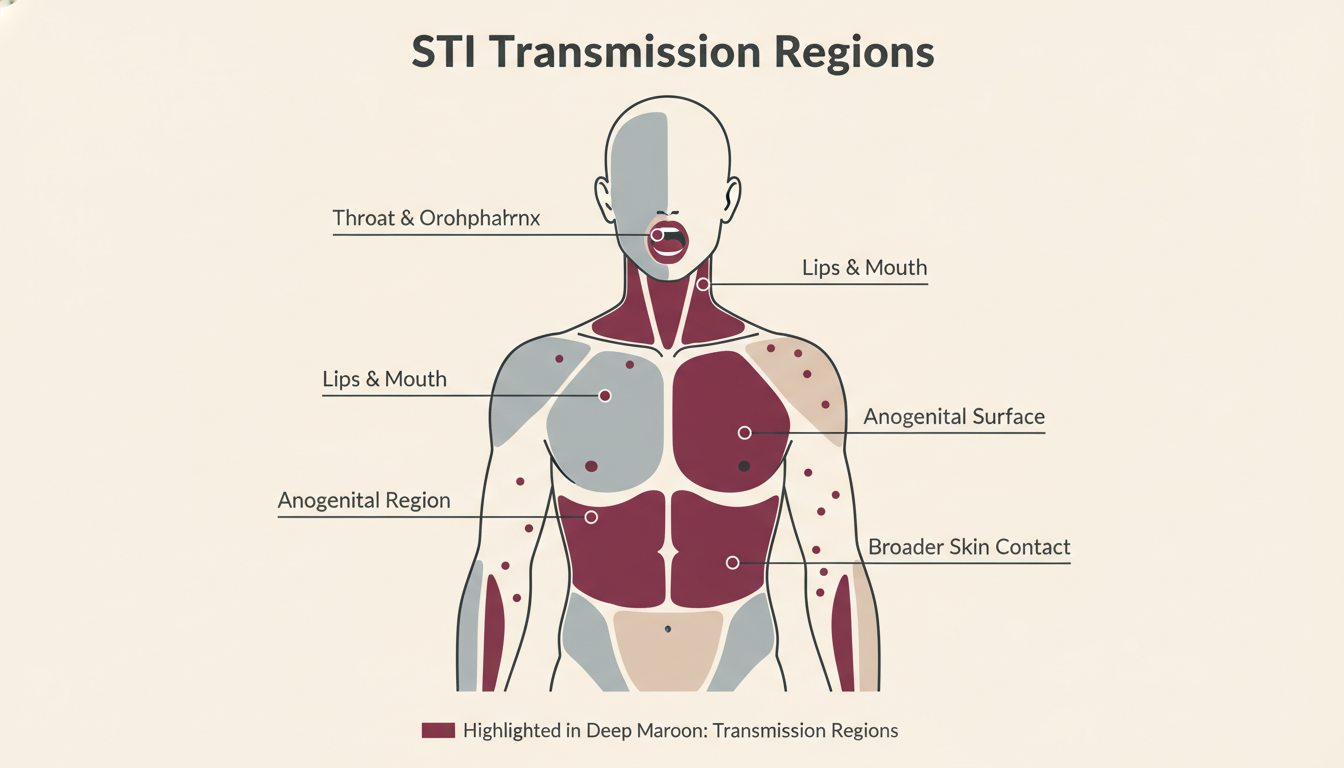
Oral sex is probably the biggest gap in how people think about STI risk with virgin partners. Plenty of people who have never had vaginal sex have given or received oral sex. Oral sex is a real transmission route for several infections, including some of the most common ones in the United States.
Gonorrhea has no problem living in the throat. You can acquire pharyngeal gonorrhea (a throat infection) from a partner who has never had vaginal intercourse, simply by performing oral sex on them. The World Health Organization confirms that gonorrhea can cause symptoms in the genitals, anus, or throat, with oral transmission being a well-documented route of spread (WHO gonorrhoea fact sheet). Chlamydia behaves similarly: it can establish in the throat after oral sex, and most pharyngeal chlamydia infections produce no symptoms at all. The infection sits there, transmissible and invisible, often without either person knowing.
Syphilis takes a different path. The painless chancres that characterize early syphilis can appear anywhere the bacteria entered the body: the genitals, yes, but also the lips, the tongue, and the inside of the mouth. Someone with an oral chancre can pass syphilis through kissing or oral sex. Because the sore is typically painless, it often goes unnoticed by both partners.
Herpes is the most efficient of the lot. HSV-1, the strain most people associate with cold sores, can pass through a kiss. If a person with oral HSV-1 gives oral sex, they can transmit herpes to their partner's genitals. If someone receives oral sex from a partner with an active cold sore, they can end up with genital herpes. Penetration is not part of any of those routes; ordinary contact is enough.
HIV transmission through oral sex is possible but considered very low risk by the CDC. For most readers worrying about an oral-sex encounter, the higher-probability concerns are herpes, HPV, gonorrhea, and syphilis, with HIV well behind on the list.
One important caveat about what we offer at home: rapid at-home screening kits, including ours, do not test pharyngeal swabs from the throat. If you suspect a throat infection specifically (sore throat after oral sex, persistent pharyngitis), that needs a clinic visit for a throat-specific swab and culture. Our rapid kits cover the genital and bloodwork side of the same encounter, which is usually the bigger concern.
Skin-to-Skin Contact and the Infections That Do Not Need Anything More
Some STIs are so efficient at spreading that they do not need fluid exchange to transmit. HPV and herpes are the clearest examples. Both viruses live on and just beneath the skin surface, which means they pass between people whenever infected skin touches mucous membranes (the soft tissue lining the genitals, mouth, or anus), regardless of whether penetration occurred.
HPV is the most common STI in the United States. The CDC describes HPV as so common that most sexually active adults will acquire at least one strain at some point in their lives, with the majority of infections clearing on their own within one to two years (CDC HPV resource center). Most people who carry HPV have no idea, because the vast majority of HPV infections produce no symptoms. During the active-infection window the virus can spread freely through skin contact. Someone can carry HPV without ever having had penetrative sex, and pass it on through genital touching, oral-genital contact, or any contact between an infected area and a mucous membrane.
Herpes follows the same logic. The CDC reports that most genital herpes infections are transmitted by people who do not know they are infected or who have no recognized symptoms when transmission occurs (CDC STI Treatment Guidelines: Genital Herpes). The phenomenon is called asymptomatic viral shedding: the virus surfaces on the skin without any outward sign, and during those windows it is transmissible. A virgin partner who has had any genital-to-genital contact, even without penetration, can carry HSV-2 and not know it. A partner who has only ever kissed someone with a cold sore can carry oral HSV-1 and pass it on through oral sex.
This article is published by stdrapidtestkits.com, which sells at-home STI testing kits. We recommend products based on fit-for-purpose for the reader's situation, not commercial benefit. Some scenarios in this article (pharyngeal infections, active oral lesions) need a clinic-administered swab; we say so explicitly when that is the right route.
Non-Sexual Routes a Virgin Partner May Not Even Know About
Here is a scenario that surprises most people: a partner who has truly had no sexual contact of any kind can still, in some circumstances, carry an STI. The routes are non-sexual and they are real.
Hepatitis B and HIV can transmit through shared needles, which matters for anyone who has used IV drugs even once, or who received a tattoo or piercing with unsterilized equipment. Both viruses can also pass from mother to child during pregnancy or childbirth, which means a person can carry hepatitis B or HIV from birth, years before any sexual contact. Universal infant hepatitis B vaccination has dramatically reduced perinatal transmission in the U.S. since the 1990s, but anyone born outside that window or in a country without universal infant vaccination may carry it.
HSV-1 is the other big one. Most U.S. adults carry oral HSV-1, and the majority of people were exposed in childhood through ordinary non-sexual contact: a kiss from a relative, sharing a cup, a daycare classmate. If they develop cold sores as adults, they can transmit HSV-1 to a sexual partner during oral sex, regardless of their sexual history.
Most U.S. adults carry oral HSV-1 acquired in childhood through ordinary non-sexual contact (a relative's kiss, a shared cup). Hepatitis B and HIV can pass from mother to child during pregnancy or birth, so a person can carry either from infancy. Both points illustrate why a partner's STI status is independent of their sexual history.
How to Assess Your Risk by Type of Contact
If you have had intimate contact with a partner who identifies as a virgin, the meaningful next step depends on what kind of contact occurred and how recently. The table below maps contact type to the infections that route can transmit, plus the practical thing to consider about each one.
| Type of contact | Key risks | What to consider |
|---|---|---|
| Kissing only | HSV-1, rarely syphilis | Lower overall risk; higher if a visible sore is present |
| Oral sex given (mouth on partner's genitals) | HSV-1, HSV-2, HPV, gonorrhea, syphilis | Real risk for pharyngeal gonorrhea and oral herpes |
| Oral sex received (partner's mouth on you) | HSV-1, HSV-2, HPV, gonorrhea, chlamydia | Depends on partner's oral-cavity exposure history |
| Skin-to-skin genital contact, no penetration | HSV-1, HSV-2, HPV, syphilis (if a sore is present) | Penetration is not required for HPV or herpes transmission |
| Anal sex (receptive or insertive) | All major STIs | Higher mucosal-tear risk than vaginal sex; condom use matters |
| Shared needles or non-sterile equipment | HIV, hepatitis B, hepatitis C | Risk applies regardless of sexual history |
When and What to Test For
If any of those contact scenarios apply to you and you are now wondering about your status, the most useful thing you can do is test. Testing replaces guesswork with information. The anxiety of not knowing is almost always worse than the result itself, and most people who test after low-risk exposures get the all-clear they came for.
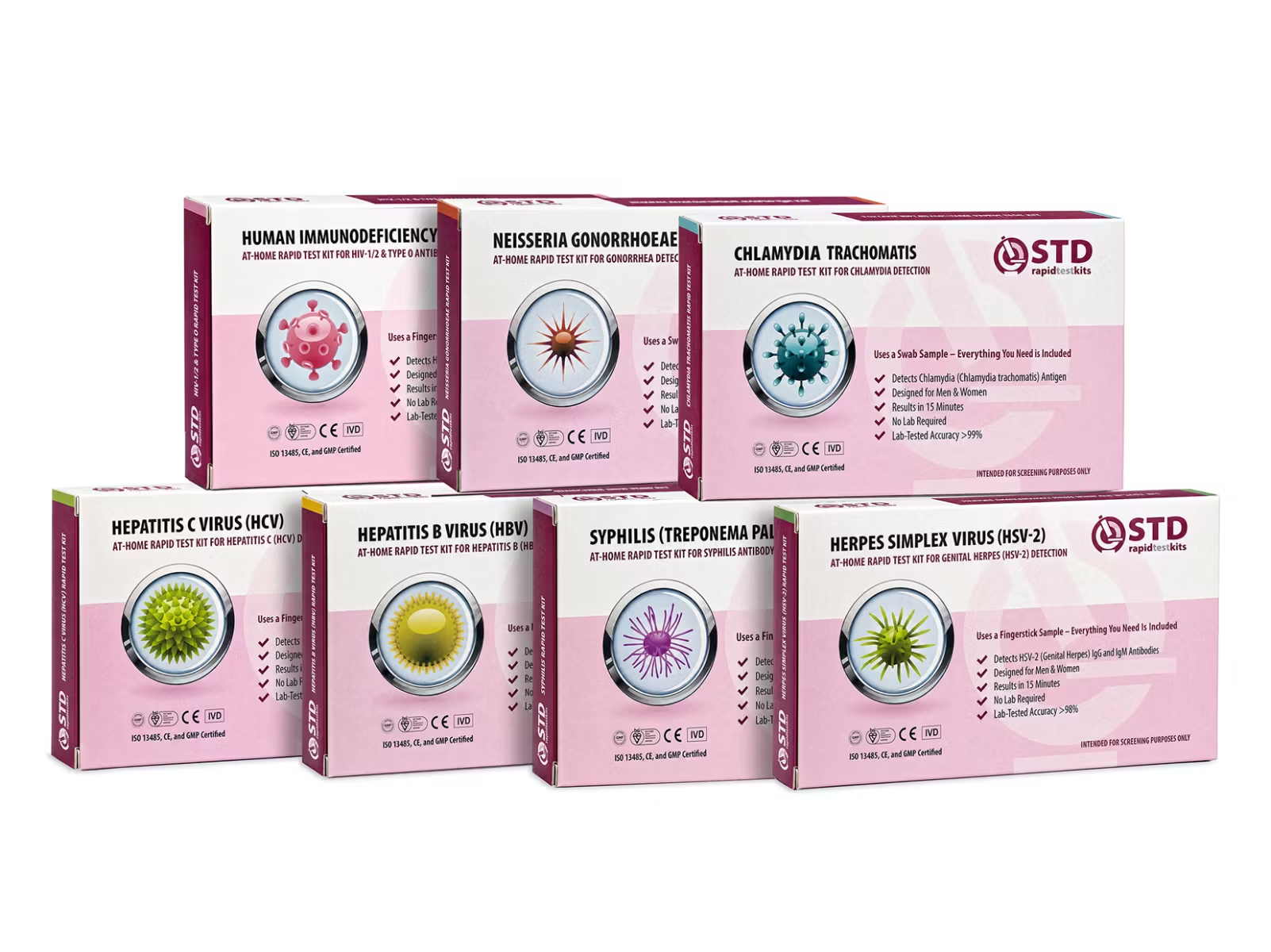
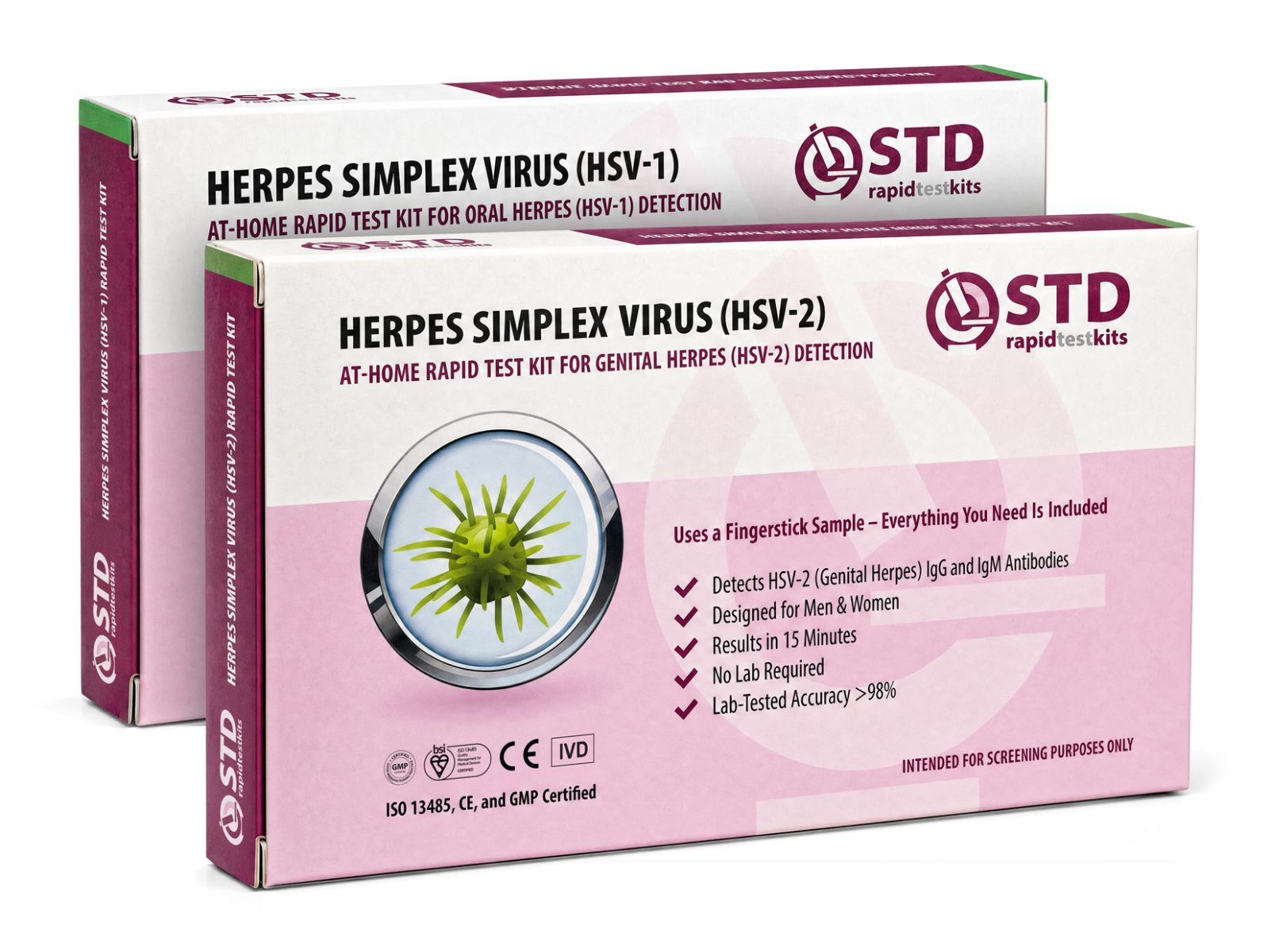
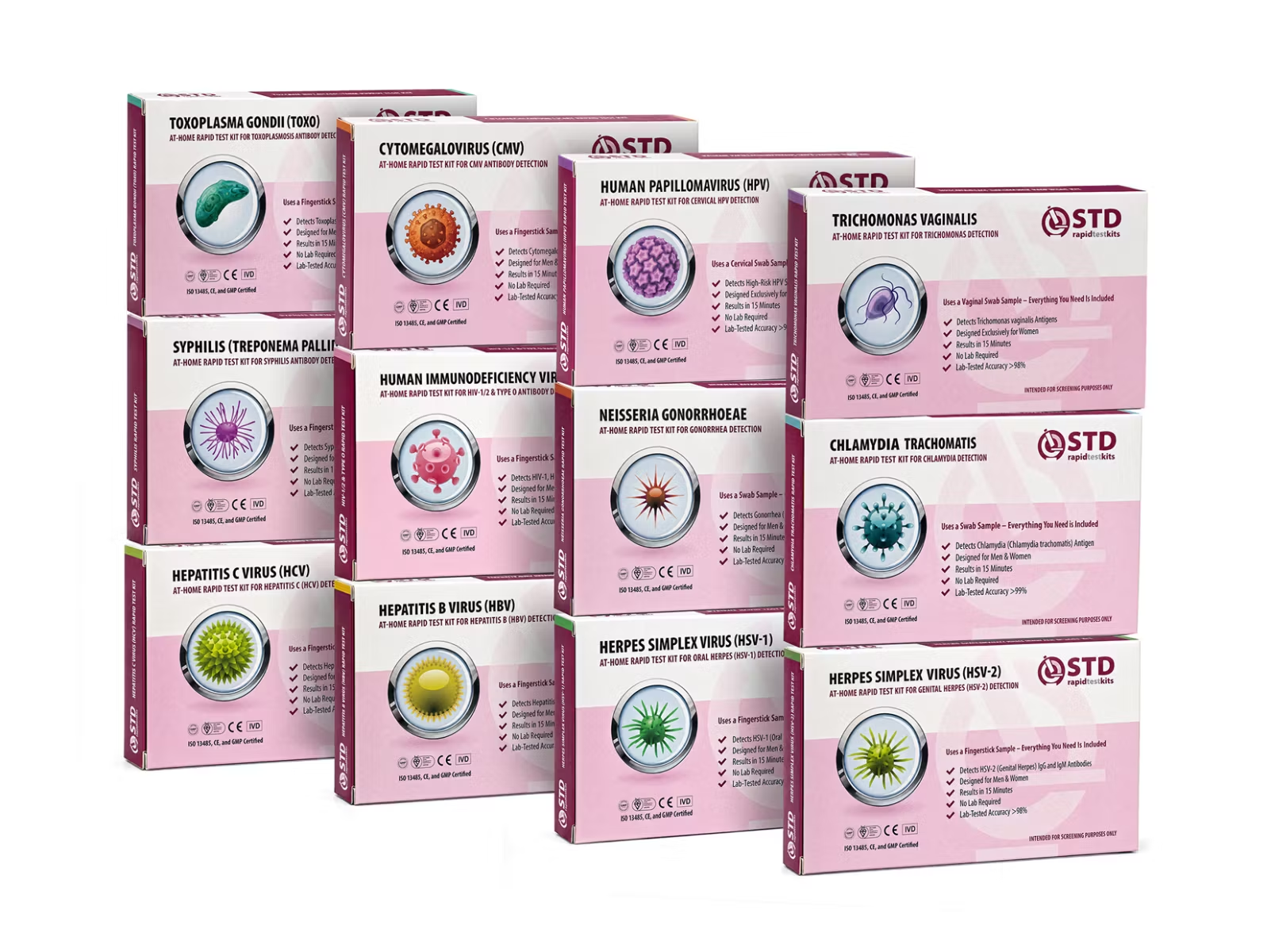
At-home rapid screening kits make this practical. No clinic appointment, no waiting room, no awkward intake conversation. The kits ship discreetly, the process takes minutes, and most return a result while you are still in your bathroom. Our rapid tests are lateral-flow immunoassays, which are different in technology from the lab NAAT/PCR tests a clinic uses; the two are complementary, with lab NAAT offering higher analytical sensitivity and home lateral-flow offering speed and privacy. A positive at-home result is worth confirming with a lab, and a negative result during the testing window is reliable.
Testing windows matter. Testing too early can produce a false negative, because the body needs time to produce enough detectable antibodies or for the bacteria to reach detectable load. Use these timing guidelines:
- Chlamydia: test from 14 days after exposure (lateral-flow swab).
- Gonorrhea (genital): test from 3 weeks after exposure (lateral-flow swab).
- Syphilis: test from 6 weeks after exposure (lateral-flow blood antibody).
- HIV: test at 6 weeks for an early indicator, retest at 12 weeks for confirmation (lateral-flow blood antibody).
- Herpes HSV-1 and HSV-2: test from 6 to 12 weeks after exposure (lateral-flow blood antibody).
- Hepatitis B: test from 6 weeks after exposure (lateral-flow blood antibody).
- Hepatitis C: test from 8 to 11 weeks after exposure (lateral-flow blood antibody).
- HPV: rapid swab self-test for women only; men needing HPV screening should see a clinic.
For pharyngeal (throat) gonorrhea or chlamydia specifically, no at-home rapid test on the market is validated for throat swabs. If your concern is throat infection after oral sex, see a clinic; our rapid kits cover the genital and bloodwork side of the same encounter.
The Myth That "Less Experience" Means "Safer"
There is an assumption underneath the original question that deserves direct attention: the idea that a partner with less sexual experience is automatically safer. It is an understandable starting point. Fewer prior partners should mean fewer opportunities for exposure, which should mean lower risk. In aggregate, that is often true. The whole picture is more complicated.
First, even one prior intimate encounter is enough to acquire and transmit herpes or HPV, both of which can stay asymptomatic for years. Someone who had oral sex once two years ago could carry an infection they have never been tested for and that has never produced a symptom. Second, the infections that travel routes other than penetrative sex (HSV-1 most prominently) can be acquired through completely non-sexual contact in childhood. The number of prior sexual partners has no bearing on whether someone carries oral HSV-1.
Third, asymptomatic transmission is the norm for most common STIs. The CDC notes that most genital herpes transmission occurs from people who do not know they are infected (CDC STI Treatment Guidelines: Genital Herpes). The same pattern holds for HPV, chlamydia, and pharyngeal gonorrhea. A person who looks and feels completely healthy can be just as transmissible as someone with visible symptoms.
Most people infected with HSV-2 are not aware of their infection. The majority of genital herpes infections are transmitted by persons unaware that they are infected or who are asymptomatic when transmission occurs.
Reducing Risk Without Eliminating Contact
Knowing the risk does not require avoiding intimacy altogether. The practical alternative is informed decisions about contact, condom use, and testing. A few simple measures meaningfully reduce STI exposure in any sexual context, including with partners who identify as virgins.
Condoms and dental dams substantially reduce transmission risk for fluid-borne infections like gonorrhea, chlamydia, HIV, and hepatitis B. They are less effective for skin-based infections like herpes and HPV, because they do not cover all the skin that might shed virus, but they still help. Correct, consistent use matters more than occasional use.
Communication before contact is genuinely useful. Asking a partner whether they have been tested recently, and for what, gives you real information rather than inferences from their self-reported sexual history. Someone can be a virgin by traditional definition and have never been tested for anything, which leaves you with no information about their status, instead of reassuring information.
Vaccination covers two major STIs. The HPV vaccine (Gardasil 9) is highly effective against the strains most likely to cause genital warts and cancer. The CDC recommends routine HPV vaccination for adolescents and young adults, with shared clinical decision-making available for some adults aged 27 through 45 who were not previously vaccinated; ask a clinician what timing applies to you (CDC HPV vaccine recommendations). Hepatitis B vaccination is recommended for all adults who have not been previously vaccinated. Both are most effective when received before first exposure, but they still provide meaningful protection in sexually active adults.
Annual testing is a reasonable baseline for most sexually active adults; more frequent panels make sense when partners change.
Frequently asked questions
- Can a virgin give me herpes?
- Yes. HSV-1 passes through kissing or oral sex, and most people carry it from non-sexual exposure in childhood. HSV-2 can transmit through skin-to-skin genital contact even without penetration. Virgin status offers no protection against herpes.
- Can you get chlamydia from a virgin?
- Yes, if there has been oral sex or genital-to-genital contact. Chlamydia can establish in the throat after oral sex and produce no symptoms, and it can spread through genital contact without full penetration. Test from 14 days after exposure with a rapid swab kit.
- Is the risk of an STD lower with a virgin partner?
- On average, yes. Statistically, fewer prior partners means fewer exposure opportunities. The risk is still nonzero, and several infections (herpes, HPV, oral HSV-1 from childhood exposure) can be present with no prior penetrative sex at all. Lower risk is not the same as no risk.
- Can you get HPV from skin-to-skin contact alone?
- Yes. HPV spreads through direct skin and mucous-membrane contact during sexual activity. You do not need penetrative sex, fluid exchange, or visible symptoms. Someone with no history of penetrative sex can carry and transmit HPV through genital touching or oral-genital contact.
- Can two virgins still get an STI from each other?
- It is uncommon but possible. If both partners have had truly zero intimate contact of any kind, the risk is very low. However, HSV-1 acquired in childhood can transmit through kissing or oral sex even between two people who consider themselves virgins. If there is any uncertainty, both partners testing before becoming intimate removes the guesswork entirely.
- Should I get tested if I only had oral sex with a virgin?
- If there was any genital contact during that oral sex, testing for herpes (blood antibody) and gonorrhea (genital swab) is reasonable. Wait 3 weeks for gonorrhea and 6 to 12 weeks for herpes seroconversion before testing for an accurate result. For pharyngeal gonorrhea specifically, see a clinic for a throat swab; no rapid home test covers throat samples.
- Does syphilis spread without penetrative sex?
- Yes. Chancres (the painless ulcers of early syphilis) can appear on the lips, tongue, or inside the mouth, and the infection can pass through kissing or oral sex with an infected person. The sores are typically painless, so neither person may notice them. Test from 6 weeks after a possible exposure.
- If my partner is a virgin, do I still need to use protection?
- Yes, unless you have both tested recently and know each other's status. Herpes and HPV can be present even with no prior penetrative sex, and condoms substantially reduce (though do not eliminate) transmission risk for most STIs. Testing is the more reliable safety measure because it tells you what you are working with.
- U.S. Centers for Disease Control and Prevention. HPV resource center. Source for HPV being so common that most sexually active adults will acquire at least one strain at some point, with most infections clearing on their own.
- U.S. Centers for Disease Control and Prevention. STI Treatment Guidelines: Genital Herpes. Confirms that most HSV-2 transmission occurs from people unaware of their infection or asymptomatic at the time.
- U.S. Centers for Disease Control and Prevention. Sexually Transmitted Infections Surveillance, 2024 (provisional). National case counts for chlamydia, gonorrhea, and syphilis.
- World Health Organization. Gonorrhoea (Neisseria gonorrhoeae infection) fact sheet. Confirms genital, anal, and pharyngeal gonorrhea transmission routes.
- U.S. Centers for Disease Control and Prevention. HPV vaccine recommendations. Patient-facing summary of routine adolescent dosing, the 15-26 catch-up window, and the shared clinical decision-making approach for adults aged 27 through 45.
- UK National Health Service. Human papillomavirus (HPV). Patient-facing summary of HPV transmission, symptoms, and clinical course.
