
Published: November 2025 | Last updated: April 2026 | Editorial review and quality control: Martina N.
You kissed someone and now something feels off. A tingle on your lip. A bump that wasn't there yesterday. A scratchy throat the next morning. The internet hands you back panic dressed as advice, and within ten minutes you have convinced yourself you have three different infections. Take a breath. Most STIs do not spread through casual kissing, and the symptoms you are noticing usually mean something far less serious than you fear.
This guide pulls together what current public-health guidance from the CDC, WHO, and NHS says about kissing-related risk: which infections can move mouth to mouth, which cannot, what the rare exceptions look like, and when symptoms warrant testing rather than reassurance.
Can you actually get an STD from kissing?
Most STIs do not spread through kissing. The realistic exception is oral herpes (HSV-1), which causes cold sores. Far more rarely, syphilis can pass when an active oral sore (chancre) is present, and oral gonorrhea has been documented in deep kissing among high-exposure groups. HIV, chlamydia, and trichomoniasis do not transmit through saliva. If you are worried after a kiss, the only infection worth watching for in the first few days is HSV-1, and only if symptoms develop.
Key Takeaways
- The realistic kissing risk is HSV-1 (oral herpes). Most other STIs need genital, anal, or oral-sex contact to spread.
- Symptoms within hours of a kiss are almost always irritation, not infection. Real herpes follows a 2 to 7 day pattern: tingle, then redness, then a cluster of small blisters.
What a Kiss Can and Cannot Pass to You
From a transmission standpoint, kissing is one of the lowest-risk forms of physical intimacy. Saliva contains enzymes (lysozyme, immunoglobulin A) that disable many pathogens before they can establish a foothold; mucous membranes in a healthy mouth are tough; and most STIs need fluids or contact saliva cannot provide. The exceptions are narrow but worth naming clearly.
Kissing-related infection risk, by pathogen:
| Infection | Spreads via kissing? | What's actually needed |
|---|---|---|
| HSV-1 (oral herpes) | Yes (most common) | Direct contact with an active sore or saliva during viral shedding |
| HSV-2 (genital herpes) | Rare from kissing alone | Genital or oral-genital contact is the typical route |
| Syphilis | Rare; only with an oral sore | Direct mucosal contact with a chancre on the lip or in the mouth |
| Oral gonorrhea | Rare | Oral-sex exposure is the main route; deep kissing has been documented but is uncommon |
| HPV (oral) | Possible but uncommon | Skin-to-mucosa contact, more often via oral sex |
| HIV | No | Blood, semen, vaginal fluid, or rectal fluid contact (not saliva) |
| Chlamydia | No | Genital, rectal, or oral-genital contact |
| Trichomoniasis | No | Genital fluid contact |
| Mono (Epstein-Barr virus) | Yes (not classified as an STI) | Saliva exchange; very common in adolescents and young adults |
HSV-1: The One Infection Kissing Reliably Moves
HSV-1 is the virus behind cold sores, and it is the single infection people genuinely do catch from kissing. The World Health Organization's most recent herpes fact sheet estimates that about 3.8 billion people under 50 (around 64% of that age group) globally are infected with HSV-1, mostly through non-sexual contact during childhood: a relative with a cold sore, a shared cup, a routine kiss on the forehead. CDC guidance describes the same picture for the United States.
Two facts make HSV-1 different from the rare exceptions further down. First, transmission does not require a visible sore. The virus sheds intermittently in saliva and on the skin around the mouth even when nothing looks wrong, which is why so many people catch it from partners who genuinely did not know they were contagious. Second, once acquired, HSV-1 stays for life; antiviral medication shortens outbreaks but does not cure the underlying infection.
That sounds heavier than it lands in real life. Most people with HSV-1 have a few cold sores per year (or fewer) and live normally. The reason it gets airtime in articles like this is volume: HSV-1 is by far the most common thing people pick up from kissing, even when the practical impact for most carriers is a recurring cold sore once in a while rather than a serious illness.
HSV-1 sheds intermittently from healthy-looking skin and saliva, so you can catch it from someone who has no visible sore. And once acquired, the virus is lifelong; antivirals shorten outbreaks but do not cure the underlying infection. Together, those two facts explain why HSV-1 ended up in roughly two-thirds of the under-50 global population.
The Rarer Routes: Syphilis, Gonorrhea, HPV, CMV
These are the infections that show up in case reports rather than in everyday clinical practice. Each has been documented in kissing transmission, but each requires conditions that are not present in a normal kiss.
Syphilis can transmit through kissing only when an infected partner has a syphilitic sore (chancre) on the lip or inside the mouth. Chancres are typically painless, which is why they get missed; they last a few weeks and then disappear on their own, even though the underlying infection continues to progress through later stages if untreated. Case reports of oral syphilis between partners who report only kissing exist, and the common factor is an unrecognized chancre.
Oral gonorrhea usually arrives via oral sex rather than kissing. A small body of research has identified pharyngeal gonorrhea in participants who reported deep kissing without oral sex, but this remains uncommon and concentrated in high-exposure populations. Pharyngeal gonorrhea is also frequently asymptomatic, which is why throat swabs (a clinic-based test) are recommended for anyone with frequent oral-sex partners regardless of how their throat feels.
HPV primarily spreads through skin-to-mucosa contact during sex. Oral HPV from kissing is documented but rare, and the larger transmission concern is oral sex rather than kissing alone. The HPV vaccine is the strongest preventive tool available and protects against the strains linked to oropharyngeal cancer; ACIP recommends routine vaccination through age 26 and shared clinical decision-making through age 45.
Cytomegalovirus (CMV) is not classified as an STI but spreads readily through saliva and behaves like one in kissing. Most healthy adults clear CMV without ever noticing it. The exception that matters: pregnant people who acquire CMV for the first time during pregnancy can pass it to the developing fetus, where it can cause congenital complications. CDC data attributes about 1 in 200 babies in the United States with congenital CMV infection, and roughly 1 in 5 of those babies will have lasting health effects.
When the Risk From Kissing Actually Goes Up
Most kisses are practically zero risk. What changes that math is condition: who has what, where, and during which moment. A few situations where transmission becomes plausible enough to think about:
Active or healing cold sores. The tingle that precedes a visible sore is when HSV-1 sheds most heavily. Healing scabs are still infectious. The window where someone with an outbreak should skip kissing runs from first tingle through full skin closure, typically within 10 days per NHS guidance.
Bleeding gums or recent dental work. Healthy oral mucosa is a real barrier. Inflamed, cut, or bleeding mucosa is not. Researchers documenting unusual oral STI transmission consistently find micro-injuries on the mouth as a contributing factor.
Open ulcers (canker sores or chancres) inside the mouth. Same logic as above; the barrier is broken, and any pathogen present has a route in.
Deep, prolonged kissing combined with another exposure. Most case reports of unusual kissing transmission involve longer exposure during a session that also included oral or genital contact, blurring what just kissing means.
When to skip the kiss
- One partner has a visible cold sore, healing scab, or that early tingling phase before a sore appears.
- Either of you has bleeding gums, recent dental work, canker sores, or unexplained mouth ulcers.
- One partner has been recently diagnosed with HSV, syphilis, or oral gonorrhea and has not finished treatment or full healing.
- Either of you is sick with an active mouth or throat infection of any kind.
Symptoms After Kissing: What They Probably Mean
Timing is the first filter. Real infections do not produce symptoms within hours; they need at least a couple of days to incubate. Anything you notice the morning after a kiss is far more likely to be irritation, friction, or hyper-awareness than infection.
For HSV-1 specifically, the typical sequence is tingle (often a day or two), then redness, then a cluster of small fluid-filled blisters that crust and heal over 7 to 10 days. A single bump that stays the same size and disappears on its own is not how cold sores behave.
Common after-kissing symptoms and what they usually mean:
| Symptom | Most likely cause | When it suggests infection |
|---|---|---|
| Tingling lips | Irritation, dryness, anxiety-driven sensitivity | Only when followed by visible blisters within 1 to 3 days |
| Single bump on the lip | Pimple, clogged pore, friction reaction | Cold sores cluster; a lone bump rarely is one |
| Sore throat the next day | Dryness, mild virus, post-drinking irritation | Persistent sore throat over 5 days warrants a swab |
| Swollen, sensitive lips | Friction, allergy, lip-balm reaction | Almost never an STI |
| Cluster of small blisters | Likely HSV-1 | This pattern, especially with a tingle preceding it, is the recognizable cold sore |
| White patch in the throat | Strep, oral thrush, post-illness coating | Persistent white patch with sore throat and swollen tonsils warrants gonorrhea and strep testing |
Myths Worth Dropping
You cannot get an STD if there was no sex. Mostly true, with the HSV-1 exception covered above. Kissing alone does not transmit HIV, chlamydia, trichomoniasis, or most of the infections people fear most. It can transmit HSV-1, and rarely, syphilis or oral gonorrhea under specific conditions. The biology is indifferent to relationship history; the only variable is whether there was contact with an active sore or with saliva during viral shedding.
No visible sore means no risk. Wrong for HSV-1. The virus sheds asymptomatically; people transmit it without knowing they have it. This is exactly how it became so widespread.
STIs in the mouth are not really serious. Oral HPV is linked to oropharyngeal cancers; oral syphilis can progress to systemic disease if untreated; oral gonorrhea contributes to the antibiotic-resistant gonorrhea problem more broadly. Treat oral infections seriously even though they live above the neckline.
Testing is overkill if it was just a kiss. For most kissing concerns, testing is not the right next step. HIV, chlamydia, and gonorrhea panels do not detect a kissing infection because those infections do not transmit that way. The exception is when symptoms develop or when there was oral or genital contact alongside the kissing, in which case targeted testing makes sense.
Only people with many partners catch oral STIs. Not how the biology works. HSV-1 routinely passes between family members during childhood. A single contact with an active cold sore is sufficient for transmission. The number of prior partners has no bearing on whether a specific exposure passes the virus.
| Common belief | What's actually true |
|---|---|
| No sex means no STI risk | Mostly correct, but HSV-1 still transmits through kissing; rare cases of syphilis and oral gonorrhea also occur |
| No visible sore means no contagion | HSV-1 sheds asymptomatically; transmission happens between partners who look perfectly healthy |
| Oral STIs are minor | Oral HPV is linked to oropharyngeal cancers; oral syphilis progresses systemically without treatment |
| Testing is overkill after just a kiss | Correct unless symptoms develop or there was oral or genital contact alongside the kissing |
| Only people with many partners catch oral STIs | HSV-1 spreads in families during childhood; one contact with an active sore is enough |
How to Kiss Smarter Without Becoming Paranoid
The goal is not to make every kiss feel risky. It is to recognize the few situations where pausing makes sense.
Watch for visible sores, your partner's and your own. A cold sore in the tingle, blister, or scab phase is the only frequently encountered situation where a brief pause genuinely matters. Once skin is fully healed, transmission risk drops sharply.
Keep oral health functional. Routine brushing, flossing, and dental check-ups maintain the mucosal barrier that does most of the protective work for you. People with untreated periodontal disease show measurably more oral viral activity in published research.
Talk about cold sores like you would talk about birth control. A simple disclosure ("I sometimes get cold sores, let's wait a few days when one is brewing") is not a mood-killer; it is the kind of small, matter-of-fact conversation that mature partners actually appreciate.
Vaccinate where you can. The HPV vaccine protects against the strains tied to oropharyngeal cancer in addition to the genital strains, with ACIP recommending routine vaccination through age 26 and shared clinical decision-making through age 45. The hepatitis B vaccine is standard in most countries. Both are routine preventive medicine, not high-risk interventions.
Test when context warrants it, not when anxiety alone warrants it. After kissing alone with no symptoms, no testing is needed. After symptoms develop, after oral sex or genital contact, or after a partner discloses an infection, targeted testing gives you actual information instead of a guess.
Skip kissing during a partner's cold-sore outbreak (tingle through full healing). Keep your gums healthy. Get the HPV vaccine if you have not already. Test when symptoms develop or when there was contact beyond kissing. That covers the realistic risk without taking the joy out of intimacy.
HSV-1 is mainly transmitted via contact with the virus in sores, saliva or skin surfaces in or around the mouth. The greatest risk of transmission is when there are active sores.
FAQs
- Can I really get an STI from a single kiss?
- From a single brief kiss with no visible sores or active illness, transmission is genuinely rare. The exception is HSV-1: if your partner is in the tingle or blister phase of a cold sore, even brief contact can pass the virus. Outside that situation, kissing once with someone whose mouth looked normal almost never transmits an STI.
- Can HIV spread through kissing?
- No. HIV is not transmitted through saliva, so kissing alone (including deep kissing) does not pose a real HIV risk. The CDC has been clear on this for decades. The only theoretical exception involves both partners having significant active bleeding in the mouth at the same time, which is essentially never the situation people are actually worried about.
- What if my partner gets cold sores?
- You can have a normal relationship with someone who gets HSV-1 outbreaks. The practical rule is to pause kissing from the first tingling sensation through complete healing of any sore (typically within 10 days per NHS guidance). Outside outbreaks, transmission risk is lower. Many couples manage this for years without the uninfected partner ever picking up the virus.
- I felt something weird the day after a kiss. Is that an STI?
- Almost certainly not. Real infections need at least a couple of days to produce symptoms; HSV-1 typically takes 2 to 7 days to show. Same-day or next-day sensations are far more likely to be irritation, friction, or anxiety-driven hyper-awareness. If nothing visible develops over the next 5 days, the kiss was almost certainly not the cause.
- Should I get tested after a kiss?
- Usually not. Standard STI panels look for HIV, chlamydia, gonorrhea, and syphilis; none of those (except syphilis with an oral chancre, very rarely) are kissing-only risks. Testing immediately after a kiss tells you about prior exposures, not the kiss itself. If symptoms develop, or if there was oral or genital contact, targeted testing at the appropriate window makes sense.
- Can HPV spread through kissing?
- The clearest practical answer regardless of transmission route is the HPV vaccine. It covers the strains linked to oropharyngeal cancer and to most genital HPV disease, and the CDC recommends it routinely through age 26 and through age 45 with shared clinical decision-making. Kissing-only HPV transmission is possible but uncommon; oral sex carries meaningfully higher risk. If you are under 45 and unvaccinated, that is the single action that addresses both routes.
- Is there a test that tells me if I have HSV-1?
- Yes, but interpretation gets tricky. A positive HSV-1 antibody result confirms exposure but does not tell you when, where, or whether you will ever have symptoms. The CDC does not recommend routine HSV-1 antibody testing in people without symptoms, because the result rarely changes management. If you have visible lesions, a swab during an active outbreak gives a more useful answer.
- What about gonorrhea in the throat?
- The practical point for at-home testers: standard rapid kits screen genital swabs, not throat swabs. Pharyngeal screening requires a clinic-administered throat swab, which is the route the CDC recommends for asymptomatic gonorrhea in people with frequent oral-sex partners. Rising global pharyngeal gonorrhea rates make this worth folding into routine check-ups if that exposure profile fits.
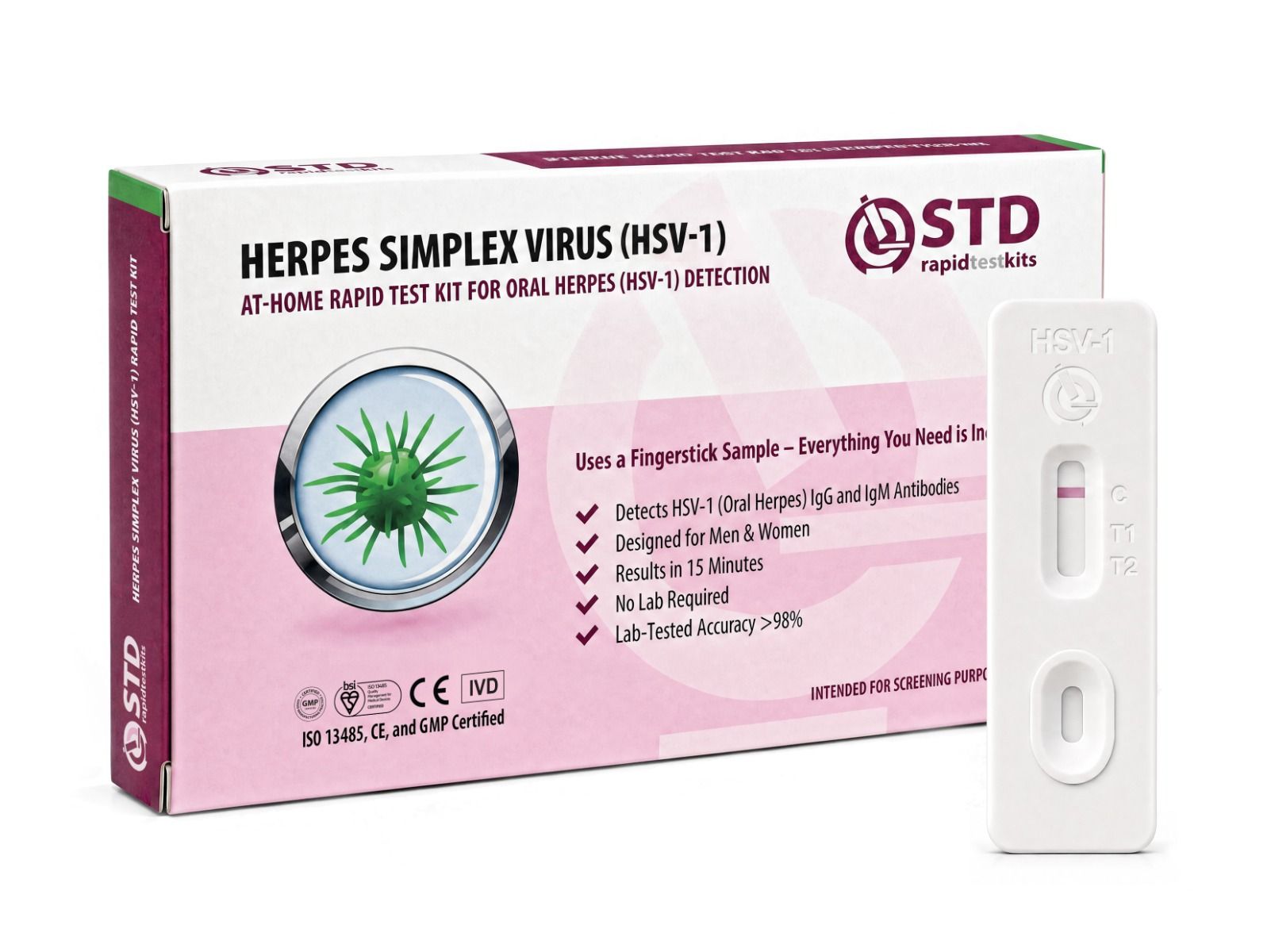
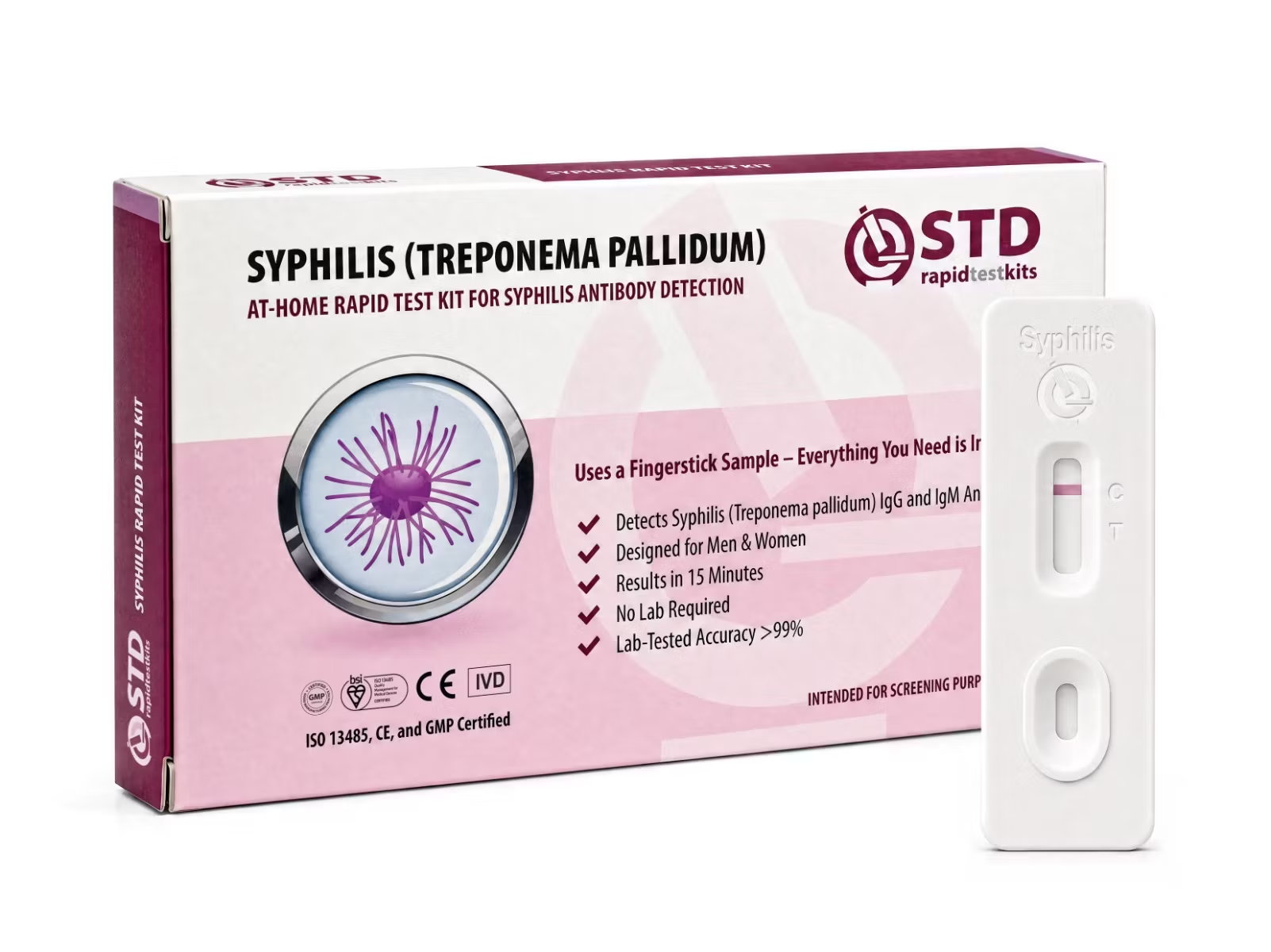
stdrapidtestkits.com sells at-home rapid lateral-flow tests for the infections discussed in this article; the kits below are relevant to the exposures covered above. We recommend products based on fit-for-purpose for the reader's concern, not commercial benefit.
- World Health Organization. Herpes simplex virus fact sheet, including global HSV-1 prevalence (about 3.8 billion people under 50, or 64% of that age group), oral-to-oral transmission routes, and asymptomatic shedding.
- U.S. Centers for Disease Control and Prevention. Herpes overview, including HSV-1 oral herpes presentation, transmission via saliva and lesion contact, and asymptomatic shedding guidance.
- UK National Health Service. Cold sores patient guidance, including outbreak progression, the 'do not kiss' window during active sores, and typical 10-day healing course.
- U.S. Centers for Disease Control and Prevention. About sexually transmitted infections, including standard transmission routes (vaginal, oral, and anal sex) and the role of intimate physical contact.
- U.S. Centers for Disease Control and Prevention. Cytomegalovirus (CMV) overview, including saliva-mediated spread, congenital CMV statistics (about 1 in 200 U.S. births), and pregnancy considerations.
