Published: October 2025 | Last updated: May 2026 | Editorial review and quality control: Martina N.
Yes, sex toys can transmit sexually transmitted infections. The risk is highest when toys move between bodies without cleaning or a fresh barrier, and the pathogens that matter most for this route, including chlamydia, gonorrhea, herpes simplex virus, trichomoniasis, and HPV, can survive on toy surfaces long enough to make that handoff possible. According to CDC sexual health guidance, STIs spread through contact with infected skin, mucous membranes, or bodily fluids, and a toy that just left one body can act as a direct bridge to the next.
This article walks through what's documented about toy-to-person transmission, how long different infections can persist on toy surfaces, what "cleaning" really means in practice, and how to think about testing if you're worried after a shared encounter. The aim is to make the precautions concrete enough that they fit into your sex life without overstating the risk.
Key Takeaways
- Shared sex toys can transmit chlamydia, gonorrhea, herpes, trichomoniasis, and HPV when toys move between bodies without cleaning or a fresh condom barrier.
- A new condom per partner per toy, plus soap-and-water cleaning between vaginal and anal use, removes the bulk of the transmission risk for non-porous toys.
How Sex Toys Carry STIs Between People
The intuition that "it's not really sex, so it's not really risky" is the most common reason people skip basic toy hygiene and skip testing afterward. But infections don't grade encounters by definition. They respond to contact with skin cells, mucous fluid, semen, blood, and warm tissue surfaces. A toy used vaginally or anally on one person, then used on a second person without cleaning or a new condom, can carry a measurable amount of any of those.
Per the CDC's STI treatment guidelines landing page, partner-services and risk-assessment guidance recommends asking about shared sex toys during exposure interviews because they function as a vehicle for several bacterial and viral STIs. The reason it gets repeated in clinical guidance is simple: people don't think to mention it, and they don't think to test for it.
What gets transferred is microscopic. A toy used briefly can pick up traces of vaginal fluid, semen, anal mucus, blood from a small abrasion, or shed skin cells from a herpes-shedding area. Most of those traces are invisible. Some of the pathogens in them stay viable on the toy's surface for hours, especially if the toy is damp or made of a porous material.
Shared-toy use sits on the CDC's partner-services exposure list alongside unprotected penetrative sex. When a clinician is doing contact tracing after a positive STI result, asking about toys is part of the standard interview, even though most patients don't volunteer it on their own.
Which STDs Can Transfer Between Bodies via a Toy
Not every STI is equally good at surviving on a surface. The list below shows the infections most commonly tied to shared-toy transmission in clinical guidance, the bodily fluids or contact route involved, and a rough sense of how long each can stay viable outside the body.
| Infection | Transmits via shared toy? | Main fluid or contact route | Surface viability |
|---|---|---|---|
| Chlamydia | Yes | Vaginal, anal, or urethral fluid | Several hours on damp surfaces |
| Gonorrhea | Yes | Vaginal, anal, or urethral fluid | Brief but enough to transfer if uncleaned |
| Trichomoniasis | Yes | Vaginal fluid | Several hours on damp surfaces in laboratory studies |
| Herpes (HSV-1, HSV-2) | Yes | Skin contact, including asymptomatic shedding | Up to a few hours on moist surfaces |
| HPV | Possible | Skin cells on toy surface | Limited data; viable on hard surfaces in lab studies |
| Hepatitis B and C | Possible | Blood traces from small abrasions | Hours to days on contaminated surfaces |
| HIV | Very low risk | Blood or genital fluid | Loses infectivity quickly outside the body |
How Long an STI Can Survive on a Sex Toy
Surface survival depends on three things: the pathogen itself, the toy's material, and the conditions where the toy sits between uses. A damp toy tossed onto a towel in a humid bathroom is the worst-case combination. A non-porous toy that was washed with soap and water and left to air-dry on a clean surface is the best-case combination.
Trichomoniasis stands out for surface survival. Trichomonas vaginalis is the only common STI parasite, and laboratory studies have shown it can stay viable on moist objects for several hours. The NHS sex activities and risk page lists shared dildos and vibrators among the routes that warrant testing when a partner's status is unknown. Bacterial STIs like chlamydia and gonorrhea are more fragile, but "more fragile" still means several hours on a damp surface, plenty of time for a back-to-back use.
Herpes is interesting because the virus relies on skin-to-skin transmission, but the surface step in between is real. HSV viability drops quickly on dry surfaces, but stays measurable on moist ones for a few hours. HPV is the hardest to pin down: lab studies show the virus can persist on hard surfaces for surprisingly long, but how often that translates to real-world infection from a shared toy isn't precisely quantified.
HIV is at the opposite end of the risk spectrum. Transmission via a shared sex toy is theoretically possible but extremely unlikely in typical encounters. HIV loses infectivity quickly outside the body and needs blood-to-blood or high-fluid-volume contact to transmit. The realistic risk involves a visibly blood-contaminated toy used immediately on abraded or inflamed mucosa; in that scenario, an HIV antigen/antibody test from roughly day 18 onward is the appropriate screen, per CDC HIV testing guidance. The vast majority of toy-only encounters do not approach that threshold.
| Infection | Approximate surface survival | Cleaning notes |
|---|---|---|
| Herpes (HSV) | Up to a few hours on moist surfaces | Soap-and-water plus alcohol wipe is effective |
| Chlamydia | Several hours on damp surfaces | Effectively removed by soap, water, and full air-drying |
| Gonorrhea | Brief on dry surfaces, longer on damp | Soap-and-water cleaning is sufficient if thorough |
| Trichomoniasis | Several hours on damp surfaces in laboratory studies | Disinfect or boil non-porous toys; condom on shared use |
| HPV | Limited data; possibly hours to days | Replace porous toys; bleach-safe materials can be disinfected |
Why Toy Material Matters More Than the Marketing Label
If you've ever bought a vibrator and seen the words "body safe" stamped on the box, you've seen one of the loosest terms in the industry. There's no universal standard behind it. The label that actually matters is whether the toy is non-porous. Non-porous materials, including medical-grade silicone, hard plastic (ABS), borosilicate glass, and stainless steel, can be cleaned thoroughly because pathogens cannot embed in microscopic surface pores.
Porous materials are a different story. Jelly rubber, TPR, TPE, elastomer blends, and "realistic" cyberskin all have surface pores invisible to the naked eye. Bacteria, viruses, and parasites can sit inside those pores and survive cleaning that would otherwise be effective on a non-porous toy. "Phthalate-free" and "latex-free" labels don't mean non-porous. If the packaging doesn't explicitly say medical-grade silicone, hard plastic, glass, or steel, assume it's porous and treat it accordingly: condom for any shared use, replace it when in doubt, and don't use it for anal-then-vaginal switches.
Soap, Boiling, or Wipes: What Cleans a Toy
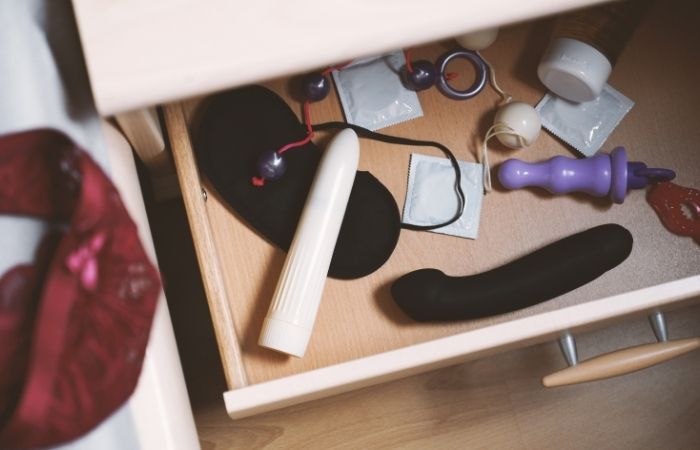
The cleaning method depends on the material and on whether the toy has electronics inside. For non-porous toys without motors, soap and warm water for 20 to 30 seconds, applied to the entire surface, removes most pathogens. For deeper sanitization on glass, stainless steel, or 100% silicone toys, you can boil for three to five minutes or run them through a dishwasher's top rack without soap residue.
For toys with motors, batteries, or rechargeable components, you can't submerge them. The realistic options are a sex-toy-specific antibacterial cleaner, or 70% isopropyl alcohol wipes used over the entire exterior, with extra attention to seams and ridges where fluid can collect. Don't use household bleach on materials that aren't bleach-safe, and don't use harsh solvents on silicone, which can degrade the surface.
Two often-overlooked rules: clean toys before AND after use, not just after, because dust, fabric fibers, and ambient bacteria accumulate in storage. And replace toys when the surface starts to look dull, tacky, or shows visible cracks. Once the material breaks down, even a non-porous toy starts behaving like a porous one.
If you're sharing sex toys, make sure you wash them between each use and always put a new condom on them each time.
Why Toy Use Counts as Exposure
(Disclosure: stdrapidtestkits.com sells the at-home rapid STI test kits referenced in this article. We recommend products based on fit for the reader's concern, not commercial benefit.)
The mental shortcut that decides whether to test is usually "did we have sex?", and toy-only encounters often fall on the wrong side of that question. The clinically relevant question is different: was there contact between someone else's mucous membranes or genital skin and yours, directly or via a shared object? If yes, the standard testing logic applies, including the window-period math.
This matters in particular for trichomoniasis (commonly missed because symptoms are mild or absent), chlamydia and gonorrhea (often asymptomatic), and herpes (which can shed without visible sores). The NHS sex activities and risk page includes shared sex toys in its list of routes that warrant testing if a partner's status is unknown.
How long should I wait to test after a shared-toy exposure?
For bacterial STIs like chlamydia and gonorrhea, test about 7 to 14 days after exposure. For trichomoniasis, test from about one week onward. For HIV antibody/antigen tests, the reliable window is around 18 to 45 days depending on the assay. For herpes and syphilis antibody tests, plan on a 6-to-12-week confirmation. If your first test is negative but the exposure was recent, retest at the longer end of the window before assuming you're clear.
When to Test, and Why Waiting Is Sometimes the Right Call
Every STI has a window period, the gap between exposure and when a test can reliably detect the infection. Testing too early can return a false negative that feels like reassurance but isn't. For most bacterial STIs (chlamydia, gonorrhea), the detection window is roughly one to two weeks from exposure. For viral STIs that rely on antibody response (HIV, herpes, syphilis), the window is longer, several weeks to a few months depending on the test technology.
If symptoms appear sooner, test sooner. Symptoms before the standard window means there's already enough pathogen present to be detected and to cause inflammation. If you're symptom-free but worried, the conservative approach is one test at the early-window mark and a confirmation test at the longer-window mark for whichever infections you're concerned about. CDC testing guidance lays out the testing-after-exposure framework in similar terms.
One additional point: if a single shared-toy encounter involved multiple potential exposure routes (vaginal, anal, oral contact in the same session), the relevant window is whichever pathogen and route combination has the longest window. Use that longest window as your confirmation date.
When Symptoms Show Up, Or Don't
Most toy-transmitted STIs are silent in the early phase. That's the hardest part for people trying to make a decision about testing. Lack of symptoms doesn't confirm you're uninfected; the body either hasn't reacted obviously yet or won't react obviously at all. Chlamydia is asymptomatic in 50% to 70% of cases regardless of sex, per Cleveland Clinic's chlamydia overview. Trichomoniasis is symptomless in roughly 70% of cases. Gonorrhea is often quiet in pharyngeal and rectal infections.
When symptoms do appear after a toy-only encounter, they tend to be mild and easy to attribute to something else.
- Burning sensation during urination
- Slight discomfort during or after penetration
- Unusual discharge
- Mild genital redness, itching, or swelling
- Small sores, ulcers, or blisters
Each of these can also point to a urinary-tract infection, contact irritation, lube allergy, or yeast infection. The only way to separate them is testing.
If a Test Comes Back Positive
Almost every STI that transmits via a shared toy is treatable, and most are curable. Chlamydia, gonorrhea, trichomoniasis, and syphilis are bacterial or parasitic and clear with a course of antibiotics or antiparasitics. Herpes and HPV are viral and managed rather than cured, but treatment reduces flare-ups and transmission risk substantially. Hepatitis B and C are managed with antivirals when active, and HIV is managed long-term with antiretroviral therapy that brings viral load to undetectable levels.
The next steps after a positive result are practical: care, not judgment. Tell any current or recent partner whose status could have been affected. Complete the prescribed treatment in full, including any partner doses. Avoid sharing toys during the treatment window, and replace any porous toys involved (silicone, glass, and stainless steel can be sanitized; jelly rubber and TPE cannot, with full confidence). Schedule a retest at the recommended interval (often six to twelve weeks for confirmation of bacterial cure or for delayed antibody response).

Toy Care That Reduces Risk
The risk-reduction stack for shared toy use is short and concrete:
Five habits that cover most of the risk
- Choose non-porous materials for anything you plan to share or use across body areas: medical-grade silicone, hard plastic, borosilicate glass, or stainless steel.
- Put a new condom on the toy for any shared use, especially between partners and between anal and vaginal use within the same session.
- Clean toys with soap and warm water before and after use; use 70% isopropyl alcohol wipes or a sex-toy cleaner for anything with motors or batteries that can't be submerged.
- Replace toys when the surface degrades, or after a confirmed STI exposure if the toy is porous.
- Get tested at the right window after any exposure where someone else's status is uncertain, even if the encounter was "only" toy-based.
Frequently asked questions
- Can I get an STI from a toy that was only used for a minute?
- Yes. Bacterial STIs and parasites like trichomoniasis can transfer in the time it takes to switch the toy from one body to another. Duration of use isn't the protective factor. Cleaning between uses, or a new condom over the toy, is what reduces the risk.
- I didn't have intercourse. Do I really need to test?
- If a shared or unclean toy was inserted vaginally, anally, or used on broken skin, it's worth testing on the appropriate window timeline. Clinically, what matters is whether there was contact between mucous membranes or genital skin and a recently shared object, regardless of how the encounter is categorized.
- Is rinsing a toy with water enough between partners?
- No. Water rinses remove visible residue but leave behind enough pathogen load, including chlamydia bacteria and trichomoniasis organisms, to reach the next user. Soap and warm water for at least 20 seconds is the minimum for non-porous toys, and a fresh condom over the toy is the simpler option for shared use.
- Do I need to throw out a toy after a positive STI test?
- If the toy is porous (jelly rubber, TPE, cyberskin), replacing it is the safer call. If it's non-porous (silicone, hard plastic, glass, stainless steel) and you can fully sanitize it (boiling, dishwasher, or alcohol-and-soap depending on whether it has electronics), keeping it is reasonable after thorough cleaning.
- Can herpes spread from a toy if no one had a visible sore?
- Yes. Herpes can shed from genital skin without any visible blister or symptom (asymptomatic shedding). A toy that touched a shedding area can carry enough virus to transmit if used on another person within a short window, especially on moist surfaces.
- How long should I wait before testing after a shared-toy encounter?
- For bacterial STIs (chlamydia, gonorrhea), test at about one to two weeks. For trichomoniasis, test from one week onward. For HIV, herpes, and syphilis antibody-based tests, the reliable window is several weeks to a few months depending on the assay. If your earliest test is negative, retest at the longer window mark to confirm.
- I have symptoms but I'm too embarrassed to go to a clinic. What now?
- At-home rapid testing is an option for several common STIs. A positive result from any home test should be followed up with a clinic-confirmed lab test, since lateral-flow chemistry is screening-grade rather than NAAT-grade (NAAT, nucleic acid amplification test, is the gold-standard lab method with higher analytical sensitivity). If symptoms are severe or include systemic signs (fever, severe pelvic or testicular pain, widespread rash), see a clinician without waiting on test results.
- I used someone else's toy and now I'm worried. What should I do?
- Don't test in the first 48 hours, the window is too short to detect anything reliably. Wait one to two weeks for a bacterial-STI screen, and plan a longer-window confirmation test for HIV, syphilis, and herpes if the source partner's status is unknown. In the meantime, use condoms with any new partners until you're cleared.
How we sourced this article: We synthesized current guidance from the U.S. Centers for Disease Control and Prevention, the National Health Service (UK), and Cleveland Clinic, alongside CDC HIV testing guidance, to summarize what's currently documented about toy-mediated STI transmission. Where the evidence is uncertain (notably HPV surface survival), we describe the limits of the data rather than overstating them.
- U.S. Centers for Disease Control and Prevention. About STIs: how STIs are transmitted via contact with infected skin, mucous membranes, and bodily fluids.
- Cleveland Clinic. Chlamydia overview: causes, asymptomatic prevalence (50% to 70% regardless of sex), treatment, and prevention.
- U.K. National Health Service. Sex activities and risk: risk-route summary including shared sex toys, with the recommendation to wash toys between uses and apply a new condom each time.
- U.S. Centers for Disease Control and Prevention. STI Treatment Guidelines landing page (overview of clinical recommendations including partner-services and exposure-route considerations).
- U.S. Centers for Disease Control and Prevention. HIV testing: window periods and post-exposure testing recommendations.
