Published: December 2025 | Last updated: May 2026 | Editorial review and quality control: Martina N.
The thought lands harder than it should. You read a forum post late at night, or you catch a vague comment from a friend, and now you are staring at your dog or cat and wondering whether something private and worrying about your own body could have come from them. Take a breath. The short answer most readers come here looking for is straightforward: human sexually transmitted infections do not pass from dogs or cats to people. The pathogens that cause chlamydia, gonorrhea, syphilis, HIV, herpes, HPV, hepatitis B and C, and trichomoniasis have evolved alongside humans and need human biology to survive and reproduce. They cannot complete that life cycle in a dog's or cat's body, and they do not jump back into yours through cuddles, licks, scratches, shared bedding, or any of the closer contact scenarios people sometimes search for anonymously.
The reassurance you came for is real. The article below explains why the biology rules this out, walks through the worried-thoughts list one item at a time, and ends with the small set of pet-related infections that warrant attention. None of them are sexually transmitted, but they are worth knowing about for general pet ownership.
Key takeaways
- Human STIs (chlamydia, gonorrhea, syphilis, HIV, herpes, HPV, hepatitis B, hepatitis C, trichomoniasis) cannot be acquired from a dog or cat. Each of these pathogens is species-specific and cannot replicate outside a human host.
- Pets can carry zoonotic infections like cat scratch disease, ringworm, toxoplasmosis, and intestinal parasites, but none of these are sexually transmitted. Routine handwashing and regular veterinary care cover the real risks.
Can you catch an STD from your dog or cat?
Current public-health guidance is unambiguous: no. The CDC's One Health program tracks the diseases that move between animals and humans, and across all of its surveillance categories, the conventional sexually transmitted infections found in humans are absent. Researchers studying zoonotic disease use the phrase species-specific to describe pathogens that adapt so completely to one host species that they cannot replicate in another. The bacteria, viruses, and parasites responsible for human STIs sit firmly in that category.
This is not a matter of degree or probability. It is closer to a biological dead end. Chlamydia trachomatis, the bacterium that causes the human genital infection, is genetically distinct from the chlamydia species seen in some animals. Animal chlamydia species exist (they cause respiratory or eye infections in cats, for example), but they do not produce the human STI. Neisseria gonorrhoeae, the cause of gonorrhea, has no animal reservoir at all and exists only in humans. Treponema pallidum, the spirochete (a corkscrew-shaped bacterium) responsible for syphilis, is the same story.
HIV is a primate virus that adapted to humans, and it does not infect dogs or cats. The herpes simplex viruses (HSV-1 and HSV-2) are human-adapted and cannot establish latent infection in non-human nerve tissue the way they do in human nerve ganglia. Human papillomavirus (HPV) is similarly host-restricted: dogs and cats carry their own papillomaviruses (different viral types, different surface proteins, different cell receptors), and the HPV strains that drive cervical and oropharyngeal cancers in humans cannot infect a dog or a cat.
The pathogens responsible for the conventional human STIs fall into four biological categories, and each one is host-restricted to humans:
- Bacteria: Chlamydia trachomatis, Neisseria gonorrhoeae, Treponema pallidum (syphilis). None has a dog or cat reservoir.
- Viruses: HIV, HSV-1, HSV-2, HPV, hepatitis B, hepatitis C. Each uses receptors and cellular machinery specific to human cells.
- Parasites: Trichomonas vaginalis. Dogs and cats carry different Trichomonas species that do not cause the human genital infection.
- Other: pubic lice and scabies can move between human hosts in close contact, but they do not establish on dog or cat fur.
Why species-specificity is such a hard barrier
A pathogen that causes disease in one species and not another is following a strict biology. Every virus and most disease-causing bacteria must dock onto a specific receptor on a host cell's surface before they can enter and replicate. These receptors evolve slowly alongside the host, and small differences between species are enough to lock a pathogen out entirely. HIV uses the CD4 receptor and the CCR5 co-receptor found on human T cells. Cat T cells carry a different receptor signature, which is why feline immunodeficiency virus (FIV), although structurally similar to HIV, uses a different molecular key and stays in cats while HIV stays in humans.
Genital tract environments compound the barrier. The human vagina and urethra maintain a particular pH, a particular microbial community (largely Lactobacillus species in healthy reproductive-age women), and a particular epithelial cell type. The corresponding tissue in a dog or a cat differs in pH, in resident microbes, and in the surface molecules a human pathogen would need to find. A human-adapted bacterium dropped into that environment would not find the conditions it needs to colonize and persist, even before the immune system got involved.
Immune systems then handle the rest. Human pathogens encounter unfamiliar recognition molecules in a non-human host and are usually cleared rapidly. The few cross-species jumps that do happen in the wider zoonotic literature (influenza, coronaviruses, Ebola, rabies) involve pathogens that already have broad host-range biology, often passing through intermediate animals and accumulating mutations along the way. None of the conventional human STIs fits that profile. They are tightly adapted, slow to evolve in this respect, and confined to people.
This is why public-health agencies have never had to investigate a transmission cluster of human STIs from pets. There is no surveillance signal, no case series, no published outbreak in the medical literature.
The three biological lock-outs
- Receptor mismatch: human STI pathogens dock onto receptors on human cells that dogs and cats do not carry.
- Genital-tract environment: pH, resident microbes, and surface molecules in animal tissue do not support human pathogen colonization.
- Immune clearance: non-human immune systems rapidly clear unfamiliar human pathogens before they can establish.
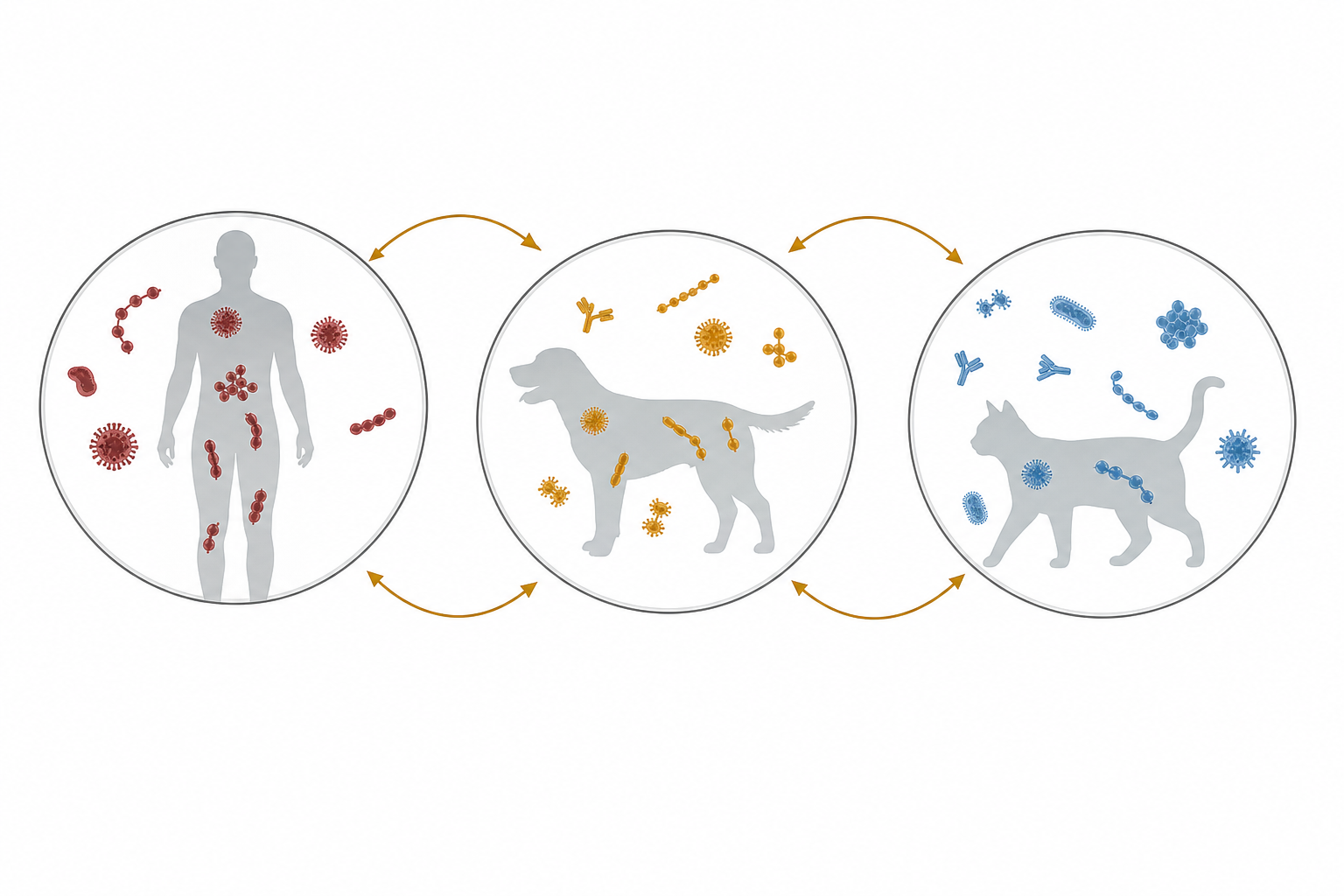
What pets can transmit (zoonotic diseases, none of them STIs)
Reassurance about STIs is the main reason most readers land here, but it is worth being clear about what pets actually can pass along. None of these are sexually transmitted, and most are easy to prevent with routine hygiene and veterinary care. They are mentioned here so that the genuine risks are not lost in the broader reassurance.
Cat scratch disease is caused by Bartonella henselae, a bacterium carried by some cats and spread to people through scratches from a cat that has been infected by fleas. It is usually mild in healthy adults: a tender lump at the scratch site and swollen lymph nodes, resolving on its own or with antibiotics if needed. The CDC describes it as the most common form of bartonellosis in the United States. Children are at higher risk because they handle cats more roughly.
Toxoplasmosis is caused by Toxoplasma gondii, a parasite shed in cat feces. Most infections in healthy adults are asymptomatic. The serious population is pregnant women, where a first-time infection during pregnancy can cross the placenta and harm the fetus. Pregnant pet owners are usually advised to have someone else change the litter box, or to wear gloves and wash hands carefully if they do it themselves. The same precaution applies to gardening in soil where cats may defecate.
Ringworm is not a worm but a fungal infection (dermatophytosis) that produces a ring-shaped rash on human skin. It spreads from infected dogs or cats through direct skin contact and is treated with topical antifungals.
Salmonella and Campylobacter infections can come from pet feces or contaminated food bowls, especially in households that feed pets raw meat diets. Handwashing after handling pets and their dishes substantially reduces the risk.
Roundworms (Toxocara canis from dogs, Toxocara cati from cats) and hookworms can transfer to humans if pet feces contaminate hands or soil. Routine deworming of pets and washing hands after outdoor play prevent most cases.
Rabies is the most serious zoonotic risk worldwide, but it is essentially eliminated in vaccinated household pets across the United States, the UK, and most of Europe. Keep dogs and cats current on rabies vaccination, particularly in regions where wildlife reservoirs persist.
None of these conditions is sexually transmitted, and the defenses are the same across the list: handwashing, basic hygiene, and routine veterinary care.
| Infection | Source | How it spreads | Sexually transmitted? |
|---|---|---|---|
| Cat scratch disease | Bartonella henselae from cats | Scratch or bite from an infected cat | No |
| Toxoplasmosis | Toxoplasma gondii from cat feces | Contact with cat feces or contaminated soil | No |
| Ringworm | Dermatophyte fungi from pets | Direct skin contact with an infected animal | No |
| Roundworm / hookworm | Toxocara and other parasites from dogs and cats | Ingestion of eggs from feces or soil | No |
| Salmonella | Pet feces or contaminated food bowls | Fecal-oral, often via unwashed hands | No |
| Rabies | Saliva of an infected mammal | Bite from an infected animal | No |
| HIV, chlamydia, gonorrhea, syphilis, herpes, HPV, hepatitis B and C, trichomoniasis | Other humans only | Sexual contact, blood exposure, or perinatal transmission | Yes, and only between humans |
The worried-thoughts list, examined plainly
This section answers the questions readers usually wonder about but feel awkward asking out loud. None of the scenarios below results in an STI transmitted from a pet.
My dog licked my genitals or my partner's genitals. Even if your pet did this, it would not transmit a human STI. A dog's saliva can carry mouth bacteria that may irritate sensitive skin or cause a minor superficial infection in someone with a broken skin barrier, but those bacteria are not Chlamydia trachomatis or Neisseria gonorrhoeae. If a human STI is present at the moment of contact, the transmission has already happened (between the humans involved); the pet is a witness, not a vector.
My cat or dog scratched me. Cat scratches can transmit Bartonella henselae (cat scratch disease). Deep bites can introduce skin or oral flora into deeper tissue. Neither of those is a sexually transmitted infection. Clean the wound with soap and water, watch for swelling or redness, and see a clinician if the wound is deep, near the eye, or shows signs of infection within a day or two.
I share my bed with my pet. Common, comfortable, and not a route for STIs. Some allergens and ectoparasites (fleas, mites) can move between sleeping surfaces, but no sexually transmitted pathogen does.
I touched my pet's genitals during grooming or vet care. Handle, then wash your hands. That single step covers everything realistic. This does not expose you to human STIs.
I had an unusual or boundary-crossing contact with an animal. If the question bringing you to a search engine is whether bestiality can transmit a human STI, the underlying biology is the same: human STI pathogens are not in the animal to be transmitted. Other risks do exist (animal-origin bacteria, physical injury, parasites), the practice is illegal in most jurisdictions, and it raises safety and welfare concerns for the animal, so this is not the article that endorses or advises it. On the specific question of human STI transmission, however: no, the pathogens that cause human STIs are not present in dogs or cats to begin with.
My partner cheated, and they blamed our pet. The pet is not a viable cover story for a human STI. If a test comes back positive, the source is human contact.
Action thresholds for the two real concerns
- A cat or dog scratch or bite: wash the wound with soap and water, watch for swelling or redness over the next 24-48 hours, and see a clinician if the wound is deep, on the hand or face, near the eye, or shows signs of infection.
- A recent human exposure (new partner, condom slip, assault, partner of unknown status): test after the window period for the specific test you use. The pet question and the testing question are separate; this is the one that warrants follow-through.
When STI anxiety is the signal, not the pet
For some readers, a worry about pet transmission is the surface form of a deeper question: did something I did with another person put me at risk? If your reason for searching is a recent human exposure (a new partner, a condom slip, a sexual assault, a partner whose own status you do not know), testing for that exposure is the productive next step, not reassurance about pets.
The CDC recommends at least annual STI screening for anyone sexually active with new or multiple partners, and more frequent screening for higher-risk groups. The infections worth attention are the ones in the table above: chlamydia, gonorrhea, syphilis, HIV, herpes, HPV, hepatitis B, hepatitis C, and trichomoniasis. Each has a window period (the time between exposure and when a test can detect the infection reliably), and each has its own most-useful sample type.
A zoonosis is an infectious disease that has jumped from a non-human animal to humans.
The few real cross-species infections worth knowing about
For completeness, a small number of infections do move between certain animals and humans and are mentioned in older patient-information materials as if they might be sexually associated. They are not. Each has a specific non-sexual route.
Brucellosis is a bacterial infection (Brucella canis in dogs, other Brucella species in livestock) that can transmit from infected dogs to humans through contact with reproductive fluids during whelping or stillbirths, not through sexual contact between species. It is rare in pet households and the highest risk is among breeders and veterinary staff handling birth tissues without protective equipment. Symptoms in humans (fever, fatigue, joint pain) are treatable with antibiotics, and the condition is reportable to public-health authorities.
Q fever (Coxiella burnetii) similarly transmits from infected livestock and occasionally dogs and cats during birthing events, through airborne particles rather than any sexual route. It is an occupational hazard for veterinary and farm workers more than a household risk.
Leptospirosis spreads through contact with the urine of infected animals (including dogs) or contaminated water, not through sexual contact. Vaccinating dogs and avoiding stagnant water in endemic areas covers the realistic exposure pathway.
The pattern across these conditions is that they involve specific occupational or environmental exposures (birthing fluids, contaminated water, airborne particles in farm settings), not the everyday contact most pet owners have with their animals.
Human STI pathogens cannot transmit between humans and pets. The infections that can spread from dogs and cats to people are non-sexual: cat scratch disease, toxoplasmosis, ringworm, salmonella, and intestinal parasites. The defenses against them are simple hygiene practices, covered below.
Sensible hygiene around pets (the small list of things that matter)
None of the practices below prevents STIs (pets are not the route to begin with), but they cover the zoonotic infections discussed earlier and are good general practice for any pet-owning household.
- Wash your hands with soap and water for 20 seconds after handling pets, their food and water dishes, and especially their feces. Soap and water beats alcohol gel for parasite eggs and some bacteria.
- Cover open cuts on your hands when grooming or cleaning pets. Most pet-mouth bacteria are harmless on intact skin but can colonize an open wound.
- Keep pets on current vaccinations and parasite prevention. Your veterinarian's routine schedule covers the diseases that are realistically transmissible.
- If you are pregnant, have someone else change the cat litter, or wear gloves and wash your hands carefully if you do it yourself. This is the toxoplasmosis precaution and it is the one that meaningfully changes a pregnancy outcome.
- If a pet bite breaks the skin, clean the wound thoroughly with soap and water and see a clinician if the wound is deep, on the hand or face, or shows redness, swelling, or warmth within 24 hours.
- Avoid feeding pets raw meat unless you understand the food-safety implications. Raw diets can introduce Salmonella and Campylobacter into the household kitchen.
- Keep pet sleeping areas, litter boxes, and food-prep surfaces separated. Routine cleaning prevents most accidental cross-contamination.
- If you handle reptiles or amphibians in addition to dogs and cats, take Salmonella precautions seriously: wash hands every time, do not kiss the animal, and keep enclosures out of the kitchen. This is the single largest source of pet-related salmonella in households.
If you had a human exposure: testing windows and what to do
For the small share of readers for whom the pet question is standing in for a real human exposure, this section covers which test to use and when. Each infection has a window period (the time between exposure and when a test can detect the infection reliably) and a most-useful sample type. Per CDC testing guidance, retest after the window period for the specific test used: up to 90 days for antibody-only rapid tests, or 45 days for a lab-based antigen/antibody test drawn from a vein.
| Infection | Earliest reliable window | Test type | Sample |
|---|---|---|---|
| Chlamydia, gonorrhea, trichomoniasis | About 14 days post-exposure (retest at 2-3 weeks) | Rapid lateral-flow | Self-collected swab |
| Syphilis | 3-6 weeks (most detected by 12 weeks) | Antibody rapid test | Fingerstick blood |
| HIV (lab antigen/antibody) | 18-45 days post-exposure | 4th-generation lab assay | Venous blood draw |
| HIV (rapid antigen/antibody) | 18-90 days post-exposure | Rapid lateral-flow | Fingerstick blood |
| HIV (antibody-only rapid) | 23-90 days post-exposure | Rapid antibody test | Fingerstick blood or oral fluid |
| Hepatitis B and C | 8-12 weeks post-exposure | Antibody rapid test | Fingerstick blood |
| HSV-2 | 6-16 weeks (seroconversion) | Antibody rapid test | Fingerstick blood |
Reading your results: rapid tests and lab confirmation
A few details that the table cannot fit: most chlamydia infections cause no symptoms, which is why screening matters more than waiting for signs. For syphilis, a primary chancre (the painless sore of early syphilis) usually appears between day 10 and day 90 after exposure, most commonly around day 21, but it can be missed because it is painless and resolves on its own. For hepatitis B specifically, vaccinated readers who have completed the three-dose series are protected and do not typically need post-exposure testing for routine sexual exposures. HSV-2 antibody tests do not detect active lesions; a clinical PCR swab from a lesion is the correct test for an active sore.
At-home rapid lateral-flow tests serve as a private first-pass screening tool. A negative is reassuring when you tested within the right window for the test you used; a positive result should be confirmed at a clinic with laboratory NAAT (for bacterial infections) or laboratory antibody testing (for the bloodborne infections), which have higher analytical sensitivity than home rapid kits.
This article is published by stdrapidtestkits.com, which sells at-home STI testing kits. The panel below covers the human-exposure scenarios described above. We recommend products based on fit-for-purpose for the reader's concern, not commercial benefit.

Frequently asked questions
- Can I get chlamydia or gonorrhea from my dog or cat?
- No. The bacteria that cause chlamydia (Chlamydia trachomatis) and gonorrhea (Neisseria gonorrhoeae) in humans are species-specific to humans. Dogs and cats carry their own chlamydia species, but those cause respiratory or eye infections in the animal and are not the genital infection associated with the human STI.
- My dog licked my face or genitals. Should I be tested for an STI?
- You do not need an STI test for a dog-tongue exposure. A dog's saliva contains mouth bacteria that may briefly irritate skin or cause a superficial infection in a wound, but it does not carry human STI pathogens. If you have a separate concern about a recent human partner, that is the exposure to test for.
- Can pets carry HPV?
- Dogs and cats carry their own papillomaviruses that can cause benign skin warts in the animal. These are not the same strains that cause cervical or oropharyngeal cancer in humans. The HPV types that drive human disease are host-restricted and cannot infect a dog or cat.
- What about a cat scratching or biting me?
- Cat scratches can transmit Bartonella henselae, the bacterium that causes cat scratch disease. That is not a sexually transmitted infection. Most cases are mild and self-limited. See a clinician if a scratch becomes swollen, painful, or is followed by fever, especially in a child or anyone with a weakened immune system.
- Can my pet give my partner an STI even if I do not have one?
- No. Pets do not host the bacteria, viruses, or parasites that cause human STIs. If a partner tests positive for an STI, the source is human contact, not the pet.
- Is there any sexually transmitted disease that can pass between humans and animals?
- There is no recognized sexually transmitted infection that moves between humans and pet dogs or cats. Some zoonotic infections (brucellosis from livestock or breeding dogs, toxoplasmosis from cats) can pass between species, but they spread through specific non-sexual routes such as birthing fluids, contaminated food, or feces, not through sexual contact.
- Should I still be tested for STIs even though my pet exposure is not the source?
- If you are sexually active with new or multiple partners, the CDC recommends annual STI screening regardless of pet ownership. If you have had a specific recent exposure to a human partner, follow the testing windows in the section above. The pet question and the testing question are separate.
- What pet-related infections should I watch for?
- Cat scratch disease, toxoplasmosis (especially during pregnancy), ringworm, intestinal parasites, and Salmonella are the realistic pet-related infections in most households. Rabies remains a concern globally but is well-controlled where household pets are vaccinated. None of these is sexually transmitted, and routine handwashing plus current veterinary care covers most of the risk.
- U.S. Centers for Disease Control and Prevention. Healthy Pets, Healthy People resource on zoonotic diseases, hygiene practices for pet owners, and the routes that move pathogens between animals and humans.
- U.S. Centers for Disease Control and Prevention. One Health initiative on cross-species disease tracking and the categories of infectious disease that move between humans and animals.
- U.S. Centers for Disease Control and Prevention. Sexually transmitted infection treatment guidelines and surveillance materials, including screening recommendations for sexually active adults.
- U.S. Centers for Disease Control and Prevention. Bartonella infection page covering cat scratch disease, transmission via cat scratches and infected fleas, and clinical course.
- U.S. Centers for Disease Control and Prevention. HIV testing window-period reference, including fourth-generation lab antigen/antibody test windows (18 to 45 days) and rapid antibody test windows (23 to 90 days), and retesting guidance after the window period for the specific test used.
- World Health Organization. Zoonoses fact sheet on diseases that pass between animals and humans, including the major routes and categories of zoonotic transmission, and the definition of zoonosis as an infectious disease that has jumped from a non-human animal to humans.
