Can I Get an STD from Cum on My Face?
Semen on intact skin is low risk for most STIs, but contact with your eyes, mouth, lips, or any broken skin changes the picture. This guide walks through which infections can transmit at each site, when an exposure deserves urgent care, and how to test if you're worried.




- Intact facial skin blocks almost every STI; mucous membranes (eyes, inside the mouth, nostrils) and broken skin are the entry points where transmission can actually happen.
- Semen in the eye is the single highest-acuity exposure site and should be evaluated by a clinician the same day to prevent vision-threatening infection.
Published: October 2025 | Last updated: April 2026 | Editorial review and quality control: Martina N.
Semen on the face carries the same pathogens as semen anywhere else on the body. The realistic question is whether those pathogens can get past your skin and reach a place where they can establish an infection. Intact facial skin is a robust barrier against almost every common STI, while the mucous membranes (the surface of the eye, the inside of the mouth, the wet inner lip, and the inside of the nostrils) plus any cut or scrape are not. The article below works through what that means in practice.
The aim here is calm, specific information rather than alarm. For most low-volume contact with intact skin, the realistic risk is very low. The cases that genuinely matter are eye exposure, oral exposure during the same encounter, and exposure on broken skin. Each of those gets its own section below, with concrete next-steps for what to do in the first hour and when to test.
Can you get an STI from semen on your face?
Yes, but the risk depends entirely on where the semen lands. Intact skin blocks almost every STI. Eyes, the inside of the mouth, lips, nostrils, and broken skin can transmit chlamydia, gonorrhea, syphilis, HSV, HIV, and hepatitis B if the partner is infectious. Eye exposure is the highest-acuity scenario and warrants same-day medical attention; oral and broken-skin exposure warrant testing on a window-period schedule (about two weeks for bacterial STIs and three to twelve weeks for HIV depending on the test type).
Key Takeaways
- Intact facial skin blocks almost every STI; mucous membranes (eyes, inside the mouth, nostrils) and broken skin are the entry points where transmission can actually happen.
- Semen in the eye is the single highest-acuity exposure site and should be evaluated by a clinician the same day to prevent vision-threatening infection.
How STI transmission through facial exposure actually works
An STI infection requires three things at once: an infectious pathogen in the fluid, an entry point in the recipient's tissue, and enough exposure for the pathogen to establish itself. Facial exposure changes only the second variable. The semen itself is exactly as infectious as it would be in any other context. What changes is whether your face provides an opening.
Skin acts as a physical and chemical barrier. The outer layer (the stratum corneum) is dry, keratinized (protein-hardened), and hostile to viruses and bacteria. Most STIs cannot establish infection through intact skin even with prolonged contact. Mucous membranes behave very differently. They are thin, moist, and rich in the cells that pathogens like HIV, gonorrhea, chlamydia, and HSV use to enter the body. The conjunctiva of the eye, the inside of the mouth, the nasal lining, and the genital tract all share this property; that is why the same fluid that bounces harmlessly off your forearm can cause infection if it lands in your eye.
Broken skin (cuts, abrasions, acne lesions, recent shaves with razor burn, eczema flares) is somewhere in between. The barrier is compromised but not absent, and the dose required for transmission is generally higher than through a true mucous membrane. The realistic risk depends on the size of the break and the pathogen involved.
Mucous membrane sites on the face: the surface of the eye (conjunctiva), the inside of the mouth, the inside of the nostrils, and the lips at the wet-dry junction. Intact skin sites: cheeks, forehead, chin, jaw, the dry outer skin of the lips, the bridge of the nose, and the external ear (excluding the eardrum). Realistic STI risk is concentrated in the first list.
Which STIs can transmit from semen on the face
The list below covers the infections worth thinking about, ranked roughly by how plausible transmission is when semen reaches a mucous membrane. The word “plausible” is doing a lot of work here; even for the higher-risk pathogens, single-encounter facial exposure is generally a lower-probability event than penetrative exposure of equivalent fluid volume.
| Infection | Eye exposure | Mouth exposure | Intact-skin exposure |
|---|---|---|---|
| Gonorrhea | Documented; can cause sight-threatening conjunctivitis | Possible (pharyngeal gonorrhea) | No |
| Chlamydia | Documented; conjunctivitis | Possible but uncommon | No |
| HIV | Theoretical, very low risk; documented case reports exist | Low risk; higher with bleeding gums or oral sores | No |
| Syphilis (primary) | Possible if a chancre is present on the partner | Possible; oral chancres do occur | Only via direct contact with an active sore |
| HSV-1 / HSV-2 | Possible; can cause ocular herpes | Possible; can cause oral HSV | Generally no on intact skin |
| Hepatitis B | Possible if mucosal contact and infectious partner | Possible; lower than blood-route risk | No (intact skin) |
| Hepatitis C | Very low; not classically considered sexually fluid-transmitted | Very low | No |
| HPV | Not a typical transmission route | Possible (oral HPV exists, but transmission via semen onto lip is unusual) | No |
| Trichomoniasis | Not documented at this site | Not documented | No |
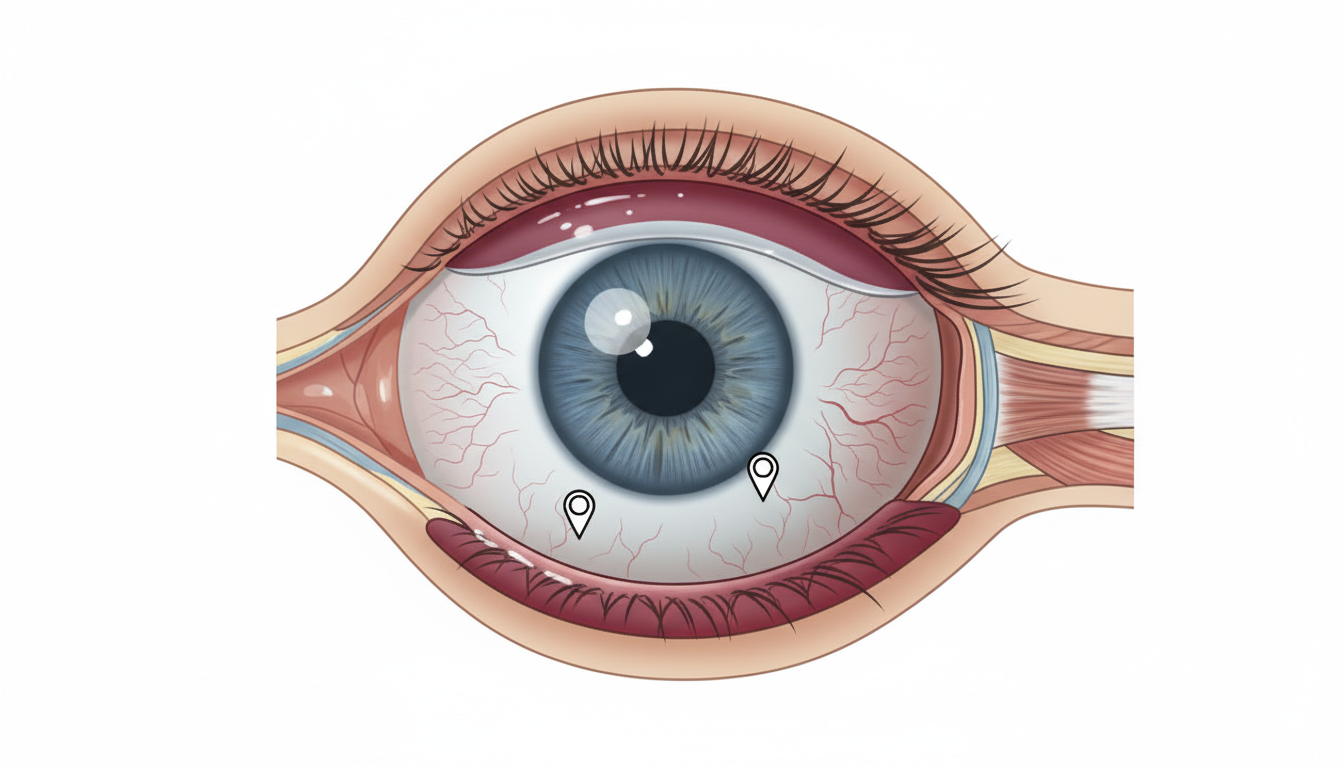
Semen in the eye: the exposure that needs same-day attention
Of every site on the face, the eye is where casual exposure carries the most acute risk. Three infections drive this:
Gonococcal conjunctivitis is a fast-progressing eye infection caused by Neisseria gonorrhoeae. It typically begins within 12 to 48 hours of exposure with intense redness, swelling of the eyelid, copious thick yellow-green discharge, and pain. Untreated, it can ulcerate the cornea and cause permanent vision loss. It is treatable when caught early, usually with intramuscular ceftriaxone plus topical care, but the window matters. Anyone who develops a hyperacute purulent conjunctivitis in the day or two after a possible exposure should be in front of a clinician within hours, not days.
Adult chlamydial conjunctivitis is more indolent: a milder, low-grade redness with stringy discharge that develops over days to a couple of weeks. It rarely threatens vision the way gonococcal conjunctivitis can, but it does require systemic antibiotics (typically a single dose of azithromycin or a course of doxycycline) because topical drops alone do not clear the genital reservoir that may be cross-seeding the eye.
Ocular herpes can occur if the semen carries HSV (more often HSV-1 in this context, though either type can infect the eye). It presents as eye pain, light sensitivity, blurred vision, and sometimes a branching corneal ulcer (a dendritic ulcer) visible under slit-lamp examination at an eye clinic. This is an ophthalmic emergency: untreated ocular HSV can permanently damage the cornea.
If semen has gone into your eye and you are even mildly symptomatic the next day, do not wait it out. Same-day urgent-care or emergency-department evaluation is the right call.
Mouth and lip exposure: lower acuity, but a real testing question
The mouth is a mucous membrane and a plausible site for several STIs to establish, but unlike the eye, the realistic timeline is longer and the symptoms (when they occur) are subtler. The most relevant infections:
Pharyngeal gonorrhea can develop after gonorrhea-containing fluid contacts the throat. It is asymptomatic in the majority of cases, which is part of why it is a public-health concern; symptomatic infections cause a sore throat, sometimes with mild fever and swollen neck lymph nodes. The CDC's screening guidance for people with potential pharyngeal exposure is a throat swab tested by NAAT, regardless of symptoms.
Pharyngeal chlamydia is uncommon but real, and is generally screened with the same throat swab.
Oral HSV from semen exposure is plausible if the partner has an active genital HSV infection (more often HSV-2, though HSV-1 genital infections also occur). The classic presentation is a cluster of small painful blisters on the lip or just inside the mouth, appearing roughly two to twelve days after exposure. Most people who are going to seroconvert do so within twelve weeks.
Primary syphilis can present as a painless oral chancre at the site of contact (lip, tongue, tonsil) about three weeks after exposure. The chancre often goes unnoticed because it does not hurt; if you have an unexplained painless ulcer in or around the mouth that lasts more than a few days, that is worth a clinical exam and a syphilis blood test.
HIV transmission from oral exposure to semen is possible but is generally considered low-risk. The risk is meaningfully higher when the receiving partner has bleeding gums, oral ulcers, recent dental work, or active gum disease, because intact oral mucosa is a relatively effective barrier.
For pharyngeal gonorrhea or chlamydia, the right test is a throat swab evaluated by NAAT at a sexual-health clinic, reliable from about 14 days after exposure. For HIV after oral exposure, plan a fourth-generation antigen-antibody test at four weeks and a confident endpoint at twelve weeks. For syphilis, blood antibody testing is reliable from three to six weeks, with three months as confirmation. Test sooner if symptoms appear.
Nose, ear, and intact skin: the lower-risk sites
The nasal lining is a mucous membrane and could in principle be a transmission site, but in practice it is rarely implicated. The volume of fluid that reaches the nasal mucosa during a typical exposure is small, and the nasal cavity is structured for clearance rather than absorption. There is no clinical evidence base for routine STI screening based on isolated nasal exposure.
The ear canal is lined with skin, not mucous membrane, and the eardrum sits behind that skin. Semen in the outer ear is essentially equivalent to semen on any other intact-skin site. The exception is an active outer-ear infection, an eczema flare, or a perforated eardrum, in which case treat it as broken-skin exposure.
Intact facial skin (cheeks, forehead, dry surface of the lips, jaw, neck) is not a documented transmission site for any sexually transmitted infection. You can rinse and move on. The realistic risk profile here is closer to a hygiene question than a public-health one.
Recent shaving, active acne lesions, eczema flares, cold sores, or any open cut on the face shifts the exposure from “intact skin” to “broken skin.” The transmission risk for hepatitis B, HIV, and HSV through a fresh break is low but non-trivial. If you shaved that morning and have a cluster of micro-cuts along the jaw or upper lip, treat the exposure as a mucous-membrane equivalent for the purposes of testing decisions.
Cum facials, face sitting, and the realistic exposure pattern
The acts that bring semen into contact with the face vary in how much fluid actually reaches a mucous membrane. Knowing the pattern helps calibrate whether testing is warranted.
Cum facials typically deposit semen on cheeks, forehead, and around the lips and chin. The most common mucous-membrane contact is incidental: a drop reaching the lower eyelid or the corner of the mouth. The realistic risk profile is dominated by what happened at the eye and at the mouth, not by the volume on intact skin. If neither eye nor mouth was involved and there is no broken skin, the testing decision is the same as for any unrelated background exposure.
Face sitting with oral-genital contact is essentially oral sex, and carries oral-sex risk for the receiving partner: pharyngeal gonorrhea, pharyngeal chlamydia, HSV, syphilis, and a low background HIV risk. The face-down geometry does not change the transmission biology; the same screening recommendations apply (throat swab plus standard blood panel timed appropriately).
Ejaculation directly into the eye, whether incidental or deliberate, is the scenario where this category genuinely earns acute medical attention. See the eye-exposure section above for the right escalation timeline.
Facial exposure without eye, mouth, or broken-skin contact does not generally warrant a separate testing schedule. Once the eye, mouth, or broken skin is involved, follow the window-period schedule below. Eye involvement specifically warrants same-day clinical evaluation, not just at-home testing on a delayed schedule.
What to do in the first hour after exposure
If semen has contacted a mucous membrane on your face, the immediate steps are simple and worth doing in the right order:
Eye: rinse with cool, clean tap water or sterile saline for several minutes. Then assess: pain, redness, light sensitivity, or visible discharge in the next 24 to 48 hours warrants same-day evaluation.
Mouth and lips: rinse with water; spitting is fine, swallowing is also fine (the stomach inactivates most pathogens). Do not scrub aggressively or use harsh mouthwash on broken oral tissue, which can worsen any micro-injury. Note the exposure date; you will use it for the testing window.
Nose: blow gently and rinse the external nostril area with water.
Skin: wash with soap and water. If you have any cuts or abrasions in the area, note them as broken-skin exposure for the testing decision.
HIV PEP consideration: if the exposure is high-risk (semen in the eye or in a fresh open cut from a partner you know or suspect is HIV-positive and not virally suppressed), HIV post-exposure prophylaxis is most effective when started within 72 hours. Sooner is better. An emergency department or sexual-health clinic can prescribe.
When to test: the window-period schedule
Tests for STIs do not detect infection at the moment of exposure. Each pathogen has a window period, the lag between exposure and the earliest reliable positive result. Testing too early gives false reassurance. The general windows below assume mucous-membrane or broken-skin exposure on the face; intact-skin contact alone does not generally warrant testing on this schedule.
Chlamydia and gonorrhea (genital, throat, or eye samples): NAAT testing is reliable from about 14 days after exposure. Test sooner if symptomatic.
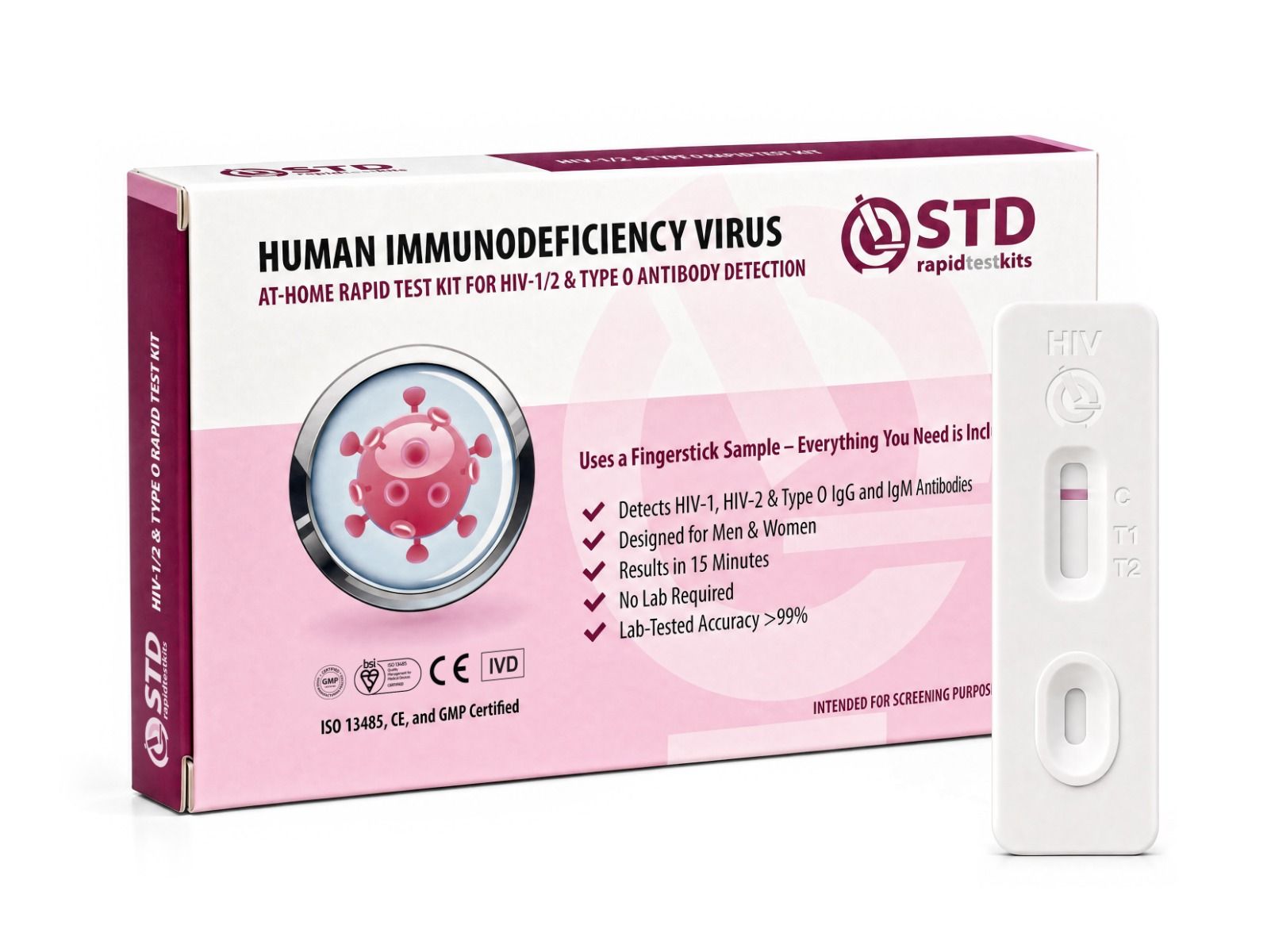
HIV: a fourth-generation antigen-antibody lab test detects most infections by 18 to 45 days. A rapid antibody test (including most home rapid kits) is reliable from about 23 to 90 days, with three months as a confident endpoint. NAAT (RNA) tests can detect HIV earlier but are not a routine screening choice.
Syphilis: blood antibody tests (RPR, VDRL, treponemal) are typically reliable from three to six weeks post-exposure, with three months as a confirmatory endpoint.
Hepatitis B: surface antigen (HBsAg) and core antibody (anti-HBc) become detectable about four to ten weeks after exposure.
Hepatitis C: antibody testing is reliable from about 8 to 11 weeks.
HSV: antibody seroconversion typically occurs within 12 weeks; if a sore appears, swabbing the lesion within the first 48 hours of its appearance is the most direct test.
If you are in the post-exposure window and uncertain which test type to pick, the practical default for low-acuity exposure is a panel at four weeks and a confirmatory HIV test at twelve weeks.
If your concern is specifically pharyngeal (throat) gonorrhea or chlamydia from oral exposure, the right test is a throat swab evaluated by NAAT. We do not currently sell a throat-swab home kit; that test is best done at a sexual-health clinic. Our blood-based panels cover the systemic infections (HIV, syphilis, hepatitis B, hepatitis C, herpes) that may also need follow-up after the same exposure.
Public-health guidance from the <a href="https://www.cdc.gov/std/">U.S. Centers for Disease Control and Prevention</a> consistently identifies mucous membranes (the surfaces of the eye, mouth, vagina, anus, and urethra) as the principal entry points for sexually transmitted pathogens. That is the underlying reason facial exposure carries some risk wherever those tissues are involved, and effectively no risk where they are not.
Reducing risk in future encounters
The interventions that move the needle here are unsexy and effective:
Know your partner's recent test status, especially for HIV, gonorrhea, and chlamydia. Recent is the key word: a six-month-old screen is less informative than a screen done since their last new partner.
Use barrier protection for oral sex when status is unknown. Condoms during fellatio are uncommon in practice but are the only intervention that materially changes the oral STI risk equation.
Avoid eye exposure deliberately. This is mostly a positioning question. Eyes closed and turned away if ejaculation onto the face is part of the scene.
Do not stack risk factors. Recent dental work, bleeding gums, an acne flare, fresh shaving, or a cold sore at the lip raises the receiving partner's risk during oral exposure. Save those activities for after the skin has healed.
Consider PrEP if HIV exposure is a recurring concern. Daily oral PrEP or long-acting injectable PrEP reduces HIV transmission risk by more than 99 percent when used as prescribed.
Get vaccinated. Hepatitis B and HPV vaccines are highly effective and cover two of the pathogens on the list above. ACIP recommends routine HPV vaccination through age 26 with shared clinical decision-making through age 45.
Routine screening on a schedule (every three to twelve months depending on your risk profile) catches most asymptomatic infections before they cause harm or are passed on.
FAQs
- Can semen on intact skin transmit any STI?
- Not under normal conditions. Intact skin is an effective barrier for every common STI. The exceptions are sites with broken skin (cuts, abrasions, active acne, fresh shave nicks, eczema flares), which behave more like a mucous membrane for transmission purposes.
- If semen got in my eye, do I need to go to the ER?
- If you developed redness, eye pain, light sensitivity, swelling of the eyelid, or thick discharge in the 12 to 48 hours after exposure, yes. Same-day urgent-care or emergency-department evaluation is the right call. Gonococcal conjunctivitis can damage the cornea fast. If you rinsed and have no symptoms after 48 hours, the acute risk is low, though routine STI testing on the standard schedule is still worth doing.
- Can you catch HIV from semen on your face?
- Possible but uncommon. The risk concentrates at three sites: the eye, the inside of the mouth (especially with bleeding gums or oral injury), and broken skin. Intact facial skin does not transmit HIV. If the exposure was high-risk (eye or open cut, partner known or suspected HIV-positive), post-exposure prophylaxis (PEP) started within 72 hours can prevent infection. An emergency department or sexual-health clinic can prescribe.
- How long after exposure should I get tested?
- For chlamydia and gonorrhea, about two weeks. For HIV, four weeks for an early result with a fourth-generation lab test, three months for confident confirmation. For syphilis, three to six weeks. For hepatitis B, about four to ten weeks; for hepatitis C, about eight to eleven weeks. If symptoms appear sooner, test sooner.
- Should I rinse my mouth with mouthwash after oral exposure to semen?
- Plain water is fine. Aggressive mouthwash use is not recommended; harsh antiseptic rinses can disrupt the protective oral mucosa and may actually increase transmission risk if the mucosa is already irritated. Spit, rinse with water, and brush normally later in the day.
- Is face sitting actually riskier than other forms of oral sex?
- Not really. Face sitting that includes oral-genital contact carries the same risk as any other oral sex on the receiving partner's mouth. The position itself does not change the transmission biology. Standard oral-sex precautions apply: barriers if status is unknown, avoid oral contact when one partner has visible sores or recent dental work, and screen on the throat-swab plus blood-panel schedule.
- Can I get pregnant from semen on my face?
- No, pregnancy is not possible from facial exposure. Pregnancy requires sperm reaching the cervix and a viable egg. Semen anywhere else on the body, including the eye, mouth, or skin, cannot cause pregnancy. The concern with facial exposure is STI transmission only.
- Should both partners test if there's been a high-risk facial exposure?
- Yes. Even if one partner is the apparent “source” and the other the apparent “recipient,” testing both is the right call: existing infections in either partner can be uncovered, and treatment is straightforward for most bacterial STIs once detected. At-home rapid testing makes this logistically easier than driving to a clinic for both people.
- U.S. Centers for Disease Control and Prevention. Sexually Transmitted Infections (STIs): prevention, transmission, and screening guidance.
- U.S. Centers for Disease Control and Prevention. HIV basics, transmission risk, and post-exposure prophylaxis (PEP) within the 72-hour window.
- World Health Organization. Sexually transmitted infections (STIs) fact sheet, including transmission routes and prevention.
- NHS. Sexually transmitted infections (STIs) overview, symptoms, and testing.
- U.S. Centers for Disease Control and Prevention. Hepatitis B and Hepatitis C transmission and screening.
- Mayo Clinic. Sexually transmitted diseases (STDs): symptoms, causes, and screening overview.