
Published: August 2025 | Last updated: May 2026 | Editorial review and quality control: Martina N.
Can birth control cause herpes outbreaks?
Indirectly, for some people. Certain hormonal methods, especially the Depo-Provera injection, can modestly increase HSV reactivation by softening the cell-mediated immunity that keeps the virus dormant. Most users notice no change at all. When a connection does appear, it usually shows up during a method change rather than steady-state use.
You started a new pill three weeks ago. Maybe you switched to the patch, or had a hormonal IUD placed, or came off Depo-Provera after years on it. Now the skin around your vulva feels tender in a way it has not in over a year. The question creeps in: coincidence, or is my birth control waking something up?
The link between hormonal birth control and herpes outbreaks is real but smaller than the internet sometimes suggests. Estrogen and progesterone influence immune cells that help keep the herpes simplex virus (HSV) dormant, and a handful of studies over the past two decades have found modest associations between certain contraceptive methods and viral activity. Most people on hormonal birth control notice no change in their outbreak rhythm. A smaller group notices a real one, usually clustered around a method change. This guide walks through what is established, what stays in the anecdotal column, and what to do if your body has shifted since you switched methods.
Key Takeaways
- Some hormonal contraceptives can modestly shift immune activity in ways that may increase how often HSV resurfaces, but they do not cause herpes and the size of the effect varies widely between people.
- If you suspect a connection, track outbreaks for two to three cycles, talk with your provider about non-hormonal alternatives like the copper IUD, and consider daily antiviral suppression if outbreaks remain frequent.
How hormonal contraceptives interact with your immune system
Hormonal contraceptives work by adding synthetic estrogen, progestin, or both into your bloodstream to suppress ovulation and thicken cervical mucus. The receptors that pick up these hormones are not only in your reproductive organs. They sit on the surface of immune cells too, including the CD8 T cells and natural killer cells (immune cells that detect and destroy virus-infected tissue) that suppress dormant viruses like herpes simplex.
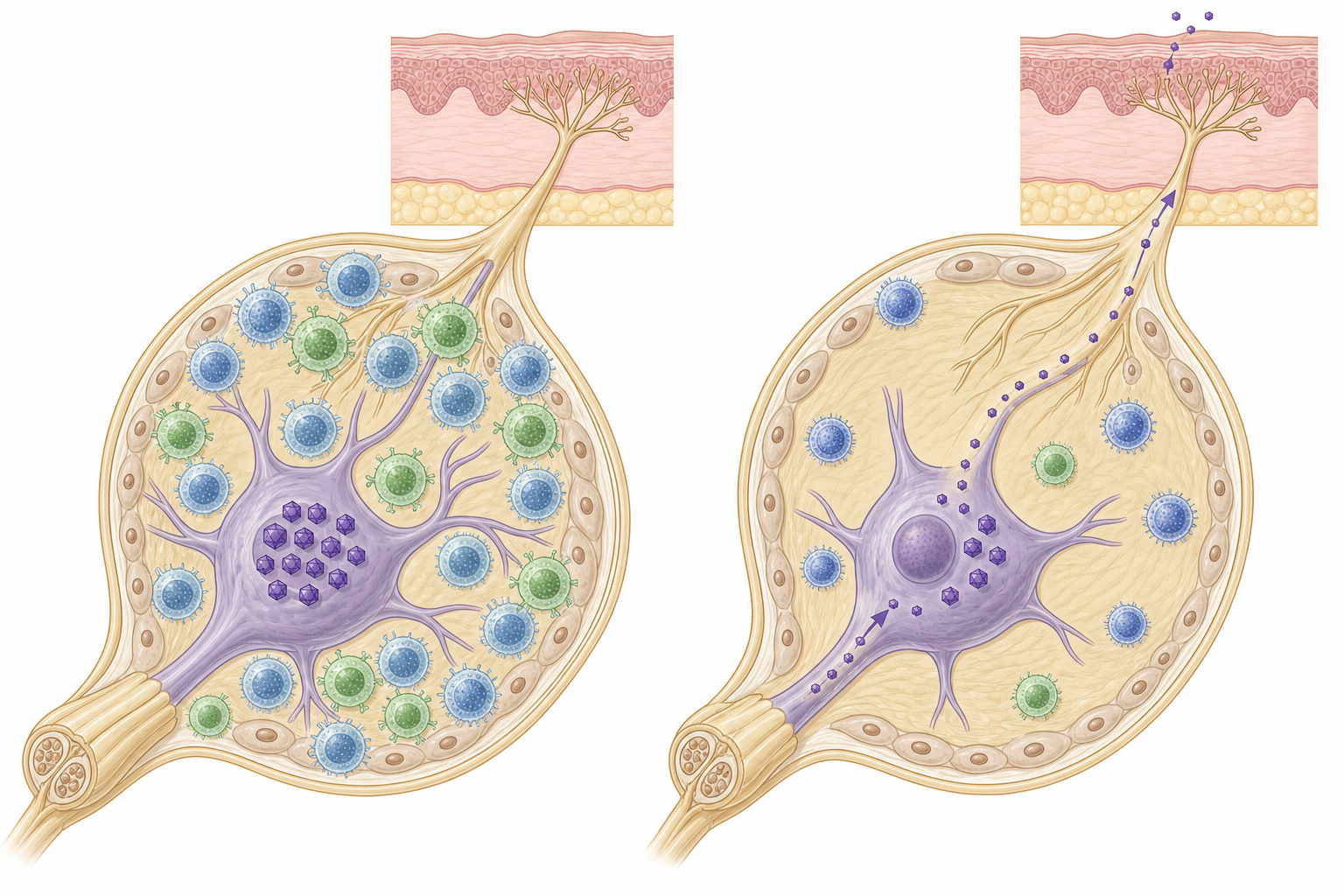
Estrogen tends to promote antibody-driven immune responses. Progesterone tends to dampen cell-mediated responses, which are the responses that hold HSV in check between outbreaks. The herpes simplex virus stays latent inside nerve cell bodies (the sacral ganglia for genital HSV-2, the trigeminal ganglia for oral HSV-1) and reactivates only when local immune surveillance softens. Anything that softens that surveillance, even slightly, can give the virus a window to travel back along the nerve to the skin surface.
This mechanism is well established for known reactivation triggers like acute stress, sleep deprivation, recent illness, and immunosuppressive medication. The open question with hormonal birth control is whether the immune shift it produces is large enough to matter clinically. For most users the shift is too small to notice. For a subset of users it appears to be enough to bump outbreak frequency upward.
It is also worth understanding what hormonal birth control does not do. It cannot give you herpes. It cannot turn a person who has never been exposed to HSV into a person with HSV. Any contraceptive effect on outbreaks operates entirely within people who already carry the virus, whether they know it or not. For background on herpes transmission and natural history, see the CDC herpes overview.
What the research actually shows
The evidence base for contraception and HSV is mostly observational rather than randomized, which means we are reading patterns, not proven cause and effect. Several findings recur across studies summarized in CDC's STI Treatment Guidelines and the broader peer-reviewed literature:
- Women using depot medroxyprogesterone acetate (Depo-Provera, the injectable progestin) tend to show slightly higher rates of HSV-2 genital shedding than women using non-hormonal methods or no contraception. The difference is small in absolute terms, on the order of a few extra days of detectable shedding per quarter in the larger cohort studies.
- Combined oral contraceptive use has produced mixed results. Some studies find no measurable effect on shedding or symptomatic outbreaks. Others find a small uptick in self-reported outbreak frequency in the first few months after starting a new pill, which often fades.
- Copper IUDs, condom-only use, and fertility-awareness methods consistently show no association with HSV activity, which is unsurprising given they do not alter circulating hormone levels.
What the research does not show is a clear mechanism that converts asymptomatic carriage into symptomatic disease in someone who has never had outbreaks. The data is about reactivation in people who already have culturable or symptomatic HSV. It is not about new acquisition or about flipping silent carriers into symptomatic ones.
The pattern that holds up most consistently is timing. People who notice a connection rarely report it during steady-state use of a method they have been on for a year. They report it during transitions: the first month on a new method, a missed-pill week, the post-stop window, or the overlap when switching from one method to another. Outbreak frequency in established HSV-2 infections also varies enormously between individuals and tends to decline over time, per CDC herpes guidance. Any contraceptive effect operates on top of that baseline variability, which is why studies need large sample sizes to detect a signal.
The strength of the evidence varies sharply by method. The Depo-Provera injection has the most consistent data for increased HSV-2 shedding, combined pills show mixed results, hormonal IUDs show only a minimal signal, and non-hormonal methods show none at all. Every one of these associations is observational rather than proven cause and effect, which is why no single method can be called a guaranteed trigger.
When transitions open the door
For people who do notice a hormonal connection, the risky moment is rarely steady-state use of a method. It is the transition, when circulating hormone levels shift fast and the immune system has to recalibrate. If you have been settled on the same method for six cycles and outbreaks suddenly increase, a different trigger like stress, illness, or sleep loss is the more likely culprit. The windows below are where readers most often report a flare lining up with a contraceptive change.
| Transition window | What shifts hormonally | Why it can open a flare |
|---|---|---|
| First month on a new method | Estrogen and progestin surge plus immune recalibration | A brief dip in local immunity can give a dormant virus an opening |
| Missed or skipped doses | Fluctuation from inconsistent dosing | Disrupted cycles may briefly destabilize viral suppression |
| Coming off a method | Sudden hormone withdrawal | Mimics a steep premenstrual drop and may coincide with a flare |
| Breakthrough ovulation on progestin-only methods | Local hormone changes around mid-cycle | Lines up with other inflammatory triggers at ovulation |
| Switching between methods | Two hormone profiles overlapping | Creates a short-term window of immune instability |
Which methods are most likely to interact with HSV
Not all hormonal contraceptives carry the same plausible risk. Methods can be ranked roughly by how much they alter systemic hormone levels and how steadily they deliver hormones into your circulation.
Highest theoretical impact. Depot medroxyprogesterone acetate (Depo-Provera) delivers a large dose of synthetic progestin every three months and produces the most pronounced cell-mediated immune changes in the published research. This is also the method most consistently associated with increased HSV-2 genital shedding in cohort studies.
Moderate theoretical impact. Combined oral contraceptive pills, contraceptive patches, and vaginal rings. These deliver moderate steady doses of estrogen and progestin daily or weekly. Some users report increased outbreaks in the first few cycles after starting a new pill formulation; many notice no change at all.
Lower theoretical impact. Hormonal IUDs (Mirena, Skyla, Liletta, Kyleena) release a small local dose of levonorgestrel into the uterus, with much lower systemic absorption than pills or injections. Most users on hormonal IUDs do not show measurable immune changes. Reports of increased outbreaks on hormonal IUDs exist but are uncommon in the literature.
Minimal or no impact. Progestin-only mini-pills are lower dose than combined pills, though they still deliver hormones systemically. Subdermal implants like Nexplanon release etonogestrel steadily; reports of increased HSV activity are rare.
Non-hormonal methods cover copper IUDs, condoms, diaphragms, cervical caps, fertility-awareness-based methods, and sterilization. These methods do not change hormone levels and are the cleanest choice if you want to remove birth control as a possible variable in your outbreak pattern.
| Method | Hormonal? | Plausible HSV interaction |
|---|---|---|
| Depo-Provera injection | Yes (progestin) | Highest reported in studies |
| Combined pills, patch, ring | Yes (estrogen + progestin) | Moderate, mixed evidence |
| Hormonal IUD (Mirena, Kyleena) | Yes (low-dose local progestin) | Low |
| Progestin-only mini-pill | Yes (progestin) | Low to moderate |
| Subdermal implant (Nexplanon) | Yes (progestin) | Low |
| Copper IUD (ParaGard) | No | None reported |
| Condoms, diaphragm, FAM | No | None reported |
| Tubal ligation, vasectomy | No | None reported |
The menstrual cycle connection
Even without contraception in the picture, many people notice their outbreaks cluster around their period. That observation has clinical backing. During the luteal phase (the second half of the cycle, after ovulation), progesterone rises and local immune activity at the cervix and vaginal mucosa softens. For someone carrying HSV-2, that is a permissive window for reactivation.
Animal and human research consistently shows that progesterone increases susceptibility of the genital tract to HSV-2 and reduces local antiviral defenses. The exact mechanism likely involves changes in cervical mucus, mucosal IgA antibody secretion (the immune proteins released at the surface of body tissues), and local cytokine balance (the mix of chemical signals coordinating inflammation in a specific tissue). Research tracking daily self-collected genital swabs in people with HSV-2 has measured shifts in viral shedding across the menstrual cycle, with shedding more common in some phases, which confirms that hormones at ordinary physiologic levels change how often the virus reaches the surface even without visible symptoms. The WHO herpes simplex virus fact sheet lists menstruation among recurrence triggers, alongside stress, illness, and fatigue.
Layer a hormonal contraceptive on top of natural cycling and you can get a few different patterns. A combined pill suppresses ovulation and dampens cyclical hormone fluctuation. For some people this smooths the picture and outbreaks become less cyclical. For others, the constant low-dose progestin acts more like a sustained luteal phase, and they notice flares more often. A progestin-only method (mini pill, implant, hormonal IUD) keeps progestin steady, which can either reduce or increase outbreak frequency depending on the individual response. Transitioning between methods creates a brief window of hormonal turbulence, and that is when many people report their first noticeable flare change.
Almost all persons with symptomatic first-episode HSV-2 genital herpes subsequently experience recurrent episodes of genital lesions.
Non-hormonal alternatives worth considering
If you want to keep effective pregnancy prevention without the hormonal piece, your options are well established. Each has tradeoffs worth weighing with your provider.
Copper IUD (ParaGard). The most effective non-hormonal method, with typical-use effectiveness above 99 percent, similar to hormonal IUDs. Inserted by a provider, lasts up to 10 to 12 years, and does not change hormone levels. Period bleeding may increase, especially in the first six months. A reasonable first choice for someone who wants long-acting reversible contraception without the hormone exposure.
Condoms. External (latex or polyurethane) and internal (polyurethane or nitrile) condoms are less effective than IUDs in typical use but offer the additional benefit of reducing transmission of HSV, HIV, and other sexually transmitted infections to a partner. Useful as a primary method or as a barrier layer added on top of another method.
Fertility-awareness-based methods. Tracking ovulation through basal body temperature, cervical mucus, or validated cycle apps. Effectiveness depends heavily on consistent daily tracking and reliable abstinence or barrier use during fertile windows. Higher behavioral effort than a daily pill.
Diaphragm or cervical cap with spermicide. Inserted before intercourse and removed several hours after. Less commonly used today but still available with a prescription and a fitting visit.
Sterilization (tubal ligation, vasectomy). Permanent. The right fit only for people who are certain they do not want future pregnancies. NHS contraception guidance covers all of these in plain English alongside efficacy figures.
The copper IUD (ParaGard) is the only fully hormone-free IUD on the market in the U.S.; every other IUD releases levonorgestrel. Typical-use effectiveness is over 99 percent for both copper and hormonal IUDs, so the choice between them is mostly about side-effect profile, not contraceptive power. The copper IUD lasts up to 10 to 12 years and is fully reversible by removal at any time.
Other HSV triggers to rule out first
Before changing your contraceptive method, take an honest look at the other known reactivation triggers. Some of them may explain a recent uptick in outbreaks better than your birth control does. CDC and major herpes-specialty references list several recurring patterns:
- Acute stress, especially the persistent kind that disrupts sleep over multiple weeks
- Recent illness, including viral infections like a cold, flu, or COVID-19
- Sleep deprivation, particularly several nights in a row
- Sun exposure on the lips or face, a common trigger for HSV-1 cold sores
- Hormonal swings around menstruation, particularly in the few days before bleeding starts
- Friction or local trauma to the affected area, including from rough sex
- New use of immunosuppressive medication, including high-dose corticosteroids, biologics, or chemotherapy
If your outbreaks track with one of these, addressing the trigger may matter more than swapping birth control. A common pattern worth flagging: outbreaks that cluster a few days before each menstrual period can look like a birth control effect but are the natural premenstrual progesterone drop causing a brief immune shift. That pattern happens whether or not you are on contraception, and it is one of the few times in the cycle when birth control can help, since steady hormone delivery can flatten the premenstrual dip.
Outbreaks clustering in the days before each period are often caused by the natural premenstrual progesterone drop, not by your birth control method. Tracking the dates against your cycle for two or three months helps separate the two patterns before you change anything.
How to tell if your contraceptive is the problem
Three steps can help you isolate the variable.
First, track outbreaks for the next two to three full cycles. A simple calendar entry with the date, severity, location, and what else was happening that week (stress, sleep, illness, new medication) is enough. Apps like Clue and Flo work fine, and even a phone notes file will do the job. The goal is to see patterns you cannot see from memory alone.
Second, look for a pattern that aligns with your birth control rather than with menstruation or other triggers. Outbreaks that consistently arrive in the first week of a new pill pack, that started within the first three months of beginning a new method, or that cluster around a Depo-Provera injection are more suspicious of a contraceptive effect. Outbreaks scattered through the cycle with no clear timing are usually driven by something else.
Third, talk with your provider before stopping or switching. There may be reasons your current method is medically helpful for you (heavy bleeding, endometriosis pain, ovarian cyst suppression, acne, menstrual migraines) that outweigh a modest increase in HSV outbreaks, especially when antiviral suppression can manage the herpes side. Stopping a method cold without a plan can mean an unintended pregnancy on top of whatever you were already trying to solve.
Date of any prodrome (tingling, burning, itch) and visible outbreak. Contraceptive method and any dose, brand, or schedule change in the prior 30 days. Cycle day if you still menstruate. Other stressors in the same window: illness, antibiotic course, travel, sleep loss, new partner, unusual friction. After eight to twelve weeks of these four data points you usually see patterns that are hard to spot from memory alone, and the log is something concrete to bring into a provider visit.
Antiviral suppression as an alternative to switching methods
If you and your provider decide your current contraceptive is otherwise the right choice, daily antiviral suppression is a well-established way to reduce HSV outbreak frequency. Acyclovir, valacyclovir, and famciclovir all lower recurrence rates substantially when taken daily.
Published CDC STI treatment guidelines describe daily suppressive therapy as reducing symptomatic recurrences by 70 to 80 percent and reducing asymptomatic viral shedding meaningfully in people with frequent outbreaks. It works on top of whatever is driving the recurrences, including any contraceptive contribution. For people having six or more outbreaks per year, suppressive therapy is a standard option worth discussing with a healthcare provider.
Episodic treatment is the other option: a short course taken at the first sign of a prodrome, the tingling, burning, or itch that often precedes a lesion, and ideally started within 24 hours, which can shorten an individual outbreak. Suppressive therapy is not a cure. It controls outbreaks while you take it, and outbreak frequency returns to baseline after you stop. Most people tolerate it well; serious side effects are uncommon. None of the three main antiviral medications has a clinically significant interaction with hormonal contraceptives, so they can be taken together without reducing the effectiveness of either.
Daily acyclovir, valacyclovir, or famciclovir reduces symptomatic recurrences by roughly 70 to 80 percent according to CDC STI Treatment Guidelines. None of the three has a clinically significant interaction with hormonal contraceptives, so you can take them alongside your current method with no reduction in contraceptive protection or antiviral potency.
When to test for HSV before making decisions
If you have never been formally tested for HSV but suspect outbreaks based on symptoms, it is worth confirming what type of herpes virus you carry before deciding which contraceptive method to use long term. HSV-1 (typically oral but increasingly genital) and HSV-2 (typically genital) have somewhat different recurrence patterns. HSV-2 tends to reactivate more often in the first one to two years; HSV-1 tends to be milder genitally and to recur less often. The MedlinePlus genital herpes overview summarizes how the two types differ in plain language.
Testing options fall into three categories.
- Blood antibody tests (type-specific IgG). Detect HSV-1 and HSV-2 antibodies, typically reliable at 12 weeks or more after a suspected initial exposure. Useful for confirming you carry the virus and which type, even when you have no current symptoms.
- PCR swab of an active lesion. The most reliable test during an actual outbreak. Requires a clinic visit while the lesion is fresh, which makes timing the limiting factor.
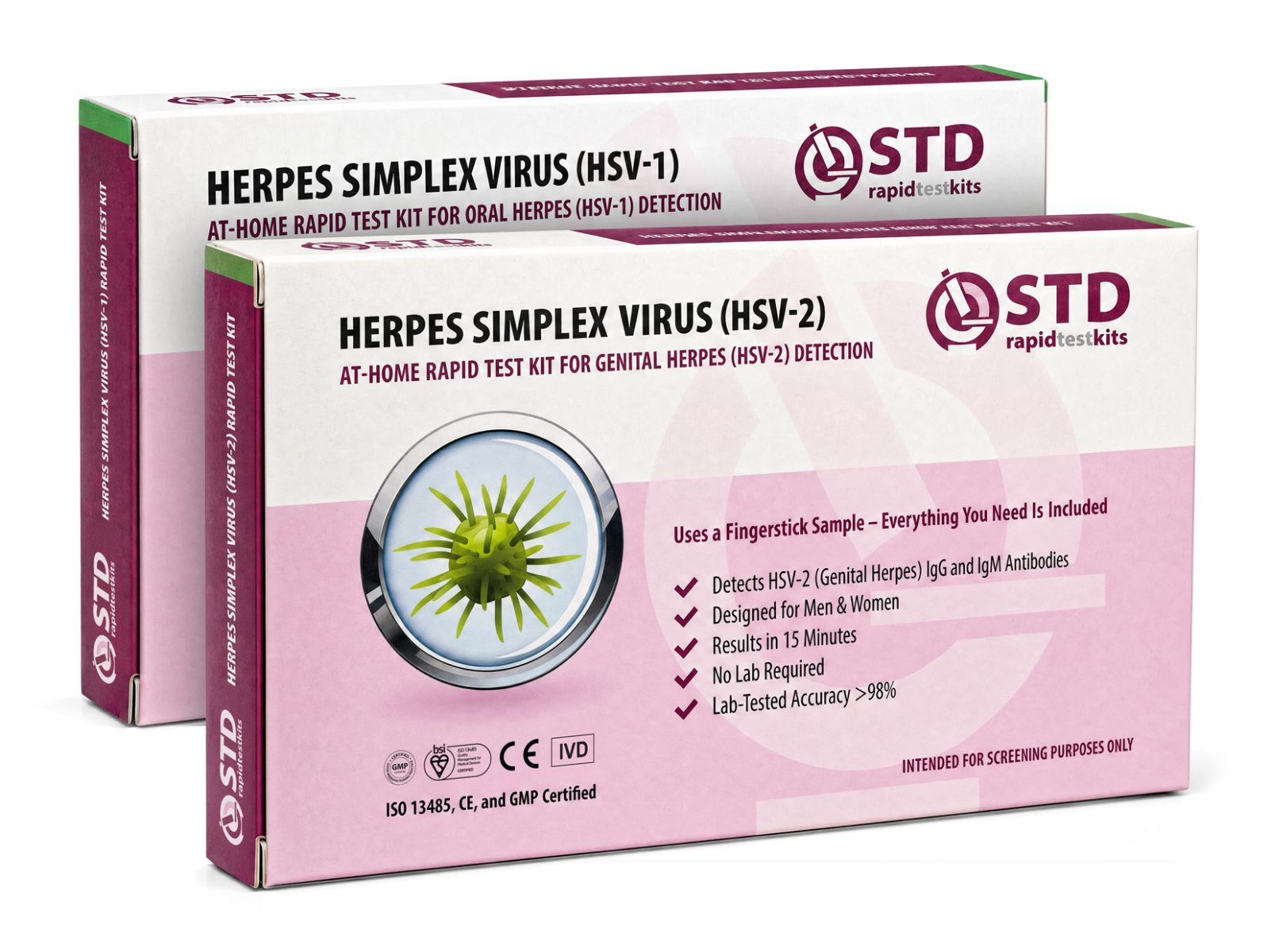
- At-home rapid antibody tests. An at-home rapid antibody test gives a preliminary result for HSV antibodies from a fingerstick blood sample. Useful as an initial screen when you suspect exposure but cannot easily get to a clinic. A positive result is worth confirming with lab testing through a provider.
CDC does not currently recommend universal HSV screening for asymptomatic adults. Testing is most useful when symptoms suggest herpes, when a partner has been diagnosed, or when you want clear information before making longer-term decisions about contraception or pregnancy. The NHS overview of genital herpes covers the typical symptom picture if you are trying to decide whether what you are seeing fits the pattern.
stdrapidtestkits.com sells at-home rapid lateral-flow tests; the product below is one of them.
Talking with your provider without a fight
The hormone-and-herpes connection is not standard teaching in most family medicine or general gynecology programs, so a provider may not have an immediate answer when you raise it. That does not mean they will dismiss you. It just means you may need to lead the conversation.
A short, factual opener works best: "I have been tracking my outbreaks for three months. They cluster in a specific window of my pill cycle. I would like to talk about whether switching method or formulation might help." That sentence is calm, evidence-based, and gives your provider something concrete to react to.
Bring the conversation to a provider when:
- Outbreaks have become noticeably more frequent or more severe since starting or switching birth control
- Outbreaks cluster in ways that align with hormone shifts in your cycle, your pill pack, or your injection schedule
- You are considering a long-acting reversible method (IUD, implant) and have a history of frequent HSV recurrences
- You want to switch to a non-hormonal method and need help choosing one that fits your life
- You are pregnant or trying to become pregnant, since HSV management changes significantly during pregnancy and at delivery
- You have been started on an immunosuppressive medication for another condition that may compound any contraceptive effect on immune surveillance
For routine outbreak management and method changes, your primary care provider, OB-GYN, or sexual health clinic can prescribe suppressive antivirals and walk through the options. For unusually severe or frequent outbreaks despite suppression, an infectious disease specialist can be a useful next stop.
Tell your OB-GYN about any herpes history early in the pregnancy. Neonatal HSV is rare but serious, and the highest transmission risk happens when a person has a first-ever genital outbreak near the time of delivery. Daily suppressive antiviral therapy from 36 weeks onward substantially reduces the chance of transmission during vaginal delivery, and most people with herpes have healthy pregnancies and healthy babies.
Broader screening when life is in flux
A contraceptive change rarely happens in a vacuum. It often lands alongside other shifts: a new partner, the start of a long-term relationship, the end of one, or returning to dating after a pause. If your sexual-health context has changed along with your hormones, this is a reasonable moment to check in on the other common sexually transmitted infections, not only HSV. A single panel can cover chlamydia, gonorrhea, HIV, syphilis, hepatitis B, and hepatitis C, the six infections most worth a look after a partner change. Most are screenable with simple panels, and many can be checked with at-home STI test kits.
The emotional weight is part of the story
It is hard to write about herpes without writing about shame. People who have managed their virus for years can still feel a wave of "back to square one" when an unexpected flare lands. If that flare arrives right after starting or switching a contraceptive, the feeling can compound: the thing meant to give you more control over your body somehow seems to have betrayed you.
That reaction is common, not a character flaw. Hormonal shifts also affect mood regulation, sleep, and emotional baseline. If you are riding a hormonal change while dealing with a flare and processing the recurring stigma around herpes, your emotional weather is going to be unsettled. That stack of pressures is real, not imagined.
It can help to reframe a flare as information rather than punishment. Your body is responding to something. You are paying attention, not backsliding. Knowing that hormones may be part of the picture means you have new variables to work with and an actual plan to discuss with a provider, instead of a vague sense that your body is unreliable. If the emotional weight is heavy, peer support communities and a therapist familiar with chronic-illness adjustment can help carry some of it.
The American Sexual Health Association (ASHA) maintains support resources for people living with herpes, including peer-led discussion groups. Planned Parenthood offers patient counseling lines that can answer questions about contraceptive choice and STI management without judgment. A therapist familiar with chronic-illness adjustment can also help separate the medical conversation from the emotional one. You do not have to handle this alone.
Your next steps if outbreaks have changed
Have you tracked your outbreaks against your method and cycle for two to three full cycles?
Yes: Compare the pattern against the method-ranking table above. Methods lower on the list carry less theoretical HSV interaction, which helps you and your provider weigh a switch.
Are outbreaks still frequent, roughly six or more per year, once you have a clear pattern?
Yes: Ask your provider about daily antiviral suppression or switching to a lower-impact method like the copper IUD.
Have you ever confirmed which HSV type you carry?
Yes: You have the information you need to discuss long-term contraception and pregnancy planning with your provider.
No: Consider a type-specific blood antibody test at least 12 weeks after a suspected exposure, then bring the result to your provider.
Guidance only. A healthcare provider can advise based on your specific situation.
Frequently Asked Questions
- Can starting birth control trigger my first ever herpes outbreak?
- No. Birth control cannot give you herpes or cause a true first infection. HSV must be acquired through skin-to-skin contact with someone shedding the virus. What can happen is that hormonal changes from a new contraceptive method coincide with an unrecognized prior exposure becoming symptomatic for the first time. If you are seeing what look like herpes lesions after starting birth control, see a provider for a swab test, which is most accurate during an active outbreak.
- Which type of hormonal birth control is most likely to affect HSV?
- Studies most consistently link the injectable progestin Depo-Provera with slightly increased HSV-2 viral shedding. Combined pills, patches, and rings show mixed results. Hormonal IUDs (Mirena, Kyleena) deliver low local doses and rarely produce noticeable changes in outbreak patterns. Non-hormonal options like the copper IUD and condoms have no association with HSV activity in the published research.
- Can switching from one method to another trigger a flare?
- Yes, this is the most consistently reported scenario. The transition window between methods is when hormone levels shift fast, and the immune system has to recalibrate. If you are switching, expect that the first one to two cycles may be unsettled. A single flare during a transition is not a verdict on the new method; three flares over three cycles is a pattern worth bringing to your provider.
- How long after starting birth control would I notice if it was affecting outbreaks?
- If a contraceptive method is going to shift your outbreak frequency, you typically notice the change within the first three months. Some users see an initial uptick that fades after the body adjusts; others see a sustained change. Tracking outbreaks for at least two to three cycles after starting any new method gives you a usable signal to bring to your provider.
- Should I stop my birth control if I think it is causing more outbreaks?
- Not without talking to your provider first. Your current method may be helping with other issues (cycle regulation, heavy bleeding, acne, endometriosis pain) that matter as much as the herpes side. A common better move is to adjust the method, add daily antiviral suppression, or switch to a lower-impact hormonal option rather than stopping cold and risking an unintended pregnancy on top of whatever else you are managing.
- Are hormonal IUDs better or worse than the pill for herpes?
- For most people, similar. Hormonal IUDs deliver progestin locally with much lower systemic exposure than a pill. Some users find that easier to tolerate; others still notice flares, especially in the first three months after insertion. The copper IUD is the only fully hormone-free IUD option and is the cleanest choice if you want long-acting reversible contraception without any hormonal contribution to HSV activity.
- Will antiviral medication interact with my hormonal birth control?
- The three standard antivirals (acyclovir, valacyclovir, famciclovir) are safe to combine with hormonal contraceptives; neither medication loses potency. The interaction worth knowing about runs in the opposite direction: certain antiseizure drugs and the antibiotic rifampin reduce contraceptive effectiveness, so make sure your prescriber sees a full list of everything you take.
- Why did my doctor not warn me about this?
- Because the link is not strongly established in the medical literature, and it is not standard teaching in primary care or general gynecology. Most providers do not bring it up unless a patient does. That is not negligence; it is the gap between population-level research and individual lived experience that exists across many areas of health, where one person's response can outpace what large studies have been able to confirm.
- U.S. Centers for Disease Control and Prevention. Genital herpes basic fact sheet (transmission, symptoms, recurrence patterns, and the observation that the number of outbreaks may decrease over time).
- U.S. Centers for Disease Control and Prevention. Sexually Transmitted Infections Treatment Guidelines: Genital Herpes (antiviral suppression efficacy of roughly 70 to 80 percent reduction in symptomatic recurrences, antibody testing window guidance, and host-factor variability in recurrence rates).
- World Health Organization. Herpes simplex virus fact sheet (global prevalence, transmission, natural history, and recurrence trigger factors including menstruation, stress, illness, and fatigue).
- National Health Service (UK). Genital herpes: causes, symptoms, and management overview.
- National Health Service (UK). Choosing a method of contraception: efficacy, hormonal and non-hormonal options, and considerations for individuals managing other conditions alongside contraception.
- MedlinePlus (U.S. National Library of Medicine, NIH). Genital Herpes, patient-facing clinical information.
