Published: August 2025 | Last updated: May 2026 | Editorial review and quality control: Martina N.
Amoxicillin sits in many medicine cabinets. It is prescribed for sinus infections, dental abscesses, ear infections, and respiratory illness, so when a sexual-health symptom appears it is natural to wonder whether last month's pink suspension or those leftover capsules already handled the problem. The answer, for almost every woman asking, is no. And the reason matters, because guessing with leftover pills can quietly delay the treatment that actually works.
This article walks through what amoxicillin can and cannot do for sexually transmitted infections in women, which antibiotics doctors actually use for each one, and how to decide whether the symptoms you have right now warrant a test, a clinic visit, or simply more time.
Key Takeaways
- Amoxicillin is not the standard treatment for any common STI in non-pregnant women. The CDC's first-line drugs are doxycycline for chlamydia, ceftriaxone for gonorrhea, and benzathine penicillin G for syphilis.
- Self-treating with leftover antibiotics can mask but not clear a sexually transmitted infection. If symptoms persist, or if a partner tests positive, a swab or fingerstick test is the only reliable way to know what is actually going on.
Why Amoxicillin Seems Like It Should Work
Amoxicillin is a broad-spectrum penicillin antibiotic. It works by interfering with the cell-wall construction of certain bacteria, which causes them to rupture before they can multiply. For everyday infections like strep throat, otitis media, and uncomplicated urinary tract infections, that mechanism is highly effective. Most adults have taken it at some point.
That track record is exactly why so many women assume amoxicillin should also clear bacterial sexually transmitted infections. The logic feels reasonable. If a single course of pink suspension can clear a sinus infection, why would the same medication not clear chlamydia or gonorrhea?
The answer is that "bacterial" is not a single category. Different bacteria have different cell-wall structures, different metabolic pathways, and different resistance profiles. The bacteria that cause genital infections have spent decades adapting to commonly prescribed antibiotics. What was effective in 1985 is often useless in 2026.
Amoxicillin disrupts bacterial cell-wall synthesis, which causes susceptible bacteria to rupture before they can multiply. The mechanism works on many common infections (strep throat, otitis media, dental abscess) but is unreliable against organisms that produce beta-lactamase enzymes or live inside human cells. Both of those are true of the most common bacterial STIs.
Which STDs Are Actually Treated With Antibiotics
Before zooming in on amoxicillin specifically, it helps to know which sexually transmitted infections respond to antibiotics at all. Antibiotics only treat bacterial and certain parasitic infections. They have no effect on viruses.
That single distinction shapes the entire treatment landscape. Bacterial STIs like chlamydia, gonorrhea, and syphilis are curable with the right antibiotic. Trichomoniasis, technically a parasitic infection, also responds to a specific class of medication. Viral STIs like herpes, HPV, and HIV need antivirals, vaccines, or long-term management instead, not antibiotics.
The table below summarizes which common STIs fall into each category, and which respond to oral antibiotic therapy.
| Infection | Type | Antibiotics used? | Typical first-line treatment |
|---|---|---|---|
| Chlamydia | Bacterial | Yes | Doxycycline (azithromycin in pregnancy) |
| Gonorrhea | Bacterial | Yes | Ceftriaxone injection |
| Syphilis | Bacterial | Yes | Benzathine penicillin G injection |
| Trichomoniasis | Parasitic | Yes (nitroimidazole class) | Metronidazole |
| Herpes (HSV-1, HSV-2) | Viral | No | Antiviral medications (acyclovir, valacyclovir) |
| HPV | Viral | No | Vaccination, watchful waiting, lesion treatment |
| HIV | Viral | No | Antiretroviral therapy |
Does Amoxicillin Treat Any STD in Women?
There is one narrow scenario where amoxicillin is recommended for an STI in women: chlamydia during pregnancy. The CDC's 2021 STI Treatment Guidelines list amoxicillin 500 mg orally three times a day for seven days as an alternative regimen for pregnant patients when the first-line option, single-dose azithromycin, is not tolerated.
For non-pregnant adults, amoxicillin is not on the recommended list at all. The first-line treatment for uncomplicated genital chlamydia is doxycycline 100 mg twice daily for seven days, with a single 1-gram dose of azithromycin as the main alternative. Both clear the infection more reliably than amoxicillin in patients who are not pregnant.
For gonorrhea, syphilis, and trichomoniasis, amoxicillin is not used. Each of those infections has its own specific medication, chosen because clinical trials have shown it clears the infection in the highest proportion of patients with the lowest rate of recurrence.
Amoxicillin's only role for sexually transmitted infections in women is as an alternative for chlamydia in pregnancy when azithromycin cannot be used. Outside that specific scenario, a clinician will almost always reach for a different antibiotic, even if amoxicillin happens to be the pill closest to hand.
Why Amoxicillin Often Fails Against STD Bacteria
The clearest example of antibiotic resistance in sexually transmitted infections is gonorrhea. Penicillin once cured it reliably. Then sulfonamides did. Then tetracycline. Then fluoroquinolones. Each was abandoned in turn as Neisseria gonorrhoeae evolved resistance. The CDC's drug-resistant gonorrhea clinical guidance describes cephalosporins like ceftriaxone as the last recommended and effective class against the strains commonly seen in the United States.
Amoxicillin shares structural similarities with the older penicillins that gonorrhea outgrew decades ago. For most circulating strains, taking amoxicillin for a gonorrhea infection is roughly equivalent to taking a placebo. The bacteria's beta-lactamase enzymes break the drug down before it can reach its target.
Chlamydia trachomatis is a different organism with a different problem. It lives inside human cells, which makes many antibiotics struggle to reach a high enough concentration to clear the infection. Doxycycline and azithromycin penetrate cells well. Amoxicillin penetrates less reliably, which is why it is reserved for the pregnancy exception rather than used routinely.

The Antibiotics Doctors Actually Use
For each bacterial STI, infectious-disease specialists have a first-line recommendation backed by clinical-trial data. The choice is rarely about strength. It is about how well the medication reaches the bacterium, how durable the effect is, and how often the organism resists it.
The table below summarizes the current first-line treatments for the four most common bacterial and parasitic STIs in women, drawn from the CDC's 2021 STI Treatment Guidelines. Amoxicillin appears only as the pregnancy-alternative line for chlamydia.
| Infection | First-line regimen (CDC 2021) | Why this medication |
|---|---|---|
| Chlamydia (non-pregnant) | Doxycycline 100 mg orally twice daily for 7 days | Penetrates intracellular pathogens well; highest cure rate in trials |
| Chlamydia (pregnant) | Azithromycin 1 g orally, single dose (amoxicillin 500 mg 3x daily for 7 days is the alternative) | Both safe in pregnancy; azithromycin has the higher adherence rate |
| Gonorrhea | Ceftriaxone 500 mg intramuscular, single dose | Last fully effective class against widely resistant strains |
| Syphilis (early) | Benzathine penicillin G 2.4 million units IM, single dose | No clinically meaningful resistance has emerged in over 70 years of use |
| Trichomoniasis (women) | Metronidazole 500 mg orally twice daily for 7 days | Nitroimidazole class is uniquely effective against the protozoan |
How Resistance Reshaped the Treatment Landscape
The shift away from older antibiotics like amoxicillin for gonorrhea did not happen all at once. It accumulated. Each time a class of drugs lost effectiveness, the CDC updated its treatment guidelines, and the older medications dropped off the list. Public-health authorities have been tracking the trajectory closely for over a decade, and the agency's framing of the current state is direct.
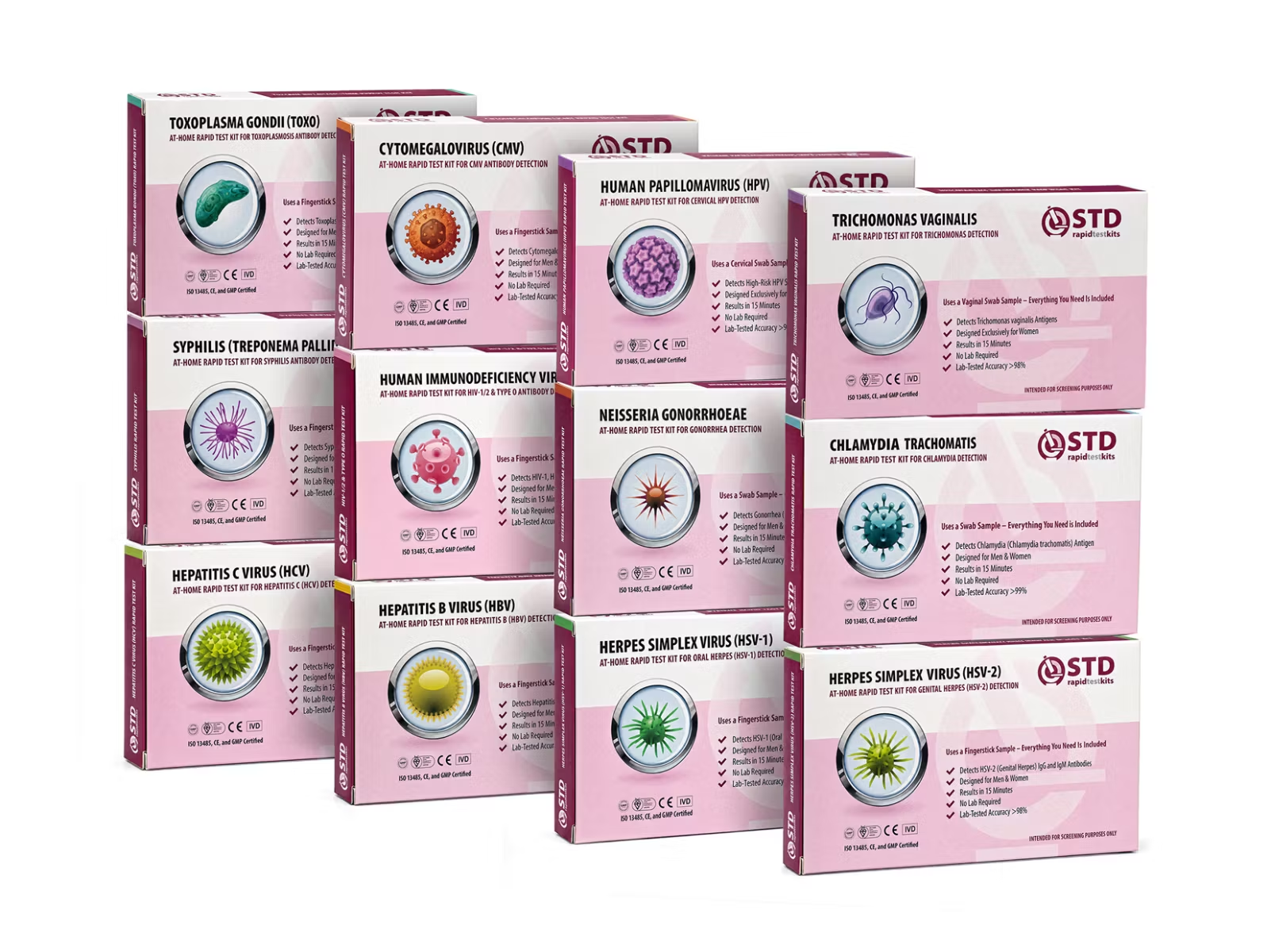
Disclosure: stdrapidtestkits.com sells at-home STI rapid test kits. The kit shown below this section is one of our products; we recommend it because the panel covers the most common bacterial and viral STIs discussed in this article, not because it carries any commercial benefit beyond that.
We are currently down to one last recommended and effective class of antibiotics, cephalosporins, to treat this common infection.

Symptoms Women Often Notice Before Testing
Many of the symptoms that lead a woman to wonder "can I just take amoxicillin?" overlap with conditions that are not STIs at all. Burning during urination can mean chlamydia, gonorrhea, or a urinary tract infection. A change in vaginal discharge can mean trichomoniasis, gonorrhea, bacterial vaginosis, or a yeast infection. The overlap is real, and it is part of why guessing at treatment usually goes wrong.
The most common pattern that pushes women to look up amoxicillin is a few days of mild burning during urination paired with a small change in discharge. That pattern can come from any of the conditions above. Visual differences sometimes offer clues, but none are diagnostic on their own. The table below maps each symptom to its most likely causes; the gallery that follows shows what some of these patterns can look like on a clinical specimen swab.
| Symptom | What it can feel like | Possible causes |
|---|---|---|
| Burning during urination | Stinging or sharp irritation when urinating | Chlamydia, gonorrhea, urinary tract infection |
| Unusual discharge | Change in color (gray, yellow, green), thickness, or smell | Chlamydia, gonorrhea, trichomoniasis, bacterial vaginosis, yeast infection |
| Pelvic discomfort | Low abdominal pain, pressure, or pain with intercourse | Pelvic inflammatory disease, untreated chlamydia or gonorrhea, ovarian or uterine conditions |
| Bleeding between periods | Unexpected spotting or post-coital bleeding | Hormonal changes, cervical inflammation from chlamydia or gonorrhea, local irritation |
| Sores or bumps near the genitals | Painful or painless lesions, warts, ulcers | Herpes, syphilis, HPV |
What These Patterns Actually Look Like
Clinical reference photographs of four of the most common discharge patterns are below. None is diagnostic on its own, but they help illustrate how different the underlying causes can look when a clinician examines a sample. Two infections can produce visually similar discharge, and two visually different patterns can still both be STIs (or neither). Overlapping appearances are exactly why clinicians rely on the swab and blood result rather than the symptom picture alone.
What Happens If You Already Took Amoxicillin
A common scenario: a woman takes amoxicillin for a dental infection in March, has a possible STI exposure in April, and develops mild burning during urination in May. The natural question is whether the March prescription somehow covered the May infection.
It almost never does. Amoxicillin clears the body within hours of the last dose, and even when active in the system it does not reliably eradicate the bacteria that cause chlamydia or gonorrhea in non-pregnant adults. In some cases, the medication's anti-inflammatory effects or its action against unrelated bacteria can temporarily reduce symptoms, which is misleading. Symptoms can fade for a week or two and return when the underlying infection re-establishes itself.
If you took amoxicillin recently and now have symptoms that suggest an STI, the next step is testing, not another round of the same drug. The right antibiotic clears the infection in days; the wrong one wastes the window where treatment is simplest.
Amoxicillin can briefly reduce inflammation or affect unrelated bacteria, which sometimes causes STI symptoms to fade for days or weeks. When the underlying infection returns, the diagnosis has been delayed by exactly that long. If symptoms come back after a course of antibiotics taken for something unrelated, treat that as a reason to test, not a reason to wait it out.
Why Some Women Have No Symptoms at All
Asymptomatic infection is the norm rather than the exception for chlamydia and gonorrhea in women. The CDC's About Chlamydia page notes that most chlamydia infections in women do not cause symptoms, which is why annual screening is recommended for sexually active women under 25 and for older women with new or multiple partners.
Silent infection is also why a quiet recovery after an unrelated course of amoxicillin proves nothing. If the original infection was asymptomatic, no improvement could have been measured in the first place. If the antibiotic temporarily suppressed inflammation, the underlying infection could continue spreading without notice.
This is the strongest practical argument for testing on a schedule that matches your sexual activity, rather than waiting for symptoms to push you in the door. Annual testing remains the only reliable way to catch infection before it progresses.
The CDC reports that most chlamydia infections in women cause no symptoms at all. This is why annual screening is recommended for every sexually active woman under 25, and for older women with new or multiple partners, rather than only for those who notice something is wrong. (CDC, About Chlamydia)
When Testing Becomes the Next Step
Testing for the most common bacterial STIs in women is simpler than many people expect. In a clinical lab, the gold-standard method for chlamydia and gonorrhea is nucleic acid amplification testing (NAAT), which can be run on a self-collected vaginal swab or a first-catch urine sample.
Home rapid tests use lateral-flow immunoassay technology rather than NAAT. The advantages are speed (results read in about 15 minutes), privacy, and no clinic visit. The trade-off is sensitivity: home rapid tests are screening tools, and a positive result is worth confirming with a lab NAAT when possible.
For someone trying to decide whether last month's amoxicillin handled the problem, a home rapid test can answer the question in an afternoon. For someone with a specific exposure event, it is also worth noting that antibody-based tests (HIV, syphilis, hepatitis B, hepatitis C) need a window of about 3 to 12 weeks after exposure before a negative result is reliable.

Why Accurate Treatment Matters
Untreated bacterial STIs do not always announce themselves. They can persist quietly for months while bacteria move from the cervix to the upper reproductive tract. The CDC's STI Treatment Guidelines describe pelvic inflammatory disease as a common downstream consequence of untreated chlamydia and gonorrhea, with infertility and ectopic pregnancy among the long-term outcomes.
That is the practical cost of guessing with the wrong antibiotic. Even when symptoms fade temporarily, the underlying infection can continue progressing. The first-line treatments work because they actually clear the bacteria, not because they manage the symptoms.
Once a specific infection is identified, treatment is straightforward. Chlamydia clears in seven days on doxycycline. Gonorrhea clears with a single injection of ceftriaxone. Trichomoniasis clears in seven days on metronidazole. The catch is knowing which infection you have before starting the medication.
If untreated chlamydia or gonorrhea spreads from the cervix to the upper reproductive tract, it can cause pelvic inflammatory disease. PID is a leading preventable cause of infertility, ectopic pregnancy, and chronic pelvic pain in women. The right antibiotic, taken promptly, prevents that progression. (CDC STI Treatment Guidelines, 2021)
What To Do If You Think You Might Have an STD
If symptoms have appeared, if a partner has tested positive, or if there has been a possible exposure recently, three steps make the next few weeks much simpler.
1. Test, do not guess. A swab or fingerstick blood test can identify the most common bacterial and viral STIs in one sitting. Home rapid tests give a result in about 15 minutes; clinic NAAT tests take 1 to 3 days.
2. Wait for the window. Antibody tests for HIV, syphilis, hepatitis B, and hepatitis C need at least 3 to 4 weeks (and sometimes up to 12 weeks) after possible exposure to be reliable. Chlamydia and gonorrhea swabs are accurate from about day 7 onward. If you test too early and the result is negative, retest after the appropriate window has passed.
3. Get the right prescription. Whatever the test result, the treatment will be specific to the organism. For bacterial STIs in non-pregnant women, that almost never means amoxicillin.
Next-step checklist
- Test, do not guess: a swab or fingerstick test can identify the most common bacterial and viral STIs in one sitting.
- Wait for the window: antibody tests need 3 to 12 weeks after possible exposure to be reliable; swabs for chlamydia and gonorrhea are accurate from about day 7.
- Get the right prescription: bacterial STIs need a specific antibiotic, which for non-pregnant women almost never means amoxicillin.
FAQs
- I took amoxicillin last month for a sinus infection. Could it have cleared an STI too?
- Almost certainly not. Amoxicillin's only recommended STI role is as an alternative for chlamydia during pregnancy when azithromycin is not tolerated. For everyone else, it is not the recommended treatment for any common STI, and for gonorrhea it is reliably ineffective because of widespread resistance.
- Why doesn't amoxicillin work for gonorrhea?
- Gonorrhea has progressively developed resistance to penicillin-class antibiotics over the past several decades. The CDC currently recommends a single 500 mg ceftriaxone injection because it is the last antibiotic class that reliably clears the infection across most circulating strains.
- Do antibiotics cure all STDs?
- Only bacterial and parasitic ones. Chlamydia, gonorrhea, syphilis, and trichomoniasis are curable with the right antibiotic. Viral STIs like herpes, HPV, and HIV need antivirals, vaccines, or long-term management instead, not antibiotics.
- My symptoms got better after a few days of amoxicillin. Doesn't that mean it worked?
- Not necessarily. Amoxicillin can reduce inflammation or temporarily affect unrelated bacteria, which can mask STI symptoms without clearing the underlying infection. If symptoms return, if you have a new partner, or if a previous partner tests positive, the infection may still be there and warrants testing.
- What is the recommended treatment for chlamydia in non-pregnant women?
- A seven-day course of doxycycline is the standard approach: 100 mg by mouth, twice daily. If doxycycline cannot be tolerated, a single 1 g azithromycin dose is the main alternative. Both clear chlamydia more reliably than amoxicillin in non-pregnant adults.
- Can a woman have an STI with no symptoms at all?
- Yes, and it is common. Most chlamydia infections in women cause no symptoms, and gonorrhea is also frequently silent. This is why the CDC recommends annual screening for sexually active women under 25 rather than waiting for something to feel wrong.
- How soon after possible exposure can I test reliably?
- Chlamydia and gonorrhea swabs are accurate from about day 7 onward. Antibody tests for HIV, syphilis, hepatitis B, and hepatitis C need a longer window, typically 3 to 12 weeks depending on the test and the infection. If you test too early and get a negative result, retest after the appropriate window has passed.
- Should I keep taking leftover antibiotics if I think I have an STI?
- No. Taking the wrong antibiotic can mask symptoms without clearing the infection, delay proper treatment, and contribute to broader antibiotic resistance. A targeted test plus a targeted prescription is shorter, cheaper in the long run, and far more likely to work.
How We Sourced This Article: Treatment recommendations come from the CDC's 2021 Sexually Transmitted Infections Treatment Guidelines, supplemented by the CDC's About Chlamydia page and the CDC's Drug-Resistant Gonorrhea clinical guidance. Pregnancy-specific guidance is drawn directly from the CDC's chlamydia treatment section. Resistance history and the cephalosporin pull quote are sourced verbatim from the CDC's drug-resistant gonorrhea page. Global classification framing comes from the World Health Organization's STI fact sheet. Where the article references home rapid testing, we describe lateral-flow immunoassay technology accurately and distinguish it from laboratory NAAT testing. We do not provide personal medical advice; readers with symptoms or exposure concerns should test or consult a clinician.
- U.S. Centers for Disease Control and Prevention. Sexually Transmitted Infections Treatment Guidelines, 2021. Source for first-line antibiotic regimens for chlamydia, gonorrhea, syphilis, and trichomoniasis, and for the pregnancy exception that lists amoxicillin as an alternative for chlamydia.
- U.S. Centers for Disease Control and Prevention. About Chlamydia. Source for the prevalence of asymptomatic chlamydia infection in women and for annual screening recommendations.
- U.S. Centers for Disease Control and Prevention. Drug-Resistant Gonorrhea (HCP). Source for the cephalosporin-as-last-effective-class claim and the resistance-history narrative, including the verbatim pull quote used in this article.
- World Health Organization. Sexually Transmitted Infections (STIs) Fact Sheet. Source for the bacterial / viral / parasitic classification framework and the global picture of STI prevalence.
- Mayo Clinic. Sexually Transmitted Diseases (STDs) Symptoms and Causes. Source for symptom-overlap patterns between STIs and non-STI conditions like UTI and yeast infection.
- MedlinePlus (U.S. National Library of Medicine). Sexually Transmitted Diseases overview. Source for the patient-facing summary distinguishing bacterial, viral, and parasitic STIs.
