Published: October 2025 | Last updated: May 2026 | Editorial review and quality control: Martina N.
Travel disrupts routines. Sleep schedules shift, alcohol intake climbs, time zones blur, and unfamiliar places make new connections feel less consequential than they really are. The result is a window where new sexual exposures become more common and existing infections are easier to ignore. A short test before and after a trip is one of the most practical ways to keep yourself, and the people you'll see next, protected from infections that often carry no symptoms at all.
Key Takeaways
- The CDC's Yellow Book lists casual sex during travel as a recurring source of new infections; a short test before and after a trip catches both what you may already carry and what you may have picked up.
- At-home rapid kits are useful for screening within the right window periods, but a positive home result should be confirmed by a clinic NAAT or lab antibody test before any treatment decision.
Why Travel Raises Your STI Exposure
Travel quietly sets up conditions that raise STI risk. The CDC's Yellow Book chapter on sex and travel notes that sexual contact during international trips is one of the underrecognized sources of new infections, particularly among young adults and travelers who are alone or in unstructured group settings (CDC Yellow Book, Sex and Travel). The mechanics behind that observation are familiar.
Drinking pushes inhibition lower. Lack of sleep makes choices feel more abstract than they really are. New partners may have a different STI prevalence than the people you usually see at home. The practical barriers to using condoms or asking about status climb sharply when you do not share a language, a city, or any plan to see this person again. Add a hostel bed, a delayed flight, a reunion at a wedding, and the tally of small frictions that usually keep risky encounters in check is gone.
None of this turns travel sex into a moral failure. It just makes routine testing before and after a trip more useful than it would be in your usual life. Many STIs detected through screening would not have been caught by symptoms alone. The CDC notes that asymptomatic infection is common across chlamydia, gonorrhea, and HIV, particularly in their early weeks (CDC, Getting Tested for STIs).
Per the CDC Yellow Book chapter on sex and travel, between 20 and 34 percent of male international travelers report casual sex abroad, and roughly half of those encounters involve no condom use (<a href="https://www.cdc.gov/yellow-book/hcp/travel-for-work-other/sex-and-travel.html" target="_blank" rel="noopener">CDC Yellow Book, Sex and Travel</a>). Those numbers are why pre- and post-trip screening is part of the standard travel-health checklist, not an overcautious add-on.
What to Test for Before You Leave
Pre-trip testing serves two purposes. The first is honest curiosity about what you may already be carrying. Many infections are asymptomatic in early stages, and a short test gives you accurate information about your body before you potentially share it with someone new. The second is timing. If you test positive for chlamydia or gonorrhea two weeks before a trip, you have time to start antibiotics, complete a course, and clear the infection before you board.
The infections worth screening for in a pre-trip panel are the ones with the highest at-home detectability and the most common asymptomatic carriage: chlamydia, gonorrhea, HIV, syphilis, and the hepatitis B and C viruses. Some travelers add herpes antibody testing, particularly when entering a new long-term relationship and wanting a baseline.
The right test for you depends on when your last potential exposure was. If your last unprotected encounter was within the past week, certain tests will not yet pick up the infection because the body has not produced detectable antibodies or antigens. The window-period guidance in the table below is calibrated to standard CDC and FDA references for the rapid lateral-flow test technologies used in our home kits.
| Infection | Earliest reliable detection from exposure | Confirm at |
|---|---|---|
| Chlamydia (rapid genital swab) | About 7 to 14 days after exposure | 14 days for routine screening |
| Gonorrhea (rapid genital swab) | About 7 to 14 days after exposure | 14 days for routine screening |
| HIV (antigen/antibody) | Around 18 to 90 days for a home rapid test; 18 to 45 days for a laboratory test | 90 days for a home rapid antigen/antibody test; 45 days for a laboratory antigen/antibody test |
| Syphilis (antibody) | About 3 to 6 weeks after exposure | 12 weeks to fully rule out |
| Hepatitis B (surface antigen) | About 3 to 6 weeks after exposure | 9 weeks for routine screening |
| Hepatitis C (antibody) | About 8 to 11 weeks after exposure | 12 weeks for routine screening |
After the Trip: When Testing Actually Catches Things
Post-trip testing is where the real catch rate lives. If anything happened on your trip, oral, vaginal, anal, or even prolonged skin-to-skin contact, the question becomes when to test, not whether. Testing too early gives a false sense of security because the infection has not had time to reach detectable levels yet. Testing too late lets a treatable infection turn into something that affects fertility, transmission to a new partner, or both.
For most bacterial infections, the practical sweet spot is around 14 days after potential exposure. Chlamydia and gonorrhea are reliably detectable by then with a swab-based rapid test. For HIV, a laboratory antigen and antibody test reaches strong sensitivity around 45 days after exposure. A home rapid antigen and antibody test, the type used in at-home kits, may need the full 90-day window for reliable ruling-out per CDC guidance (CDC HIV Testing).
Syphilis sits in between. Antibody tests typically detect it from about 3 weeks but do not reach full reliability until around 12 weeks. If you had a high-risk exposure during travel, the safest sequence is a 14-day test for the bacterial infections, followed by a second test at 4 to 6 weeks for syphilis and a 90-day recheck for HIV with a home rapid kit. Hepatitis B and C take longer still, and a 12-week recheck is reasonable when your exposure included blood contact, shared needles, or genital piercings done abroad.
How soon after a trip should I test for STIs?
For chlamydia and gonorrhea, around 14 days after potential exposure gives reliable detection on a rapid swab test. For HIV, a home rapid antigen and antibody test reaches reliable ruling-out at 90 days; a laboratory antigen and antibody panel reaches strong sensitivity at 45 days. For syphilis, plan a recheck at 4 to 6 weeks. If your exposure was within the last week and you have symptoms, see a clinician sooner; testing before the window opens may produce a false-negative result.
What At-Home Kits Cover, and What They Do Not
Honest framing matters here. The kits sold on this site, and most reputable at-home STI tests, are rapid lateral-flow tests. They use the same sample types as standard lab tests, swab for chlamydia and gonorrhea, fingerstick blood for HIV, syphilis, hepatitis, and herpes, but laboratories use higher-sensitivity NAAT or PCR methods on their end. That means a home rapid kit performs well for screening within the right window, while a positive home result is worth confirming with a clinic NAAT or repeat lab antibody test before any treatment decision.
What we do not sell, and what some travel exposures genuinely call for: pharyngeal swabs (for throat gonorrhea or chlamydia after oral sex), rectal swabs (for anal exposure), and urine-based NAAT panels. If your trip included receptive oral or anal sex with a partner of unknown status, a clinic visit for a multi-site swab panel is the medically right move. Our at-home swab kits are validated for genital sample collection only.
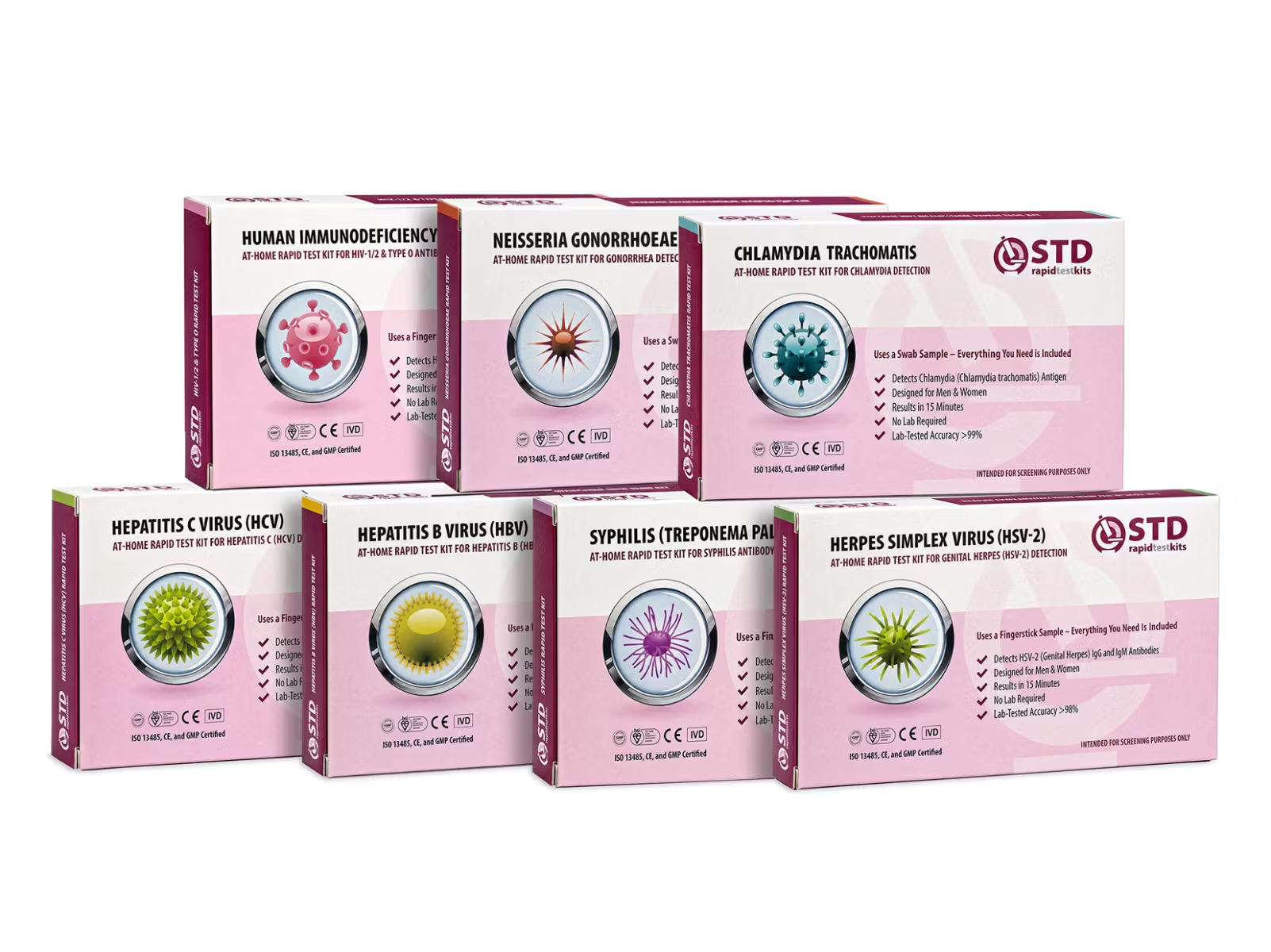
For a typical pre-trip and post-trip routine, our combination kits are designed to cover the most commonly screened infections in one box. The 7-in-1 includes the bacterial swabs alongside the bloodwork for HIV, syphilis, and hepatitis. The 8-in-1 covers an additional infection layer for travelers wanting broader coverage and is validated for both men and women. Both ship in plain unmarked packaging and produce results in roughly 15 minutes per test strip.
This article is published by stdrapidtestkits.com, which sells at-home STI test kits. We recommend products only when they fit the reader's actual need. The information here is general guidance, not a clinical diagnosis. For symptoms or exposures you are unsure about, see a licensed clinician.
Building Testing Into a Travel Ritual
The cleanest version of this is mechanical. About a week before you fly, you take a baseline test. About two to four weeks after you return, depending on what happened on the trip, you take a second test. With at-home kits, both tests fit in roughly 30 minutes of your time on each end. If you prefer a clinic, schedule the second appointment when you book your return flight, and write the test date into the same calendar where the trip lives.
For travelers who fly often or who reunite with a regular partner after time apart, a small pre-trip test before each significant exposure can replace a lot of vague reassurance with real data. Couples who travel separately frequently work this into their reunion routine: both partners do a simple panel before they spend time together, and both feel calmer for it. Nothing in that workflow assumes anyone has done anything wrong; it is the same logic as wearing a seatbelt before any drive, regardless of whether you expect a collision.
If You Test Positive While Traveling
A positive at-home test is not a final diagnosis. Lateral-flow rapid kits like the ones we sell are designed for screening, with a confirmatory lab test as the standard next step (CDC, Getting Tested for STIs). For bacterial infections, that confirmation is a clinic NAAT. For HIV, it is the standard antigen and antibody panel followed by a Western blot or HIV-1 differentiation assay if positive.
While you are still abroad, you have options. Most major cities have urgent care clinics, public health centers, or sexual health services with same-day testing and treatment. Telehealth services covering U.S. residents abroad can sometimes prescribe antibiotics for confirmed bacterial infections, and pharmacies in many countries dispense common STI antibiotics with a local consultation. The most important step, regardless of geography, is to stop having unprotected sex until the result is confirmed and, where appropriate, treated.
If the rapid result is HIV-positive, do not start any medication on the basis of that result alone. The standard pathway is a confirmatory antigen and antibody panel at a clinical laboratory, followed by a clinician conversation about treatment options. The U.S. CDC information line at 1-800-CDC-INFO can connect you to local resources whether you are home or abroad.
CDC travelers' health guidance notes that travelers who have sex with new partners abroad face elevated STI risk, and that many infections produce no symptoms in their early weeks (<a href="https://www.cdc.gov/yellow-book/hcp/travel-for-work-other/sex-and-travel.html" target="_blank" rel="noopener">CDC Yellow Book, Sex and Travel</a>; <a href="https://wwwnc.cdc.gov/travel/page/std" target="_blank" rel="noopener">CDC Travelers' Health, Sexually Transmitted Infections</a>). Testing before and after travel is the most reliable way to know your status when symptoms cannot be relied on as a signal.
Talking to Partners About Testing After a Trip
The best time to talk about testing is before there is any pressure on the conversation. After a trip, before reunion sex with a partner who stayed home, the simplest framing is the truest one: 'I traveled and I want both of us to be safe, so I tested when I got back, and I have results.' Most partners receive that as care. The few who do not are telling you something useful about themselves.
For new partners met during a trip, a similar approach works in reverse. If the connection might continue, pre-emptively offering to test together before the next time you see each other normalizes testing as part of dating, not as a panic response. CDC guidance recommends that travelers who form sexual connections abroad disclose those exposures to providers and partners back home (CDC Yellow Book, Sex and Travel). Disclosure becomes far easier when testing is already part of the routine.
If you tested positive, the conversation gets harder, but the script stays simple: 'I tested positive for X. Most cases are treatable. I wanted to tell you so you can also test if you want to. I am sorry, and I want to be honest.' That is the entire script. The other person's reaction is theirs, but the disclosure is the right thing on your side.

FAQs
- How soon after returning from a trip should I get tested?
- Two weeks covers the bacterial infections: chlamydia and gonorrhea are reliably detectable by day 14 on a rapid swab test. Layer in a 4 to 6 week syphilis test for full post-trip coverage. For HIV, plan a 90-day recheck when using a home rapid antigen and antibody test, or 45 days when using a laboratory antigen and antibody panel. If you have symptoms before any window opens, see a clinician without waiting.
- I used condoms throughout the trip. Do I still need to test?
- Condoms substantially reduce risk for fluid-borne infections like HIV, gonorrhea, and chlamydia. They offer less protection against skin-to-skin infections like herpes and HPV, and they offer no protection at all if oral sex was unprotected. A test after a trip with new partners is still the most reliable way to know your status.
- Can your at-home kits detect throat or rectal infections?
- No. Our rapid kits are validated for genital sample collection (vaginal or penile swab) and fingerstick blood. If your trip included receptive oral or anal sex and you are concerned about pharyngeal or rectal infection, a clinic visit for a multi-site swab panel is the medically appropriate route.
- What if my partner tested negative? Can I skip my test?
- Your own test reflects your own exposure window and timing. A partner may have tested before their own window closed, and exposures during travel are individual events. Test based on your own potential contact, regardless of what a partner's result shows.
- Are at-home rapid tests as accurate as lab tests?
- For their intended use of screening, rapid lateral-flow tests perform well within their window periods. Labs use NAAT and PCR methods that have higher analytical sensitivity than rapid tests. For any positive home result, a clinic-confirmed lab test is the next step before treatment. A negative home test within the appropriate window is reassuring, but no test is absolute.
- What if I test positive while still abroad?
- Stop unprotected sex until you have a confirmed result. Most major cities have urgent care or sexual health clinics with same-day testing. Telehealth services can sometimes provide guidance and prescriptions for U.S. residents traveling. For an HIV-positive result on a home test, do not start medication until a confirmatory lab test is complete.
- How private is the home test if I share my address?
- Our kits ship in plain unmarked packaging with no medical or brand language on the outside. Tracking labels do not reveal contents. Testing happens privately at home and produces results in roughly 15 minutes per strip. Results are not transmitted anywhere unless you choose to share them.
- Do I need a baseline test before a trip if I have not had sex in months?
- If you are confident in your last test result and have had no exposure since, a pre-trip baseline is optional rather than essential. Travelers reuniting with a partner after time apart often choose to test anyway as a clean baseline before the trip. The benefit is calmer testing on the post-trip end, when timing actually matters.
How we sourced this article: We combined current public-health guidance from the CDC's Yellow Book and Travelers' Health pages with the CDC's general STI testing guidance, then translated the window-period and test-technology details into plain-English action items. The information here is general guidance, not a clinical diagnosis. For symptoms or exposures that concern you, see a licensed clinician.
- U.S. Centers for Disease Control and Prevention. CDC Yellow Book chapter on sex and travel, including STI risk factors and pre-travel counseling.
- U.S. Centers for Disease Control and Prevention. CDC Yellow Book chapter on the pre-travel consultation.
- U.S. Centers for Disease Control and Prevention. Getting tested for STIs, including window-period guidance for common infections.
- U.S. Centers for Disease Control and Prevention. HIV testing information, including window periods for laboratory and rapid antigen and antibody tests.
- U.S. Centers for Disease Control and Prevention. Travelers' Health information on sexually transmitted infections and travel.
- World Health Organization. Sexually transmitted infections fact sheet.
