How Accurate Are At-Home Syphilis Rapid Tests Compared With a Lab Test?
A syphilis rapid test and a lab test can look at the same antibodies and still answer different questions. This guide sets the manufacturer's figures beside what lab testing adds: staging, false-positive checks and treatment tracking. It also covers what a positive or a negative from a fingerstick test can and cannot tell you, and the cases where a clinic is the better first stop.
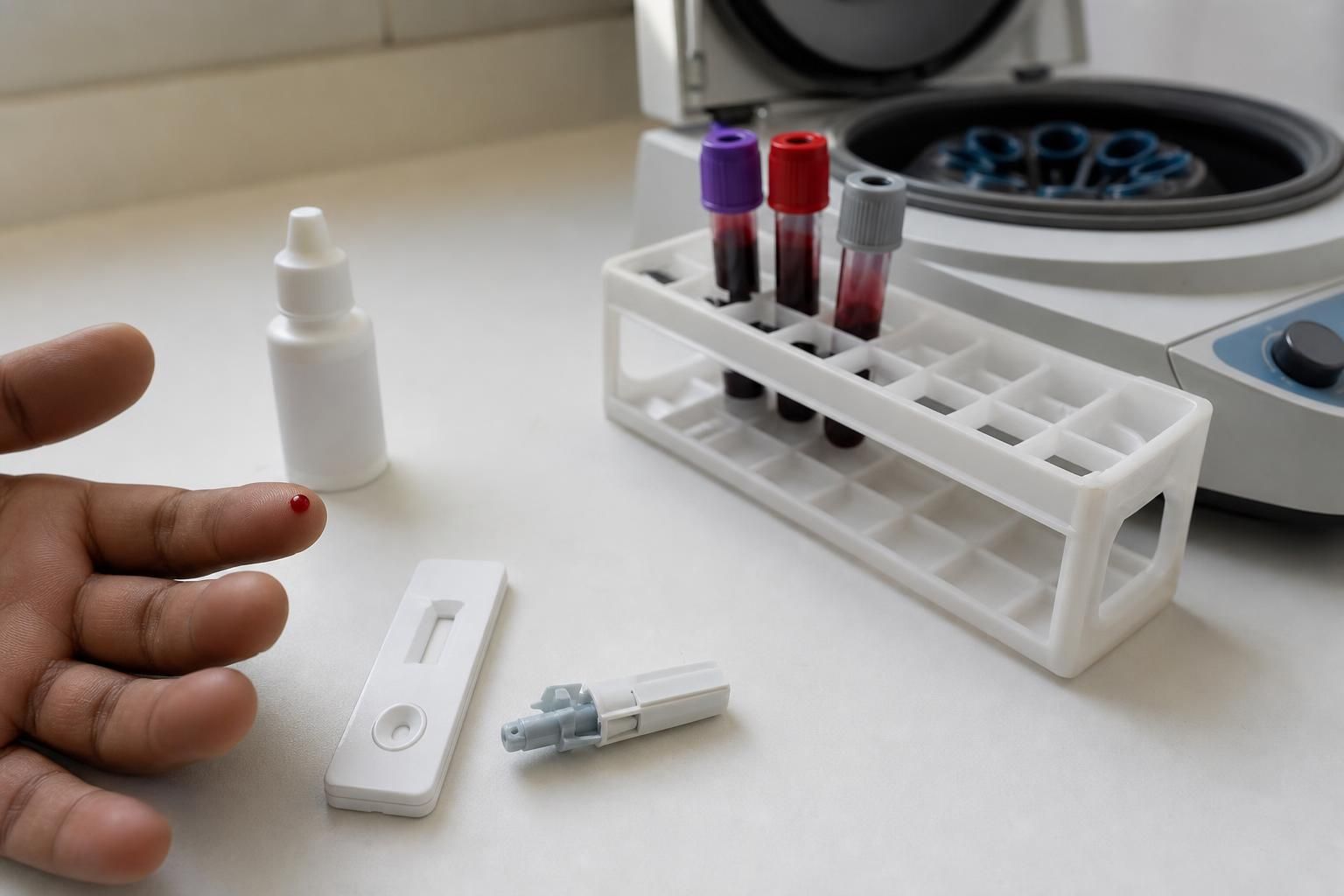



- A syphilis rapid test detects treponemal antibodies, which usually stay positive for life, so a positive cannot tell a new infection from one cured years ago.
- A lab adds a second blood test (RPR or VDRL) that, together with your history and an examination, helps confirm the result, judge the stage and follow treatment.
Published: October 2026 | Last updated: October 2026 | Editorial review and quality control: Martina N.
How accurate is an at-home syphilis rapid test compared with a lab test?
The manufacturer's figures for our kit, measured on clinic-collected specimens against a lab treponemal assay, are high (99.5% sensitivity, 99.3% specificity), but field studies of another rapid syphilis test found lower sensitivity. It also answers a narrower question than lab testing: it cannot tell a current infection from a treated one, stage it or track treatment. A positive needs lab confirmation; a negative before 12 weeks is provisional.
A syphilis rapid test and a syphilis lab test usually measure the same thing: antibodies the immune system makes against Treponema pallidum, the bacterium that causes syphilis. The difference is what happens next. A lab never relies on a single antibody result. It pairs two different kinds of blood test, and that pairing, read together with your history and an examination, is what lets a clinician judge whether an infection is new, old, treated or still active.
That makes the usual "which is more accurate?" question a little lopsided for syphilis. Our general guide to rapid STD test accuracy versus lab testing explains sensitivity and specificity across infections. This article covers what is specific to syphilis: what the lab's two-step method adds, what the published figures for rapid tests show, and how to read a home result, including the common case of a positive that reflects an infection you already treated.
What a lab means by "a syphilis test"
In a lab, syphilis testing is a sequence of two tests. The CDC's treatment guidelines state that a presumptive diagnosis "requires use of two laboratory serologic tests": a nontreponemal test, the RPR (rapid plasma reagin) or VDRL, and a treponemal test, such as TP-PA, an enzyme or chemiluminescence immunoassay, or a rapid treponemal assay (CDC STI Treatment Guidelines, syphilis). Relying on only one type, the same page warns, can produce false negatives in primary syphilis and false positives in people who never had it or were treated before.
The two test types do different jobs:
- Treponemal tests detect antibodies aimed at the bacterium itself. They are specific to syphilis, but in most people they stay reactive for life. The CDC notes that 15–25% of people treated during the primary stage become nonreactive again after 2–3 years.
- Nontreponemal tests (RPR, VDRL) detect a broader antibody response to tissue damage caused by the infection. They are reported as a titer, a dilution such as 1:16, that tends to rise with active disease and fall after treatment. That is why clinicians use them to monitor treatment response.
Nontreponemal tests have weaknesses of their own. The CDC's 2024 laboratory recommendations estimate that "biologic false positive" reactions, caused by conditions other than syphilis, occur in 0.2–0.8% of the population. Other infections, recent vaccinations, injection drug use and autoimmune conditions can all trigger them (CDC Laboratory Recommendations for Syphilis Testing, 2024). Labs may run the tests in either order, starting with the RPR (the traditional algorithm) or with an automated treponemal assay (the reverse algorithm). Either way, a reactive first test is followed by the other type.
Rapid test and lab, side by side
Almost every syphilis rapid test, including fingerstick home kits, is a treponemal test. It does the same job as the treponemal half of the lab sequence, on a drop of capillary blood and with no instrument. The World Health Organization notes that rapid tests "can provide results in minutes, facilitating immediate treatment initiation" (WHO syphilis fact sheet). Speed is the real advantage. What is missing is the second test, plus anything that requires examining a sore.
The table compares the three main ways syphilis is tested. The third column, testing fluid from a sore, matters most for very early infection, covered further down.
At-Home Rapid Test vs Lab Blood Testing vs Testing a Sore
| Feature | At-home rapid treponemal test | Lab two-step blood testing | Clinic test of a sore (darkfield or PCR) |
|---|---|---|---|
| What it detects | Treponemal antibodies only | Treponemal antibodies plus nontreponemal (RPR/VDRL) antibodies | The bacterium itself, in fluid from a lesion |
| Sample | Fingerstick whole blood | Venous blood draw | Swab or fluid from an open sore |
| Time to result | Minutes, at home | Usually days, through a clinic or lab | Same day (darkfield) to days (PCR), specialist labs only |
| Tells new from previously treated infection | No | Yes, with history and RPR titer | Shows current infection at that sore |
| Stages infection or tracks treatment | No | Contributes, with RPR titers over time and the clinical picture | No |
| Very early primary syphilis | May still be negative | May still be negative | Can be positive before antibodies appear |
| Best fit | Private screening with no symptoms and no past syphilis | Confirming a positive, past syphilis, pregnancy, follow-up | A sore you can see now |
A rapid test covers the screening step. Confirming, staging and follow-up need the lab.
What the accuracy figures show
Accuracy figures for syphilis rapid tests come from studies that compare the rapid test with a lab treponemal test on the same people. For our at-home syphilis test, the manufacturer's package insert reports 99.5% sensitivity and 99.3% specificity (99.4% overall agreement) against TPHA, a laboratory treponemal assay. Three qualifiers come with those numbers. The figures come from clinic-collected specimens, not from people testing themselves at home. The kit is intended for fingerstick whole blood according to the manufacturer's instructions, and the manufacturer publishes no figure for home-read results. And it is a preliminary screening test, so its result is a starting point, not a diagnosis.
Results on stored samples in a lab and results in the field can differ a lot. A 2020 meta-analysis of a different product, the Syphilis Health Check rapid treponemal test, found pooled sensitivity of 98.5% in laboratory evaluations on stored serum but 87.7% in prospective studies. Pooled specificity was 95.9% and 96.7% (Bristow et al., Clinical Infectious Diseases, 2020). The authors linked the gap partly to training and quality monitoring, and noted that testing whole blood instead of serum may also have contributed. Those numbers belong to that assay, not ours. They show how performance measured on stored samples can drop when the same test is run in real conditions.
Sensitivity is the share of people with antibodies whom the test flags as positive. Specificity is the share of people without antibodies whom it correctly reports as negative. A single "accuracy" figure blends the two and hides which kind of error a test makes. Neither figure tells you directly how likely your own result is to be right. That also depends on how common syphilis is among people like you, covered in the next section.
Reading a positive result
A reactive rapid test means treponemal antibodies were detected. There are three main reasons that can happen, and the test cannot tell them apart.
A current infection. This is the reason you test. It needs a clinician, lab confirmation and treatment, usually penicillin.
A past infection that was treated. When the FDA authorized a different product, the first over-the-counter syphilis antibody test, in 2024, it stated plainly that results "will be positive for individuals previously diagnosed with syphilis, even if they were successfully treated" (FDA news release, August 2024). The same applies to any treponemal rapid test. If you have had syphilis before, a home antibody test cannot detect reinfection. Your clinic tracks that with RPR titers, and the NHS describes several retests in the first 12 months after treatment (NHS: Syphilis).
A false positive. With a 99.3% specificity, false positives are uncommon in any one person. Across many people tested, though, they add up. Here is a worked illustration using the insert figures and an assumed prevalence, not data from any real group: if 1 in 100 people tested had treponemal antibodies from a current or past infection, then out of 1,000 tests about 10 would be true positives and about 7 false positives. Roughly 6 in 10 positives would be real. Under a further assumption of 1 in 10, about 94% of positives would be real. Real-world figures could be less favorable than these insert-based ones, and even a true positive does not say whether the infection is current or past; only a clinician, using both lab tests together with your history, can separate the two. That is why every positive goes to a clinician, and why the FDA calls a home antibody result alone "not sufficient to diagnose syphilis infection."
Treponemal antibodies generally persist after treatment and cannot be used to distinguish between a current infection or a previously treated infection.
Reading a negative result, and why timing matters
A negative rapid test is reliable only if your body has had time to make antibodies. Primary syphilis "often appears about 3 weeks after exposure, with an incubation period of 10–90 days," according to the CDC's 2024 laboratory recommendations. The same document warns that both test types "might not yet be reactive in certain persons with primary syphilis, particularly those with very recently appearing lesions." A lab blood test has the same blind spot early on, so going to a lab instead does not solve this.
The manufacturer's product information for our kit, as recorded in our catalog, gives a detection window of 3–6 weeks after exposure. A negative earlier than 12 weeks after your last exposure is provisional; the manufacturer's product information advises retesting at 12 weeks. A negative at or after 12 weeks, with no new exposure since, is far more reassuring, though no screening test can rule infection out completely.
If a sex partner has been diagnosed with syphilis, contact a clinician now rather than waiting to retest. The CDC advises presumptive treatment for people exposed within 90 days before a partner's diagnosis of primary, secondary or early latent syphilis, even when their own tests are negative (CDC STI Treatment Guidelines).
If you can see a sore now, skip the home test as a first step. The painless chancre of primary syphilis is easy to miss, and it heals on its own in 3 to 6 weeks whether or not it is treated (CDC: About Syphilis). Healing does not mean the infection is gone. The CDC guidelines describe darkfield microscopy and molecular tests of lesion fluid as "the definitive methods for diagnosing early syphilis." Those are clinic and specialist-lab tests, not something any home kit does.
When a Syphilis Antibody Test Becomes Reliable
- Day 0 Exposure
No antibodies yet; any test now is too early
- Week 3 Sore often appears
Antibody tests may still be negative; a sore needs a clinic test
- Week 6 Manufacturer's detection window ends
Manufacturer's product information: antibodies detectable from 3–6 weeks
- Week 12 Retest point
A negative here, with no new exposure, is much more reassuring
Incubation ranges from 10 to 90 days (CDC). The 3–6 week and 12-week points come from the manufacturer's product information for our kit.
When a home test fits, and when to start at a clinic
Screening matters because syphilis often causes no noticeable symptoms. The WHO estimates that 8 million adults aged 15 to 49 acquired syphilis worldwide in 2022 and advises people at higher risk to test at least once a year. In the United States, reported cases rose 80% between 2018 and 2022, according to CDC data cited by the FDA.
A home rapid test is a reasonable first step if all of these apply:
- You have no sore, rash or other symptoms.
- You have never been diagnosed with or treated for syphilis.
- You are not pregnant. Prenatal syphilis screening belongs with your prenatal care.
- Your last possible exposure was at least 6 weeks ago, and no partner has been diagnosed with syphilis.
In that situation its strengths are real: a result in private, no appointment, and a flat kit price instead of a visit plus lab fees. If any item on the list does not apply to you, go to a clinic first. In the UK, NHS sexual health services test for free. Our guide to how home syphilis test kits work covers the fingerstick steps and how to read the result window.
This article is published by stdrapidtestkits.com, which sells at-home STI testing kits.
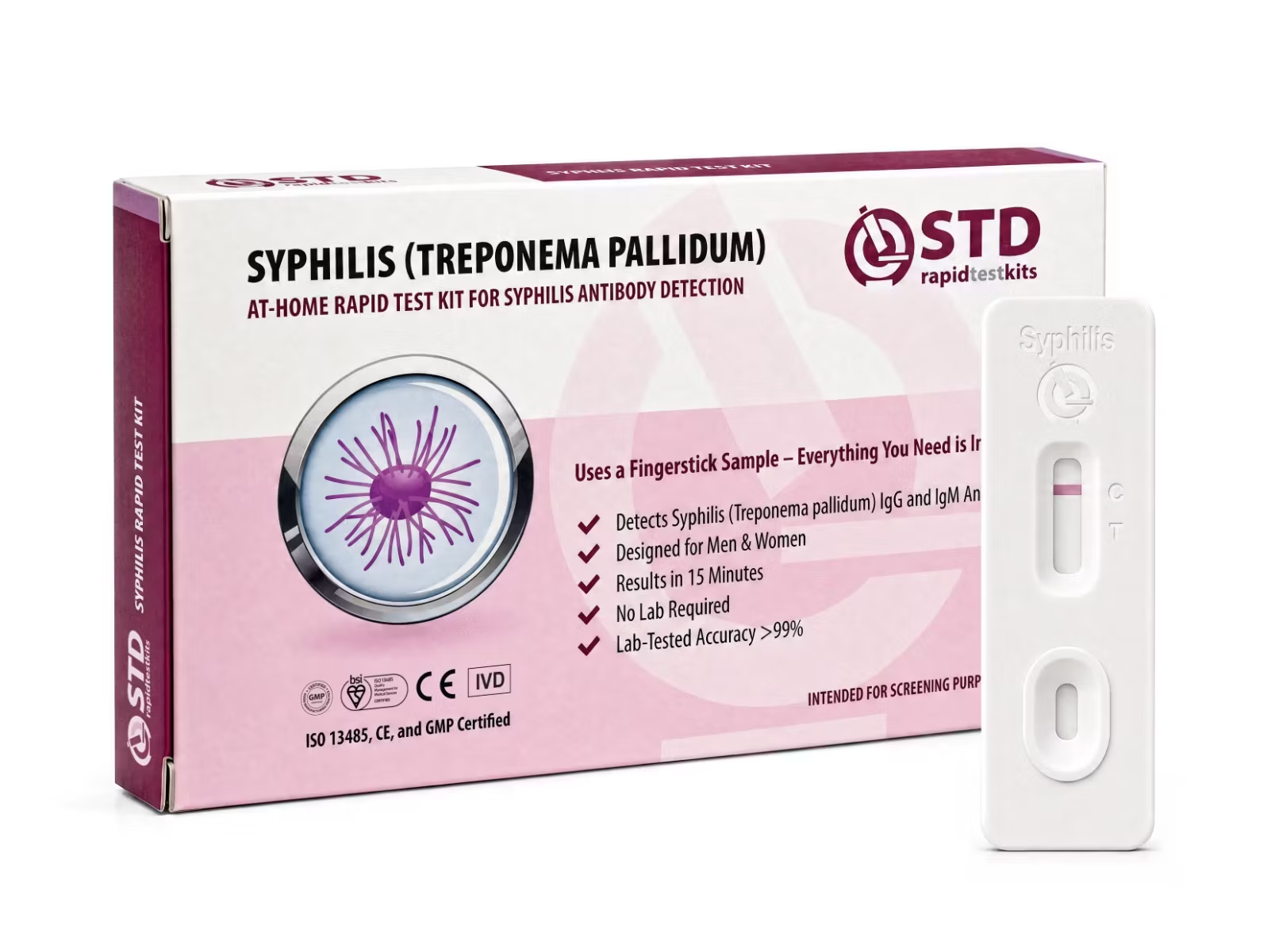
Turning a result into a next step
Which step applies depends on your result, how long ago your last exposure was, and whether you have had syphilis before.
This article summarizes current guidance from the U.S. Centers for Disease Control and Prevention (CDC), the World Health Organization (WHO), the NHS and the U.S. Food and Drug Administration (FDA) and the other sources listed below. Each specific figure or recommendation links to the page that states it, and every page used is listed under Sources with what it supports. It is general health information written by our editorial staff, not a diagnosis or a treatment plan; how we choose topics and use sources is described in our editorial policy.
- U.S. Centers for Disease Control and Prevention. Sexually Transmitted Infections Treatment Guidelines: Syphilis (last reviewed October 2024). Two-test serologic diagnosis, treponemal reactivity persisting for life and 15–25% reversion after primary-stage treatment, nontreponemal titers for monitoring, presumptive treatment of partners exposed within 90 days, and darkfield and molecular lesion testing as definitive methods for early syphilis.
- U.S. Centers for Disease Control and Prevention. Laboratory Recommendations for Syphilis Testing, United States, 2024 (MMWR Recomm Rep 73(1)). Biologic false-positive rate of 0.2–0.8% and its causes, traditional and reverse algorithms, treponemal antibodies not distinguishing current from treated infection, incubation of 10–90 days, and nonreactive serology in very early primary syphilis.
- U.S. Centers for Disease Control and Prevention. About Syphilis (January 2025). Painless sores that last 3 to 6 weeks and heal with or without treatment.
- World Health Organization. Syphilis fact sheet (May 2025). Rapid tests giving results in minutes, an estimated 8 million adult infections in 2022, and annual testing for people at higher risk.
- NHS. Syphilis (last reviewed March 2026). Clinic testing and repeat testing in the first 12 months after treatment.
- U.S. Food and Drug Administration. News release on marketing authorization of the First To Know Syphilis Test (August 16, 2024). Positive results after successful treatment, the need for confirmatory testing, and the 80% rise in U.S. cases from 2018 to 2022.
- Bristow CC, Klausner JD, Tran A. Clinical Test Performance of a Rapid Point-of-Care Syphilis Treponemal Antibody Test: A Systematic Review and Meta-analysis. Clin Infect Dis. 2020;71(Suppl 1):S52–S57. Pooled sensitivity of 98.5% in lab studies vs 87.7% in prospective studies for the Syphilis Health Check assay.