
Published: December 2025 | Last updated: May 2026 | Editorial review and quality control: Martina N.
At-home STD test kits work for trans women, and they work well, when the sample type matches the exposure and the timing matches the infection's window period. The kit itself does not care about gender identity. It cares about which body site to test, when to test it, and whether you collected the sample correctly.
This guide walks through how to choose a kit that fits your anatomy and behaviors, whether hormone therapy changes anything (it does not), what to do if a result comes back positive, and how to spot the timing mistakes that cause most false negatives. The aim is straightforward, affirming information you can act on without having to explain yourself to anyone.
At-home STD tests are reliable for trans women when three things line up: the right sample type for the exposure (swab, blood, or urine), the right timing relative to the window period, and proper sample collection. Hormone therapy, including estrogen and testosterone blockers, does not interfere with bacterial or viral detection.
Key Takeaways
- Choose your sample site by what kind of sex you had (oral, anal, frontal), not by the gender on your ID. The right swab in the right place is what determines accuracy.
- Hormone therapy does not affect STD test results. Test timing relative to the window period and proper sample collection are the two factors that actually drive whether a result is accurate.
Who This Guide Is For: Trans Women and At-Home STD Testing
Whether you are pre-op, post-op, or non-op, whether you have had one partner or many, whether you are navigating stealth, dating apps, long-term love, or a scare after a one-night stand, this article is for you. It is also for the trans women who have been misgendered at clinics, turned away from urgent care, or handed the wrong swab because someone assumed they knew your anatomy.
Accurate, affirming sexual-health testing is a basic part of body autonomy, not a luxury. If you have ever thought, "I want to take care of myself, but I do not trust the system to get me right," you are not alone. Testing is care. It is clarity. And it should work for your actual body and lived reality, not a checkbox on a form.
This guide is written for trans women across the full range of medical and relationship histories: pre-op, post-op (including vaginoplasty), or non-op; single, partnered, or casually dating; on estrogen and anti-androgen therapy or not. The sample-selection logic in this article is driven by your sexual behaviors, not by your surgical status or gender marker.
What At-Home STD Testing Tests For, and How It Works
At-home STD kits fall into two broad categories. Rapid lateral-flow tests give results at home in about 15 minutes from a fingerstick blood drop, and are used for blood-borne infections like HIV, syphilis, hepatitis B and C, and the herpes types. Mail-in NAAT (nucleic acid amplification test) panels use swabs or urine samples that you ship to a lab, and are used mainly for bacterial infections like chlamydia, gonorrhea, and trichomoniasis. Both formats can be accurate. Both can be used by trans women.
Here is the key point most kits do not say out loud: the test does not ask how you identify. It asks where on your body to look. A throat swab tests the throat. A rectal swab tests the rectum. A urine sample tests the urethra. A vaginal or front-hole swab tests that canal. The bacteria and viruses do not change based on the gender marker on your ID, so the matching sample type gives a clean answer regardless of how you describe yourself on a form.
| Test format | Sample needed | What it detects | Notes for trans women |
|---|---|---|---|
| Rapid fingerstick blood test | Fingerprick blood drop | HIV, syphilis, hepatitis B and C, HSV-1, HSV-2 | Accuracy is unaffected by hormones or surgical history |
| Mail-in NAAT lab panel | Urine, throat swab, rectal swab, or vaginal/front-hole swab | Chlamydia, gonorrhea, trichomoniasis | Choose sample sites by sex acts, not by gender identity |
| Rapid swab cassette | Self-collected genital swab | Chlamydia, gonorrhea (and HPV / trichomoniasis for women's vaginal-swab kits) | Match the swab to the body site exposed during sex |
On Hormones, Therapy, and Test Reliability
Estrogen does not change how STDs show up on tests. Neither does spironolactone, finasteride, or any other anti-androgen routinely used in feminizing hormone therapy. These medications act on the body's hormonal pathways. STD tests look for bacterial DNA, viral RNA, or antibodies the immune system produces in response to infection. Those are different biological systems, and they do not interact in a way that would generate a false positive or a false negative on a properly used kit.
What hormones can change is how some symptoms feel or look. Post-vaginoplasty healing can produce discharge variations that mimic infection. Estrogen-related changes in skin and mucosa may make irritation, dryness, or yeast overgrowth more common, and those can be mistaken for an STD symptom. Because hormonal context can muddy symptom interpretation, periodic testing on a fixed schedule (not symptom-driven testing alone) gives you the cleanest picture of what is actually happening. The CDC's STI screening guidance for trans and gender-diverse people emphasizes site-specific screening based on sexual practices, with at least annual testing recommended for sexually active adults and more frequent testing for anyone with new or multiple partners.
What hormones do and do not affect
- Do not affect: bacterial DNA detected by NAAT, viral RNA detected by NAAT, and antibody assay results from rapid fingerstick blood tests.
- Can affect: symptom presentation (discharge, irritation, mucosal changes), which is why symptom-only testing is unreliable for trans women on hormone therapy.
- Practical implication: stick to a fixed testing schedule based on partner exposure rather than waiting for symptoms to drive the decision.
When and Where to Swab: Real Talk for Real Bodies
If you have ever been handed a urine cup and told to "pee in this" even though your urethra was not involved in the sex you had, you already know the problem. Testing errors do not start in the lab, they start when the wrong sample type is used for the wrong exposure. A urine test will not catch a throat infection. A vaginal or front-hole swab will not catch a rectal infection. Understanding your exposure sites matters far more than what is listed on a form.
Rapid consumer kits, including the ones sold on this site, cover blood-based infections (HIV, syphilis, hepatitis, the herpes types) and genital-site swabs for chlamydia and gonorrhea. Dedicated throat (pharyngeal) and rectal swab testing is generally done through clinic-administered samples or mail-in NAAT lab panels from clinical providers, not as a rapid at-home cassette. If your exposure was oral or anal, plan on a clinic visit or mail-in NAAT panel for the site-specific swab, alongside whatever blood-borne screening you do at home.
Match the sample to the contact:
| If you had this kind of contact | Use this sample | Common infections detected |
|---|---|---|
| Receptive anal sex | Rectal swab (clinic or mail-in NAAT) | Chlamydia, gonorrhea |
| Receptive oral sex | Throat swab (clinic or mail-in NAAT) | Gonorrhea, chlamydia (less common at this site) |
| Insertive (penile) sex | Urine sample | Chlamydia, gonorrhea, trichomoniasis |
| Penetrative sex with a neovagina or front hole | Vaginal/front-hole swab | Chlamydia, gonorrhea, trichomoniasis |
| Shared toys, rimming, oral-anal contact | Rectal plus throat swabs | Gonorrhea, chlamydia, occasionally HSV |
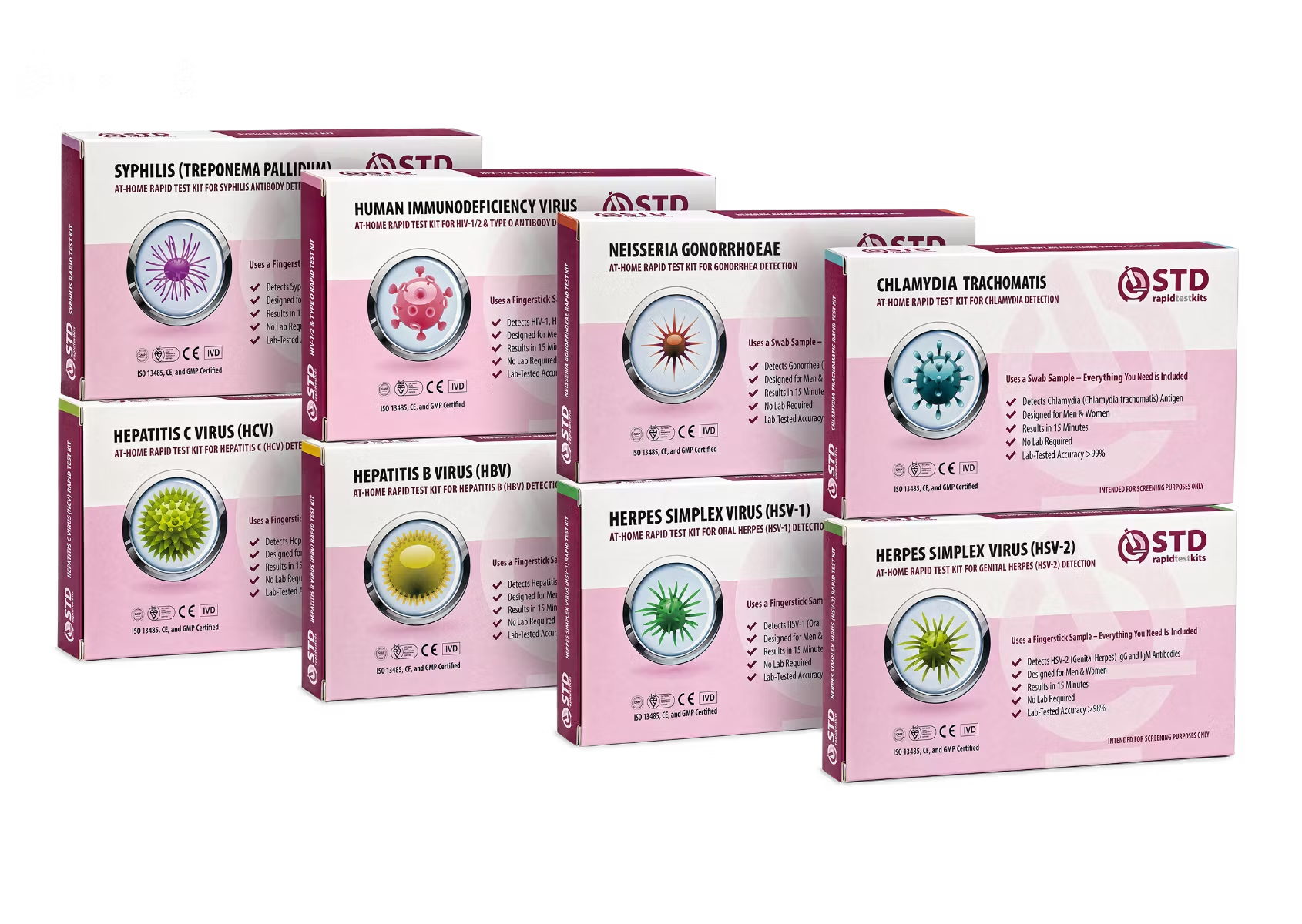
This site sells rapid at-home STD kits, including the multi-infection panel below. The kit linked here is one product fit for the testing scenarios this guide describes; the editorial recommendations on sample-site selection above stand on their own.
Does Surgery Change What Tests You Need?
Whether or not you have had gender-affirming bottom surgery, your STD risk profile is driven by your behavior, not by your surgical history. The kit selection logic is the same: test the body sites that had contact during sex.
If you have had vaginoplasty and use your neovagina (the surgically constructed vaginal canal) for receptive penetrative sex, a vaginal swab is appropriate. The skin lining of a neovagina is not identical to a cisgender vagina, but bacterial pathogens like chlamydia and gonorrhea still colonize the mucosa, and current clinical guidance treats anatomical site sampling as the most reliable approach. The UCSF Center of Excellence for Transgender Health's STI guidelines recommend site-based screening that mirrors the body sites used during sex, including the neovaginal canal where applicable. If a kit's instructions are silent on neovaginal collection or your result is unclear, a follow-up with a trans-competent clinician is the cleanest next step.
If your sexual activity has not involved your genitals (for example, oral or anal only), then a urine or vaginal swab is not what you need. You need throat and rectal swabs. This is the single most common testing miss in trans women's care: a clinician orders urine when the actual exposure was somewhere else entirely. Choosing the swabs yourself, whether at home for the sites available or in clinic for throat and rectal, removes that error.
Clinicians should ask about and screen for STIs based on each patient's anatomic inventory and sexual practices, not on gender identity, and should sample all anatomic sites of potential exposure.
Accuracy and Timing: What Trans Women Need to Know
At-home STD kits use the same underlying technology as clinic-based tests. Mail-in panels run on NAAT chemistry, the laboratory standard for detecting chlamydia and gonorrhea, and deliver high sensitivity when sample collection is correct. Rapid lateral-flow tests for HIV and syphilis are antibody-based, with sensitivity that depends on when in the post-exposure window the test is run; both formats achieve high specificity when used as instructed (per CDC laboratory testing guidance for STIs).
The two failure modes that matter are testing too early and collecting the sample incorrectly. Neither is specific to being trans, and neither is a flaw in the kit itself. They are timing and technique issues. If you were exposed on Friday and test on Monday, a negative result does not mean you are clear; it means the infection has not yet replicated to detectable levels, and you should retest once the relevant window has passed.
| Infection | Test type | Earliest reliable test |
|---|---|---|
| Chlamydia | NAAT (swab or urine) | About 14 days after exposure |
| Gonorrhea | NAAT (swab or urine) | About 7 to 14 days after exposure |
| Trichomoniasis | NAAT (swab or urine) | About 7 to 28 days after exposure |
| Syphilis | Antibody blood test | 3 to 6 weeks after exposure |
| HIV (lab 4th-generation antigen-antibody) | Lab blood test | By about 4 to 5 weeks after exposure |
| HIV (rapid antibody fingerstick) | Rapid blood test | About 23 to 90 days after exposure |
If You Test Positive: What Happens Next
A positive result from an at-home kit is the start of a follow-up workflow: confirm if needed, treat if indicated, notify recent partners, retest after treatment. Most bacterial STDs (chlamydia, gonorrhea, trichomoniasis, syphilis) are curable with a single course of antibiotics. HIV and herpes are not curable but are highly manageable with current treatment, and a positive HIV result from a rapid test always requires laboratory confirmation before any treatment decision is made.
HIV in particular deserves clear context. CDC surveillance data shows that trans women in the United States, particularly Black and Latina trans women, face disproportionately high HIV prevalence compared with the general adult population. Routine, proactive testing matters here as a practical tool for staying ahead of an infection that, when diagnosed early and treated, no longer changes life expectancy in any meaningful way. Modern antiretroviral therapy gets viral load to undetectable, which means untransmittable to sexual partners.
Many trans women avoid in-person clinics for reasons that have nothing to do with the result and everything to do with being misgendered or asked for a deadname in a waiting room. There is now a clear alternative. Trans-affirming telehealth services can review your at-home results, confirm whether you need follow-up testing, and prescribe treatment when appropriate, often without a single in-person visit. Planned Parenthood Direct and several LGBTQ-affirming telehealth providers offer this pathway in most states.
- Do not panic. Most STDs are curable with a single antibiotic course or highly manageable with current medications.
- If your test was a rapid at-home cassette, get a laboratory confirmation before starting treatment. Lab confirmation matters most for HIV and syphilis, where the implications of a false positive are significant.
- Begin treatment as soon as it is appropriate, and avoid sexual contact until the full course is complete and any post-treatment retesting confirms clearance.
- Notify recent partners so they can test and, if needed, treat. Several services offer anonymous partner-notification messaging if direct conversation feels unsafe.
- Retest after treatment, typically 3 to 4 weeks later for bacterial STDs, to confirm the infection has cleared.
Privacy, Stigma, and Taking Control
Many trans women do not avoid sexual-health care because they do not value their health. They avoid it because of past harm: misgendering, deadnaming, invasive questions, having a body talked about like a puzzle instead of a person. National survey work from groups like the National LGBTQ Task Force and the U.S. Transgender Survey has documented these patterns for years, and they correlate directly with delayed testing and worse health outcomes.
At-home kits remove most of those friction points. You can collect a sample without explaining your anatomy to a stranger, without wondering whether the nurse will understand what "front hole" means, and without filling out intake forms that assume all sex is vaginal and only cisgender men get HIV.
The kits themselves arrive in discreet packaging with no STD-related labels on the outside. Return envelopes for mail-in panels are similarly unbranded. Results come through a secure portal or encrypted email, and most providers let you choose how to receive them. If shared living arrangements are a concern, consider shipping to a friend's address or a parcel locker.
Three concrete friction points disappear when you test at home: no need to explain your anatomy, pronouns, or surgical history to a stranger; no intake forms that assume your gender or your sex acts; and no waiting-room or pharmacy-counter visibility, with discreet packaging on delivery and secure-portal results.
Take the Next Step (Without Shame)
If you have read this far, you are probably weighing one of two things: a recent exposure you cannot stop thinking about, or a general sense that you have not tested in a while and you should. Either way, the path forward is the same. Pick the kit that matches the exposure or covers the broadest range you want to screen for. Time it to the window period. Follow the collection instructions exactly. For oral or anal exposures, plan a clinic or mail-in NAAT panel for the site-specific swab.
You do not need a doctor's permission to take care of your own body. You do need a kit that respects your anatomy, your timing, and your privacy. At-home testing does not fix every gap in trans healthcare, but it gives you a tool that does not require explaining yourself to anyone.
Frequently Asked Questions
- Do at-home STD kits actually work for trans women?
- Yes. The kits detect bacterial DNA, viral RNA, or antibodies that are independent of gender identity. What matters is matching the sample type to the body site that was exposed during sex. If you had anal sex, a rectal swab is needed (typically through a clinic or mail-in NAAT panel). If you had oral, use a throat swab via the same route. If your urethra or front hole was involved, a urine sample or vaginal swab is appropriate. The right sample in the right place gives a clean result.
- Does estrogen or anti-androgen therapy affect test results?
- No. Hormone therapy does not interact with the chemistry that STD tests rely on. NAAT tests look for bacterial or viral genetic material. Antibody tests look for the immune response to infection. Neither is influenced by estrogen, spironolactone, or any other commonly used feminizing hormone medication.
- If I only had oral sex, do I still need to test?
- Yes, particularly for gonorrhea. Pharyngeal (throat) gonorrhea is common and often produces no symptoms, and it is missed entirely by urine-only testing. A throat swab takes seconds and is painless, and most consumer rapid kits do not include one, so plan on a clinic visit or mail-in NAAT panel for that specific sample.
- I have not had bottom surgery. Does that change which test I need?
- Only in the sense that you would not need a vaginal or front-hole swab. Your STD risk and the right sample sites are determined by what kind of sex you had, not by what surgery you have or have not had. If your sex involved your urethra, a urine sample is appropriate. If it involved your throat or rectum, the corresponding swab is what you need.
- If I have had vaginoplasty, can I use a standard vaginal swab kit?
- Yes, with one caveat: not every commercial vaginal-swab kit is explicitly validated on neovaginal tissue. The kit will still detect bacterial pathogens that colonize the mucosal lining, but if your result is unclear or symptoms persist, follow up with a clinic that specializes in trans care for confirmatory testing.
- What if I test positive at home?
- A positive at-home result is a starting point for follow-up, not a final diagnosis. For rapid tests, particularly HIV, get laboratory confirmation before any treatment decision. For most bacterial STDs, a positive NAAT result is reliable enough to start treatment, usually a single antibiotic course coordinated through a telehealth provider. Trans-affirming telehealth services can prescribe and arrange follow-up without an in-person clinic visit.
- How soon after exposure can I test?
- Each infection has a window period. Chlamydia and gonorrhea are reliably detectable about 14 days after exposure. Syphilis takes 3 to 6 weeks. HIV varies by test type: lab-based fourth-generation antigen-antibody tests catch most infections by 4 to 5 weeks, while rapid antibody fingerstick tests may take up to 3 months for the most conservative all-clear. Testing too early is the single most common cause of a false-negative result.
- How often should I test if I am sexually active?
- If you have new partners or any condomless sex, every 3 to 6 months is a reasonable baseline for chlamydia, gonorrhea, and syphilis. Annual HIV testing is the CDC's minimum recommendation for sexually active adults, with more frequent testing (every 3 to 6 months) for anyone at higher risk. Always test after a known or suspected exposure once the relevant window period has passed.
How we sourced this article: We combined current guidance from the CDC's STI Treatment Guidelines (particularly the section on transgender and gender-diverse persons), the UCSF Center of Excellence for Transgender Health, and the CDC's HIV surveillance and testing pages. The aim is to translate official public-health guidance into plain-English action items for readers making their own testing decisions. We do not provide clinical diagnosis. For symptoms that concern you, see a licensed provider.
- U.S. Centers for Disease Control and Prevention. Sexually Transmitted Infections Treatment Guidelines, 2021: Transgender and Gender Diverse Persons. Site-based screening guidance and behavior-driven sample selection.
- U.S. Centers for Disease Control and Prevention. STI Screening Recommendations. Anatomic-site screening intervals for sexually active adults.
- U.S. Centers for Disease Control and Prevention. HIV and Transgender People: facts, statistics, and surveillance data for transgender adults in the United States.
- UCSF Center of Excellence for Transgender Health. Sexually Transmitted Infections: clinical guidelines for trans and gender-diverse patients, including neovaginal site sampling.
- U.S. Centers for Disease Control and Prevention. Getting Tested for STIs: overview of who should get tested, self-test and mail-in kit options, and screening frequency recommendations.
- U.S. Centers for Disease Control and Prevention. HIV Testing: test types and window periods, including antibody, antigen-antibody, and nucleic acid test detection ranges.
