

Published: November 2025 | Last updated: April 2026 | Editorial review and quality control: Martina N.
An STD diagnosis lands like a door slamming shut on intimacy. The first question most people sit with at 2 a.m. is not about treatment plans or partner notification. It is something quieter and harder: when can I touch someone again, and will anyone want to touch me back?
The answer is more reassuring than the panic suggests, and more specific than a one-size-fits-all rule. Whether you were just diagnosed with chlamydia, are decades into living with herpes, or have HIV that is now well-controlled on treatment, the math of safe sex after a diagnosis comes down to three variables: which infection, where treatment stands, and whether your partner is in the loop. What follows is the honest version, infection by infection.
Can you still have sex after testing positive for an STD?
Yes, with timing that depends on the infection. Plan on about 7 days after finishing antibiotics for chlamydia, gonorrhea, or trichomoniasis, and only once your partner has also been treated. Avoid sex during an active herpes outbreak; daily suppressive antivirals plus condoms cut transmission risk meaningfully between outbreaks. People living with HIV who reach an undetectable viral load on consistent treatment cannot sexually transmit the virus, the U=U principle. Timing, partner coordination, and disclosure matter more than abstinence.
Key Takeaways
- For bacterial STIs (chlamydia, gonorrhea, trichomoniasis), the standard CDC wait is 7 days after a single-dose antibiotic regimen, and only once your partner has also been treated.
- For HIV, sustained undetectable viral load on antiretroviral therapy makes sexual transmission categorically not occur (Undetectable equals Untransmittable, U=U).
When Sex Is Safe Again: Three Variables That Matter
“Safe” after an STD diagnosis is not a single moment. It is the point where three things line up at once: the infection is no longer transmissible from your body, your partner has been tested or treated where relevant, and you are using the kind of protection that matches the specific transmission route. Get all three right and risk drops to near zero. Get two right and you are still rolling dice.
The first variable is the biology of the infection itself. Bacterial infections like chlamydia and gonorrhea respond to a defined course of antibiotics; once the bacteria are cleared, transmission risk falls away. Viral infections behave differently. Herpes lives in nerve cells and reactivates intermittently, so transmission risk is never quite zero between partners with mismatched status. HIV transmission is tied to viral load, and modern antiretroviral therapy can suppress that load below detection.
The second variable is whether your partner has also been addressed. Bacterial STDs commonly bounce between partners when only one person is treated, an issue covered in detail in the reinfection section below.
The third variable is the protection method. Condoms work well against fluid-borne infections (chlamydia, gonorrhea, HIV) and less well against skin-to-skin infections (HSV, HPV, syphilis sores located outside the covered area). The right protection depends on what you are protecting against.
Biology of the infection: has it been cleared from your body (bacterial) or suppressed below the transmission threshold (viral)?
Partner status: has anyone you may have exposed been tested or treated, so reinfection cannot bounce back to you?
Protection method: does what you are using match the transmission route (condoms for fluid-borne, plus suppressive antivirals or vaccination for skin-borne)?
Bacterial Infections: Treat, Wait, Confirm
For bacterial STDs (chlamydia, gonorrhea, syphilis, trichomoniasis), the core idea is simple. Antibiotics kill the bacteria, but clearance is not instantaneous. The body needs a short window after the last dose for the infection to fully resolve from infected tissues. According to the CDC STI Treatment Guidelines, the standard guidance is to wait 7 days after a single-dose antibiotic regimen (or until you finish a 7-day regimen) before resuming sex, and only with partners who have also been treated.
That second clause is the one most people miss. If you finished your doxycycline on Monday and your partner has not been treated yet, having sex on the following Monday will simply hand the infection right back to you.
Treat the wait times below as floors rather than ceilings. If symptoms persist past the wait period or you are uncertain, retesting (called a test of cure for some infections) is the next step.
| Bacterial STI | Standard Treatment | Wait Before Resuming Sex | Partner Step |
|---|---|---|---|
| Chlamydia | 7-day doxycycline (preferred); single-dose azithromycin (alternative) | 7 days after single dose, or 7 days after finishing course | Partner must be treated before resuming |
| Gonorrhea | Single-dose ceftriaxone injection | 7 days after treatment | Partner must be treated; CDC suggests retesting at 3 months |
| Syphilis | Penicillin injection (1 to 3 doses by stage) | Until any sores have fully healed; follow-up titer testing per clinician | Partner notification and treatment per clinician |
| Trichomoniasis | Single-dose metronidazole or tinidazole | 7 days after treatment | Partner must be treated to prevent reinfection |
How the Treatment Timeline Works
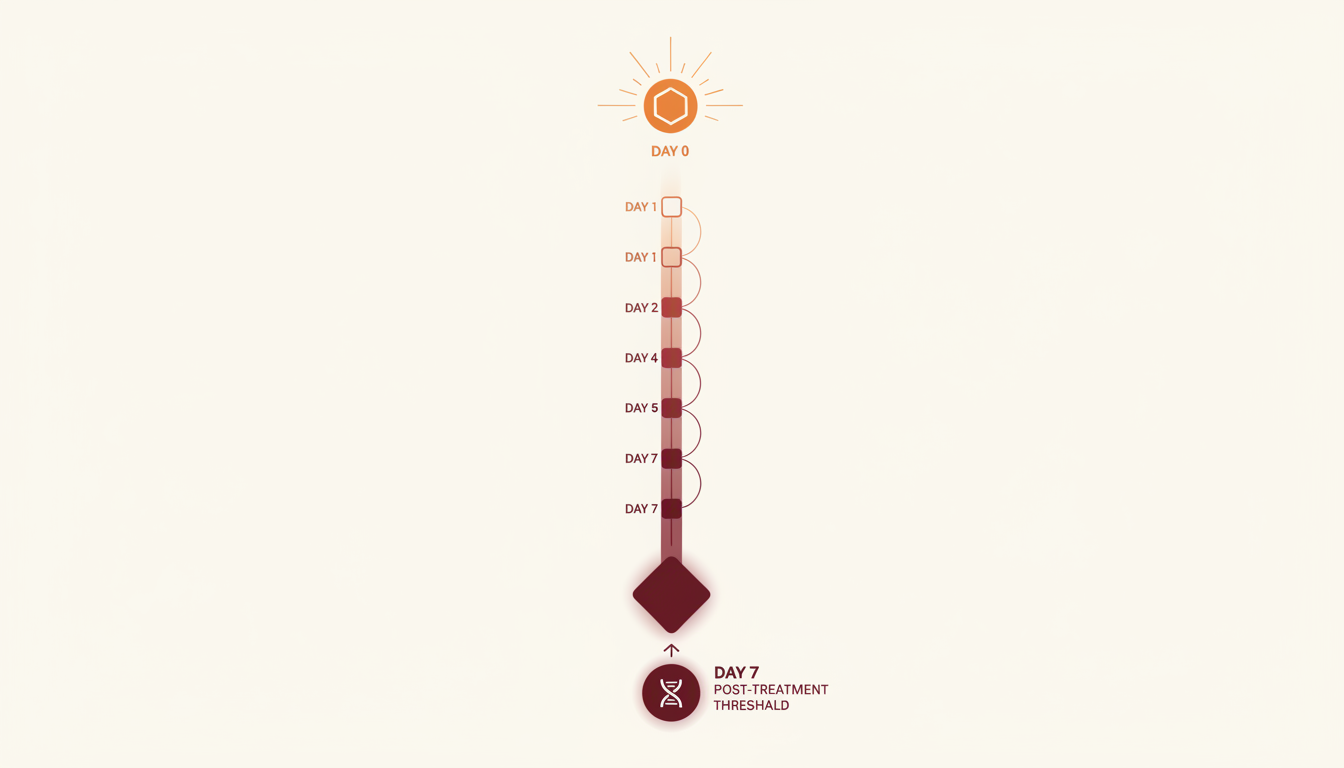
Antibiotics are not a kill switch. The medication starts working within hours, but full clearance from infected tissues takes days. During that lag, you can still feel completely fine and still pass the infection on. Symptoms tend to fade faster than the bacteria clear, which is exactly the trap most people fall into. You wake up feeling normal, assume you are done, and resume sex three days into a seven-day window. The infection moves from you to your partner, who passes it back two weeks later.
This is why “feel fine” is the wrong signal to act on. The right signal is “the regimen is complete, the wait period is done, and my partner has also been treated.” All three of those, simultaneously.
Viral Infections: Different Math, Different Decisions
Viral infections do not follow the bacterial playbook. There is no antibiotic that clears them, and the question becomes management rather than cure.
For herpes (HSV-1 or HSV-2), the virus persists in nerve ganglia and reactivates intermittently. Transmission risk is highest during visible outbreaks but is not zero between them, because of asymptomatic viral shedding (the virus is present on skin without visible symptoms). The CDC overview of genital herpes notes that daily suppressive antivirals (valacyclovir or acyclovir) reduce both shedding and transmission, and consistent condom use further reduces risk in mismatched-status couples.
For HIV, the math is different again. Transmission risk is tied directly to viral load, the amount of virus circulating in the blood. Antiretroviral therapy suppresses that load. Once it falls below the detection limit of standard tests and stays there, sexual transmission risk is effectively zero. This is the U=U principle, formally endorsed by the World Health Organization and by the CDC.
If a person living with HIV reaches and maintains an undetectable viral load through consistent antiretroviral therapy, sexual transmission to partners does not occur. This is the consensus position of the CDC, WHO, and the International AIDS Society. U=U is a categorical statement rather than a probability one, supported by partner studies including PARTNER and PARTNER2 that followed thousands of serodiscordant couples and recorded zero linked transmissions when the partner living with HIV was virally suppressed.
Living with Herpes: A Realistic Picture
Herpes carries the heaviest stigma load of any common STI, partly because it is lifelong and partly because public conversation about it tends to swing between catastrophe and dismissal. The middle ground is more useful. According to the CDC's surveillance data on genital herpes, an estimated 572,000 new genital herpes infections occur each year in the United States among people aged 14 to 49 (2018 CDC estimates). The condition is common, and many people who have it are dating, partnered, or married, with partners who remain HSV-negative for years.
The realistic picture for HSV-2: avoid sex during prodrome (the tingling or itching that precedes an outbreak) and during visible lesions. Take daily suppressive antivirals if you have frequent outbreaks or an HSV-negative partner. Use condoms consistently, knowing they reduce risk significantly but not completely because the virus can shed from skin areas the condom does not cover. Disclose to new partners before sex so they can make informed choices. With those four habits in place, many serodiscordant couples (one positive, one negative) live for years without transmission.
The blood antibody test for HSV-2 is most informative when used 12 weeks or more after a suspected exposure, since seroconversion takes time. Results are most useful as a baseline (have I ever been exposed?) rather than as a “right now” indicator of an active outbreak, which a clinic-administered swab of an active lesion handles better. We sell a rapid at-home herpes antibody test that can help confirm exposure status from the privacy of home, with the timing caveats above; we recommend products on this site based on fit-for-purpose for the reader's concern, not commercial benefit.
Reinfection: The Ping-Pong Loop and How to Stop It
The most common reason an STD seems to “come back” is not treatment failure. It is a partner who never got treated. The bacteria sit untouched in their tissues while you finish antibiotics, wait the recommended seven days, and then have sex with the source of your original infection. Within days you are positive again. Clinicians sometimes call this the ping-pong effect.
This pattern shows up most often with chlamydia and gonorrhea, the two highest-incidence bacterial STIs in the United States. Per the CDC's STD prevention guidance, people treated for chlamydia or gonorrhea are advised to retest about three months after treatment, regardless of whether the partner says they were treated, because reinfection rates within that window are non-trivial. Expedited partner therapy, where your clinician prescribes treatment for your partner without a separate visit, is legal in most states and reduces this gap.
Three rules close the loop. First, do not have sex during your seven-day wait. Second, do not resume sex with the original-exposure partner until they have also completed treatment. Third, retest at three months for chlamydia or gonorrhea, even if you have no symptoms. Silent reinfection is common.
How to Disclose Without Derailing the Moment
The biology of an STD is often easier than the conversation about it. Disclosure is required ethically, and in some jurisdictions legally for HIV, when transmission is possible. The question is one of timing and tone rather than whether to do it at all.
The patterns that work share a few features. Disclose before clothes come off, never in the middle. Pick a moment with low pressure (a walk, a meal) where the conversation can land without being interrupted. Lead with calm and information rather than apology. The script does not need to be poetic; it needs to be clear. The callout below shows one version that has worked for many people.
Disclosure on dating apps is a separate question. Some people put their status in the bio (“HSV-2+, happy to answer questions”). Others prefer to mention it once a conversation feels promising. There is no single right way to do it.
“I want to share something before we get physical. I have HSV-2. I take daily antivirals, I have not had an outbreak in eight months, and we would use condoms. If you have questions, I am happy to answer them. If it is a dealbreaker, I respect that.”
That structure does three things at once. It shows responsibility (you are bringing it up unprompted). It hands the listener facts they can act on (antivirals, outbreak history, protection). And it puts the decision in their hands without asking for reassurance. Most people respond with curiosity rather than panic; the ones who do not are filtering themselves out, which is information you wanted anyway.
Condoms, Skin-to-Skin, and How Protection Maps to Infection
Condoms are excellent at blocking infections that travel in fluids and only fair at blocking infections that travel through skin contact. This distinction is the single most useful idea to internalize about protection.
Fluid-borne infections (chlamydia, gonorrhea, HIV, hepatitis B, hepatitis C) live in semen, vaginal fluids, blood, or rectal secretions. A condom that stays intact through the encounter physically blocks those fluids from reaching mucosal tissue. Risk reduction here is high, especially when paired with regular testing.
Skin-borne infections (HSV-1, HSV-2, HPV, syphilis when chancres are present) can transmit from areas a condom does not cover, including the base of the penis, the scrotum, the vulva, the perianal region, and the upper inner thighs. Condoms still reduce risk in these encounters, but they do not eliminate it. Adding daily suppressive antivirals (for HSV) or vaccination (for HPV, in the eligible-age group) closes more of the gap.
Fluid-borne (high condom benefit): chlamydia, gonorrhea, HIV, hepatitis B, hepatitis C, trichomoniasis. Consistent and correct condom use substantially reduces transmission.
Skin-borne (moderate condom benefit, layered tools needed): HSV-1, HSV-2, HPV, syphilis with active sores outside the covered area. Add suppressive antivirals (HSV), HPV vaccination where age-eligible, and avoid sex during active outbreaks or visible chancres.
HIV-specific: sustained undetectable viral load on antiretroviral therapy eliminates sexual transmission risk (U=U). PrEP for the HIV-negative partner adds belt-and-braces protection in serodiscordant couples.
Window Periods and When a Test Becomes Reliable
A test taken too early returns a negative result that does not represent your true status; it is just a snapshot of your body before the infection became detectable. Each STI has its own window period, defined by how long it takes the body to either accumulate detectable bacteria or produce detectable antibodies. Testing inside that window is a coin flip.
The windows below are the points at which a negative test starts to mean something. For maximum confidence, retest at the longer end of the range or follow your clinician's specific guidance. Per NHS sexual health guidance, retesting is also routinely advised three months after treatment for chlamydia or gonorrhea regardless of symptom status, because silent reinfection is common. For HSV-2 antibody testing specifically, most assays reach their confidence point at 12 weeks; a small subset of assay labels extend the window to 16 weeks.
| Infection | Earliest Useful Test | Most Confident Test |
|---|---|---|
| Chlamydia | 14 days after exposure | 2 to 4 weeks |
| Gonorrhea | 1 to 2 weeks after exposure | 3 weeks |
| Syphilis (treponemal antibody) | 3 to 6 weeks after exposure | 12 weeks |
| HIV (4th-gen Ag/Ab lab test) | 18 to 45 days after exposure | 90 days for full confidence |
| HIV (rapid antibody test) | 23 to 90 days after exposure | 90 days |
| Herpes HSV-2 (antibody) | 6 to 8 weeks | 12 weeks (some assay labels extend to 16) |
| Hepatitis B | 6 weeks | 12 weeks |
| Hepatitis C | 8 to 11 weeks | 12 weeks |
Choosing a Home Test for Where You Are Now
The right home test depends on the question you are trying to answer. If you are inside the wait period after antibiotic treatment for chlamydia or gonorrhea, a swab-based two-in-one panel is what closes the test-of-cure loop. If you had a single high-risk exposure event and want to cover the common bloodborne infections (HIV, syphilis, hepatitis B, hepatitis C) plus the common bacterial ones, a multi-infection combo kit gives broader coverage in one shipment. If you are specifically tracking HSV after a possible exposure, the herpes blood antibody test is the at-home option, with the timing caveat above.
Our home tests are rapid lateral-flow immunoassays. They are designed for screening with same-day results at home, and they are not the same technology as laboratory NAAT or PCR testing, which has higher analytical sensitivity. A reactive home result is worth confirming with a clinic NAAT when possible; a non-reactive result inside the appropriate window is informative on its own.
Rebuilding Sexual Confidence After a Diagnosis
The body often clears an STD faster than the head does. People who finish treatment and test clear can spend months feeling disconnected from their own desire, flinching at touch, or interpreting normal physical sensations as recurring symptoms. This is a documented response to a medical event with social weight, and it is not a sign of permanent damage.
Three things tend to help most people. The first is giving the body time to relearn that touch is safe, which matters most in the early weeks after treatment ends. The second is replacing catastrophizing with the real statistics of the diagnosis, since most STIs are common, treatable, or manageable. The third is relational repair, often through a therapist or a sex-positive support community, which helps the diagnosis stop being a defining feature and become one fact among many.
Confidence rarely returns in a single moment. It tends to rebuild in small increments: a flirty exchange, a kiss without anxiety, sex where the focus is on pleasure rather than on whether something is going wrong.
Sustained undetectable HIV viral load achieved through consistent antiretroviral therapy means the virus cannot be sexually transmitted to partners. Undetectable equals untransmittable.
FAQs
- How long after antibiotic treatment can I have sex again?
- Standard CDC guidance is 7 days after a single-dose antibiotic regimen, or 7 days after finishing a 7-day course, for chlamydia, gonorrhea, and trichomoniasis. The wait gives the medication time to clear the infection from your tissues. Equally important: your partner has to be treated too, otherwise you can be reinfected on day eight.
- My symptoms went away after two days. Doesn't that mean I'm clear?
- Not yet. Symptoms tend to fade faster than the bacteria are cleared from infected tissues. You can feel completely fine and still be contagious during the wait period. The right signal is regimen complete plus full wait period plus partner treated, not “I feel better.”
- What if my partner refuses to get treated, or keeps putting it off?
- Most US states allow expedited partner therapy, where your clinician writes a partner prescription you take home with you, no separate clinic visit needed. Several telehealth services can also dispatch a partner prescription remotely if scheduling is the obstacle. If your partner still declines treatment, the only protective option is to delay resuming sex with that partner: having sex with an untreated source is the fastest path to silent reinfection.
- Are condoms enough protection on their own?
- It depends on what you are protecting against. For fluid-borne infections (chlamydia, gonorrhea, HIV, hepatitis), condoms are highly effective when used correctly. For skin-to-skin infections (HSV, HPV, some syphilis sores), condoms reduce risk meaningfully but do not eliminate it because they do not cover all skin. Layered protection works best for those.
- What does U=U actually mean for HIV?
- U=U is undetectable equals untransmittable. When a person living with HIV reaches and maintains an undetectable viral load on consistent antiretroviral therapy, the virus cannot be sexually transmitted to a partner. This is a categorical statement rather than a probability one, supported by the PARTNER and PARTNER2 studies and endorsed by the CDC and WHO.
- Can I get the same STD again after I have already had it?
- Most STIs do not produce reliable lasting immunity, so reinfection is genuinely possible. Reinfection from an untreated partner is the most common pattern, but new exposures from new partners also count. Retesting at three months after chlamydia or gonorrhea treatment is standard for this reason.
- Should I retest after my treatment is done?
- Often yes. The CDC recommends retesting about three months after treatment for chlamydia and gonorrhea, even if you have no symptoms, because silent reinfection is common. For HIV, syphilis, and herpes, your clinician will guide you on follow-up testing based on your specific situation and clinical course.
- How do I tell a new partner about my diagnosis without ruining the moment?
- Pick a low-pressure moment before things get physical, lead with information rather than apology, and keep it short. A working script: “I have HSV-2, I take daily suppressive antivirals, and we would use condoms. Happy to answer any questions.” That gives them facts they can act on without putting you in the position of asking for reassurance.
- U.S. Centers for Disease Control and Prevention. Sexually Transmitted Infections Treatment Guidelines: definitive treatment regimens (including doxycycline-preferred chlamydia regimen) and post-treatment wait periods.
- U.S. Centers for Disease Control and Prevention. About Genital Herpes: 2018 incidence estimate of 572,000 new infections per year among ages 14 to 49, transmission via asymptomatic shedding, and the role of suppressive antivirals.
- U.S. Centers for Disease Control and Prevention. STDs / STIs prevention and screening overview, including retesting at three months after chlamydia or gonorrhea treatment.
- World Health Organization. HIV and AIDS Fact Sheet: people on antiretroviral therapy with an undetectable viral load do not transmit HIV to sexual partners.
- U.S. Centers for Disease Control and Prevention. Treating HIV: antiretroviral therapy, viral suppression, and the U=U (Undetectable equals Untransmittable) consensus.
- National Health Service (UK). Sexually Transmitted Infections (STIs): testing, window periods, and partner notification guidance.
