
Published: August 2025 | Last updated: May 2026 | Editorial review and quality control: Martina N.
The image of suburbia as a sealed bubble of low-risk living has been pretty stubborn. Quiet streets, married couples, kids in soccer cleats, and the assumption that the public-health story of sexually transmitted infections belongs somewhere else entirely. That assumption no longer matches what surveillance data shows.
The U.S. Centers for Disease Control and Prevention reported more than 2.4 million combined cases of chlamydia, gonorrhea, and syphilis in 2023 (CDC STI surveillance, annual report), and the geographic spread is broader than the old urban-problem framing suggests. Rates have climbed across age brackets that suburban readers belong to, including adults in their 30s, 40s, and 50s.
This article is about what that data does and does not say, why complacency is the real risk factor in many neighborhoods, and the practical testing decisions that protect you and the people around you. If you are reading this without an active concern about exposure, that is exactly the audience public-health professionals want to reach. Awareness is most useful before the moment you need it.
Key Takeaways
- Reported STI rates in the U.S. have climbed for nearly a decade across most regions and age groups, including older adults and married couples, per CDC surveillance data.
- Most STIs cause no symptoms, so the only reliable way to catch them early is testing on a routine schedule that does not depend on noticing anything wrong.
What the CDC Data Actually Shows About STIs Outside Cities
The framing about a sudden suburban hotspot can be misleading if it suggests a clean geographic shift. What CDC surveillance reports show is broader and steadier.
According to the agency's 2023 annual surveillance data, roughly 2,459,136 combined cases of chlamydia, gonorrhea, and syphilis were reported, with congenital syphilis cases nearly 700% higher than a decade ago (CDC STI surveillance, annual report). Chlamydia remains the most-reported notifiable infection in the U.S., with the highest rates among 15-to-24-year-olds and rising case counts among adults aged 25 to 54.
County-level rate maps for chlamydia and gonorrhea, which the CDC publishes through its surveillance dashboards, show that the contrast between a large city and its surrounding counties within a single metro area is often narrower than people assume. Several counties classified as suburban now show per-capita case rates roughly on par with their adjacent urban core.
What the data does not show is a tidy before-and-after where rural and suburban communities suddenly became risky. STIs follow social and sexual networks rather than zip codes, and the urban-versus-suburban framing was always too simple.
The pattern is not unique to the U.S. The World Health Organization flagged a significant global increase in syphilis cases among adults aged 15 to 49 over the past several years (WHO STI fact sheet), with parallel upward trends for gonorrhea, including the slow expansion of antimicrobial-resistant strains that clinicians are watching closely.
CDC's annual STI surveillance reports show 2,459,136 combined cases of chlamydia, gonorrhea, and syphilis in 2023. Congenital syphilis counts are nearly 700% higher than a decade ago. Provisional 2024 figures show a partial decline but remain above 2.2 million combined cases.
Why Suburban Safety Is a Myth: The Risk Drivers
Several patterns help explain why STI rates are no longer (and arguably never were) a strictly urban phenomenon.
Population mobility. Many people who live in suburban or exurban neighborhoods commute, travel, or socialize across the wider metro area. Sexual networks follow people, not geography. A relationship that begins on a dating app or at a downtown bar is part of the same network when it continues at a suburban address.
Dating-app usage. Geosocial dating apps have expanded partner-network density across previously isolated communities. The same apps that have changed urban dating culture have changed suburban dating culture, and the introductions they enable do not stop at city limits.
Older adults dating again. One of the fastest-growing demographics in STI case counts is adults in their 40s, 50s, and 60s. Divorce, widowhood, and later-life dating increase partner turnover in age groups that grew up before comprehensive STI awareness campaigns existed. Suburban populations skew older than urban centers in many U.S. regions, which means a sizable share of new-partner activity is happening among people who least expect to consider themselves at risk.
Declining condom use. National surveys, including the CDC's Youth Risk Behavior Survey, have tracked a slow decline in self-reported condom use among adolescents and young adults over the past decade. That pattern carries into adulthood. People aging out of routine sexual-health screening at college health centers often never re-establish a regular testing routine.
Reduced public-health funding outside cities. State and county-level public-health departments serving suburban areas tend to have fewer dedicated STI staff per capita than urban departments. Outreach, contact tracing, and free-testing clinics are scarcer in many of those counties, so cases that would be promptly identified in a city may go undiagnosed longer.
The five structural drivers at a glance
- Population mobility: suburban residents commute, travel, and date across the wider metro area.
- Dating-app density: geosocial apps have spread partner-network density into previously isolated communities.
- Older-adult dating: divorce, widowhood, and re-partnering raise partner turnover in age groups that grew up before STI awareness campaigns.
- Declining condom use: self-reported barrier use has fallen across age groups for over a decade.
- Reduced public-health infrastructure: suburban counties have fewer dedicated STI staff and contact tracers per capita than urban departments.
The Testing-Gap Problem in Suburban Healthcare
A specific source of preventable spread is the gap between where suburban adults seek healthcare and where comprehensive STI testing is routinely offered.
Most primary-care visits do not automatically include STI screening for adults over 25 unless the patient reports symptoms, requests testing, or fits a higher-risk profile that the clinician identifies. The CDC's screening guidelines call for annual chlamydia and gonorrhea screening for sexually active women under 25 and for older women with risk factors, plus risk-based screening for men (CDC STI program). For partnered adults in monogamous-presenting relationships, those criteria often default to no screen unless the patient specifically asks.
Urgent-care centers and walk-in clinics, which serve a large share of suburban populations, vary widely in what they offer. Some run rapid panels on request, others refer out, and some decline STI testing entirely unless a patient is symptomatic. Out-of-pocket costs in clinic settings range from roughly $50 to several hundred dollars, depending on the panel and on insurance coverage.
Patients also report discomfort asking for STI testing in family-medicine settings, especially when the clinician has known them for years or is also their children's pediatrician. That social friction is real and it changes behavior. Adults who would happily order a flu test put off STI screening because they do not want a particular doctor to ask follow-up questions.
The result of those gaps is straightforward. Many infections in suburban populations are never tested for. The infections that are tested are often caught late. And contact tracing, which depends on case identification, becomes difficult when the people most likely to be infected are also least likely to be screened.
At-home testing closes one part of this gap by removing the in-clinic discomfort and the access friction. It lowers the activation energy for routine screening that public-health agencies have recommended for years. For symptomatic infections or to confirm a positive screening result, a clinical visit remains the appropriate path.
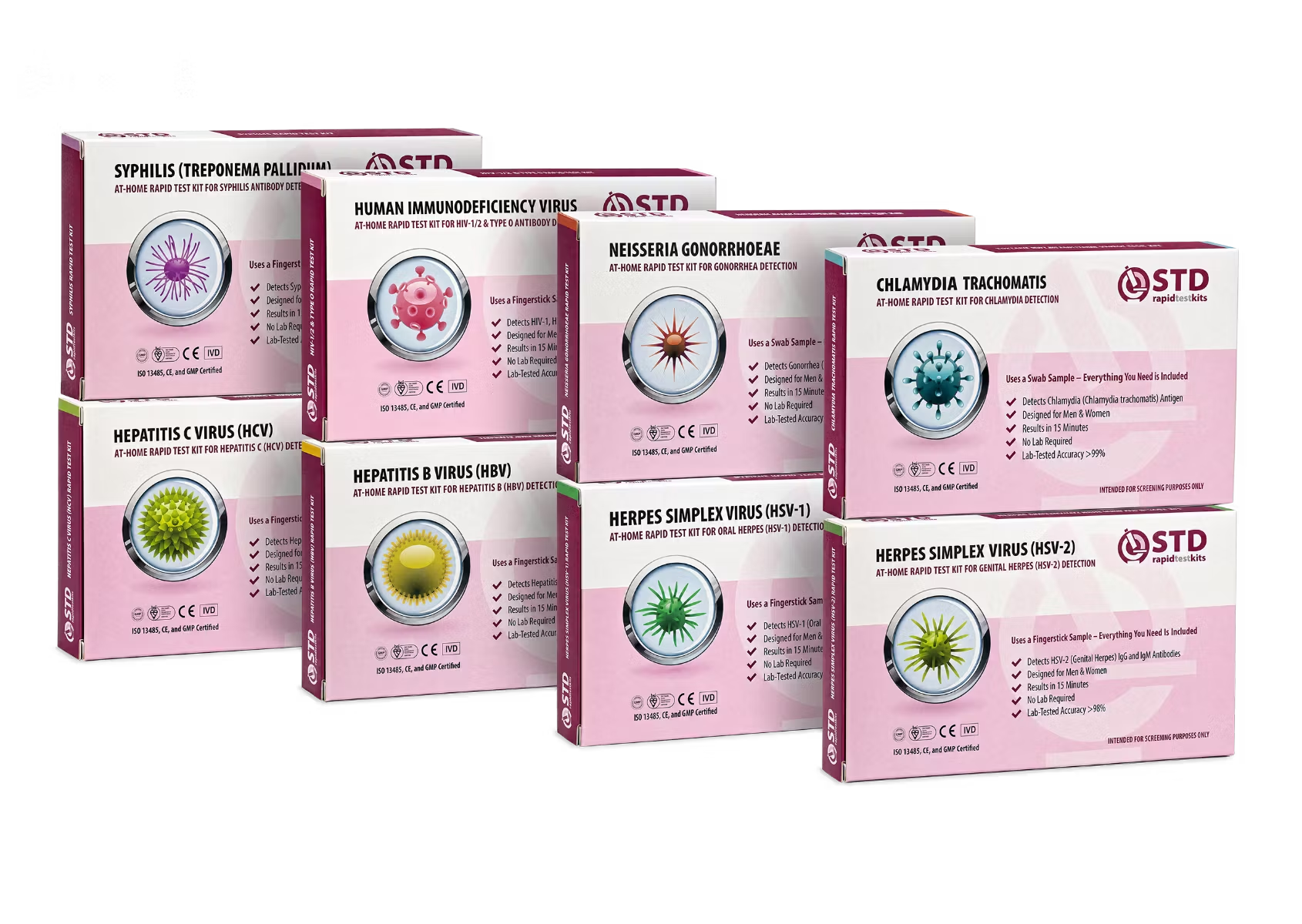
This article is published by stdrapidtestkits.com, which sells at-home STI testing kits. We recommend products based on fit-for-purpose for the reader's concern, not commercial benefit. The product links below are for the at-home rapid tests that match the testing decisions discussed above.
What Rising STI Rates Really Look Like in Your Community
The numbers can feel abstract. What does it actually mean when a county's chlamydia rate climbs roughly 20% over five years?
In real terms, college clinics test positive more often each semester; health-department contact-tracing caseloads run higher; and more pregnancies screen positive for syphilis at the first prenatal visit, which is where most congenital cases are caught.
It also means more silent infections in adults who never get tested. Chlamydia and gonorrhea cause no noticeable symptoms in the majority of women and a substantial share of men (CDC STI program). Untreated, these infections can cause pelvic inflammatory disease, infertility, ectopic pregnancy, and chronic pelvic pain in women, and epididymitis (inflammation of the tube behind the testis) and reduced fertility in men. They also raise the risk of HIV acquisition during a future exposure.
The CDC reported roughly 572,000 new genital herpes infections in 2018 among Americans aged 14 to 49, the majority of whom had no symptoms at the time of infection (CDC herpes overview). A similar pattern of high transmission with low symptomatic recognition applies to HPV, which causes nearly all cervical cancers and a significant share of throat and anal cancers (CDC HPV information).
Diagnosed cases represent only a fraction of the infections circulating in any given community at one time. The remainder circulate in communities that never ran the test that would have identified them.

How to Protect Yourself and Your Household
The action items below are aimed at adults across the relationship-status spectrum. None of them require panic. They do require routine.
A practical checklist
- Test on a schedule, not on a feeling. Most STIs cause no symptoms, so a no-symptom no-test default is not protective.
- Test after any new partner, regardless of how comfortable the relationship feels or how vetted you believe the partner to be.
- Use barrier protection until both partners have tested. Condoms and dental dams remain the best non-pharmaceutical risk-reduction tools.
- Talk to your kids about sexual health early and matter-of-factly. The CDC and the American Academy of Pediatrics both recommend age-appropriate sexual-health conversations well before adolescence.
- Get the HPV vaccine if you are eligible. ACIP recommends routine HPV vaccination through age 26 and shared clinical decision-making through age 45 (see CDC HPV vaccine recommendations at https://www.cdc.gov/vaccines/vpd/hpv/hcp/recommendations.html).
- If you take PrEP for HIV prevention, keep up with the quarterly STI screening that goes alongside it.
When to Test, and What Kind of Test
The right test depends on what infection you are screening for and how recently a potential exposure happened. A few principles apply across most situations.
Window periods matter. Most STIs have a delay between exposure and reliable detection. Chlamydia and gonorrhea are usually detectable about 1 to 2 weeks after exposure. Syphilis blood tests typically turn positive 3 to 6 weeks after exposure. Fourth-generation antigen-antibody HIV tests typically detect infection 18 to 45 days after exposure; older antibody-only tests have a longer window of roughly 23 to 90 days depending on the assay (CDC HIV testing overview). HSV-2 antibody seroconversion is typically reliable 6 to 12 weeks after a new exposure, with some assays recommending up to 16 weeks for a high-confidence negative result (CDC STD treatment guidelines, genital herpes). The table below summarizes the practical numbers.
Sample type matters. Chlamydia, gonorrhea, trichomoniasis, and HPV are tested from a swab of the affected anatomical site, such as a vaginal or penile swab, or a throat or rectal swab for those exposure routes. HIV, syphilis, hepatitis B, hepatitis C, and HSV antibody panels are blood tests, typically from a fingerstick at home or a venous draw in a clinic.
Laboratory NAAT versus rapid lateral-flow chemistry. Lab-processed nucleic acid amplification tests (NAATs) remain the analytical reference standard for chlamydia and gonorrhea per CDC laboratory guidance. Home-test lateral-flow cassettes use a different and faster chemistry. They are useful screening tools for asymptomatic adults, especially when the alternative is no test at all, and any positive home result is worth confirming with a lab test through your clinician.
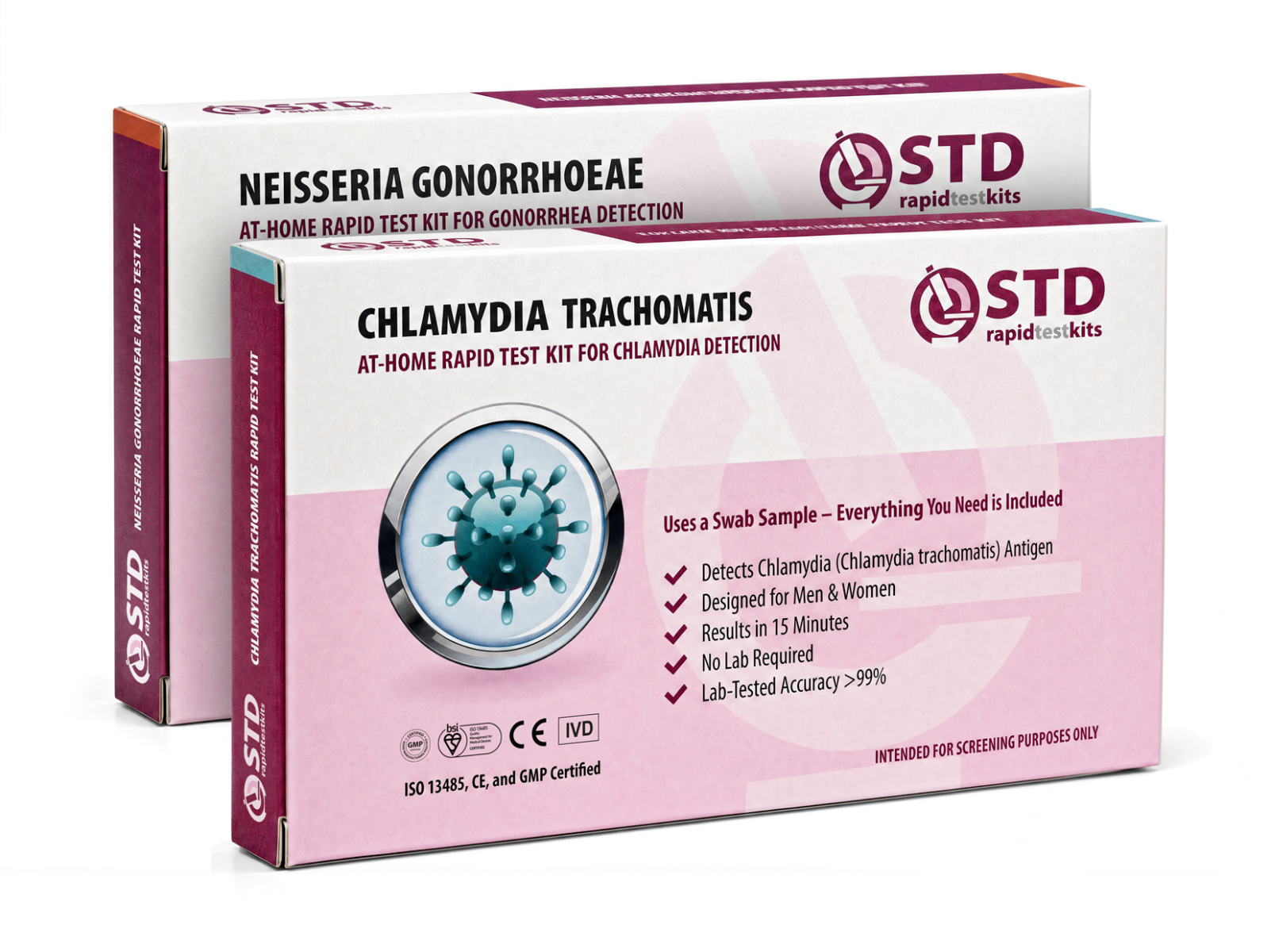
Throat and rectal exposures need a different sample. Our at-home rapid swab kits are validated for genital sample types. For oral or anal exposures, the appropriate test is a pharyngeal or rectal swab processed in a clinical or lab setting. We do not sell those kits at home, and a clinic visit is the right path.
| Infection | Sample Type | Window Before Reliable Detection |
|---|---|---|
| Chlamydia, Gonorrhea | Genital swab | 1 to 2 weeks |
| Syphilis | Blood (fingerstick or venous) | 3 to 6 weeks |
| HIV (4th-generation antigen-antibody) | Blood (fingerstick or venous) | 18 to 45 days; older antibody-only tests up to 90 days |
| Hepatitis B, Hepatitis C | Blood (fingerstick or venous) | 6 to 12 weeks |
| HSV-2 antibody | Blood (fingerstick or venous) | 6 to 12 weeks (up to 16 weeks for some assays) |
Common Misconceptions About Suburban STI Risk
A few patterns come up repeatedly in conversations about why this matters in non-urban communities.
"I am married, so I do not need to test." Monogamy is protective only when both partners are fully infection-free at the start of the relationship and remain so. Past infections from before the relationship can still surface. Herpes can stay latent for years before a first noticeable outbreak, and HPV can take years to manifest as visible warts or detectable cellular changes. Infidelity also exists, and infections do not check marital status before transmitting.
"You can tell when someone has an STI." The most common pattern across chlamydia, gonorrhea, HPV, HSV, and early syphilis is no visible symptoms. The CDC has been clear about this for decades, and it is the single biggest reason regular testing matters. People look fine because they feel fine, and most infected people do.
"Home tests are unreliable." Home rapid lateral-flow tests use the same antibody or antigen detection chemistry as the rapid tests used in many clinic settings. Reported sensitivity and specificity vary by manufacturer and target infection, and each product page lists those figures specifically. A positive screening test is always worth confirming with laboratory testing, and a negative result during the window period is always worth repeating after the window closes.
"STI testing is too expensive." Local health departments and federally funded community health centers offer free or sliding-scale STI testing in most states (CDC STI resources). Find a clinic through the CDC's GetTested locator. At-home test kits range from roughly $30 to $200 depending on the panel.
"Teenagers are the biggest concern." Adolescents and young adults still account for the highest rate of new chlamydia and gonorrhea cases per CDC surveillance, but adults aged 30 to 55 represent the largest absolute increase in case counts over the past several years. The framing of STIs as a young person's problem is precisely the framing that has slowed adult testing rates.
"Oral sex is safe." Gonorrhea, syphilis, chlamydia, HSV, and HPV can all transmit through oral-genital contact. Pharyngeal gonorrhea in particular has been a focus of CDC clinical guidance because of its role in antimicrobial-resistant strain emergence.
Many STIs have no symptoms, so people may not know they have an infection. Without testing and treatment, STIs can lead to serious health problems and can be passed to sex partners.
FAQs
- Can I still get an STI if I am in a monogamous relationship?
- Monogamy protects against new acquisition from outside the relationship but does not clear infections already present when the relationship started. Some infections like herpes and HPV can take years to surface for the first time, and asymptomatic chlamydia or gonorrhea from before the relationship can persist if never screened for. If neither partner has been tested since the relationship began, an STI screen for both removes the uncertainty.
- How often should adults get tested for STIs?
- The CDC recommends at least annual chlamydia and gonorrhea screening for sexually active women under 25 and for older women with risk factors. Anyone with new or multiple partners should test more often, typically every 3 to 6 months. Adults on PrEP test quarterly. A reasonable default for sexually active adults outside a long-term mutually monogamous relationship is annual screening at minimum.
- How accurate are at-home STI test kits compared to lab tests?
- Home rapid lateral-flow kits use the same antibody or antigen chemistry as many clinic rapid tests. Reported sensitivity and specificity vary by infection and by manufacturer, so check the figures on each product page. Lab-processed NAATs are the analytical reference standard for chlamydia and gonorrhea. The two test types are complementary. Home testing is a screening tool, and any positive home result is worth confirming through your clinician.
- What is the most commonly diagnosed STI in non-urban areas right now?
- Chlamydia, followed closely by gonorrhea, per current CDC surveillance. Both are reported across every age band, with the highest rates among 15-to-24-year-olds and the largest absolute increases among adults aged 25 to 54. Syphilis case counts have also been climbing nationally, including congenital syphilis at first prenatal visits.
- Can oral sex really transmit STIs?
- Yes. Gonorrhea, syphilis, chlamydia, HSV, and HPV can all transmit through oral-genital contact. Pharyngeal gonorrhea is a particular focus of CDC clinical guidance because of its role in the spread of antimicrobial-resistant strains. The right test for an oral exposure is a pharyngeal swab, which is processed in a clinical or laboratory setting.
- What are early STI symptoms I should watch for?
- Burning during urination, unusual discharge, genital itching or pain, new sores or bumps, lower-abdominal pain, or unexplained sore throat after an oral exposure. The most common pattern across STIs is no symptoms at all. Symptom-based testing alone misses the majority of infections. Treat regular testing as the primary detection method and symptoms as an additional reason to go in.
- Is there free or low-cost STI testing in suburban areas?
- Yes. Federally funded community health centers, county health departments, and Planned Parenthood clinics offer free or sliding-scale STI testing in most U.S. counties. The CDC's GetTested locator at <a href="https://gettested.cdc.gov">gettested.cdc.gov</a> shows nearby options by zip code. Some primary-care offices will also order screening with no out-of-pocket cost under preventive-care coverage rules.
- What is the right window period to wait before testing after a potential exposure?
- Chlamydia and gonorrhea swab tests are reliable about 1 to 2 weeks after exposure. Syphilis blood tests turn positive about 3 to 6 weeks after exposure. Fourth-generation antigen-antibody HIV tests typically detect infection 18 to 45 days after exposure; a confirmatory test after the full window period, around 90 days for most assay types, is advisable before treating a negative result as conclusive. HSV-2 antibody seroconversion is typically reliable at 6 to 12 weeks, with some assays recommending up to 16 weeks for a high-confidence negative. Testing earlier than the window closes is fine but a negative result before the window closes should be repeated.
The Bottom Line for Your Neighborhood
Suburban STI rates are not climbing because of a moral failing in any particular community. They are climbing because of population mobility, dating-app introductions, declining condom use, older-adult dating, and reduced public-health infrastructure outside dense urban cores. None of those conditions is going to reverse on its own.
Routine screening is what turns hidden infections into treated infections. Treated chlamydia and gonorrhea are typically cured with antibiotics. Treated syphilis is curable. Treated HIV becomes undetectable and untransmittable. Treated HSV and HPV cannot be cured outright but can be monitored and managed, and HPV-related cancers are largely preventable with vaccination plus screening.
Suburban readers are not safer than urban ones because of where they live. They are safer when they test on a schedule that does not depend on symptoms.
Test on a routine schedule that does not depend on symptoms. Test again after any new partner regardless of how comfortable the relationship feels. Confirm any positive home screening result through your clinician so you can get appropriate treatment and notify partners.
- U.S. Centers for Disease Control and Prevention. Annual STI surveillance reports, including 2023 totals for chlamydia, gonorrhea, and syphilis and congenital syphilis trends.
- U.S. Centers for Disease Control and Prevention. STI program overview, including screening recommendations and information on asymptomatic infection patterns across chlamydia, gonorrhea, and syphilis.
- World Health Organization. Sexually transmitted infections fact sheet, covering global syphilis and gonorrhea trends, antimicrobial resistance, and adult prevalence estimates.
- U.S. Centers for Disease Control and Prevention. Genital herpes overview, including 2018 new-infection figures among adults aged 14 to 49 and information on asymptomatic transmission.
- U.S. Centers for Disease Control and Prevention. STD treatment guidelines, genital herpes section, covering HSV serology and seroconversion timing.
- U.S. Centers for Disease Control and Prevention. Human papillomavirus information, including the role of HPV in cervical, anal, and oropharyngeal cancers and ACIP vaccination recommendations.
- U.S. Centers for Disease Control and Prevention. HPV vaccine recommendations for clinicians, including routine vaccination through age 26 and shared clinical decision-making through age 45.
- U.S. Centers for Disease Control and Prevention. HIV testing overview, including test-type comparisons and window periods for antibody, antigen-antibody, and nucleic acid tests.
