
Published: September 2025 | Last updated: May 2026 | Editorial review and quality control: Martina N.
Burning when you pee. The constant urge to go again five minutes after you just went. Pelvic pressure that will not let up. If you have ever had a urinary tract infection before, your brain probably skips straight to the same conclusion: it is another UTI, time for cranberry juice and maybe a clinic visit.
That assumption misses chlamydia more often than most people realize. The two conditions share so much surface-level overlap that even experienced clinicians order tests for both when a patient describes urinary symptoms after sex. The fix is not panic. The fix is knowing what each one looks like, what each one does if you ignore it, and how to test fast enough to catch the right one.
Key Takeaways
- Burning urination, urgency, and pelvic pain can come from a UTI or from chlamydia. The two infections need different antibiotic classes, so guessing wrong delays the right treatment.
- Most chlamydia cases cause no symptoms at all. If your UTI symptoms do not resolve within 48 hours of antibiotics, or you have new-partner exposure in the past three weeks, test for chlamydia.
Why a UTI and Chlamydia Can Feel Almost Identical
The reason these two infections feel so similar is anatomical. A urinary tract infection inflames the lining of the urethra and bladder, usually because E. coli bacteria climbed up from the area around the anus and got established somewhere they should not be. Chlamydia, caused by the bacterium Chlamydia trachomatis, spreads through sexual contact and infects the cervix, the urethra, or both. When chlamydia inflames the urethra, the urethra reacts the same way it reacts to a UTI: it hurts when fluid passes through it.
That shared inflammation is why the early hours of either infection can feel identical. The burn, the urgency, and the low pelvic heaviness all arrive together, and your brain reaches for whichever explanation fits your past. If your past includes UTIs, that is the explanation it picks.
The trouble is that chlamydia is much sneakier than a UTI. The CDC reports that most people with chlamydia have no symptoms at all (CDC chlamydia overview). Among the minority who do feel something, the symptoms are usually mild, intermittent, and easy to attribute to something else. So a chlamydia infection that flares like a UTI for a few days is one of the few chances your body gives you to catch it. If you misread that signal, the infection often quiets back down while continuing to cause damage in the background.
UTI and chlamydia respond to different antibiotic classes. Common UTI antibiotics like nitrofurantoin and trimethoprim-sulfamethoxazole do nothing for chlamydia. Common chlamydia antibiotics like doxycycline and azithromycin do not reliably cover the bacteria that cause most UTIs. Treating one when the real problem is the other lets the infection keep going, sometimes for months.
Where the Symptoms Diverge
Once you get past the shared opening hours, UTI and chlamydia symptoms start to look different. A UTI usually escalates fast and stays loud. The burning sharpens, the urgency becomes constant, the urine itself can look cloudy or smell strong, and pain settles in just above the pubic bone. If the infection climbs to the kidneys, you will likely run a fever and feel back or flank pain (NHS UTI guidance).
Chlamydia is quieter and weirder. The discharge tends to show up before the burning, and the burning is usually milder. People with vaginas often notice spotting between periods or bleeding after sex. People with penises often notice a clear or cloudy fluid at the tip of the urethra in the morning, sometimes alongside aching in the testicles. Both groups may feel a deeper pelvic ache rather than the surface-level bladder pressure of a UTI.
Here is a side-by-side reference. Match what you are feeling against both columns and notice which one fits more of your symptoms.
| Symptom or feature | UTI | Chlamydia |
|---|---|---|
| Cause | Bacteria (usually E. coli) entering the urinary tract | Sexually transmitted Chlamydia trachomatis bacteria |
| Burning when urinating | Sharp, intense, gets worse fast | Often mild or intermittent, sometimes absent |
| Urinary urgency and frequency | Constant, dominant symptom | Sometimes present, usually milder |
| Discharge | No discharge; cloudy or strong-smelling urine | Vaginal or penile discharge, may be clear, white, or yellow |
| Pelvic pain pattern | Pressure just above the pubic bone | Deeper, lower pelvic ache; pain during sex |
| Bleeding between periods | Not associated | Common with cervical chlamydia |
| Fever and flank pain | Possible if infection reaches the kidneys | Rare unless the infection has spread |
| Asymptomatic possibility | Uncommon (most UTIs cause clear symptoms) | Very common (most cases have no symptoms) |
| Standard treatment | Nitrofurantoin or trimethoprim-sulfamethoxazole | Doxycycline or azithromycin |
Why Treating Chlamydia as a UTI Is Risky
The danger of guessing wrong is not the burning sensation, which fades on its own either way. The danger is what happens when chlamydia is left untreated for weeks or months while you wait for a UTI to resolve.
For people with vaginas, the most consequential complication is pelvic inflammatory disease. PID happens when chlamydia (or gonorrhea, or both) climbs from the cervix into the uterus, the fallopian tubes, and the ovaries. Inflammation in the fallopian tubes scars the tissue. Scarred tubes have trouble moving an egg toward the uterus, which raises the risk of an ectopic pregnancy and can cause infertility (CDC pelvic inflammatory disease overview). The CDC notes that PID can also cause long-lasting pelvic pain that does not improve when the underlying infection is finally treated.
For people with penises, untreated chlamydia can spread to the epididymis, the coiled tube behind each testicle, causing epididymitis. Symptoms include testicular pain and swelling, which can become severe. Less commonly, untreated chlamydia contributes to chronic prostatitis or reactive arthritis (NHS chlamydia overview).
And for everyone with chlamydia: the infection passes to sexual partners regardless of whether either person feels anything. Most of those partners will also have no symptoms. The chain continues until someone tests.

How Testing Differs in Practice
UTI and chlamydia testing use different tools because they look for different bacteria.
For a UTI, the standard first step is a urinalysis, often paired with a urine dipstick that flags white blood cells, nitrites, or blood in the urine. If the dipstick is positive, many providers will start empiric antibiotics for a typical UTI without waiting for a culture. A urine culture takes 24 to 48 hours and identifies the exact bacteria so the treatment can be adjusted if the empiric choice misses.
For chlamydia, the gold-standard lab test is a nucleic acid amplification test, or NAAT. NAAT runs on a first-catch urine sample (the first portion of any urine stream) or on a self-collected vaginal swab. Vaginal swabs perform slightly better than urine for women, which is why most providers prefer them.
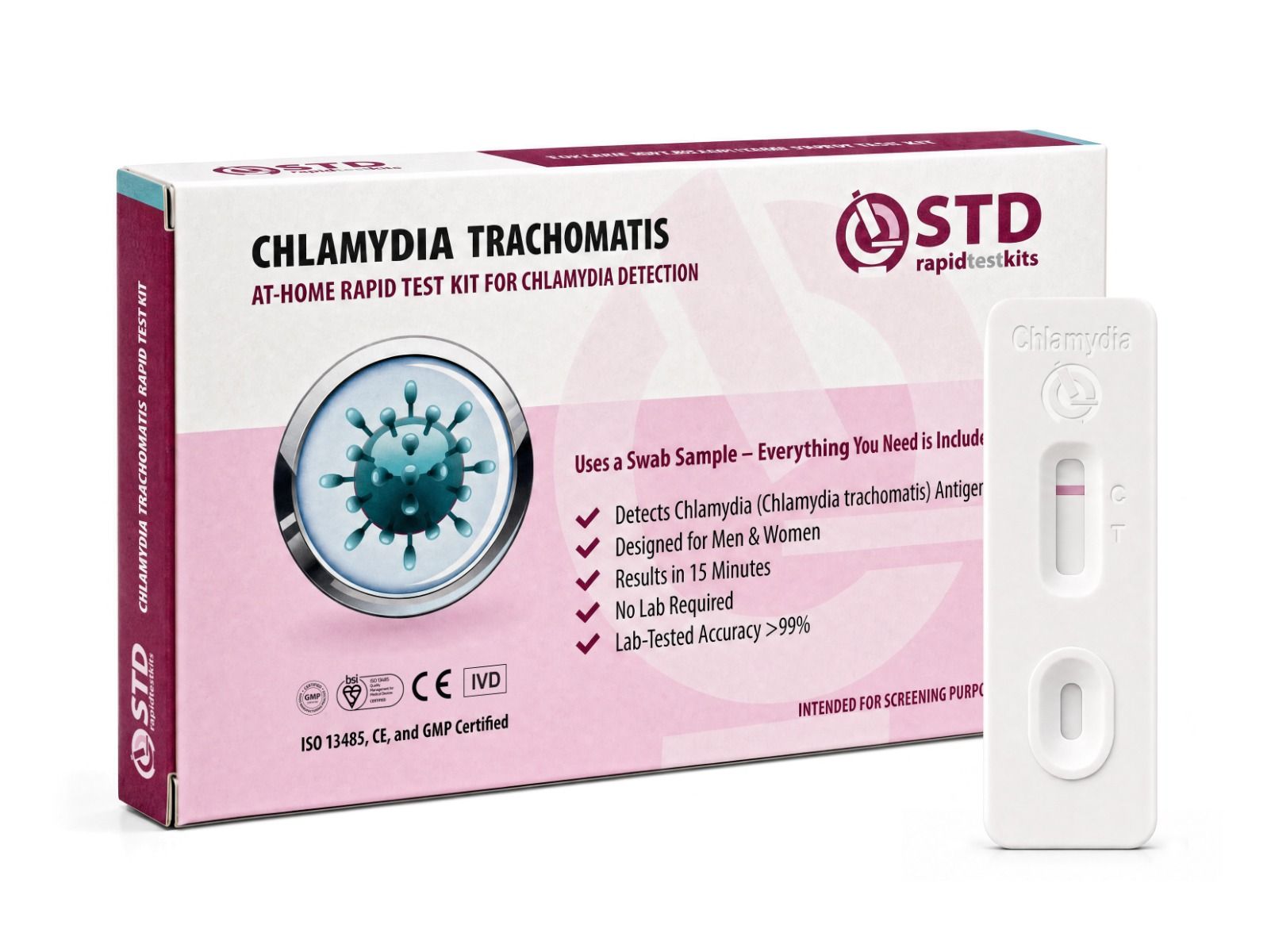
At-home rapid chlamydia testing uses lateral-flow chemistry on a self-collected swab. The two test technologies sit at different points on the speed-versus-sensitivity tradeoff. Use the table below as a reading guide: a positive rapid result is reliable and worth acting on, while a negative rapid during a strong symptom flare or shortly after a known exposure is worth confirming with a lab NAAT.
| Attribute | Lab NAAT | At-home rapid lateral-flow |
|---|---|---|
| Result speed | 1 to 3 days after the lab receives the sample | About 15 minutes after running the swab |
| Analytical sensitivity | Highest available; gold standard for confirming infection | Lower than NAAT; works best when bacterial load is high during a symptom flare |
| Best use case | Confirmatory test, screening at a clinic, follow-up after a positive rapid | Private first screen at home, fast answer when a clinic visit is hard to arrange |
What Our Test Kits Cover
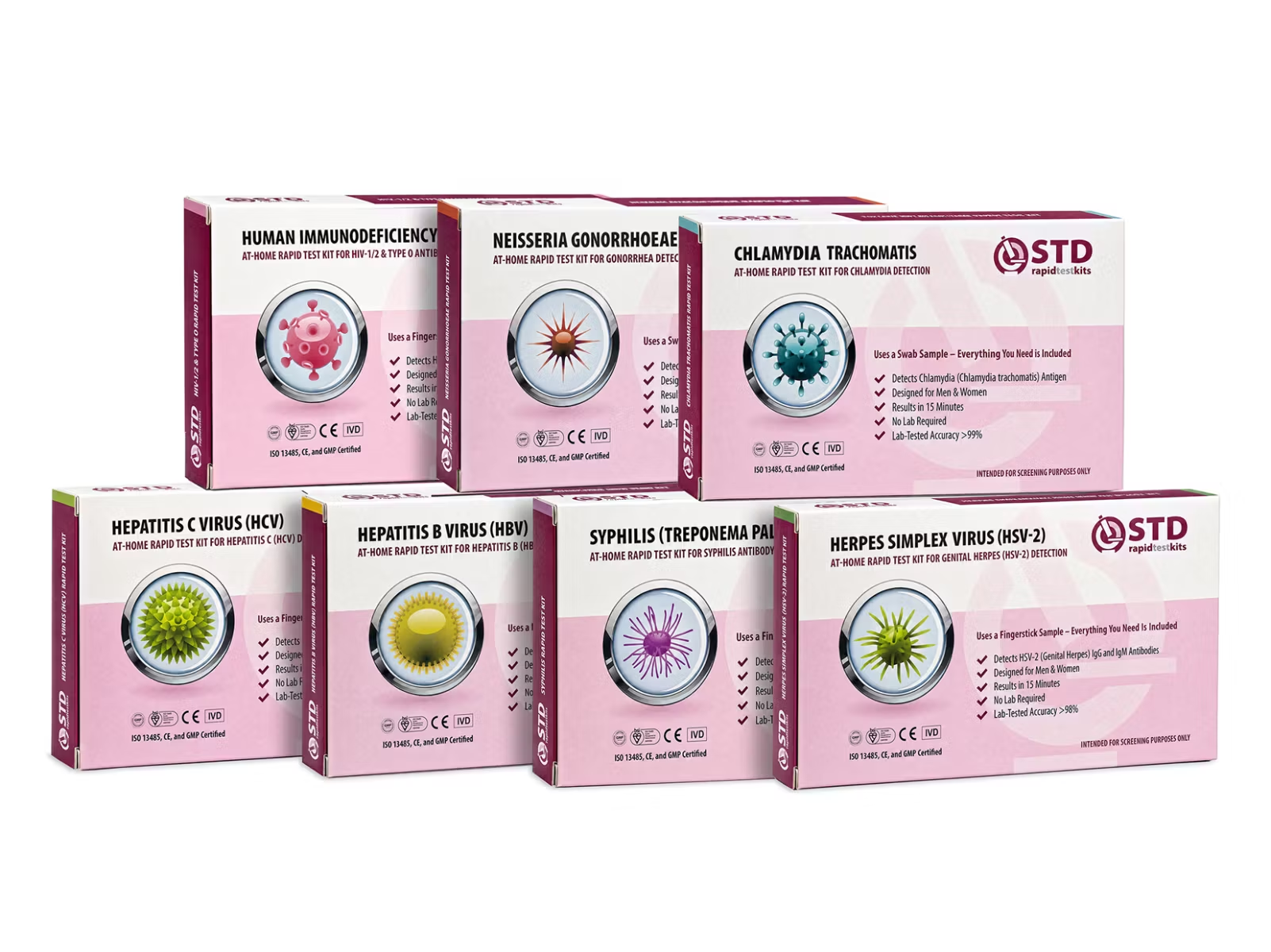
stdrapidtestkits.com sells rapid lateral-flow chlamydia and gonorrhea swabs, plus combination kits that screen for several STIs at once. We do not sell a UTI test. If your symptoms strongly suggest a UTI alone (cloudy urine, suprapubic pressure, fever, flank pain), a primary-care or urgent-care visit is the right first step. If your symptoms could be either condition, our rapid chlamydia or combination tests answer the STI half without a clinic trip, and a clinician can rule the UTI in or out separately.
When to Test, and When to Retest
You do not need a perfect reason to test. If any of the following are true, testing is the right next step.
- You have classic UTI symptoms (burning, urgency, pelvic pressure) and you have had unprotected sex with a new or untreated partner in the past three weeks.
- You started UTI antibiotics and you do not feel noticeably better within 48 hours.
- Your symptoms are mostly discharge or post-sex bleeding rather than the bladder-pressure pattern of a typical UTI.
- A current or former partner told you they tested positive for an STI.
- You have not been screened in over a year and you are sexually active, especially with new or multiple partners.
If your test comes back positive for chlamydia and you complete treatment, the CDC recommends a retest about three months later to catch reinfection. Reinfection from an untreated partner is the most common reason for a positive retest, not a treatment failure (CDC STI Treatment Guidelines, chlamydia).
Men and women who have been treated for chlamydia should be retested approximately 3 months after treatment, regardless of whether they believe their sex partners were treated.
What to Do If UTI Antibiotics Did Not Help
This is the single most useful diagnostic clue you have. UTIs caused by E. coli respond fast to standard first-line antibiotics. By 48 hours of effective treatment, most people are noticeably better. If you finished a course (or even just made it 48 hours in) and you still feel burning, urgency, or pelvic pain, the original diagnosis is probably wrong.
The most common reasons a course of UTI antibiotics fails to help:
- It was chlamydia or gonorrhea after all. Both can present with urethritis (irritation of the urethra) that mimics a UTI. Standard UTI antibiotics do not cover them.
- It was trichomoniasis. Trich is another sexually transmitted infection that can cause urethral irritation, especially in people with vaginas. It needs a different antibiotic class entirely (metronidazole or tinidazole).
- It was a UTI caused by a resistant strain. If E. coli has developed resistance to the first-line antibiotic, a urine culture will identify what does work.
- It was a yeast infection or vaginitis, not a urinary infection at all. Irritated vulvar tissue can produce a burning sensation when urine touches it that feels like dysuria (the medical term for painful urination) but is contact pain on the external tissue.
The right next step is not another round of the same antibiotic. The right next step is testing for the alternatives.

Reassurance: Common, Treatable, Survivable
Some context worth keeping in mind while you decide what to do.
Chlamydia is the most commonly reported bacterial sexually transmitted infection in the United States, and the actual case count is higher than reported because most cases are silent and never diagnosed. Most people who have ever been sexually active will encounter it at some point. It is fully treatable with a short course of antibiotics: per the CDC's current Sexually Transmitted Infections Treatment Guidelines, doxycycline 100 mg twice daily for seven days is the first-line regimen for non-pregnant adults (CDC chlamydia treatment guidelines).
UTIs are even more common, especially for people with vaginas, who can experience them repeatedly throughout life. They are also fully treatable. Both conditions become serious when they are ignored, not when they are caught early.
The reason this article exists is not to alarm you. It is to give you a faster off-ramp from the "is this anything?" loop. If you are reading because you are quietly worried about symptoms that might be more than a UTI, the answer to "should I test?" is almost always yes. Testing is fast, private, and ends the loop.
FAQs
- Can chlamydia really feel like a UTI?
- Yes. Chlamydia inflames the urethra in the same way a UTI does, which produces the same burning, urgency, and pelvic pressure. The two are easily confused in the first 24 to 48 hours, especially in people with a history of UTIs. The differentiating clues are usually discharge, post-sex bleeding, or a recent new partner; if any of those are present, test for chlamydia.
- How fast should UTI antibiotics work, and what does it mean if they do not?
- Standard first-line UTI antibiotics produce noticeable improvement within 48 hours when the diagnosis is correct. If you are 48 hours in and your symptoms are unchanged, the original diagnosis is probably wrong. The most common alternatives are chlamydia, gonorrhea, trichomoniasis, a yeast infection, or a UTI caused by an antibiotic-resistant strain. Each of these needs a different test and a different treatment.
- What kind of discharge points to chlamydia rather than a UTI?
- UTIs do not cause discharge from the vagina or penis. UTI urine itself can look cloudy or smell strong, but that is the urine, not discharge. Chlamydia, on the other hand, often causes a clear, white, or yellow discharge that is separate from urine. If you have new discharge along with burning urination, lean toward chlamydia and test.
- Can men get UTIs, or are urinary symptoms in men usually from an STI?
- Men do get UTIs, but they are uncommon, especially in younger men. When a man under about 50 has burning urination, urgency, and any urethral discharge, the odds favor an STI such as chlamydia or gonorrhea over a true UTI. Men with risk factors (prostate enlargement, recent catheter use, diabetes) can get UTIs. Either way, the right answer is to test rather than guess.
- Can I have a UTI and chlamydia at the same time?
- Yes, and it is more common than you would expect. The two infections do not protect against each other, and the conditions that put you at risk for one (sexual activity, anatomy, hygiene around urination) often overlap with the conditions that put you at risk for the other. This is why combination testing is so useful: you do not have to choose one diagnosis and miss the other.
- How long can chlamydia stay silent in my body?
- Months, sometimes years. The CDC notes that most chlamydia infections never cause noticeable symptoms, which means the only way to find them is through routine screening. A silent infection still causes inflammation, can still pass to partners, and can still progress to PID, epididymitis, or scarring. Routine testing every 3 to 6 months is the right rhythm if you are sexually active with new or multiple partners.
- Does cranberry juice help with chlamydia?
- No. Cranberry products contain compounds (proanthocyanidins) that may make it slightly harder for E. coli to stick to the bladder wall, which is the bacterium most UTIs are caused by. Cranberry has no effect on Chlamydia trachomatis, which is a different bacterium living in different tissue. If your burning is from chlamydia, cranberry juice will not help and waiting it out lets the infection continue.
- Is at-home chlamydia testing accurate enough to act on?
- A positive result on an at-home rapid chlamydia test is reliable and worth acting on by contacting a clinician for treatment. A negative result is a useful screen but is less sensitive than a laboratory NAAT, especially shortly after exposure or during a strong symptom flare. If your symptoms persist after a negative rapid test, follow up with a clinic NAAT. The two technologies are complementary, not equivalent.
- U.S. Centers for Disease Control and Prevention. Chlamydia overview. General prevalence, asymptomatic-rate language, transmission, and complications.
- U.S. Centers for Disease Control and Prevention. Pelvic Inflammatory Disease overview. PID complications including infertility, ectopic pregnancy, and chronic pelvic pain.
- U.S. Centers for Disease Control and Prevention. STI Treatment Guidelines, Chlamydial Infections. First-line doxycycline regimen and three-month retest recommendation.
- U.K. National Health Service. Urinary tract infections (UTIs) overview. Standard UTI symptom presentation and kidney-spread warning signs.
- U.K. National Health Service. Chlamydia overview. Symptom presentation, complications including epididymitis and reactive arthritis.
