Faint Line on STD Test: What It Means and When to Retest
A faint second line on an at-home STI rapid test sits in a confusing middle space between clear positive and clear negative. This guide explains what the line really means on the lateral-flow chemistry our kits use, why early testing is the most common cause of a weak band, when to retest, and when to skip the home test entirely and book a clinic appointment.
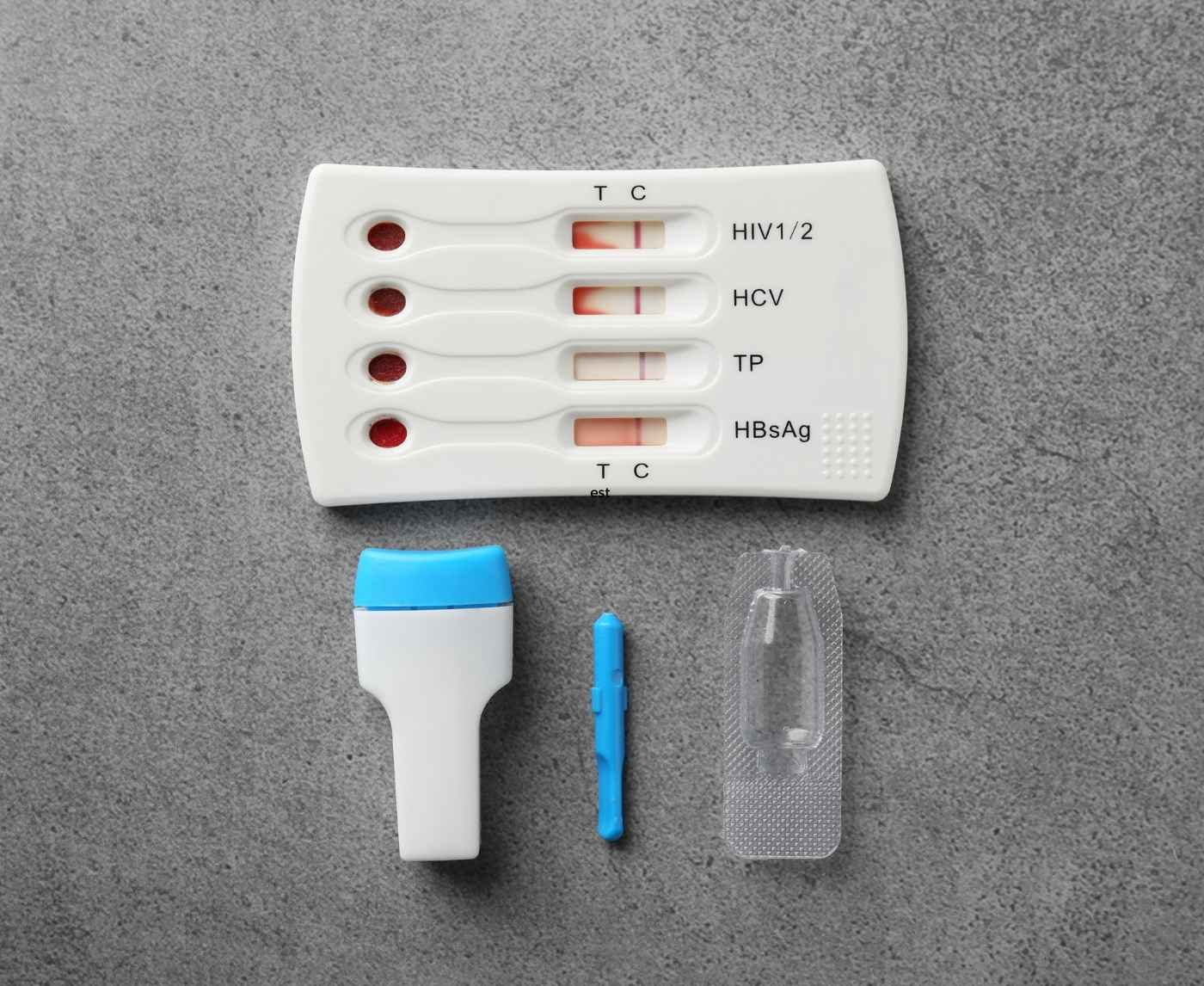



- A faint line that appears within the kit's read window is more often a true positive at low marker concentration than a fluke. Treat it as a signal worth confirming, not as noise to dismiss.
- Lines that appear after the read window has closed are evaporation artifacts and do not count. Always read the cassette at the time the instructions specify, then discard.
Published: December 2025 | Last updated: April 2026 | Editorial review and quality control: Martina N.
The control line came up bold. Beside it, faintly, sits a second line. The line is dim but clearly visible, and search-result answers swing from "definitely positive, retest right now" to "just an evaporation line, ignore it." This guide is the calm middle. It walks through what a faint line really represents on the lateral-flow rapid tests sold for home use, why the line can look weak even when the result is real, when the line is noise rather than signal, and what to do next.
Does a faint line on a rapid STI test mean I have an STI?
A faint second line that appears within the kit's stated read window (usually 10 to 20 minutes) and matches the test's color guide is most often a real positive at a low antibody or antigen concentration. It can also reflect testing too early in the window period, an expired or mis-stored kit, or an evaporation artifact read past the time window. The right next step is almost always to retest with a fresh kit at the correct interval, and to confirm any persistent faint or positive result with a clinic-based lab test.
Key takeaways
- A faint line that appears within the kit's read window is more often a true positive at low marker concentration than a fluke. Treat it as a signal worth confirming, not as noise to dismiss.
- Lines that appear after the read window has closed are evaporation artifacts and do not count. Always read the cassette at the time the instructions specify, then discard.
How a rapid lateral-flow STI test produces those two lines
Every at-home rapid STI test sold in the US uses lateral-flow immunoassay chemistry, the same family of tests as a home pregnancy test or a COVID rapid antigen test. Your sample (a fingerstick blood drop for HIV, syphilis, hepatitis B, hepatitis C, and herpes panels; a self-collected vaginal or penile swab for chlamydia, gonorrhea, trichomoniasis, and HPV) is mixed with a buffer and applied to one end of a paper-and-membrane strip inside the cassette.
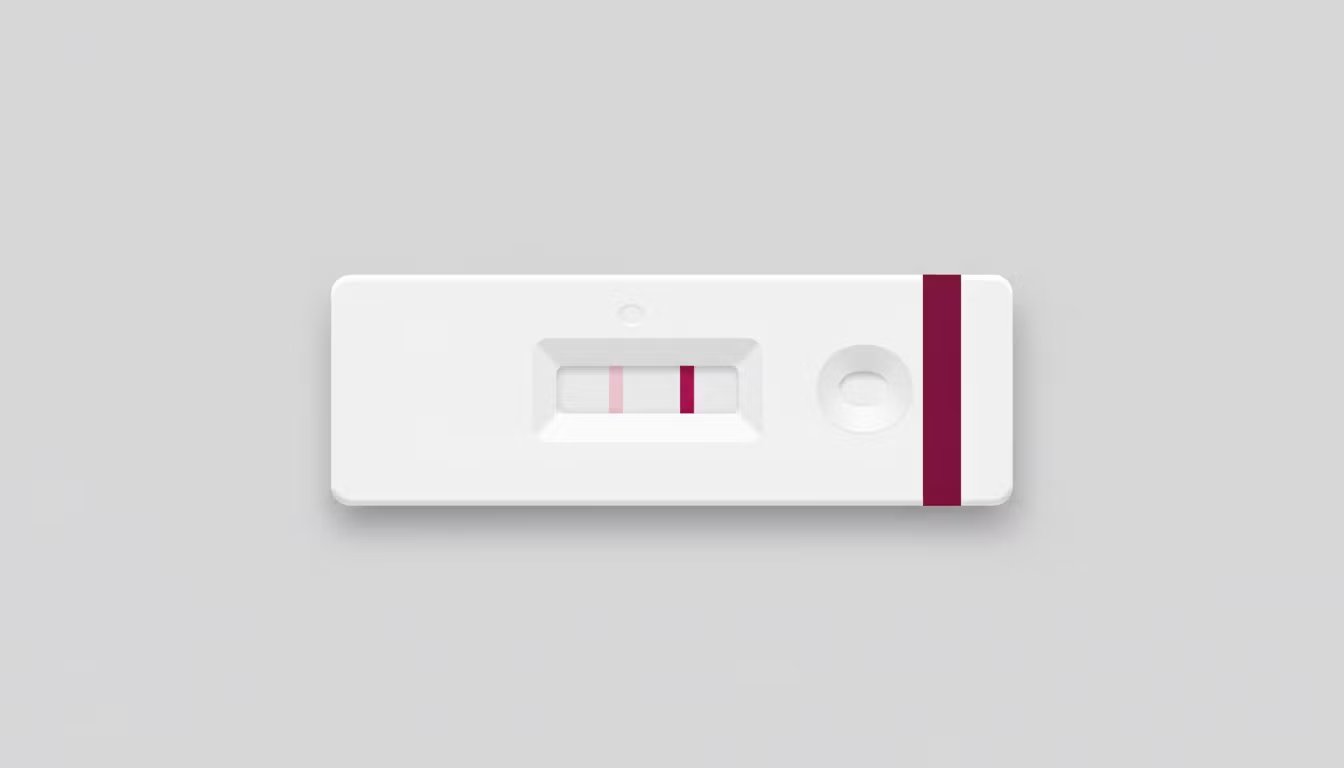
The strip wicks the sample sideways. Embedded antibodies tagged with a colored dye latch onto the target marker if it is present in your sample, for example antibodies your body produced in response to HIV, or surface proteins shed by chlamydia bacteria. When the dyed complex hits the test region (T), it concentrates into a visible band. Excess dye continues to the control region (C) and binds there regardless of the sample, confirming the chemistry ran. One band at C means negative. Bands at both C and T means a marker was detected, and that result counts even when the T-line is dim.
This site sells only lateral-flow rapid tests, the home version of the same chemistry used in clinic point-of-care testing. We do not sell urine-sample tests, throat or rectal swabs, or lab-processed mail-in nucleic acid amplification panels. If you used a urine-based or throat-swab test from a different provider, the troubleshooting in this guide still mostly applies, but always cross-check the kit's own instruction sheet first; manufacturer-specific read windows and sample-volume requirements vary.
What a faint second line actually means
A barely-visible T-line is the test telling you it found some of the target marker, but at a low concentration. Three common scenarios produce this pattern:
- Early-stage infection. Your immune system has started producing antibodies, but the level is still ramping up. The strip detects the early antibody load and reports it honestly with a faint band that will get darker if you retest later in the window.
- Late-stage or treated infection. Antibodies for some STIs (notably syphilis and herpes) decline over time after the initial peak. A faint line years after a treated infection can reflect persistent low-level antibody, which is one reason providers monitor syphilis treatment response with non-treponemal tests like RPR or VDRL rather than the treponemal antibody assays used for initial screening (CDC, syphilis treatment guidelines).
- Marker-borderline result. The kit's chemistry is calibrated to flag positives above a specific cutoff. Samples sitting at or just below the threshold can produce a barely-perceptible band even when the actual marker level is clinically meaningful.
Lighting and viewing angle also matter when reading a faint cassette. A cassette read in low ambient light, or held at an oblique angle, can hide a real faint band; the same cassette under bright neutral light viewed straight-on reveals it clearly. If you suspect a faint line but cannot quite tell, photograph the cassette under good light and zoom in. Phone cameras often resolve color saturation that the human eye misses, especially when emotional load is high.
The table below summarizes the line patterns most readers see and how to interpret each one.
| What you see | Most likely meaning | What to do next |
|---|---|---|
| Bold C, faint T, both inside the read window | Real positive at low marker concentration | Retest with a fresh kit; confirm any persistent T-line at a clinic |
| Bold C, no T | Likely negative | If still inside the window for the infection, retest after the window closes |
| Bold C, faint T appearing only after the read window has closed | Evaporation artifact, not a real result | Discard, retest with a fresh kit and a timer |
| Faint or missing C | Test is invalid regardless of T-line | Discard and retest with a new kit |
| Faint T on an expired kit | Unreliable; reagent degradation distorts results | Discard and retest with an in-date kit |
Why testing too early is the most common reason for a faint line
The window period is the gap between exposure and when a test can reliably detect the resulting infection. Test inside that window and the marker may be present in your blood or genital sample at concentrations the strip can technically register, but only weakly. That is exactly when faint lines appear.
Window periods vary by infection and by test technology. The ranges below are conservative and apply to lateral-flow rapid antibody and antigen tests of the kind sold for home use; lab-based nucleic acid amplification tests (NAATs) detect some infections sooner. Always check your specific kit's instruction sheet for the manufacturer's stated window. For HIV in particular, the CDC notes that antibody tests can usually detect HIV 23 to 90 days after exposure, with most rapid and self-tests falling in that range (CDC, HIV testing).
| Infection | Sample type | Conservative window period | Retest interval after a faint line |
|---|---|---|---|
| HIV (rapid antibody) | Fingerstick blood | 23 to 90 days for definitive negative | Retest at 6 to 12 weeks if first faint line was earlier |
| Syphilis (treponemal antibody) | Fingerstick blood | 3 to 6 weeks | Retest at 6 weeks; clinic-confirm if line persists |
| Chlamydia (antigen) | Self-collected swab | 1 to 2 weeks | Retest at 14 days post-exposure |
| Gonorrhea (antigen) | Self-collected swab | 1 to 2 weeks | Retest at 14 days post-exposure |
| Hepatitis B surface antigen | Fingerstick blood | 3 to 9 weeks | Retest at 9 to 12 weeks if first faint line was earlier |
| Hepatitis C antibody | Fingerstick blood | 8 to 11 weeks | Retest at 12 weeks; clinic-confirm with HCV RNA |
| HSV-2 antibody | Fingerstick blood | 6 to 12 weeks (most); up to 16 weeks for confident negative | Retest at 16 weeks if first faint line was earlier |
When the test kit itself is the problem
Lateral-flow chemistry is robust but not bulletproof. A kit that has been frozen, baked in a hot car, stored in a humid bathroom drawer, or left past its printed expiration date can produce inconsistent reactions. The most common kit-related causes of a misleading faint line are:
- Expired reagents. The dye-tagged antibodies inside the strip break down over time. An expired kit can underbind the target marker, producing a faint line where a fresh kit would show a bold one, or a faint line where a fresh kit would show none at all.
- Heat or humidity damage. Cassettes opened or stored above the manufacturer's stated range (most label between 36F and 86F, kept dry) can lose specificity and report borderline results inconsistently.
- Sample volume or technique error. Too little blood, sideways buffer drips, double-dipping a swab, or contaminating the cassette window with a fingertip can all distort the wick pattern and produce smudged, faint, or blotchy bands.
- Reading past the window. Read the cassette only during the manufacturer's stated read window (usually 10 to 20 minutes after sample application). Lines that appear after the strip dries are evaporation residue, not a real result.
If your faint line came from a kit that lived in a hot car, sat under a leaky bathroom shelf, or expired six months ago, the safe interpretation is to discard the result entirely and start again with a fresh, in-date kit.
Before you trust any home-test result, find the foil pouch your cassette came in. Check the printed expiration date and the storage-range icons on the back. If the kit was ever in a hot car, in direct sun, in a freezer, or in a steamy bathroom drawer, treat it as compromised even if it looks fine. The reagents inside are temperature-sensitive, and a degraded kit can produce convincing-looking faint lines that have nothing to do with your actual health status.
The control line is the most important line on the cassette
Every cassette has two regions: T (test, where a positive result appears) and C (control, where a band always appears if the chemistry ran correctly). The C-line is the test telling you it worked. No C-line means the strip is broken or the sample never reached the strip's reactive zone, and the T-line cannot be trusted regardless of whether it is bold, faint, or absent.
If you read your cassette and the control band is missing, do not interpret the test region. Discard the cassette and start again with a fresh kit. If the control band is present but unusually faint, the chemistry probably ran weakly, and any T-line you see should be confirmed with a second kit before you act on it.
Most cassettes label the regions explicitly with a printed "C" and "T" inside the result window. Older or simpler cassettes may rely on position alone, with the control line positioned closer to the buffer-flow terminus. Either way the principle is the same: the line that always appears, regardless of sample, is the one telling you the chemistry ran. Treat any cassette where that line is missing or barely visible the same way you would treat a kitchen scale that does not zero out, by discarding it and using one that calibrates correctly.
Persons with reactive antibody screening test results require confirmatory testing before a diagnosis is made or treatment is initiated.
How to retest, and what to retest with
The right retest depends on three things: how long since exposure, what the original test was, and what symptoms (if any) you have now.
If you are inside the window period. Wait until the window has closed for the specific infection (see the table above) and retest with a fresh kit of the same type. If the original was an HIV antibody rapid test taken at three weeks post-exposure, repeat at six to twelve weeks for a more confident read. Retest results that are clearly negative once the window has closed are reliable evidence the original faint line was a false alarm.
If you are past the window and still seeing a faint line. The result is likely a true low-marker positive. Confirm with a clinic-based lab test. For HIV, that means a fourth-generation antigen-antibody combo test or an HIV RNA NAAT. For syphilis, treponemal plus non-treponemal serology (typically RPR or VDRL). For chlamydia and gonorrhea, a NAAT on the appropriate sample. Most STI clinics will run a confirmatory test the same day you walk in.
If you cannot tell which side of the window you are on. The safest move is to retest with a combo kit that covers the most likely infections, and treat any persistent faint result as a reason to see a clinician. Combination kits cover more infections in a single retest than running several single-infection tests in parallel. Pick the breadth that matches your actual risk profile (a 2-in-1 chlamydia plus gonorrhea swab covers a single high-risk genital exposure; a 6-in-1 or 8-in-1 panel covers several blood-borne and genital infections after a higher-risk encounter) rather than testing for everything regardless of context.
Retesting after treatment is its own protocol. Antibody-based tests for some infections (HIV, herpes, syphilis treponemal) can stay positive long after the active infection has cleared, because antibodies persist. Always follow your clinician's retest schedule rather than running another rapid test at home and panicking when the line is still there.
This article is published by stdrapidtestkits.com, which sells the at-home rapid lateral-flow kits referenced above; we recommend kits based on fit-for-purpose for the reader's concern, not commercial benefit.
When to skip the home test and go straight to a clinic
Rapid at-home tests are screening tools, useful when access to a clinic is hard, when discretion matters, or when you want a fast read on a low-risk encounter. They are not the right starting point in every situation. Skip the home test and book a clinician if:
- You have current symptoms. Genital sores, unusual discharge, painful urination, fever, rash on palms or soles, or pelvic pain need a clinical evaluation regardless of what a home test says. A negative home test does not rule out an active symptomatic infection, and a positive home test still needs treatment from a provider.
- The exposure was high-risk and recent. Condomless sex with a partner known to have an untreated infection, or potential needle-sharing exposure, warrants same-day clinical evaluation. HIV post-exposure prophylaxis (PEP) only works when started within 72 hours of exposure and ideally as soon as possible, so any delay matters (CDC, HIV PEP).
- You are pregnant or trying to become pregnant. Several STIs change pregnancy risk profiles, and the screening cadence in pregnancy is its own protocol that a clinician should manage.
- Your home test is repeatedly faint or invalid. Two or three faint or no-control-line results in a row points to either a kit batch issue or a borderline biological signal that a lab can resolve faster than continued home testing.
Most STI clinics, including Planned Parenthood and county public-health departments in the US, offer same-day testing on a sliding scale. Telehealth providers can arrange lab orders and confirmatory tests if you cannot get in-person care, and many will accept a photo of your home test cassette as a starting point for the visit (NHS, STI overview, for the equivalent UK pathway).
Faint line FAQs
- Does a faint line always mean I have an STI?
- Not always. The first thing to check is timing. If the line only appeared after the kit's stated read window closed (usually 10 to 20 minutes from sample application), it is almost certainly an evaporation artifact and does not count. If the line did appear inside the read window and matches the color described in the instructions, it usually means the test detected some level of the marker it screens for, and you should confirm with either a fresh kit or a clinic-based lab test before drawing conclusions.
- What if the faint line only showed up after the read window closed?
- That is almost always an evaporation artifact. As lateral-flow strips dry, residual reagents can leave a ghost mark in the test region. Real results only count when read inside the kit's stated window, which is usually 10 to 20 minutes from sample application. Anything you see at 30 minutes, an hour, or the next morning does not reflect the chemistry that ran during the test.
- Can an expired kit produce a fake faint line?
- Yes. Reagent degradation in expired kits can produce both false faint positives and false negatives. If your kit is past the printed expiration date, treat any result it gives you (faint, bold, or none) as unreliable and retest with a fresh, in-date kit. Storage extremes (frozen, baked in a hot car, kept in a humid bathroom drawer) can damage in-date kits the same way.
- Are faint lines more common on certain STI tests?
- They show up most often on antibody-based blood tests for HIV, syphilis, and herpes when the user tests early in the window period, before antibody levels have peaked. They also show up on swab antigen tests for chlamydia and gonorrhea when the bacterial load on the swab is borderline. Fourth-generation HIV antigen-antibody lab tests detect infection earlier than rapid antibody tests, but every assay has a window before the marker reaches a strong-line concentration.
- I feel fine but the line is faint. Should I still take it seriously?
- Yes. Many STIs are asymptomatic in their early or chronic stages, especially chlamydia, syphilis, hepatitis B, and HIV. Absence of symptoms is not evidence of absence of infection. A faint line in an asymptomatic person is just as worth confirming as a faint line accompanied by symptoms; sometimes more so, because asymptomatic infections are the ones most likely to go untreated and onward-transmit.
- If both the C and T lines are faint, what does it mean?
- A weak control line suggests the chemistry ran poorly, which makes any test-region reading unreliable. The safer interpretation is to treat the entire run as invalid, discard the cassette, and retest with a fresh kit. If the control line is consistently weak across multiple kits from the same batch, the batch may have a quality-control problem and you should switch to a kit from a different production lot.
- What is the single best way to avoid faint-line confusion next time?
- Three things. First, use an in-date kit stored at room temperature out of direct sunlight and humidity. Second, set a timer for the manufacturer's read window and read the cassette only during that window, not before and not after. Third, test inside the recommended detection window for the specific infection you are screening for, rather than the day after exposure when the marker has not yet built up to a detectable level.
Next steps when you see a faint line
If the line appeared inside the read window, take it seriously. Wait the appropriate retest interval (usually one to two weeks for early-window infections, or until the full antibody window closes for blood-based tests), then run a fresh kit. If the second kit also shows a faint or clearly positive line, see a clinician for a confirmatory lab test. If symptoms develop at any point, skip the retest and go straight to a clinic. A faint line is the test reporting something at the margin of its detection range. Run another kit, and confirm with a clinician if the line stays.

- U.S. Centers for Disease Control and Prevention. Overview of common sexually transmitted infections and how they are transmitted, used here as the general STI types-and-transmission reference.
- U.S. Centers for Disease Control and Prevention. HIV testing overview, including the 23 to 90 day antibody-test window period for rapid and self-tests.
- World Health Organization. Sexually transmitted infections fact sheet. Global prevalence, symptom presentation, and testing-pathway recommendations.
- U.S. Centers for Disease Control and Prevention. STI Treatment Guidelines, syphilis chapter. Source for treponemal versus non-treponemal serology and the use of RPR or VDRL to monitor syphilis treatment response.
- U.S. Centers for Disease Control and Prevention. HIV post-exposure prophylaxis (PEP), including the 72-hour window for starting PEP after a possible exposure.
- U.S. National Library of Medicine, MedlinePlus. STI test overview, sample types, and result interpretation for the major sexually transmitted infections.
- U.K. National Health Service. Overview of STI symptoms, testing, and where to seek care, used here as the equivalent UK clinical pathway for confirmatory testing.