
Published: November 2025 | Last updated: May 2026 | Editorial review and quality control: Martina N.
News from Ireland over the past two years has put a number on something millions of people already feel: getting a routine STI test has become a months-long wait, and in some towns it has stopped being available at all unless you already have symptoms or a named contact. The country's Health Service Executive has confirmed sustained pressure on its public sexual-health services, and the Health Protection Surveillance Centre (HPSC) continues to record rising notifications of chlamydia, gonorrhea, and syphilis. The headlines focus on Dublin, but the same access pattern appears in the UK, the United States, and Canada, and the rest of this article walks through what that means for someone trying to get tested today.
Key Takeaways
- Public STI testing in Ireland, the UK, and parts of the US has wait times of weeks to months. The same access gap exists worldwide, not just locally.
- Most STIs cause no symptoms, so a clinic that screens only symptomatic patients misses the majority of infections in the community.
Ireland's testing backlog is part of a global pattern
Framing the Irish backlog as one country's budget shortfall misses what the data shows. The World Health Organization estimates roughly one million curable STIs are acquired worldwide every day, the majority of them asymptomatic. Demand for screening has risen across high-income countries while public-sector capacity has not kept pace.
In Ireland, the friction became visible when people began sharing wait times publicly. The HSE has reported sustained increases in chlamydia, gonorrhea, and syphilis notifications, and several public clinics have triaged services so that asymptomatic walk-ins get pushed to home-test kits or weeks-long wait lists. Some local services moved to symptom-only or contact-traced screening, which sounds reasonable until you remember that most chlamydia and most pharyngeal gonorrhea cases cause no symptoms at all (CDC). If clinics only screen the visibly sick, the infections that drive transmission go unnoticed, and the country's case counts climb anyway.
The WHO estimates roughly 1 million curable STIs are acquired worldwide every day. The four countries covered in this article (Ireland, the UK, the US, Canada) sit inside that wider trend: rising demand for screening, public-sector capacity that has not scaled to match, and routine asymptomatic screening pushed to mail-order kits or wait lists.
The emotional cost of a broken testing system
Imagine building up the courage to test, maybe after a partner disclosed an exposure, maybe because something felt off, and being told the next appointment is six weeks away. For someone already anxious or working through stigma, the wait isn't just an inconvenience. It changes behavior. Public health surveys consistently find that people who can't access testing within their planning horizon are more likely to skip protection in the meantime, delay telling partners, and avoid the system entirely on the next round.
For people already excluded from mainstream care, survivors of sexual violence, sex workers, trans and non-binary people, queer folks in rural areas, the delay can land as a message that their health isn't a priority. None of that is hypothetical. The HSE itself flagged uneven access as one of the drivers behind its 2024 review of national sexual-health services. Access to testing is a basic prerequisite for stopping transmission and for personal autonomy over health decisions.

Where at-home testing steps in
Disclosure: stdrapidtestkits.com sells the rapid home-testing kits referenced in this article.
A self-administered rapid kit doesn't replace a sexual-health clinic for treatment, partner notification, or complex symptoms. What it does is collapse the time between worry and a credible answer. You can screen on your own schedule, in your own home, without explaining your sex life to a stranger or competing for a slot that doesn't exist.
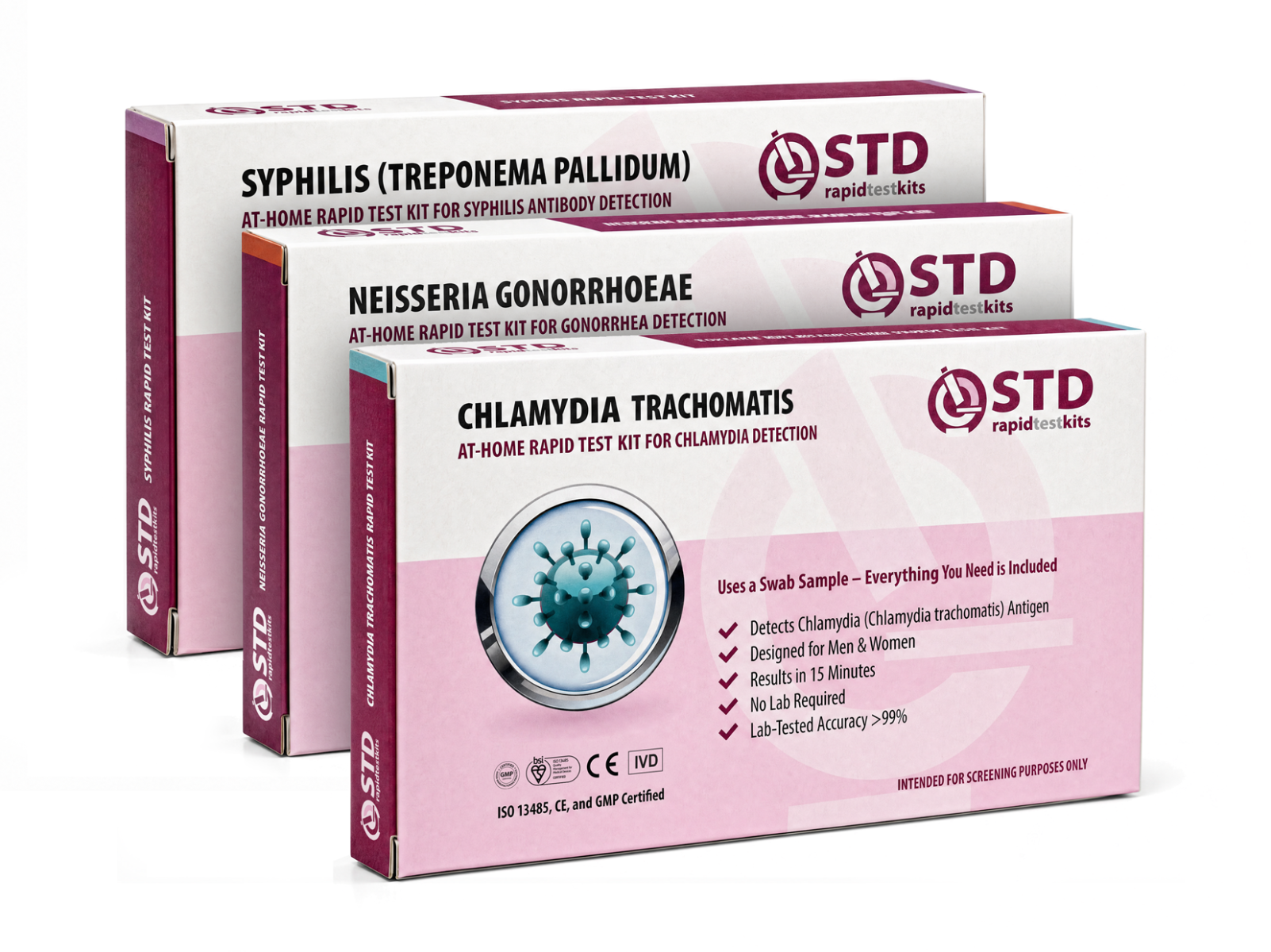
The rapid lateral-flow kits sold through stdrapidtestkits.com cover the most common questions people ask their doctors: chlamydia and gonorrhea via self-collected swab, plus HIV, syphilis, and hepatitis via fingerstick blood. These are screening tools, not lab-grade NAATs. A positive rapid result is worth confirming through a clinic, and a clinic NAAT is still the gold-standard test technology where it's accessible.
Used well, a home test is also a way to walk into a clinic faster. If you already know your screening result, the clinic appointment can focus on treatment, partner tracing, or follow-up testing rather than starting from zero.
Rapid lateral-flow kits are designed to screen. Clinic NAATs (PCR-based laboratory testing) are designed to confirm. They answer different questions: a home rapid kit answers quickly, am I likely positive right now? A clinic NAAT answers with high analytical sensitivity, is the infection definitively present? Use both in sequence when a home result comes back positive.
Global trends, local failures
The Irish numbers sit inside a wider pattern. The HPSC's 2023 notification data showed chlamydia and gonorrhea cases climbing year over year, with HIV diagnoses rising in particular subgroups including younger men and migrants (HPSC). The infrastructure for diagnosing and treating those cases hasn't scaled to match.
The UK has seen similar pressure: Public Health bodies and the NHS have reported reduced walk-in capacity at sexual-health (GUM) clinics in several regions since 2021, with online-order kits being used to absorb routine asymptomatic screening (NHS). In the United States, the mechanism is different but the result rhymes; the CDC has flagged sustained increases in syphilis and gonorrhea, and rural public-health funding has been cut in several states, lengthening waits for basic screening (CDC). Canada, often held up as a model for access, has begun routing more routine STI testing through private labs to manage public-sector backlogs in several provinces.
Across England, multiple regions have reported reduced GUM (genitourinary medicine) clinic walk-in hours and staffing since 2021, with online-order kits absorbing routine asymptomatic screening (NHS). In the US, CDC surveillance shows sustained year-over-year increases in syphilis and gonorrhea, while several rural states have cut public sexual-health funding, lengthening waits for in-person screening.
Snapshot of global STI testing delays
Wait times vary by clinic and by season, but the broad pattern across high-income public sectors is consistent. Routine non-emergency STI screening waits compiled from the HSE (Ireland), the NHS (UK), the U.S. CDC, and provincial Canadian health authorities run as follows.
| Country | Public-clinic wait (routine) | Top reported barrier | At-home testing availability |
|---|---|---|---|
| Ireland | 4 to 8 weeks | Limited slots, staff shortages | Yes; mail-order kits, uneven rural distribution |
| United Kingdom | 2 to 6 weeks | Clinic closures, high demand | Yes; NHS-issued kits and private vendors |
| United States | 10 days to 6 weeks | Clinic underfunding, insurance gaps | Yes; widely available online |
| Canada | 2 to 4 weeks | Provincial lab delays | Yes; primarily private labs |
Not everyone can wait, and they shouldn't have to
Delay has consequences. Untreated chlamydia is the leading preventable cause of pelvic inflammatory disease, which can scar the fallopian tubes and reduce future fertility (CDC chlamydia fact sheet). Untreated gonorrhea can cause epididymitis in men and is increasingly resistant to first-line antibiotics. Untreated syphilis progresses through stages, with neurological and cardiovascular damage possible in late stages (CDC syphilis fact sheet).
HIV deserves its own paragraph here, because it's the fear that drives so many testing decisions and because the public-clinic gap has direct knock-on effects. Untreated bacterial STIs disrupt mucosal barriers and modestly raise the risk of HIV acquisition during a subsequent exposure. If HIV exposure itself is what you're worried about, the testing window matters: a fourth-generation antigen/antibody lab test can detect infection from roughly 18 to 45 days after exposure, while antibody-only rapid tests typically need 23 days to three months for reliable results (CDC HIV testing guidance). A single negative result inside the window doesn't rule out infection; repeat testing at the end of the window is what closes the loop, and a dedicated at-home HIV rapid test can cover the screening side when clinic appointments aren't available.
There is a quieter cost as well: trust. When public services dismiss or delay someone repeatedly, they're less likely to try again, and they're more likely to assume that no symptoms means no infection. That assumption is wrong for most STIs, and it accounts for much of the ongoing transmission that stays invisible in places where public screening is rationed. If your public-sector wait is unworkable, using a home screen is a reasonable and practical bridge while you remain on a clinic list.
The hidden cost of testing gaps: undiagnosed infections
Long testing delays aren't only an emotional problem, they're an epidemiological one. When access slows, infections stay hidden and silent transmission continues. The proportion of STIs that are asymptomatic is the part of the picture most readers underestimate.
Public-health data is consistent on this. The U.S. CDC estimates that most chlamydia infections in women cause no noticeable symptoms, and a substantial share in men do the same (CDC chlamydia detailed fact sheet). Gonorrhea is similar at common sites, and pharyngeal (throat) gonorrhea is asymptomatic in the vast majority of carriers. Syphilis can sit quietly through its early latent stage for months. The clinical reality is that if you only test the people who feel sick, you miss the larger group who carry and pass infection without warning.
People who try to test and can't sometimes turn to alternatives that worsen the picture. Some take antibiotics speculatively when a partner discloses an exposure, which fuels resistance and masks the actual diagnosis. Others wait, hoping things will resolve.
The World Health Organization notes in its fact sheet on sexually transmitted infections that most STIs are asymptomatic, that symptoms when they occur are often non-specific, and that limited access to testing and treatment contributes to ongoing community spread. See <a href="https://www.who.int/news-room/fact-sheets/detail/sexually-transmitted-infections-(stis)" target="_blank" rel="noopener">WHO STI fact sheet</a> for the full text.
Where undiagnosed STIs concentrate by region
Public-sector screening coverage varies sharply by region, with patterns reported by national surveillance systems and the CDC's STI Treatment Guidelines. Where access is easiest, asymptomatic detection runs higher; where backlogs or insurance friction are worst, chlamydia and gonorrhea drift unnoticed for the longest.
| Region | Screening coverage gap | Most commonly missed infections | Main barrier |
|---|---|---|---|
| Ireland | Significant | Chlamydia, gonorrhea | Clinic backlog, rural access |
| United Kingdom | Significant | Syphilis, chlamydia | Clinic closures, stigma in rural areas |
| United States | Wide | Gonorrhea, Mycoplasma genitalium | Insurance gaps, infrequent routine screening |
| Canada | Moderate | Chlamydia, syphilis | Lab delays, limited northern access |
The shame spiral: why some people give up on testing
What rarely makes it into public health dashboards is the cycle that follows a missed appointment. It starts with one delay, then a no-show because life moved on, then a partner who won't talk about it, and then the next bout of worry feels heavier than the first. The longer the gap, the harder restarting feels.
For people already navigating stigma, that gap compounds. The longer someone goes without testing, the more complicated and isolating it feels to walk back into a clinic, especially in a small community where staff are visible neighbors. Clinicians who work in stigma-aware care commonly report this pattern: the people most at risk of falling out of routine screening are the ones who have already done it once and felt let down by the wait.
The way out is to make the next step as small as possible. A self-administered rapid screen at home is a small step. It doesn't require booking, doesn't require travel, doesn't require a conversation before you're ready for one. A clear positive result then becomes a reason to walk into a clinic, with a concrete agenda. A clear negative result is a reason to keep testing on schedule.

You deserve more than a waitlist
If you're stuck in the maybe-next-week cycle, the bottleneck is public service capacity. Your health doesn't have to pause while the public sector catches up. There are practical tools to bridge the gap, and using them counts as harm reduction in straight terms. The path forward is short and concrete, summarized below.
- Screen at home for the infections that match your risk profile.
- Confirm any positive result with a clinic NAAT (PCR-based laboratory test) where you can.
- Treat through whichever channel is fastest, public clinic, GP, or private provider.
- Re-test on schedule a few weeks after treatment to confirm clearance, and continue routine screening every 3 to 6 months if you have new or multiple partners.
Continue using condoms or other barrier protection during the screening window. Your sexual health doesn't have to wait for the public sector to rebuild capacity.
Frequently Asked Questions
- Is Ireland really out of STI testing slots?
- In many regions of Ireland, public STI testing waits run several weeks, and some smaller clinics have moved to symptom-only or contact-traced screening. That doesn't mean testing is impossible. It means routine asymptomatic screening through public clinics is often delayed. Home-test kits and private clinics fill the gap for many people in the meantime.
- I have no symptoms. Should I still test?
- Yes, if you've had a new partner, multiple partners, or a partner with a known exposure. The majority of chlamydia and pharyngeal gonorrhea cases are asymptomatic, especially in women. Routine screening every 3 to 6 months is the CDC's standing advice for people with multiple or new partners, with or without symptoms.
- Can I just test at home instead of going to a clinic?
- For routine screening of common STIs, yes. Rapid lateral-flow kits are accurate when the instructions are followed and you're outside the early window period. They are screening tests. A positive result is still worth confirming with a clinic NAAT, and treatment is still done through a clinician. For symptomatic cases, anatomically specific samples like throat swabs, or partner notification, a clinic visit is still the right step.
- What if my partner refuses to get tested?
- This happens often. Try shifting from accusation to teamwork: "Let's both get checked so we know we're good." Suggest doing it together at home if a clinic feels like too much. If they still won't, get yourself tested anyway, use protection, and make the decision that protects your health.
- Why are throat swabs important?
- Oral sex can transmit gonorrhea and chlamydia to the throat. Pharyngeal infections are usually symptom-free, so they only get caught when a clinician actively swabs the throat. If you give or receive oral sex, ask for a throat swab at your clinic visit. Note: home rapid kits cover genital swabs and blood draws, not pharyngeal samples. For throat testing, you'll need a clinic.
- What happens if I can't get tested in time?
- Untreated infections continue to be transmissible and can cause complications, pelvic inflammatory disease and infertility from untreated chlamydia, antibiotic-resistant gonorrhea, and progression of untreated syphilis. Testing late is still better than not testing. If the public clinic can't see you, a home screen is a credible bridge. Confirm any positive with a clinic and start treatment as soon as you can.
- How often should I test if I'm sexually active?
- If you have new or multiple partners, screening every 3 to 6 months is reasonable. If you have one partner who isn't monogamous, the same applies. Always re-test a few weeks after treatment to confirm clearance. A single negative result doesn't cover indefinite future exposures.
- Is at-home testing really accurate?
- Peer-reviewed validation studies for lateral-flow chlamydia and gonorrhea tests typically report sensitivity above 90% when the sample is collected per instructions and the test is used outside the early window period; check the IFU (instructions for use) sheet bundled with your specific kit for its published sensitivity and specificity figures. Analytical sensitivity remains below a laboratory NAAT, so a positive home result is worth confirming at a clinic. Practically speaking, the best test is the one you'll actually do.
How we sourced this article: We combined current guidance from leading public-health authorities, the CDC, the WHO, the NHS, and Ireland's HSE and HPSC, with surveillance data from each country's national reporting system. Editorial framing is the writer's; clinical accuracy was reviewed by Dr. Aikaterini Maragkou before publication. Below are the most relevant sources for further reading.
- Health Service Executive (Ireland). Survey on sexual-health testing among 18 to 30 year olds, showing more than half have never tested for an STI.
- World Health Organization. Fact sheet on sexually transmitted infections, including global burden estimates and the asymptomatic-carriage problem.
- U.S. Centers for Disease Control and Prevention. STI Treatment Guidelines, the canonical reference for which infections are included in a routine screening panel and how often to screen.
- Health Protection Surveillance Centre (Ireland). National STI notification data, including the most recent year-over-year increases in chlamydia, gonorrhea, and syphilis.
- NHS (United Kingdom). Patient-facing guidance on sexually transmitted infections, NHS sexual-health clinic access, and home-testing options.
- U.S. Centers for Disease Control and Prevention. HIV testing overview, including window periods for fourth-generation antigen/antibody tests and antibody-only rapid tests.
