

Published: July 2025 | Last updated: April 2026
You noticed something in your mouth. A creamy patch on the tongue, a sore that will not heal, gums that bleed when you brush. And now you are wondering whether this is the first sign of HIV. Mouth signs alone never confirm HIV, and acute HIV (the early infection that follows a recent exposure) usually presents as a flu-like illness affecting the whole body, not as an isolated tongue patch. Oral changes linked to HIV exist, they matter, and clinicians take them seriously in the right context. Most readers who arrive here with a single mouth symptom turn out to have something far more common: dehydration, a stressed-out immune system fighting off a regular viral illness, a recent antibiotic course, dental hygiene that needs a refresh. This article walks through every oral sign that has been associated with HIV, what each one usually means, why timing matters more than appearance, and how to move from a Google spiral to a real answer.
Can HIV show up in your mouth?
Yes, though mouth signs alone never confirm HIV. HIV-related oral changes (thrush, persistent ulcers, gum disease, hairy leukoplakia) usually appear when the immune system is already weakened, often months or years into untreated infection. Acute HIV more commonly presents as a flu-like illness with fever, sore throat, and swollen lymph nodes. Most isolated oral symptoms are explained by canker sores, dehydration, gingivitis, or thrush from non-HIV causes. The only way to confirm or rule out HIV is a properly-timed test: a NAT from about 10 days post-exposure, a 4th-generation antigen/antibody test from 18 to 45 days, or a rapid fingerstick antibody test from roughly 23 to 90 days, per <a href="https://www.cdc.gov/hiv/testing/" target="_blank" rel="noopener">CDC HIV testing guidance</a>.
Key Takeaways
- HIV can cause oral thrush, persistent ulcers, gum disease, and hairy leukoplakia, though each of these signs is far more often caused by something else, and none of them is diagnostic on its own.
- The reliable answer to “is this HIV?” comes from a properly-timed test, not from staring at your tongue. NAT detects HIV from about 10 days, 4th-generation tests from 18 days, rapid fingerstick from roughly 23 days post-exposure.
How HIV Affects Oral Health
HIV targets CD4 T-cells, the white blood cells that coordinate immune response. As CD4 counts drop, the mouth becomes more vulnerable to infections that a healthy immune system normally suppresses. That includes overgrowth of Candida yeast, reactivation of latent viruses such as Epstein-Barr, and inflammatory gum disease driven by oral bacteria.
Most oral manifestations of HIV occur in people who do not yet know they are infected, who are not on antiretroviral therapy (ART), or whose HIV has progressed to advanced stages. People on effective ART with suppressed viral loads rarely develop the classic HIV-associated oral conditions, because the underlying immune compromise that drives them is prevented.
Acute HIV (the seroconversion phase, roughly 2 to 4 weeks after exposure) typically behaves like a viral illness affecting the whole body: fever, fatigue, sore throat, swollen lymph nodes, body aches, sometimes a rash. Mouth ulcers can occur during this phase, though they almost never appear as the only symptom. Both the WHO HIV fact sheet and the NHS HIV symptoms guide describe acute HIV in systemic terms, not as a mouth-first illness.
HIV depletes CD4 T-cells, which weakens local immune defenses in the mouth. That allows microbes already living there (Candida yeast, Epstein-Barr virus, oral bacteria) to overgrow or reactivate, producing the classic oral findings. Effective ART preserves CD4 counts, which is why oral problems are far less common in people with suppressed viral loads.
Oral Thrush, the Most Recognizable Oral Sign
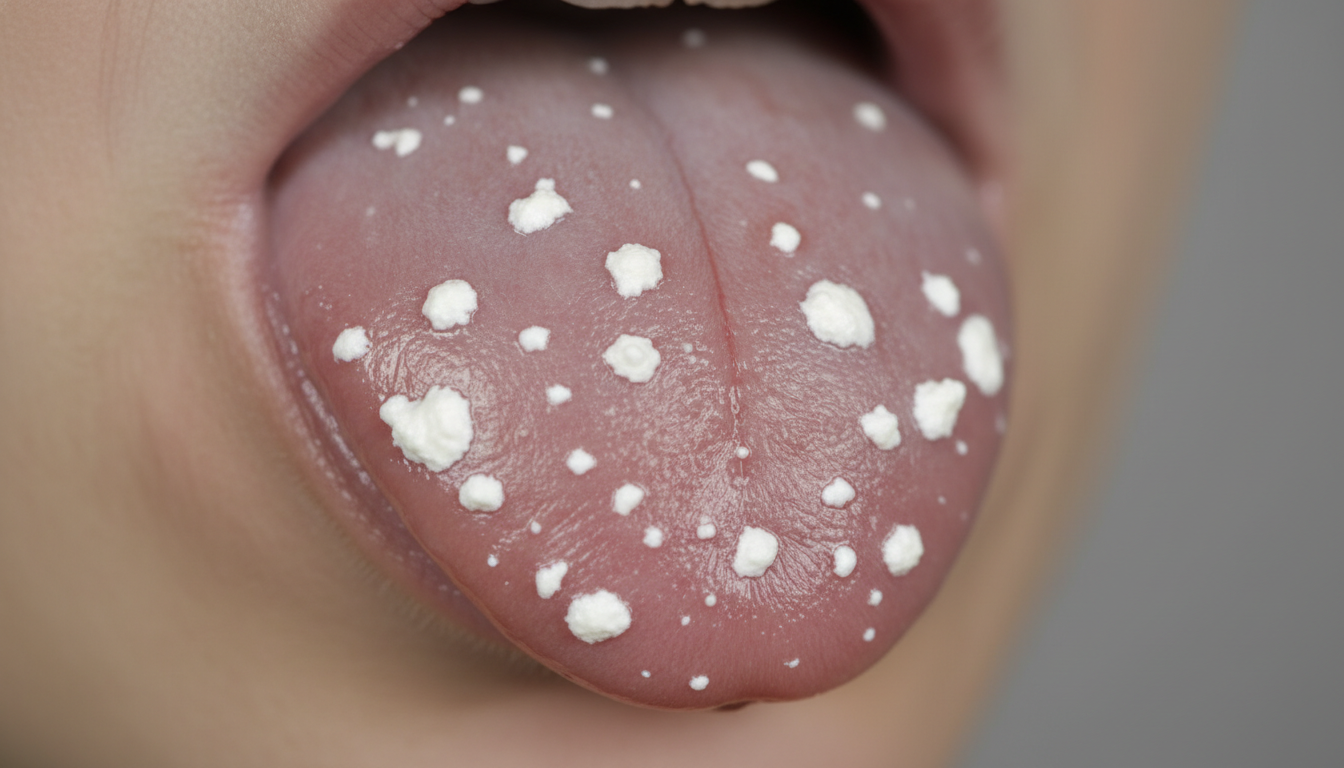
Oral candidiasis (thrush) is the oral condition most strongly associated with HIV in clinical literature. It is also extremely common in people without HIV. Thrush appears as creamy white patches on the tongue, inner cheeks, palate, or back of the throat. Unlike normal tongue coating or food residue, the patches do not wipe off easily. When they do, they often leave a red, sometimes raw area underneath.
Thrush is caused by overgrowth of Candida albicans, a yeast that lives normally in the mouth and digestive tract. Several conditions allow it to overgrow: recent antibiotic use, inhaled corticosteroid use (often from asthma inhalers without rinsing afterward), uncontrolled diabetes, dry mouth, denture irritation, smoking, pregnancy, infancy, advanced age, and immune suppression including HIV.
What makes thrush more clinically suspicious for HIV: it appears in an otherwise healthy adult with no obvious explanation, recurs frequently, spreads down the throat (esophageal candidiasis), or is paired with other systemic signs of immune compromise. Persistent or recurrent oral thrush in an otherwise healthy adult is consistent with clinical descriptions of HIV-associated oral manifestations in standard medical references.
A single episode of thrush after an antibiotic course rarely warrants alarm. Persistent thrush with no obvious cause, particularly after a possible HIV exposure, is worth taking seriously and getting tested.
Mouth Ulcers, Sores, and Lesions
Most mouth ulcers are aphthous ulcers (canker sores): small, painful, round-to-oval sores with a white-to-yellow center and a red border, typically appearing inside the cheeks, on the lips, or under the tongue. They heal on their own within 7 to 14 days. Stress, minor trauma (a bitten cheek, a hot drink, sodium lauryl sulfate in some toothpastes), certain foods, hormonal cycles, and nutritional deficiencies all trigger them.
HIV can be associated with mouth ulcers in two main ways. During acute HIV infection, oral ulcers can occur as part of the seroconversion illness, alongside fever and sore throat. In advanced untreated HIV, persistent or atypical ulcers can appear, and Kaposi sarcoma (a cancer linked to advanced HIV) can produce purplish or reddish lesions on the palate or gums. Kaposi sarcoma is rare in people on effective ART.
What makes a mouth ulcer worth investigating: it lasts longer than two weeks, recurs frequently with no obvious trigger, occurs in unusual places (back of the throat, soft palate), or is paired with other symptoms of acute illness or systemic immune issues.
One important caveat: a painless oral ulcer that has been present for more than ten days and is not healing can also be the chancre of primary syphilis. STIs co-occur, so a sexual-health workup typically screens for several at once.
Any oral lesion that has not healed after 14 days warrants clinical evaluation, regardless of suspected cause. The differential includes oral cancer, primary syphilis chancre, persistent fungal or viral infection, and several treatable conditions beyond HIV. Two weeks is the threshold most clinicians use before escalating beyond watch-and-wait.
Gum Changes and HIV-Associated Periodontal Disease
Ordinary gingivitis (red, puffy, sometimes-bleeding gums) is extremely common and almost always related to plaque buildup, not HIV. It improves with consistent brushing, flossing, and a professional cleaning. If gum problems persist despite good oral hygiene, that is worth a dental evaluation, though gingivitis on its own is not an HIV red flag.
HIV can produce two distinctive forms of gum disease that go beyond ordinary gingivitis. Linear gingival erythema (LGE) appears as a bright red band along the gum line that does not improve with normal brushing and flossing. Necrotizing ulcerative periodontitis (NUP) is a more aggressive form that causes rapid gum tissue and bone loss, often with severe pain, bleeding, and a distinctive bad-breath odor.
Both conditions can occur in other immune-compromising states, though they are unusual enough in otherwise healthy adults that clinicians treat them as a prompt for immune evaluation, including HIV screening. Unusual gum patterns are one of several immune-compromise signals that a clinician weighs alongside CD4 history and systemic findings, not a stand-alone diagnostic feature.
Ordinary bleeding gums improve with consistent brushing, flossing, and a professional cleaning. A bright red gum-line band that persists despite good hygiene (linear gingival erythema, or LGE) is the pattern worth investigating further. Rapid gum and bone loss with severe pain and bad breath (necrotizing ulcerative periodontitis, or NUP) is a stronger signal still.
Other Oral Findings That Can Occur with HIV
Several less common oral conditions are associated with advanced or untreated HIV. None of them diagnose HIV on their own. They are patterns clinicians weigh together with risk history, systemic symptoms, and lab tests.
- Oral hairy leukoplakia: white, corrugated, ribbed patches on the lateral (side) surfaces of the tongue. Caused by Epstein-Barr virus reactivation. Cannot be scraped off, which distinguishes it from thrush. Almost always indicates significant immune suppression.
- Xerostomia (chronic dry mouth): can result from HIV-related salivary gland dysfunction or from medications used to treat HIV and other conditions. Increases the risk of cavities, taste changes, and oral infections.
- Angular cheilitis: cracked, inflamed corners of the mouth, often with associated yeast or bacterial infection. Common in nutritional deficiencies, denture problems, and immune compromise.
- Atypical aphthous-like ulcers: larger, deeper, and slower to heal than typical canker sores.
- Oral warts (HPV-related): cauliflower-textured growths inside the mouth, more common in HIV-positive people because of immune-related HPV reactivation.
- Kaposi sarcoma: purplish or reddish lesions on the palate or gums, indicating advanced untreated HIV. Rare in people on effective ART.
Conditions That Look Like HIV but Usually Are Not
The mouth has a vocabulary of symptoms that overlap heavily with non-HIV explanations. Most readers who land here worrying turn out to have something completely unrelated to HIV. The point is not to dismiss the worry, only to give it the right shape.
| Mouth finding | Most common cause | When it might suggest HIV |
|---|---|---|
| White patches that wipe off | Oral thrush from antibiotics, inhaled steroids, dry mouth, smoking, or diabetes | Persistent or recurrent in an otherwise healthy adult, no obvious trigger |
| Painful round ulcer with white center | Aphthous ulcer (canker sore) from stress, trauma, foods, or hormonal cycle | Multiple, deep, slow to heal, paired with fever or systemic symptoms |
| Bleeding gums | Plaque-related gingivitis from inadequate brushing or flossing | Bright red gum-line band that does not improve with good hygiene (linear gingival erythema) |
| White ribbed patches on side of tongue | Lichen planus, leukoedema, or chronic frictional irritation | Oral hairy leukoplakia (cannot be scraped off, EBV-driven) |
| Cracked, sore corners of mouth | Vitamin or iron deficiency, denture friction, lip-licking habit | Recurrent angular cheilitis with yeast component in immunocompromised context |
| Persistent dry mouth | Medication side effect, mouth breathing, dehydration, anxiety | Salivary gland dysfunction with other systemic signs |
| Painless ulcer not healing | Trauma, irritation from a sharp tooth or denture | Primary syphilis chancre, oral cancer, or HIV-associated atypical ulcer (needs evaluation) |
Why Timing Matters More Than Symptoms
HIV testing depends on a window period: the time between exposure and when a test can reliably detect infection. Tests that look for the virus directly (NAT) detect HIV earliest. Tests that look for antibodies the body produces against HIV take longer. The CDC's HIV testing page publishes the windows clinicians use:
| Test type | Sample | Earliest detection after exposure | Typical reliable window |
|---|---|---|---|
| Nucleic acid test (NAT / RNA) | Blood, lab-run | About 10 days | 10 to 33 days |
| 4th-generation antigen/antibody (lab) | Blood, lab-run | About 18 days | 18 to 45 days |
| Rapid antigen/antibody (point-of-care) | Fingerstick blood | About 18 to 45 days | Up to 90 days for some tests |
| Antibody-only rapid test | Fingerstick blood or oral fluid | About 23 days | 23 to 90 days |
What the Window Period Actually Means
Testing too early can produce a falsely reassuring negative. Someone who tests on day 10 with a rapid antibody test may genuinely have HIV that has not yet produced detectable antibodies. The result reads negative for that test on that day, and is still wrong about the underlying status.
This is also why focusing on visible mouth changes is the wrong tool. The mouth does not reveal recent HIV infection on a reliable timeline. Window periods do. If you had a possible exposure recently and you are scrutinizing your mouth for evidence, the more useful question is: how many days has it been, and which test fits that window?
Day 7 post-exposure: no test is reliable yet. Wait, do not interpret a negative result.
Day 18 to 45: a 4th-generation lab test or a NAT gives a meaningful result.
Day 90 and beyond: every standard HIV test on the market gives a reliable result, including rapid fingerstick antibody tests.
Can You Get HIV From Oral Sex?
This is one of the most-searched questions, and it deserves a direct answer. Per CDC guidance on how HIV spreads, oral sex is classified among the extremely rare ways HIV might be transmitted, with little to no risk in typical circumstances. There are documented cases, though they are rare, and the per-act risk is much lower than from condomless anal or vaginal sex.
Risk goes up when there are open sores, bleeding gums, recent dental work, ejaculation in the mouth, or other STIs in the mouth or genital area at the time of contact. It also goes up when the partner with HIV has a high viral load, which is most likely if they are untreated or were recently infected and have not yet started ART.
For partners with HIV who are on effective ART with an undetectable viral load, the risk of sexual transmission (including through oral sex) is effectively zero. This is the U=U principle (Undetectable = Untransmittable), endorsed by the CDC, WHO, and major HIV organizations.
If you had oral sex and you are now staring at a mouth symptom wondering if that is how it started, that symptom almost certainly has an unrelated cause, and it cannot confirm or rule out HIV either way. For an exposure within the past few weeks, a NAT or 4th-generation lab test taken at the appropriate window is what resolves the question.
People with HIV who take antiretroviral therapy as prescribed and reach an undetectable viral load do not transmit HIV through sex of any kind, including oral sex. The CDC, WHO, and HIV.gov all endorse this principle. It is one of the most important practical reasons that early diagnosis and continuous treatment matter for both the person living with HIV and their partners.
When Mouth Symptoms Warrant Faster Attention
Most oral symptoms resolve on their own within two weeks. A few patterns deserve a quicker medical evaluation, regardless of HIV concern, because they can also signal oral cancer, persistent infection, autoimmune disease, or another STI:
- Any oral lesion that has not healed after two weeks.
- New, persistent thrush in an otherwise healthy adult with no obvious cause (no recent antibiotic, no inhaled steroid, no diabetes).
- Severe gum disease that does not improve with consistent brushing, flossing, and a professional cleaning.
- Multiple oral symptoms occurring together with systemic illness: fever, weight loss, fatigue, swollen lymph nodes, drenching night sweats.
- White patches that bleed when scraped, change shape, or grow over weeks.
- A painless ulcer present for more than ten days. This pattern can indicate a primary syphilis chancre, which needs treatment regardless of HIV status.
If any of these apply, see a primary care provider, dentist, or sexual-health clinic. They will run the right tests for what they actually see, which is usually a mix of an HIV test, an STI panel, and an oral examination.
If any of the patterns above apply, see a clinician within a few days. A single symptom with no systemic signs and no recent likely exposure can reasonably be watched for two weeks before escalating, then evaluated if it has not resolved.
How to Actually Get Tested
Three main routes exist for HIV testing in the United States:
- Clinic, primary care, or sexual-health center: a venous blood draw sent to a lab, usually a 4th-generation antigen/antibody test or a NAT. Highest analytical sensitivity, longest turnaround (typically a few days).
- Community testing site or pharmacy rapid test: fingerstick rapid antibody/antigen test or oral-fluid swab, results in about 20 minutes. Common at sexual-health clinics, Planned Parenthood, and many pharmacies.
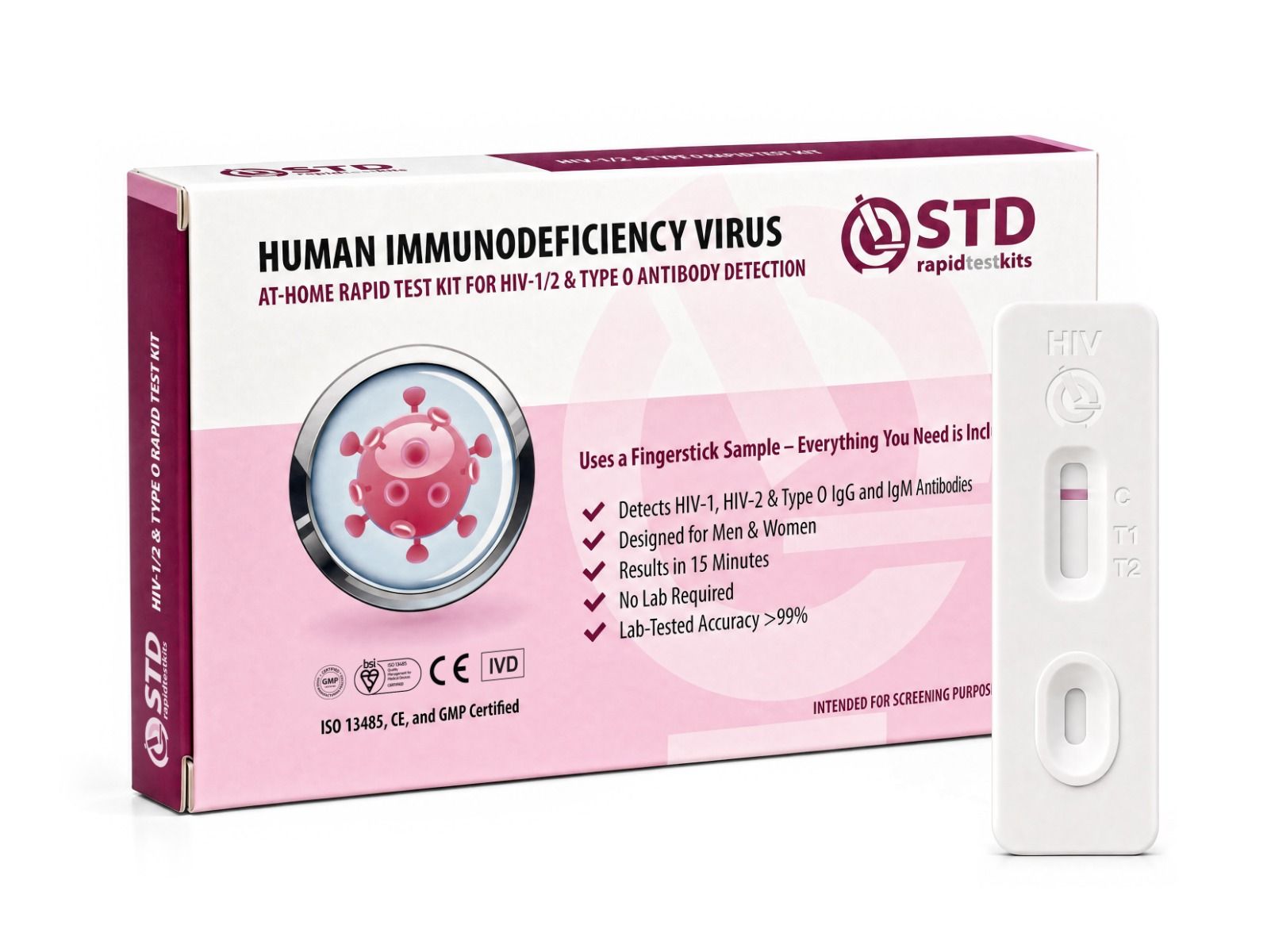
- At-home rapid test: fingerstick lateral-flow blood test you order and run yourself, results in about 15 to 20 minutes. Useful for screening when privacy or convenience matters.
This site sells at-home rapid lateral-flow tests; the description below covers the full testing landscape, including lab options that have higher analytical sensitivity than at-home rapid kits.
At-home rapid tests use lateral-flow chemistry. They screen for HIV antibodies (and in some cases the p24 antigen). They are not the same technology as lab NAT or 4th-generation chemistry: lab tests have higher analytical sensitivity, particularly during the early window. A positive result from any rapid test is worth confirming with a lab-run NAT or 4th-generation test. A negative rapid test outside the appropriate window is a true negative for that exposure.
After the Result, Whatever It Is
A negative test taken outside the appropriate window means no HIV from that exposure. If oral symptoms persist, see a clinician (often a dentist or primary care provider) to identify the actual cause, because most non-HIV explanations are treatable, sometimes with nothing more than better hydration, a different toothpaste, an antifungal mouthwash, or a deep cleaning.
A positive result is not the catastrophe it once was. Modern antiretroviral therapy is highly effective. People who take HIV medicine as prescribed and reach an undetectable viral load can live long and healthy lives, per the HIV.gov overview. They also do not transmit the virus sexually when their viral load is suppressed (U=U). Early diagnosis means earlier treatment, better long-term outcomes, fewer opportunistic infections, and less time spent in uncertainty.
If you are scared to test, that is normal. The fear of knowing rarely matches the reality of either result, and the cost of not knowing (continuing to wonder, possibly transmitting unknowingly if positive, missing the window for early treatment) is higher than the cost of finding out.
People who take HIV medicine as prescribed and get and keep an undetectable viral load can live long and healthy lives.
Frequently Asked Questions
- How soon after exposure can mouth symptoms appear if it is HIV?
- If oral signs occur as part of acute HIV, they typically show up 2 to 4 weeks after exposure as part of a flu-like seroconversion illness, alongside fever, sore throat, swollen lymph nodes, and fatigue. Isolated mouth changes within a few days of exposure are almost never HIV-related, because the virus has not yet caused enough immune disruption.
- Does oral thrush always mean HIV?
- Thrush has many more common causes than HIV. Recent antibiotic use, inhaled corticosteroids without rinsing, uncontrolled diabetes, dry mouth, smoking, dentures, pregnancy, infancy, and old age are all more frequent triggers. Persistent thrush in an otherwise healthy adult with no obvious cause is the pattern that genuinely warrants HIV testing.
- Can I tell HIV apart from a regular canker sore by looking?
- Visual inspection alone cannot reliably tell them apart. A canker sore from stress and an HIV-associated atypical ulcer can look similar at first. Distinguishing features include duration over two weeks, recurrence with no obvious trigger, location at the back of the throat or soft palate, and accompanying systemic signs, none of which a mirror can resolve.
- What is the difference between oral thrush and hairy leukoplakia?
- Thrush is creamy white plaques that wipe off, often leaving a red mucosa beneath, caused by Candida yeast. Hairy leukoplakia is corrugated, ribbed white patches on the side of the tongue that cannot be scraped off, caused by Epstein-Barr virus reactivation. Hairy leukoplakia is more strongly associated with significant immune suppression.
- Can HIV cause dry mouth?
- Yes. HIV can cause salivary gland dysfunction (sometimes called HIV-associated salivary gland disease), and many medications used to treat HIV or other conditions reduce saliva production. Chronic dry mouth raises the risk of cavities, taste changes, and oral infections, so it is worth raising with a dentist or primary care provider regardless of cause.
- Are bleeding gums a sign of HIV?
- Almost always, no. Most bleeding gums are gingivitis from plaque buildup, and they resolve with consistent brushing, flossing, and a dental cleaning. The HIV-associated gum patterns (linear gingival erythema and necrotizing ulcerative periodontitis) are unusual: a bright red band along the gum line that does not respond to good hygiene, or rapid gum and bone loss with severe pain.
- Can a dentist diagnose HIV from a mouth exam?
- Visual examination of the mouth alone does not diagnose HIV. Dentists may flag findings such as persistent thrush, hairy leukoplakia, or unusual gum disease that suggest immune compromise and prompt a referral for HIV testing. Some dentists are trained to recognize HIV-associated oral patterns; others may refer to a physician for evaluation.
- If I had oral sex two weeks ago and now have a sore mouth, should I test?
- The risk of HIV from oral sex is very low, and a sore mouth two weeks later is much more likely to be an unrelated cause. That said, two weeks is the right time to consider a NAT (which detects HIV from about 10 days post-exposure). A 4th-generation antigen/antibody test becomes reliable from 18 days, and a rapid antibody test from about 23 days. Testing at the appropriate window resolves the question reliably.
- U.S. Centers for Disease Control and Prevention. HIV testing types and window periods, including NAT, antigen/antibody, and antibody-only assays.
- U.S. Centers for Disease Control and Prevention. How HIV spreads, including the classification of oral sex as an extremely rare transmission route with little to no risk.
- World Health Organization. HIV fact sheet covering acute infection, transmission, treatment, and U=U.
- NHS. HIV and AIDS symptoms guide describing the systemic, flu-like nature of acute HIV.
- HIV.gov. Symptoms of HIV across acute, clinical-latency, and advanced stages, with the long-and-healthy-life statement on ART.
- Mayo Clinic. HIV/AIDS topic landing page covering symptoms, causes, and stage-by-stage clinical features for the general reader.