Published: September 2025 | Last updated: May 2026 | Editorial review and quality control: Martina N.
A broken condom, a partner mentioning a positive result, or a quiet worry the morning after... whatever brought you here, the question is the same: how soon after possible chlamydia exposure can a test actually find it?
Test too early and you will likely get a false negative. Wait too long without retesting and you can pass chlamydia along to someone else even while feeling fine. For most adults, the practical benchmark is around two weeks after exposure. There is more nuance if you are weighing an at-home rapid test, a mail-in lab kit, or a clinic visit, and this guide walks through each option with the timing math behind it.
Key Takeaways
- Most chlamydia tests reach reliable accuracy around 14 days after exposure. Earlier results can miss real infections, so plan to retest at the two-week mark if you test sooner.
- Most people with chlamydia have no symptoms (the CDC and NHS both emphasize this), so a test is the only reliable way to know.
How soon after exposure should I test for chlamydia?
Chlamydia bacteria need time to multiply to levels that a test can detect. The exact window depends on the type of test you use, but consensus guidance from the CDC's STI treatment guidelines and standard NAAT performance data points to roughly the same answer: most modern chlamydia tests perform best around two weeks after exposure. Testing as early as 7 to 13 days can flag some infections, but a single early negative is not the same as being in the clear.
If your exposure was less than 24 hours ago and you are reading this in a panic, the most useful thing you can do right now is mark the date. Day 14 from that exposure is when most accuracy ranges peak. If symptoms appear before then, testing earlier is reasonable, but plan to retest at two weeks regardless of the early result.
How soon after exposure can a chlamydia test detect the infection?
Clinic-based nucleic acid amplification tests (NAATs), and quality at-home rapid lateral-flow tests when timed correctly, reach reliable accuracy around 14 days after exposure. The <a href="https://www.cdc.gov/std/treatment-guidelines/chlamydia.htm">CDC's chlamydia guidance</a> treats roughly two weeks as the practical benchmark. Some lab-grade tests can flag infection earlier (around day 7 to 13), but a negative result before two weeks does not rule chlamydia out. If you test in the first week, plan to retest at day 14.
Window period vs. incubation period: what is happening between exposure and detection
Two timelines start running the moment chlamydia bacteria reach a mucous membrane. They are easy to confuse, but they answer different questions.
- Incubation period is how long it takes symptoms to appear (if they appear at all). For chlamydia, this typically ranges from 1 to 3 weeks after exposure, though most infections never produce noticeable symptoms (per CDC chlamydia treatment guidelines).
- Window period is how long it takes the infection to be detectable on a test. For modern NAATs, this is usually around 1 to 2 weeks, with day 14 widely used as the practical standard (per CDC chlamydia treatment guidelines).
You can have no symptoms and still test positive. You can also have no symptoms and still pass chlamydia to a partner. The window period, not how you feel, decides when a test result becomes meaningful.
Chlamydia testing timeline: day by day after exposure
The numbers below reflect consensus guidance from the CDC's chlamydia treatment guidelines and standard NAAT performance ranges. Treat them as a planning tool, not a diagnosis. Symptoms are not required for any of these stages, and the absence of symptoms does not change the timing.
| Days since exposure | Test detection rate | What to do |
|---|---|---|
| 0 to 3 days | Very low: bacteria not yet multiplied to detectable levels | Wait. A test now is likely to miss a real infection. |
| 4 to 6 days | Low: only some lab-grade NAATs may detect | Hold for symptoms. If they appear, test, but plan to retest at day 14. |
| 7 to 13 days | Moderate: high-sensitivity NAATs can flag many infections | Testing is reasonable, but treat a negative as preliminary. |
| 14+ days | High: most NAATs and quality at-home kits reach peak accuracy | Best window for a single confirmatory test. |
| 3+ months | Very high: recommended retest interval after treatment | CDC recommends retesting about 3 months after treatment to catch reinfection from an untreated partner. |
Why most chlamydia infections feel like nothing
Chlamydia is sometimes called a silent infection for a reason. The CDC's chlamydia overview and NHS chlamydia guidance both emphasize that most people with chlamydia have no symptoms at all. When symptoms do appear, they are easy to mistake for a urinary tract infection, ordinary irritation, or post-period spotting.
Common subtle signs include burning during urination without obvious discharge, lower abdominal or pelvic pressure, pain during sex, and unusual spotting between periods. None of these are diagnostic. None of them rule out chlamydia, either. Waiting for symptoms before testing means many infections progress quietly to pelvic inflammatory disease, epididymitis, or fertility problems while feeling like nothing has changed.
If you have any of these in the weeks after a possible exposure, treat it as a reason to test, not as a diagnosis:
- Burning during urination, with or without discharge
- Lower belly or pelvic pressure that does not track with your cycle
- Pain during sex or after ejaculation
- Unusual discharge, color changes, or new smell
- Spotting between periods
- Testicular ache, swelling, or tenderness
Several of these can also be a UTI, yeast infection, or non-STI irritation. A test is what tells the difference.
Comparing at-home rapid, mail-in lab, and clinic chlamydia tests
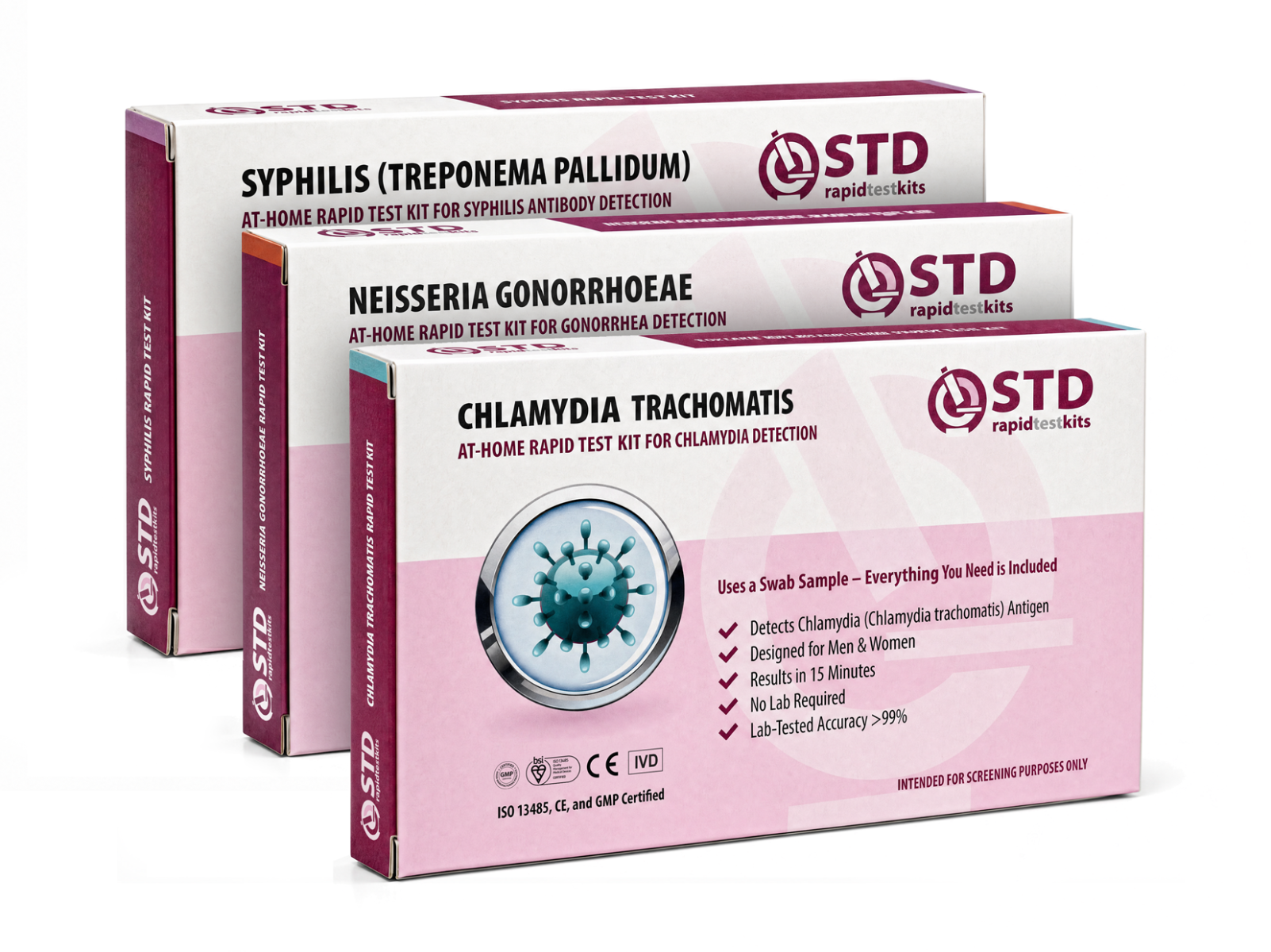
The right test depends on three things: how soon after exposure you are, how much privacy you want, and whether you also need clinical care. Lab NAATs (the kind clinics and most mail-in services use) remain the gold-standard testing technology for chlamydia per the CDC. At-home rapid kits use lateral-flow chemistry instead; they are useful screening tools, especially when timed correctly, but a positive result is worth confirming with a lab NAAT when possible.
Note: stdrapidtestkits.com sells the at-home rapid chlamydia test described in this section. We recommend products based on fit-for-purpose for the reader's concern, not commercial benefit.
| Method | Sample type | Speed | Strengths | Limits |
|---|---|---|---|---|
| At-home rapid swab | Self-collected swab | Result in about 15 minutes | Total privacy, no shipping, useful at day 14+ | Lateral-flow sensitivity is below lab NAAT; confirm a positive at a clinic |
| Mail-in lab kit (NAAT) | Self-collected swab or urine | 1 to 3 business days after lab receives sample | Lab-grade NAAT, discreet packaging, no clinic visit | Requires mailing access and a few days of waiting |
| Clinic NAAT | Provider-collected swab or urine | Same day to several days | Highest analytical sensitivity, immediate treatment if positive | Insurance, paperwork, possibly waiting room |
If your exposure could involve more than chlamydia
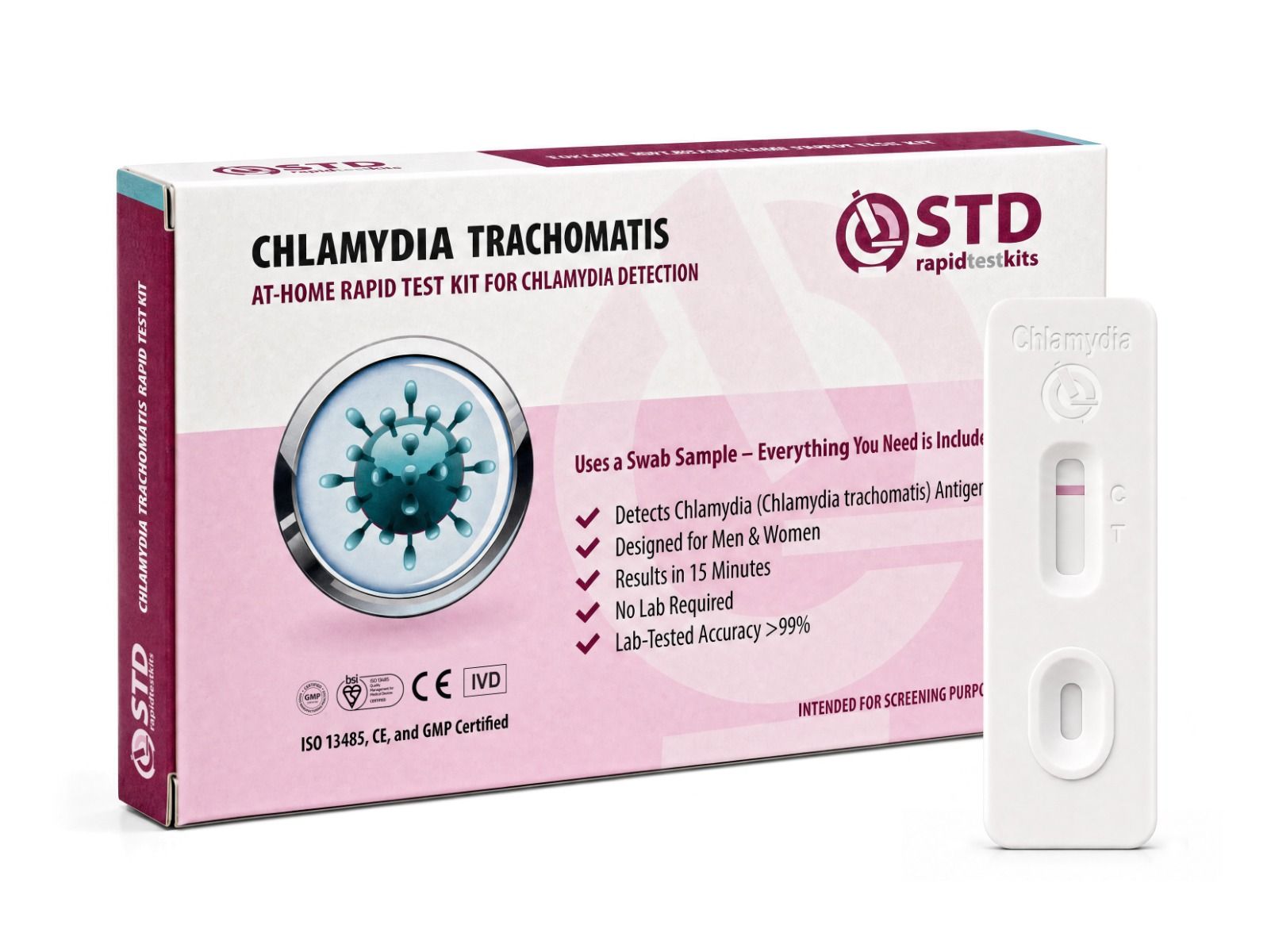
Chlamydia and gonorrhea share transmission routes and frequently co-infect, which is why CDC screening guidance often pairs them. STIs remain a major public-health concern globally, with the World Health Organization estimating hundreds of millions of new curable STI cases each year, and HIV remains the most consequential infection many readers actually fear when they Google chlamydia testing.
If your concern is broader than chlamydia alone, testing for several infections at once usually saves you from the spiral of repeat clinic visits or repeat shipping. Multi-test panels keep their accuracy windows aligned with chlamydia's two-week mark for the swab-based components, while syphilis and HIV need longer. Per CDC HIV testing guidance, modern fourth-generation antigen-antibody tests are typically reliable from about 45 days after exposure, with rapid fingerstick antigen/antibody tests having windows up to 90 days after exposure. Syphilis requires a longer window period than chlamydia; the CDC syphilis treatment guidance and a clinician can advise on timing specific to your exposure.
Annual chlamydia screening of all sexually active women aged less than 25 years is recommended, as is screening of older women at increased risk for infection.
When to retest: after treatment, after new exposure, or after symptoms persist
One negative test is not the end of the conversation. Three retest scenarios apply to most readers:
- Four weeks after antibiotics, only if symptoms persist. The CDC does not recommend a routine test of cure for uncomplicated chlamydia in non-pregnant adults, because dead bacterial DNA can produce a false-positive NAAT result for up to four weeks after therapy. If you do retest after treatment, wait at least four weeks.
- Three months after treatment. The CDC recommends a routine retest about three months after treatment because reinfection (often from an untreated partner) is the most common cause of repeat positives.
- Two weeks after any new exposure. A previous negative does not protect against a new partner or a new incident. Restart the 14-day clock.
For people who are pregnant or immunocompromised, testing follows different rules. Pregnant patients are typically retested in the third trimester, and a documented test of cure may be recommended. Immunocompromised patients sometimes need extended windows or repeat testing.

What if symptoms continue after a negative test or completed treatment?
Persistent burning, discharge, pelvic pain, or testicular ache after a clean chlamydia result rarely means the test was wrong. The more common explanations are co-infections, a different infection altogether, or a non-STI cause.
- Co-infection. Gonorrhea, trichomoniasis, and Mycoplasma genitalium share symptoms with chlamydia and are often missed on a chlamydia-only test. A combination panel covers these directly.
- A different STI. Herpes, syphilis, and HPV produce symptoms that can be confused with bacterial STIs but require different tests and different treatments.
- Non-STI causes. UTIs, yeast infections, bacterial vaginosis, and prostatitis can mimic chlamydia. A clinical visit usually sorts these quickly.
If you have already tested for chlamydia twice (early and again at the 14-day mark) with negative results and symptoms have not improved, a broader panel or a clinic visit is the next step. The longer a symptomatic infection goes untreated, the higher the risk of pelvic inflammatory disease in women and complications like epididymitis or reactive arthritis in men.
FAQs
- Can recent antibiotics affect a chlamydia test result?
- Yes. Even antibiotics taken for an unrelated infection (a sinus infection, a dental procedure) can suppress chlamydia bacteria below the threshold a test can detect, producing a temporary false-negative. If you have taken antibiotics in the past four weeks, wait at least four weeks after finishing the course before testing.
- Is chlamydia testing recommended during pregnancy?
- Yes. The CDC recommends chlamydia screening at the first prenatal visit for all pregnant women, and again in the third trimester for those at increased risk. Untreated chlamydia in pregnancy is linked to preterm birth, premature membrane rupture, and infections passed to the baby during delivery. Treatment is safe and effective during pregnancy with pregnancy-approved antibiotics.
- What if I have a weakened immune system?
- Immunocompromised patients (people on immunosuppressants, those living with HIV, or those with chronic conditions) sometimes have a longer window before tests detect chlamydia. Wait at least 21 days after exposure if possible, and consider a lab-processed NAAT for higher analytical sensitivity. Discuss timing with your treating provider.
- Can I get chlamydia from oral sex, and do I need a different test for that?
- Yes, oral chlamydia is possible. The bacteria can colonize the throat without causing symptoms. Standard at-home rapid kits use genital swabs and do not test the throat directly, so a clinic-collected pharyngeal swab is the test you need for that exposure route. Our at-home rapid kits cover the genital and bloodwork side of the same exposure event.
- Should my partner test even if they have no symptoms?
- Yes. Most people with chlamydia carry the infection without feeling sick, so a partner can transmit it without ever knowing. Coordinated testing (and coordinated treatment if needed) is the only reliable way to stop reinfection ping-pong between partners.
- My first test was negative, but I am still worried. Should I retest?
- If the first test was within the first 13 days after exposure, yes. Plan a retest at the 14-day mark or later. If the first test was already at day 14 or later and you have no new exposures or symptoms, a single negative is generally reliable. Repeat anxiety-driven testing past that point usually does not change the answer.
- Do I need to retest after I finish my chlamydia antibiotics?
- For most people treated for chlamydia, the answer is no. A follow-up test is not part of routine care. The exception: if symptoms come back or never fully clear, retest, but only after waiting four full weeks (an earlier swab can pick up dead bacterial DNA and read as a false positive). Separately, a three-month retest is encouraged for everyone, since it catches the most common reason for a second positive, which is reinfection from an untreated partner.
- I am in a long-term monogamous relationship. Do I really need to test?
- If neither partner tested at the start of the relationship, an undiagnosed infection from before the relationship can persist for years without symptoms. A single one-time baseline test for both partners closes that gap. After that, the screening interval drops back to whatever the CDC recommends for your age and risk profile (annually for sexually active women under 25 and for higher-risk groups).
- U.S. Centers for Disease Control and Prevention. Chlamydial Infections, STI Treatment Guidelines. Includes diagnostic considerations, retesting recommendations (NAATs not recommended at less than 4 weeks after therapy), and population-specific screening intervals.
- U.S. Centers for Disease Control and Prevention. About Chlamydia. Overview of symptoms, prevalence, and asymptomatic infection rates.
- National Health Service (United Kingdom). Chlamydia. Symptoms, testing options, and treatment overview for general readers.
- U.S. Centers for Disease Control and Prevention. HIV Testing. Window-period guidance for fourth-generation antigen-antibody and rapid fingerstick antigen/antibody tests.
- U.S. Centers for Disease Control and Prevention. Syphilis, STI Treatment Guidelines. Diagnostic methodology and treatment recommendations.
- World Health Organization. Sexually Transmitted Infections fact sheet. Global incidence and clinical context for curable STIs.
