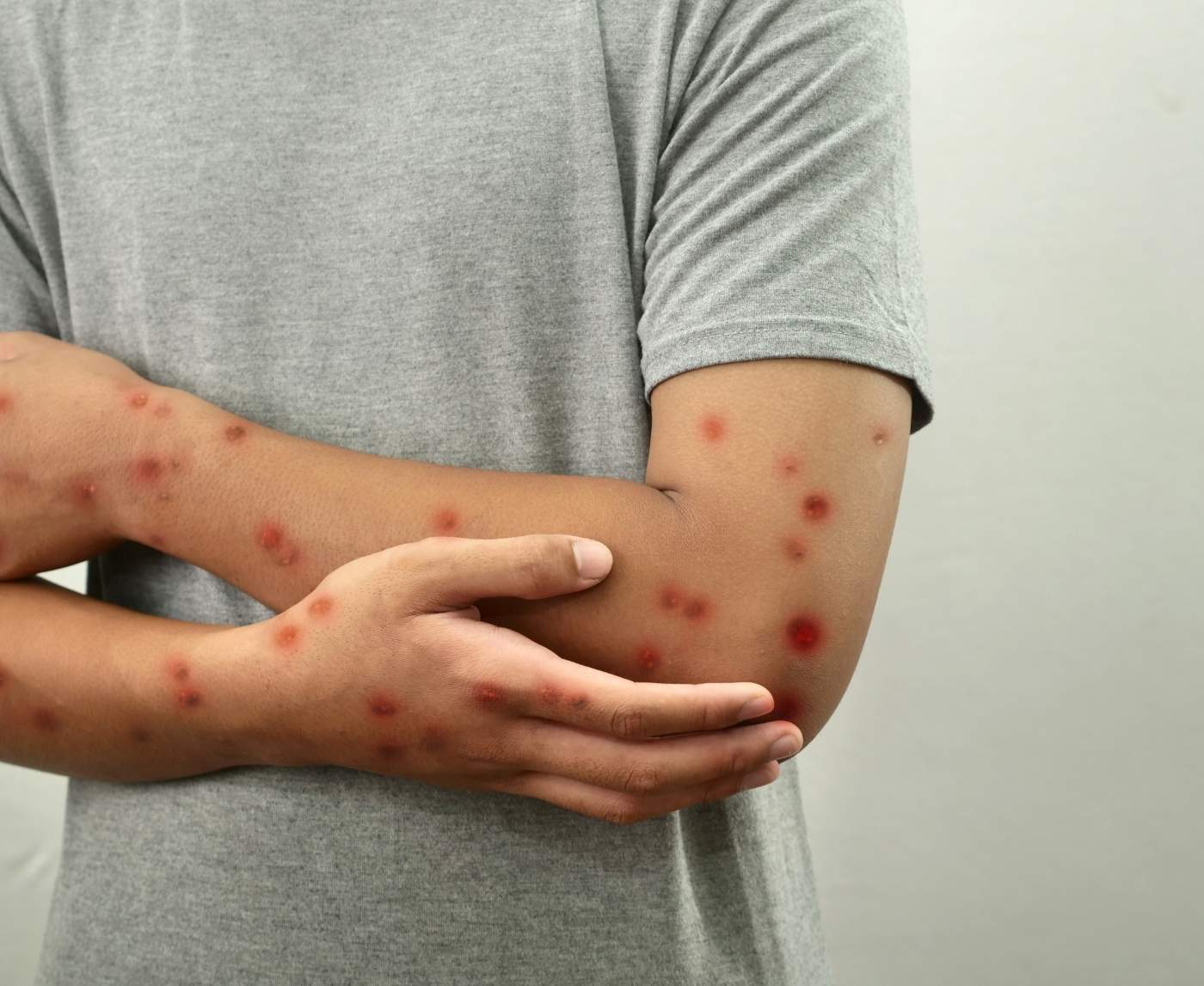
Published: September 2025 | Last updated: May 2026 | Editorial review and quality control: Martina N.
Can monkeypox look like an STI?
Yes. Mpox often begins with genital, anal, or oral lesions that resemble herpes blisters or a syphilis chancre. The most useful difference is timeline: mpox lesions stage through five phases over one to two weeks, while herpes blisters appear and crust within a few days. A confirmed mpox diagnosis still requires a clinic-collected lesion swab for PCR; no at-home mpox test exists.
You notice a bump that wasn't there yesterday. Maybe a sore that stings when you pee. The first thought is probably a sexually transmitted infection. The second, after some doomscrolling, might be monkeypox. Both can look nearly identical in the first few days of an outbreak, and that overlap is exactly why so many people walk into a clinic with the wrong assumption about what they have.
This guide explains how monkeypox (mpox) and common STIs actually differ, when each at-home STI test kit will give you a useful answer, and what the right next step is for the sore or rash in front of you. The short version: most people who think they have mpox after an exposure are dealing with something more common, and most people who think they have herpes during a known mpox exposure window may have something rarer than they realize. A clinician swab is the only confirmed mpox test, but ruling out common STIs at home is a fast and useful first step. stdrapidtestkits.com sells the at-home rapid STI test kits referenced below; the recommendations note what each kit can and cannot detect relative to mpox.
Key Takeaways
- Mpox is not formally an STI but spreads mainly through close skin-to-skin contact during sex; its lesions routinely get mistaken for herpes or syphilis in the first week, when the visual overlap is greatest.
- At-home rapid tests can quickly rule out common STIs (chlamydia, gonorrhea, syphilis, HIV, hepatitis, HSV antibodies), but mpox itself is confirmed only by a clinic-collected lesion swab and PCR. There is no consumer at-home mpox test as of writing.
Why monkeypox and STI symptoms overlap so often
Monkeypox is not formally classified as a sexually transmitted infection. The World Health Organization's mpox fact sheet describes it as a viral disease spread by close personal contact, including respiratory droplets during prolonged face-to-face exposure, contact with infected lesions or scabs, and contact with contaminated bedding or towels. During the 2022 global outbreak the dominant route shifted: most non-endemic cases were linked to close skin-to-skin contact during sex, especially among gay, bisexual, and other men who have sex with men. Cluster reports across 2024 and 2025 continued to surface in U.S. metros and in clade I cases tracked by WHO.
That shift is what created the diagnostic mess. People started showing up to sexual health clinics with a single genital sore, tender groin lymph nodes, and a low fever, the exact symptom set most clinicians associate with herpes simplex or primary syphilis. Some early mpox patients had only one lesion and no other symptoms. Many initially assumed their lesions were herpes, a pattern documented in case series from the 2022 outbreak, before lab results confirmed mpox.
The shared symptom set, in plain terms:
- Genital, anal, perianal, or oral lesions
- Painful urination when sores sit near the urethra
- Swollen, tender lymph nodes, usually in the groin
- Fever, chills, headache, body aches
- A rash that may spread beyond the original site
What raises specific suspicion of mpox over a typical STI: lesions that move through clearly distinct stages over one to two weeks (a flat spot becomes a raised bump, then a fluid-filled blister, then a pus-filled pustule, then crusts over and falls off), often with a small dent in the center of mature lesions. The pattern that fits herpes more cleanly is a tight cluster of small painful blisters on a red base that crust over within a few days, frequently returning in the same spot.
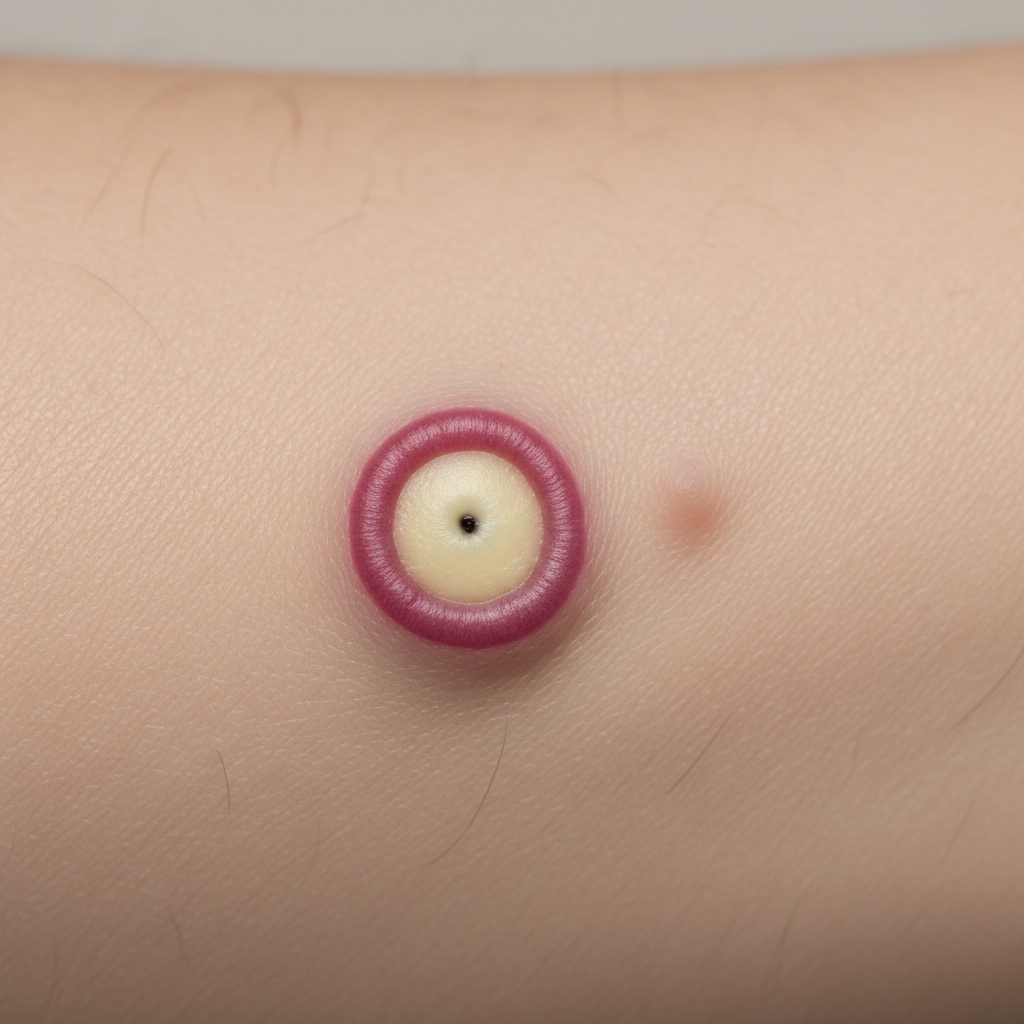
How the lesions look in comparison
Visual identification alone is not reliable for any of these conditions. Telling them apart from a single phone photo is genuinely hard, even for clinicians. That said, there are pattern differences a careful look can pick up, and they shape what you do next.
Mpox lesions tend to be deep-seated, firm, and well-circumscribed. A mature pustule often has a small central depression, a feature clinicians call umbilication. Lesions can appear in waves, but in a single body region they usually evolve together; the same area may show several pustules at the same stage. They are often painful, especially when in the anogenital region. The CDC's mpox signs-and-symptoms page details the typical lesion progression, and the NHS mpox page covers the same staged pattern for UK readers.
Herpes simplex (HSV-1 or HSV-2) usually begins with localized tingling, burning, or itching for 12 to 24 hours, followed by a tight cluster of small fluid-filled vesicles on a red base. The blisters break open within a few days, leaving shallow tender ulcers that crust over and heal within one to two weeks. Recurrences tend to come back in the same spot. The CDC's genital herpes page describes the recurrent pattern.
Primary syphilis shows up as a single firm, round, painless ulcer (a chancre) at the site of contact, often on the penis, vulva, anus, lips, or inside the mouth. It usually appears within weeks of the exposure and is usually painless, which is why so many people miss it. It heals on its own within three to six weeks even without treatment, but the infection has only moved into a quieter stage. See the CDC's syphilis information.
Molluscum contagiosum looks superficially similar to mpox because it also produces small, raised, dome-shaped bumps with a central dimple. The differences: molluscum bumps are pearly, painless, and skin-colored rather than inflamed, and they appear gradually rather than as a single outbreak with fever.
Ingrown hairs and folliculitis are by far the most common mimic. A single inflamed bump near the hairline of the bikini area, often with a hair visible in the center, that resolves within a few days is almost always one of these.
When a sore warrants a clinician this week, not next
Most new bumps after sex are folliculitis, contact irritation, or an ingrown hair. None of those need same-week medical attention. A subset of presentations do, and recognizing them shifts the plan from at-home testing to in-person evaluation.
The signals worth acting on quickly are listed in the callout below. They are not paranoia bait; each one tracks a complication or a presentation that home kits cannot resolve.
A sore or rash with any of these signals warrants in-person evaluation rather than home testing alone:
- Rapid spread of new lesions across the body
- Severe pain, especially with anorectal lesions or proctitis
- Lesions in the rectum or throat, or inability to urinate
- Signs of secondary bacterial infection at the lesion (warmth, pus, red streaks tracking from the lesion)
- Fever above 101°F (38.3°C) lasting more than 24 hours
- A known mpox contact within the last three weeks
Mpox specifically requires lesion-swab PCR testing through a clinic or local health department. Many U.S. counties offer this at no out-of-pocket cost, even for uninsured patients, particularly in jurisdictions with active case clusters.
How transmission differs (and why it matters at home)
The way each infection spreads changes what you do once you suspect it. Get this part right and you protect partners, housemates, and yourself.
Monkeypox spreads through direct contact with the rash, scabs, or body fluids of someone who is infected, and through contaminated objects like sheets, towels, or sex toys. It can also pass through respiratory secretions during prolonged face-to-face contact. Per the CDC's mpox basics, the infectious period runs from when symptoms start until the rash has fully healed and a fresh layer of skin has formed. That is typically two to four weeks. Condoms reduce some risk during sex but do not cover all skin-to-skin contact, so they are partial protection at best.
Herpes simplex spreads through direct contact with active sores or, less commonly, through asymptomatic viral shedding from the mouth, anus, or genitals. Condoms help but do not cover the entire potentially infectious area. Once you have HSV it stays in the body for life, with periodic outbreaks that vary by person.
Syphilis spreads through direct contact with a chancre during vaginal, anal, or oral sex. Condoms used correctly and consistently reduce risk substantially when the sore sits in the area they cover. The CDC's syphilis basics covers transmission in detail.
Gonorrhea and chlamydia spread through unprotected vaginal, anal, or oral sex. They often produce no symptoms at all, especially in women, which is why screening matters even without lesions.
HIV spreads through specific body fluids (blood, semen, vaginal and rectal fluids, breast milk) during unprotected sex or shared injection equipment. HIV is not transmitted by surface contact, casual touch, or kissing. Acute HIV can produce a flu-like illness with a non-specific rash two to four weeks after exposure, which is why people with a sudden mystery rash and known recent risk sometimes raise the question.
The practical takeaway: mpox is the only one in this list with meaningful surface and fabric transmission. If mpox is on your differential, isolation also means hot-washing sheets and towels, not only abstaining from sex.
Mpox isolation goes beyond no-sex
- Unlike other STIs on this list, mpox transmits through contaminated fabric. Hot-wash sheets, towels, and clothing separately until a clinician clears you.
- The infectious period continues from symptom onset until every scab has fallen off and a fresh layer of skin has formed underneath, typically two to four weeks from rash onset.
- Condoms reduce some risk during sex but do not cover all the skin-to-skin contact that transmits mpox; they are partial protection at best.
Window periods: when each test reliably detects infection
Every STI has a window period: the time between exposure and the moment a test can reliably detect the infection. The window is not the same as the incubation period (when symptoms start). For some infections the body can be contagious well before either the test or the symptoms catch up, which is part of why guessing rarely works.
Bacterial infections show up faster than viral or treponemal ones. Chlamydia and gonorrhea become detectable on lab NAAT within 7 to 14 days of exposure. Syphilis blood tests look for antibodies, which typically take 3 to 6 weeks to develop and are considered reliable by week 6 to 12. If you test earlier than that window, confirm with a clinician. HIV detection windows depend on the test type: a fourth-generation antigen-antibody test catches most infections within 18 to 45 days, with confirmatory testing extending to 90 days.
Herpes is its own case. The body produces detectable HSV-2 antibodies in most people by 6 to 12 weeks after infection, and rapid blood antibody tests look for those antibodies rather than the virus itself. A negative herpes blood test in the first month of infection does not rule herpes out.
If your symptom started fewer than 7 days ago, a home test for chlamydia or gonorrhea will probably be too early. If you are at the 14-day mark and still have a sore that has not healed, retesting plus an in-person look is the right move. The table below summarizes each infection's timing at a glance.
| Infection | Test Type | Sample | Window Period | Most Reliable At |
|---|---|---|---|---|
| Chlamydia | Lab NAAT or rapid lateral-flow swab | Genital swab or urine | 7 to 14 days | 14 days or more |
| Gonorrhea | Lab NAAT or rapid lateral-flow swab | Genital swab or urine | 7 to 14 days | 14 days or more |
| Syphilis | Blood antibody (treponemal/non-treponemal) | Blood (fingerstick or venous) | 3 to 6 weeks | 6 to 12 weeks |
| HIV | Fourth-generation Ag/Ab combo or NAAT | Blood or oral fluid | 18 to 45 days (Ag/Ab) | 45 to 90 days |
| HSV-2 (genital herpes) | Blood antibody | Blood (fingerstick) | 6 to 12 weeks | 12 weeks or more |
| Mpox | Lesion-swab PCR (clinic only) | Direct swab of an active lesion | Once a lesion appears | Active lesion present |
When to suspect mpox specifically
Most genital sores are not mpox. The base rate of common STIs is far higher in any given population. That said, a few signals raise the index of suspicion enough that you should ask your provider directly about mpox testing rather than assume herpes and move on.
None of the signals listed below alone confirms mpox. Together they are reason to call a clinician rather than self-diagnose.
- Recent close contact with someone who had a confirmed or suspected mpox rash, including sexual contact, shared bedding, or being in a household together. Per the <a href="https://www.cdc.gov/mpox/signs-symptoms/" target="_blank" rel="noopener noreferrer">CDC's mpox signs-and-symptoms page</a>, people usually get sick within 21 days of close contact.
- Lesions that show clear stage progression over one to two weeks (flat spot, raised bump, blister, pustule, scab) rather than the quick blister-and-crust cycle of herpes.
- Lesions in the perianal or anal area accompanied by rectal pain, bleeding, or proctitis, especially after recent receptive anal sex with a partner of unknown mpox status. This was a common 2022 outbreak presentation.
- A single lesion plus prominent fever, chills, and tender swollen lymph nodes. Herpes can cause systemic symptoms in a first outbreak, but the combination of one deep pustule plus marked groin lymphadenopathy fits mpox more than typical recurrent herpes.
- Travel to or from an area with active mpox transmission, or recent attendance at events where WHO or CDC has documented clusters.
How an accurate diagnosis is made
The confirmation pathway differs by infection. Knowing this saves time when you are deciding between an at-home rapid test and a clinic visit.
Monkeypox. Confirmed by PCR on a swab taken directly from a lesion. There is no widely available at-home mpox test as of writing. If your clinician suspects mpox they will swab a lesion (sometimes more than one) and send it to a public health or commercial lab. Antibody tests for mpox exist but are not used for routine clinical diagnosis.
Herpes. An active sore is best tested by direct PCR or viral culture from the lesion fluid. When you are between outbreaks, a type-specific blood antibody test (HSV-1 versus HSV-2 IgG) tells you whether you have been infected at some point. Our HSV-1 and HSV-2 home tests are blood antibody tests, useful for confirming past infection rather than for diagnosing whether a sore in front of you right now is herpes. For an active lesion, a clinic swab is the right tool.
Syphilis. A blood test detects antibodies, usually within three to six weeks of exposure. Lab confirmation typically uses two different antibody tests in sequence. At-home rapid lateral-flow blood tests can flag a positive that is then worth confirming at a clinic.
Gonorrhea and chlamydia. The lab gold standard is NAAT (nucleic acid amplification testing), usually on urine, a vaginal swab, or a swab of the affected site. Our at-home rapid tests are lateral-flow assays on a self-collected swab; they are useful for screening, and a positive is worth confirming via lab NAAT when possible.
HIV. A fourth-generation antigen-antibody blood test detects most infections by about 45 days. Earlier than that, the test may miss an infection that is genuinely there. Lateral-flow rapid tests like the one we sell are antibody tests, accurate after the window period closes.
Note on scope: our at-home Trichomoniasis and HPV swab kits are validated for vaginal self-swab only. Male readers needing those specific tests should see a clinic. The 6-in-1 panel below covers infections relevant to both anatomies.
When and how to retest
Retesting is one of the most useful and most underused tools in self-managed sexual health. There are three situations where retesting is the difference between thinking you are okay and knowing for certain.
If your first test was within the early window (under 7 days for bacterial swabs, under 45 days for a 4th-generation HIV antigen-antibody test, under 6 weeks for syphilis antibody, or under 12 weeks for HSV antibody), retest at the late end of the window. The body has had time by then to either produce the antibody or accumulate enough bacterial DNA on the swab.
If you tested positive and were treated, retest 3 to 4 weeks after the treatment course ends to confirm clearance. Reinfection is common when partners are not treated at the same time, and a quiet reinfection in someone with female anatomy can progress to pelvic inflammatory disease before symptoms reappear.
If your first test was negative but the symptom has not resolved, retest plus an in-person evaluation. A persistent sore at the 14-day mark with a negative bacterial-STI panel is a signal to ask a clinician about herpes PCR culture, syphilis dark-field or serology, and mpox PCR specifically.
- Tested early in the window: retest at the late end of the window for that specific infection (see the table above).
- Tested positive and treated: retest 3 to 4 weeks after the antibiotic course ends to confirm clearance and catch reinfection from an untreated partner.
- Tested negative but the symptom is still there: retest plus in-person evaluation, with direct testing of the sore itself (herpes culture, syphilis serology, mpox PCR).
- Active sore in front of you right now: clinic-collected swab sent for PCR. This is what differentiates an active herpes lesion from a syphilis chancre from an mpox pustule.
- Past exposure, no active lesion, want a baseline status: blood antibody tests (HSV-1, HSV-2, syphilis, HIV, hepatitis B, hepatitis C). At-home rapid lateral-flow kits cover this set.
What to do if you have symptoms right now
An action plan that respects both the genuine possibility of mpox and the more common reality of an STI:
- Pause sexual contact until you know what you are dealing with. This includes oral. Mpox transmits through skin-to-skin contact in any of those contexts.
- Document the lesion. Take a clear, well-lit photo with a date stamp. Note when you first noticed it, whether it has changed, and any other symptoms (fever, chills, swollen lymph nodes).
- Run a rapid at-home STI panel. A multi-infection home kit can quickly tell you whether you have a common STI that fully explains your symptoms. A negative panel does not rule out mpox; it removes the more probable culprits.
- Call a clinician for any lesion that progresses through pustular stages, is accompanied by significant fever and swollen lymph nodes, or appears after a known mpox exposure. Mpox swabs are clinic-only as of writing.
- Isolate sensibly if mpox is on the table. Wash linens, towels, and clothing in hot water. Avoid sharing them with household members until a clinician clears you. The infectious period continues until all scabs have fallen off and fresh skin has formed underneath.
- Skip internet remedies. Tea tree oil, apple cider vinegar, garlic compresses, and similar suggestions do not treat any of these infections. Some make lesions worse and harder to interpret if you later need a clinical exam.
Mpox can spread from person to person through direct contact with the infectious rash, scabs, or body fluids, including during sex and other intimate contact.
What happens if you test positive
A positive at-home result is the start of a treatment plan, not an emergency. Most STIs are treatable, and several are fully curable.
For chlamydia and gonorrhea, treatment is a short course of antibiotics through a telehealth provider or in-person clinic. Some U.S. states permit expedited partner therapy, where the same provider can prescribe antibiotics for your sexual partner without requiring them to schedule a separate visit.
For syphilis, treatment is one to three injections of penicillin depending on stage, with follow-up blood antibody testing at 6 and 12 months to confirm cure.
For HIV, modern antiretroviral therapy started promptly leads to undetectable viral load within months. People with undetectable HIV do not transmit the virus sexually (the U=U principle, documented by HIV.gov). Early diagnosis and treatment are the strongest predictors of long-term outcomes.
For herpes, antivirals do not cure the infection but reduce outbreak frequency, severity, and transmission risk. Many people manage HSV-2 with episodic or daily suppressive therapy.
The other piece is partner notification. Brief and blameless works best: name the infection, recommend they get tested, and share a link to a clinic or an at-home kit. Most public health departments offer anonymous notification services if a direct conversation feels impossible; their websites have a request form.
Common myths worth correcting
Several confident-sounding claims about mpox circulate online, on dating apps, and in friend group chats. The highest-stakes one is broken out in the callout below; five more follow.
"If it is just one bump, it is probably nothing." Mpox routinely starts with a single lesion. So does primary syphilis. A single new bump that does not resolve in a few days is worth looking at rather than waiting out.
"You can't get mpox from oral sex." You can. Oral lesions and pharyngeal involvement have been documented in 2022 outbreak cases.
"I'm vaccinated, so I can't get it." The JYNNEOS vaccine reduces risk substantially but does not eliminate it. Breakthrough infections happen, especially with repeated high-risk exposure.
"A negative STI panel means I am safe." A negative STI panel during the testing window for each infection means those infections are unlikely. It does not test for mpox at all.
"At-home STI kits are screening only and have to be confirmed at a lab." Not quite. A positive home result is worth lab confirmation for some infections (especially syphilis and the bacterial STIs), but for most readers and most exposure situations, the result the home kit gives you is the result. The bigger limitation is window-period timing, not test technology.
The 2022 outbreak hit gay, bisexual, and other men who have sex with men hardest, and surveillance data still reflects that pattern. But anyone in close skin-to-skin contact with an infected person can catch mpox. WHO documents transmission in heterosexual partnerships, household contacts, and healthcare workers. Treating mpox as a single-community disease misses real cases in everyone else and delays the clinic visit that confirms it.
What to do based on what you're seeing
Do you have a known mpox contact in the last 21 days, OR a lesion progressing through clear stages (flat, raised, blister, pustule, scab) over more than a few days?
Yes: Call a clinic or local health department this week for a lesion-swab PCR. Mpox cannot be diagnosed at home. Isolate bedding and towels in the meantime.
Is the sore present alongside fever above 101°F, severe pain, anorectal symptoms, or rapid spread of new lesions?
Yes: See a clinician in person within the week. Direct lesion testing (herpes culture, syphilis dark-field, mpox PCR) is what resolves these presentations.
Is the sore mild and was the suspected exposure 7 or more days ago?
Yes: Run an at-home rapid STI panel to rule out the common drivers (chlamydia, gonorrhea, syphilis, HIV). Document the lesion with a dated photo and pause sexual contact until you have a result.
No: Wait until the window opens for the test you need: 14 days for chlamydia and gonorrhea swabs, 6 weeks for syphilis antibody, 45 days for a 4th-generation HIV test, 12 weeks for HSV antibody. If the sore does not resolve by 14 days, retest plus see a clinician.
Use this as a triage map between at-home testing and a clinic visit. None of these branches replace clinician judgment for a sore that worries you.
FAQs
- Is it monkeypox if I just have one bump near my genitals?
- Possibly, but most single bumps are not mpox. Ingrown hairs, folliculitis, herpes, a syphilis chancre, and molluscum contagiosum all start as single lesions too. If the bump progresses through clear stages over a week (flat, raised, blister, pustule, scab) or is accompanied by fever and swollen groin nodes, ask a clinician about an mpox swab. A rapid at-home STI panel can help rule out the more common causes first.
- Can monkeypox cause painful urination like chlamydia?
- Yes. Mpox lesions in or near the urethra can make urination painful, and lesions in the rectum can produce significant pain during bowel movements. The symptom on its own does not distinguish mpox from chlamydia, gonorrhea, or genital herpes; testing does.
- What does a monkeypox rash look like compared to herpes?
- The most reliable difference is the timeline. Mpox lesions stage slowly through flat spot, raised bump, blister, pustule, and finally scab over one to two weeks. Herpes blisters appear and crust within a few days, and they tend to recur in the same spot over time. At any single point in time both can look similar; how they evolve over a week is what separates them. Visual identification alone is still not reliable, so confirm with a swab PCR for an active lesion.
- How long should I wait before testing after a possible exposure?
- The answer depends on the infection. Bacterial tests for chlamydia and gonorrhea open up at the 7-to-14-day mark. For HIV, a fourth-generation antigen-antibody test detects most infections within 18 to 45 days; if you are using an antibody-only rapid test, wait at least 6 weeks. For syphilis, antibody tests become meaningful at 3 to 6 weeks and are most reliable by week 6 to 12. HSV-2 antibodies follow a similar 6-to-12-week curve. The per-infection breakdown is in the window-period table above.
- Can I have an STI and mpox at the same time, and will mpox show up on an STD panel?
- Yes to co-infection: rates were notably high in the 2022 outbreak. A combination at-home STI panel can clarify the STI question while a clinic handles the mpox swab. Note that mpox does not appear on any STD panel, home or clinic; mpox testing requires a clinician-collected swab of an active lesion sent for PCR. Knowing what you have and don't have for each pathogen separately leads to the right treatment for each.
- What if I test negative but still have symptoms?
- A negative test in the early window does not rule out infection. If your symptom (a sore, a rash, persistent discharge) has not resolved at 14 days, plan to retest plus see a clinician. They can do direct testing on a sore (herpes culture, syphilis dark-field microscopy, mpox PCR) that home kits cannot replicate.
- Is it safe to have sex once I no longer have visible mpox lesions?
- Per CDC guidance, you remain potentially infectious until every scab has fallen off and a fresh layer of skin has formed underneath. That is typically two to four weeks from rash onset. Healed lesions can still shed virus in the late phase, so wait for full skin healing before resuming sex.
- U.S. Centers for Disease Control and Prevention. Mpox: overview, transmission, signs and symptoms, the 21-day incubation period after close contact, and general rash stage progression.
- World Health Organization. Mpox fact sheet covering global epidemiology, transmission routes, clinical features, and prevention.
- U.S. Centers for Disease Control and Prevention. Genital Herpes (HSV-1 and HSV-2): clinical presentation, prodrome, and recurrence patterns.
- U.S. Centers for Disease Control and Prevention. Syphilis information for the public, covering primary chancre presentation and stages.
- HIV.gov. HIV basics, treatment, and the Undetectable equals Untransmittable (U=U) principle.
- U.K. National Health Service. Mpox condition page covering symptoms, isolation, and clinical pathway.
