Best and Worst Lubes for Condom Safety: HIV Risk Explained
Which lubes keep condoms intact, and when to test after a slip.



- Oil-based products like coconut oil, baby oil, Vaseline, and most lotions weaken latex condoms within a minute of contact, sharply raising the chance of breakage during sex.
- Water-based and silicone-based lubes are condom-safe. Isotonic, glycerin-free formulas also reduce the mucosal irritation that can make HIV easier to transmit during receptive anal sex, where per-act risk is highest at roughly 138 per 10,000 exposures per CDC estimates.
Published: September 2025 | Last updated: May 2026 | Editorial review and quality control: Martina N.
Lube does more than smooth out friction. The right one protects the latex condom you are relying on; the wrong one can weaken that latex within a minute, raise mucosal friction enough to tear tissue, or pull moisture from delicate cells in ways that make HIV easier to transmit. This guide explains which lubricants are genuinely condom-safe, which ones quietly raise HIV risk, and what to do if a condom slipped, broke, or you skipped lube entirely.
What follows is a plain-English summary of CDC, WHO, and NHS guidance, plus the peer-reviewed laboratory and human-tissue research those guidelines are built on. We publish this site, stdrapidtestkits.com, and we sell at-home rapid STI test kits; product mentions appear where they fit the situation, not because lube and testing always need to be paired.
Why the wrong lube can ruin the right condom
Latex is strong in tension but vulnerable to oil. When mineral oil, petroleum jelly, baby oil, or any cooking oil contacts a latex condom, it disrupts the polymer chains that give the rubber its elasticity. The condom loses strength fast. Laboratory work cited in CDC condom-use guidance found that latex exposed to mineral-oil lubricants lost most of its tensile strength within roughly sixty seconds of contact. No subsequent research has overturned the headline result.
The list of oil products that damage latex is longer than most people expect. It includes coconut oil, baby oil, Vaseline and other petroleum jellies, most hand lotions and massage oils, and even plant oils marketed as natural or organic. They all share the same problem with latex regardless of how wholesome the label looks. If you used any of these with a latex condom, assume the condom is compromised even when it appears intact afterward.
Two safer condom-compatible categories exist. Water-based lubes are the most common; they wash off easily and play nicely with latex, polyurethane, and polyisoprene condoms alike. Silicone-based lubes last much longer without reapplication and are particularly suited to receptive anal sex, where friction is highest and the body produces no lubrication of its own. Hybrid water-and-silicone lubes also exist and are usually labeled as condom-safe. Non-latex condoms (polyurethane or polyisoprene) sometimes tolerate oils, but the safe move is to check the packaging on the specific brand before assuming it does.
Receptive anal sex with an HIV-positive partner: roughly 138 transmissions per 10,000 exposures (about 1.4 percent). Insertive anal: roughly 11 per 10,000. Receptive vaginal: roughly 8 per 10,000. Insertive vaginal: roughly 4 per 10,000. Oral sex: very low. Figures come from <a href="https://www.cdc.gov/hiv/" target="_blank" rel="noopener">CDC HIV transmission estimates</a> and represent average risk before factoring in viral load, condoms, PrEP, or other STIs.
Why oil breaks condoms in minutes
The reason oils fail with latex is structural. Latex is a polymer of long, cross-linked rubber chains. Oils are non-polar solvents that slip between those chains and break the cross-links, a process chemists call swelling. Lab studies dating from the 1980s onward documented severe loss of tensile strength in latex within seconds of oil contact, a finding well-established in contraceptive research and reflected in WHO condom guidance.
You will not hear the condom give out. There is no audible snap, no obvious tear. The molecular damage is invisible, and the breach often happens mid-encounter without either partner noticing until afterward. The same panic-pattern shows up in Google queries like "condom broke with no obvious tear" or "coconut oil condom safe," which account for a meaningful share of HIV-anxiety-driven testing visits each year.
Polyurethane condoms, sold under brands like Trojan Supra and a few internal (female) condoms, are oil-tolerant. They are also less elastic than latex and have a slightly higher breakage rate from friction itself. If you must use an oil, polyurethane is your only safe condom pairing, and you should still confirm on the specific brand's packaging.
Oil plus latex equals failure within about sixty seconds. Water-based and silicone-based lubes are the only categories that keep latex condoms intact. If oil-based is your preference, switch to polyurethane condoms after checking the specific brand's packaging.
Silicone, water-based, or oil: the three-category test
Most of what is sold as personal lubricant falls into one of three buckets: silicone, water-based, or oil. Two of those buckets are condom-safe. One is not. Understanding the differences in sixty seconds is enough to make most of the right choices in a drugstore.
Water-based lubes use water and a thickening agent, commonly cellulose, glycerin, or a polymer like propylene glycol. They are compatible with latex, polyisoprene, and nitrile condoms, and they are safe with every common toy material including silicone. They dry faster than silicone, so you may need a top-up, and high-glycerin formulas can cause yeast issues in people prone to them. Look for short ingredient lists and the word isotonic or iso-osmolar if you want the gentlest option on rectal tissue.
Silicone-based lubes use medical-grade silicone oils (typically dimethicone or cyclomethicone). They stay slick much longer than water-based products, which is why people who have receptive anal sex tend to prefer them. They are condom-safe with latex and polyisoprene, harder to wash off, and not compatible with silicone toys (the lube can degrade the toy surface). Hybrid lubes blend water and silicone and behave somewhere in the middle.
Oil-based products are the danger category. Mineral oil, petroleum jelly, coconut oil, body lotion, massage oil, and cooking grease all weaken latex and polyisoprene within minutes. The condom may look intact afterward, but its tensile strength drops sharply long before it visibly tears. Oils are only acceptable with polyurethane condoms or condom-free sex with a partner whose status you know.
| Lube type | Latex condom safe? | Glide duration | Best use | Trade-off |
|---|---|---|---|---|
| Water-based | Yes | Short (10 to 30 min) | Sensitive skin, silicone toys, easy cleanup | Dries faster, may need reapplication |
| Silicone-based | Yes | Long (45+ min) | Receptive anal sex, water play, long sessions | Damages silicone toys; hard to wash off |
| Water and silicone hybrid | Usually (check label) | Medium | Mixed scenarios | Performance varies by brand |
| Oil-based (lotion, coconut, Vaseline) | No | N/A | Skip with any latex condom | Degrades latex within minutes |
| Flavored or warming | Sometimes | Short | Oral play only, ideally | Often hyperosmolar or sugary; can irritate mucosa |
| Spit | N/A (no lubricant role) | Seconds | Not a real lube category | Dries instantly, introduces oral bacteria |
The science of friction, tears, and HIV transmission
The rectal lining is roughly one cell thick. The vaginal lining is thicker but still vulnerable to abrasion, particularly during longer sessions or whenever natural lubrication is low (hormonal contraception, breastfeeding, perimenopause, certain antihistamines, dehydration, fatigue). Both surfaces are dense with the immune cells HIV preferentially infects. When friction exceeds what the tissue can absorb, capillary networks tear at a microscopic level. The tears are usually invisible to the naked eye, but they are not invisible to virus already present in semen, blood, or rectal or vaginal fluid.
External lubrication reduces that friction substantially. It also keeps the condom itself from heating, stretching, and microtearing under load. A condom that stays intact with external lubrication is doing the job the wrapper promises. Strip the external lubrication and the same condom now has to fight thermal expansion and dry surface drag at once, with the failure point shifting from very unlikely to noticeably plausible.
There is a second, subtler problem with the wrong lube even when it is condom-compatible. Laboratory studies of rectal mucosal cells in the 2000s and 2010s found that lubricants with very high osmolality (concentrations of dissolved solutes much higher than the body's own fluids) pull water out of mucosal cells by osmotic gradient. The cells shrink, the epithelial barrier weakens, and the tissue becomes both more permeable and more inflamed. Several widely-sold products including KY Jelly, KY Warming, Astroglide, and many flavored or warming lubes were in this hyperosmolar category at the time those studies ran. The uncomfortable implication is that a lube that feels great in the moment can temporarily leave rectal tissue more vulnerable to HIV than no lube at all, by chemically irritating the same cells the virus would otherwise need to overcome.
Lubes engineered for receptive anal sex aim to be isotonic (osmolality close to the body's own roughly 280 to 380 mOsm/kg) and free of glycerin, parabens, propylene glycol, and other ingredients linked to mucosal stress in laboratory work.
How to pick a lube that actively protects you
Once condom compatibility is settled, three factors decide whether a lube actively helps or quietly irritates: osmolality, glycerin content, and additive load.
Osmolality is how concentrated the lube is compared to the cells it touches. WHO guidance for HIV-prevention programs suggests aiming for products at or below roughly 1,200 mOsm/kg for anal use, with isotonic formulas closer to the body's own range the gentlest option. If a lube label does not list osmolality, the brands marketed as isotonic and glycerin-free (Sliquid Sassy, Good Clean Love Almost Naked, Slippery Stuff, and similar) are reasonable defaults.
Glycerin is a sweetener-like ingredient used to give water-based lubes their slick feel. People prone to vaginal yeast infections may want to avoid it; glycerin also raises osmolality. Many of the better-regarded rectal-safe lubes are explicitly glycerin-free for both reasons.
Additives are the wild card. Flavoring, warming or cooling agents, numbing agents like benzocaine, and most fragrances can irritate sensitive tissue. Numbing agents are actively counterproductive for HIV risk: they suppress the pain signals that would normally tell you to stop before tearing happens. If a lube tingles, burns, or smells strongly, that is the product telling you it is not the one. The same goes for flavored lubes used internally; they are formulated for taste, not for mucosa, and many contain sugars that disrupt vaginal pH and raise the risk of bacterial vaginosis or yeast overgrowth.
Lubricants make it less likely that the condom will break, slip or fall off and can enhance pleasure during sex. This is especially important during anal sex as the rectum, unlike the vagina, does not have natural lubrication.
Pre-lubricated condoms: friend or foe?
Most condoms sold in the U.S. and Europe come pre-lubricated with a thin layer of silicone or water-based lubricant. That layer is engineered for one specific purpose: smooth unrolling and initial insertion. It is not engineered to last through a thirty-minute session, and definitely not through receptive anal sex, where the body produces no lubrication of its own.
The published anal-sex research from the 2010s is fairly consistent on this point: insufficient lubrication is among the strongest predictors of condom breakage and slippage during receptive anal sex, even when the condom is pre-lubricated. Pre-lubed should be read as starts smoothly, not as good for the duration.
Adding more lube on top is the right move, with one important caveat. Match the added lube to the condom material. Putting an oil-based natural product on top of a latex condom whose factory lubrication is silicone-based does not save you. The oil contacts the latex within seconds, and the polymer chemistry described earlier kicks in regardless of what else is on the surface. Use water-based or silicone-based added lube on latex; use silicone or properly-labeled water-based on polyisoprene; use any of the three on polyurethane after a quick check of the packaging.
Match added lube to condom material: water-based or silicone on latex; silicone or properly-labeled water-based on polyisoprene; any of the three on polyurethane after checking packaging. Never put an oil on latex, even on top of factory silicone lubrication.
Sex without lube: does that mean you are safer?
One persistent piece of sex-ed folklore says that lube is extra and that going without somehow keeps things simpler or safer. The evidence points the other way, especially during receptive anal sex but also during long vaginal sex or any time natural lubrication is low. Without enough external lubrication, three things happen at once.
The condom experiences more drag and heat, which raises the chance of breakage and slippage. The mucosal surface experiences more friction, which raises the chance of microscopic tears that act as entry points for HIV and other STIs. And the cumulative discomfort makes people more likely to abandon condoms in later encounters, because they associate the condom itself with pain that was actually about the missing lube.
The same logic applies to post-sex symptoms many people brush off as normal. Burning during urination, raw or stinging skin, rectal soreness, light bleeding, or unusual discharge in the day or two after sex are not par for the course. They are signs the tissue absorbed more friction than it should have. When those symptoms follow a condom break, a slip, or sex with a new or untested partner, they belong in a testing decision rather than a take-the-edge-off conversation.

Common myths that quietly raise lube risk
Several myths push people toward higher-risk choices. Naming them is most of the fix.
Myth one: spit works fine. It does not. Saliva dries within seconds, contains amylase and bacteria that can irritate rectal tissue, and provides essentially no sustained friction reduction. Spit is marginally better than dry friction in a complete emergency, though it does not function as a real lubricant and offers no protective benefit worth counting on.
Myth two: only the receptive partner needs lube. HIV transmission risk is asymmetric (receptive carries higher per-act risk), but both partners are exposed. Condoms that bind, slip, or grind on a dry insertive partner can break or roll off. Lube benefits the entire encounter.
Myth three: natural means safe. Coconut oil, almond oil, jojoba, shea butter, and most cooking-aisle products are oils. They all degrade latex within minutes; the label's organic branding has no bearing on what they do to the polymer chemistry. Look for water-based or silicone-based products explicitly labeled condom-compatible.
Myth four: lube is optional for anal sex if you go slow. The rectum produces no lubrication, and slow does not solve mucosal fragility. Going slow without lube still causes microtears; it just spreads them out over more time.
Myth five: warming, tingling, or numbing lubes are an upgrade. They are usually downgrades. The additives that produce those sensations are often irritants, and numbing agents in particular suppress the pain feedback your body uses to stop before tissue tears.
"Natural" on a label is a marketing claim with no bearing on latex chemistry. Coconut, almond, jojoba, and shea-based products all weaken latex within minutes. If a condom-compatible product is the goal, the package must say water-based or silicone-based, regardless of how virtuous the rest of the ingredient list reads.
When testing is the next move
If a condom broke, slipped, or was used with the wrong lube and you are unsure how compromised it actually was, the most useful next step is not a perfect reconstruction of what happened. It is a testing plan matched to the relevant window periods, plus a quick decision about whether post-exposure prophylaxis (PEP) is appropriate.
PEP is a 28-day antiretroviral regimen that can prevent HIV seroconversion when started within 72 hours of a high-risk exposure (a partner who is HIV-positive without confirmed undetectable viral load, or a partner whose status is unknown after a condom failure). A sexual health clinic, urgent care, or emergency department can prescribe it; the sooner you start, the better it works.
For HIV testing itself, three formats with three different window periods are available. CDC HIV testing guidance lays out the ranges; the table below summarizes both HIV and the other STIs you may want to test for after a condom failure.
| Infection | Test type | Sample | Window period | When to retest |
|---|---|---|---|---|
| HIV | NAAT (RNA detection) | Blood (lab) | 10 to 33 days | Confirm with Ag/Ab test at 45 days |
| HIV | Fourth-generation antigen/antibody | Blood (lab or mail-in) | 18 to 45 days | Retest at 90 days for full clearance |
| HIV | Antibody-only rapid (at-home) | Fingerstick or oral fluid | 23 to 90 days | Retest at 90 days if early negative |
| Chlamydia | NAAT or rapid swab | Urine or genital swab | 7 to 14 days | Retest at 14 days if early |
| Gonorrhea | NAAT or rapid swab | Urine or genital swab | 7 to 14 days | Retest at 14 days if early |
| Syphilis | Antibody blood test | Blood | 21 to 42 days | Retest at 6 weeks and 90 days |
| Hepatitis B and C | Antibody blood test | Blood | 3 to 12 weeks | Retest at 12 weeks for confirmation |
Testing for chlamydia, gonorrhea, and other STIs
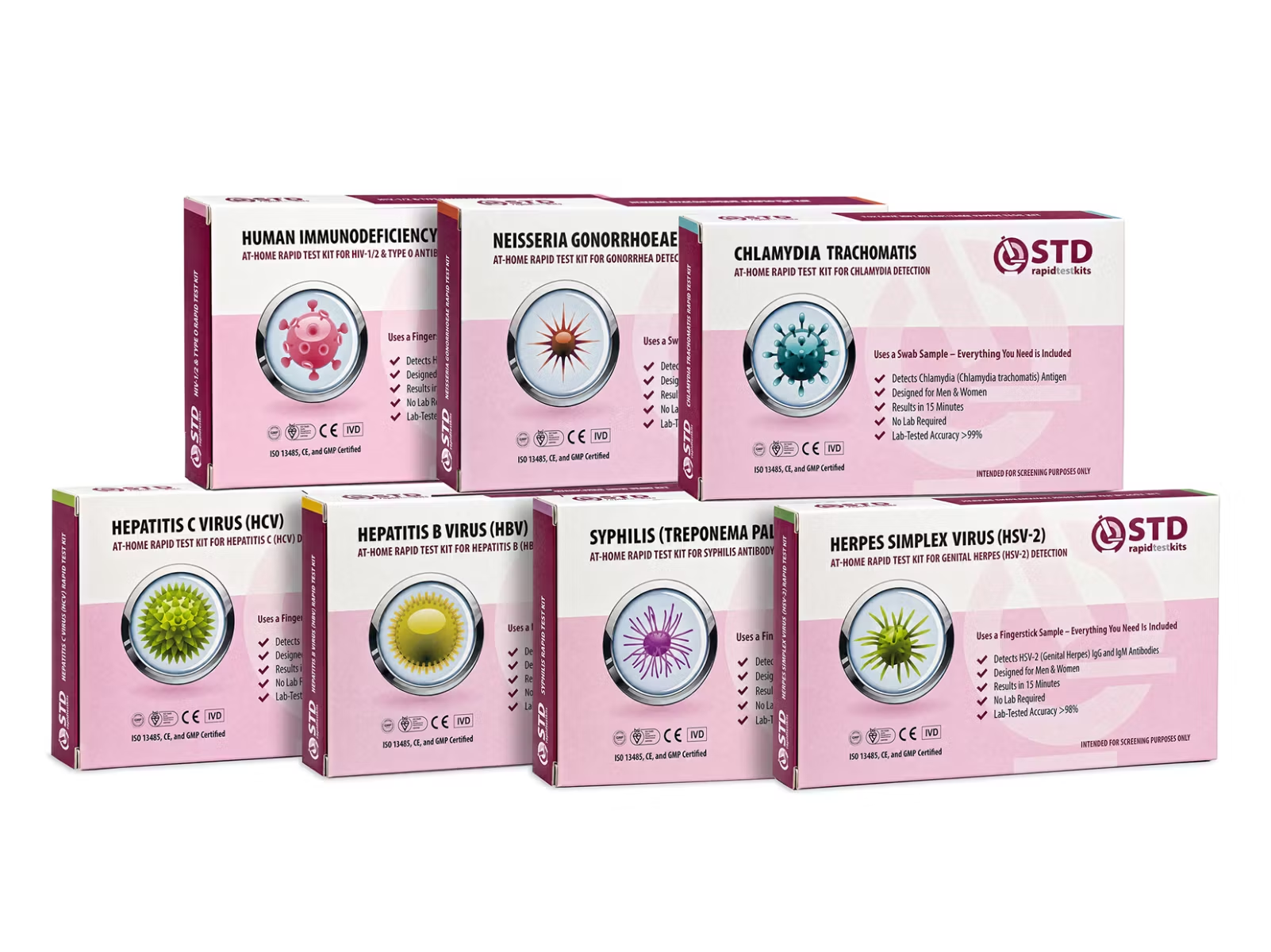
HIV is rarely the only thing on the table after a condom failure. CDC STI guidance gives infection-specific windows: chlamydia and gonorrhea are often detectable from about 7 to 14 days post-exposure on a rapid swab; syphilis from roughly three weeks on a blood test, with a retest at 6 weeks and again at 90 days to call a definitive negative; hepatitis B and C have longer windows and usually warrant a retest at twelve weeks.
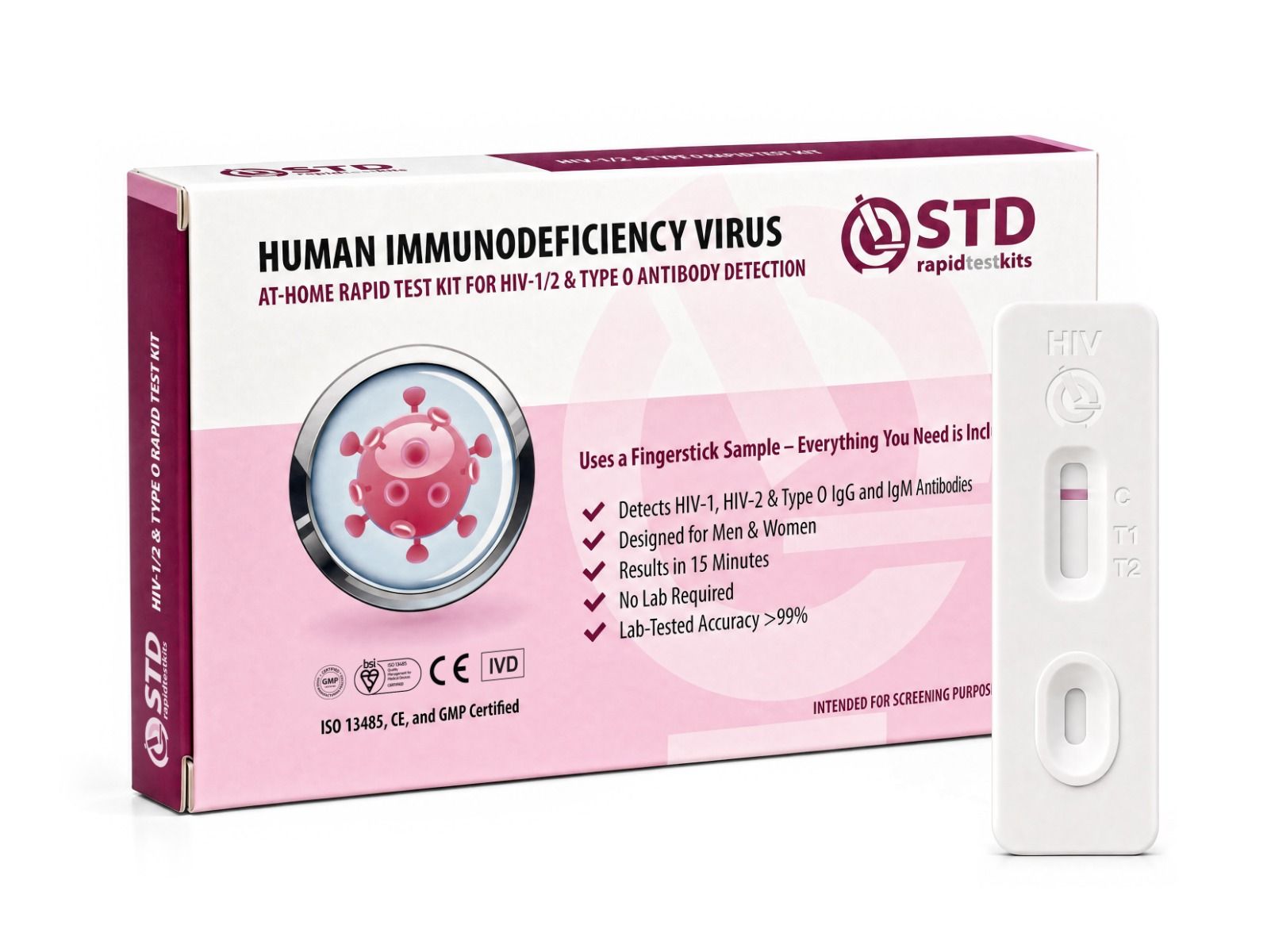
The practical implication is that testing right after a slip is rarely the full answer. A baseline test in the day or two after the event establishes what was already present before this exposure, which matters if you are between regular screenings. The more decision-relevant test is the one taken after the window period for the infection you are most worried about. For broader exposure (oral, vaginal, or anal sex with a new or untested partner), a combo panel covers HIV, syphilis, hepatitis B, hepatitis C, chlamydia, gonorrhea, and HSV-2 antibodies on a single collection event. Worth noting: none of our home tests cover throat or rectal-site infections, so a clinic-administered pharyngeal or rectal swab is the right move if those routes are part of the exposure picture.
FAQs
- Does lube on its own prevent HIV?
- Lube is part of the protection equation rather than a barrier in its own right. What it does is keep the actual barrier (the condom) intact and reduce the mucosal friction that creates entry points for HIV. Used with a condom, the right lube lowers transmission risk indirectly by preventing breakage and microtearing. Used alone, lube cannot stop HIV.
- Does coconut oil really break condoms?
- Yes. Coconut oil weakens latex within minutes, and the condom can fail without any visible tear. If you prefer oil-based products, switch to polyurethane condoms after checking that brand's packaging; oil contacts latex within seconds regardless of how organic or food-grade the label looks. For nearly everyone using standard pharmacy condoms, switch to water-based or silicone-based lube.
- Is silicone really safer than water-based for HIV risk?
- Neither is intrinsically safer for HIV. Both are condom-compatible and both reduce microtear-forming friction. Silicone holds glide longer, which matters for receptive anal sex because the rectum produces no natural lubrication and most encounters last beyond what water-based formulas can sustain without reapplication. If a water-based lube dries mid-encounter and friction picks back up, you lose the protective effect. Either works; the better choice is the one you will actually reapply often enough to stay slick.
- I used a lot of silicone lube and the condom slipped off. What now?
- Silicone lube is very slippery, which is part of why it works so well for anal sex. In very generous quantities it can occasionally cause condoms to slip. Apply enough to reduce friction, and reapply as needed rather than over-applying at the start. If a condom slipped off mid-act, treat it as a potential exposure: ask a clinician about PEP within 72 hours if the partner's status is high-risk or unknown, plan a baseline test now, and a follow-up after the relevant window.
- The condom did not break. Do I still need to worry?
- If the condom stayed on, did not slip, and was used with a compatible lube, your risk is genuinely low, though microscopic tears from friction or irritation can still allow transmission; get tested at the appropriate window if anything felt off afterward. Irritation, burning, or bleeding after anal sex are the symptoms most worth following up on.
- What is osmolality and why does it matter for HIV risk?
- A hyperosmolar lube temporarily weakens the rectal lining by pulling water out of mucosal cells, leaving the epithelial barrier more permeable to HIV than it would otherwise be. WHO guidance puts the practical ceiling at roughly 1,200 mOsm/kg for anal use, and isotonic formulas close to the body's own 280 to 380 mOsm/kg are safest. If a brand does not list osmolality on the label, an explicitly isotonic, glycerin-free product is the safer default.
- Can flavored or warming lubes cause problems?
- They can. Many flavored lubes are sugary, which can disrupt vaginal pH and raise the risk of bacterial vaginosis or yeast overgrowth. Many warming or tingling formulations are hyperosmolar, meaning they pull water out of mucosal cells and weaken the epithelial barrier. Flavored water-based lubes are reasonable for oral use; for penetrative sex, prefer an isotonic, glycerin-free product designed for that purpose.
- Can I test for HIV right after a condom break?
- First question: is PEP still an option? The 72-hour clock starts at the exposure. If the partner is HIV-positive or unknown-status and the exposure looked high-risk, that prescription beats any same-day test. For testing itself, a clinic NAAT is reliable from about day 10, a lab fourth-generation antigen/antibody test by day 45, and a home antibody-only rapid kit from day 23 onward. A baseline test now is useful only to document what was present before this exposure; the answer-bearing test is the one done after the window closes.
The bottom line
Treating lube as part of safer sex rather than as an optional extra is what the laboratory and clinical evidence keeps pointing to. The lube you choose decides whether a latex condom stays a barrier or becomes a weakened sheet that fails under load. It also decides whether your mucosal lining stays robust or becomes temporarily more permeable to HIV and other STIs. Oil-based products are the highest-impact mistake. Hyperosmolar warming or flavored products are the subtler one. Plain water-based and silicone-based lubes, isotonic and glycerin-free when possible, used in adequate quantity and reapplied as needed, are what current CDC and WHO HIV-prevention messaging recommends.
If something already happened (a slip, a break, a session you regret), you do not need to predict the outcome. Within 72 hours, ask a clinician about PEP if the exposure was high-risk. After that, plan a baseline test now and a window-period retest matched to the infection you are most worried about. The same logic applies to the partner you were with, if testing is something the two of you can talk about.
Next steps
- Choose a water-based or silicone-based lube labeled condom-compatible; avoid coconut oil, Vaseline, baby oil, and lotions with any latex condom.
- Reapply during longer sessions; for receptive anal sex, prefer isotonic, glycerin-free formulas to reduce mucosal irritation.
- After a condom break, slip, or wrong-lube event with a high-risk or unknown-status partner, ask a clinician about PEP within 72 hours.
- Plan a baseline HIV test now and a window-period retest at roughly 45 days for a lab Ag/Ab test, with a 90-day confirmation if antibody-only rapid testing at home.
How we sourced this article: We combined current guidance from the CDC, WHO, and NHS with the peer-reviewed laboratory and human-tissue research those guidelines are built on. HIV per-act risk figures come from CDC transmission estimates; condom-and-lubricant compatibility data from CDC and WHO condom guidance; lubricant osmolality findings from published laboratory studies of rectal and vaginal mucosal cells; and HIV testing window periods from current CDC testing guidance. Every external link opens in a new tab so you can verify claims without losing your place.
- U.S. Centers for Disease Control and Prevention. HIV basics, transmission routes, and per-act risk framings used throughout this article.
- U.S. Centers for Disease Control and Prevention. Condom use and effectiveness guidance, including which lubricants are compatible with latex.
- U.S. Centers for Disease Control and Prevention. HIV testing windows for NAAT, fourth-generation antigen/antibody, and antibody-only rapid tests.
- U.S. Centers for Disease Control and Prevention. STI screening and treatment guidance; window-period framing for chlamydia, gonorrhea, syphilis, and viral hepatitis.
- World Health Organization. HIV fact sheet covering transmission risk factors and the role of condoms in prevention.
- World Health Organization. Condoms fact sheet, including the verbatim lubricant pull-quote and guidance on lubricant compatibility for anal sex.
- U.K. National Health Service. Condom guidance, including which lubricants are compatible with latex and which are not.