

Published: November 2025 | Last updated: May 2026 | Editorial review and quality control: Martina N.
Syphilis cases in the United States climbed for more than a decade to multi-decade highs, and spring break travel has become one of the patterns driving how the bacteria moves through campus-aged populations. The pathogen spreads quietly. Most people transmit syphilis before they notice any symptom, and the early warning signs are designed to be missed: a small painless sore at the site of entry, a faint rash that fades on its own, mild flu-like aches that pass within a week. None of those alone is a clear signal to test.
This guide walks through what the current data shows, what each stage of syphilis looks like, how travel-tied exposure patterns work, and what a sensible testing window looks like after a possible exposure. The goal is practical: enough information to make a clear decision about when to test, what to discuss with a partner, and which test type fits a specific concern. None of this is moralizing about spring break behavior. It is a clinical and logistical primer for the people who travel, the people they meet, and the people waiting at home.
Key Takeaways
- U.S. syphilis cases sit at multi-decade highs, and congenital syphilis has risen for 12 consecutive years according to CDC surveillance.
- Most transmissions happen before anyone notices a symptom. Testing three to six weeks after a possible exposure is the most reliable way to catch syphilis early.
Why U.S. Syphilis Cases Are at Multi-Decade Highs
The CDC's most recent annual STI surveillance report documented 41,496 primary and secondary syphilis cases in the United States in 2024. Primary and secondary cases declined 22 percent from 2023 (the second consecutive yearly decline at this most-contagious stage), but the absolute total remains at multi-decade highs after more than ten years of climbing case counts. Congenital syphilis (passed from a pregnant person to their baby during pregnancy) tells a different story: it rose for the 12th consecutive year, with nearly 4,000 cases reported in 2024.
Several factors are running together. Routine sexual-health clinic capacity has shrunk in many states. Partner-notification programs that trace contacts back through a network of exposures have been underfunded for years. Infections with few or no symptoms are harder to catch without active screening. Rapid antibiotic treatment, once standard at sexual-health clinics, has been harder to access in regions where those clinics have closed or merged.
Young adults aged 18 to 29 account for a large share of new diagnoses, and case rates concentrate in states that combine population density, large university campuses, and constrained public-health budgets. Florida, Texas, California, Mississippi, and Louisiana lead recent surveillance tables. Spring break destinations within those states (Miami, Panama City, Padre Island, San Diego) become amplification points during the late-March and early-April travel weeks.
The World Health Organization's syphilis fact sheet reports approximately 8 million new syphilis infections among adults aged 15 to 49 in 2022, which means the U.S. trend is part of a wider global picture rather than a domestic anomaly. Prevention and testing literacy matter for U.S. travelers because of how quickly post-travel infections redistribute across states and partner networks.
Congenital syphilis deserves particular attention because it is the consequence layer that public-health planners track most closely. When a pregnant person carries untreated syphilis, the bacteria can cross the placenta and cause stillbirth, neonatal death, low birth weight, or long-term neurological, skeletal, and developmental damage in surviving infants. Routine prenatal syphilis screening catches the infection early enough for treatment with penicillin to prevent transmission to the baby in nearly all cases, which is why prenatal screening visits are the single most effective public-health intervention against the congenital pattern. The continued rise in congenital cases reflects missed or delayed prenatal care more than any biological change in the disease.
One reason syphilis is harder to contain than some other STIs: the primary-stage chancre is painless, often hidden inside the mouth, vagina, or anus, and disappears on its own within three to six weeks. By the time anyone might notice a problem, the bacteria has often moved into the secondary stage, and a person may have transmitted the infection to one or more partners without realizing it.
Syphilis can be cured with the right antibiotics from a healthcare provider. However, treatment will not undo any damage the infection has already done.
The Four Stages of Syphilis and What You Might Notice
Syphilis progresses through four clinical stages if untreated, each with a distinct pattern. Understanding which stage produces which symptoms helps explain why so many people who carry the infection never realize it until a routine test catches it.
Primary stage
The first sore typically appears about three weeks or more after exposure, per NHS clinical guidance, though the window can range from a few days to a few months. The hallmark is a chancre: a single round firm sore at the site of bacterial entry, usually painless. Chancres often appear on the genitals, but they can also form on the cervix, inside the rectum, on the lips, in the mouth, or on the fingers. Because they don't hurt, they're easily mistaken for a shaving cut, ingrown hair, canker sore, or pimple. The chancre heals on its own in three to six weeks whether or not the person seeks treatment per CDC clinical guidance. The infection itself does not resolve.
Secondary stage
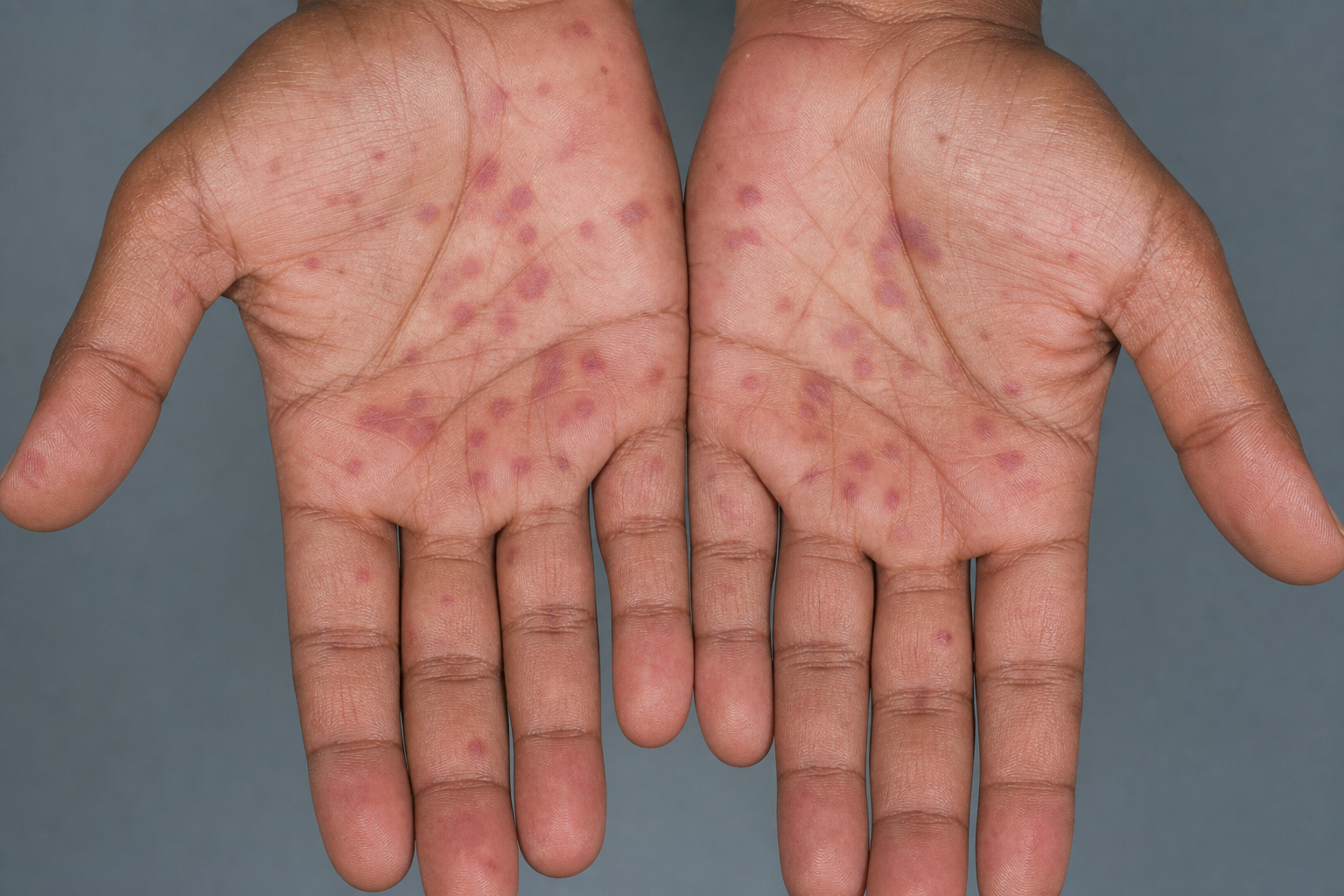
The secondary stage begins weeks after the primary chancre resolves, per CDC clinical guidance. The most recognizable feature is a rash made up of rough, copper-red or dusky-pink macules and papules. Unlike most rashes, syphilis rash often involves the palms of the hands and the soles of the feet, which is one of the strongest clues for clinical recognition. Other secondary symptoms include patchy hair loss, mucous patches inside the mouth or on the genitals, swollen lymph nodes, low-grade fever, and fatigue. As with the primary chancre, secondary symptoms can fade without treatment while the bacteria persists.
Latent stage
After secondary symptoms resolve, syphilis enters a latent period with no visible signs. Blood tests still detect antibodies. Early latent syphilis (within one year of infection) is considered transmissible through sexual contact. Late latent infection is generally not infectious through sexual contact but can still be passed to a fetus during pregnancy, which is why prenatal syphilis screening is part of standard obstetric care.
Tertiary stage
Develops in a significant minority of untreated cases, typically 10 to 30 years after the initial infection per CDC clinical guidance. Tertiary syphilis can damage the cardiovascular system (aortic aneurysm), the central nervous system (neurosyphilis with cognitive decline, paralysis, or coordination loss), the eyes (ocular syphilis with vision loss), and the ears (otosyphilis with hearing loss). Neurosyphilis and ocular syphilis can also occur during earlier stages, and recent surveillance suggests these complications are appearing earlier in some cases.
The image below shows the classic secondary-stage rash on the palms, which dermatology atlases use as a teaching example because of how characteristic the distribution is.
How Spring Break Travel Accelerates the Spread
Travel doesn't create infections, but it does change how they move through a population. A localized cluster of syphilis cases in a single city can be tracked, contacted, and treated through routine public-health investigation. When the same infections leave with travelers, they redistribute across dozens of campuses, regions, and countries within a week, which makes contact tracing far harder.
Several travel-tied factors raise transmission probability during spring break weeks:
- Higher rates of casual sexual contact with new partners, often without prior STI conversations.
- Less consistent condom use, particularly during oral sex, which can still transmit syphilis through contact with a chancre.
- Alcohol and recreational substance use that reduces the reliability of barrier protection.
- Returning home before any primary-stage chancre appears, which leaves the original exposure city out of the contact-tracing window.
- Anonymous or low-contact-information hookups, which break the chain of partner notification if a diagnosis comes back positive a month later.
The dispersion problem is the central issue. A typical syphilis incubation period of about three weeks means most people are back home, often with their regular partners, before the first chancre appears. By then, the original exposure city is no longer where the public-health work needs to happen. The patient's home state or campus health center becomes the new front line, and partner-notification efforts depend on whether the patient can identify and contact people they slept with during travel.
Post-travel testing matters even for people who feel well. The current generation of rapid antibody tests works by detecting immune response to Treponema pallidum, the bacterium that causes syphilis. Detectable antibodies usually appear three to six weeks after exposure, which means a person who feels well during and after a trip can still return a positive test result inside that window.
The incubation period between bacterial exposure and the first visible chancre averages around three weeks. Most spring break travelers return home well inside that window, which means the original exposure city is no longer where contact tracing can usefully happen. Anyone testing positive a month later has to retrace partner contacts across states, friend groups, and dating apps from a week they may not have documented carefully. Honest contact-information exchange at the time, even just a first name and a social handle, makes a substantial difference if a later partner-notification conversation becomes necessary.
What Practical Prevention Looks Like for Travelers
The single highest-yield individual measure is consistent condom use, including during oral contact. Syphilis transmits through skin-to-skin contact with a chancre, and chancres can form in locations a condom does not cover (the base of the penis, scrotum, vulva, perineum, anus, lip, or inside the mouth). Condoms reduce but do not eliminate transmission risk; they remain the most evidence-supported personal measure per NHS clinical guidance.
Practical pre-travel and during-travel measures include:
- Get a baseline syphilis test in the four to six weeks before travel, especially if you've had unprotected sex with new partners recently. A clean baseline makes any post-travel positive result much easier to interpret.
- Pack more condoms than you expect to use. Travel pharmacies often run out during peak weeks, and unfamiliar brands at unfamiliar shops are not always what you want.
- Bring a small water-based lubricant if you anticipate condom use; better lubrication reduces condom failure rates.
- Avoid sharing sex toys between partners without cleaning and barrier protection.
- Keep a contact path open with anyone you sleep with. A first name and a social-media handle is usually enough for a later partner-notification conversation if it becomes necessary.
- Plan to test again three to six weeks after returning home, even if you feel fine.
The reason for the post-travel test, rather than relying on symptoms, is straightforward. A large proportion of primary-stage syphilis chancres go unnoticed by the person who has one, either because the sore is hidden internally, because it is painless and resembles other skin marks, or because it appears and disappears during a travel week when no one is paying close attention to a small lesion.
Alcohol and recreational substances lower the consistent use of condoms and shift judgment about when to engage in sexual contact. They also raise the risk of consent ambiguity. If sexual contact is happening under heavy intoxication, the safest position is to slow down or stop. None of this is a moral judgment. It is a practical observation about how transmission patterns work during peak-party weeks.
Testing Windows: When Results Are Reliable
Syphilis testing usually involves a blood test that detects antibodies your immune system produces in response to Treponema pallidum. The two common antibody types are non-treponemal (RPR, VDRL) and treponemal-specific (TP-PA, FTA-ABS, and the lateral-flow rapid tests used in at-home kits). Antibodies typically become detectable three to six weeks after exposure, consistent with guidance from the CDC, CDC STI Treatment Guidelines, and NHS on the early-symptom timeline.
What this means in practice:
- A test taken less than three weeks after a possible exposure can return a false-negative result even in a person who has syphilis. The body has not yet produced enough antibodies for the test to detect.
- Testing three to six weeks post-exposure is generally a reliable first checkpoint.
- If the initial test is negative but exposure risk was high, a repeat test at 12 weeks is the conservative confirmation window.
- If a chancre is currently visible, a clinician can test the fluid from the sore directly through darkfield microscopy or PCR and confirm a diagnosis before antibodies are detectable, which is faster than waiting for the seroconversion window.
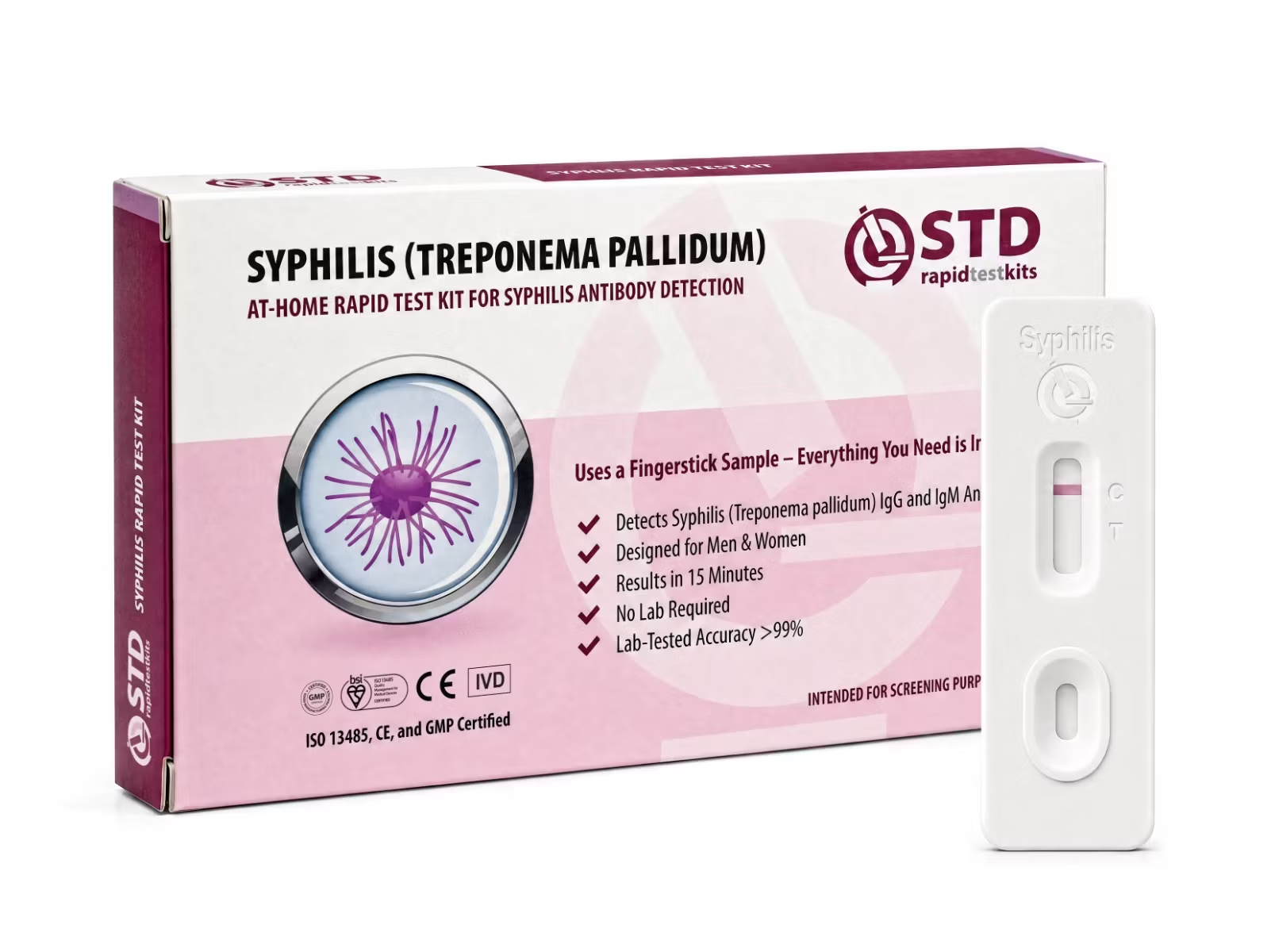
At-home rapid lateral-flow tests use fingerstick blood and produce a result in roughly 15 minutes. They are screening tools rather than confirmatory tests. A positive at-home result should be followed by a clinic visit for a confirmatory test panel (typically RPR plus a treponemal-specific assay) and, if confirmed, a prescription for benzathine penicillin G. A negative at-home test taken inside the window-period range is reassuring but not definitive. Laboratory testing offers higher analytical sensitivity in the early window than home tests do; the two methods are complementary, not equivalent.
Penicillin remains the standard treatment for all stages of syphilis. Early-stage syphilis usually responds to a single intramuscular dose. Late or latent infection requires a longer course. People with a documented penicillin allergy can be desensitized in a clinical setting and then treated with penicillin; the CDC STI Treatment Guidelines explicitly recommend desensitization for pregnant patients with penicillin allergy because alternative antibiotics are less reliable against the bacteria.
Note: stdrapidtestkits.com sells the at-home rapid tests referenced below. Banner descriptions reflect what each kit screens for and the appropriate window-period use.
Steps to Take Before, During, and After Travel
The sequence below treats spring break as a high-contact week away from regular partners and surroundings, and focuses on the steps that reduce avoidable harm.
Before you leave
- If you've had unprotected sex with anyone new in the last six months, get a baseline test. A combination panel that covers syphilis, HIV, chlamydia, and gonorrhea provides the clearest reference point.
- Pack condoms. Bring more than you expect to use, and pack a small water-based lubricant if you anticipate condom use.
- If you take pre-exposure prophylaxis (PrEP) for HIV, plan refills and dosing around your travel window.
- Think about how you will exchange contact information with people you sleep with. A phone number or a social handle is enough for a later conversation if it becomes necessary.
During the trip
- Use condoms consistently for vaginal, anal, and oral contact. Syphilis transmission through oral contact is well-documented and often underestimated.
- Trust your read of a situation. If something feels off, it usually is. Removing yourself politely costs nothing.
- Limit unfamiliar substance combinations. A single bad mix on vacation produces a disproportionate share of medical incidents.
After you get back
- Schedule a test three to six weeks after your last possible exposure. A combination panel catches the most common travel-tied infections in one sitting.
- Watch for primary symptoms: a single painless sore at any site of contact, including inside the mouth, on the lip, or at the anus. A persistent sore lasting longer than a few days deserves a clinical look even if you tested negative early.
- If you do test positive, notify the partners you can reach. Many state health departments will perform anonymous partner notification on your behalf if you provide contact information.
Common Misunderstandings About Syphilis
The folklore around syphilis is denser than around most STIs, partly because the disease has been around for centuries and partly because clinicians stopped seeing it in routine practice for a few decades. A few patterns worth clearing up.
"Only people with many partners get syphilis." Risk depends on exposure, not on partner count. A single unprotected encounter with a person in the infectious window is enough for transmission. Syphilis follows from bacterial exposure, and the number of partners someone has had does not change that biology.
"If I had syphilis I'd feel it." A substantial share of people with confirmed syphilis report no symptoms at the time of diagnosis. Primary chancres are painless. Secondary symptoms often resolve on their own. Latent infection is asymptomatic by definition.
"The sore went away so the infection is gone." The chancre heals because the immune system contains the initial site of bacterial entry. The bacteria itself has already disseminated through the lymphatic system and can persist for years if untreated.
"I'm allergic to penicillin so I can't be treated." Penicillin allergy is real but is also frequently mis-attributed. Many childhood reactions later turn out not to be true allergies on formal testing. For confirmed allergy, desensitization in a clinical setting is the established approach. Alternative antibiotics exist but are less reliable for syphilis specifically.
"If my partner tested positive it means they cheated." A positive partner result does not by itself establish recent infidelity. Syphilis can remain undiagnosed for years. A new positive result can reflect a recent exposure, an old exposure that was never detected, or a missed past diagnosis. Treat a partner's positive result as a clinical conversation rather than a confrontation.
Frequently Asked Questions
- Can you get syphilis from oral sex?
- Syphilis transmits through direct contact with a chancre, which can form on the lip, inside the mouth, on the tongue, or in the throat. Oral contact with an infected partner's genitals or oral contact with an infected partner's mouth can both transmit the bacteria, which is why oral-sex condom and dental-dam use matters for syphilis prevention specifically.
- What does a primary syphilis chancre look like?
- A single round firm sore, usually painless, between roughly 5 and 20 millimeters across, with a slightly raised edge. The base of the sore is typically smooth and clean. It can appear at any site of bacterial entry: genitals, anus, mouth, lip, or fingers. Because it doesn't hurt, it is often mistaken for a shaving cut, ingrown hair, canker sore, or pimple.
- Is a rash on the palms and soles always syphilis?
- Other conditions, including some viral exanthems and drug reactions, can produce palmar and plantar rashes, so a palmar rash is not automatically syphilis. But syphilis is one of the few common causes, and any rash on those locations that comes with mouth sores, swollen lymph nodes, or recent sexual exposure deserves prompt testing.
- How soon after a possible exposure can I test reliably?
- If your last possible exposure was this week, plan your first test for the three-to-six-week mark after that date. A negative result then is reassuring for most situations. For high-risk exposure (a known infected partner, condomless contact with unknown status), schedule a second confirmatory test at 12 weeks to rule out an early-window false negative.
- Is syphilis curable?
- Penicillin remains the standard treatment and clears the bacterial infection completely when started early. Late or tertiary syphilis treatment can stop further damage but does not reverse damage that has already occurred to the cardiovascular or nervous systems.
- Can someone be reinfected after being treated?
- Reinfection is possible because successful treatment clears the bacteria but does not produce lasting immunity. A second exposure can produce a second infection, which is why routine retesting and consistent prevention practices matter even after a previous cure.
- My partner tested positive. What should I do?
- Get tested yourself even if you have no symptoms and feel well. If the partner is mid-treatment, avoid sexual contact until the clinician confirms the partner is no longer infectious. Discuss the result without assuming a timeline; syphilis can remain undiagnosed for years, so a positive result is not necessarily a recent-exposure result.
- Are at-home rapid syphilis tests reliable?
- At-home rapid lateral-flow tests are useful screening tools when used inside the appropriate window period. A positive result should be confirmed at a clinic with a treponemal-specific test before treatment is prescribed. A negative result within the window is reassuring; outside the window it can represent a false negative, which is why post-travel timing matters.
- U.S. Centers for Disease Control and Prevention. Annual STI Surveillance: 2024 provisional U.S. case counts for primary, secondary, and congenital syphilis.
- U.S. Centers for Disease Control and Prevention. About Syphilis: clinical overview of the four stages, including primary chancre duration and tertiary timing.
- U.S. Centers for Disease Control and Prevention. STI Treatment Guidelines: syphilis treatment, including penicillin desensitization for allergic patients.
- World Health Organization. Syphilis fact sheet: global incidence (approximately 8 million new adult infections in 2022) and stage-based clinical overview.
- UK National Health Service. Syphilis symptoms: incubation timing for the first chancre and stage-based symptom descriptions.
- UK National Health Service. Syphilis: prevention guidance and condom recommendations.
