Can You Catch STDs From Animals? Zoonotic Facts and Myths
Most human STDs evolved to spread between people and cannot be caught from animals or pets. A few zoonotic infections do mimic STD symptoms, which is where most of the confusion comes from. Here is what the science actually says, which myths to drop, and when at-home testing is the right tool.



- Human STDs like HIV, chlamydia, gonorrhea, syphilis, and herpes evolved to spread between people and cannot be caught from animals or pets.
- A few zoonotic infections (brucellosis, leptospirosis, toxoplasmosis) cause symptoms that mimic STDs, which is why clear testing matters when symptoms are ambiguous.
Published: November 2025 | Last updated: May 2026 | Editorial review and quality control: Martina N.
The internet has plenty of confident claims that animals give people sexually transmitted infections: koalas with chlamydia, pigs with herpes-like rashes, sheep with diseases that act, supposedly, just like gonorrhea. Most of these stories collapse the moment a microbiologist looks at them, because human STDs are extremely species-specific. They evolved to spread between people and almost always need direct sexual contact between two humans to move at all.
What's actually true is more interesting. A handful of real zoonotic infections, infections that DO pass from animals to humans, produce symptoms that overlap with classic STDs: genital pain, rash, fever, swollen lymph nodes, flu-like illness. That overlap is where most of the "I caught X from an animal" rumors come from. The illness was real, but the transmission route was not sexual.
This article walks through what zoonotic diseases are, which ones get confused with STDs and why, what current public-health guidance says about every major myth in this space, and when at-home testing is the right tool versus when you need a clinic.
Key Takeaways
- Human STDs like HIV, chlamydia, gonorrhea, syphilis, and herpes evolved to spread between people and cannot be caught from animals or pets.
- A few zoonotic infections (brucellosis, leptospirosis, toxoplasmosis) cause symptoms that mimic STDs, which is why clear testing matters when symptoms are ambiguous.
What zoonotic diseases actually are
A zoonotic disease, or zoonosis, is any infection that naturally jumps from a non-human animal to a person. The list is enormous and most of it has nothing to do with sex. The World Health Organization's zoonoses fact sheet describes over 200 known types of zoonoses and notes that they comprise a large percentage of all newly identified infectious diseases in humans.
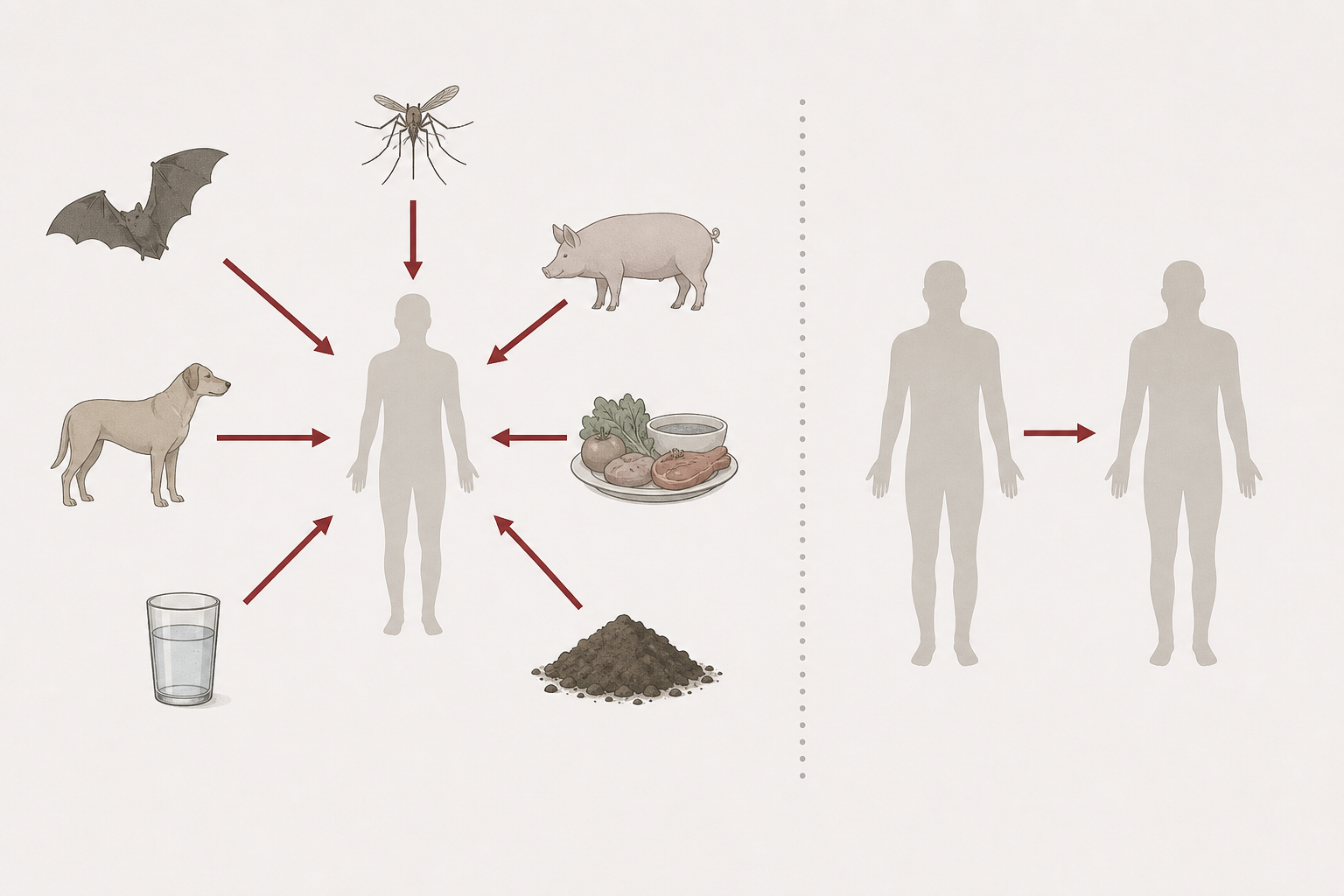
Zoonotic infections travel by routes that are easy to picture once you list them out:
- Bites or scratches (rabies from a dog, cat-scratch disease from a kitten)
- Direct contact with an animal's body fluids, skin, or fur (ringworm, anthrax, brucellosis)
- Bites from arthropod vectors that feed on animals and people (Lyme disease, plague, West Nile virus)
- Eating contaminated meat, dairy, or eggs (salmonella, toxoplasmosis, brucellosis, certain E. coli strains)
- Inhaling aerosolized droplets near infected animals (hantavirus, Q fever, avian influenza)
- Contact with animal urine or water that has been contaminated by it (leptospirosis)
- Handling fecal material (toxoplasmosis from cat litter, hookworm from soil)
Some are mild, others catastrophic. Some are common in farmers and veterinarians and rare in everyone else. None are classical STDs, even when the symptoms look superficially similar.
Public-health agencies separate zoonotic diseases from STDs deliberately because the prevention strategies are completely different. Avoiding raw milk and washing hands after handling a kitten does not prevent gonorrhea. Condom use does not prevent toxoplasmosis.
Zoonoses reach people through animal bites and scratches, direct fluid or skin contact, arthropod vectors (ticks, fleas, mosquitoes), contaminated food and water, aerosolized droplets near sick animals, and contact with animal urine or feces. Sexual contact between two humans is not on that list. Mixing the two prevention frameworks leaves the actual transmission route uncovered.
Can humans catch STDs from animals? The short answer
In essentially every practical sense, no, and the science on each pathogen tells the same story.
Each major human STD has been studied closely, and the same pattern emerges. The pathogen evolved alongside humans, uses human-specific cellular machinery, and either cannot infect other species or causes a different disease when it does.
HIV. Modern HIV is a strictly human-specific virus. The WHO's HIV/AIDS fact sheet describes transmission only through body fluids of an infected person: blood, breast milk, semen, and vaginal fluids. CDC surveillance data attributes roughly 67% of new HIV diagnoses in 2022 to male-to-male sexual contact, 22% to heterosexual contact, and 7% to injection drug use. Every route on that list is human-to-human. HIV's distant evolutionary ancestor is a simian immunodeficiency virus found in primates, but the virus that exists today is genetically and biologically a human pathogen.
Chlamydia trachomatis. This is the species that causes human chlamydia. It is genetically distinct from Chlamydia pecorum, the strain that infects koalas, and from Chlamydia abortus, which infects sheep and causes pregnancy loss in livestock. The species barrier holds. Documented human cases of Chlamydia abortus occur in shepherds and veterinarians exposed to lambing fluids, and they produce a flu-like or septic illness, not the classical urogenital chlamydia presentation.
Gonorrhea, syphilis, trichomoniasis. All caused by pathogens that are functionally human-only. Trichomonas vaginalis in humans is a different organism from the Trichomonas species in cattle, birds, and fish, and the species do not interchange.
Herpes simplex. HSV-1 and HSV-2 are human herpesviruses. Other species have their own herpesviruses. Herpes B virus in macaques is the famous example, and it CAN infect humans, usually through a bite from an infected monkey, but it causes encephalitis rather than genital lesions, and it is not sexually transmitted between species.
HPV. Human papillomaviruses are exquisitely host-specific. The strains that cause cervical cancer or genital warts in humans don't infect animals.
Mycoplasma. Various Mycoplasma species infect both animals and people, but the species that cause sexually transmitted infections in humans (Mycoplasma genitalium, Mycoplasma hominis) are human-adapted. Animal Mycoplasma species cause veterinary diseases and are not established human STI agents.
Simian foamy virus (SFV). SFV is a retrovirus that infects primates and can spill over to humans through bites from infected monkeys, particularly in primate-handling occupations and ritual hunting contexts. Person-to-person sexual transmission of SFV has not been established. SFV is a research curiosity rather than a public-health problem in the general population, and it is not the same kind of infection as HIV despite both being retroviruses.
Zoonotic infections that look like STDs
Here is where the confusion lives. Several zoonotic infections produce symptoms that overlap with classical STDs. They are not sexually transmitted. They are not human-only. But the clinical picture can look similar enough to send someone to an STD clinic.
Brucellosis. Brucella bacteria infect cattle, goats, pigs, and sheep, and they pass to humans through unpasteurized dairy, undercooked meat, or direct contact with infected animal tissues. The CDC's brucellosis page lists swelling of the testicles and scrotum area among symptoms that may continue or recur until treated, along with fever, fatigue, joint pain, and sweating. A man presenting with testicular pain and fever could easily be worked up for gonorrhea or chlamydia first. The differentiator is exposure history: brucellosis is occupational (farmers, veterinarians, slaughterhouse workers) or food-borne (raw cheese from endemic regions).
Leptospirosis. Leptospira bacteria live in the kidneys of rodents and many other animals and shed into their urine. People get infected through contact with water or soil that has been contaminated by that urine, especially in flooding, freshwater sports, and agricultural work. The CDC describes the disease as biphasic, with an initial flu-like phase of fever, chills, headache, muscle aches, vomiting, and diarrhea, followed in severe cases by a second phase that can involve kidney or liver failure and meningitis. The initial phase can mimic the acute retroviral syndrome of early HIV closely enough to confuse a clinician who does not know the exposure history.
Toxoplasmosis. The parasite Toxoplasma gondii completes its life cycle in cats and infects intermediate hosts, including humans, through cat feces, undercooked meat, or contaminated soil and water. According to the CDC, most healthy adults with toxoplasmosis have no symptoms, and those with symptoms experience mild flu-like illness with swollen lymph nodes, muscle aches, and pains. That symptom profile overlaps with acute HIV. The two are genuinely hard to tell apart on symptoms alone, which is one of many reasons HIV testing exists.
Q fever. Coxiella burnetii from sheep, goats, and cattle. Acute Q fever causes high fever, sweats, headache, and sometimes hepatitis. It has been confused with mononucleosis, brucellosis, and acute HIV in initial workups.
Cat-scratch disease. Bartonella henselae, spread by a cat scratch or bite. Produces regional lymph-node swelling, low-grade fever, and a small papule at the scratch site. The swollen node can be mistaken for the regional adenopathy that accompanies a syphilis chancre.
If a genital symptom is the primary complaint in a sexually active adult, whether that is pain, rash, ulcer, or discharge, the right move is still STD testing first. Most genital symptoms in this population are STDs. Zoonotic differentials become relevant when STD testing is negative AND there is a meaningful exposure history.
| Infection | STD symptom it mimics | Actual transmission source |
|---|---|---|
| Brucellosis | Testicular swelling, genital pain, fever | Unpasteurized dairy, livestock contact, undercooked meat |
| Leptospirosis | Flu-like illness resembling acute HIV; sometimes a rash | Water or soil contaminated by infected-animal urine |
| Toxoplasmosis | Swollen lymph nodes and flu-like illness resembling acute HIV | Cat feces, undercooked meat, contaminated soil or water |
| Q fever | High fever and malaise resembling acute HIV or mononucleosis | Aerosols from sheep, goats, or cattle |
| Cat-scratch disease | Regional lymph-node swelling resembling syphilis adenopathy | Cat scratch or bite |
Common myths, debunked
A few claims worth taking apart cleanly.
"Humans regularly catch HIV from monkeys today." The ancient cross-species spillover that produced HIV happened decades ago and has not been observed to repeat in ordinary contact. Working with primates carries occupational infection risks (B virus, simian foamy virus) that are not HIV. Modern HIV moves between people.
"Bestiality causes STDs." Bestiality does not cause classical STDs like gonorrhea, syphilis, chlamydia, or HSV-2, because those pathogens do not have a non-human reservoir to draw from. What it CAN do is transmit zoonotic infections (brucellosis, Q fever, leptospirosis), unusual bacterial overgrowths, parasitic infections, and traumatic injuries. Bestiality is illegal in most jurisdictions for several reasons; STDs in the conventional sense are not the primary one.
"Pet owners get more STDs." No published surveillance supports this. Pet owners do get more cat-scratch disease, more toxoplasmosis (especially when handling litter while pregnant or immunocompromised), and more salmonella from reptiles. None of these are STDs.
"Wildlife STD outbreaks can spread to humans." Wildlife do have their own STD-like infections. Koalas have chlamydia. Dolphins have genital warts. Sea lions carry a urogenital herpesvirus. None spread to humans. The species barrier holds because the pathogens have adapted to specific host-cell receptors that human cells don't display.
"You can catch syphilis from sheep." The sheep-syphilis stories trace to medieval shepherding folklore, not to clinical evidence. Treponema paraluiscuniculi is a rabbit pathogen and does not infect humans. Sheep-strain spirochetes exist but do not cause human syphilis.
"Toxoplasmosis is a sexually transmitted disease." Toxoplasma can be present in the semen of acutely infected men, and a small number of animal studies suggest sexual transmission is biologically possible. Despite that, sexual transmission has never been a meaningful documented route in humans. Real toxoplasmosis transmission remains overwhelmingly food and cat feces.
"Koala chlamydia can spread to humans." Koalas are infected with Chlamydia pecorum, which has not been shown to cause urogenital disease in people. Working closely with koalas in wildlife rescue carries some occupational risk, but not human urogenital chlamydia the way human Chlamydia trachomatis does.
| Myth | What the science says |
|---|---|
| Humans regularly catch HIV from animals today | Modern HIV uses human-specific cell machinery; the ancient spillover happened through hunting and butchering of primates, not in ordinary contact |
| Bestiality transmits classical STDs | Gonorrhea, syphilis, chlamydia, and HSV-2 have no animal reservoir; the real risk is zoonotic infections and physical injury |
| Pet owners get more STDs | Pets transmit zoonoses (toxoplasmosis, ringworm, salmonella, cat-scratch disease), not STDs |
| Wildlife STD outbreaks spill into humans | Koala chlamydia and dolphin warts are adapted to host-cell receptors that human cells do not display |
| Sheep cause syphilis | Medieval shepherding folklore; sheep-strain spirochetes do not produce human syphilis |
| Toxoplasmosis is sexually transmitted | Transmission is overwhelmingly cat feces and undercooked meat; sexual transmission has never been a documented public-health route |
For a sexually active adult with genital symptoms (rash, ulcer, discharge, pain), STDs are the dominant cause and the correct starting workup. Zoonotic differentials become relevant when STD testing is negative AND there is a meaningful exposure history: livestock work, freshwater immersion, raw dairy, undercooked meat, or close contact with a sick animal. If symptoms persist after a negative STD panel, a clinician can widen the differential.
Why these myths persist
Three things keep the animal-STD stories alive online despite the science being clear.
The first is genuine symptom overlap. Brucellosis really can cause testicular swelling. Leptospirosis really can produce a rash. Toxoplasmosis really can mimic the flu-like onset of HIV. A person who acquires one of these infections and connects it to a recent animal contact reaches a logical-but-wrong conclusion, and the story spreads from there.
The second is the shadow of the HIV origin story. The fact that HIV did, in deep evolutionary time, emerge from a primate retrovirus gets compressed in the retelling into "HIV came from monkey sex." That compression is wrong: the historical spillover happened through hunting and butchering of infected primates, not through sexual contact, and modern HIV is a human-only virus regardless of how it got here.
The third is folk wisdom. Pre-microbial-science explanations of disease attributed many illnesses to contact with animals, often correctly (rabies, brucellosis) and sometimes wrongly (the sheep-syphilis stories). Those folk explanations still circulate, often with a thin veneer of pseudo-science added on top.
The simian-to-human event that produced HIV happened decades ago through hunting and butchering of infected primates, not through sexual contact with animals. Modern HIV is a human-only virus and moves only between people through the routes documented in CDC and WHO data. The evolutionary origin and the contemporary transmission profile are two different facts, and conflating them is the engine behind most of the "HIV from animals" rumors online.
How to protect yourself from real zoonotic risks
The interventions are unglamorous and effective. Most zoonotic infections are preventable with a small set of practical habits, mostly built around hand hygiene, food handling, water exposure, and protective gear when working with animals. The table below pairs each habit with the infections it addresses.
| Practice | What it helps prevent |
|---|---|
| Wash hands after animal contact, after handling pet food, and after gardening or farm work | Toxoplasmosis, salmonella, cat-scratch disease, soil-borne parasites |
| Cook meat to safe internal temperatures (USDA: 145°F whole cuts, 160°F ground meat, 165°F poultry) | Toxoplasmosis, salmonella, brucellosis, E. coli |
| Avoid unpasteurized dairy and raw-milk cheese from informal markets | Brucellosis, listeria, Q fever, salmonella |
| Cover wounds before freshwater contact; avoid floodwater immersion | Leptospirosis |
| Wear gloves and protective gear around sick, lambing, or calving animals | Brucellosis, Q fever, Chlamydia abortus |
| Keep pets on a current rabies and deworming schedule | Rabies, intestinal parasites |
| Talk to a clinician about toxoplasma exposure before pregnancy if you have outdoor cats or eat raw-cured meats | Congenital toxoplasmosis |
When at-home STD testing makes sense
For sexual health, the protective tools are different and well-established: barrier methods, vaccination (HPV, hepatitis B, mpox where appropriate), pre-exposure prophylaxis for HIV when relevant, and regular STI testing. The two prevention frameworks address different risks and don't substitute for each other.
At-home testing fits a specific use case: a sexually active adult who wants to verify their status, who suspects a recent exposure, or who has symptoms they want to investigate quickly and privately. STD Rapid Test Kits sells the rapid at-home panels described in this section. At-home testing does not replace clinic-based care for severe or persistent symptoms, and it does not test for the zoonotic infections discussed above.
What an at-home rapid panel can answer:
- Am I carrying chlamydia or gonorrhea? (genital swab, results in around 15 minutes)
- Am I HIV antibody-positive? (fingerstick blood, with the most reliable window 12+ weeks after exposure)
- Am I syphilis antibody-positive? (fingerstick blood, with a reliable window of roughly 3 to 6 weeks after exposure)
- What is my hepatitis B and C status? (fingerstick blood)
- Am I HSV-1 or HSV-2 antibody positive? (fingerstick blood, only meaningful well after seroconversion)
What at-home rapid tests cannot answer:
- Do I have brucellosis, leptospirosis, toxoplasmosis, or another zoonotic infection? See a clinician; these need specific serology or culture.
- Is this rash from animal contact or from an STD? A clinician needs to examine it.
- Do I have a throat-only or rectal-only infection? Site-specific swabs require clinic testing, and we do not sell pharyngeal or rectal swab kits.
The CDC's STI program recommends routine screening for sexually active adults regardless of symptoms, with frequency tailored to risk. Most people landing on a "could it be an animal" page are working through a confusing symptom and want to rule out the most likely causes first. An at-home rapid panel covers the high-probability STI causes. If the panel is negative and symptoms persist, the clinic workup can widen to zoonotic possibilities.
Zoonoses comprise a large percentage of all newly identified infectious diseases as well as many existing ones. Over 200 known types of zoonoses are recognized today.
Frequently Asked Questions
- Can humans catch HIV from animals?
- No. HIV is human-specific today. Its distant evolutionary ancestor was a simian retrovirus, but CDC 2022 surveillance attributes every documented U.S. transmission route to human-to-human contact: roughly 67% male-to-male sexual contact, 22% heterosexual contact, and 7% injection drug use. Animal contact is not on that list.
- Can a person catch chlamydia from a koala, cat, or pet?
- No. Koala chlamydia (C. pecorum) and human chlamydia (C. trachomatis) are distinct organisms that do not interchange. Farm workers can occasionally contract C. abortus from sheep lambing fluids, but that produces a flu-like or septic illness, not the urogenital infection that a home swab test screens for.
- Do brucellosis or leptospirosis spread through sex?
- Not in any meaningful way. Both are zoonotic infections acquired through animal contact, contaminated food, or water exposure. They can produce symptoms that resemble STDs (testicular swelling, fever, rash, flu-like illness), which is why exposure history matters in diagnosis.
- Can I get an STD from my dog or cat?
- Pets cannot transmit conventional STDs. They can transmit zoonotic infections (toxoplasmosis from cats, ringworm, salmonella from reptiles, cat-scratch disease) but not human STDs like chlamydia, gonorrhea, syphilis, or HIV.
- I have a genital rash after handling livestock. Is brucellosis a concern?
- Get checked by a clinician. Most genital rashes in sexually active adults are STDs, so STD testing is usually the right first step. If STD testing is negative and you have livestock or raw-dairy exposure, the clinician can order serology for brucellosis or other zoonotic differentials.
- Does cleaning a cat litter box put me at risk for any STD?
- No. Cleaning a litter box can transmit toxoplasmosis (a parasite), not an STD. Toxoplasmosis matters most in pregnancy and in immunocompromised people; otherwise it is usually mild or symptomless.
- Does an at-home STD test detect zoonotic infections?
- No. At-home rapid panels test for human STIs (HIV, chlamydia, gonorrhea, syphilis, hepatitis B and C, herpes). They do not detect brucellosis, leptospirosis, toxoplasmosis, or Q fever. Those require clinic-ordered laboratory tests.
- When should I take an at-home STD test versus going to a clinic?
- At-home testing fits known exposure to a sexual partner, periodic screening for sexually active adults, and confirming status before a new relationship. See a clinic for severe symptoms (high fever, painful sores, persistent rash), exposure to an animal you suspect was sick, possible pregnancy, or any home result you want confirmed.
- World Health Organization. Zoonoses fact sheet describing transmission routes, the figure of over 200 known types of zoonoses, and the burden of newly identified infectious diseases.
- U.S. Centers for Disease Control and Prevention. Brucellosis About page covering symptoms (including testicular swelling), transmission via unpasteurized dairy and direct livestock contact, and prevention.
- U.S. Centers for Disease Control and Prevention. Leptospirosis About page describing transmission via animal urine and contaminated water and the biphasic flu-like illness pattern.
- U.S. Centers for Disease Control and Prevention. Toxoplasmosis About page covering cat-feces and undercooked-meat transmission and the typically mild flu-like illness in healthy adults.
- U.S. Centers for Disease Control and Prevention. HIV facts and statistics page with 2022 transmission-category proportions (male-to-male sexual contact, heterosexual contact, injection drug use).
- World Health Organization. HIV/AIDS fact sheet describing human-only transmission via blood, breast milk, semen, and vaginal fluids.
- U.S. Centers for Disease Control and Prevention. Sexually Transmitted Infections (STI) program landing page covering screening recommendations and prevention guidance for sexually active adults.