

Published: October 2025 | Last updated: April 2026 | Editorial review and quality control: Martina N.
Sexually transmitted infections, often shortened to STIs or STDs, pass between people through a handful of well-understood biological routes. The headline route is sexual contact, vaginal, anal, or oral. But several STIs also pass through blood, from a pregnant person to a fetus or newborn, and through direct skin-to-skin contact with an infected area. Knowing which routes apply to which infections helps you make accurate decisions about risk, testing windows, and prevention.
This article published by stdrapidtestkits.com is a plain-English summary of current public-health guidance from the U.S. Centers for Disease Control and Prevention (CDC), the World Health Organization (WHO), and the UK National Health Service (NHS). We sell at-home rapid STI testing kits, and we recommend products only when they fit the reader's situation, not by default.
How are STDs passed from person to person?
Most STDs spread through sexual contact involving the exchange of semen, vaginal fluids, or direct skin-to-skin contact with infected areas during vaginal, anal, or oral sex. Several infections (HIV, hepatitis B, hepatitis C, syphilis) also spread through blood, including shared injection equipment. Some pass from a pregnant person to a baby during pregnancy, delivery, or breastfeeding. Herpes, syphilis, and HPV can spread by skin-to-skin contact even when no fluids are exchanged. Casual contact like hugging, sharing drinks, or using the same toilet seat does not spread STIs.
Key takeaways
- Sexual contact is the dominant route, but blood exposure, mother-to-child transmission, and skin-to-skin contact also spread specific STIs.
- Condoms cut risk substantially for fluid-borne STIs but offer only partial protection against skin-to-skin infections like herpes and HPV.
The main routes STIs travel between people
Every STI has a preferred biological route. Some prefer body fluids (semen, vaginal secretions, blood, breast milk). Others prefer direct contact with infected skin or mucous membranes. A few use both. Understanding which route applies to which infection is the foundation of accurate risk assessment.
The four routes that account for almost every documented STI transmission are:
- Sexual contact involving genital, anal, or oral mucosa, with or without ejaculation.
- Bloodborne transmission through shared needles, contaminated medical or tattoo equipment, or transfusion of unscreened blood (now rare in countries with screened blood supplies).
- Perinatal transmission from a pregnant person to the fetus during pregnancy, the newborn during delivery, or via breastfeeding.
- Direct skin-to-skin contact with infected areas, even when those areas show no visible symptoms.
Casual contact does not transmit STIs. There are no documented cases of HIV, chlamydia, gonorrhea, syphilis, or herpes spreading through hugging, sharing utensils, sitting on a toilet seat, or being in the same swimming pool as an infected person. The biology rules these routes out: these pathogens require direct mucosal contact, fluid exchange, or blood-to-blood contact, none of which occur in casual settings.
The four transmission routes at a glance
- Sexual mucosal contact during vaginal, anal, or oral sex carries the largest share of STI transmissions.
- Bloodborne exposure through shared injection equipment or unsterilized tattoo and piercing tools transmits HIV, hepatitis B, and hepatitis C.
- Perinatal transmission from a pregnant person to the fetus or newborn passes HIV, syphilis, gonorrhea, chlamydia, herpes, and hepatitis B.
- Direct skin-to-skin contact with infected areas transmits herpes, HPV, and syphilis chancres, even when no fluids are exchanged.
Sexual contact: the dominant transmission route
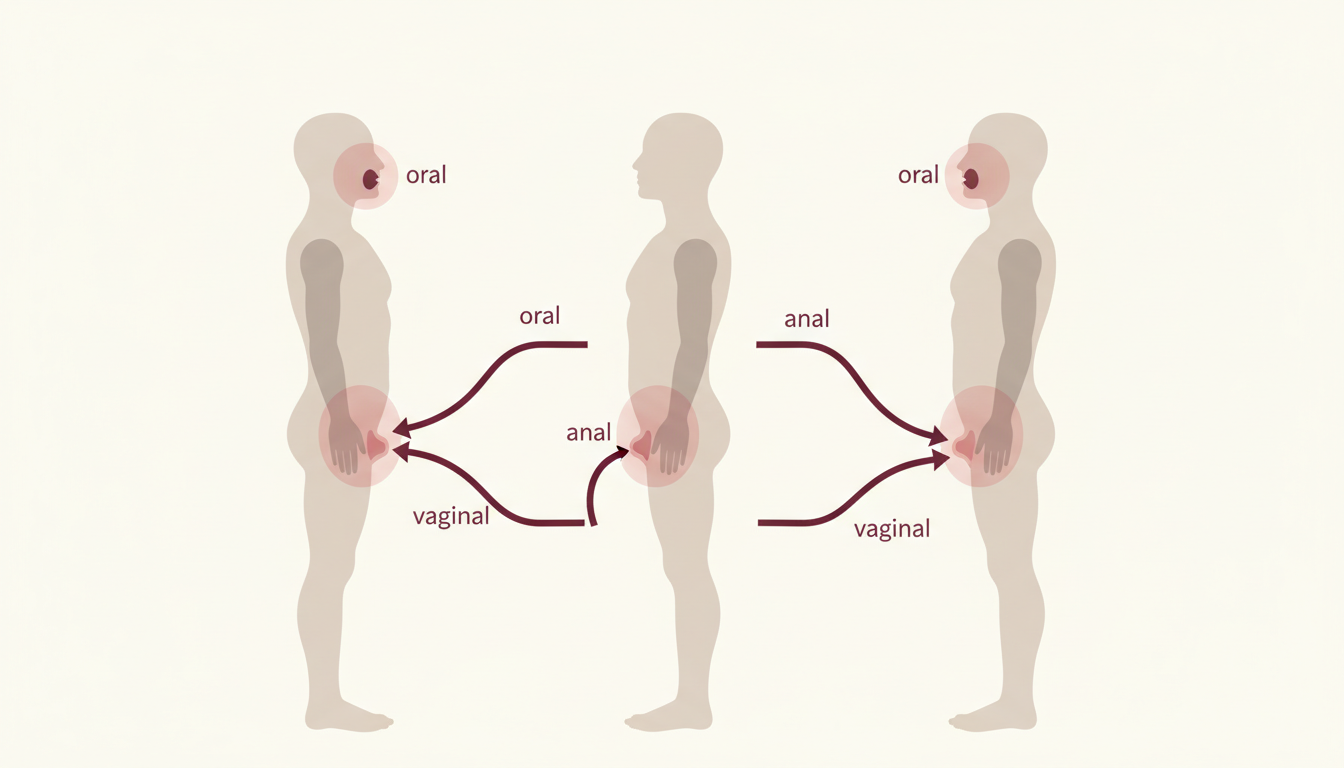
Sexual contact covers any activity that brings genital, anal, or oral mucosa into contact with a partner's genital, anal, or oral mucosa. The exchange of semen, pre-ejaculate, vaginal secretions, or blood during these activities transmits most bacterial and viral STIs.
Vaginal sex
Vaginal intercourse transmits chlamydia, gonorrhea, trichomoniasis, syphilis, HIV, hepatitis B, herpes simplex virus (HSV), and human papillomavirus (HPV). Receptive partners (people whose vagina receives the penis) generally face higher per-act transmission risk for HIV than insertive partners, because the vaginal mucosa has a larger absorptive surface area than the urethra.
Anal sex
Anal intercourse carries the highest per-act HIV transmission risk of any sexual activity for the receptive partner. The rectal lining is thin, contains many immune cells that HIV infects, and tears more easily than vaginal tissue. Anal sex also efficiently transmits chlamydia, gonorrhea, syphilis, herpes, and HPV. Rectal infections are often asymptomatic, so a person can have a rectal STI without knowing it.
Oral sex
Oral sex transmits gonorrhea, chlamydia, syphilis, herpes, HPV, and (much less commonly) HIV. Pharyngeal gonorrhea (gonorrhea in the throat) is frequently asymptomatic and is a recognized reservoir for antibiotic-resistant strains. Per the CDC's STI treatment guidelines, anyone with multiple oral-sex partners should consider routine pharyngeal screening alongside genital screening.
Importantly, ejaculation is not required for transmission. Pre-ejaculate fluid contains infectious quantities of HIV, chlamydia, and gonorrhea organisms. Vaginal lubrication contains infectious organisms as well. Sex without ejaculation does not eliminate STI risk.
Non-sexual routes that still matter
Several STIs travel through routes that have nothing to do with sex. The main non-sexual routes are bloodborne exposure and perinatal transmission.
Bloodborne transmission
HIV, hepatitis B, and hepatitis C are the three bloodborne infections most often grouped with STIs because sex is one of their transmission routes, but blood-to-blood contact is another. The most common contemporary blood routes are:
- Shared injection equipment among people who use drugs (the dominant non-sexual route in most high-income countries).
- Needlestick injuries, primarily in healthcare settings.
- Unsterilized tattooing, body piercing, or acupuncture equipment.
- Transfusion of unscreened blood or blood products. Modern blood-bank screening has made this route extremely rare in countries with regulated blood supplies, per the WHO sexually transmitted infections fact sheet.
Perinatal (mother-to-child) transmission
A pregnant person with an untreated STI can pass the infection to the fetus during pregnancy, to the newborn during delivery, or via breastfeeding. The infections most often transmitted this way are HIV, syphilis, gonorrhea, chlamydia, herpes, and hepatitis B. Perinatal transmission is one of the strongest reasons routine prenatal STI screening is part of standard antenatal care worldwide. Treated early, most perinatal transmissions are preventable.
What does not transmit STIs
Toilet seats, swimming pools, gym equipment, shared towels (with the rare exception of pubic lice in close-contact settings), shared drinks, food, hugging, and casual kissing on the cheek do not transmit chlamydia, gonorrhea, syphilis, HIV, hepatitis B, or hepatitis C. Open-mouth kissing can rarely transmit HSV-1 (the cold-sore virus) when one partner has an active oral lesion.
Most bacterial and viral STIs spend long stretches without obvious symptoms in at least one partner. A person can transmit chlamydia, gonorrhea, HIV, herpes, or HPV without knowing they are infected. Routine screening on a schedule matters more than symptom-watching.
Skin-to-skin contact: the often-overlooked route
Three significant STIs pass primarily through direct skin-to-skin contact rather than through fluids: herpes simplex virus, human papillomavirus, and syphilis (during the primary chancre or secondary rash stage). For these infections, the transmission event is contact between the infected skin or mucous membrane of one person and the skin or mucous membrane of another.
Condoms cover the penile shaft but not the scrotum, perineum, or pubic area. A herpes lesion or HPV-affected skin outside that zone can transmit during otherwise protected sex. People with genital herpes can also transmit the virus during symptom-free periods. The NHS overview of genital herpes notes that transmission risk is highest in the first six months after infection and decreases significantly after two years, but remains possible at any point even when no lesion is visible.
This is why suppressive antiviral therapy (for herpes) and HPV vaccination (for HPV) are central to prevention strategies for these infections, alongside barrier methods.
Pathogens grouped by type
STIs are caused by three categories of pathogen, and the category determines the treatment options. Knowing which group your infection belongs to is useful for understanding the prognosis.
| Pathogen type | Common examples | Treatment outlook |
|---|---|---|
| Bacterial | Chlamydia, gonorrhea, syphilis | Curable with antibiotics when treated promptly |
| Viral | HIV, HSV-1, HSV-2, HPV, hepatitis B, hepatitis C | Mostly manageable rather than curable; some (HCV) now have curative regimens |
| Parasitic | Trichomoniasis, pubic lice, scabies | Curable with antiparasitic medication |
How well do condoms actually protect you?
Condoms are the single most effective barrier method for reducing STI transmission, but the protection they offer differs sharply by infection type.
Where condoms work very well
For fluid-borne STIs, where transmission depends on contact between mucous membranes and infectious genital fluids, latex and polyurethane external condoms used correctly and consistently substantially reduce risk. The CDC's condom effectiveness page notes that consistent and correct condom use reduces the risk of HIV, gonorrhea, and chlamydia transmission. Effectiveness depends heavily on consistent use; using a condom "sometimes" provides much weaker protection than using one every time.
Where condoms work less well
For STIs that spread through skin-to-skin contact (herpes, HPV, syphilis chancres), condoms reduce risk but do not eliminate it. The condom only covers part of the skin that may be infected. Genital herpes lesions on the labia, scrotum, or upper thigh are not covered by a condom on the penile shaft. HPV-affected skin in the pubic or perineal area is similarly outside the condom's protection zone.
The bottom line on condoms
A correctly used condom is the most effective barrier method available, full stop. But it is not 100% protective for any STI, and it is meaningfully less protective for skin-to-skin infections than for fluid-borne ones.
Symptoms: what to watch for and when
Symptoms vary widely between infections, and many STIs are asymptomatic for long periods. Common signs that should prompt a clinical evaluation or testing include:
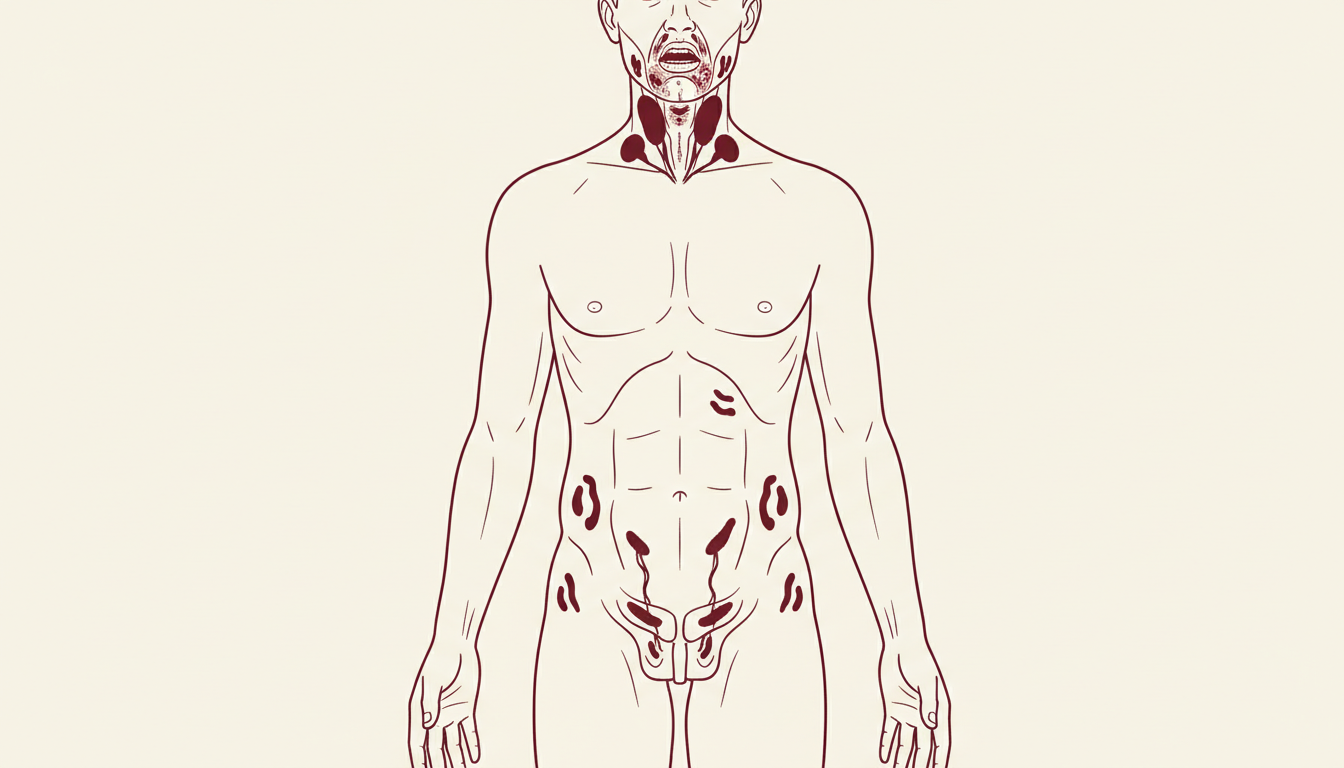
- Sores, bumps, ulcers, or blisters in the genital, anal, or mouth area
- Painful or burning urination
- Unusual penile or vaginal discharge (changes in color, smell, or volume)
- Bleeding between menstrual periods or after sex
- Pain during vaginal or anal sex
- Swollen or tender lymph nodes, particularly in the groin
- Lower abdominal or pelvic pain
- Fever, body aches, or unexplained fatigue
- Rash, including rashes on the palms of the hands or soles of the feet (a classic sign of secondary syphilis)
CDC STI guidance stresses that a substantial fraction of infections produce no symptoms at all. Roughly half of chlamydia infections in women and a smaller but meaningful fraction in men cause no noticeable signs. Pharyngeal and rectal infections are particularly likely to be silent.
Window periods: why the timing of a test matters
Every STI has a window period, the time between exposure and the point at which a test can reliably detect the infection. Testing too early produces false negatives. Testing at the right time gives a result you can trust.
If you are testing because of a specific recent exposure, calculate your window before booking the test. Testing on day 5 after a possible chlamydia exposure will be falsely reassuring; the right wait is around two weeks. The CDC's STI treatment guidelines give the canonical window-period reference for each infection.
Approximate window periods for common STIs
| Infection | Earliest reliable test window | Typical reflex test |
|---|---|---|
| Chlamydia | About 14 days after exposure | Self-collected swab or urine NAAT |
| Gonorrhea | About 14 days after exposure | Self-collected swab or urine NAAT |
| Syphilis | Roughly 3 to 6 weeks after exposure (antibody) | Treponemal blood test |
| HIV (4th-generation antigen-antibody) | Roughly 18 to 45 days after exposure | Lab combo immunoassay |
| HIV (rapid antibody) | Roughly 23 to 90 days after exposure | Fingerstick rapid antibody test |
| Herpes (HSV-2 antibodies) | Roughly 6 to 12 weeks after exposure | Type-specific antibody blood test |
| Hepatitis B | Roughly 4 to 10 weeks after exposure | Hepatitis B surface antigen blood test |
| Hepatitis C (antibody) | Roughly 8 to 11 weeks after exposure (some up to 6 months) | Anti-HCV antibody blood test |
Untreated STIs: what's at stake
STIs are sometimes dismissed as nuisance infections. Many produce mild or no early symptoms. The reason routine screening is taken seriously is that the long-term consequences of untreated infections are substantial.
- Pelvic inflammatory disease (PID). Untreated chlamydia or gonorrhea can ascend from the cervix into the uterus and fallopian tubes, causing PID. PID is a leading preventable cause of tubal infertility, ectopic pregnancy, and chronic pelvic pain.
- Infertility. In men, untreated chlamydia or gonorrhea can cause epididymitis and rarely contributes to infertility. In women, the link is stronger and well-documented.
- Increased HIV transmission risk. Genital ulcers from herpes or syphilis disrupt the mucosal barrier and concentrate HIV-target immune cells at the site, raising both per-act HIV acquisition risk and per-act HIV onward-transmission risk.
- Cancer. Persistent infection with high-risk HPV strains causes nearly all cervical cancers and a substantial fraction of anal, penile, vulvar, vaginal, and oropharyngeal cancers. Chronic hepatitis B and hepatitis C cause most liver cancer.
- Neurological complications. Untreated late-stage syphilis can cause neurosyphilis, with permanent cognitive and motor consequences.
- Pregnancy complications. Untreated syphilis in pregnancy causes stillbirth, neonatal death, and congenital syphilis. Untreated gonorrhea or chlamydia at delivery can cause neonatal conjunctivitis and pneumonia.
Most of these complications are preventable when an infection is detected and treated early.
Every long-term complication listed above shares the same precondition: an infection that went undetected long enough to cause damage. Routine screening on a schedule, paired with prompt treatment of any positive result, prevents almost all of these outcomes.
Prevention: the layered approach that actually works
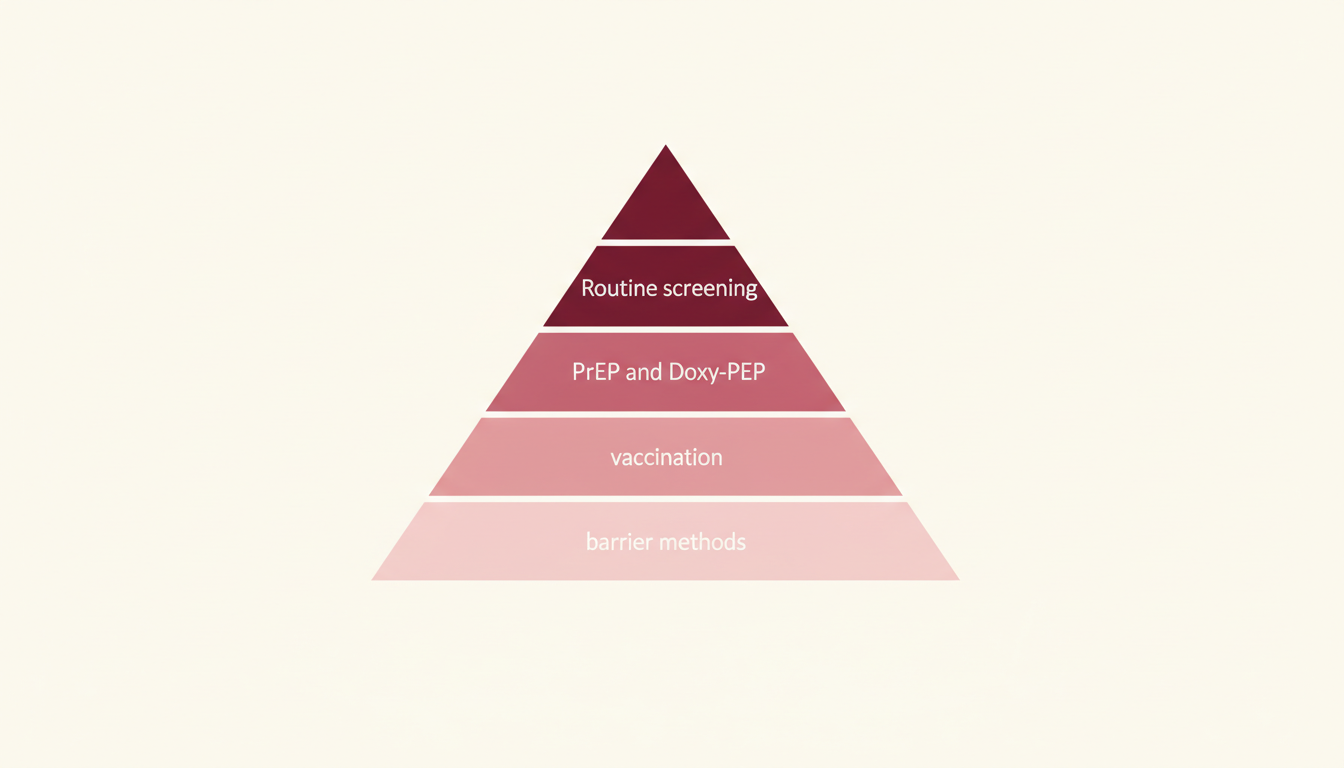
No single prevention strategy covers every STI. Effective prevention combines several tools that each address a different transmission route.
Barrier methods
External (penile) condoms, internal (vaginal) condoms, and dental dams used correctly and every time form the front line for fluid-borne infections.
Vaccination
Two STIs have effective vaccines:
- HPV vaccine. Per the U.S. Advisory Committee on Immunization Practices (ACIP), routine vaccination is recommended through age 26 and shared clinical decision-making applies through age 45. The vaccine is most effective when given before sexual debut.
- Hepatitis B vaccine. Routinely given in infancy in most countries. Adults at higher risk who were not vaccinated should be offered the series.
Pre-exposure prophylaxis (PrEP)
Daily oral PrEP for HIV reduces sexual HIV acquisition by roughly 99% when taken as prescribed, according to the CDC's HIV prevention guidance. Long-acting injectable PrEP is now available for people who prefer it. PrEP does not protect against other STIs, so it is paired with regular screening.
Doxy-PEP
Doxycycline post-exposure prophylaxis (a single dose of doxycycline within 72 hours of condomless sex) is now recommended for some men who have sex with men and transgender women at elevated risk of bacterial STIs. Discuss with a clinician whether you qualify.
Routine screening
Regular STI testing catches asymptomatic infections before they spread or cause complications. Testing frequency depends on activity:
- Annually for sexually active women under 25, and any sexually active person with a new partner.
- Every 3 to 6 months for men who have sex with men with multiple partners, per CDC guidance.
- After every new partner if practical, particularly before stopping condom use in a new relationship.
Honest partner communication
Asking a new partner about their STI testing history, recent exposures, and current status is awkward; it is also the single highest-yield prevention conversation available. Mutual recent testing before condom-free sex is a well-validated risk-reduction strategy.
STIs have a profound impact on sexual and reproductive health worldwide. More than 1 million curable STIs are acquired every day, the majority of which are asymptomatic.
Diagnosing STIs: clinic, lab, and at-home options
STI diagnosis combines a clinical history (about partners, recent exposures, symptoms), physical examination where relevant, and laboratory testing. The lab test required depends on the suspected infection.
What clinicians use
- NAAT (nucleic acid amplification testing) is the laboratory gold standard for chlamydia, gonorrhea, and trichomoniasis. NAAT detects the pathogen's genetic material directly and has very high sensitivity.
- Treponemal and non-treponemal blood tests are used for syphilis. A reactive screening test is confirmed with a second specific test.
- 4th-generation HIV combo immunoassays detect both HIV antibody and p24 antigen, shortening the window period compared to antibody-only tests.
- Type-specific antibody testing distinguishes HSV-1 from HSV-2 in people without active lesions; PCR or culture of an active lesion is preferred when one is present.
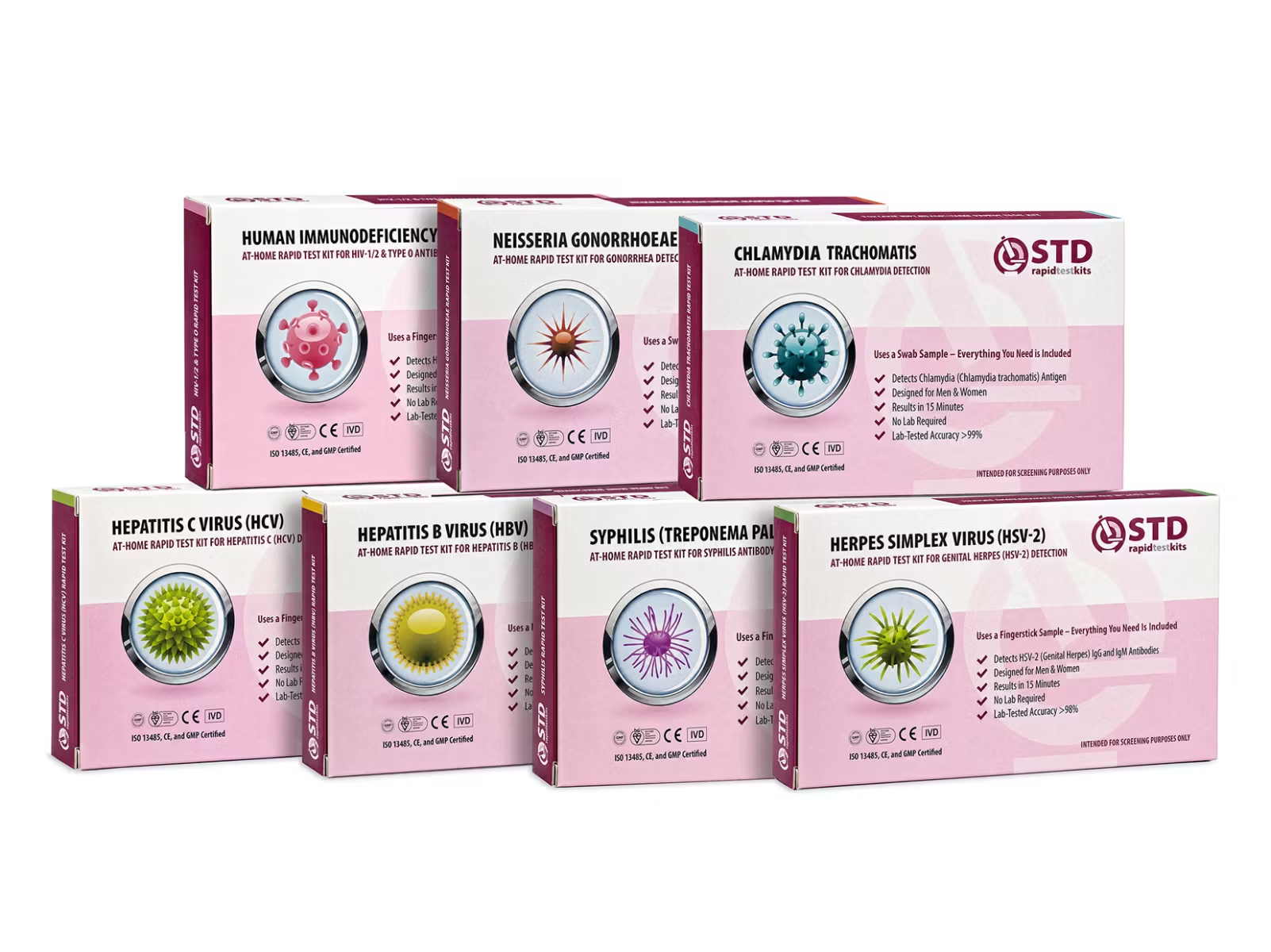
What at-home rapid tests do
At-home rapid lateral-flow tests are screening tools, not laboratory NAATs. They use the same sample type as some lab tests (a self-collected swab for chlamydia and gonorrhea, a fingerstick blood drop for HIV and syphilis), but the chemistry is different. Lateral-flow tests trade some analytical sensitivity for speed, privacy, and cost. They are most useful for:
- Routine screening at home when a clinic visit is inconvenient.
- Quick reassurance after a low-to-moderate-risk exposure, with the appropriate window-period wait.
- People who have testing-related anxiety and would otherwise delay screening.
A positive at-home rapid result should be confirmed with a clinic-based lab test before treatment. A negative rapid result still warrants a clinic visit if symptoms persist, because rapid tests are screening tools and a negative does not rule out infection at the lab-NAAT sensitivity level.
At-home rapid tests do not cover every clinical scenario. Book a clinic appointment instead if any of the following apply: visible genital sores, ulcers, or unusual discharge that is worsening; pelvic pain, fever, or unexplained weight loss; a known sexual contact with a confirmed STI (you may need empirical treatment, not just testing); pregnancy; a needle-stick injury or condom failure with a partner whose status you do not know (HIV PEP must start within 72 hours); pharyngeal or rectal exposure where a swab is needed (we do not sell pharyngeal or rectal swab kits, a clinic does).
STIs by the numbers
Recent global figures from the WHO STI fact sheet illustrate the scale of these infections.
- More than 1 million sexually transmitted infections are acquired every day worldwide.
- An estimated 374 million new infections of chlamydia, gonorrhea, syphilis, and trichomoniasis occur each year among people aged 15 to 49.
- An estimated 520 million people aged 15 to 49 (about 13%) have a genital infection with HSV-2.
- HPV is the most commonly acquired STI; nearly all sexually active people will be infected at some point in their lives.
- The majority of STIs are asymptomatic, particularly in early stages.
- According to the WHO's 2025 STI fact sheet, drawing on 2022 global surveillance data, untreated syphilis in pregnancy contributed to over 390,000 adverse birth outcomes globally, including stillbirth, neonatal death, and congenital syphilis.
Frequently asked questions
- Can you get an STD from a toilet seat?
- No. None of the common STIs (chlamydia, gonorrhea, syphilis, HIV, herpes, HPV, hepatitis B, hepatitis C) survive long enough on hard surfaces or transmit through skin contact with toilet seats. The bacteria and viruses that cause these infections require direct mucosal contact, fluid exchange, or blood-to-blood contact, none of which occur on a toilet seat.
- Can you get an STD without having sex?
- Yes, for some infections. HIV, hepatitis B, and hepatitis C transmit through shared injection equipment or contaminated medical and tattoo equipment. Several STIs (HIV, syphilis, gonorrhea, chlamydia, herpes, hepatitis B) can pass from a pregnant person to a baby during pregnancy or delivery. Skin-to-skin contact with active herpes lesions can transmit HSV between non-sexual close contacts in rare circumstances. The dominant route, however, is still sexual contact.
- How long after exposure should I get tested?
- It depends on the infection. Chlamydia and gonorrhea are reliably detected from about 14 days post-exposure. Syphilis from roughly 3 to 6 weeks. HIV from about 18 to 45 days for a 4th-generation lab test, longer for rapid antibody tests. HSV antibodies from 6 to 12 weeks. If you test before the window period closes, a negative result can be falsely reassuring.
- Do condoms protect against all STIs?
- No. Condoms are highly effective for fluid-borne STIs (HIV, chlamydia, gonorrhea, hepatitis B) when used correctly and consistently. They offer only partial protection against skin-to-skin infections (herpes, HPV, syphilis chancres) because they do not cover all skin that may be infected. Combine condoms with HPV vaccination and routine screening for the strongest layered protection.
- Can I get an STD from oral sex?
- Yes. Gonorrhea, chlamydia, syphilis, herpes, and HPV all transmit through oral sex. Pharyngeal gonorrhea is particularly common and often asymptomatic. HIV transmission via oral sex is documented but uncommon compared to vaginal or anal sex. Using condoms or dental dams during oral sex reduces but does not eliminate risk.
- Are rapid home STI tests as accurate as lab tests?
- Home rapid tests screen effectively but have lower sensitivity than lab NAATs, especially in early or asymptomatic infection. Confirm any positive with a clinic lab test; see a clinician if symptoms persist despite a negative result.
- If my partner tested negative, do I still need to test?
- Yes, if there is any chance you have had a different exposure. Window-period mismatches are common: your partner may have tested before their own window period closed, or one of you may have had an exposure outside the relationship. Testing yourself directly is the only way to confirm your own status.
- Can STIs be cured?
- Bacterial and parasitic STIs (chlamydia, gonorrhea, syphilis, trichomoniasis, pubic lice) are curable with the right antibiotic or antiparasitic regimen. Viral STIs are mostly managed rather than cured. HIV is controlled with lifelong antiretroviral therapy. HSV is suppressed with antivirals. HPV is cleared by the immune system in most cases over months to years, though some strains persist and cause cancer. Hepatitis C now has highly effective curative regimens; hepatitis B is typically managed long-term. Catching any STI early gives the best treatment outcome.
- U.S. Centers for Disease Control and Prevention. Sexually transmitted infections hub, including overview of transmission routes, symptoms, and asymptomatic infection prevalence.
- U.S. Centers for Disease Control and Prevention. Sexually transmitted infections treatment guidelines, including window periods, pharyngeal screening, and confirmatory testing recommendations.
- U.S. Centers for Disease Control and Prevention. Condom effectiveness and use guidance for HIV and STI prevention.
- U.S. Centers for Disease Control and Prevention. HIV prevention hub, including PrEP effectiveness and long-acting injectable PrEP guidance.
- World Health Organization. Sexually transmitted infections fact sheet (September 2025 update, drawing on 2022 surveillance data), including global incidence, prevalence, and adverse-birth-outcome estimates.
- UK National Health Service. Genital herpes condition overview, including transmission risk over time and symptom-free transmission.
