
Published: September 2025 | Last updated: May 2026 | Editorial review and quality control: Martina N.
For millions of Americans, getting tested for an STI is not a 15-minute errand. It is a logistics puzzle that involves a working car, flexible hours away from work, and a clinic that is both open and within reach. When any of those pieces fall away, the test gets pushed off. Delayed testing is one of the quietest reasons infections like chlamydia, gonorrhea, and syphilis keep spreading in the U.S., particularly in communities that already carry the highest baseline rates.
This article walks through what the access gap actually looks like, who it hits hardest, and what at-home rapid tests and mobile clinics can and cannot replace. The goal is not to make anyone feel careless for waiting. The goal is to respect that the healthcare system is built for people with options, and to show you how to test when it is not built for you.
Key Takeaways
- Transportation gaps and clinic shortages are now treated as measurable health-equity issues, not personal failings, and they consistently rank among the top reasons people delay or skip STI testing.
- At-home rapid lateral-flow kits and mail-in lab kits give people in rural and transit-poor areas a credible way to screen without a traditional clinic visit, with caveats around timing and confirmation.
Why Distance Still Decides Who Gets Tested
The U.S. healthcare safety net for sexual health was never evenly distributed. Federally Qualified Health Centers, Title X family planning sites, and dedicated STI clinics tend to cluster in mid-sized to large cities. The further you live from a population center, the further you tend to be from a clinic that offers free or low-cost STI testing.
The Health Resources and Services Administration designates parts of the country as Health Professional Shortage Areas when there are too few primary-care, dental, or mental-health providers per resident. A large share of these areas are rural, but a meaningful share are urban neighborhoods that have lost clinics over the past two decades. STI services are not always called out separately, but in practice they follow the same pattern: where primary care is thin, sexual-health services are thinner.
Even when a clinic technically exists nearby, the practical access can still be poor. A clinic that is open three days a week, books out two weeks in advance, and shuts on weekends is functionally inaccessible to anyone with an unpredictable work schedule. Add in long bus headways, sparse rideshare coverage, and parking that sometimes costs more than the visit itself, and ten miles becomes a much larger barrier than the map suggests.
Researchers at the Rural Health Information Hub identify transportation as a major barrier to rural healthcare access, noting that rural populations face long distances and a lack of reliable transit options that keep care out of reach.
- A clinic that is open three days a week and books out two weeks in advance.
- A bus route that stops running before evening shifts end.
- Parking fees that exceed the cost of the visit itself.
- Confidentiality concerns when the only clinic is one neighbor or family member away.
- No weekend hours, no telephone triage, and no walk-in slot.
How Geography Becomes a Risk Factor
Picture two neighborhoods. One sits in a metro area with a subway line, multiple urgent-care centers, and an STI clinic within a 10-minute walk. The other sits 25 miles outside a small city, with one community health clinic that runs short hours and a single county bus route that does not connect to it. The first neighborhood treats testing as an errand. The second neighborhood treats testing as an expedition.
This is what public-health researchers describe as a “testing desert.” In these zones, infections go undetected longer. People can stay asymptomatic but contagious for weeks or months. Recommended retesting after a positive result (the CDC suggests retesting at three months for chlamydia and gonorrhea) often does not happen at all. By the time symptoms appear and someone seeks care, the infection may already have been passed on multiple times.
The numbers in the table below are general patterns drawn from CDC and rural-health access reporting. Exact figures vary year to year.
| Setting | Typical Distance to Nearest STI Clinic | Realistic Transit Options | Documented Testing Engagement |
|---|---|---|---|
| Urban, transit-rich | 1 to 3 miles | Subway, frequent bus, rideshare | Higher |
| Urban, transit-poor | 3 to 7 miles | Limited bus service | Moderate |
| Suburban | 7 to 15 miles | Personal vehicle or rideshare | Low |
| Rural | 15 to 30+ miles | Personal vehicle, occasional volunteer transport | Very low |
When Waiting Becomes the Default Response
Public-health researchers have documented a recurring pattern in surveys of people who skipped or delayed STI testing. Cost and stigma still rank high, but in many recent surveys, transportation and “I could not get the time off” outpace both. People wait because the next available appointment is two weeks away, because they cannot leave work for a 10 a.m. slot, or because the clinic is on a bus route that does not run after 6 p.m.
That delay does something specific to symptoms. With chlamydia and gonorrhea, mild symptoms can fade on their own even though the infection is still active. People interpret that fade as “I must have been wrong, it was nothing.” The infection is still active, still contagious, and still capable of progressing. Untreated chlamydia and gonorrhea can spread upward in the reproductive tract and cause pelvic inflammatory disease (PID), an infection of the uterus and fallopian tubes that can scar reproductive tissue. According to CDC guidance, untreated chlamydia and gonorrhea are among the leading preventable causes of tubal-factor infertility in U.S. women.
Clinicians often see the same arc on the back end: someone shows up months after their original symptoms with a more advanced complication and explains that they did not have a way to get tested when the symptoms first appeared. It is a failure of the system to meet people where they are. The fix is not to lecture people about testing more often. The fix is to make testing reach them.
If a clinic visit is genuinely off the table this month, an at-home rapid test or a mail-in lab kit is a legitimate first step. Plan to confirm any positive result with a clinician (in person or via telehealth) so you can be matched to the right antibiotic if treatment is needed. Disclosure: this site sells the at-home rapid tests discussed below.
What Happens When You Cannot Just “Go Get Tested”
Searching for “STI test near me” looks easy in theory. In practice, for millions of people, the search returns one of three frustrating outcomes.
When transportation is the actual barrier, people fall into predictable patterns. They delay. They guess based on what they read online. They try to self-diagnose from photos that may or may not match their situation. Some people pause sexual activity out of fear; others try to live as if nothing is wrong because the alternative is logistically impossible. The gap between “I think I need to get tested” and “I actually got tested” routinely stretches into weeks, sometimes months.
This delay does not just affect the person waiting. It affects partners. It contributes to ongoing chains of transmission that public-health departments are then trying to interrupt months later. The burden falls disproportionately on Black, Hispanic, LGBTQ+, and lower-income populations that already face higher baseline infection rates per the CDC's STI surveillance reporting.
- No clinic shows up at all. The map result is empty, or the nearest pin is a state line away.
- A hospital backlog. The closest option is a hospital outpatient clinic with a three-week appointment wait.
- No confidential option. A clinic exists, but it is closed weekends, booked solid, or cannot offer confidential billing to someone still on a parent’s insurance.
At-Home Rapid Testing as a Real Alternative
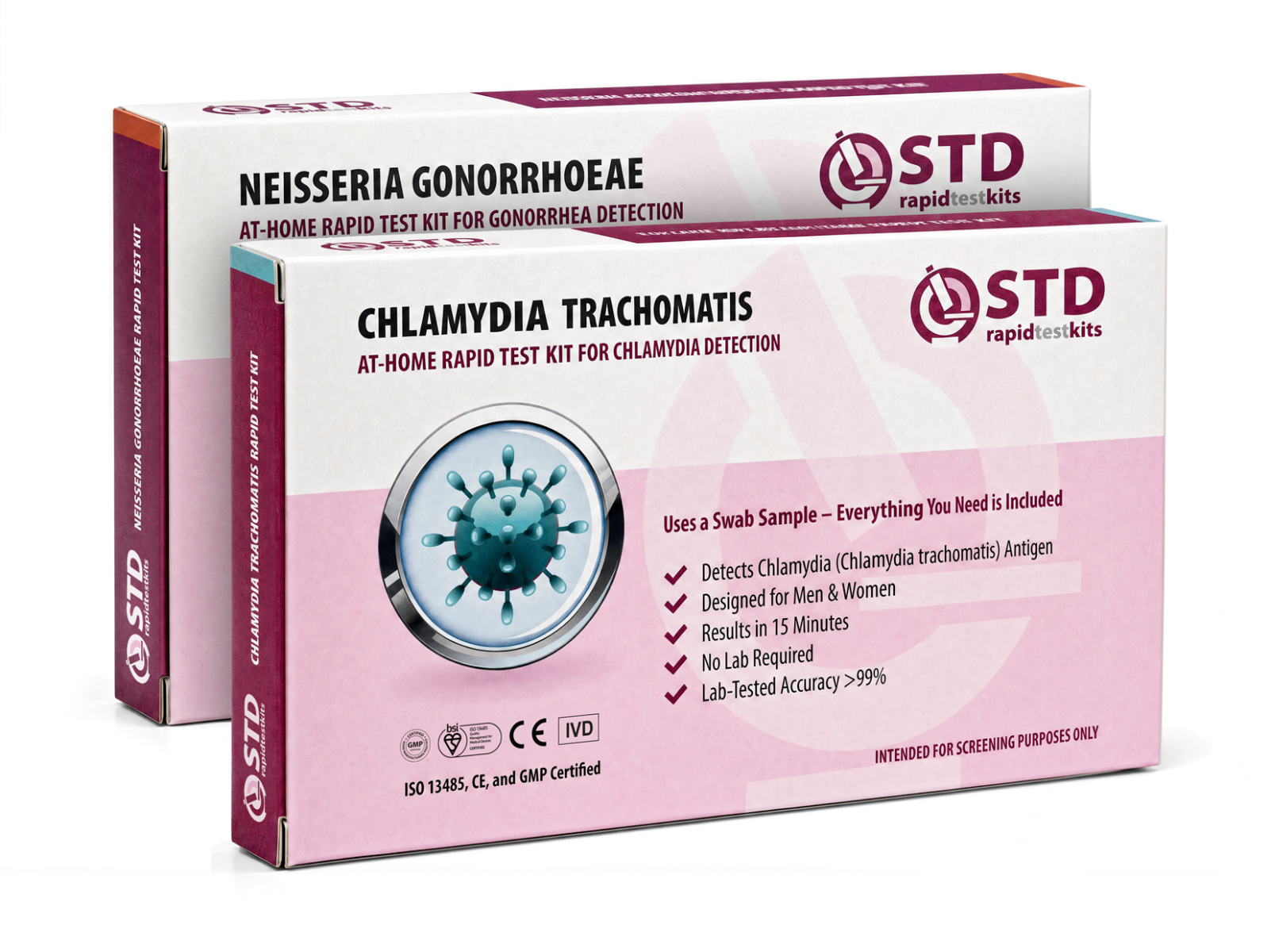
At-home STI testing is no longer a fringe product. Lateral-flow rapid kits use the same self-collected swab or fingerstick blood drop that a clinic might collect, and they read out at home in roughly 15 minutes. Mail-in lab kits use the same self-collection step but ship the sample to a certified lab for processing, which usually takes a few business days but offers the higher analytical sensitivity of laboratory testing.
For people in testing deserts or with no reliable transportation, the value is clear: you can screen on your own schedule, in your own bathroom, without lining up a ride or burning a sick day. The trade-offs are also real. Rapid lateral-flow tests are best understood as screening tools. They are most reliable after the appropriate window period (about one to two weeks for chlamydia and gonorrhea, three to twelve weeks for HIV depending on the test type, longer for HSV antibody tests). And a positive screening result is worth confirming through a clinical lab so you can be matched to the right treatment.
None of this is a reason to avoid screening at home. It is a reason to time the screen well, to retest if you tested very early, and to plan a follow-up channel (a telehealth visit works) if the result is positive. For someone who simply cannot reach a clinic this week, screening now and confirming later is materially better than waiting another month for an appointment that may not come.
How Mobile Clinics Try to Bridge the Gap
In several U.S. cities, public-health departments and nonprofit partners run mobile STI testing units that park near libraries, community centers, shelters, and busy public-transit nodes. They are staffed with clinicians, follow a published schedule, and typically offer rapid HIV, chlamydia, gonorrhea, and syphilis screening on the spot.
The model has been deployed in cities like Philadelphia, Minneapolis, Oakland, and Atlanta, and several local evaluations have reported meaningful increases in testing uptake among populations that do not engage with brick-and-mortar clinics. The CDC's STI health-equity work documents how social, economic, and structural factors drive access gaps.
The downside is that mobile units depend on local funding, local staffing, and local political will. They are not consistently available across most of the country. In many states there is no mobile STI testing program at all. At-home rapid kits and mail-in lab kits have grown so quickly partly because they scale without depending on local funding decisions, and they reach the rural counties and exurbs that mobile units rarely cover.
How Long Should You Wait to Test After a Possible Exposure?
The short answer: it depends on the infection, and there is a real cost to testing too early. Each STI has a “window period,” the time between exposure and when a test can reliably detect the infection. Test before the window closes and you can get a false negative that gives you a misleading sense of safety.
For chlamydia and gonorrhea, most rapid swab tests are designed to be reliable from about 14 days after exposure, with some kits validated as early as 7 days. For syphilis, antibody tests typically need three to six weeks to turn positive. For HIV, fourth-generation antigen-antibody lab tests can reliably detect infection by about 45 days, while rapid antibody-only tests usually need closer to three months. For HSV antibody panels, seroconversion (the point at which your body has produced enough antibodies for a test to detect them) can take 12 weeks or longer.
Practically, that means a few timing rules of thumb. If your possible exposure was less than five days ago, most tests will not detect anything yet, but you can use the time to order an at-home kit so it arrives close to your test window. If it has been one to two weeks, this is a reasonable point to screen for chlamydia and gonorrhea, with a plan to retest at three weeks if the first result is negative and you still have symptoms or were high-risk. Beyond two weeks, you are inside the reliable window for most common bacterial STIs. For HIV and syphilis, plan a second test at the longer window for confirmation.
If you tested early and got a negative but something still feels off, retest.
| Testing Method | Travel Required | Result Turnaround | Privacy | Best Suited For |
|---|---|---|---|---|
| In-clinic visit | Yes | Same day to about 5 days | Low to moderate | People with nearby access who want clinician follow-up in one visit |
| Mail-in lab kit | No | About 2 to 5 business days after the lab receives the sample | High | Rural or transit-limited users who want lab-grade analytical sensitivity |
| At-home rapid lateral-flow test | No | About 15 to 20 minutes | Very high | Anyone who needs an immediate result and full discretion |
| Mobile testing unit | Yes (local) | Often immediate | Moderate to high | Urban and peri-urban areas with active community outreach programs |
What the Data Show About the Cost of Waiting
The hard public-health data on delayed STI testing keeps pointing in one direction. Communities with poor access to sexual-health services see higher rates of untreated chlamydia and gonorrhea, more diagnosed cases of late-stage syphilis, and higher rates of reinfection because partners often go untreated as well. The CDC's annual STI surveillance summary consistently identifies these gaps as a primary driver of the upward trend in U.S. STI cases over the past decade.
What the surveillance numbers do not always capture is why people wait. They wait because rideshare does not exist where they live. They wait because the only confidential clinic requires them to physically walk past someone they know. They wait because a day off of work means losing rent money. And they wait because their bodies often give them no obvious sign that something is wrong, until something is very wrong.
The interventions that move the numbers are concrete: mobile units in underserved areas, telehealth follow-up, and credible at-home tests for people who cannot reach a clinic at all.

You Deserve Answers, Not Obstacles
Distance to a clinic should not decide whether you can find out what is going on with your body. If a clinic visit is realistic for you this week, take it; the in-person workflow has its own real advantages, including immediate clinician follow-up and a single visit for testing and treatment. If a clinic visit is not realistic this week or this month, do not just wait it out.
Order a screening kit, screen at the right point in the window period, and plan a confirmation pathway (a telehealth visit works well) if anything comes back positive. The most consequential mistake people make is not testing wrong. It is not testing at all because the system made it too hard to start.

Frequently Asked Questions
- What can I do if I have STI symptoms but no way to get to a clinic?
- You have credible options. An at-home rapid lateral-flow test can give you a same-day screening result. A mail-in lab kit can give you a lab-grade result in a few business days. If symptoms are getting worse fast (severe pain, high fever, fast-spreading rash, sores in the mouth or eyes), use a telehealth provider as a faster bridge to a same-day antibiotic prescription where appropriate.
- How accurate are at-home STI tests compared to clinic testing?
- It depends on the technology and on timing. At-home lateral-flow rapid tests are screening tools and are typically reported in the mid-to-high 90s for sensitivity and specificity when used after the appropriate window period. Mail-in kits processed by certified labs use NAAT or similar technology and are essentially equivalent to in-clinic lab testing. The main risk to accuracy is testing before the window has closed.
- What is a “testing desert”?
- It is shorthand for a community where the practical access to STI testing is so limited it functions as no access at all. Many rural counties qualify, but so do urban neighborhoods that have lost clinics over the past decade or that are not served by reliable public transit. Living in a testing desert is one of the strongest documented predictors of delayed STI diagnosis.
- How soon after possible exposure can I test reliably?
- Three numbers to anchor on: 14 days for chlamydia and gonorrhea swab tests; about 45 days for a fourth-generation HIV lab test; closer to 3 months for a rapid HIV antibody-only test. Syphilis antibody tests sit between, at roughly three to six weeks. See the “How Long Should You Wait to Test” section above for the full per-infection timing table and what to do if you tested earlier than the window.
- Will my parents or partner know if I order an at-home kit?
- At-home test kits ship in unbranded discreet packaging. There is no clinic on the return address. You do not need insurance to order, and there is no callback or shared medical-record entry on a parental insurance plan. The kit, the testing, and the result are entirely controlled by you.
- What should I do if my at-home test is positive?
- Most STIs are treatable, and several (chlamydia, gonorrhea, trichomoniasis) are curable with a short course of antibiotics. The next step after a positive screening result is a confirmation through a clinician (a telehealth visit works) so you can be matched to the correct treatment. Notifying recent sexual partners is part of the protocol and there are anonymous notification services that can help.
- Are mobile STI testing units actually available in my area?
- Mobile STI testing is concentrated in larger metro areas and depends on local public-health funding. Many smaller cities and most rural counties do not have one. Your state or county health department's website is the most reliable place to check. Where mobile units are available, they often offer the same rapid HIV, chlamydia, gonorrhea, and syphilis tests as a clinic, on the spot.
- Why do communities with less clinic access have higher STI rates?
- Because untreated infections continue to be transmitted. When testing is delayed, infections persist longer, partners are often not notified or treated, and reinfection becomes more common. The pattern is structural: it tracks with where clinics were defunded or never opened, not with individual behavior. Closing the testing-access gap is one of the higher-impact public-health interventions for STI rates.
- U.S. Centers for Disease Control and Prevention. Sexually transmitted infections (STI) overview, surveillance data, and prevention guidance, including the link between untreated chlamydia/gonorrhea and pelvic inflammatory disease.
- U.S. Centers for Disease Control and Prevention. STI health-equity work, documenting how social, economic, and structural factors drive access gaps.
- Health Resources and Services Administration. Health Workforce shortage-areas data portal, used to identify Health Professional Shortage Areas across the U.S.
- Rural Health Information Hub. Healthcare access in rural communities, identifying transportation as a major rural healthcare-access barrier.
- U.S. Centers for Disease Control and Prevention. Health-related social needs measure definitions, including transportation as a measurable health-care access factor.
- World Health Organization. Sexually transmitted infections fact sheet, with global epidemiology and treatment recommendations.
