

Published: August 2025 | Last updated: April 2026 | Editorial review and quality control: Martina N.
You used a condom. You did the right thing. So why does the test result still feel like a betrayal? This article is for anyone who has been practicing protection consistently and still ended up worried, symptomatic, or positive. Condoms reduce sexual-health risk substantially, but not to zero, and the gap between those two figures explains a large share of the diagnoses that catch people off guard. The reason is straightforward anatomy: latex and polyurethane block fluid exchange, but they cannot cover every inch of skin involved in sex. Some sexually transmitted infections do not need fluid to spread. Below you will find what condoms actually prevent, what slips through anyway, and how at-home testing fills a gap a wrapper alone cannot.
Do condoms prevent every STI?
No. With consistent and correct use, condoms substantially reduce the risk of fluid-borne infections (HIV, chlamydia, gonorrhea), typically by 80% or more for HIV transmission. They reduce the risk of skin-to-skin infections (herpes, HPV, syphilis) by a smaller margin, because those infections can transmit from genital skin a condom does not cover. Routine STI testing is the only way to confirm your actual status, regardless of how careful you have been with protection.
Key Takeaways
- Condoms cut transmission risk for fluid-borne STIs (HIV, chlamydia, gonorrhea) by roughly 80% or more with consistent correct use; for skin-to-skin STIs (herpes, HPV, syphilis) the protective effect is meaningful but partial.
- “I used protection” is not a substitute for testing. A window-period-aware home or clinic test is the only way to convert “I think I’m fine” into “I know I’m clear.”
What condoms actually do (and where the gap starts)
Latex and polyurethane condoms work as physical barriers. With consistent and correct use they are among the most reliable contraceptive methods, and they meaningfully reduce transmission of fluid-borne sexually transmitted infections like HIV, gonorrhea, and chlamydia (CDC condom-effectiveness guidance). The CDC describes consistent condom use as one of the most reliable ways to lower STI risk short of abstinence or a mutually monogamous relationship between two people who have both tested negative.
The catch sits in two words: consistent and correct. Most “condom failures” are not the latex breaking. They are usage gaps. The condom went on after some skin contact had already happened. The condom slipped during sex and was not noticed for several minutes. An oil-based lubricant degraded the latex. The wrong size let bodily fluid pass around the rim.
Even when clinical studies follow couples who use condoms 100% of the time, with no skipped uses and no late application, the protective effect is impressive but not absolute. In serodiscordant couples (one partner with HSV-2, one without), CDC herpes guidance states that condoms reduce but do not eliminate transmission risk, because the virus can shed from skin in areas a condom does not cover. The CDC's communication resources put the risk reduction for skin-to-skin STIs as meaningful but well below the very high reduction seen for fluid-borne STIs.
So the question is not whether condoms work. They reduce risk in measurable, important ways. The real question is what they cover, and what falls outside the latex line. For some infections the answer is “almost everything that matters.” For others the answer is “the part that ejaculates, but not the part that touches.” Most people learn the first half of that distinction in school. Almost nobody learns the second half until they get a diagnosis they did not see coming.
A standard external condom covers the shaft of the penis. It does not cover the scrotum, the inner thighs, the perineum, the labia, the pubic mound, or the area around the anus. Any infection that can spread from skin in those zones, such as herpes, HPV, or a syphilis chancre, can transmit even with perfect condom use.
The skin-to-skin gap: herpes, HPV, and syphilis
Three of the most common STIs in the United States do not need fluid to spread. They need contact between infected skin or mucous membrane and uninfected skin or mucous membrane.
Herpes (HSV-1 and HSV-2). Herpes transmits from the surface of skin or mucosa, often when no sore is visible. The World Health Organization estimates that more than one in five adults worldwide carries genital herpes infection, much of it undiagnosed. The virus can shed from skin in the genital region between outbreaks, including from areas a condom does not cover. The protective effect of consistent condom use is meaningful but partial, because the virus does not move through fluid; it moves through skin.
HPV (human papillomavirus). HPV transmits through skin-to-skin genital contact and can pass even when neither partner has visible warts or a known infection. Most sexually active adults will be exposed to HPV at some point. Most clear it on their own; some develop persistent infection that, years later, can lead to cervical, anal, or oropharyngeal cancers. Condoms reduce HPV transmission but do not stop it, because the virus lives on broader genital skin.
Syphilis. Primary syphilis presents as a painless ulcer (a chancre) at the site of infection. If that ulcer is on the shaft of the penis, a condom can cover it. If it is on the scrotum, vulva, perineum, anal margin, lip, or inside the mouth, a condom does not. The CDC's syphilis guidance is explicit that condoms reduce risk but offer incomplete protection because of where chancres can appear.
The shared theme: protection that depends on where the contact happens, not on whether anyone ejaculated. That is also why none of these three infections show up reliably on the symptom radar. Most people who carry them feel nothing.
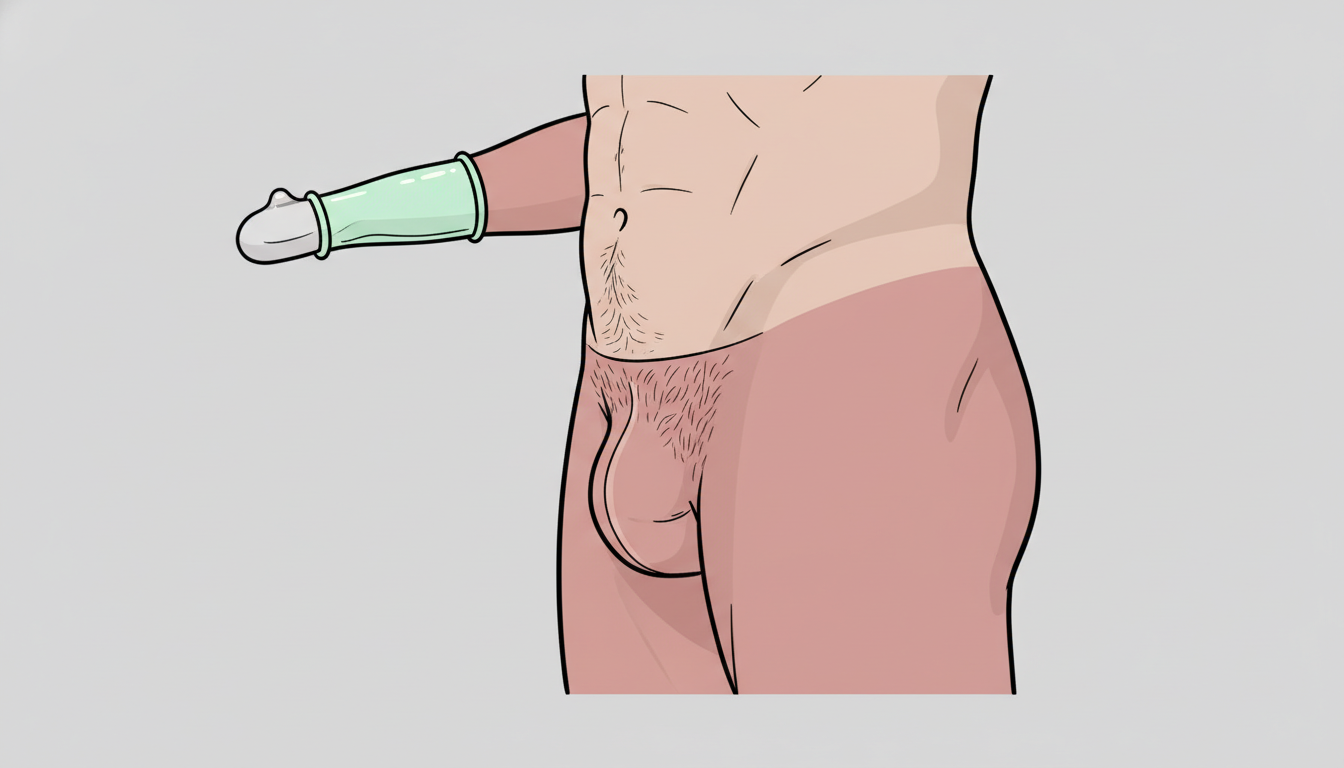
When condoms do hold the line: HIV, chlamydia, and gonorrhea
The story is genuinely better for fluid-borne STIs.
HIV transmission requires entry of infected fluid (semen, vaginal secretions, blood, or rectal fluid) into the body of an uninfected partner. Latex and polyurethane condoms, used correctly, block that pathway. Studies of HIV-discordant couples (one partner HIV-positive, one HIV-negative) consistently show that condom use cuts transmission risk by roughly 80% or more, with even higher protection at 100% consistent use. Combined with PrEP (pre-exposure prophylaxis) for the HIV-negative partner, the protective stack approaches near-elimination of HIV risk during sex.
Gonorrhea and chlamydia behave similarly. Both live in genital fluids and the cells lining the urethra, cervix, rectum, or pharynx. A condom keeps the fluid where it started, which is most of the protective work. The harder problem is that both infections frequently show up in the throat or rectum from oral or anal contact where a condom may not have been used at all, or where it was only worn during part of the encounter. The CDC's STI surveillance reporting shows pharyngeal and rectal infections climbing year over year, mostly in cases where the genital encounter was protected but oral or anal contact was not.
Bottom line: if your concern is HIV, chlamydia, or gonorrhea acquired through penetrative vaginal or penile-anal sex with consistent correct condom use, your odds are very good. If oral sex was part of the encounter, or if there was any genital-to-genital skin contact before the condom went on, the math shifts.
Consistent correct condom use cuts HIV transmission risk by roughly 80% in discordant-couple studies. Add daily PrEP for the HIV-negative partner, and the combined protective stack approaches near-zero risk during sex. Layering tools is what real risk reduction looks like.
Oral sex is the forgotten risk zone
Oral sex is often classified as “lower risk,” and that classification is partly true. HIV transmission through unprotected oral sex is rare. Pregnancy risk is zero. But the list of infections that move comfortably through oral exposure is longer than most people expect.
Pharyngeal (throat) gonorrhea and chlamydia are increasingly diagnosed in people who report only oral exposure to a partner with a genital infection. Both often cause no sore throat at all, which means they sit untreated and contribute to onward transmission. Syphilis chancres can appear on the lips or inside the mouth after oral contact with a partner's chancre or rash. HSV-1, the strain associated with cold sores, transmits readily during oral sex and is now responsible for an increasing share of new genital herpes diagnoses, particularly among younger adults. HPV can establish in the oropharynx and is the cause behind much of the rise in oropharyngeal cancers in recent decades.
Condoms during fellatio and dental dams during cunnilingus or rimming both reduce these risks, but neither is in widespread use. Neither carries the cultural weight that “always use a condom for vaginal sex” does. The result is a routine gap between what people consider “safer sex” and what an actual oral exposure can transmit.
If oral sex has happened in the last few months, especially with a new partner whose status you do not fully know, the relevant at-home testing menu is a fingerstick blood panel (HIV, syphilis, hepatitis B and C, herpes antibodies) plus a self-collected swab for genital chlamydia and gonorrhea. One important caveat: for a confirmed throat or rectal infection, the only fully reliable option is a clinic-administered swab. Our at-home swab kits are validated for genital sites only.

Symptoms can lie, or stay silent entirely
The most common reason people skip testing after protected sex is that they feel fine. No itching, no burning, no rash, no discharge, no unusual smell. The internal logic is intuitive: protection plus no symptoms equals nothing to worry about. Unfortunately, that math is wrong far more often than it is right.
Chlamydia is sometimes called the silent infection because most infected women and roughly half of infected men experience no noticeable symptoms (CDC STI fact sheets). HPV almost always presents without symptoms; reliable detection comes from cervical screening (the Pap or primary HPV test), not from how you feel. Gonorrhea in the throat or rectum routinely produces nothing detectable at all. Even early HIV infection is asymptomatic in many people, and the seroconversion fevers that do occur are easily mistaken for a passing flu.
When symptoms do appear with skin-to-skin STIs, they often look like something else. A small herpes ulcer can be dismissed as a paper cut or a pimple. Razor burn, an ingrown hair, a stress rash, eczema, or a yeast infection all live on the same visual map as early STI signs. Primary syphilis produces a single painless ulcer that disappears on its own within a few weeks, whether you treat it or not. The infection does not disappear with the chancre; it just moves to its next stage.
Feeling fine is the absence of a positive symptom, not the absence of infection. The only way to convert “I think I'm fine” into a result you can trust is a test that matches the relevant exposure window for the infection you are screening for.
| Infection | Condom protection | Often asymptomatic? | At-home test sample |
|---|---|---|---|
| HIV | High with consistent use | Yes (early stage) | Fingerstick blood |
| Chlamydia | High with consistent use | Yes (most women) | Self-collected swab |
| Gonorrhea (genital) | High with consistent use | Often | Self-collected swab |
| Syphilis | Partial; depends on chancre site | Sometimes | Fingerstick blood |
| Herpes (HSV-1, HSV-2) | Partial | Yes for most carriers | Fingerstick blood antibody |
| HPV | Partial | Yes, almost always | Self-collected vaginal swab (women only) |
| Hepatitis B / C | High with consistent use | Sometimes | Fingerstick blood |
Testing windows: when can you actually trust a result?
Every STI test has a window period: the time between exposure and the point at which the test can reliably detect the infection. Test too early and you can get a false negative for an infection you actually have. Test at the right point and you get a result you can act on.
The general windows for at-home rapid tests (per CDC STI treatment guidelines):
- Chlamydia and gonorrhea (swab): detectable from about day 5 after exposure, with most kits performing best from day 7 onward.
- HIV, fourth-generation antigen-antibody (lab): detection from about 18 to 45 days after exposure. Antibody-only rapid home tests detect from about 23 to 90 days. After a high-risk exposure, retest at 12 weeks for confidence.
- Syphilis (treponemal antibody, blood): 3 to 6 weeks for most people; some take longer to seroconvert.
- Hepatitis B (HBsAg, blood): typically 3 to 6 weeks; up to 9 weeks in some cases.
- Hepatitis C (anti-HCV, blood): typically 8 to 11 weeks; some assays detect earlier.
- Herpes (HSV-2 antibody, blood): most people develop detectable antibodies within 6 to 12 weeks after exposure; late seroconverters may take up to 16 weeks.
- HPV (self-collected swab, women): no fixed window; the kit detects high-risk HPV DNA when present. Screening guidelines recommend testing on a routine cervical-cancer-screening cadence rather than reactively after a single exposure.
A condom slip, a partner disclosure, or a noticed symptom all lead to the same question: is now the right moment to test? For most concerns, two screening points (one at the early end of the window, one at the back end) catch what a single test could miss.
Building a testing rhythm without panic
Strong safer sex is more than “use a condom and hope.” It looks like a stack: a condom plus knowledge of your status, plus your partner's, plus a re-test cadence that fits your life.
For most adults that cadence falls into one of three patterns:
- One stable partner, both tested negative at the start of the relationship: annual or semi-annual screening, plus a fresh test if anything changes (a new partner enters the picture, an exposure scare, a new symptom).
- More than one partner over the past year, or partners whose other partners you do not know well: every three to six months for a full STI panel. The CDC's STI treatment guidelines specifically recommend at-least-annual screening for sexually active adults under 25 and quarterly screening for men who have sex with men with multiple partners.
- A specific exposure concern (a condom slip, a partner disclosure, a new symptom): a baseline test now, knowing some infections will not yet be detectable, plus a follow-up test at the back end of the relevant window period.
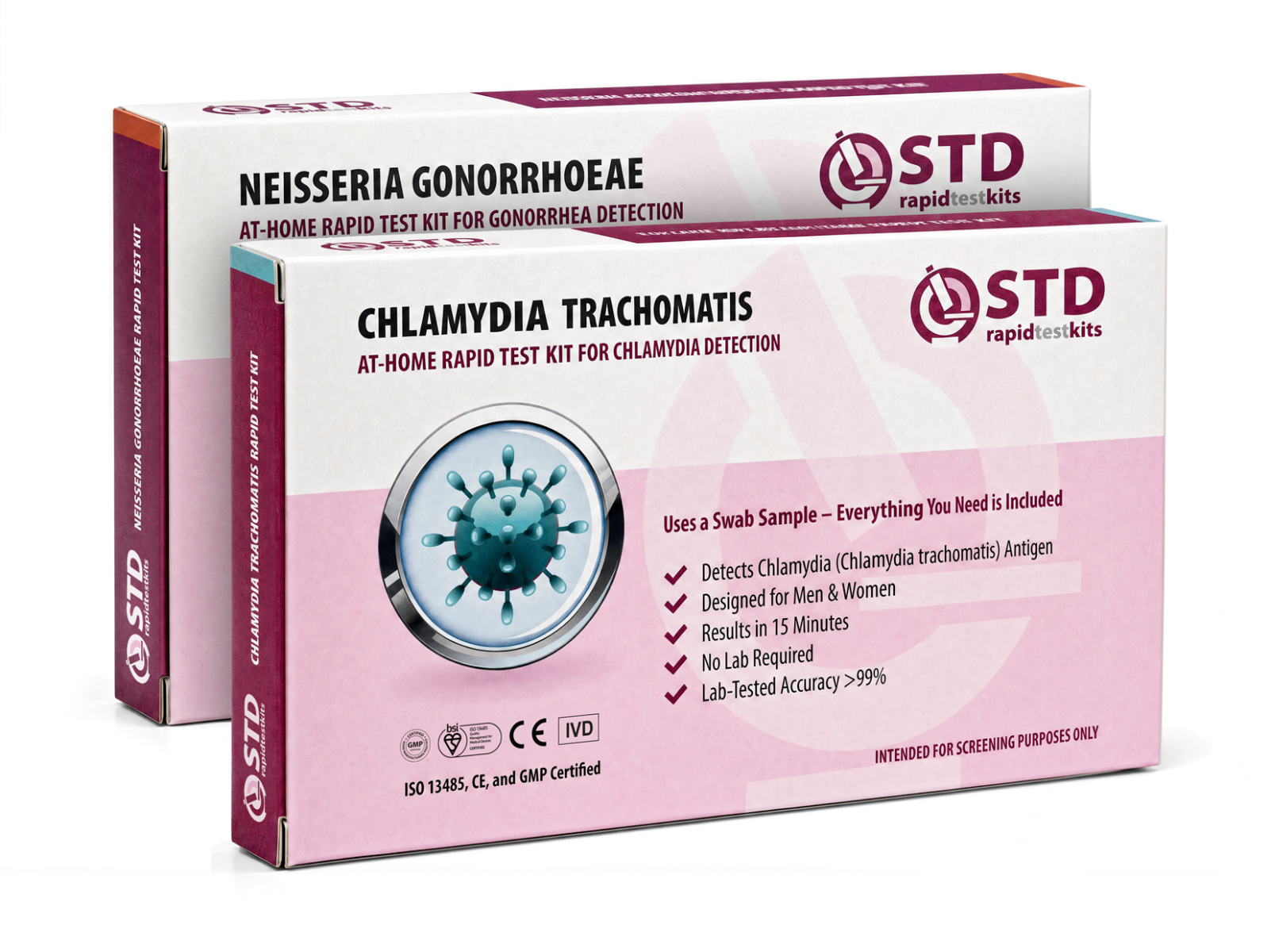
At-home testing makes any of those rhythms easier to actually keep. There is no clinic appointment, no waiting-room time off work, no in-person disclosure of why you are there. The kit arrives, you collect a sample, and you read the result. Rapid lateral-flow tests typically give a result in about 15 minutes. The single biggest barrier to STI testing is the friction of getting it. At-home kits remove most of that friction, which is why uptake among people who would have skipped a clinic visit is higher.
Note on scope: our at-home Trichomoniasis and HPV swab kits are validated for vaginal self-swab only. Male readers needing a trich or HPV test should see a clinic. Our 8-in-1 kit is sold for any-gender use; the 10-in-1 expanded panel is women-only.
Product: herpes-test
Testing as a feature of safer sex, not a failure of it
The instinct to read a positive STI result as a failure of protection misses the point. Condoms reduce risk substantially without promising zero, and they are one item on a longer safer-sex menu that also includes vaccination (HPV, hepatitis B), PrEP for HIV, and routine testing.
A positive result on a routine panel is not evidence that you did anything wrong. It is the system working as designed: an infection found, treatable in most cases, and addressed before it can pass on or progress. Most of what at-home rapid panels detect (chlamydia, gonorrhea, syphilis, hepatitis B and C, HIV) is treatable or manageable with medication that is far easier to access early than late. Herpes and HPV are not curable, but knowing about them changes how you protect partners and how you respond to early signs.
Testing is also the only intervention on the safer-sex menu that confirms what you suspect, rather than reducing odds you cannot see. The other tools manage the probability of infection. A test answers the actual question: are you carrying this, right now, at the moment you tested?
When used correctly and consistently, condoms are highly effective at preventing the sexual transmission of HIV. Some sexually transmitted infections are spread through skin-to-skin contact, and condoms may not provide complete protection.
FAQs
- I used a condom every time. Why would I still need testing?
- Because a condom covers the shaft of the penis but not the rest of the genital area. For fluid-borne STIs (HIV, chlamydia, gonorrhea), consistent correct use cuts transmission risk by 80% or more. For skin-to-skin STIs (herpes, HPV, syphilis), the protective effect is meaningful but partial, and any infection that can transmit from uncovered skin can still spread.
- Which STIs can spread despite consistent condom use?
- The skin-to-skin infections: herpes (HSV-1 and HSV-2), HPV, and syphilis. All three can transmit from genital skin a condom does not cover (scrotum, vulva, perineum, mouth, anal margin).
- If the condom did not break, am I really at risk?
- Possibly. Condoms can slip, be applied after some skin contact, or simply not cover the area where transmission happened. For skin-to-skin STIs, an intact condom is not the same as full coverage. It also matters whether the condom was used for the entire encounter, including any genital-to-genital contact before penetration.
- Can I get an STI from oral sex even with a condom?
- Yes. Oral sex is the most common site of pharyngeal (throat) gonorrhea, and HSV-1 (oral herpes) transmits readily during oral sex. Condom use during fellatio reduces but does not eliminate these risks. Dental dams help during cunnilingus and rimming. Condom-protected oral sex still leaves more residual risk than condom-protected vaginal sex does.
- My partner says they tested negative. Do I still need to test?
- Maybe. The relevant questions are: when did they test, what infections did the test panel actually cover, and have they had any partners since then? A negative test from six months ago does not cover the last six months. A panel that screened only HIV does not say anything about chlamydia, herpes, or syphilis.
- How long after a possible exposure should I wait to test?
- Chlamydia and gonorrhea swabs: about 5 to 7 days. HIV: 18 to 45 days for fourth-generation antigen-antibody lab tests; antibody-only rapid home tests need up to 90 days. Retest at 12 weeks after a high-risk exposure for full confidence. Syphilis: 3 to 6 weeks. Hepatitis B: 3 to 6 weeks. Hepatitis C: 8 to 11 weeks. Herpes blood antibody: 6 to 12 weeks for most people; up to 16 weeks for late seroconverters. If you test early, retest at the back end of the window for confidence.
- Can a positive home test be wrong?
- Yes. Confirm any positive with a lab NAAT (chlamydia or gonorrhea) or a confirmatory blood panel (HIV, syphilis) before starting treatment. Rapid lateral-flow tests screen reliably at home but carry lower analytical sensitivity than lab PCR; confirmation also opens up treatment options.
- Does getting tested mean something is wrong with me?
- No. Routine STI testing is a standard component of preventive sexual health, and the CDC recommends it for all sexually active adults at intervals based on activity level. Testing is what responsible looks like in practice, and it is no more shameful than a dental cleaning.
- U.S. Centers for Disease Control and Prevention. Condom effectiveness, communication resources, and consistent-use guidance for STI risk reduction.
- World Health Organization. Genital herpes infection: prevalence (over 1 in 5 adults worldwide) and skin-to-skin transmission, 2024 fact sheet.
- U.S. Centers for Disease Control and Prevention. Sexually transmitted infections section: surveillance, fact sheets, and prevention guidance for chlamydia, gonorrhea, syphilis, and HPV.
- U.S. Centers for Disease Control and Prevention. Sexually transmitted infections treatment guidelines: screening cadence recommendations and window-period guidance.
- U.S. Centers for Disease Control and Prevention. Genital herpes (HSV-1 and HSV-2): transmission routes, condom limitations, and asymptomatic shedding.
- UK National Health Service. Sexually transmitted infections (STIs): symptoms, when to test, and clinical pathways.
