Telehealth vs Clinic STD Testing: Accuracy, Cost, and Privacy Compared
Telehealth STI care is faster and more private than ever, but in-person clinics still own certain cases: visible symptoms, antibiotic injections, urgent pelvic pain. This guide walks through the trade-offs honestly so you can match the right care model to your situation without wasting a clinic visit or missing an infection.




- Telehealth works well for routine STI screening, refills, and discreet follow-up. In-person clinics remain essential for visible symptoms, antibiotic injections, severe pain, and pregnancy-related concerns.
- Home-collected and telehealth-ordered samples use the same CLIA-certified labs as clinics, so analytical accuracy is comparable when you follow the collection instructions. Rapid at-home cassettes use lateral-flow chemistry and are screening tools, not a lab NAAT replacement.
Published: August 2025 | Last updated: May 2026 | Editorial review and quality control: Martina N.
Maybe you noticed a symptom this morning. Maybe you had a risky encounter last weekend and the anxiety has not faded, or it has been more than a year since your last full screening and you want to fix that without making a production of it. Whatever brought you here, you are now trying to decide between logging into a telehealth app, driving to a clinic, or ordering a test kit to your front door.
The short answer: both telehealth and in-person clinics now offer real, lab-grade STI care. The right choice usually comes down to a small number of practical questions. Do you have visible symptoms? Do you need a same-day antibiotic injection? How much does privacy matter where you live? What does your insurance cover?
This article walks through the trade-offs honestly. We sell at-home rapid test kits, so we have a commercial reason to recommend testing from home. The goal here is to match the care to your situation, not to push you toward a kit that doesn't fit your concern. If you genuinely need a clinic visit, we will tell you.
Key Takeaways
- Telehealth works well for routine STI screening, refills, and discreet follow-up. In-person clinics remain essential for visible symptoms, antibiotic injections, severe pain, and pregnancy-related concerns.
- Home-collected and telehealth-ordered samples use the same CLIA-certified labs as clinics, so analytical accuracy is comparable when you follow the collection instructions. Rapid at-home cassettes use lateral-flow chemistry and are screening tools, not a lab NAAT replacement.
Why so many people now start with telemedicine
Telehealth grew quickly during the COVID era and never really retreated. According to the U.S. Department of Health and Human Services telehealth program, virtual visits remain a meaningful share of outpatient care across primary care, behavioral health, and sexual health. For STI care specifically, the appeal is concrete:
- Privacy. No waiting room, no parking-lot encounters, no chart that lives at a clinic across the street from your office.
- Speed of access. A consult can happen the day you notice a problem, often within the same hour.
- Geographic reach. Telehealth removes the rural-care gap for people who live an hour or more from the nearest STI clinic. The Health Resources and Services Administration highlights this as one of telehealth's strongest use cases.
- Stigma reduction. A meaningful chunk of delayed testing is driven by the fear of being seen. Virtual care erases that.
Direct-to-consumer telehealth platforms now ship at-home collection kits in plain packaging, route the samples to the same labs hospitals use, and deliver results through HIPAA-compliant patient portals.
- Annual screening when you have no symptoms and just want to stay on schedule.
- Single-infection question after one specific exposure with a known window period.
- Prescription refills for ongoing antivirals or PrEP.
- Discreet follow-up when you live with family, share insurance, or work in a small town.
What in-person clinics still do better
A screen cannot examine a body. That sounds obvious, and it is the central reason traditional STI clinics are not going away. The cases where in-person care still wins are specific, and they matter:
- Visible symptoms. Sores, lesions, rashes, abnormal discharge, swollen lymph nodes, and pelvic tenderness all benefit from a clinician's direct look, often with a speculum, lighted otoscope, or hand-held magnifier.
- Injectable treatment. The CDC's 2021 STI Treatment Guidelines recommend a 500 mg intramuscular ceftriaxone injection as first-line therapy for uncomplicated gonorrhea. Telehealth can prescribe oral antibiotics, but a needle has to enter a real shoulder.
- Same-day NAAT and rapid serology. Many public clinics now offer point-of-care nucleic acid amplification tests with results during the visit, and same-day HIV and syphilis rapid tests. If your timeline is hours rather than days, that matters.
- Pregnancy and pelvic concerns. Suspected pelvic inflammatory disease, ruling out an ectopic pregnancy, or any STI workup during pregnancy needs a clinic exam.
- On-site counseling. Some readers feel safer with a human in the room. Public health clinics also offer partner-notification support that is harder to replicate remotely.
This is not a competition for which model is universally better. It is a question of fit.
This article is published by stdrapidtestkits.com, which sells at-home STI testing kits. We recommend products based on fit for the reader's concern, not commercial benefit. If your situation calls for a clinic visit, that recommendation appears directly in the section that applies to you, not as a buried footnote.
Accuracy: are telehealth STI tests really equivalent?
This is the question that drives the most reader anxiety, and the honest answer has two parts.
When a telehealth service ships your sample to a lab, that lab is typically CLIA-certified and runs the same NAAT or serology assay your in-person clinic would order. Self-collected vaginal swabs for chlamydia and gonorrhea, in particular, perform comparably to clinician-collected swabs in published validation studies and are explicitly endorsed by the CDC's STI program for use in screening. Self-collected urine for the same infections is the standard collection method in many settings. The accuracy bottleneck is collection technique, not lab quality.
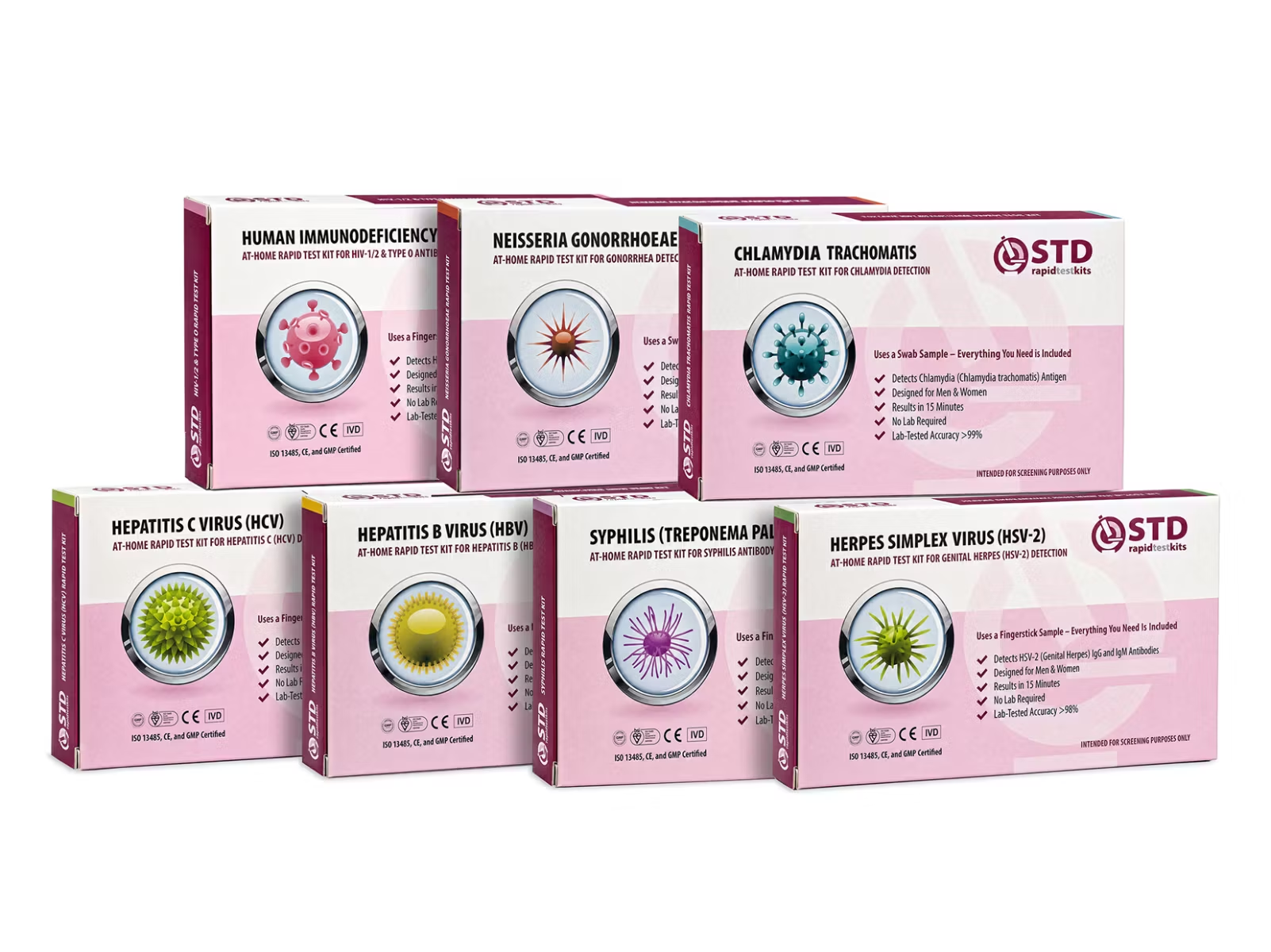
When the test is a rapid at-home cassette, like the ones we sell, the chemistry is different. These are lateral-flow immunoassays. They give you a result in roughly 15 minutes on a kitchen table. They are excellent screening tools, but they are not the same technology as a lab NAAT, and the sensitivity profile differs, especially for very early infections (before seroconversion, the point at which your immune system has produced enough antibodies to register on a blood test, for blood-based antibody tests; or before bacterial load rises high enough to detect for swab-based antigen tests). A positive rapid result should always be followed up with a confirmatory lab test. A negative result close to the exposure date should be repeated after the window period closes.
The practical implication: if you want the best analytical sensitivity, a telehealth platform that ships a sample to a NAAT lab matches what a clinic offers. If you want a result in 15 minutes at home and you understand the screening-vs-confirmatory distinction, a rapid cassette is fit for purpose.
Either way, the worst option is no test at all. The CDC's STI surveillance statistics attribute a large share of new transmissions to undiagnosed infections, and the friction of going to a clinic is one of the reasons people skip screening entirely.
Cost: what each model actually charges
Sticker prices vary widely. The realistic ranges in 2026 look like this:
- Telehealth lab mail-in kits: roughly $50 to $200 for the kit and lab processing combined, depending on how many infections the panel covers.
- Telehealth video consultations: $30 to $75 out of pocket for a single visit at most direct-to-consumer platforms.
- At-home rapid cassettes: $25 to $100 per kit, depending on whether you choose a single-infection or combination panel.
- Public health clinics: often free or sliding-scale for individual STI testing through state and county sexual-health programs. The CDC GetTested locator can find free or low-cost testing near you.
- Private clinics or urgent care: $80 to $300 or more for a full panel without insurance, before any office visit fee.
Two important caveats. First, insurance changes everything. Many commercial plans now cover telehealth visits at parity with in-person care, and the Medicaid telehealth benefit covers a broad range of virtual visits in every state, but coverage of at-home test kits specifically remains spotty across plans. Check before you book or order.
Second, the cheapest visible option is not always the cheapest real option. A free public-clinic test plus a half day off work plus parking can cost more in total than a $90 telehealth kit. A $25 rapid cassette plus a missed early infection because you misread the window period can cost much more than that.
Privacy: the real and the perceived
Privacy is the single biggest reason readers tell us they pick telehealth. There are two kinds of privacy at play, and they are not equal.
Procedural privacy, the kind telehealth solves well, is about who sees you walk into the clinic, who answers the phone at the front desk, and what shows up on a partner's car insurance bill for a parking validation. At-home kits arrive in plain shipping boxes with no test-specific markings. Video consults happen on your phone in a closed room. Results live in a HIPAA-protected portal that only you log into.
Procedural privacy is real, and it matters, especially for readers in small towns, on shared insurance plans, or living with family or roommates.
The other kind is data privacy, and it is more nuanced. Telehealth platforms generate digital records: lab orders, video consult notes, and prescription history. Reputable services are HIPAA-compliant and limit data sharing, but read the privacy policy of any provider before you sign up. Anything that calls itself a wellness app rather than a healthcare provider may not be bound by HIPAA at all.
Procedurally private and HIPAA-compliant is the standard you want. Most established telehealth STI services meet it. Cheap, anonymous-looking platforms with no listed clinicians or licenses are the ones to avoid; they may be neither private nor accurate.
- HIPAA-compliant infrastructure stated explicitly in the platform's privacy policy. If the document avoids the word HIPAA, the platform may be operating as a wellness app, not as a healthcare provider.
- Plain-label shipment confirmed on the FAQ or shipping page. Look for an explicit statement that the return label and outer packaging carry no test-specific wording.
How a telehealth STI service actually works
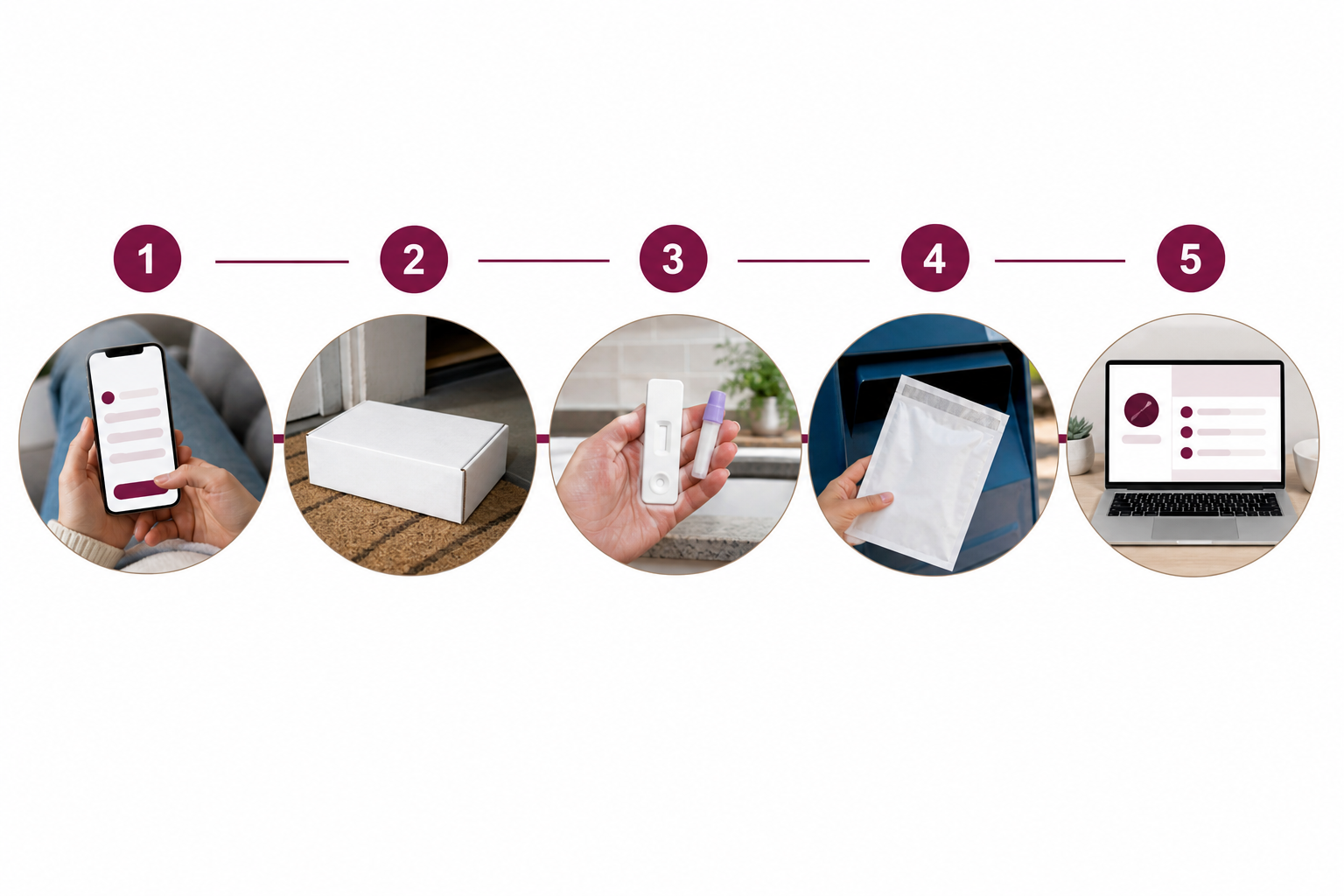
The end-to-end flow is more standardized than most people expect. A typical visit looks like this:
- Choose a test or consult. You select a single-infection test, a combination panel, or a symptom-based video consultation with a licensed clinician.
- Sample collection. If you ordered a mail-in kit, it arrives in two to four days in plain packaging. You follow the included instructions to collect a vaginal swab, urine sample, or fingerstick blood sample. Some platforms instead route you to a nearby Quest or LabCorp draw station.
- Return to lab. The kit ships back in a prepaid mailer. Lab processing typically takes two to five business days from receipt.
- Secure results. Results land in a HIPAA-compliant patient portal. Most platforms offer a follow-up call with a clinician for any positive result.
- Prescription or referral. For oral antibiotics, the platform's licensed clinician can issue a prescription to your local pharmacy. For an injectable like ceftriaxone, or any condition needing a physical exam, you receive a referral to a local clinic.
For rapid at-home cassette tests, the loop is even shorter: the kit arrives, you self-collect, you read the result in 15 minutes, and you confirm anything positive with a follow-up lab or clinic visit.
| Factor | Telehealth / At-home | In-person clinic |
|---|---|---|
| Best for | Routine screening, refills, follow-up, after a single known exposure with no symptoms | Visible symptoms, severe pain, pregnancy concerns, injections |
| Time to result | 2 to 5 business days for lab mail-in; about 15 minutes for rapid cassette | Same-day for rapid tests; 1 to 7 days for send-out labs |
| Privacy | High (plain packaging, no waiting room, portal results) | Variable; depends on community size and clinic location |
| Cost (uninsured) | $25 to $200 typical range, depending on panel | Free at public clinics; $80 to $300 or more at private clinics |
| Treatment options | Oral antibiotics, antivirals, PrEP (pre-exposure prophylaxis for HIV) refills via prescription | Oral antibiotics plus injectables plus on-site procedures |
| Physical exam | None during the visit | Yes, when clinically indicated |
| Insurance coverage | Strong for video visits; mixed for at-home kits | Broad, including Medicaid and most commercial plans |
When you should skip telemedicine and go straight to a clinic
There is no telehealth visit that replaces an in-person evaluation when any of the following are true:
- Severe pelvic, abdominal, or scrotal pain
- High fever, chills, or feeling systemically unwell after a possible STI exposure
- Visible sores, ulcers, blisters, or a rapidly spreading rash in the genital area
- Heavy abnormal bleeding outside your normal cycle
- Symptoms suggesting pelvic inflammatory disease (lower-abdominal pain plus fever plus discharge)
- Pregnancy plus any new STI symptom or exposure concern
- Known exposure to a partner diagnosed with an antibiotic-resistant infection (your clinician needs to choose treatment based on lab susceptibility, not a script)
- Sexual assault, where forensic evaluation, prophylaxis, and counseling all need to happen in a coordinated visit
If any of these apply, do not wait two days for a mail-in kit. An urgent-care clinic, an emergency department, or a same-day public sexual-health clinic is the right call.
Severe pelvic or scrotal pain, high fever after a possible exposure, visible sores or a spreading genital rash, or any STI symptom during pregnancy all need same-day in-person evaluation. If you have been sexually assaulted, an emergency department or designated SANE program can coordinate forensic exam, prophylaxis, and counseling in a single visit. Do not wait on a mail-in kit.
How to vet a telehealth STI provider
Not every platform that calls itself a telehealth service is operating to a real medical standard. Use this short checklist before you hand over a credit card and a sample:
- CLIA-certified lab partners. The platform should name the lab it uses (Quest, LabCorp, or a comparable certified reference lab). If the lab is unnamed or located somewhere with no equivalent regulatory framework, walk away.
- Licensed clinicians in your state. Telehealth prescribing requires a clinician licensed in the state you are physically located in. Most legitimate platforms surface this on their About or Provider page.
- HIPAA-compliant infrastructure. The privacy policy should explicitly state HIPAA compliance and describe how data is stored and shared.
- A real prescription pathway. A platform that promises antibiotics without any clinician interaction is operating outside the rules, and you should not trust the rest of its workflow either.
- Clear follow-up support. Positive results need a clinician follow-up call and partner-notification support. Bare-bones services that simply email you a PDF and disappear are not a substitute for medical care.
- Realistic pricing. Suspiciously cheap full-panel kits (under $25 for a 5-infection panel) are usually using unlicensed labs or skipping confirmatory testing.
The same logic applies to at-home rapid kits. Look for FDA-cleared or CE-marked devices, manufacturer-published sensitivity and specificity figures, clear collection instructions, and a real customer-support channel for questions about a positive result.
The two non-negotiables
- A named CLIA-certified lab partner. If the platform will not tell you which lab processes the sample, the result is not trustworthy enough to base a treatment decision on.
- A clinician licensed in the state you are physically located in. Without this, the prescription pathway is operating outside legal rules and the platform should be avoided regardless of how cheap or fast it looks.
A practical hybrid that works for most readers
The argument we hear most often from clinicians: stop framing this as either-or. The pragmatic flow for most adults is hybrid.
- Start at home for routine annual screening or after a known single exposure with no symptoms. Either a rapid cassette for fast triage or a mail-in lab kit for the most analytically sensitive result.
- Use telehealth for treatment when the result is positive on something oral antibiotics can handle (uncomplicated chlamydia, trichomoniasis) and your platform can prescribe in your state.
- Move to in-person care the moment you have visible symptoms, severe pain, pregnancy concerns, or a need for an injection or in-clinic procedure.
This pattern catches more infections earlier (because the friction of the first step drops to almost zero), uses clinic time for the cases that genuinely need a physical exam, and keeps the cost of routine screening low. Before you start, save the address and phone number of one nearby urgent-care or sexual-health clinic in your contacts, so the moment symptoms shift the situation from at-home to in-person, the next step is already one phone call away.
Frequently Asked Questions
- Is telehealth STI testing as accurate as clinic testing?
- When a telehealth service ships your sample to a CLIA-certified lab running NAAT or standard serology, the analytical performance matches what you would get from a clinic visit. The CDC explicitly endorses self-collected vaginal swabs for chlamydia and gonorrhea screening. Accuracy bottlenecks come from collection errors or testing too early in the window period, not from the lab itself.
- Can a telehealth clinician prescribe STD medication?
- In most U.S. states, yes, for oral antibiotics like doxycycline for chlamydia or oral antivirals for herpes outbreaks. For infections that require an intramuscular injection (the CDC's first-line treatment for gonorrhea is 500 mg of ceftriaxone IM), telehealth platforms will issue a referral to a local clinic or urgent care for the actual injection.
- When should I skip telemedicine and go straight to a clinic?
- If you can see the symptom (sores, ulcers, a spreading genital rash) or feel it sharply (severe pelvic or abdominal pain, fever after a possible exposure), go in person the same day. Pregnancy plus any new STI concern, suspected antibiotic-resistant exposure, and sexual-assault evaluation also fall outside what telehealth can safely handle. If you are unsure whether your symptom qualifies, err toward the clinic. Same-day sexual-health clinics handle walk-ins.
- Does insurance cover telehealth STI testing?
- Most commercial insurance plans now cover telehealth video visits at parity with in-person visits, and Medicaid covers a broad range of telehealth services in every state. Coverage of at-home test kits specifically is more variable; some plans reimburse, others do not. Always check your benefits before booking or ordering.
- What if I need an antibiotic injection?
- A telehealth clinician can diagnose, order labs, and write a prescription, but a needle has to enter your body in person. For gonorrhea, the CDC's 2021 STI Treatment Guidelines recommend 500 mg of intramuscular ceftriaxone, which means a same-day visit to a local clinic, urgent care, or community-health center. Many telehealth platforms coordinate this referral for you.
- Can telehealth handle HIV testing?
- Yes. The CDC has recognized at-home HIV testing as a legitimate screening pathway. Telehealth platforms offer both rapid at-home cassettes (results in roughly 20 minutes from a fingerstick) and mail-in lab kits. Any reactive at-home result should be confirmed with a lab-based fourth-generation antigen and antibody test before starting treatment decisions.
- Are telehealth STI kits really discreet?
- Reputable services ship in plain corrugated boxes with no test-specific markings on the outside, no clinical wording on the return label, and no descriptive line items on credit-card statements (they appear as a brand name rather than as STI testing). Procedural privacy is one of telehealth's strongest features.
- Can I use telehealth STI services while traveling?
- Telehealth prescribing is licensed by the state or country you are physically located in. Most U.S. platforms can issue lab orders to partner facilities in major U.S. cities, but cross-state prescribing rules vary, and most platforms cannot legally serve you outside the United States. If you are traveling internationally, plan to use local services or carry a current screening result with you.
Product: STD-8
- U.S. Centers for Disease Control and Prevention. Sexually Transmitted Infections Treatment Guidelines, 2021. First-line treatment recommendations including 500 mg intramuscular ceftriaxone for uncomplicated gonorrhea.
- U.S. Centers for Disease Control and Prevention. CDC STI program hub covering screening guidance, self-collected sample support, and clinical recommendations for sexually active adults.
- U.S. Department of Health and Human Services. Telehealth.HHS.gov program information on virtual care delivery in primary, behavioral, and sexual health.
- Health Resources and Services Administration. Telehealth and the rural-care gap, including its application to STI screening for medically underserved areas.
- Kaiser Family Foundation (November 2019). Telemedicine in Sexual and Reproductive Health issue brief on virtual STI care models, coverage, and accessibility. Predates the COVID-era expansion; use for framing rather than current utilization figures.
- Medicaid.gov. Federal Medicaid program portal covering state telehealth benefits, including virtual STI consultations and laboratory services.
- U.S. Centers for Disease Control and Prevention. CLIA program overview describing the certification standard used by laboratories that process STI samples.
- U.S. Centers for Disease Control and Prevention. STI Statistics hub with national surveillance reports on chlamydia, gonorrhea, and syphilis, including data on undiagnosed infections and screening pathways.