Published: November 2025 | Last updated: May 2026 | Editorial review and quality control: Martina N.
Daily antivirals for genital herpes are among the most asked-about prescriptions in sexual health. People want a clear answer to a few specific questions: what does the pill do, does it stop outbreaks completely, does it make someone non-contagious to partners, and is it safe to take year after year?
The honest answer is layered. Suppressive therapy reliably reduces both outbreak frequency and the risk of passing herpes to a partner. It does not eliminate either. Knowing where the line falls matters, because expecting a cure leaves room for confusion and self-blame when reality does not match the hope. Many people start daily valacyclovir expecting to never have a flare again, then panic when a familiar tingle returns four months in.
This guide walks through what daily valacyclovir, acyclovir, and famciclovir do in practice, how they compare, when they make sense, and what trade-offs come with long-term use. The information draws on current CDC STI Treatment Guidelines, WHO guidance, and the published transmission and safety studies those guidelines are built on.
Key Takeaways
- Daily suppressive therapy cuts genital herpes outbreak frequency by 70 to 80 percent and reduces partner-to-partner HSV-2 transmission by roughly 48 percent in the largest controlled trial (Corey et al., NEJM 2004).
- Low-level viral shedding and breakthrough symptoms still occur during therapy, so suppression is a risk reducer rather than a cure or a transmission guarantee.
Who suppressive therapy is really for
Suppressive therapy is not only for people with constant outbreaks. The CDC STI Treatment Guidelines describe it as a reasonable option for anyone with recurrent genital herpes who wants to reduce flare frequency, for people in serodiscordant relationships where transmission to a partner is a concern, and for those whose recurrences cause significant distress or disruption to daily life.
The threshold many providers use as a starting point is roughly six or more outbreaks per year, but the cutoff is soft. A person with two or three severe outbreaks per year may still benefit if those flares are deeply disruptive. Someone with eight mild outbreaks may decide they would rather treat each one episodically than commit to a daily pill. The decision is not driven by a single number; it is driven by the lived impact of the virus on the person sitting in the exam room.
The pattern of triggers also matters. When outbreaks track predictably with menstrual cycles, periods of intense stress, illness, or sleep loss, a daily preventative often makes more sense than waiting for symptoms because the trigger is recurring and unavoidable. Episodic treatment, taken only when symptoms appear, can fall short for this group because the prodrome window is short and life sometimes does not allow a same-day pharmacy run.
Suppression also serves a role that is sometimes overlooked: it lowers the mental load of living with the diagnosis. Knowing that the daily pill is doing background work can shift attention away from constant body monitoring. Whether that emotional benefit is worth the routine is a personal call, not a clinical one, and a good prescribing visit will discuss it openly.
- People with roughly six or more outbreaks per year, or fewer but disruptive ones
- People in serodiscordant relationships, where one partner has HSV-2 and the other does not
- Anyone whose recurrences cause significant emotional distress or interfere with daily life
What daily antivirals actually do
Valacyclovir, acyclovir, and famciclovir are nucleoside analogs. They resemble the building blocks the herpes virus uses to copy itself, so the virus incorporates them and then cannot complete replication. The result is fewer infectious viral particles circulating in skin and mucosal tissue, which translates into fewer days of viral shedding and fewer symptomatic outbreaks.
These drugs do not clear the latent reservoir. Herpes simplex virus hides in sensory nerve ganglia, and no current antiviral reaches it there. That is why every credible source, including the CDC and WHO, frames suppressive therapy as containment rather than eradication. The virus is still present in your body during therapy; the medication keeps it quiet most of the time.
How quiet depends on the person. Randomized trials consistently show that daily valacyclovir or acyclovir reduces clinically apparent outbreaks by 70 to 80 percent in people with frequent recurrences. Asymptomatic shedding (viral activity in the skin without visible symptoms) drops too, though not to zero. Research from the University of Washington virology group has shown that even with daily valacyclovir, low-level shedding still occurs on a small fraction of days, mostly without producing visible lesions.
The practical implication is that the pill changes the math of daily life with herpes but does not flip a switch. A person on consistent suppression has fewer outbreak days, fewer shedding days, and a lower per-act transmission risk to a partner. They do not have zero of any of these.
| Antiviral | Typical daily suppressive dose | Effect on outbreak frequency | Transmission data |
|---|---|---|---|
| Valacyclovir (Valtrex) | 500 mg once daily (1 g daily for people with 10+ outbreaks/year) | 70-80% fewer recurrences in trials | Most studied; ~48% reduction in HSV-2 transmission to partners |
| Acyclovir | 400 mg twice daily | Comparable to valacyclovir with consistent adherence | Fewer shedding days; transmission reduction inferred but less directly measured |
| Famciclovir | 250 mg twice daily | Effective for recurrence suppression; used less often than valacyclovir | Limited transmission-specific data |
Why outbreaks can still happen on suppression
Roughly a quarter to a third of people on consistent daily therapy still experience at least one outbreak per year. The numbers in published trials usually land between 70 and 80 percent reduction in recurrences, which means a meaningful minority continue to have breakthrough flares even when taking the medication exactly as prescribed.
Several factors influence whether a flare happens despite the medication. Adherence is the largest one. Missing doses, especially several in a row, lets viral replication catch up. Even with perfect adherence, other forces still play a role. Physical stress (lack of sleep, intense exercise, a concurrent illness) can trigger reactivation. So can hormonal shifts around menstruation. Friction from sex, tight clothing, or hair removal can locally irritate the area and prompt the nerve to release virus.
A breakthrough does not mean the medication has failed. Compared to outbreaks without therapy, breakthroughs on suppression are usually milder, heal faster, and involve fewer days of shedding. Providers generally evaluate whether suppression is working at the six- to twelve-month mark, not after a single breakthrough, because outbreak frequency is the long-term metric.
If breakthroughs are frequent or severe despite consistent dosing, the dose can sometimes be increased (for example, 500 mg of valacyclovir daily moved up to 1 g daily), or the drug switched. Persistent severe recurrences also warrant checking for other contributing infections, since HSV reactivation can be driven by changes in immune status.
- Missed doses, especially several in a row
- Physical stress: poor sleep, intense exercise, or a concurrent illness
- Hormonal shifts around menstruation
- Local skin friction from sex, tight clothing, or hair removal
How long until the meds start working
The antiviral effect starts within hours. Once valacyclovir or acyclovir is in your bloodstream, replication of any actively dividing virus slows, which is why these same drugs (at higher doses) are also used episodically to shorten an active outbreak.
The broader suppression effect, meaning fewer flares and less asymptomatic shedding, builds gradually over weeks. The first month is when many people report noticing fewer prodrome tingles and faster healing of any minor episodes. By two to three months, the baseline shedding rate is usually meaningfully lower. Most providers recommend assessing the response at six to twelve months before deciding whether to continue, change dose, or step down to episodic therapy.
If you are starting suppression specifically to protect a partner, providers commonly recommend pairing the daily medication with condoms during the first several weeks while shedding rates are still settling. This is not because the drug is failing during that period; it is because the transmission-risk reduction documented in trials reflects months of consistent dosing, not a few days.
| Timeline on daily suppression | What is happening |
|---|---|
| First 24-48 hours | Antiviral active in the bloodstream; may shorten any active outbreak in progress |
| Week 1-2 | Some people notice fewer prodrome tingles; early side effects (headache, nausea) usually appear here if they will appear at all |
| Week 2-4 | Shedding days begin to decrease; visible outbreaks become less frequent |
| Month 2-3 | Suppression effect stabilizes; transmission-risk reduction approaches study-published levels |
| Month 6-12 | Provider reviews outbreak frequency, side effects, and whether to continue, adjust dose, or switch to episodic therapy |
Suppression and partner transmission risk
The most often-cited study on transmission was published in the New England Journal of Medicine in 2004 by Corey and colleagues. It enrolled almost 1,500 monogamous heterosexual couples in which one partner had genital HSV-2 and the other did not. The HSV-2 positive partner took 500 milligrams of valacyclovir daily for eight months. Symptomatic HSV-2 acquisition in the previously uninfected partner dropped by 75 percent compared with placebo. Overall HSV-2 acquisition (symptomatic plus asymptomatic seroconversion) dropped by 48 percent.
That 48 percent figure is what clinicians usually quote when discussing suppression for transmission reduction. It is also worth saying out loud what the study did and did not measure. The trial was on heterosexual couples, the index partner was usually the woman, and the result has not been replicated in every demographic. The CDC nevertheless endorses daily valacyclovir as a transmission-reduction tool, and consistent condom use adds independent protection on top, with combined estimates suggesting an additional 30 to 50 percent reduction.
What suppression does not do is bring transmission risk to zero. The virus still sheds occasionally, sometimes on days with no visible symptom and no warning. Disclosure to partners therefore remains the standard of care, regardless of whether someone is on daily medication. Most clinicians who counsel couples on this point describe suppression and condoms as a combined strategy, not a substitute for the disclosure conversation.
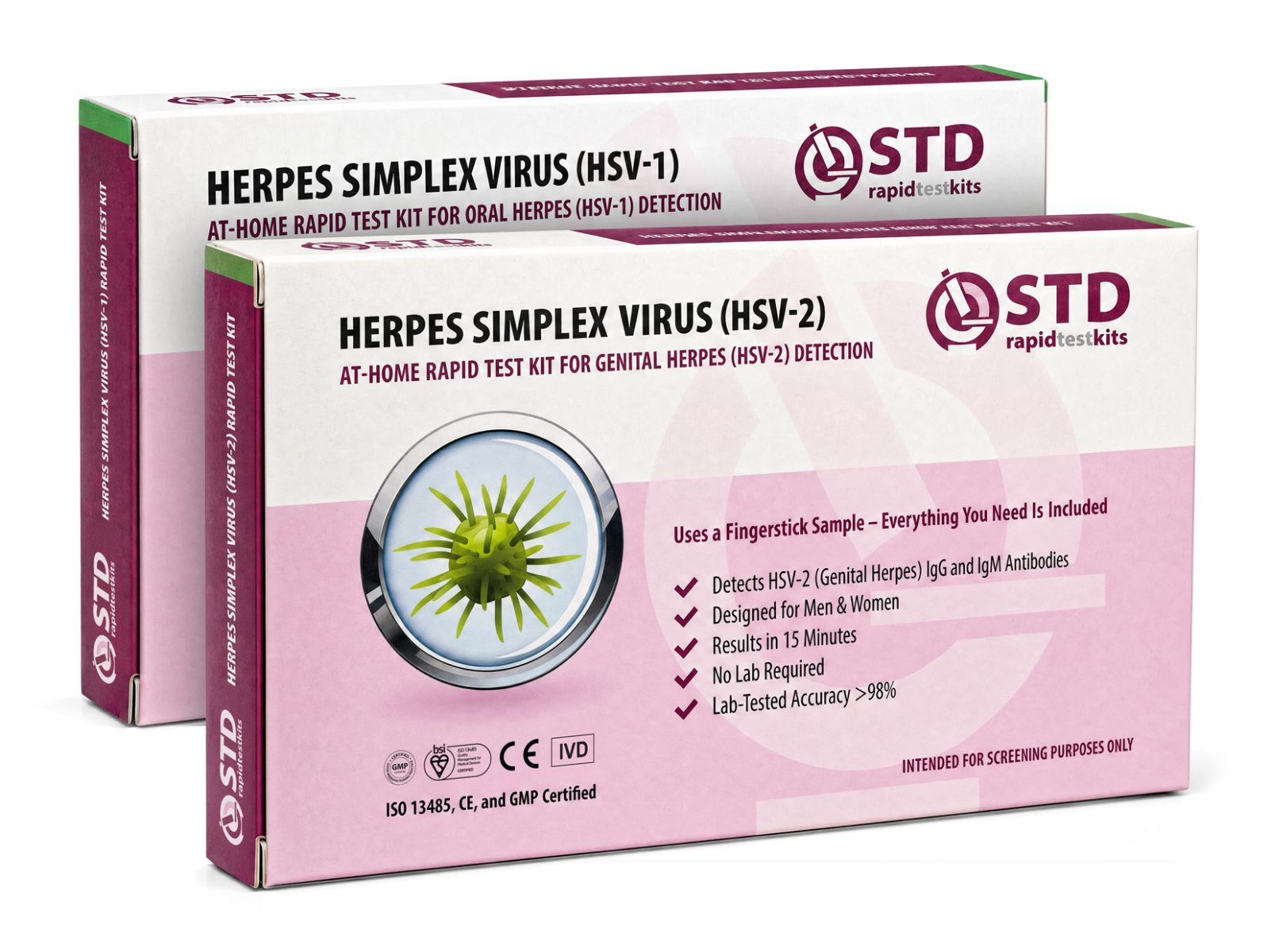
A practical note on testing partners: before relying on suppression to protect a partner, the partner's HSV-1 and HSV-2 status is genuinely useful information. Some partners already carry HSV-2 antibodies from a previous exposure they never knew about, which changes the conversation entirely. This article links to at-home rapid tests sold on this site, which is one option for partner screening alongside clinic-based testing.
Suppressive therapy reduces the frequency of genital herpes recurrences by 70 to 80 percent in patients who have frequent recurrences. Many people benefit from suppressive therapy, even those with less frequent recurrences.
Daily versus episodic therapy
Suppressive (daily) and episodic (as-needed) therapy are both reasonable strategies in CDC and WHO guidance. The choice depends on outbreak frequency, partner status, and personal preference.
Episodic therapy means keeping antivirals on hand and starting them at the first sign of prodrome (tingling, itching, burning, or a small spot of irritation in the usual location). Started within 24 hours of prodrome, episodic dosing can shorten an outbreak by one to two days and reduce its severity. It does little for asymptomatic shedding between outbreaks, so it is not a transmission-reduction strategy.
Daily suppression is typically chosen by people who have six or more outbreaks per year, who are in a relationship with an uninfected partner, who experience significant emotional impact from recurrences, or whose outbreaks tend to be severe enough to disrupt work or sleep. Some people switch between the two strategies over time. A common pattern is daily suppression during a new relationship or pregnancy, then a step-down to episodic once life is steadier and outbreak frequency has dropped on its own.
Considerations a provider commonly weighs:
- Frequency: fewer than four outbreaks per year often does not justify daily therapy
- Severity: severe or prodrome-heavy outbreaks favor daily prevention
- Transmission concern: an uninfected partner usually tips the balance toward daily
- Pill-taking tolerance: some people simply do not want a daily routine, and that preference is legitimate
- Cost and insurance coverage of long-term generic versus brand-name medication
A practical hybrid some clinicians suggest: episodic by default, with a planned switch to daily suppression around predictable trigger periods (new partner, exam season, travel, third trimester of pregnancy).
Stopping suppressive therapy
There is no withdrawal effect from stopping antivirals. The drugs leave the body within a couple of days, and the immune system goes back to managing the virus on its own.
What stopping reveals is your natural outbreak pattern in the current state of your life. Outbreak frequency often declines over the first few years after an initial herpes infection, regardless of whether someone has been on suppression. Some people who stop after a year or two of daily therapy find their underlying rate has dropped to one or two flares per year, which is comfortably in episodic territory. Others find the previous frequency returns within a few months.
If you are stopping suppression while still in a partnered relationship where transmission was the original concern, talk to your provider first. Common strategies include staying on daily therapy through high-risk life periods (a new relationship, pregnancy, an immunosuppressive treatment), tapering during a stable low-stress stretch, or coordinating the change with the partner getting an HSV-2 antibody test of their own.
One thing not to do: stop because of a single side-effect day. Mild nausea, headache, or fatigue that appears in week one often resolves by week three. Stopping inside the first month makes it hard to tell whether the medication was going to work, so it is usually worth pushing through the initial adjustment period before drawing conclusions.
- During a stable, low-stress stretch of life, not in the middle of a stressor
- After a partner has tested negative for HSV-2 antibodies and you have agreed on a plan together
- Before switching to episodic therapy, with antivirals already on hand for the first prodrome
- Not in week one over mild side effects that usually resolve by week three
Long-term safety of daily antivirals
Valacyclovir and acyclovir have been studied at suppressive doses for more than a decade in some cohorts, and the safety record in otherwise healthy adults is reassuring. The main side effects in trials and in routine practice are mild and uncommon: occasional headache, nausea, abdominal discomfort, or fatigue. Most resolve within the first few weeks or with a small dose adjustment.
Kidney handling is the one area providers watch. Both drugs are cleared by the kidneys, and people with impaired renal function may need a reduced dose. Severe renal complications are rare but described, mostly in people with pre-existing kidney disease or those taking other nephrotoxic medications. Bloodwork is not routinely required for healthy adults on standard suppressive doses, but providers may order periodic creatinine checks for people with risk factors or for those staying on therapy for many years.
Drug interactions are limited but worth flagging at the prescribing visit. Probenecid and cimetidine can raise valacyclovir levels. Other nephrotoxic drugs (some antibiotics, certain chemotherapy agents) deserve a closer look when combined with daily antiviral suppression.
Pharmacy cost and access are more often the practical limit on long-term use. Generic valacyclovir and acyclovir are available in most countries, and many insurance plans cover them. Cash prices for generic acyclovir 400 mg twice daily are often the cheapest long-term option. Brand-name Valtrex can be substantially more expensive, with no clinical advantage over the generic for most patients.
| Safety area | What to know |
|---|---|
| Common side effects | Mild headache, nausea, abdominal discomfort, or fatigue; usually resolve in the first few weeks |
| Kidney function | Both drugs are cleared by the kidneys; dose reduction may be needed for impaired renal function or for people on other nephrotoxic drugs |
| Drug interactions | Probenecid and cimetidine can raise valacyclovir levels; review other nephrotoxic medications at the prescribing visit |
Suppression during pregnancy
Suppressive therapy plays a specific, evidence-supported role in pregnancy. The American College of Obstetricians and Gynecologists and the CDC both recommend daily suppressive antiviral therapy starting around 36 weeks of gestation for people with a history of genital herpes. The goal is to reduce the chance of viral shedding at the time of delivery, which lowers the risk of neonatal herpes (a rare but serious infection that can occur when a newborn passes through a birth canal with active virus).
Valacyclovir and acyclovir are both considered acceptable in pregnancy. Registry data covering large numbers of exposed pregnancies have not shown an increased risk of birth defects with first-trimester exposure, though most pregnancy-specific recommendations focus on the third trimester. Anyone with a history of genital herpes should mention it early in prenatal care, because the third-trimester suppression plan and the cesarean-delivery decision (made if there is an active outbreak or prodrome at the time of labor) are decided together with the OB.
Pre-conception, partner testing matters too. A pregnant person who acquires herpes for the first time in the third trimester has the highest risk of passing the virus to the newborn, because maternal antibody protection has not had time to develop and cross the placenta. This is one situation where knowing both partners' HSV-1 and HSV-2 status before conception meaningfully changes the management plan. If only one partner is positive, suppression in the positive partner plus condom use through the pregnancy reduces the chance of a new maternal infection.
ACOG and the CDC recommend daily suppressive antiviral therapy starting around 36 weeks of gestation for anyone with a history of genital herpes, to reduce viral shedding at delivery and lower the risk of neonatal herpes. Mention any prior genital herpes diagnosis early in prenatal care so the third-trimester suppression plan and any cesarean-delivery decision can be coordinated with your OB.
The emotional weight of a daily pill
Beyond the pharmacology, taking a pill every morning for an incurable virus carries a psychological tone of its own. For some people the routine is grounding. The daily action is evidence of control, of doing something concrete to protect themselves and a partner. For others, the morning pill is a daily reminder of a diagnosis they did not choose, and the routine itself adds to the mental load.
Both responses are normal. Providers familiar with herpes management often raise this during follow-up visits because the medication's value extends past outbreak frequency. If the daily pill is reducing anxiety, it is doing useful work even on days the virus would have been quiet anyway. If the pill is increasing daily distress without a strong transmission or frequency reason behind it, episodic therapy may serve the same medical need with less mental friction.
Counseling and peer-support resources help with the parts of living with herpes that medication cannot reach: disclosure conversations, stigma, the spiral of anxiety around a partner's reaction. The medical question of which antiviral and at what dose is, in many cases, easier to answer than the broader question of what role the diagnosis takes up in your life. Both questions matter, and they often need different kinds of support.
If you are weighing whether daily suppression is the right step, the most useful conversation is with a provider who knows your outbreak history, your relationship situation, and your priorities. The pharmacology is well-mapped. The personal calculus around it is the part that benefits from a real discussion.

Frequently asked questions
- Do I have to take herpes meds forever?
- No. Some people stay on daily suppression for years because it reliably reduces outbreaks or supports a serodiscordant relationship. Others use it short-term during a new relationship, a pregnancy, or a stressful life period, and step down to episodic treatment when things settle. Most providers reassess at six to twelve months and adjust based on outbreak frequency, side effects, and personal preference.
- What if I miss a dose?
- Missing one dose does not flip a switch. Take it when you remember if it is within a few hours of the usual time, or skip it and resume the next dose as scheduled if it is close to the next one. Consistent dosing over weeks and months is what produces the suppression effect, so an occasional missed dose is not a problem; repeated missed doses week after week are.
- Can I still pass herpes to my partner while on daily meds?
- Yes, the risk is lower but not zero. The largest trial showed daily valacyclovir reduced HSV-2 transmission to partners by about 48 percent over eight months. Consistent condom use adds independent protection on top. Suppression plus condoms is a meaningfully safer combination than either alone, but neither eliminates the risk, so disclosure to partners remains the standard.
- What if I still get outbreaks on suppressive therapy?
- About 20 to 30 percent of people on consistent suppression still have at least one outbreak per year. A breakthrough does not mean the medication has failed; breakthroughs on suppression are usually milder and shorter than untreated outbreaks. If they are frequent or severe, the dose can sometimes be increased or the drug switched. Talk to your provider before assuming the medication is the problem.
- Is daily herpes medication safe long-term?
- Decades of safety data are reassuring for most healthy adults. The common side effects (occasional headache, nausea, fatigue) are mild and usually resolve in the first few weeks. Kidney function is the one watch-point: people with pre-existing renal disease or on other nephrotoxic medications may need a dose adjustment. Routine bloodwork is not required for healthy adults on standard suppressive doses.
- Can I take daily herpes meds during pregnancy?
- Yes, and in many cases it is recommended. ACOG and the CDC both endorse daily suppressive antiviral therapy from around 36 weeks for people with a history of genital herpes, to reduce the chance of viral shedding at delivery and lower the risk of neonatal herpes. Valacyclovir and acyclovir are both considered acceptable in pregnancy. Discuss the plan with your OB so the third-trimester suppression and delivery decision are coordinated.
- How soon do daily herpes pills start working?
- Within hours for the antiviral effect on actively replicating virus, which is why these drugs can also shorten an active outbreak. Within two to three months for baseline shedding suppression to settle to study-published levels. By six to twelve months, providers typically reassess outbreak frequency and decide whether to continue, change dose, or step down to episodic therapy.
- Do I still need to disclose if I am on daily suppression?
- Yes. Suppression reduces transmission risk substantially but does not eliminate it. Disclosure is the standard of care regardless of medication use, both ethically and as part of an informed-consent conversation with a partner. Being on daily medication is something to share during that conversation, because it shows the steps you are already taking and frames the discussion around shared protection rather than fear.
This article synthesizes current guidance from the CDC STI Treatment Guidelines (Genital Herpes), the WHO Herpes Simplex Virus fact sheet, the NHS Genital Herpes page, the Mayo Clinic Genital Herpes topic, the American College of Obstetricians and Gynecologists, and the published transmission and safety trials those organizations rely on. Where data come from a specific study (such as the Corey 2004 valacyclovir transmission trial), the trial is cited inline. The article is editorial content from medical-writing staff, not a substitute for an individual prescribing visit.
- U.S. Centers for Disease Control and Prevention. STI Treatment Guidelines: Genital Herpes (suppressive and episodic therapy regimens, pregnancy guidance).
- U.S. Centers for Disease Control and Prevention. About Genital Herpes (overview of HSV-1, HSV-2, shedding, transmission).
- World Health Organization. Herpes Simplex Virus fact sheet (global epidemiology and treatment overview).
- National Health Service (UK). Genital Herpes: treatment and self-care guidance.
- Mayo Clinic. Genital Herpes: symptoms, causes, and management.
- Corey L, Wald A, Patel R, et al. Once-Daily Valacyclovir to Reduce the Risk of Transmission of Genital Herpes. New England Journal of Medicine. 2004;350:11-20. (The reference trial for the ~48% transmission-reduction figure quoted throughout.)
- American College of Obstetricians and Gynecologists. Genital Herpes: patient FAQ and clinical guidance (third-trimester suppression and delivery planning).
