Published: December 2025 | Last updated: May 2026 | Editorial review and quality control: Martina N.
The choice between a herpes swab and a herpes blood test is rarely about which one is sharper or more advanced. It is about what is actually happening in your body right now and whether the test you are about to take is built for that moment. Get the timing wrong and even a high-quality test can give you a misleading result; the test did not fail, you simply asked it a question it could not answer at that moment.
The two tests answer different questions. A PCR swab asks whether the herpes simplex virus is present in this specific sore today. A blood antibody test asks whether your immune system has produced detectable antibodies to herpes simplex at any point in the past. Those are two completely different timelines, and most of the confusion around herpes testing comes from treating them as interchangeable.
Key Takeaways
- A clinician-collected PCR swab is the most accurate herpes test when you have a fresh visible sore; sensitivity drops as the lesion heals.
- Blood antibody tests, including at-home rapid kits, need about 12 weeks after exposure before they reliably detect HSV antibodies.
Two Tests, Two Different Questions
A herpes simplex virus (HSV) infection has two distinct features a laboratory can target. The first is the virus itself: viral DNA inside the fluid and cells of an active lesion. The second is the antibodies your immune system produces in response to that virus, proteins that circulate in your blood once an infection has been established.
PCR (polymerase chain reaction) swab tests look for the virus. They sample a lesion directly and amplify any HSV DNA in that sample. According to the U.S. Centers for Disease Control and Prevention, HSV nucleic acid amplification testing including PCR is the most sensitive method for confirming a genital herpes diagnosis from a lesion (CDC STI Treatment Guidelines on genital HSV infections).
Blood antibody tests look for your immune memory. They detect immunoglobulin G (IgG) antibodies specific to HSV-1 or HSV-2. These antibodies do not appear instantly. They take weeks to build, so blood testing is more informative weeks after a suspected exposure than days after one.
PCR swab: Is the herpes simplex virus actively present in this lesion today? Tests the sore itself.
Blood antibody test: Has your immune system produced IgG antibodies to HSV-1 or HSV-2 at any point? Tests your bloodstream for immune memory.
The Swab Test: What It Detects and When It Is Useful
If you have a fresh herpes lesion (a vesicle, an open ulcer, or a recently broken blister), a clinician-collected PCR swab is the gold standard. The swab collects fluid and cells from the lesion, and a laboratory runs PCR to detect HSV DNA. Sensitivity is highest when the lesion is fresh and actively shedding virus, and it falls as the lesion heals (Mayo Clinic overview of genital herpes).
This explains a frustrating pattern that turns up over and over again in clinical practice. Someone notices a sore on day one. They wait four or five days because they assume more time means a clearer result. By the time the clinic collects the sample, the lesion is already crusting over, viral shedding has dropped, and the PCR comes back negative even though the infection was real. The takeaway is the opposite of what most people guess: with an active lesion, earlier sampling is more accurate.
An important note on scope. PCR swab testing is a clinician-administered test. At-home herpes test kits sold by stdrapidtestkits.com and similar online retailers are not PCR swab kits. They are blood antibody tests. For the swab option discussed in this section, you will need a sexual-health clinic, urgent care visit, or primary-care provider.
| Stage of lesion | PCR swab sensitivity | What is happening |
|---|---|---|
| Fresh vesicle (day 1 to 2) | Very high | Virus is actively shedding at peak levels |
| Open ulcer (day 2 to 4) | High and beginning to decline | Detectable but viral load is decreasing |
| Crusting or scab forming | Lower | Less viral DNA available to amplify |
| Healed lesion | Not useful | No active lesion to swab |
| No visible lesion | Not possible | No sample can be collected |
The Blood Test: What Antibodies Tell You and What They Do Not
Blood tests for herpes look for HSV-specific IgG antibodies. Your body produces them in response to infection, but production is not instant. Per CDC and WHO guidance on herpes simplex virus, most people seroconvert over a period of weeks to a few months after exposure, with 12 weeks commonly used as the conservative reference point for reliable antibody detection (CDC STI Treatment Guidelines on type-specific serologic testing). HSV-1 follows a similar antibody timeline.
A blood test taken too soon after exposure can return a negative result that is not truly negative. The infection may exist, but the antibodies are not detectable yet. This is the window period, and it is the single most common reason people end up with a misleading early blood-test result.
A few things a blood antibody test can tell you:
- Whether your immune system has ever encountered HSV-1
- Whether your immune system has ever encountered HSV-2
- That you have been exposed to herpes simplex at some point in your life
A few things a blood antibody test cannot tell you:
- Exactly when the exposure happened
- Whether the infection is oral or genital (antibodies do not carry location information)
- Whether you are currently shedding virus
- Whether the lesion you have right now is from this infection or something else entirely
| Time after exposure | Likelihood of antibody detection | What is happening in the body |
|---|---|---|
| Under 2 weeks | Very low | Antibody response has not started |
| 3 to 6 weeks | Moderate | Early immune response is building |
| 6 to 12 weeks | High | Most infections become detectable |
| 12 weeks and beyond | Very high | Reliable antibody presence for most people |
Where At-Home Blood Testing Actually Fits
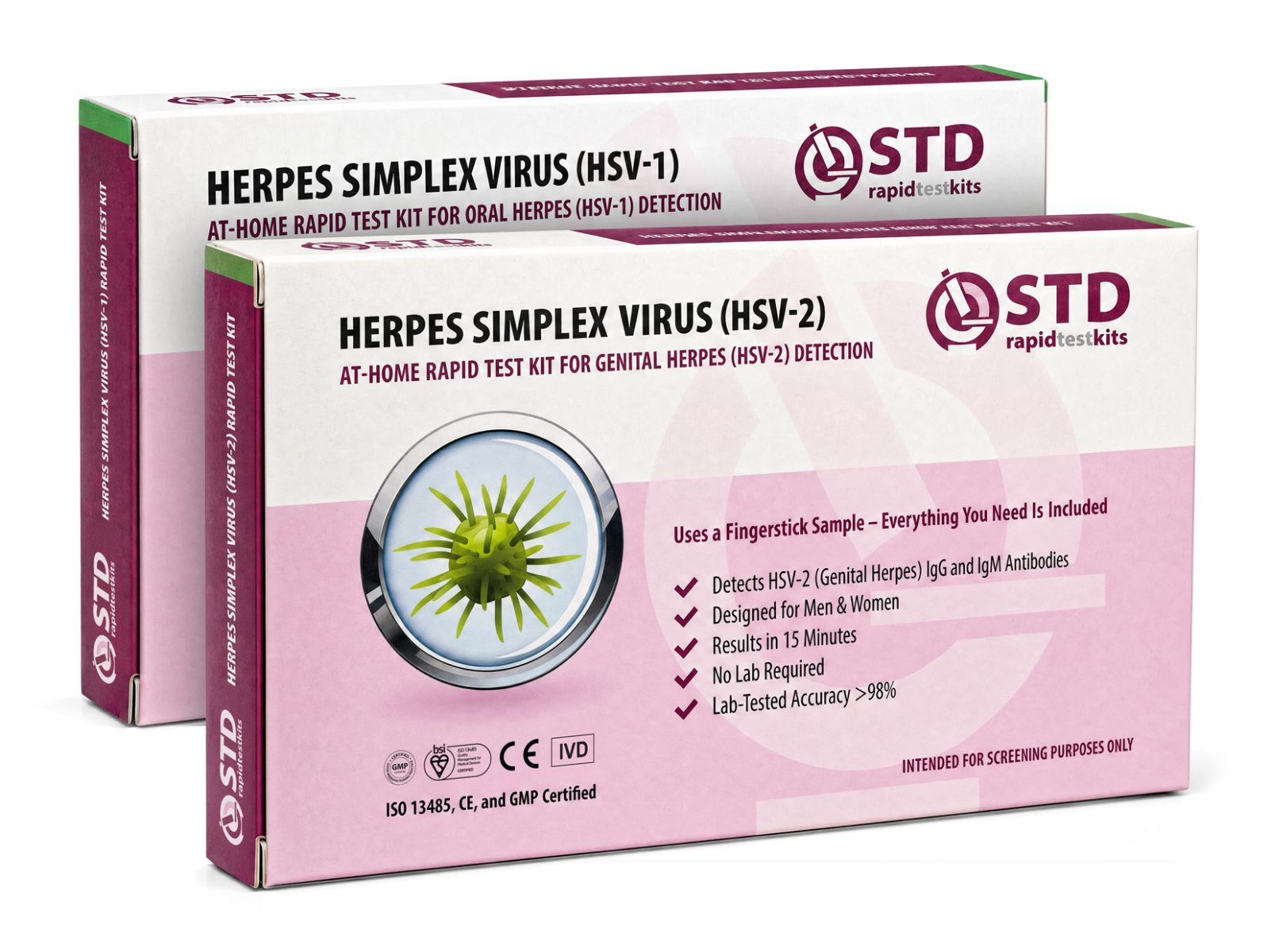
At-home rapid herpes tests use the same underlying biology as laboratory blood antibody tests. A fingerstick draws a small blood sample, a lateral-flow assay checks for HSV antibodies, and a result appears within minutes. These are screening tests. A positive result is worth confirming with a laboratory immunoassay before major decisions about treatment or partner notification.
Because at-home tests are blood antibody tests, they fit one specific situation well and another situation poorly. When at-home blood testing is the right tool: you have no current symptoms, you want to know your status after a possible past exposure, it has been at least 12 weeks since that exposure, and you want a private result without booking a clinic appointment. When at-home blood testing is the wrong tool: you have an active sore today (a clinic PCR swab is what answers that question), the exposure was within the last few weeks (you are still inside the window period), or you need to distinguish oral from genital infection (blood antibodies cannot do that).
Our rapid home herpes test is a fingerstick blood antibody test, not a lesion swab. It detects long-term immune response to HSV-1 and HSV-2. It is most useful 12 or more weeks after a suspected exposure when you want a private status check. For an active visible sore, a clinic-administered PCR swab is the more accurate tool, and we recommend that over our kit for that specific situation.
Which herpes test should I take right now?
If you have a visible sore today, a clinic-collected PCR swab is the most accurate option. If you have no symptoms and your possible exposure was more than 12 weeks ago, an at-home or clinic blood antibody test fits. If the exposure was within the last few weeks, wait until at least the 12-week mark before testing. Choosing by your timeline, not by convenience, prevents the most common false-negative result.
False Negatives Happen on Both Sides
A negative result that is not really negative is one of the most common testing problems with herpes. It happens with both swab and blood testing, for different reasons.
Swab false negatives mostly come from late sampling. The lesion has started healing, viral shedding has dropped, and there is not enough HSV DNA in the sample for PCR to amplify reliably. They can also come from collection technique, where the swab does not contact the most active part of the lesion.
Blood antibody false negatives mostly come from early testing. The antibody response has not built yet, so even a sensitive assay has nothing to find. A retest at the 12-week mark after exposure usually clarifies the picture, per standard clinical guidance on type-specific serology.
If your symptoms strongly suggest herpes but a test came back negative, that is not the end of the conversation. It usually means you tested at a moment when that particular test could not see what was happening.
| Test type | Why a false negative happens | How to address it |
|---|---|---|
| PCR swab | Sampled late, lesion already crusting; or swab missed the active edge of the lesion | Swab the next active lesion early; consider a clinical exam |
| Blood antibody test | Tested before seroconversion (antibodies not yet at detectable levels) | Retest at the 12-week mark after the suspected exposure |
A Decision Guide Based on Your Timeline
The right test depends on three things: do you have a visible sore right now, has enough time passed since exposure for antibodies to form, and do you have access to a clinic for PCR sampling. Matching those three variables to a test is the entire game.
| Your situation | Best test | Where to get it |
|---|---|---|
| Active visible lesion today | PCR swab of the lesion | Sexual-health clinic, urgent care, primary care |
| No symptoms, exposure 12 or more weeks ago | Blood antibody test | At-home kit or clinic |
| No symptoms, exposure under 3 weeks ago | Wait, then test | Plan a blood test at the 12-week mark |
| Active lesion plus you want long-term status | PCR swab now, blood test 12 weeks later | Both, in sequence |
| Lesion already healed before you could test | Blood antibody test at the 12-week mark | At-home kit or clinic |

When Both Tests Together Make Sense
The cleanest answer-set usually comes when both tests are used at the right moments rather than as substitutes for each other. Someone notices a lesion, gets a PCR swab during the active phase to identify whether the lesion itself is HSV, and then takes a blood antibody test about 12 weeks later to confirm whether IgG antibodies have established. The PCR answers what this sore is today. The blood test answers whether the immune system has processed an HSV infection.
This layered approach is also useful when a PCR swab comes back negative despite suspicious symptoms. Per CDC treatment guidance, type-specific blood antibody testing can help clarify diagnosis in those cases by confirming or ruling out past exposure.
1. Active lesion: book a clinic visit for a PCR swab the same week the sore appears.
2. Follow-up: a blood antibody test at the 12-week mark after the exposure to confirm seroconversion.
What to Do Next, in Plain Terms
If you have a visible sore right now, the most useful step is a same-week clinic visit for a PCR swab. The earlier in the lesion cycle the sample is collected, the higher the test sensitivity. Do not wait for the sore to look worse before getting it tested.
If you have no symptoms but a possible exposure within the last few weeks, the most useful step is to wait. Mark a date 12 weeks from the exposure on your calendar and plan a blood antibody test for that date. Testing earlier is more likely to mislead than to inform.
If you have no symptoms and the exposure was more than three months ago, a blood antibody test (at home or at a clinic) will give a meaningful answer about your HSV-1 and HSV-2 antibody status. A positive result indicates exposure at some point; a laboratory confirmation immunoassay is the standard follow-up before any treatment or partner-notification decisions.
- Active sore today: book a clinic visit this week for a PCR swab.
- Possible exposure under 3 weeks ago, no symptoms: wait, then test at 12 weeks.
- Possible exposure 12+ weeks ago, no symptoms: an at-home blood antibody test will give a meaningful result.
Frequently asked questions
- Can a blood test miss herpes?
- Yes, especially in the first 12 weeks after exposure. The blood test looks for IgG antibodies, and your immune system needs time to produce them at detectable levels. Per CDC guidance, most people seroconvert by the 12-week mark, so a negative result before that window has limited reliability. A retest at 12 weeks is the standard next step if symptoms or exposure suggest infection.
- How accurate is an at-home herpes blood antibody test?
- Sensitivity and specificity figures vary by manufacturer and assay; check the specific product's instructions-for-use for validated performance data. Across the category, modern lateral-flow HSV IgG assays perform well after the appropriate window period. Used too early, even a high-sensitivity test can return a false negative because there are simply no antibodies to detect yet.
- Should I take a blood test if I have a sore right now?
- For an active sore, a clinician-collected PCR swab of the lesion is significantly more useful. It tests the lesion itself rather than your long-term immune memory, and it gives information about what is happening today. A blood test can still be helpful 12 weeks later to confirm seroconversion, but it should not replace swabbing the active sore.
- What is the difference between HSV-1 and HSV-2 testing?
- HSV-1 and HSV-2 are related but distinct viruses. HSV-1 is most commonly associated with oral herpes (cold sores) but can also cause genital infection. HSV-2 is most commonly associated with genital herpes. Type-specific antibody tests distinguish between the two by detecting antibodies that bind to HSV-1 specific or HSV-2 specific proteins.
- Can I test for herpes without symptoms?
- Yes, and that is one of the main reasons blood antibody testing exists. Many HSV infections are asymptomatic or produce symptoms mild enough to be mistaken for something else. Type-specific IgG antibody testing can identify past exposure even with no current outbreak. Timing still matters: at least 12 weeks after the suspected exposure for a reliable result.
- Why does a blood test not tell me where I have herpes?
- Antibodies circulate in your bloodstream throughout your body, so a blood test detects systemic immune response, not the specific anatomical site of infection. The test can confirm HSV-1 or HSV-2 exposure but cannot distinguish oral, genital, or other site of infection. Determining anatomical site usually requires a clinical exam and lesion-based testing during an outbreak.
- How long should I wait after exposure before a blood test?
- Clinical guidance uses the 12-week mark as the standard reference point for reliable HSV antibody detection. Testing at 12 weeks gives the most reliable result for most people. Some take slightly longer to seroconvert, so an indeterminate or borderline result is sometimes worth a follow-up test a few weeks later.
- What if my symptoms disappear before I can get a swab?
- The swab window has closed for that outbreak, but a blood test taken at the 12-week mark after the suspected exposure can still confirm whether your immune system has produced HSV antibodies. If outbreaks recur, the next active lesion is another opportunity for PCR swab confirmation.
- U.S. Centers for Disease Control and Prevention. Sexually Transmitted Infections Treatment Guidelines, genital HSV section, on PCR sensitivity and the role of type-specific serologic testing.
- U.S. Centers for Disease Control and Prevention. Herpes overview and at-a-glance fact sheet, supporting the general background on HSV-1 and HSV-2 epidemiology.
- World Health Organization. Herpes simplex virus fact sheet, supporting global epidemiology and the general clinical picture of HSV-1 and HSV-2.
- Mayo Clinic. Genital herpes symptoms and causes overview, supporting lesion appearance and the rationale for sampling during active outbreaks.
- UK National Health Service. Genital herpes overview and diagnosis guidance, supporting clinical-exam and swab-collection best practice.
