Published: June 2025 | Last updated: May 2026 | Editorial review and quality control: Martina N.
Is there a real difference between STI and STD?
STI describes a sexually transmitted pathogen in the body, often with no symptoms. STD describes an infection that has progressed to symptoms or measurable tissue damage. Most clinicians and public health agencies default to STI because most cases never reach the disease stage. Testing and treatment depend on the specific organism, not which acronym appears on the result.
A text from a past partner reads: "Hey, just letting you know, I tested positive for an STI." The first reaction is usually a pause, then a quick mental loop. Is STI the same thing as STD? Did they pick the gentler word on purpose? Should the message land differently than if it had said STD?
That loop is familiar to plenty of readers. Public health agencies have spent the last two decades shifting from "sexually transmitted disease" to "sexually transmitted infection," and the change has rippled through clinics, dating apps, and news headlines without anyone sending a clear memo. The single letter swap, I instead of D, has shaped public-health messaging and changed reader behavior: when people test, how they tell partners, whether they avoid clinics altogether.
This article is published by stdrapidtestkits.com, which sells at-home rapid STI testing kits. We recommend kits based on fit for the reader's concern, not commercial benefit; if you need a test type we do not sell, we say so plainly.
Key takeaways
- STIs are among the most common infections in the United States, affecting tens of millions of people each year per CDC surveillance data. Most are silent for weeks or months, which is why symptom-based testing misses most cases and public-health agencies recommend screening on a schedule rather than waiting for something to feel wrong.
- Catching an infection early usually prevents the disease that follows: untreated chlamydia can cause pelvic inflammatory disease and infertility; untreated syphilis can damage the nervous system; persistent high-risk HPV can drive cancer over years.
The Real Difference: Infection vs Disease
STI and STD are not strict synonyms, even though they appear interchangeably online and on insurance forms. The cleanest way to read them: an STI is the presence of a sexually transmitted pathogen in the body, with or without symptoms. An STD is what we call it once that pathogen has caused recognizable illness, tissue damage, or measurable disease.
The CDC and WHO have moved toward STI as the umbrella term in their public-facing guidance for two reasons. First, most STIs are asymptomatic for long stretches; calling everything a "disease" wrongly implies that a person is only worth testing once they feel sick. By that point, transmission and complications have often already happened. Second, the older framing carries moral weight that the newer framing does not. "Infection" is what you call strep throat, ear infections, and bladder infections. The word does the work of normalizing testing.
The order is always infection first, disease second (if at all). A person picks up Chlamydia trachomatis from sexual contact. The bacteria colonize cervical, urethral, or rectal tissue and start replicating. At this stage, the person has a chlamydia infection. They may feel completely fine. If the infection ascends to the upper reproductive tract and causes pelvic inflammatory disease, that is the moment infection graduates to disease.
Practically: most lab forms still code STIs as STDs because billing software has not caught up. The pathogen and the test are the same. Focus on what is actually being looked for, not the abbreviation on the requisition slip.
| Aspect | STI (infection) | STD (disease) |
|---|---|---|
| What it describes | Pathogen present in the body, multiplying or dormant | Pathogen has caused recognizable symptoms or tissue damage |
| Symptoms required? | No, often silent for weeks or months | Yes, or measurable damage on exam or imaging |
| Reversibility | Often fully curable (bacterial, parasitic) or fully managed (viral) | Some damage may be permanent (PID-related infertility, neurological syphilis, cancer from persistent HPV) |
| Testing relevance | Most transmissions happen here. Screening on a schedule catches it. | Treatment focus shifts from cure to damage control and follow-up |
| Examples | Chlamydia before symptoms, asymptomatic gonorrhea, latent syphilis, asymptomatic HPV | Pelvic inflammatory disease from chlamydia, late-stage syphilis, AIDS, cervical dysplasia |
How an Infection Becomes a Disease
Not every STI graduates into a full STD. Whether it does depends on three things: the pathogen, how long it stays untreated, and the host's immune response.
Untreated chlamydia is the textbook example. Most people who acquire Chlamydia trachomatis have no symptoms in the first weeks. If the bacteria reach the upper reproductive tract, they can cause pelvic inflammatory disease, scar fallopian tubes, and lead to infertility or ectopic pregnancy. The infection is curable with a short course of antibiotics; the disease that follows is often not fully reversible. The same logic applies to gonorrhea.
HPV behaves differently. Most genital HPV infections clear on their own within roughly two years, with the CDC's HPV page reporting that about 9 in 10 infections resolve without health problems in that window (CDC: About Genital HPV Infection). Persistent high-risk strains, however, can drive cervical, anal, oropharyngeal, and penile cancers over years. Syphilis stages itself in a recognizable arc: a painless chancre, then a secondary rash, then a long latent phase that can end in cardiovascular or neurological disease decades later.
The shared lesson: catching the infection early often prevents the disease entirely. That is the practical reason public-health agencies want people testing on a schedule, not just when something hurts.
A test inside the right window, even an at-home rapid screen, is more useful than a perfect lab test you delay because the clinic is across town or the appointment is three weeks out. Speed of testing reduces the time the pathogen has to do damage and to spread. An at-home screen taken this week beats a perfect clinic test booked for next month, especially for infections where every extra week of undetected spread matters for treatment options and onward transmission.
Bacterial vs Viral: The Distinction That Actually Affects Treatment
If there is a clinical divide worth understanding more than STD versus STI, it is bacterial versus viral. The treatment course, prognosis, and long-term management of any sexually transmitted condition hinge on this split far more than on which acronym appears on the result slip.
Bacterial and parasitic STIs (chlamydia, gonorrhea, syphilis, trichomoniasis) are caused by living organisms that respond to a defined course of antibiotics or antiparasitics. The CDC's STI treatment guidelines specify the medication, dose, and duration for each: doxycycline or azithromycin for chlamydia, an intramuscular ceftriaxone injection (with combinations adjusted for emerging resistance) for gonorrhea, penicillin G across all stages of syphilis, and metronidazole or tinidazole for trichomoniasis. Follow-up testing confirms clearance. A positive bacterial test is rarely a long-term identity: it is a discrete medical event with a treatment endpoint, a partner-notification step, and a re-test on a known schedule.
Viral STIs (HIV, HSV-1, HSV-2, HPV, hepatitis B, hepatitis C) behave differently. Antivirals suppress activity and reduce symptoms and transmission risk, but most viral STIs are managed long-term rather than cured. Hepatitis C is the notable exception, now considered curable in most patients with direct-acting antiviral regimens. HIV is well-managed with antiretroviral therapy that can reduce viral load to undetectable levels, which also prevents sexual transmission. HPV is its own pattern: most infections clear without treatment, while persistent high-risk strains are the cancer-risk subset.
This split changes the meaning of a positive result. A positive chlamydia or gonorrhea test is a one-time conversation about completing a defined treatment course. A positive HSV-2 or HIV test is a longer conversation about ongoing management and partner protection. Each path is workable; the timelines differ. A rapid kit that only checks for one family of pathogens leaves the other invisible, which is why a multi-infection panel is usually the right shape for a recent exposure where you are uncertain what to test for.
| Family | Examples | Curable? | At-home rapid kit available |
|---|---|---|---|
| Bacterial | Chlamydia, gonorrhea, syphilis | Yes, with antibiotics if caught in time | Yes, all three |
| Viral | HIV, HSV-1, HSV-2, HPV, hepatitis B, hepatitis C | Most are managed long-term; hepatitis C is now considered curable in most patients with direct-acting antivirals | Yes for HIV, HSV, hepatitis B and C. HPV at-home rapid kit is validated for vaginal self-swab only (women). |
| Parasitic | Trichomoniasis, pubic lice, scabies | Yes, with targeted medication | Trichomoniasis at-home rapid kit is validated for vaginal self-swab only (women) |
By the Numbers: How Common Are STIs Really?
A large part of the stigma around STIs comes from an assumption that they are rare and that getting one says something about a person's judgment. The data does not back that assumption.
The CDC's STI surveillance data shows sexually transmitted infections are among the most common infections in the United States, affecting tens of millions of people each year (CDC STI overview). A large share of people who are currently infected do not know it.
A few patterns from CDC surveillance help reset the perception:
- HPV is the most common STI in the U.S.; about 9 in 10 infections clear on their own within two years (CDC: About Genital HPV Infection). The prevalence is high precisely because exposure is routine for sexually active adults.
- Chlamydia is the most reported bacterial STI in the U.S., with well over a million reported cases each year per the CDC's annual STI surveillance reports. Most early-stage cases produce no symptoms.
- Syphilis cases in the U.S. have risen substantially over the past decade, with the CDC reporting increases across multiple population groups, prompting renewed public health focus on routine testing and partner notification.
- Gonorrhea cases have followed a similar upward trend, with treatment becoming more complex as antibiotic resistance evolves.
None of these numbers make any individual diagnosis less stressful in the moment. They do change the question the diagnosed person is sitting with, from "what does this say about me?" to "how do I handle this medically?" Many millions of people are handling it right now, most of them quietly.
More than 1 million curable sexually transmitted infections (STIs) are acquired every day worldwide in people 15-49 years old, the majority of which are asymptomatic.
Why the Word Choice Affects Testing Behavior
Stigma is a measurable barrier to care, not just a feelings issue. Public health research on STI testing consistently shows that perceived stigma delays testing and treatment. People wait longer to come in, skip partner notification, and convince themselves a symptom is something else, a urinary tract infection or a friction issue or an allergic reaction, until weeks pass and the infection has time to spread or progress. That delay is not laziness. It is the predictable cost of growing up in a culture that frames STIs as moral verdicts rather than common medical events.
The word patients hear at first contact with the system shapes whether they come back. Asking for an "infection screen" is socially easier than asking for a "disease test," and that lower friction matters for routine, repeat testing. The CDC's modeling for HIV indicates that a substantial share of new transmissions trace back to people who do not know they are positive; the same pattern is well documented for chlamydia and gonorrhea.
This is the practical reason most providers, public-health agencies, and medical schools have moved to STI as the default. STD is not wrong; it is narrower. Most rapid-screening kits, including the lateral-flow tests we sell, look for an infection whether or not it has progressed to disease. The aim is to catch the pathogen at the stage where treatment is shortest and consequences are smallest. Shame from a positive result is a conditioned cultural response. The medical treatment path runs on its own schedule regardless.
Testing Windows: When Each Test Can Find What
Every STI has a window period: the gap between exposure and the moment a test can reliably detect the infection. Test too early and you can get a false negative because the pathogen has not yet replicated or triggered an antibody response. Wait too long after symptoms and you may miss the optimal treatment window.
The exact window depends on the infection and on what the test is looking for: live organism (swab), viral or bacterial genetic material (NAAT, nucleic acid amplification test, or PCR), antigen (rapid lateral flow for some pathogens), or antibody (rapid lateral flow for HIV, syphilis, HSV).
| Infection | Earliest reliable test window | Conclusive window | What home rapid kits use |
|---|---|---|---|
| Chlamydia | About 1 to 2 weeks after exposure | 2 weeks (lab NAAT confirms) | Self-collected genital swab, lateral-flow |
| Gonorrhea | About 1 to 2 weeks after exposure | 2 weeks (lab NAAT confirms) | Self-collected genital swab, lateral-flow |
| Trichomoniasis | 1 to 2 weeks | About 1 month | Self-collected vaginal swab, lateral-flow (women only) |
| HIV (4th-generation lab antigen-antibody) | About 18 days | 45 days for most, 90 days conclusive | Not used at home. Lab clinic test only. |
| HIV (home rapid antibody) | About 6 weeks | 12 weeks (with retest at 12 weeks for definitive antibody result) | Fingerstick blood, lateral-flow antibody |
| Syphilis | 3 to 6 weeks (antibody) | 90 days | Fingerstick blood, lateral-flow antibody |
| HSV-2 (antibody) | 6 to 8 weeks | 12 weeks (most patients); up to 16 weeks with specific IgG assays | Fingerstick blood, lateral-flow antibody |
| Hepatitis B | 3 to 6 weeks (HBsAg) | 9 weeks | Fingerstick blood, lateral-flow |
| Hepatitis C | 8 to 11 weeks (antibody) | 6 months | Fingerstick blood, lateral-flow antibody |
At-Home Testing vs Clinic Testing
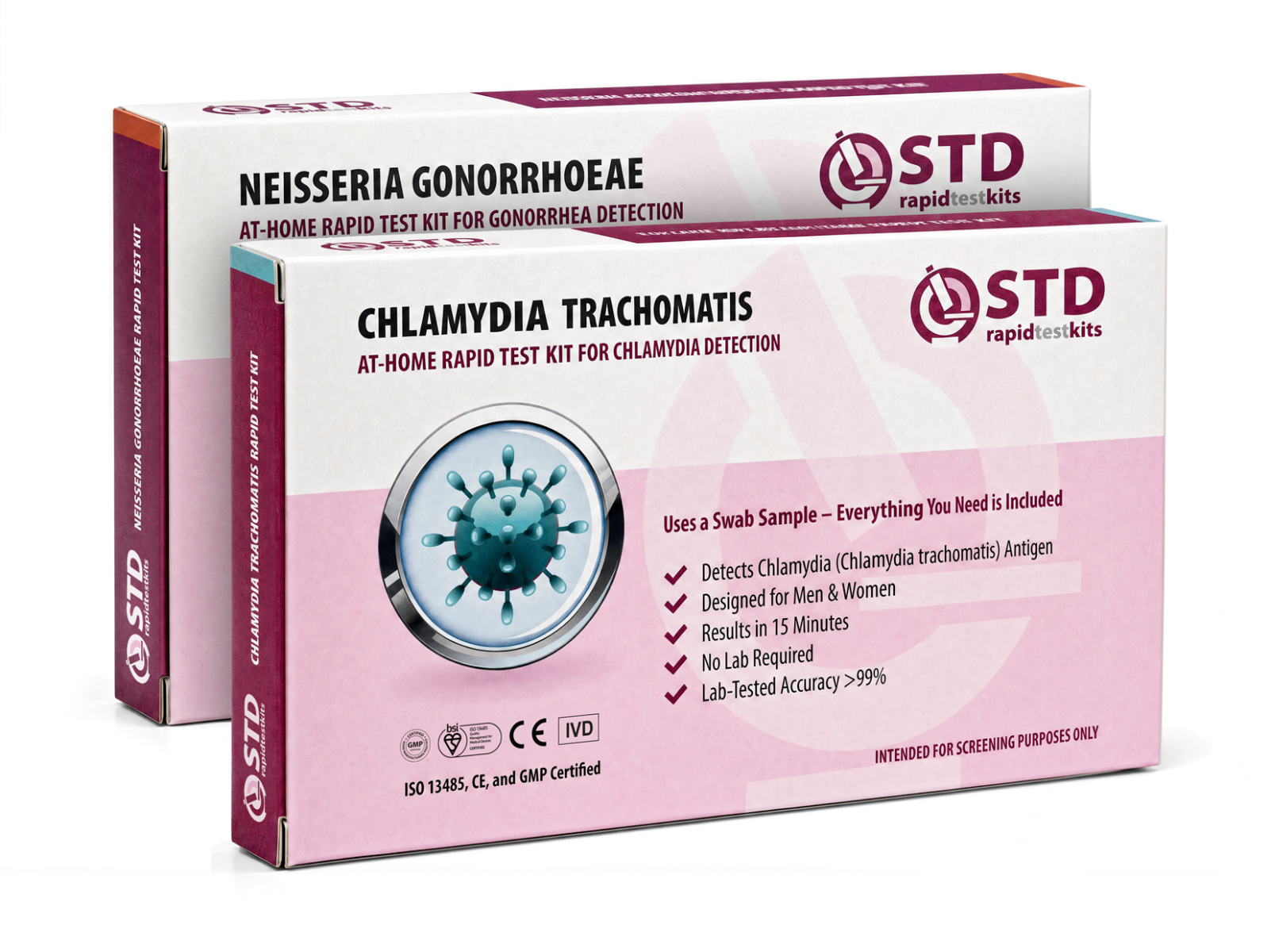
Home test kits, like the rapid lateral-flow cassettes we sell, are designed for screening, privacy, and speed. They use a self-collected swab or fingerstick blood sample and read results in about 15 minutes using lateral-flow chemistry. They are not the same technology as a laboratory NAAT or PCR, and the practical implications are worth spelling out.
For chlamydia and gonorrhea, lab NAAT remains the analytic gold standard, with the highest published sensitivity, especially in asymptomatic infections. The home rapid test is a fast, private screening tool that uses the same swab sample type as a lab NAAT, but the chemistry differs. The two are complementary, not equivalent. A positive at-home result is worth confirming at a clinic: most providers will retest and then prescribe, and most state health departments require an official lab result for the reportable infections (HIV, syphilis, gonorrhea, chlamydia).
The advantage of home testing is timing and friction. If embarrassment, distance from a clinic, or a chaotic schedule would otherwise delay you for a week or two, an at-home STI test kit gives you a screening result in 15 minutes and a clear next step. For a known exposure where you want to cover the most common screening pair first, a chlamydia and gonorrhea combo swab is the standard starting point.
Prevention Beyond Condoms
Condoms reduce but do not eliminate STI transmission. Skin-to-skin pathogens like HPV and herpes can spread from areas a condom does not cover, and condoms are only as effective as their consistent and correct use. A layered approach works better than relying on any single barrier:
- Vaccines. The HPV vaccine is recommended through age 26 for routine catch-up vaccination, with shared clinical decision-making for some adults aged 27 to 45 (CDC HPV vaccines page). Hepatitis B vaccination is a standard three-dose series and is available to adults at any age.
- PrEP (pre-exposure prophylaxis). Daily oral or long-acting injectable medication that the CDC says greatly reduces the chance of getting HIV from sex or injection drug use when taken as prescribed (CDC PrEP page).
- Doxy-PEP (doxycycline post-exposure prophylaxis). A 200 mg dose of doxycycline taken within 72 hours of condomless sex reduces bacterial STIs (chlamydia and syphilis substantially, gonorrhea more modestly) in men who have sex with men (MSM) and trans women. The CDC issued formal clinical guidelines for doxy-PEP in December 2024 (CDC doxy-PEP guidance).
- Routine screening. The US Preventive Services Task Force recommends chlamydia and gonorrhea screening for sexually active women 24 and younger, with frequency based on risk-factor assessment since the last negative test. The CDC separately recommends at least annual screening for sexually active women under 25, and at least annual screening for MSM with site-specific testing where anatomical exposure warrants it.
No single tool stops every STI. Condoms cut fluid-borne transmission. Vaccines lock out HPV and hepatitis B. PrEP handles HIV. Routine screening catches the silent infections before they cause damage. Stack the layers that fit your situation, and review the stack when your situation changes (new partner, pregnancy planning, switching to non-monogamy).
Partner Notification: An Awkward Conversation, Done Right
If you test positive, partners need to know. This is uncomfortable, sometimes legally required (in many U.S. states for HIV, syphilis, and a few others), and ethically expected for the rest. Anonymous notification services (TellYourPartner.org and the CDC's TellYourContacts) let you send a heads-up without identifying yourself if you would prefer.
What to include in the conversation:
- The specific infection, so they know which test to ask for.
- The approximate exposure window, so they can choose the right timing.
- A practical next step, often a clinic referral or an at-home rapid kit they can order privately.
For bacterial infections, recent partners typically means anyone in the past three to six months; for viral infections, the relevant window is often longer. For chlamydia and gonorrhea specifically, expedited partner therapy (EPT) is legal in most states. A clinician can prescribe antibiotics for the partner without an in-person exam. EPT meaningfully reduces re-infection rates, which protects you as much as your partner. Where the exposure event was broader (multiple partners, unknown status, mixed sex acts), a multi-infection panel covers more ground in one collection than chasing each pathogen separately.
Pregnancy, LGBTQ+ People, and Older Adults
Standard screening advice shifts meaningfully for pregnant people, MSM, and adults over 55.
Pregnancy. Untreated syphilis crosses the placenta and causes congenital syphilis, which has surged in the U.S. for several consecutive years. The CDC recommends syphilis, HIV, hepatitis B, and hepatitis C testing starting early in pregnancy, with repeat screening for higher-risk patients later in pregnancy and at delivery (CDC STI testing page). The 2021 CDC STI Treatment Guidelines recommend syphilis screening at multiple points during pregnancy for higher-risk patients; see your provider or the CDC STI guidance for the current schedule.
Men who have sex with men. The CDC recommends at least annual screening for chlamydia, gonorrhea, syphilis, and HIV, with site-specific testing (rectal, pharyngeal, urethral) where exposure has occurred. Our at-home rapid kits cover the genital and bloodwork side of an exposure event; we do not sell pharyngeal or rectal swab tests. If your specific exposure was oral or anal, a clinic providing site-specific NAAT testing is the right step, and our kits can still cover the adjacent genital and blood-based screening from the same exposure.
Adults 55 and older. Reported chlamydia and gonorrhea rates in this age group have risen sharply since 2015, partly because routine STI screening often falls off the radar after age 50 even when sexual situations change. Medicare Part B covers an annual HIV screen; ask your provider about adding chlamydia, gonorrhea, and syphilis to the panel if your situation has shifted (new partner, divorce, dating apps).
Per the 2021 CDC STI Treatment Guidelines, syphilis is screened at multiple points during pregnancy for higher-risk patients, generally at the first prenatal visit and again later in pregnancy and at delivery. The expanded screening schedule is a direct response to rising congenital-syphilis rates. Confirm the current schedule with your provider, since state-level recommendations sometimes go further than the federal baseline.
Bottom Line
Swap one letter, shift the framing. Calling a condition an infection rather than a disease keeps the focus on the stage where treatment is shortest, complications are smallest, and shame is lowest. Most STIs are quiet for weeks; most damage happens in that quiet window. The clinical distinction that matters more than STD versus STI is bacterial versus viral, because that decides whether you complete a one-time treatment course or move into longer-term management. Routine testing, layered prevention, and honest partner conversations are what shrink the gap between transmission and treatment. If anxiety from a recent exposure is driving you, an at-home rapid test inside the right window can give you a starting answer in 15 minutes; a clinic confirms whatever the home test surfaces.
Which test fits your situation right now?
Was there a known sexual exposure within the past 2 weeks, and you currently have no symptoms?
Yes: Start with the chlamydia and gonorrhea combo swab now (the two infections with the shortest reliable detection window). If the exposure was broader, plan a bloodwork panel at 6 weeks for HIV, syphilis, and hepatitis B/C.
Has it been more than 6 weeks since exposure, or the situation involved multiple partners or unknown status?
Yes: Run a 6-in-1 multi-infection panel so one collection covers the most common bacterial and viral targets together (chlamydia, gonorrhea, HIV, syphilis, hepatitis B, hepatitis C).
Did your at-home rapid test return a positive result?
Yes: Photograph the cassette, book a clinic confirmation within a week, complete any prescribed treatment, and notify recent partners with the specific infection name so they can test on the right window.
No: If symptoms develop or you remain concerned, re-test at the conclusive window listed in the testing-windows table above (varies by infection).
Guidance for the most common scenarios. A licensed provider can tailor this to your specific history.
Two things to take with you
- Catch the infection before it becomes a disease. Test on a schedule, not on symptoms, since the disease stage is where the permanent damage happens.
- Know whether your concern is bacterial or viral. Both are medically manageable: bacterial infections resolve with a defined antibiotic course, while viral infections are controlled with long-term suppression. What you do next is decided by the pathogen, not the acronym on the result.
Frequently asked questions
- What's the practical difference between STI and STD?
- The gap is timing. STI names the pathogen from the moment it enters the body, and most cases involve no symptoms yet. STD applies once that pathogen has caused recognizable illness or measurable tissue damage. Public-health agencies default to STI because that is the stage where treatment is easiest and where most onward transmission actually happens.
- Why do so many websites and clinic forms still say STD if STI is more accurate?
- Two reasons. First, search behavior: the older term has decades of momentum and is what most people type into Google, so websites use STD in titles and product copy to match what readers actually search for. Second, billing software and many state health-department codes were built around the older terminology and have not been updated. The underlying tests, treatments, and reportable-disease rules are identical regardless of the heading.
- Does a clinic or insurer charge anything differently based on whether it's labeled STD or STI testing?
- No. Lab analysis is identical. Insurance coverage depends on the specific tests ordered and your plan, not on whether the panel is labeled STD or STI. For at-home rapid kits, the per-organism accuracy depends on the kit and the test technology, not the marketing language above the product name.
- If I have no symptoms, do I still need to test?
- Yes. A large share of chlamydia, gonorrhea, trichomoniasis, and HPV infections are asymptomatic in the early weeks. Symptom-driven testing misses most cases. The CDC and USPSTF recommend routine screening on a schedule based on age, sex, and partner situation, not based on whether something hurts.
- Can an STI become an STD over time?
- Yes, and that is the central reason to test before symptoms appear. An asymptomatic chlamydia infection can progress to pelvic inflammatory disease. Untreated syphilis can advance through stages that affect the heart and nervous system. Untreated hepatitis B can become chronic and cause liver disease. Early detection routinely prevents the infection-to-disease transition.
- Are home rapid tests as accurate as clinic tests?
- For chlamydia and gonorrhea, lab NAAT is more analytically sensitive, especially in asymptomatic cases. Home lateral-flow kits are fast and private, but they are a screening first step, not a final answer. Confirm any positive result at a clinic, and be aware that a very early test can still miss a fresh infection even with a negative read. Sensitivity varies by pathogen and product; check each kit's instructions for use for the published figures.
- How long after exposure should I test?
- If you are uncertain which STI to test for: 2 weeks covers chlamydia and gonorrhea, 6 weeks is the earliest useful window for syphilis and the home HIV antibody test, and 6 to 8 weeks is the earliest window for HSV-2 antibody (most patients seroconvert by 12 weeks, with some assays needing up to 16 weeks). When in doubt, test once at the earliest window and repeat at the conclusive window if still concerned. The testing-windows table above gives per-infection detail.
- Can an STI cause permanent damage?
- Some can if untreated. Untreated chlamydia and gonorrhea can lead to pelvic inflammatory disease and infertility. Untreated syphilis can cause neurological and cardiovascular complications. Persistent high-risk HPV can drive cervical, anal, and oropharyngeal cancers over years. Most of these outcomes are preventable with timely testing and treatment.
- If I test positive at home, what happens next?
- Take a photo of the result, then book a clinic confirmation. The clinic runs a lab test, prescribes treatment if positive, and supports partner notification. State health departments require official lab results for the reportable STIs (HIV, syphilis, gonorrhea, chlamydia).
- How often should I screen if I'm in a long-term mutually monogamous relationship?
- After both partners have tested negative inside their conclusive windows, routine screening can drop unless circumstances change: a new partner, planning a pregnancy, new symptoms, or a switch away from mutual monogamy.
- U.S. Centers for Disease Control and Prevention. Sexually transmitted infections (STIs) overview, including current default terminology and surveillance framing of STIs as among the most common infections in the United States.
- U.S. Centers for Disease Control and Prevention. About Genital HPV Infection, used for the 9-in-10 clearance rate of new genital HPV infections within two years.
- U.S. Centers for Disease Control and Prevention. STI testing recommendations, including pregnancy-screening guidance and routine annual screening intervals.
- U.S. Centers for Disease Control and Prevention. Clinical Guidelines on the Use of Doxycycline Post-exposure Prophylaxis for Bacterial STI Prevention, issued December 2024.
- U.S. Centers for Disease Control and Prevention. PrEP information used for the HIV-prevention section, including the agency's 'greatly reduces' framing.
- World Health Organization. Sexually transmitted infections (STIs) fact sheet, including the daily acquisition figure for curable STIs and the asymptomatic-transmission framing.
- US Preventive Services Task Force. Recommendation: Chlamydia and Gonorrhea Screening (used for risk-factor-based screening guidance in women 24 and younger).
- U.K. National Health Service. Overview of sexually transmitted infections (STIs) for general public reference.
