
Published: October 2025 | Last updated: May 2026 | Editorial review and quality control: Martina N.
Sexually transmitted infections hit harder in the military than in the matched civilian age band, and the Department of Defense has been tracking the gap for two decades. The active force skews young, moves often, and works in conditions that disrupt continuity of care. None of that makes the question complicated, but it does make the answer specific.
This guide walks through what the military will test you for and when, what Tricare covers, what enters your record, what affects deployability, and when an at-home test is the right call instead of the base clinic. Bottom line first: most STIs are curable, and most do not end careers. The privacy questions have answers that are more nuanced than rumor suggests. Read the relevant section and use the FAQ at the end for the specific scenario you are weighing.
This article is published by stdrapidtestkits.com, which sells at-home STI testing kits. We recommend products based on fit-for-purpose for the reader's concern, not commercial benefit.
Do STDs end a military career?
Most do not. Curable bacterial infections like chlamydia, gonorrhea, syphilis, and trichomoniasis are treated and you remain deployable. HIV triggers a medical evaluation board and restricts certain assignments, but per <a href="https://www.health.mil/">DoD policy revised in 2018</a>, it is no longer an automatic discharge. Routine HIV screening at accession and before deployment is mandatory; testing outside those touchpoints, including at-home options, is your decision.
Key takeaways
- Chlamydia and gonorrhea are the top two reportable STIs across active-duty branches every year, with female service members under 25 testing positive at roughly twice the rate of their male peers in Defense Health Agency surveillance.
- Tricare fully covers in-network STI screening and treatment with no cost-share, but a positive test in your military medical record can affect overseas assignments and security-clearance medical reviews depending on the diagnosis.
Why STD rates are higher among service members
Pull any year of the Defense Health Agency's Medical Surveillance Monthly Report and chlamydia tops the chart for reportable infections across all branches. Gonorrhea sits near the top. Syphilis has climbed steeply since 2014, tracking the civilian trend but at a faster slope on a per-capita basis.
The drivers are mostly structural rather than behavioral. The active force has a median age in the low-to-mid 20s, and that age band carries the highest STI rates in any population. Layer three structural factors on top and the gap widens:
- Frequent station changes. PCS moves, six-month deployments, and TDY rotations break up stable partnerships and create gaps where new partners enter. The pattern is well-documented in DoD survey data.
- Higher alcohol exposure than civilian peers. Most reasonable comparison studies show active-duty drinking, particularly binge drinking, exceeds the civilian peer group. Alcohol consistently lowers the probability that a condom enters the equation.
- Variable healthcare access during deployment. Care quality ranges from a ship's corpsman to a host-nation clinic two hours from base. Asymptomatic infections (which is most chlamydia and gonorrhea) get carried home untested when access is thin.
Defense Health Agency surveillance flags female service members as testing positive at notably higher rates than males. That is partly a screening artifact, since women under 25 get annual chlamydia screens under routine screening guidance and men do not, and partly a real prevention-messaging gap that DoD reviews of branch-level data have called out repeatedly.
Chlamydia has topped the active-duty reportable-infection chart every year for the past two decades, per the Defense Health Agency's <a href="https://www.health.mil/">Medical Surveillance Monthly Report</a>. Gonorrhea sits second. Both run measurably higher than rates in the matched civilian age band, with the gap widest among service members under 25. Syphilis cases across DoD have roughly doubled across multiple branches since 2014, mirroring the steep civilian rise but at a faster slope per capita.
STIs most common in the military
Members of the armed forces face the same infection mix as the general population, but the relative volume differs. The five infections below account for the vast majority of diagnoses across active-duty surveillance. Each behaves differently when it comes to symptoms, treatment, and deployability.
Chlamydia
The most reported STI in every active-duty branch every year. Most cases produce no symptoms; most damage (pelvic inflammatory disease, fertility issues, epididymitis) comes from infections that go untreated long enough to ascend the reproductive tract. Annual screening is recommended for sexually active women under 25 and for men in higher-prevalence settings, which most military environments qualify as.
Gonorrhea
Second most reported. The strain mix in service members tracks community spread, and antibiotic-resistant gonorrhea has been documented at multiple installations. Pharyngeal and rectal infections are commonly silent, which is why both CDC and DHA recommend extragenital screening for anyone with that exposure history. Note: our at-home kit covers genital sample types only; pharyngeal or rectal screening should go through the MTF or a civilian Tricare provider.
Syphilis
Rates have risen steeply across DoD since 2014, doubling in many branches over the decade. Untreated syphilis progresses through stages that get easier to miss and harder to treat as time passes. The secondary-stage rash on palms and soles is a classic presentation worth recognizing. Treatment is a single penicillin injection for primary or secondary disease; latent disease may require three weekly injections.
Genital herpes (HSV-1 and HSV-2)
Mirrors the general population: most cases are HSV-1 from oral exposure or HSV-2 from genital exposure. The infection is chronic but rarely affects fitness for duty, and outbreaks are managed with daily or episodic antiviral therapy. Note that commercial rapid antibody panels typically detect HSV-2, not HSV-1; if HSV-1 is your specific concern, the dedicated single-target test is the right tool.
HIV
HIV screening at accession is mandatory under DoD Instruction 6485.01, and personnel are re-screened periodically and before deployment. A confirmed positive triggers a medical evaluation board, but per DoD policy revised in 2018, HIV alone is no longer disqualifying for continued service. Restrictions on certain overseas assignments still apply. Modern fourth-generation antigen-antibody tests detect most infections by 45 days post-exposure; antibody-only tests typically need 90 days for reliable detection.
| Infection | How it presents in most people | Treatment | Deployment impact |
|---|---|---|---|
| Chlamydia | Asymptomatic in roughly 70% of women and 50% of men; mild discharge or pain when symptoms appear | Single-dose or 7-day antibiotic | None once treated |
| Gonorrhea | Painful urination, discharge; pharyngeal and rectal cases often silent | Combination antibiotic injection plus oral; resistance is rising | None once treated |
| Syphilis | Painless ulcer, then rash, then years of silence if untreated | Penicillin injection (1 to 3 doses by stage) | None once treated; late-stage cases may need evaluation |
| Genital herpes (HSV-1 / HSV-2) | Recurrent painful blisters; many cases asymptomatic | Daily or episodic antiviral; lifelong but manageable | Generally none; outbreaks treated |
| HIV | Often silent for years; some report flu-like illness 2 to 4 weeks after exposure | Daily antiretroviral therapy with effective viral suppression | Triggers MEB; restricts overseas postings; not an automatic discharge |
What mandatory military screening covers
The military runs a structured screening cadence that catches some infections automatically and leaves others to your initiative. Knowing the difference matters because the gaps are real.
- At accession (enlistment or commissioning): mandatory HIV test under DoD Instruction 6485.01. Some MEPS sites add hepatitis B screening; chlamydia and gonorrhea screening is not universal at accession.
- Before deployment: HIV is re-checked. Pregnancy testing for women. Other STI screening is not automatic; it is offered if you ask or if a clinical indication exists.
- Annually for women under 25: chlamydia screening per Bright Futures and DoD periodic health assessment guidance. Routine annual screening drops off after age 25 unless risk factors apply.
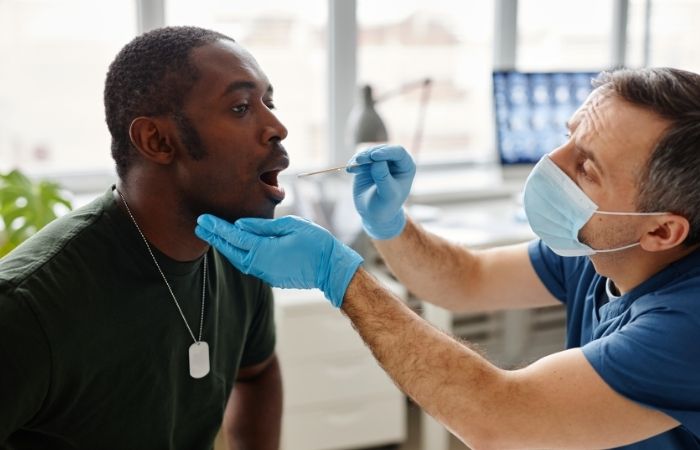
- Symptom-driven testing: at any time, you can walk into a military treatment facility (MTF) and request testing for symptoms or known exposure. Tricare covers it.
What this leaves uncovered, for a typical male service member with no symptoms: regular gonorrhea, syphilis, herpes, and HPV screening. None of those are part of routine annual physicals. If you want them, you have to ask, or you have to test on your own time.
Tricare, confidentiality, and your medical record
Tricare covers STI screening and treatment under preventive-care benefits with no cost-share when delivered by an in-network provider, including military treatment facilities and authorized civilian providers under Tricare Prime, Select, or Reserve Select. Diagnostic tests for symptoms and follow-up treatment are also covered without copay in most plans. The financial side is straightforward; the privacy side is not.
Your military medical record (AHLTA, transitioning to MHS Genesis) holds every test ordered through an MTF or Tricare-authorized civilian network. Lab results, diagnoses, prescriptions, and clinical notes all live in that record. Anyone with a legitimate need-to-know in the military health system can read it: your primary care manager, your unit's flight surgeon or battalion surgeon, the medical evaluation board if one is convened, and security-clearance investigators when they request medical information with your consent.
Most STI diagnoses do not generate command notification. Curable infections like chlamydia and gonorrhea are treated as routine medical care, and nobody picks up the phone to your platoon sergeant. Two situations change that:
- Conditions that affect readiness or deployability. Active hepatitis B with abnormal liver enzymes, untreated syphilis, or HIV all generate paperwork that flows through medical channels and may surface to your command in deployability determinations.
- Conditions that require duty restriction. A documented herpes outbreak severe enough to need a profile change (rare) or any condition that limits a deployable status will show up in your readiness data.
None of this should deter you from getting tested at the MTF if symptoms appear or if you have known exposure. The cost of an undiagnosed infection is always higher than the privacy cost of a documented test. The question is whether asymptomatic, low-suspicion screening belongs in your record at all.
Periodic reinvestigation for clearance can include medical-record review with your consent (you authorize it on the SF-86 / SF-86C). HIV diagnosis, ongoing chronic conditions, and untreated infections may be flagged. The infections themselves are rarely disqualifying. Non-disclosure on the SF-86 is the bigger risk. If you are weighing whether to test through the MTF or privately, factor your clearance posture into the decision.
When at-home testing makes sense
An at-home rapid test is a screening tool, not a substitute for clinical care. It is most useful when:
- You want a baseline read after a new partner without committing the test to your military medical record.
- You are on leave or on liberty and the base clinic is not accessible, or you would rather not start a chart entry over a routine screen.
- You want to confirm exposure timing before deciding whether to escalate to a clinical visit. A positive at-home result is your cue to walk into the MTF; a negative is reassurance that does not generate paperwork.
- You have already been treated and want a private re-check before resuming partner activity.
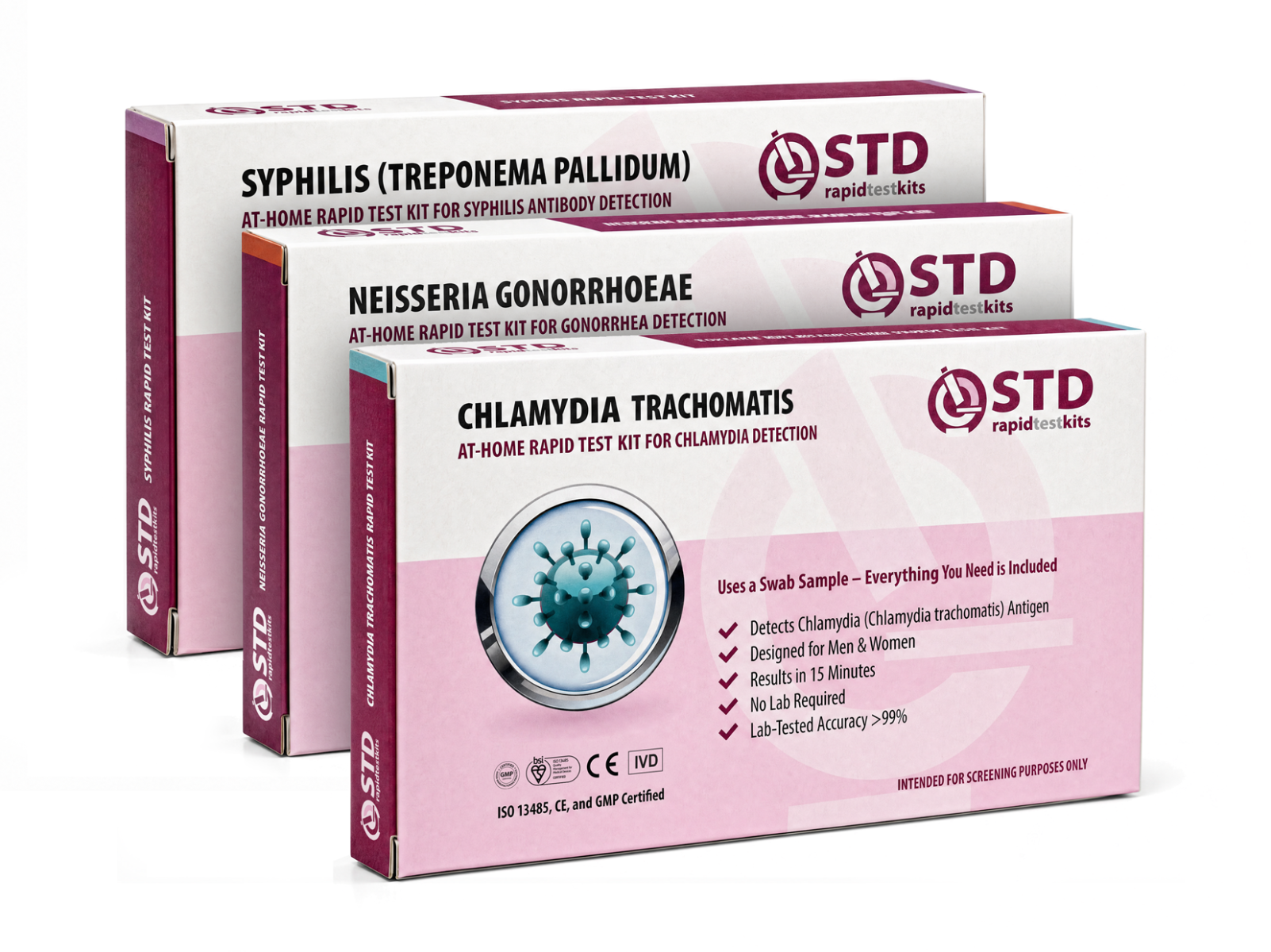
The trade-off: at-home rapid tests are lateral-flow immunoassays, not laboratory NAATs. The CDC's gold standard for chlamydia and gonorrhea remains nucleic-acid amplification testing in a CLIA-certified lab. The home test is fast, private, and a useful screen, but a positive result is worth confirming with a lab NAAT through the MTF or a civilian Tricare provider before treatment. The two are complementary, not equivalent. Per the published performance figures on our Chlamydia, Gonorrhea, and Syphilis 3-in-1 product page, sensitivity for our rapid kits sits in the mid-to-high 90s for symptomatic infections; asymptomatic detection runs lower than NAAT, which is why we recommend layering at-home screening with periodic lab testing rather than replacing one with the other.
One more practical note: at-home test purchases do not show up on Tricare claims because they are out-of-pocket. They will not appear in your medical record unless you bring the result to a provider yourself.
Prevention that actually cuts risk
Prevention messaging in the military tends toward generic advice that is hard to act on. Specific is better.
- Carry condoms on liberty, not just on base. Free condoms are stocked at most MTFs and many wellness clinics. The friction is having one in your wallet at 0200 in port, not at the post chapel on a Tuesday.
- Get the HPV vaccine if you are eligible. Active-duty service members are routinely offered Gardasil 9 at no cost through age 26 under ACIP guidance. Under shared clinical decision-making, the vaccine is available through age 45. It prevents the strains that cause most cervical, anal, and oropharyngeal cancers, and the military covers it.
- Use PrEP if you are at substantial HIV risk. Tricare covers daily oral PrEP (Truvada or Descovy) and the on-demand 2-1-1 dosing pattern for eligible patients. Long-acting injectable cabotegravir is available at select MTFs. PrEP discussions can happen at your MTF without command notification.
- Test your partners, not just yourself. The single biggest reason chlamydia and gonorrhea recur in service members is reinfection from an untreated partner. Expedited partner therapy (EPT) is legal in most states; ask your provider.
- Limit alcohol on liberty if exposure history says it changes your decisions. Most regretted exposures in DoD prevention research cluster around heavy-drinking events. Counting drinks beats abstract advice.

Deployment, discharge, and career reality check
Rumors persist that any STI ends a career. They do not, but the picture is more nuanced than the official line suggests.
- Curable bacterial STIs (chlamydia, gonorrhea, syphilis, trichomoniasis): treated and you stay fully deployable. The diagnosis enters your record but rarely surfaces beyond the medical chain. Annual physicals do not flag historical chlamydia.
- Genital herpes: almost never affects deployability. Outbreaks are managed with daily or episodic antivirals.
- HPV: the infection itself is not tracked or restricted. Cervical changes detected on Pap surveillance are managed routinely under women's-health protocols.
- Hepatitis B: chronic active infection with elevated liver enzymes can affect overseas-assignment medical clearance. Vaccinated personnel and resolved infections are not restricted.
- Hepatitis C: chronic infection generates a medical evaluation board referral. Modern direct-acting antiviral treatment cures most cases within 8 to 12 weeks, and you typically return to fully deployable status after sustained virologic response.
- HIV: the most consequential. Per DoD Instruction 6485.01, a confirmed positive triggers a medical evaluation board. Under the post-2018 policy, HIV is not automatically disqualifying for continued service or, in some branches, for accession. Overseas assignments and certain MOS categories (combat arms, aviation, submarines) carry restrictions. Service members on stable antiretroviral therapy with undetectable viral loads have continued careers in CONUS and select overseas postings.
Discharge specifically for an STI diagnosis is rare and almost always involves either fraudulent enlistment (concealing a known HIV-positive status at accession) or repeated misconduct connected to the diagnosis. The infection itself almost never ends the career; the documentation around it sometimes does.
Sexually transmitted infections continue to be among the most commonly reported notifiable conditions in the U.S. military, with chlamydia and gonorrhea accounting for the majority of cases.
Frequently asked questions
- Will my commanding officer find out if I test positive?
- Not for routine curable STIs. Chlamydia, gonorrhea, syphilis, and trichomoniasis are treated as routine medical care and stay within the medical chain. Conditions that affect readiness or deployability (HIV, untreated active hepatitis B, late-stage syphilis) generate paperwork that may surface to command through deployability determinations, not through direct disclosure of the diagnosis.
- Can I get tested while deployed?
- Symptomatic testing is available wherever a corpsman, IDC, or BAS is in reach, but routine screening capacity varies by location. Some shipboard and forward-deployed environments stock rapid HIV and pregnancy tests but not chlamydia or gonorrhea NAAT collection kits. At-home test kits travel well and let you screen privately during deployment.
- Does Tricare cover STI testing and treatment?
- Yes. Routine STI screening is covered as preventive care with no cost-share when ordered by a Tricare-authorized provider. Diagnostic tests, treatment, and partner therapy are also covered. Out-of-pocket purchases like at-home test kits are not Tricare-reimbursable but also do not enter your military medical record.
- Can I deploy with HIV?
- It depends on viral suppression and the specific assignment. Service members on stable antiretroviral therapy with undetectable viral loads can continue serving in CONUS and certain overseas postings under the post-2018 DoD policy. Combat-arms, aviation, submarine, and some special-operations assignments still carry restrictions. The medical evaluation board determines individual case dispositions.
- How often should service members get screened?
- Annual chlamydia screening is recommended for women under 25; men benefit from annual screening in higher-prevalence settings, which most military environments qualify as. Add gonorrhea, syphilis, and HIV screening every 3 to 12 months for personnel with multiple partners or new partners since the last test. After any new partner, a 4-week post-exposure check covers chlamydia and gonorrhea; HIV needs 45 days for fourth-generation tests and 90 days for antibody-only tests.
- Is at-home STD testing accurate enough to rely on?
- Treat it as a starting point, not a final answer. A positive result should be confirmed with an MTF lab test (or a civilian Tricare provider's lab) before any treatment decision. A negative result, paired with no symptoms and no recent high-risk exposure, is reasonable reassurance. The clinical reality behind that rule: lateral-flow rapid kits perform better on symptomatic infections than asymptomatic ones, and laboratory NAAT remains the higher-sensitivity tool. Use the at-home kit when privacy or speed matters; escalate to lab testing the moment a result, a symptom, or an exposure history calls for it.
- Will an STI history block a security clearance?
- Almost never. The clearance process focuses on judgment, financial stability, and foreign contacts; medical history matters only when it suggests untreated chronic conditions or when omitted from required disclosures. Honest disclosure on the SF-86 of any condition you are asked about is the safer path. The infections themselves are rarely disqualifying; non-disclosure is.
- Are condoms actually free on base?
- Yes, at most military medical treatment facilities, sexual-health clinics, and many unit health-promotion offices. They are typically out in a basket near the front desk. Take what you need; nobody tracks who picks them up.
Bottom line: protect your readiness, protect yourself
The military runs a screening cadence that catches some infections automatically and leaves the rest to your initiative. Knowing what is mandatory, what Tricare covers, what enters your record, and what affects deployability lets you make informed decisions instead of guessing. Most STIs are curable, most do not end careers, and most of the privacy concerns that keep service members from testing are addressable with the right combination of MTF visits and at-home screening.
If you have symptoms or a known exposure, the MTF is the right call: testing and treatment are covered, fast, and clinically appropriate. If you want regular asymptomatic screening without the chart entry, an at-home test is a reasonable middle ground. Either way, the goal is the same: stay informed, stay treated, stay deployable.
- U.S. Centers for Disease Control and Prevention. STI prevention, screening, and surveillance fact sheets covering chlamydia, gonorrhea, syphilis, herpes, and HIV.
- U.S. Centers for Disease Control and Prevention. HIV testing windows, fourth-generation antigen-antibody guidance, and PrEP eligibility.
- Military Health System (Defense Health Agency). DoD Instruction 6485.01 on HIV policy, Medical Surveillance Monthly Report on STI rates in active-duty service members, and DoD sexual-health initiatives.
- Tricare. Preventive-care benefits, STI screening and treatment coverage, and PrEP coverage details across Tricare Prime, Select, and Reserve Select.
- U.S. Centers for Disease Control and Prevention. HPV vaccination guidance, including ACIP routine vaccination through age 26 and shared clinical decision-making through age 45.
