
Published: September 2025 | Last updated: May 2026 | Editorial review and quality control: Martina N.
What do first-time testers need to know?
Pick a path that fits your situation: an at-home rapid test for private, no-symptom screening, a mail-in lab kit for lab-grade analysis, a clinic for symptoms or a known exposure, or telehealth to confirm and treat. Test after the right window period, because testing too early can miss an infection. Any positive home result should be confirmed by a lab.
You are here because something is on your mind. Maybe it is a new partner, a torn condom, a friend who casually mentioned getting tested every six months, or a vague worry that has stuck around longer than you would like. Whatever brought you here, the fact that you are ready to sort out your first STD test is already a small win. Most people delay this for years. You have not.
This guide is built for first-time testers. We will cover what an STD test checks, how rapid cassettes work, how at-home kits compare to clinic visits, mail-in labs, and telehealth, why timing matters more than urgency, what each kind of result means, how to handle the partner conversation, and how to move past the shame that keeps a lot of people stuck. No judgment, no jargon you cannot follow, and no pressure to pick a path that does not fit your situation.
Key Takeaways
- At-home rapid tests work well for routine screening after the right window period; symptoms or a known recent exposure usually need a clinic exam.
- Window periods matter more than urgency. Testing too soon can return a false negative even when an infection is already brewing.
What Counts as an STD Test (and Why There Is No Single One)
The phrase "STD test" sounds like one procedure. In reality, several different tests fall under that label, because different infections need different samples and no single test screens for everything. A standard screening panel covers chlamydia, gonorrhea, syphilis, and HIV. Broader panels add herpes (HSV-1 and HSV-2), hepatitis B and C, trichomoniasis, and HPV. The exact mix depends on what kit or clinic you use and what your risk factors look like.
Sample types fall into three buckets. Swabs collect cells from the vagina, penis, throat, or rectum and are used for chlamydia, gonorrhea, trichomoniasis, and HPV. Blood samples, drawn from a vein in a clinic or collected at home with a fingerstick lancet, look for antibodies to HIV, syphilis, herpes, and hepatitis. Urine is sometimes used for chlamydia and gonorrhea, especially in men. The CDC's STI testing guidance describes all three sample types as routine, depending on the infection being tested for.
At-home kits sold to consumers are rapid lateral-flow tests. They are not the same technology as a laboratory NAAT (nucleic acid amplification test), which clinical labs use for chlamydia and gonorrhea diagnosis under the CDC's 2021 STI treatment guidelines. Lateral-flow and lab NAAT are complementary, not interchangeable. A home rapid test is a strong first screen. A lab test is what you want for confirmation after a positive home result.
| Test Type | Sample Method | Where It Happens | What It Detects |
|---|---|---|---|
| Lateral-flow rapid test | Self-collected swab or fingerstick blood | Home | Chlamydia, Gonorrhea, Trichomoniasis, HIV, Syphilis, Hepatitis B/C, HSV |
| NAAT (lab platform) | Urine, swab, or provider-collected sample | Lab via clinic | Chlamydia, Gonorrhea, Trichomoniasis |
| Antibody/antigen blood draw | Venous blood draw | Clinic / lab | HIV (4th gen), Syphilis, Hepatitis B and C |
| Visual / physical exam | Clinician observation | Clinic only | Herpes lesions, genital warts, syphilis chancres |
| Pap and HPV co-test | Cervical swab | Clinic | HPV strains, cervical cell changes |
How an At-Home Rapid Test Works
The mechanics are simpler than the unboxing usually makes them feel. Most rapid kits sold for home use are lateral-flow immunoassays, the same chemistry behind home pregnancy tests and the at-home COVID antigen tests most households kept on a shelf in 2021. You collect a small sample, apply it to the cassette window, add the buffer drops, and wait about 15 to 20 minutes for the result lines to develop.
The sample type depends on the infection. A fingerstick of blood reads HIV, syphilis, hepatitis B, hepatitis C, and HSV antibody status. A self-collected vaginal or penile swab reads chlamydia, gonorrhea, trichomoniasis, and HPV. Most cassettes show a control line (proving the test ran correctly) and a test line (showing reactivity to the infection). Two lines means a reactive (positive) screen. One control line alone means non-reactive (negative). No control line at all means an invalid test, and you should retest with a fresh cassette.
Lateral-flow chemistry is a screening tool. A reactive rapid result should be confirmed with a laboratory assay before treatment is finalized: a NAAT for chlamydia or gonorrhea, the treponemal then non-treponemal sequence for syphilis, and the fourth-generation antigen-antibody algorithm for HIV. A non-reactive result is reliable when you are past the test's window period for that infection. If you tested inside the window, treat the negative as preliminary and retest later.
How to read a lateral-flow cassette
- Control line only (one line): non-reactive. Negative result, reliable if you are past the window period.
- Control line plus test line (two lines): reactive. Positive screen that should be confirmed by a clinical lab assay before treatment.
- No control line at all: invalid test. The cassette did not run correctly. Discard it and retest with a fresh kit.
- Any faint test line counts as reactive. Read the result at the time window the instructions specify, not earlier and not hours later.
At-Home Kit, Mail-In Lab, Clinic, or Telehealth
Several formats share the same shelf in your decision space, and the right choice is rarely the same for every reader. At-home rapid kits trade scope and follow-up for privacy and speed. You collect your own sample, read your own result in 15 to 20 minutes, and nobody else has to know unless you tell them. That makes at-home STI test kits genuinely useful for routine screening, for breaking the inertia that keeps people from testing at all, and for people who live somewhere that walking into a clinic feels socially or geographically hard.
Mail-in lab kits are the alternate at-home format we do not sell on this site, but you should know they exist. You self-collect the same swab or fingerstick sample, package it in a prepaid return envelope, and a CLIA-certified lab runs the same NAAT or antibody assay a clinic would use. Results land 2 to 5 business days later in a secure portal. Mail-in kits are slower than rapid cassettes but more sensitive for low-titer or early infections.
Clinic visits trade some privacy for two things at-home cannot give you: a person who can examine you for visible signs (lesions, swelling, discharge patterns) and a broader panel that may include sample types we do not sell at home, such as throat or rectal swabs. If you have symptoms, a clinician will spot things you can miss in a mirror, and a positive result can be treated and counseled in the same visit.
Telehealth threads between these options. A licensed clinician reviews your results by video or chat, can prescribe treatment for uncomplicated infections, and routes anything complex to in-person care, all without a waiting room. It works best for asymptomatic screening and simple treatment, not for emergencies or anything that needs a physical exam.
Cost varies. Many public health clinics, college clinics, and Planned Parenthood locations offer sliding-scale or free testing, especially for HIV. At-home kits are paid out of pocket but do not require insurance, lab orders, or a copay conversation at the front desk. Neither path is universally cheaper; it depends on your situation.
| Format | Privacy | Speed | Sensitivity | Best For |
|---|---|---|---|---|
| At-home rapid kit | Highest | 15 to 20 minutes | Moderate to high | Screening, post-window check-ins, relationship-onset testing |
| Mail-in lab kit | High | 2 to 5 business days | High (NAAT or 4th-gen) | Confirmatory follow-up, low-titer infections, accurate asymptomatic screening |
| Telehealth visit | High | Same-day consult | Depends on the test ordered | Result review, prescriptions, uncomplicated treatment without a waiting room |
| Clinic visit | Lower | Same day to 1 week | Highest, plus exam and culture | Complex symptoms, pelvic exam needed, pregnancy with symptoms, treatment-resistant infection |
Window Periods: The Single Most Important Thing to Get Right
A window period is the gap between a possible exposure and the point when a test can reliably detect the infection. Each STI has its own window because each one triggers detectable signals on its own schedule. Bacterial infections such as chlamydia and gonorrhea generally become detectable within one to two weeks. Viral infections such as HIV take longer because antibody tests rely on the immune system to produce a measurable response.
For HIV, the CDC's HIV testing page states that antibody tests can usually detect HIV 23 to 90 days after exposure, while antigen/antibody laboratory tests can usually detect HIV 18 to 45 days after exposure. An at-home HIV test uses a fingerstick blood sample read at home, so plan around the antibody window; a laboratory fourth-generation test detects earlier. A negative result during that window is not the same as a clean bill of health. For syphilis, a blood antibody test is typically reliable from three to six weeks post-exposure. For herpes, a blood IgG test generally takes twelve weeks or longer to become consistently positive; some people seroconvert by six to eight weeks, but false negatives are common before the twelve-week mark, so twelve weeks is the threshold to trust a negative. Hepatitis B typically shows on a surface-antigen test from about three to nine weeks; hepatitis C antibody from about eight to twelve weeks.
If you test before the window period closes, a negative result is not the end of the story. Re-test at the recommended interval, and if you have ongoing symptoms or a known exposure, see a clinician sooner rather than waiting for the calendar. If your concern is preventing HIV rather than testing for it, post-exposure prophylaxis (PEP) is time-sensitive and must be started within 72 hours of a high-risk exposure. PrEP is the planning-ahead version, a daily medication that prevents HIV infection. Doxy-PEP, a single dose of doxycycline taken within 72 hours of sex, is a newer option some clinicians recommend to lower bacterial STI risk for certain higher-risk groups. All of these are clinician decisions, not at-home decisions.
| Infection | Earliest Reliable Detection | Ideal Retest Window | Best Tested At |
|---|---|---|---|
| Chlamydia | 1 to 2 weeks | 14+ days post-exposure | Home or clinic |
| Gonorrhea | 1 to 2 weeks | 14+ days post-exposure | Home or clinic |
| HIV (antigen/antibody lab) | 18 to 45 days | 45 days for definitive negative | Clinic preferred |
| HIV (rapid antibody) | 23 days minimum | 90 days for definitive negative | Home or clinic |
| Syphilis | 3 to 6 weeks | 6 weeks post-exposure | Home or clinic |
| Herpes (IgG blood) | 12+ weeks | Retest at 12 weeks for definitive negative | Clinic preferred |
| Hepatitis B | 3 to 9 weeks | Confirm with full panel if reactive | Home or clinic |
| Hepatitis C | 8 to 12 weeks | RNA confirmatory if antibody reactive | Home or clinic |
Four First-Time Tester Scenarios That Probably Sound Familiar
Numbers and tables only get you so far. The real decision lives inside people's lives, where shame, scheduling, identity, and access shape what gets done. These are composite scenarios drawn from common first-time tester patterns. You may see parts of yourself in them.
The college sophomore who heard from a partner. Jared, 20, learned that someone he had been with tested positive for gonorrhea. He used condoms, but not perfectly, and he has no symptoms. Too embarrassed to walk into the campus clinic, he orders a chlamydia and gonorrhea home kit at 3 a.m. The result is negative, though the five-day wait wore his nerves down. In hindsight the campus clinic was the faster, cheaper path, but the home kit was what he could emotionally manage.
The post-breakup re-entry. Erin, 26, is out of a long relationship and newly seeing someone, with lower-back pressure she cannot explain. She does not want to sit in a doctor's office and recount her history, so she orders an at-home test. It comes back positive, and she has no follow-up plan because she let herself imagine only a negative. The right next step is a clinic visit to confirm the result and start treatment, which she eventually books.
The routine-care role model. Leila, 35, is a nurse who schedules an annual STI screen the way she schedules a dental cleaning. No drama, no special occasion needed. Regular screening for sexually active adults is exactly what CDC STI testing guidance describes, with more frequent testing for people with new or multiple partners.
The reader for whom a clinic feels unsafe. Theo, 29, is a trans man living somewhere that coming out to a clinician has gone badly before. At-home testing lets him take care of his body on his own terms. When he tests positive for chlamydia, he uses an online telehealth visit to get treatment. That is not a substitute for long-term primary care. It still beats avoiding care entirely.

When Symptoms Mean a Clinic, Not a Kit
Screening and diagnosis are different jobs. Screening is what you do when you have no symptoms and want to know your status. Diagnosis is what happens when something is already wrong and you need an answer. Pain when peeing, unusual or smelly discharge, sores or bumps on the genitals or mouth, persistent pelvic pain, testicular pain, or an unexplained rash all move you from screening to diagnosis. At that point, a home kit on its own is usually not the right tool.
Two reasons stand out. First, a clinician can examine visible lesions, swab the right anatomical site, and rule out look-alike conditions. Many vaginal symptoms turn out to be yeast infections or bacterial vaginosis, both common, treatable, and not sexually transmitted. Some throat or rectal infections need a clinically collected swab, which is not something we sell as an at-home kit. Second, untreated bacterial STIs cause real downstream harm. Untreated chlamydia can ascend from the cervix into the upper reproductive tract and cause pelvic inflammatory disease, which the NHS links to scarred fallopian tubes, infertility, and ectopic pregnancy. Untreated syphilis progresses over years to nerve, heart, and brain involvement, and untreated gonorrhea can spread to the joints and bloodstream. Treatment early in the course prevents almost all of these complications.
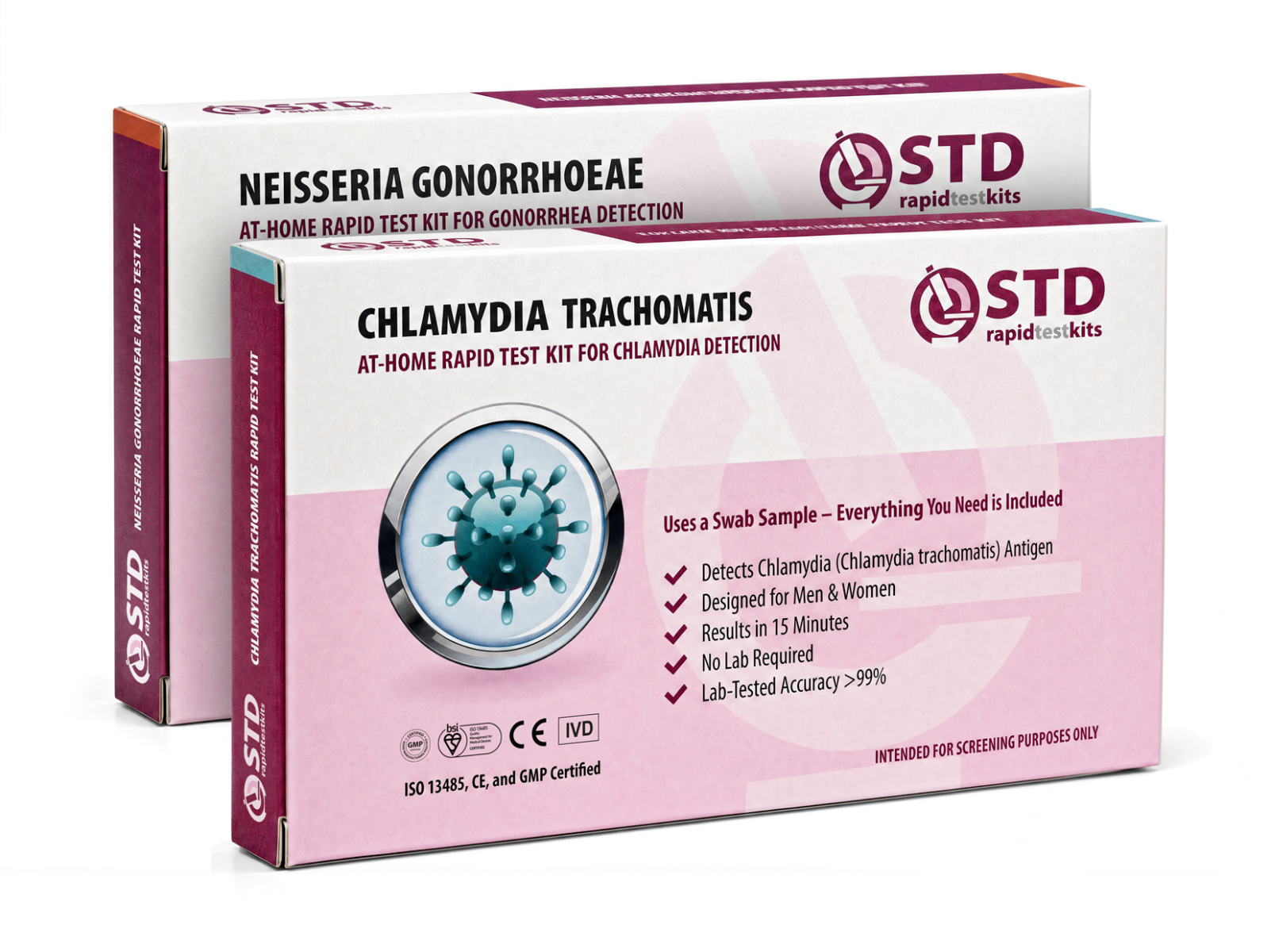
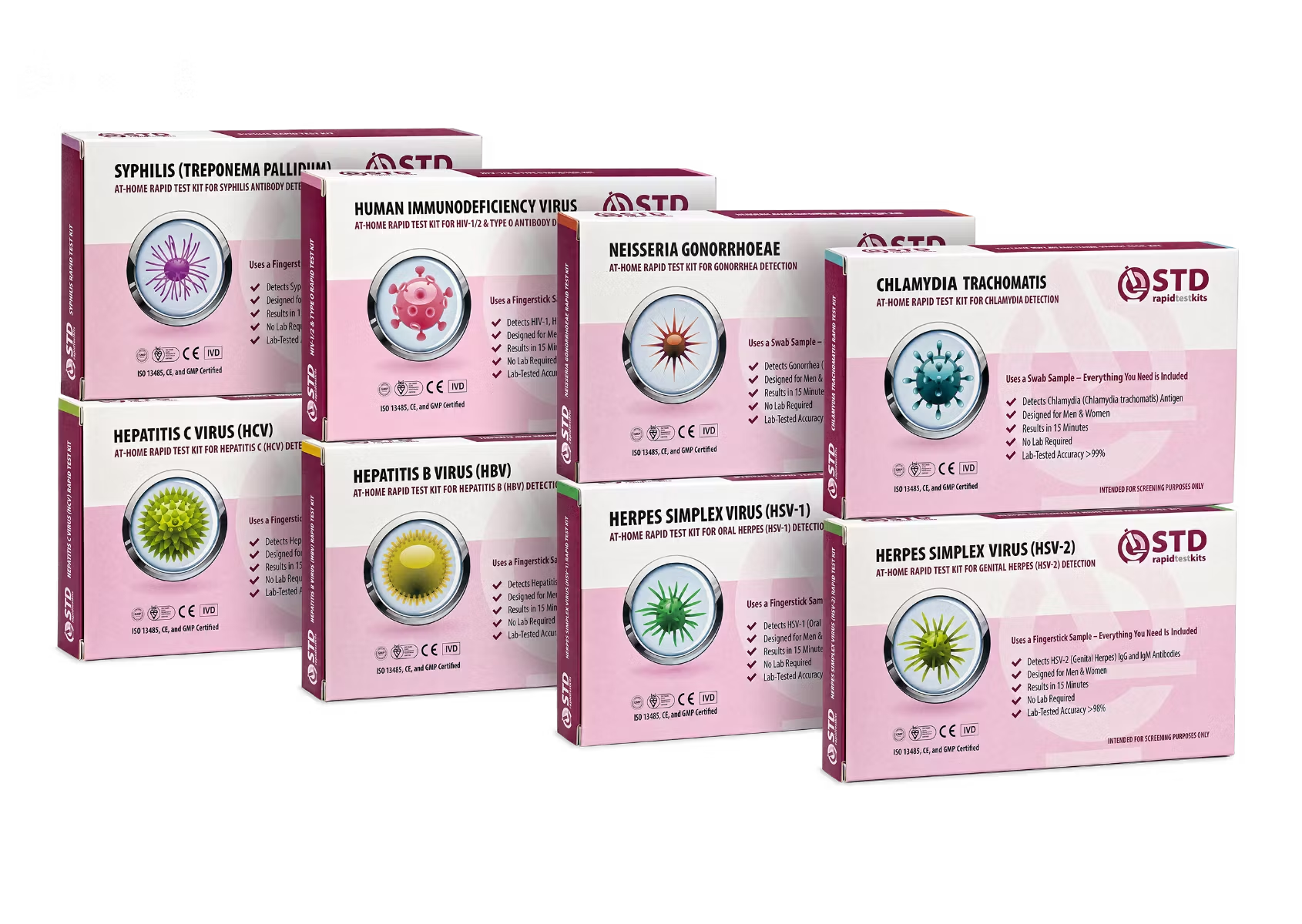
If you have symptoms, do not wait a week for a kit to arrive. Book a clinic visit or telehealth consultation today, and use a home kit afterward for routine screening when you are symptom-free. For transparency, stdrapidtestkits.com sells the rapid home kits referenced in the banners in this guide, and the recommendations come from our own catalog. We flag them where they genuinely fit the section topic, not in every section.
- You have severe pelvic, testicular, or abdominal pain, with or without fever.
- You suspect pelvic inflammatory disease (deep pelvic pain, painful sex, abnormal discharge, fever).
- You are pregnant and have new genital, abdominal, or systemic symptoms.
- You have an actively bleeding genital lesion, or a lesion that does not match a typical STI presentation.
- You have signs of disseminated infection: rash plus joint pain, painful eye, or neurological symptoms.
- You have been treated and the symptoms have not cleared (possible resistant gonorrhea, treatment failure, or another diagnosis).
After the Test: What Each Result Means
Negative, with no symptoms, and a closed window period. Good news. You can move on. As a rough guide, the CDC's STI testing guidance describes at least annual screening for sexually active adults under 25 and for older adults with new or multiple partners, and more frequent screening, often every 3 to 6 months, for people with higher-exposure profiles, including men who have sex with men and people on PrEP. People in mutually monogamous, recently tested relationships often need less, but defer to a clinician for your situation.
Negative, but the window period is not closed yet, or you have symptoms. This is the trickiest result to read. A negative taken before the window period closes cannot rule the infection out. Re-test at the recommended interval. If symptoms are present, see a clinician sooner rather than waiting for the next test.
Positive. Take a breath. STIs are common and most are treatable. Millions of new STI infections occur every year in the United States, according to CDC STI surveillance data, so a positive result puts you in a very large group of people who all moved on with normal lives after treatment. Most bacterial STIs (chlamydia, gonorrhea, syphilis, trichomoniasis) clear with a short course of antibiotics dosed per current CDC STI treatment guidelines: doxycycline or azithromycin for chlamydia, ceftriaxone for gonorrhea, metronidazole or tinidazole for trichomoniasis, benzathine penicillin for early syphilis. Viral STIs are managed long-term, often well enough that they barely affect daily life.
The first practical step after a positive at-home result is a clinical visit, in person or via telehealth, to confirm the result on a lab platform, start treatment, and talk about notifying recent partners. A telehealth clinician can review your results by video or chat and send a prescription to your pharmacy, often the same day, for uncomplicated infections. The next step depends on the result: start treatment, schedule a retest if the window was still open, or notify a partner who may have been exposed.

The Partner Conversation (and How Private Home Testing Really Is)
The conversation with a current or recent partner is often the part of an STI diagnosis that feels heaviest, sometimes heavier than the diagnosis itself. Telehealth platforms have leaned into this pattern with anonymous notification tools and clinician-supported scripts. You can send an anonymous text through services like Tell Your Partner, or use your state health department's anonymous notification tool. Many platforms will help you draft the message: clear, non-shaming, action-oriented. Something like "You may have been exposed, here is what to test for and where to go."
On privacy: at-home testing is as private as you make it. Kits ship in plain envelopes with no infection name on the box. Results live in a secure portal you control, or stay on the cassette in your hand. No insurance is billed unless you choose, so no diagnosis code lands on a claim your insurer reads. The realistic threat model is your own household: a roommate or family member who opens your mail. If that is a concern, ship to a P.O. box or a friend's address. The WHO's STI fact sheet identifies stigmatization as one of the direct impacts of STIs on sexual and reproductive health, which is exactly the friction private home access is built to remove.
Minors face a different set of rules. Many U.S. states allow people under 18 to access confidential STI testing and treatment without parental consent, but the rules vary by state and by service. Check your local health department's guidance before assuming privacy by default; teen-clinic programs and Planned Parenthood are usually the best starting points for state-specific minor-access rules.
- Anonymous notification tools: Tell Your Partner, dontspreadit.com, and most state health department websites offer free anonymous text or email tools you can send without revealing your identity.
- Kit packaging: ships in plain envelopes with no infection name, return address as a generic company name, no clinical labels visible from outside.
- Insurance: not billed for direct-to-consumer kits unless you opt in. No diagnosis code attached to your insurance record.
- Results: live in a secure portal you control, or stay on the cassette in your hand. Telehealth follow-up is one-on-one with the clinician.
- Minors: confidential access varies by state. Local teen clinics, Planned Parenthood, and state-health-department teen pages are the most accurate sources for your jurisdiction.
Spotting a Legitimate At-Home Test
The at-home testing category attracts both careful operators and pure-marketing pop-ups. The difference is visible in three places: device clearance, lab certification (for mail-in products), and clinician access (for any platform that prescribes treatment).
For a rapid cassette, check that the test format you are buying is recognized by FDA in-vitro diagnostic clearance pathways, or that the vendor names the cleared device. For a mail-in lab kit, check that samples go to a CLIA-certified lab; the lab should be named on the product page, not gestured at as "lab quality." For any telehealth platform that prescribes antibiotics or PrEP, there should be a real state-licensed clinician in the loop, reachable by video or thorough chat, not just a symptom checklist that spits out prescriptions. Independent patient-education resources, such as those from the American Sexual Health Association, are a useful third-party reference if you want a non-vendor opinion.
Red flags to avoid: a product page that does not name the device or the lab; "instant" results promised without a clear cassette format or lab pathway; prescriptions issued without clinician contact; a privacy policy that allows automatic insurance billing or third-party marketing by default. A platform that buries those terms is signaling something about how it will treat your information.
- The product page does not name the device, the cleared assay, or the lab running the sample.
- The platform offers prescriptions without a clinician video, phone, or thorough chat review.
- Results are promised to be "instant" without a clear lab pathway or a recognized cassette format.
- The privacy policy allows automatic insurance billing, third-party marketing, or data resale by default.
- The pricing page is unclear about retesting or confirmatory lab work after a reactive screen.
When Shame Tries to Decide for You
Avoidance is the most common reason people test late. Shame whispers that not knowing is safer than confirming, when the opposite is closer to the truth. STIs that go undiagnosed cause real medical harm: scarred fallopian tubes, infertility, progressive neurological damage, transmission to a partner who would have wanted to know. Many of these infections cause no symptoms while they do that damage, which is why testing rather than waiting for a sign is the only reliable read (MedlinePlus). The harm from asking the question is, at worst, a treatable diagnosis. The harm from avoiding it can be permanent.
If shame is the wall between you and a clinic visit, an at-home kit is a legitimate workaround. It is private, fast, and does not require explaining yourself to anyone. The tradeoff is that a home kit alone does not give you the conversation a clinician would, so telehealth providers and sexual-health hotlines (like the CDC-INFO line) fill that gap. Use whatever combination breaks the inertia.
Routine STI screening is not a confession of bad behavior. It belongs in the same category of preventive care as a dental cleaning, an eye exam, or a cholesterol check. We treat it differently for cultural reasons, not medical ones, and putting it on the same calendar as your other checkups is what makes it stick.
Many STIs cause no symptoms. Anyone who is sexually active can get an STI. Testing is the only way to know for sure if you have one.
Choosing What Is Right for You
You do not have to be in a relationship, showing symptoms, or certain about what happened last weekend to deserve a clear answer. If the question is on your mind, that is reason enough. The next step is choosing a path that fits your situation: an at-home rapid kit if you have no symptoms and want a discreet starting point, a mail-in lab kit if you want lab-grade analytics without a clinic visit, a clinic visit if you have symptoms or a known exposure, or a combination kit if you want belt-and-suspenders coverage in one go.
The best test is the one you actually take this week. The worst test is the one you keep putting off until you forget which exposure you were worried about in the first place. Pick one, do it, and let yourself off the hook for the rest.
Which First Test Path Fits You?
Do you have symptoms right now, such as pain when peeing, sores, unusual discharge, or pelvic pain?
Yes: Choose a clinic or a telehealth visit today rather than a home kit. Symptoms call for an exam, and sometimes a swab from a site a home kit cannot reach.
Are you worried about one specific recent exposure?
Yes: Time your test to the window period for the infection that concerns you most. If you cannot wait, test now, treat a negative as preliminary, and retest at the right interval.
Do you mainly want a private result without a clinic visit?
Yes: Start with an at-home rapid kit for a fast screen, or a mail-in lab kit for higher analytical sensitivity, then confirm any positive with a lab.
No: A clinic or telehealth screen on your usual schedule is a solid default; sexually active adults benefit from at least annual screening, more often with new or multiple partners.
Guidance only. A clinician can advise based on your specific situation.
First-Time Tester FAQs
- Is it normal to be nervous about my first STD test?
- Yes, and it does not mean anything about you. The nerves come from not knowing the process: what they will ask, what the swab or fingerstick feels like, what happens if the result is positive. After the first test, most people find the anticipation was the hard part, not the test itself. If clinic nerves are the wall, an at-home kit can be a softer starting point.
- Are at-home tests as accurate as clinic tests?
- For routine screening after the window period has closed, yes, with one important caveat: lab NAATs (the molecular tests used in clinical labs) have higher analytical sensitivity than home lateral-flow cassettes, so a reactive home result should always be confirmed at a clinical lab before treatment starts. Mail-in lab kits sit in between, using lab-grade chemistry with self-collected samples. Inside the window period, accuracy is limited by biology, not technology: the test cannot detect what your body has not produced yet.
- What if I test too soon after exposure?
- You may get a false negative. Every STI has a window period: the gap between exposure and the point a test can detect the infection. If you tested early and the result is negative, plan to retest at the recommended interval (about 2 weeks for chlamydia and gonorrhea, up to 3 months for HIV antibody tests to be fully definitive, 12 weeks or more for HSV-2 IgG). If symptoms appear in the meantime, see a clinician.
- I had symptoms, but my home test was negative. What now?
- Three possibilities. You may have tested inside the window period for the infection you have. Your symptoms may come from a non-STI cause, such as a yeast infection, a UTI, or normal post-coital irritation. Or your sample may have missed the right site, since rectal or throat infections will not show on a genital swab. The next step depends on which fits: retest at the appropriate window, see a clinician for a different sample type, or treat the non-STI cause directly.
- I have no symptoms. Should I still test?
- Yes. Many STIs cause no symptoms for weeks or months. Chlamydia and gonorrhea are especially well-known for staying silent while still being transmissible and still causing long-term damage. The CDC recommends regular STI screening for sexually active adults, more often for people with new or multiple partners. No symptoms is the best time to screen, before any complications develop.
- Can I get antibiotics for an STI through a telemedicine visit?
- Yes, for uncomplicated bacterial infections in most U.S. states. After a clinician reviews your test results and exposure history, they can prescribe doxycycline or azithromycin for chlamydia, ceftriaxone for gonorrhea, metronidazole for trichomoniasis, or benzathine penicillin for early syphilis, with dosing per current CDC guidelines. Complicated infections, treatment failures, and pelvic inflammatory disease are routed to in-person care.
- My home test came back positive. What do I do?
- Confirm it first. Most STIs are very treatable, and the next step is a clinical lab visit or telehealth consult to verify the result and start treatment. Many at-home kit companies bundle a telehealth visit that handles both. You will also want to think about notifying recent partners so they can test and treat too. None of this is something you have to figure out alone in the moment.
- If I get treated, can I get reinfected by the same partner?
- Yes, and this catches a lot of people off guard. Bacterial STIs like chlamydia and gonorrhea do not give you lasting immunity. If your partner was not also tested and treated, you can pick the infection right back up after your antibiotics finish. The partner conversation is awkward and worth having, because incomplete treatment means immediate re-exposure risk: treatment is only complete when your sexual partners from the relevant window are also tested and treated.
How we sourced this article: This guide was built from current CDC, NHS, WHO, MedlinePlus, and Planned Parenthood guidance on STI testing, then molded into plain language based on the situations people commonly experience. We prioritized guidance from public health authorities for any specific timing, accuracy, screening-interval, or treatment claim. Every external link points to one of those sources, and the citation list below shows what each source supports. We do not provide clinical diagnosis. For symptoms that concern you, see a licensed provider.
- U.S. Centers for Disease Control and Prevention. Getting tested for STIs, including sample types (blood, urine, swab), self-testing options, and screening guidance for different risk populations.
- U.S. Centers for Disease Control and Prevention. HIV testing reference, used here for HIV-specific window periods (antibody 23 to 90 days; antigen/antibody lab 18 to 45 days).
- U.S. Centers for Disease Control and Prevention. 2021 STI treatment guidelines portal, used for first-line treatment regimens (doxycycline, ceftriaxone, metronidazole, benzathine penicillin) and the confirmatory testing pathway after a reactive screen.
- U.S. Centers for Disease Control and Prevention. STI statistics landing page with links to annual surveillance reports, used for the framing that millions of new STI infections occur in the U.S. each year.
- National Health Service (UK). Chlamydia overview and complications, used here for the point that untreated chlamydia can cause pelvic inflammatory disease, which can lead to infertility and ectopic pregnancy.
- World Health Organization. Sexually transmitted infections fact sheet, used here for the framing of stigmatization as a direct impact of STIs on sexual and reproductive health.
- MedlinePlus, U.S. National Library of Medicine (NIH). Sexually transmitted infections overview, used here for the point that many STIs cause no symptoms and that testing is the only reliable way to know your status.
- Planned Parenthood. STD testing overview, used here for where to access testing (including free or low-cost options) and the point that many STDs have no symptoms.
