
Published: October 2025 | Last updated: May 2026 | Editorial review and quality control: Martina N.
Waiting for STD test results can feel longer than waiting for any other lab test you have ever ordered. The hours stretch, your imagination fills the silence, and the question nobody answers upfront is the one you actually need: how long is this going to take?
This guide compares realistic turnaround times for the three most common ways people test today: walk-in or scheduled clinic testing, mail-in self-collection kits, and rapid lateral-flow home tests. The right choice depends on the infection you are screening for, the timeline you are working with, and the kind of certainty you need at the end. Speed matters, but it is rarely the only thing worth optimizing for.
Disclosure: this site sells the at-home rapid kits described below. Clinic and mail-in options are covered alongside them so you can compare on the same page.
Key Takeaways
- At-home rapid lateral-flow tests for HIV, syphilis, hepatitis, and herpes can return a screening result in 15 to 20 minutes; clinic NAAT testing for chlamydia, gonorrhea, and trichomoniasis typically takes 2 to 5 days end-to-end (up to a week with holiday or lab delays).
- Speed and accuracy serve different purposes. Use rapid kits for fast screening at the right point in the window period, and confirm any positive or close-call result with a clinic NAAT or fourth-generation antigen/antibody panel.
Who this guide helps
This article is for anyone weighing the wait-it-out versus act-now spiral after a possible exposure or new symptom. You may not want results sent through your primary care provider's portal. You may live an hour from the nearest sexual health clinic. You may simply have a flight on Tuesday and want answers before then. Whatever the reason, the right testing path is the one that matches your timeline and the biology of the infection you are screening for.
The biology part is what most articles skip. A test taken three days too early can return a clean result and still miss an active infection. Speed without timing is just faster wrong answers. The sections below cover both: how long each test type takes to return a result, and when in the exposure window each test is able to detect what you are looking for.
- You had a possible exposure and want clarity before your next sexual contact.
- You have new symptoms but no nearby clinic appointment for several days.
- You are traveling and need a screening result before returning home.
- You want to test without a paper trail through insurance or a primary care portal.
Why clinic results take longer than the test itself
Clinics are not slow because nobody cares. They are slow because every step of the workflow has to coordinate with the next. Most clinics run their STI samples through external reference labs that batch specimens to keep per-test costs down. Your swab or urine cup may sit in a transport queue for a day before it even reaches the bench. Once it does, the assay itself is fast: a chlamydia or gonorrhea NAAT (nucleic acid amplification test) runs through the analyzer in a few hours.
After the lab releases the result, your clinician usually needs to review and sign off before it lands in the patient portal. Friday-afternoon results often do not appear until Monday. Holidays add another day or two. Most U.S. patients see chlamydia and gonorrhea NAAT results in 2 to 5 days end-to-end, and syphilis or HIV laboratory panels in 1 to 7 days depending on the lab partner (CDC, Getting Tested for STIs).
None of that delay reflects on test accuracy. Lab NAAT and laboratory-based antigen-antibody panels remain the analytical gold standard for the infections they cover.
- Day 0: Sample collected at the clinic.
- Day 0 to 1: Specimen courier-batched and sent to the reference lab.
- Day 1 to 3: Lab runs NAAT or antibody assay, often in batches once a tray fills.
- Day 2 to 4: Result released electronically to the ordering clinician.
- Day 3 to 5: Clinician reviews, signs off, and the result posts to the patient portal.
How at-home rapid tests deliver a result in 15 minutes
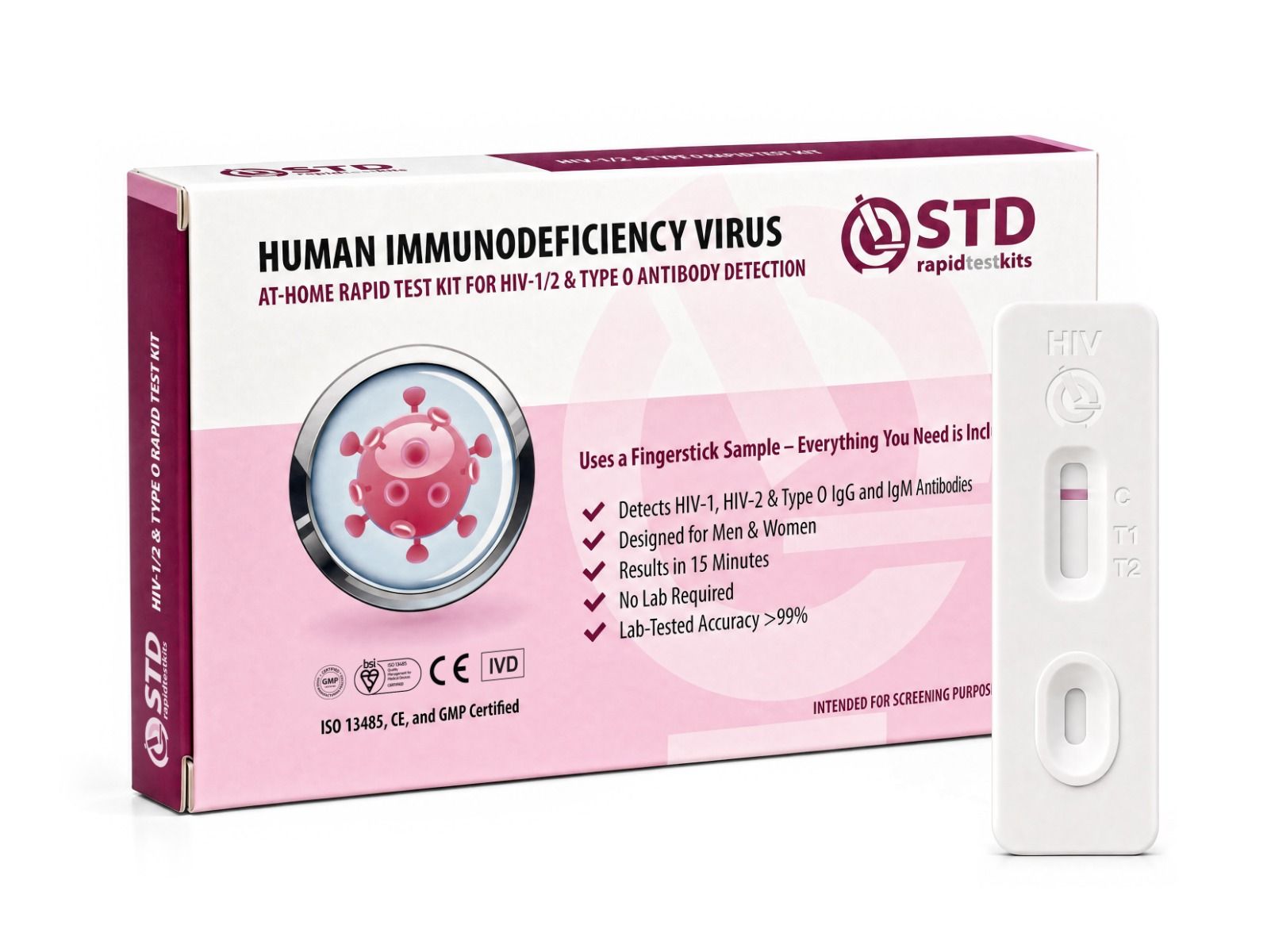
Rapid home tests work on a different chemistry than the lab tests above. Instead of amplifying genetic material, they use lateral-flow immunoassay strips: the same technology behind a pregnancy test or a COVID-19 antigen test. You apply a drop of fingerstick blood (for HIV, syphilis, hepatitis B, hepatitis C, herpes) or a self-collected swab (for chlamydia, gonorrhea, trichomoniasis, HPV) to a cassette, and antibody-coated strips bind any target antigen or antibody as the sample wicks across. A visible line forms in 10 to 20 minutes.
The advantage is obvious: no lab queue, no portal sign-off, no commute. The tradeoff is analytical sensitivity. Lateral-flow strips are designed for screening, not for confirmation. Their detection threshold is higher than NAAT for most infections, which means a positive rapid result is meaningful, but a negative one inside the early window period does not rule out infection. Plan around that limit instead of pretending it is not there.
Reputable at-home rapid kits are CE-marked and built to align with WHO and CDC point-of-care testing guidance for rapid screening. They are screening tools, not replacements for laboratory NAAT or fourth-generation HIV antigen-antibody testing in a clinic. The two technologies serve different roles in the same screening journey.
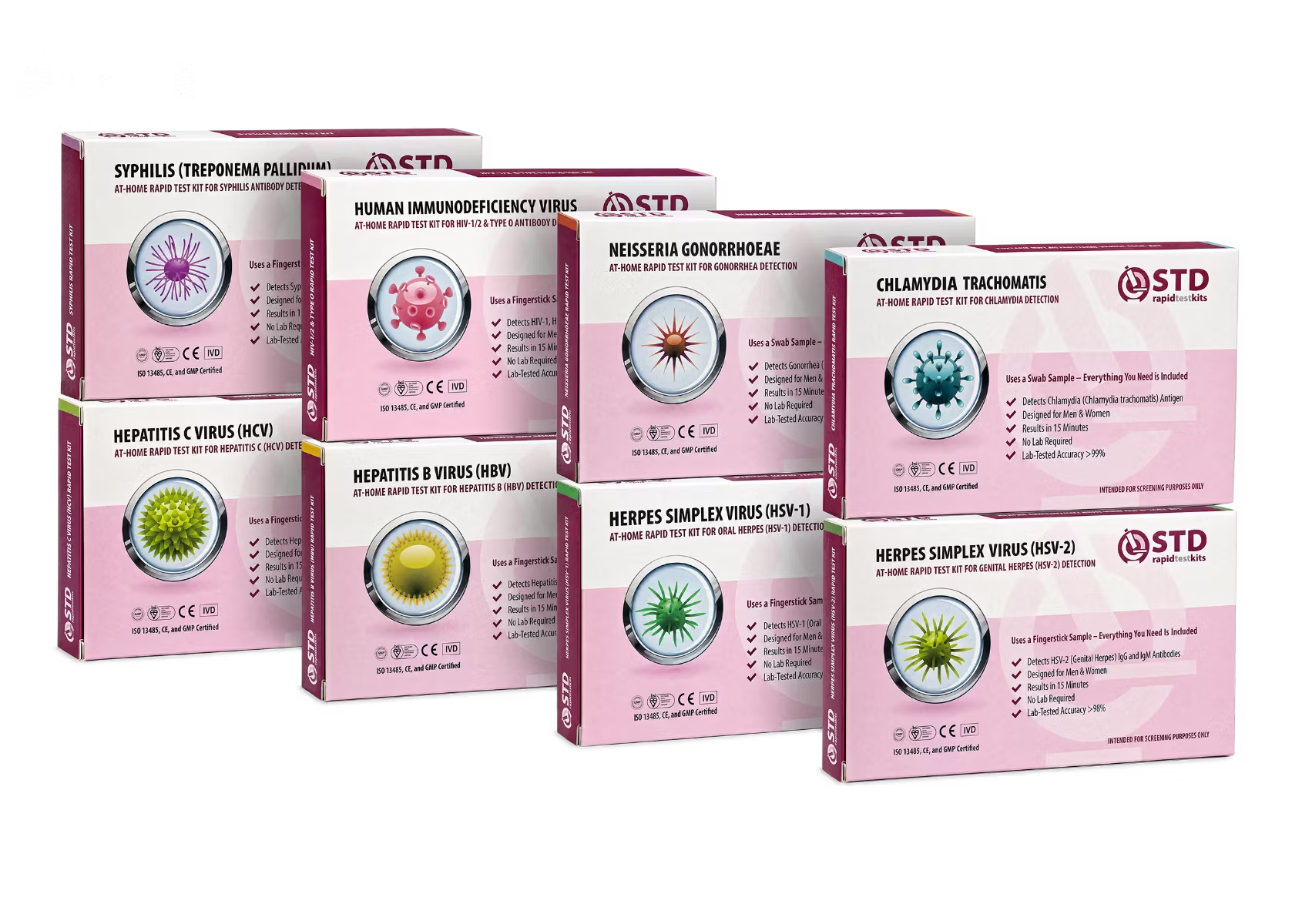
Available as at-home lateral-flow rapid tests: HIV antibody (blood), syphilis (blood), hepatitis B and C (blood), HSV-1 and HSV-2 (blood), chlamydia (swab), gonorrhea (swab), trichomoniasis (vaginal swab, women), HPV (vaginal swab, women).
Require a clinic and a lab: pharyngeal (throat) and rectal swabs for chlamydia or gonorrhea, fourth-generation HIV antigen/antibody combo testing, NAAT confirmation of any positive screen, and laboratory molecular methods for resistant gonorrhea.
How fast can I actually get STD results?
An at-home rapid lateral-flow test for HIV, syphilis, herpes, hepatitis B, or hepatitis C returns a screening result in 10 to 20 minutes once you have collected the sample. A clinic NAAT for chlamydia or gonorrhea is typically returned in 2 to 5 days, depending on the lab partner and queue volume. Mail-in self-collection kits sit in the middle: 2 to 5 days after the lab receives your sample, plus 1 to 2 days of overnight shipping each direction.
Result speed by infection: what to expect
Every infection has its own rhythm. Some have rapid lateral-flow tests available at home; some only run on lab NAAT. The table below shows realistic turnaround for each common STI, both at the clinic and at home, based on standard U.S. lab workflows and the rapid kits we sell. Times can vary by region, lab partner, and overnight-shipping availability.
| Infection | Lab gold standard | Clinic result time | At-home rapid result | Mail-in self-collection result |
|---|---|---|---|---|
| Chlamydia | NAAT (PCR) | 2 to 5 days | Lateral-flow swab, 15 to 20 minutes | 2 to 4 days post-arrival |
| Gonorrhea | NAAT (PCR) | 2 to 5 days | Lateral-flow swab, 15 to 20 minutes | 2 to 4 days post-arrival |
| Syphilis | Treponemal + non-treponemal antibody | 2 to 7 days | Lateral-flow blood, 15 to 20 minutes | 2 to 4 days post-arrival |
| HIV | Fourth-generation antigen/antibody (Ag/Ab) + RNA confirmation | 1 to 3 days | Lateral-flow antibody blood, 15 to 20 minutes | 1 to 2 days post-arrival |
| Hepatitis B / C | Antigen + antibody panel | 2 to 5 days | Lateral-flow blood, 15 to 20 minutes | 2 to 4 days post-arrival |
| Trichomoniasis (women) | NAAT or antigen | 2 to 5 days | Lateral-flow vaginal swab, 15 to 20 minutes | 2 to 4 days post-arrival |
| HPV (women) | Cervical cytology + HPV NAAT | 5 to 14 days | Lateral-flow vaginal swab, 15 to 20 minutes | Not standard |
Why timing matters more than speed
The fastest result is worthless if you tested before the infection was detectable. Every test has a window period: the gap between exposure and when antibodies, antigens, or organism counts cross the assay's detection threshold. Test inside the window and you can get a clean negative on a sample that contains an active infection.
The CDC's screening guidance gives reasonable defaults. Chlamydia and gonorrhea NAAT can detect infection from roughly 7 to 14 days after exposure for most patients. Syphilis antibody testing reliably picks up after about 3 to 6 weeks. HIV fourth-generation Ag/Ab assays detect within 18 to 45 days; rapid HIV antibody-only home tests need 23 to 90 days for reliable detection (CDC HIV Testing). For hepatitis C, antibody tests can miss a recent exposure: CDC guidance is to use an HCV RNA (NAT) test rather than relying on antibodies for any exposure within the past six months (CDC Hepatitis C Testing).
Same-day testing after a possible exposure can give you emotional triage; it usually cannot give you a final answer. Most readers should plan a follow-up at the right point in the window. For chlamydia or gonorrhea after unprotected sex, that means retesting at 14 days. For HIV, retest at 6 weeks (clinic Ag/Ab) or 12 weeks (rapid antibody) for a confident result. For syphilis, retest at 6 weeks.
If your last possible exposure was within 72 hours, even the fastest rapid test may not detect an active infection. A negative result on day 1 does not rule out infection. Use the test for immediate clarity, then retest at the right point in each infection's window period (14 days for chlamydia or gonorrhea, 6 to 12 weeks for HIV depending on assay).
When the speed of a home test changes your next move
Speed is not just emotional. There are situations where 15-minute results genuinely change what you do next, and others where the same speed mostly buys peace of mind. Knowing the difference helps you spend testing budget where it matters.
A rapid result changes your next move when:
- You are about to start a new sexual relationship. A clean rapid screen taken 2 to 3 weeks after your last possible exposure gives you and your partner a defensible starting point. A 5-day clinic wait pushes that conversation back by a week.
- You are pregnant or trying to conceive. Active untreated chlamydia, syphilis, gonorrhea, or HIV in pregnancy changes prenatal care immediately. Faster screening shortens the gap between exposure suspicion and treatment.
- You had a known exposure to a partner with a confirmed infection. Knowing your status sooner lets you start expedited partner therapy or post-exposure prophylaxis on the right timeline.
- You are traveling and far from a clinic you trust. A rapid test in a hotel room is genuinely faster than waiting for a return flight to access in-person care.
Speed mostly buys peace of mind when there is no time-sensitive decision waiting on the result. That is still valuable.
When you still need a clinic
At-home rapid tests are screening tools. They do real work, but they do not cover the full clinical picture. There are situations where the right next move is a clinic visit, regardless of how fast a home test could give you a number.
Plan a clinic appointment when:
- You have symptoms that need a physical exam. Pelvic pain, abnormal bleeding, testicular swelling, fever, or visible lesions warrant in-person assessment. A test result alone does not replace clinical evaluation.
- Your rapid test is positive. A positive lateral-flow result is meaningful, but confirmation testing matters: lab NAAT for chlamydia and gonorrhea, fourth-generation Ag/Ab and RNA for HIV, treponemal and non-treponemal panels for syphilis. CDC STI testing guidance is explicit that positive screens require confirmatory laboratory work-up.
- The infection you are concerned about is not on a swab or fingerstick panel we sell. Pharyngeal (throat) and rectal swabs for gonorrhea and chlamydia, for example, require clinic collection and lab NAAT. We do not sell pharyngeal or rectal swab kits; if exposure was oral or anal, see a clinic.
- You are pregnant. Standard prenatal STI screening is part of obstetric care. A home test is fine for early triage but not a substitute for the panel your prenatal team will run.
No HIV test can detect HIV immediately after infection. The time between when a person gets HIV and when a test can accurately detect it is called the window period.
Privacy, cost, and what at-home tests get right
Speed is the headline benefit of at-home testing. Privacy is the runner-up, and for some readers it is the deciding factor. Walking into a clinic, even a sexual health clinic, can feel like a confession when it should be a routine. Receiving an unmarked envelope and self-collecting a sample on your bathroom counter is just less freighted.
What at-home testing gets right on the privacy axis:
- Plain shipping. Kits ship in unbranded outer packaging. Nothing on the label tells your roommate or your mail carrier what is inside.
- No insurance trail. No claim filed, no explanation-of-benefits arriving at a parent's or partner's address. The transaction looks like any other small online purchase on a card statement.
- No portal upload. Your result lives on the cassette in your hand. You decide who sees it, including whether you want to share it with a clinician later.
- Self-paced. You can take the test at 11 PM on a Sunday. The cost of testing in time-off-work and copays often disappears.
Cost is the privacy-adjacent benefit most readers do not anticipate. A clinic visit without insurance can run several hundred dollars for a full STI panel; with insurance it leaves a paper trail and a copay. A rapid home kit is a single line on a card statement, no claim filed, no deductible reset. For readers comparing options on both budget and discretion, the two often line up.
Privacy is one of the strongest predictors of whether someone actually completes a screening test.

How to combine speed with certainty
The strongest testing plan rarely picks one option over another. It uses each tool for the part of the question it is best at. A two-step approach gives most readers both the immediate clarity of a rapid test and the analytical depth of a lab NAAT or fourth-generation Ag/Ab panel.
A reasonable two-step pattern looks like:
- Rapid lateral-flow at home, 1 to 7 days after the exposure event. This is your emotional triage step. A negative is not yet definitive, but it gives you a baseline and breaks the panic loop. A positive is meaningful and changes your next move immediately.
- Lab confirmation at the right window-period checkpoint. For chlamydia, gonorrhea, or trichomoniasis, that is a 14-day NAAT (clinic or mail-in). For HIV, a 6-week fourth-generation Ag/Ab panel or a 12-week rapid antibody retest. For syphilis, a 6-week treponemal antibody panel.
Most readers do not need every individual test. A combined home rapid panel covers the high-prevalence infections in one visit, and a single follow-up clinic appointment closes the loop on anything the rapid screen missed. That is faster overall than waiting for a clinic appointment alone, and more reliable than depending on rapid testing alone.
Testing rarely happens in a single moment. It tends to be a sequence: an immediate rapid screen for clarity, a follow-up lab test for certainty, and treatment if needed.
FAQs
- How long do clinic STD test results take?
- Most U.S. patients see chlamydia and gonorrhea NAAT results in 2 to 5 days, syphilis in 2 to 7 days, and HIV laboratory antigen/antibody panels in 1 to 3 days. Weekends, holidays, and provider sign-off can stretch any of those timelines. The lab assay itself runs quickly; the queue around it is what creates the wait.
- Are at-home rapid tests as accurate as lab tests?
- Lateral-flow rapid tests have higher detection thresholds than lab NAAT or fourth-generation antigen/antibody panels, so they are slightly less sensitive in the early window period. They are designed for screening, not confirmation. A positive rapid result is meaningful, and a negative result outside the window period is reliable for screening. Confirm any positive with a clinic lab panel.
- Can I test the same day as a possible exposure?
- You can take a rapid test for immediate emotional clarity, but expect it to miss early infection. For chlamydia or gonorrhea, retest at 14 days. For HIV, retest at 6 weeks with a clinic Ag/Ab panel or 12 weeks with a rapid antibody test. For syphilis, retest at 6 weeks. Same-day testing buys peace of mind, not a final answer.
- Why is a clinic STD test so much slower than the rapid kit at home?
- The lab assay itself is fast, but specimens travel through transport queues, batch processing, and provider sign-off before the result reaches your portal. Reference labs batch samples to keep cost per test low, which adds 1 to 3 days. The rapid kit at home skips every step except the chemistry, which is why it returns a result in 15 minutes.
- Do mail-in lab kits work as fast as rapid home kits?
- Mail-in kits sit between rapid and clinic testing. The lab assay is the same gold-standard NAAT a clinic uses, but you add 1 to 2 days of shipping each way plus 2 to 4 days of lab processing. End-to-end, mail-in kits land at 4 to 8 days. The advantage over a clinic visit is convenience and privacy, not raw speed.
- Which STIs cannot be tested at home with a rapid kit?
- Pharyngeal (throat) and rectal swabs for chlamydia and gonorrhea require clinic collection and lab NAAT, and we do not sell pharyngeal or rectal swab kits. HPV at-home rapid testing is validated for vaginal self-swab only (women); male HPV testing requires a clinic. Trichomoniasis rapid swab is also women-only at home.
- What if my rapid home test is positive?
- Take a breath. A positive screen is meaningful but not the final word. Schedule a clinic or telehealth appointment for confirmation testing: lab NAAT for chlamydia or gonorrhea, fourth-generation antigen/antibody and RNA for HIV, treponemal and non-treponemal panels for syphilis. Most STIs are treatable, and starting confirmation early gives you the best treatment timeline.
- How do I know I am still inside a window period?
- Each infection has a different window. Chlamydia and gonorrhea are typically detectable from 7 to 14 days after exposure. Syphilis antibody testing reliably picks up after 3 to 6 weeks. HIV fourth-generation antigen/antibody assays cover 18 to 45 days; rapid antibody-only home tests need 23 to 90 days. For hepatitis C, an antibody test can miss recent exposures; CDC guidance is to use an HCV RNA (NAT) test for any possible exposure within the past six months. If you tested inside any of these windows and got a negative, retest at the upper end of the window.
How we sourced this article: Our article was constructed based on current advice from the most prominent public health and medical organizations, then molded into simple language based on the situations people actually experience. We synthesized CDC, WHO, Mayo Clinic, and Cleveland Clinic guidance with practical product knowledge from the kits we sell. We do not provide clinical diagnosis. For symptoms or positive results that concern you, see a licensed provider.
- U.S. Centers for Disease Control and Prevention. STI testing recommendations and how to get tested.
- U.S. Centers for Disease Control and Prevention. HIV testing types, window periods, and where to get tested.
- U.S. Centers for Disease Control and Prevention. Hepatitis C testing guidance: when to use antibody testing versus HCV RNA (NAT) for recent exposures.
- Mayo Clinic. STD testing overview, sample types, and what to expect.
- World Health Organization. Sexually transmitted infections (STIs) fact sheet, including diagnostic considerations.
- Cleveland Clinic. STD/STI testing: what to expect, including timing and follow-up.
- Mayo Clinic. STD testing: what's right for you, with guidance on choosing tests by exposure and symptom profile.
