
Published: December 2025 | Last updated: May 2026 | Editorial review and quality control: Martina N.
What are the signs of chlamydia in Latina women, and what should I do?
Most women have no symptoms at all. When signs appear, they are subtle: unusual or yellowish discharge, spotting between periods, mild pelvic pressure, or burning when you urinate that mimics a UTI. Because chlamydia is usually silent, the CDC recommends annual screening for sexually active women under 25, plus a test about two weeks after any possible exposure.
Chlamydia is the most commonly reported bacterial sexually transmitted infection in the United States, and Latina women carry a disproportionate share of new diagnoses. CDC surveillance data show that as of 2018, the chlamydia rate among Hispanic or Latino people was roughly 1.9 times the rate among non-Hispanic white people (CDC, Health Disparities in Hispanic or Latino People). The gap is not about behavior. It traces back to access to care, language match with providers, insurance and clinic geography, and how often routine screening actually gets offered during a primary-care visit. The infection itself is famously quiet: the CDC describes asymptomatic chlamydia as common among both men and women, and the WHO notes that many people with chlamydia have no symptoms or only mild ones (CDC STI Treatment Guidelines; WHO Chlamydia Fact Sheet). The bacteria can quietly inflame the cervix, climb into the uterus, and scar the fallopian tubes, sometimes for years, before anything looks wrong. This guide is for any woman who suspects something is off, feels fine but wants to be certain, or needs straightforward answers without the shame that too often gets in the way.
Key Takeaways
- Chlamydia is usually silent, yet left untreated it can scar the fallopian tubes and threaten fertility, so testing (not waiting for symptoms) is the only reliable way to know your status (CDC, WHO).
- Latina women are screened less consistently in primary care, so asking for the test by name (or ordering a private at-home kit) is often the step that actually catches it.
Why chlamydia goes unnoticed in Latina women
Chlamydia spreads regardless of ethnicity. The disparity in chlamydia diagnoses among Latina women reflects uneven access to screening, language barriers in clinical settings, and assumptions providers sometimes carry about who is at risk. Three forces stack together for many Latina patients. First, sexual health is often a private subject in Latino households, so younger women may not raise it with parents, partners, or providers until something is already wrong. Second, primary-care visits in community clinics are often short, and routine STI screening tends to be offered only when a patient asks or when a pregnancy is involved. Third, common cultural framings around marriage, monogamy, and faith can quietly translate into a clinical assumption that a Latina patient does not need an STI panel.
Even when a woman shows up to a clinic, screening is not guaranteed. Providers sometimes skip an STI test if a patient describes herself as monogamous or married, even though her partner's history is unknown. Short visits, language barriers, and assumptions about risk all contribute. CDC data on health disparities in Hispanic or Latino populations attributes the gap in chlamydia outcomes to structural drivers including access to care and screening uptake rather than to differences in behavior, and the CDC's screening guidelines acknowledge that targeted outreach is needed to close those gaps (CDC, Health Disparities in Hispanic or Latino People; CDC screening recommendations). The result is that infections quietly progress while the woman believes she is being careful.
The CDC recommends annual chlamydia screening for all sexually active women under 25, and for older women with new or multiple partners. Patient-side initiative is often what gets the screening on the chart, whether that means asking a provider directly or using a private at-home test kit. This guide is published by stdrapidtestkits.com, which sells at-home STI test kits; we recommend tests based on fit for the reader's concern, not commercial benefit.
If routine STI screening is not offered at your annual visit, ask for it by name: “I would like a chlamydia test, even if I do not have symptoms.” Naming the test in plain language short-circuits the assumption that you do not need it.
The symptoms most women miss
When chlamydia does cause symptoms, they rarely look like what people imagine. There is usually no painful sore, no obvious rash, no foul odor. The signs are quieter and almost always mistaken for something else, which is why so many infections drift along untreated. The WHO notes that most people with chlamydia have few or no symptoms, and the NHS makes the same point in its testing advice: most people who have chlamydia do not notice any symptoms, so screening rather than symptom-watching forms the public-health backbone of chlamydia control (WHO Chlamydia Fact Sheet; NHS, Chlamydia).
Here are the signs women most commonly report once they look back, and the everyday explanations that initially seemed to fit. Having one or more does not confirm an infection, but it is a reason to test rather than wait:
Symptoms women most often miss
Most women have no symptoms at all. Having one or more of these does not confirm chlamydia; only a test can do that.
- Increased or yellowish vaginal discharge, often mistaken for a yeast infection or a normal cycle change Common
- Burning when urinating, easily assumed to be a urinary tract infection Common
- No symptoms at all, by far the most common pattern in women Common
- Light bleeding between periods or after sex, often blamed on rough sex, missed pills, or stress Less common
- Mild pelvic pressure or cramping, written off as period cramps or ovulation pain Less common
- Pain or discomfort during sex, rationalized as dryness or anxiety Less common
UTI or chlamydia? Why the misdiagnosis is so common
The single most common diagnostic shortcut in chlamydia care is mistaking it for a urinary tract infection. The symptoms overlap heavily: burning when urinating, lower abdominal pressure, urinary urgency. UTIs are treated with antibiotics that target gram-negative urinary pathogens. Chlamydia needs a different antibiotic class entirely, typically doxycycline for one week per CDC treatment guidelines (CDC STI Treatment Guidelines). When a clinician treats a presumed UTI without ordering a chlamydia nucleic-acid amplification test (NAAT), the wrong antibiotic clears nothing, the symptoms either fade on their own or get blamed on “recurrence,” and the bacterium continues replicating quietly in the cervix.
The misdiagnosis is not random. Research on primary-care patterns suggests women of color, including Latinas, are more often diagnosed with a UTI based on symptoms alone, without confirmatory laboratory testing, compared with white patients presenting the same complaints, part of a broader pattern of diagnostic disparity documented in CDC health-disparities data (CDC, Health Disparities in Hispanic or Latino People). Implicit assumptions about a patient's sexual history, partner count, or marital status drive part of that pattern. The protective move from the patient side is asking, in plain words, for both a urine culture and a chlamydia and gonorrhea NAAT when any urinary or pelvic symptom shows up.
If you have urinary or pelvic symptoms, the appointment-saving sentence is: “I would like a urine culture for UTI and a NAAT for chlamydia and gonorrhea.” Asking for both at the same visit prevents the round trip where a UTI prescription fails and you come back two weeks later still sick.
Why timing your test matters
Chlamydia testing is highly sensitive, but only after the bacteria have replicated to detectable levels. Test too early and you can get a false negative even though the infection is brewing. The window period for chlamydia is roughly 1 to 3 weeks, with day 14 as the practical inflection point most clinicians use for accuracy. NAAT (nucleic acid amplification test) is the standard laboratory method. At-home rapid kits use a different technology, lateral-flow immunoassay, applied to the same swab sample type, which is why the day-14 window applies to both (CDC STI Treatment Guidelines).
If you have an exposure scare and cannot wait two weeks for emotional reasons, an early test still has value. A positive result before day 14 is reliable, but a negative result needs to be confirmed with a second test once the window has fully opened. The table below shows what each phase tells you:
| Time since exposure | What testing shows | What to do |
|---|---|---|
| 0 to 6 days | Too early; bacteria may not be detectable yet | Wait, unless severe symptoms appear |
| 7 to 13 days | Detection becomes possible, but false negatives still happen | Consider an early test plus a retest at day 14 or later |
| 14 days or more | Best accuracy for chlamydia testing | Test now; this is the ideal detection window |
| 3 months after positive treatment | Standard re-screening interval | Retest to detect reinfection from an untreated partner |
When chlamydia reaches the uterus and fallopian tubes
Untreated chlamydia rarely stays put. The bacteria can travel from the cervix into the uterus and onward into the fallopian tubes, where they cause an inflammatory cascade called pelvic inflammatory disease, or PID. PID can develop with no obvious symptoms, and the scar tissue it leaves behind is what most directly threatens future fertility (CDC STI Treatment Guidelines).
The CDC Treatment Guidelines note that C. trachomatis can cause multiple serious complications in women, the most serious of which include pelvic inflammatory disease, ectopic pregnancy, and infertility. The WHO echoes this in its global fact sheet: untreated chlamydia can cause PID and an increased risk of infertility and ectopic pregnancy (WHO Chlamydia Fact Sheet). Damage accumulates with each reinfection. Even silent infections that resolve on their own (rare, but possible) can leave behind enough scarring to block an egg from passing through a fallopian tube. The reassuring side of the math: most women who catch and treat a single infection promptly never face a fertility consequence at all, which is exactly why early testing matters so much.
For Latina women, the same access gaps that delay initial diagnosis also delay PID treatment, giving the infection more time to cause cumulative tubal damage. PID treated within days usually heals without scarring. PID treated weeks later often does not. A single swab test closes that window before the scarring begins.

Cultural silence and the good-girl trap
For many Latinas, the silence around sexual health is the harder obstacle. Sex is often tied to morality in Hispanic households, and asking for an STI test can feel like confessing guilt, even when there is nothing to confess. Many young women learn early that questions about sexual health are not safe to ask out loud, and that lesson sticks long after they leave home.
This silence shapes behavior. Women who would never leave a UTI untreated will sit on a strange discharge for months, assuming yeast or hormonal variance, waiting for the body to correct itself, and blaming themselves when it does not. The infection continues doing damage during every one of those quiet months, often without any symptom strong enough to break through the assumption that nothing is really wrong.
The same biological mechanisms move chlamydia from one body to another whether you waited until marriage, whether the partner you trusted was honest, or whether contact happened once or a hundred times. A test result is medical information you can act on.
Birth control prevents pregnancy, not chlamydia
Hormonal contraception is excellent at one thing: preventing pregnancy. Pills, IUDs, implants, and the patch all work by suppressing ovulation or thickening cervical mucus to block sperm. None of those mechanisms touch a bacterium that has already entered the cervix. There is no contraceptive method that prevents a sexually transmitted infection except a barrier method (condoms for penetrative sex, dental dams or condoms for oral).
The practical risk is that long-term birth control creates a false sense of full coverage in monogamous-seeming relationships, and condom use drops. If exclusivity has not been confirmed by both partners testing negative recently, the protection is only against pregnancy. The simplest fix is a baseline test for both partners early in the relationship, before condoms come off. After that, the math is honest: continue condoms, or accept that any new outside exposure restarts the testing clock.
If condom feel is the sticking point, it is usually fixable. Thinner latex or polyisoprene brands, a few drops of water-based lubricant inside and outside the condom, and putting it on at the start of foreplay rather than the last second all reduce the friction that makes couples skip it.
| Method | Prevents pregnancy | Reduces STI transmission |
|---|---|---|
| Hormonal pill | Yes | No |
| IUD (hormonal or copper) | Yes | No |
| Implant or injection | Yes | No |
| External (male) condom | Yes, with correct use | Yes |
| Internal (female) condom | Yes, with correct use | Yes |
| Dental dam | Not applicable | Yes, for oral contact |
How at-home testing changes the dynamic
Traditional STI testing required an appointment, a clinic intake, and a conversation with a stranger about your sex life. For Latina women navigating language barriers, immigration concerns, conservative family dynamics, or the simple reality of running into someone you know in a small clinic waiting room, that model has always created friction. An at-home chlamydia test removes most of it.
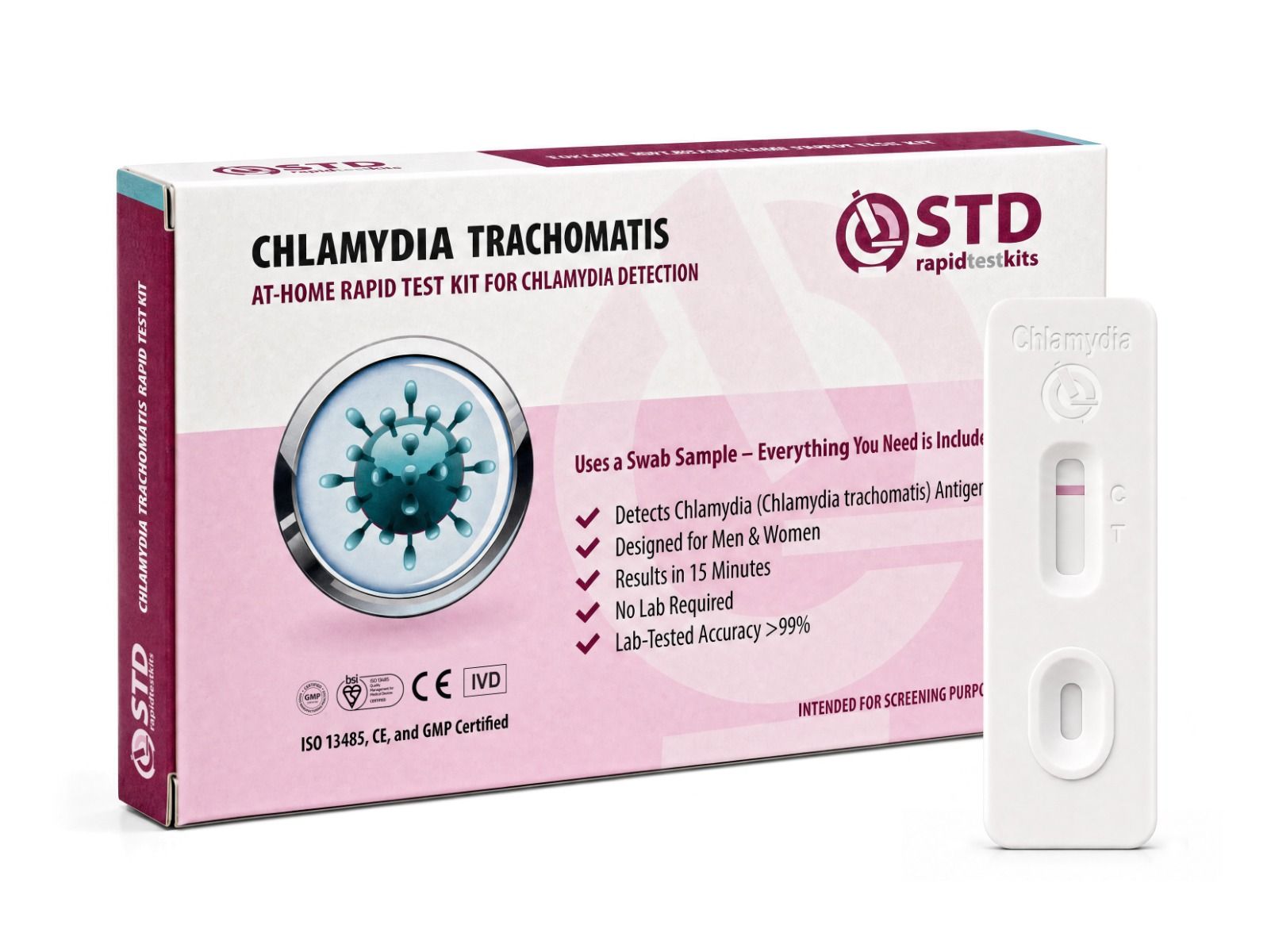
An at-home rapid test uses a self-collected vaginal swab and lateral-flow chemistry to give a clear positive or negative result in about 15 minutes. Self-collected vaginal swabs have been validated against clinician-collected swabs and are accepted for screening when used per the kit instructions (CDC STI Treatment Guidelines). The swab sample type is the same one a clinic uses for NAAT confirmation, though the laboratory NAAT remains more analytically sensitive for low-titer or asymptomatic infections, so a positive home result is worth confirming through a clinic when treatment is being prescribed. Results stay with you, no insurance claim is generated, and the package arrives in plain unmarked shipping. Below is how the main testing options compare:
| Test option | Privacy level | Speed of results | Best fit for |
|---|---|---|---|
| Clinic visit | Low to moderate | Same day to a few days | Persistent symptoms, exam needed, or treatment required onsite |
| At-home rapid test | Very high | About 15 minutes | Immediate clarity, total privacy, and routine screening with no clinic visit |
| Mail-in lab kit | High | 2 to 5 business days | A lab-confirmed result without a clinic visit |
What to do if your test is positive
First, the calm part: chlamydia is one of the most treatable bacterial infections in medicine. Standard treatment is doxycycline 100 milligrams taken twice daily for 7 days, with azithromycin as a single-dose alternative in specific situations including pregnancy (CDC STI Treatment Guidelines). No injections, no hospital stay. The medication is inexpensive, generic, and well-studied. Most women clear the infection completely with one course.
A positive result does not mean you are reckless or broken. It means your body has encountered a common bacterial infection, you found out, and you can act on it. After starting treatment, the CDC recommends abstaining from sex for at least 7 days to avoid passing the infection back and forth, and treating any current sexual partners regardless of their symptom status.
If your at-home test reads positive, the next step is contacting a clinician (in person or via telehealth) to get the antibiotic prescription. Some telehealth services can prescribe based on a self-reported positive at-home result; others will want a confirmatory clinic NAAT first. Either way, untreated chlamydia gets quieter and more entrenched over time, so do not wait. If you ever experience severe pelvic pain, fever, or unusual bleeding alongside a positive result, treat that as urgent and seek in-person evaluation rather than self-treatment, since it suggests PID.
Steps after a positive result
- Contact a clinician or telehealth service to get the antibiotic prescription.
- Complete the full antibiotic course exactly as prescribed, even if symptoms clear in the first day or two.
- Abstain from sex for at least 7 days after starting treatment.
- Notify any current and recent sexual partners so they can test and be treated.
- Book the 3-month retest before leaving the appointment so it does not slip.
Telling a partner without falling apart
The conversation after a positive result is rarely as bad as the dread of having it. Most partners react with concern rather than condemnation, especially if you keep the message short and matter-of-fact. You do not owe a confession or an apology. The goal is information that lets the other person take care of their own health.
Two short scripts work in almost every situation. For a current partner: “I tested positive for chlamydia. The treatment is one week of antibiotics. You need to get tested and treated too, otherwise we will keep passing it back. A telehealth clinic can prescribe if an in-person visit is hard.” For a recent past partner: “I tested positive for chlamydia recently. I am letting you know so you can get tested. It is treatable and most people do not have symptoms.”
You do not have to explain timelines, name other partners, or accept blame. If saying it directly feels unsafe or unworkable, most U.S. state and county health departments offer anonymous partner-notification services that contact partners on your behalf without identifying you, and many local STI clinics will route the notification through their own staff if you ask. In practice, most of these conversations end with logistics, where to get tested and how soon, rather than blame.
“I tested positive for chlamydia. You should get tested too, and if you test positive, you can get the same antibiotics I am taking.”
That is enough. No timeline, no apology, no naming names.
Why retesting is part of the plan, not optional
Antibiotics clear the current infection but do not make you immune. The CDC recommends a follow-up test about 3 months after treatment for everyone who tests positive, regardless of how you feel and regardless of whether your partner reports being treated (CDC STI Treatment Guidelines). Reinfection from an untreated partner is the single most common pattern, and the second infection is just as silent as the first.
Most repeat cases trace back to one of two sources: a partner who said they were treated but never finished the antibiotic course, so the bacterium ping-pongs between you, or a separate new exposure in the months after treatment with no fresh test ordered. Both situations resolve with the same tool, the 3-month follow-up test.
If you are under 25 or have new or multiple partners, the same annual screening rule applies even after a clean result. Think of it the way you think of a Pap smear or a dental cleaning: regular maintenance, on a calendar, separate from any specific worry. The reliable habit is to schedule the 3-month follow-up test before you finish the antibiotic course, while the appointment is still in front of you.
Not sure what to do next? Start here
Has it been at least 14 days since a possible exposure?
Yes: Test now. Day 14 and beyond is the most accurate window for both lab NAAT and at-home swab tests.
Did the test come back positive?
Yes: Contact a clinician or telehealth service for the antibiotic prescription, finish the full course, and avoid sex for 7 days after starting treatment.
Have you already been treated for chlamydia in the past few months?
Yes: Make sure recent partners are tested and treated, then book a retest about 3 months after treatment to catch reinfection.
No: Keep to routine screening: once a year if you are under 25 or have new or multiple partners.
Guidance only. A clinician can advise based on your specific situation.
Chlamydia often has no symptoms, but it can cause serious health problems, even without symptoms. If symptoms occur, they may not appear until several weeks after having sex with a partner who has chlamydia. Even when chlamydia has no symptoms, it can damage a woman's reproductive system.
FAQs
- Can I really have chlamydia and feel completely normal?
- Yes, and it is the norm rather than the exception. Most women who test positive report no prior symptoms, which is why the CDC's annual screening recommendation for sexually active women under 25 exists independently of any symptom trigger. The infection can sit quietly for weeks, months, or longer while still being transmissible and still capable of damaging the cervix, uterus, and fallopian tubes.
- How soon after sex should I test for chlamydia?
- Wait at least 14 days after potential exposure for the most accurate result. Earlier testing is possible if you cannot wait emotionally, but a negative result before day 14 should always be confirmed with a second test once the window has fully opened. Both lab NAATs and at-home rapid kits use the same swab sample type, which is why the day-14 window applies to both.
- Can you get chlamydia without penetrative sex?
- Yes. Chlamydia spreads through contact with infected genital, oral, or rectal mucous membranes, and through sex toys shared between partners without cleaning. Oral sex, anal sex, and genital-to-genital contact without penetration can all transmit it, and partners with vaginas can pass it to each other through shared toys or hand-to-genital contact. If mucous-membrane contact happened, testing is reasonable.
- Can chlamydia really feel like a UTI?
- Yes, and that overlap is one of the most common reasons chlamydia gets missed. Burning when urinating, pelvic pressure, and urinary urgency occur in both. The difference is that a UTI antibiotic does not treat chlamydia. If you have urinary symptoms after a possible exposure, ask explicitly for a chlamydia and gonorrhea NAAT alongside the urine culture.
- Does birth control protect me from chlamydia?
- No. Hormonal contraceptives prevent pregnancy by suppressing ovulation or thickening cervical mucus. Neither mechanism stops a bacterial infection. The only contraceptive options that reduce STI transmission are barrier methods (external condoms, internal condoms, dental dams). Birth control and STI protection are two separate categories of decision.
- Could chlamydia cause infertility, even if I never had symptoms or am trying to conceive?
- It can. Untreated chlamydia can climb from the cervix into the uterus and fallopian tubes, scarring tissue and blocking eggs from passing through. This is called pelvic inflammatory disease, or PID, which the CDC Treatment Guidelines list alongside ectopic pregnancy and infertility as the most serious complications of C. trachomatis infection in women, with damage accumulating after each repeat infection. Most women who treat a single infection early never face a fertility consequence. If you are pregnant or trying to conceive, tell your provider about any prior diagnosis, since untreated chlamydia in pregnancy raises the risk of premature birth and can pass to the baby during delivery as an eye infection or pneumonia (Office on Women's Health).
- Can I have chlamydia in a long-term monogamous relationship?
- Yes. The infection can have been present from before either of you started the relationship, sometimes for years, with no symptoms in either partner. A single negative test for both of you at the start of the relationship rules out current infection only at that moment. Periodic retesting is still appropriate if either partner has any prior exposure history that was never tested.
- Why do I need to retest 3 months after treatment?
- The 3-month follow-up test exists because treatment clears your infection, not your partner's. If your partner was not treated, or did not finish the antibiotic course, the bacterium returns. One follow-up test at 3 months closes that loop before another round of silent inflammation can start, and the CDC recommends it whether or not symptoms returned.
- U.S. Centers for Disease Control and Prevention. STI Treatment Guidelines, chlamydial infections section: asymptomatic infection prevalence, self-collected vaginal swab as an acceptable specimen, doxycycline first-line treatment, azithromycin alternative, complications including PID and ectopic pregnancy and infertility, and 3-month retest recommendation.
- U.S. Centers for Disease Control and Prevention. STI screening recommendations including annual screening for sexually active women under 25 and during pregnancy, with third-trimester retesting.
- U.S. Centers for Disease Control and Prevention. About Chlamydia patient overview: transmission, symptoms, complications, and permanent reproductive-system damage in women.
- U.S. Centers for Disease Control and Prevention. Health Disparities in Hispanic or Latino People: in 2018, the chlamydia rate among Hispanic or Latino people was roughly 1.9 times the rate among non-Hispanic white people, with discussion of structural drivers including access to care and screening uptake.
- World Health Organization. Chlamydia fact sheet covering global prevalence, transmission routes, asymptomatic or mildly symptomatic nature of most infections, and complications including PID, infertility, and ectopic pregnancy.
- National Health Service (UK). Chlamydia overview confirming most people with chlamydia notice no symptoms and advising testing once a year or with a new partner.
- Office on Women's Health, U.S. Department of Health and Human Services. Chlamydia A-Z topic page covering symptoms, testing, treatment, and pregnancy considerations including premature birth and newborn infection.
