
Published: October 2025 | Last updated: May 2026 | Editorial review and quality control: Martina N.
Burning when you pee, a constant urge to run to the bathroom, and a dull pressure in your lower abdomen: for most women that pattern points to one thing, a urinary tract infection. And often that hunch is right. But chlamydia, the most commonly reported bacterial STI in the United States, can produce a near-identical set of symptoms. More confusingly, in most women who carry it, chlamydia produces no obvious symptoms at all, while quietly causing damage that may surface years later as fertility problems or chronic pelvic pain (CDC, Chlamydia Basics).
This guide walks through how to tell UTI and chlamydia apart, why standard urine tests can miss chlamydia entirely, why some antibiotics help only partially, and what to do when the discomfort returns after a finished course.
Key Takeaways
- Chlamydia and UTI symptoms overlap closely enough that misdiagnosis is common, especially when a urine dipstick comes back clean but burning, urgency, and pelvic pressure persist.
- Most women with chlamydia have no symptoms at all, which is why the CDC recommends annual screening for sexually active women under 25 regardless of how they feel.
When Symptoms Look Almost Identical
UTIs and chlamydia can both start with the same red flags: burning during urination, a frequent urge to pee, lower abdominal discomfort, and sometimes cloudy urine. For many women the automatic assumption is a UTI, and in many cases that assumption holds. UTIs are extremely common in people with vaginas because of how short the female urethra is and how close it sits to bacteria from the digestive tract.
The same anatomy that makes UTIs frequent also makes the urethra a neighbor to the cervix, which is where Chlamydia trachomatis tends to set up shop. When chlamydia inflames the cervix or the urethra itself, the urinary symptoms can mirror a bladder infection almost exactly.
Picture a common scenario. A woman in her late twenties walks into urgent care with classic UTI complaints: burning, pressure, urgency. The provider runs a urine dipstick, finds trace blood but no nitrites or leukocyte esterase, and sends her home with a short course of nitrofurantoin. The pills help a little. A week later the burning creeps back, this time with light spotting after sex and a dull ache deep in her pelvis. A second visit, this time with a swab test, reveals the original cause: chlamydia, which had been there all along. The overlap between chlamydia and UTI symptoms is a recognised reason why initial evaluations miss the underlying STI, particularly when providers default to a urine dipstick without ordering an STI panel.
Cloudy or smelly urine is typical of a UTI and uncommon with chlamydia. Post-coital spotting, unusual vaginal discharge, or pelvic pain that persists despite a finished UTI antibiotic course are stronger pointers toward chlamydia. None of these is diagnostic on its own, but they shift the conversation toward an STI panel rather than a second round of UTI antibiotics.
Side by Side: How the Two Compare
Not every case follows the textbook, but the table below summarizes how each infection most often presents in women. Use it as a starting point for the conversation with your provider, not as a self-diagnosis tool.
| Symptom | Typical in UTI | Typical in Chlamydia |
|---|---|---|
| Burning during urination | Very common | Common |
| Frequent urge to pee | Very common | Sometimes |
| Cloudy or smelly urine | Often | Rare |
| Pelvic pain or pressure | Occasionally | Common |
| Bleeding after sex | Rare | Possible |
| Unusual vaginal discharge | Not typical | Common |
| Fever or chills | Possible in severe infections | Rare |
| Completely symptomless | Rare | Very common |
Why a Clean Urine Test Does Not Rule Out Chlamydia
One of the most damaging assumptions in primary care is that a clean urine dipstick rules out infection of any kind. Standard urinalysis looks for bacteria, white blood cells, and nitrites in the bladder. It is not designed to detect chlamydia, which lives inside the cells of the cervix or urethra rather than floating freely in urine. Unless your provider specifically orders a chlamydia and gonorrhea test (a NAAT, or nucleic acid amplification test, is the laboratory gold standard per the CDC STI treatment guidelines), the infection will not appear on a UTI workup.
Picture a 31-year-old who tests negative for a UTI after a week of pressure and irritation. She feels relieved but still off. Her provider chalks it up to stress or dehydration. Six months later, irregular spotting and pelvic twinges lead to a pap smear, which finally turns up chlamydia that has been silently traveling up her reproductive tract. No discharge. No odor. Just one moment when peeing felt hot, then nothing. By that point, low-grade inflammation in the fallopian tubes has already happened.
Public health bodies push routine screening for sexually active women under 25 and for anyone with a new or non-monogamous partner because most women with chlamydia have no symptoms at all (<a href="https://www.ncbi.nlm.nih.gov/books/NBK537282/" target="_blank" rel="noopener">NCBI StatPearls, urethritis differential</a>). Annual screening is the only way to catch what symptoms will not tell you.
When Antibiotics Help, but Do Not Solve It
“They gave me meds, but it never really went away.” That refrain shows up often in women treated for suspected UTIs. Most uncomplicated bladder infections clear within a few days on short-course antibiotics like nitrofurantoin or trimethoprim-sulfamethoxazole. So when burning, urgency, or pelvic pressure refuses to subside, two questions matter: was it antibiotic resistance, and was the right infection being treated in the first place?
For undiagnosed chlamydia, the antibiotic choice is everything. Nitrofurantoin concentrates in the bladder and does not reach the cervical or urethral tissues where chlamydia lives. Trimethoprim-sulfamethoxazole has limited activity against chlamydia at standard UTI dosing. The CDC-recommended treatment for chlamydia is a 7-day course of doxycycline (100 mg twice daily), with azithromycin as an alternative during pregnancy. None of these are typical UTI prescriptions.
So someone could finish the full UTI course, feel slightly better from rest and hydration, and never clear the underlying STI. Worse, the partial relief can lull them into thinking the problem is solved while the infection migrates upward. Untreated, that progression can lead to pelvic inflammatory disease (PID), associated with scarring of the fallopian tubes and elevated risk of ectopic pregnancy and infertility.
If burning, urgency, or pelvic pressure comes back within weeks of finishing a UTI antibiotic, ask your provider directly whether you were tested for chlamydia and gonorrhea, not just for a UTI. A second urine dipstick will not catch a missed STI.
Your Next-Step Decision Tree
When symptoms overlap, the decision to test for an STI should not depend only on how things feel. It should also factor in your recent sexual history, whether prior treatment actually worked, and what was tested at that visit. If the burn or pressure is back after a finished antibiotic course, ask yourself: was the original UTI confirmed by a urine culture or only a quick dipstick? Was the sample clean? Were you tested for chlamydia, gonorrhea, or trichomoniasis at the same visit?
If the answers add up to “only a dipstick, no STI panel,” it is time to widen the net. The flow below maps how to think about the next step.
Note: this site sells at-home rapid test kits, and product links in this article go to our own catalog. We recommend products based on fit-for-purpose for the reader's concern, not commercial benefit.
| If You Feel... | And Your UTI Test Was... | Consider This Next Step |
|---|---|---|
| Burning, urgency, pelvic pain | Positive | Finish treatment, but test for STIs if symptoms return or worsen |
| Same symptoms | Negative | Request a full STI screen, especially for chlamydia |
| Symptom relief followed by return within weeks | Any result | Test for chlamydia or other STIs that mimic UTI |
| Discharge, bleeding after sex, or pain during sex | UTI not confirmed | High priority for chlamydia or trichomoniasis testing |
Why Symptoms Come Back, or Never Fully Leave
Some infections shout. Others whisper, then go silent for months while damage accumulates. The second pattern is what makes chlamydia so easy to misread as a UTI, stress, dehydration, or “just how my body is sometimes.” When symptoms never fully resolve, or fade and then return, three explanations dominate.
The first is that the original infection was never treated, because UTI antibiotics did not touch it. The second is reinfection: a treated chlamydia infection cleared, then a partner who was never tested or treated passed it back. The third, more rarely, is residual inflammation from a now-cleared infection.
Consider a 28-year-old who finishes UTI antibiotics, feels fine for two weeks, then notices a return of pressure plus a new symptom: a deep, aching pain during sex and a heavier feeling in her lower belly. Rather than assuming bad luck, she uses an at-home swab test and finds out she has chlamydia. Distinguishing which of the three scenarios applied usually requires retesting after the recommended interval.
Three reasons UTI-like symptoms come back
- The original infection was never treated. UTI antibiotics like nitrofurantoin do not cover chlamydia.
- Reinfection from an untreated partner. Even a perfect course of doxycycline does not protect against re-exposure.
- Residual inflammation from a now-cleared infection. Less common, and it usually fades on its own within a few weeks.
Retesting: When, and Why It Matters
Even with a perfect course of doxycycline, you can get chlamydia again from an untreated partner. Reinfection is common enough that the CDC's STI treatment guidelines recommend retesting roughly three months after treatment for women, regardless of whether partners report being tested. Use the table below as a quick reference.
| Scenario | Recommended Retest Timing | Why It Matters |
|---|---|---|
| Finished chlamydia treatment | Re-test in 3 months | To catch any reinfection or lingering bacteria |
| Symptoms return within 30 days | Test immediately | Could be persistent or resistant infection |
| New sexual contact after treatment | Test 2 to 6 weeks after encounter | Window-period coverage and reinfection screening |
| Partner was never tested or treated | Test again within 4 to 6 weeks | High chance of reinfection even after treatment |
Which Test Fits Your Situation
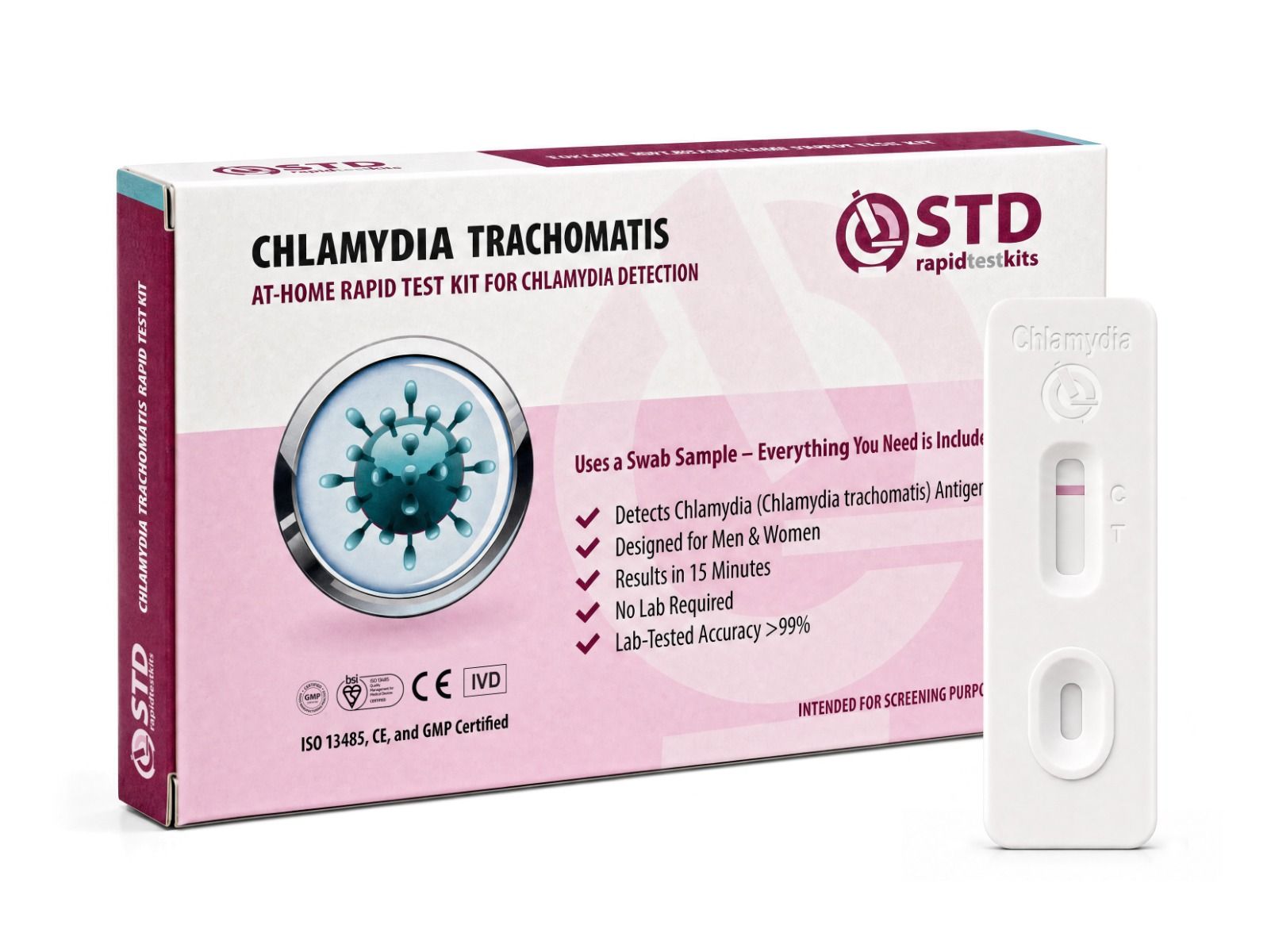
If a single-infection rapid test fits your situation, the chlamydia kit above is the most direct match. If a recent encounter has you wondering about more than chlamydia, a broader panel makes more sense, and a combined kit can cover the most common bacterial and bloodborne STIs in one purchase.
Single-infection vs combo kit, in one glance
- Pick a single-infection chlamydia kit when the question is narrow: UTI antibiotics did not fully clear symptoms, or a partner has tested positive for chlamydia specifically.
- Pick a combo kit when the question is broader: a new partner, an unprotected encounter, or symptoms (discharge, post-coital bleeding, pelvic pain) that could point to more than one infection.
- Either way, swab-based tests are most reliable starting 1 to 2 weeks after possible exposure. Bloodborne tests in a combo (HIV, syphilis, hepatitis) have longer window periods, so retest at the relevant interval if a recent exposure is the reason for testing.

After You Test: Privacy, Support, and What Comes Next
Whether the result is positive or negative, the harder part of testing is rarely the test itself. It is what comes after. Telling a partner. Sitting with the question of who passed it to whom. Or, on the other side, accepting that something else is going on and the search continues.
If chlamydia comes back positive, the treatment is straightforward and effective: a 7-day course of doxycycline (100 mg twice daily) cures most uncomplicated infections per current CDC guidelines, with azithromycin reserved for pregnancy. Many states allow telehealth prescriptions, and several services will mail the medication. The clinical part is almost always the easy part.
If the test is negative, you have not lost anything. You have ruled something specific out, which gives your provider a clearer next direction to investigate. Persistent UTI-like symptoms with negative chlamydia and gonorrhea testing might point toward interstitial cystitis, a culture-confirmed atypical UTI, or vaginal flora changes that warrant a different workup. If symptoms persist after ruling out chlamydia and gonorrhea, a referral for interstitial cystitis or a specialist pelvic workup is the appropriate next direction.
Chlamydia often has no symptoms, but it can cause serious health problems, even without symptoms.
FAQs
- Can chlamydia really feel exactly like a UTI?
- Often, yes. Burning during urination, a constant urge to pee, and pelvic pressure are all common to both. The clinical clue is what is missing or different: chlamydia rarely makes urine cloudy or smelly, and it does not respond to typical UTI antibiotics. If a “UTI” keeps coming back or never fully clears, an STI panel is the next step.
- Can I have a UTI and chlamydia at the same time?
- Yes. The bladder and the cervix sit close together, and both can be infected at once. UTI antibiotics can treat the bladder infection without touching the chlamydia, leaving you partially better and still infectious. If antibiotics helped only a little, or helped and then stopped helping, asking specifically for an STI screen at the next visit is reasonable.
- My UTI test was negative but I still feel the burning. What now?
- A negative urine dipstick rules out a typical bladder infection but does not rule out chlamydia, gonorrhea, or trichomoniasis. All three can cause urinary symptoms in women and require their own tests. A NAAT swab in clinic, or an at-home rapid lateral-flow kit, is how you check for these specifically.
- Will chlamydia clear up on its own?
- No. Chlamydia is bacterial and does not resolve without antibiotics. Symptoms may ease, but the bacteria can keep inflaming the cervix and fallopian tubes, eventually leading to pelvic inflammatory disease and a higher risk of fertility problems.
- How soon after sex should I test for chlamydia?
- Testing 1 to 2 weeks after a possible exposure gives the most reliable result for swab-based and NAAT-based tests, per the <a href="https://www.cdc.gov/chlamydia/about/" target="_blank" rel="noopener">CDC chlamydia page</a>. If symptoms appear sooner, test now and retest at the 2-week mark to confirm.
- Can I get chlamydia from oral sex?
- Yes, although oral chlamydia is less common than genital. Pharyngeal infection rarely produces symptoms, so unprotected oral exposure followed by new urinary or throat irritation is worth a full panel rather than a single-site test. At-home rapid swabs are designed for genital sampling, so a clinic-based throat swab is the better tool when oral infection is the concern.
- What if my partner refuses to get tested?
- You can still test, treat, and use barrier protection going forward. Untreated partners are the most common reason chlamydia comes back after a clean course of antibiotics. Some clinicians can prescribe expedited partner therapy in states where it is allowed, which lets you carry medication directly to a partner without an additional visit.
- Why didn't my doctor mention testing for STIs?
- Time pressure and patient assumptions both play a role. Some providers default to UTI workups in younger women without offering an STI panel unless the patient asks. Saying directly, “Can we rule out chlamydia and gonorrhea while we are here?” is a reasonable request and often changes what gets ordered.
How We Sourced This Article: Our article was constructed based on current advice from leading public health and medical organizations (CDC, Mayo Clinic, NIH/NCBI), translated into plain language for the situations real readers actually face when symptoms overlap. Specific clinical claims (treatment regimens, retesting intervals, screening recommendations) are linked inline to their primary sources.
- U.S. Centers for Disease Control and Prevention. Chlamydia basics, symptoms, and screening recommendations.
- U.S. Centers for Disease Control and Prevention. Chlamydial infections section of the STI treatment guidelines, including doxycycline regimen and retesting cadence.
- U.S. Centers for Disease Control and Prevention. Urinary tract infection (UTI) basics, risk factors, and diagnostic approach.
- Mayo Clinic. Urinary tract infection (UTI) topic page, including symptoms, causes, and when to seek care.
- U.S. Centers for Disease Control and Prevention. STI program landing page, which covers pelvic inflammatory disease as a recognized complication of untreated chlamydia.
- National Center for Biotechnology Information / StatPearls. Urethritis differential diagnosis, including chlamydial etiologies in women.
