
Published: August 2025 | Last updated: May 2026 | Editorial review and quality control: Martina N.
You can test for sexually transmitted infections without a regular doctor, without insurance, and without setting foot in a clinic. At-home rapid kits cover most of the common STIs, the privacy is real, and the science behind the chemistry is well-established. The catch is that timing, sample-collection technique, and what you do with a positive result still matter. This guide walks through what at-home testing can answer, when each test becomes reliable after exposure, and how to handle a result you did not expect.
It is also written for the reality that many people land on a page like this scared. Maybe you are uninsured, between providers, on a parent's plan, or worried about confidentiality. None of that makes you irresponsible. The aim here is calm, specific information you can act on in your own time, without anyone else having to know.
Key Takeaways
- At-home rapid STI kits cover most of the common infections (HIV, syphilis, chlamydia, gonorrhea, herpes, hepatitis B and C, trichomoniasis, and HPV for women) and do not require a prescription, an insurance card, or a clinic visit to buy or use.
- Accuracy depends on testing during the right window after exposure (1 to 16 weeks depending on the infection) and following the kit instructions exactly. A negative result taken too soon after exposure is not the same as 'no infection.'
Why "just see your doctor" is not always an option
Telling someone to "just go to the doctor" assumes a lot. It assumes they have a primary care provider on file. It assumes the visit will be affordable. It assumes the conversation will be safe. For a meaningful share of U.S. adults, at least one of those assumptions does not hold.
Common patterns this guide is written for:
- You moved cities or aged off a parent's insurance and have not lined up a new provider.
- You are uninsured, or on a high-deductible plan where a clinic visit comes with a real out-of-pocket cost.
- You share insurance with a partner or parent and do not want sexual-health care to show up on the explanation of benefits.
- You are worried about being judged, misgendered, or lectured at urgent care.
- You are traveling, between jobs, in a temporary living situation, or simply prefer to handle this privately first.
None of those are unreasonable barriers. Avoidance after a possible exposure is also one of the most common things readers describe, and it almost always makes the anxiety worse than the test result would. The good news is that the testing infrastructure has caught up. You can buy a regulated at-home kit, collect a sample, and have an answer in about 15 minutes, or hand the same situation off to a telehealth clinician later if you want a second opinion.
What at-home STI testing screens for
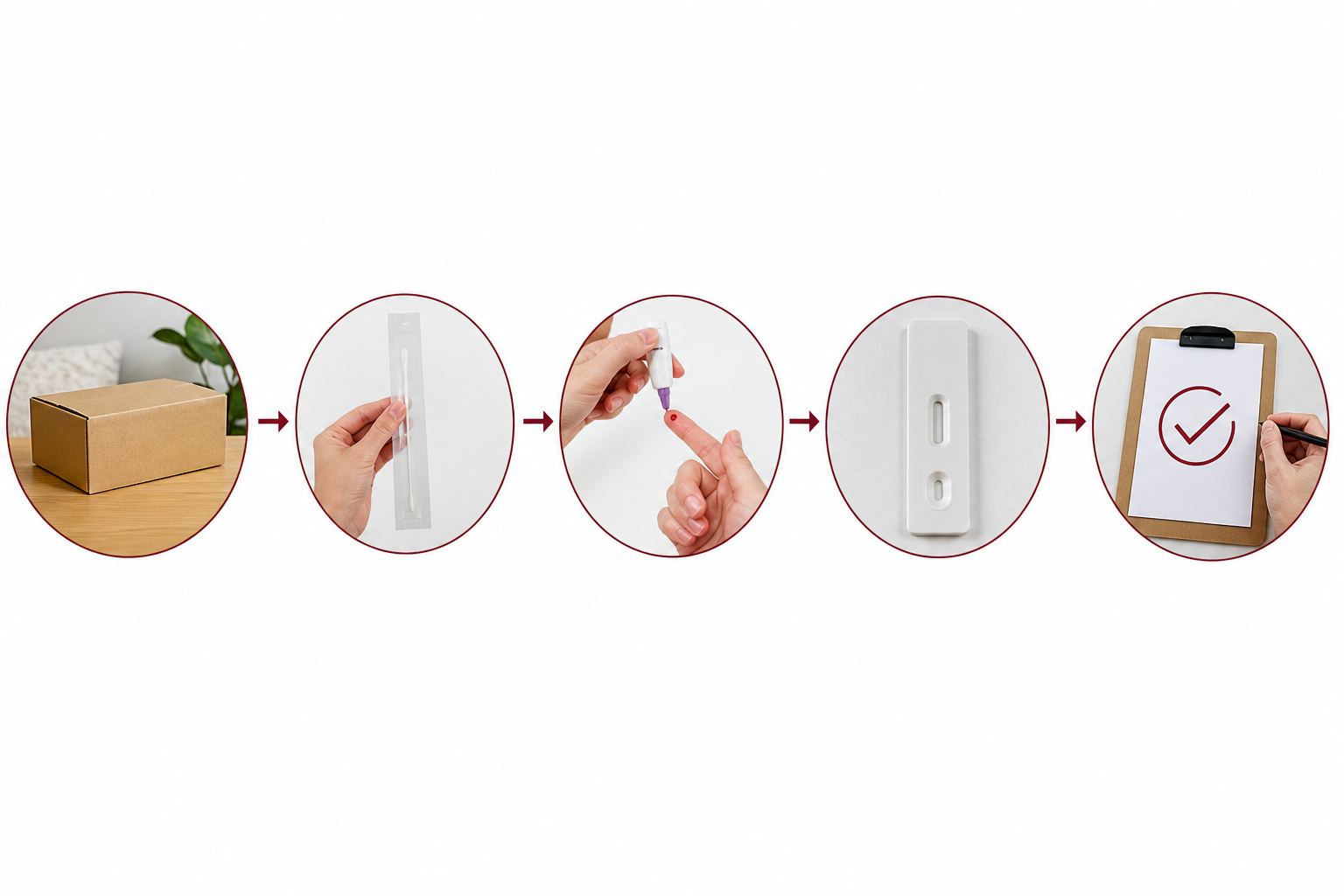
An STI test does not require a clinical exam in most cases. The majority of routine STI screening relies on samples that are easy to collect at home: a self-administered swab of the vaginal or penile area, a fingerstick blood sample, or for some lab-based panels, an oral swab. Stirrups and fluorescent lights are not part of the diagnostic chemistry; they are part of the clinic workflow that may or may not apply to you.
Two formats dominate the at-home testing market:
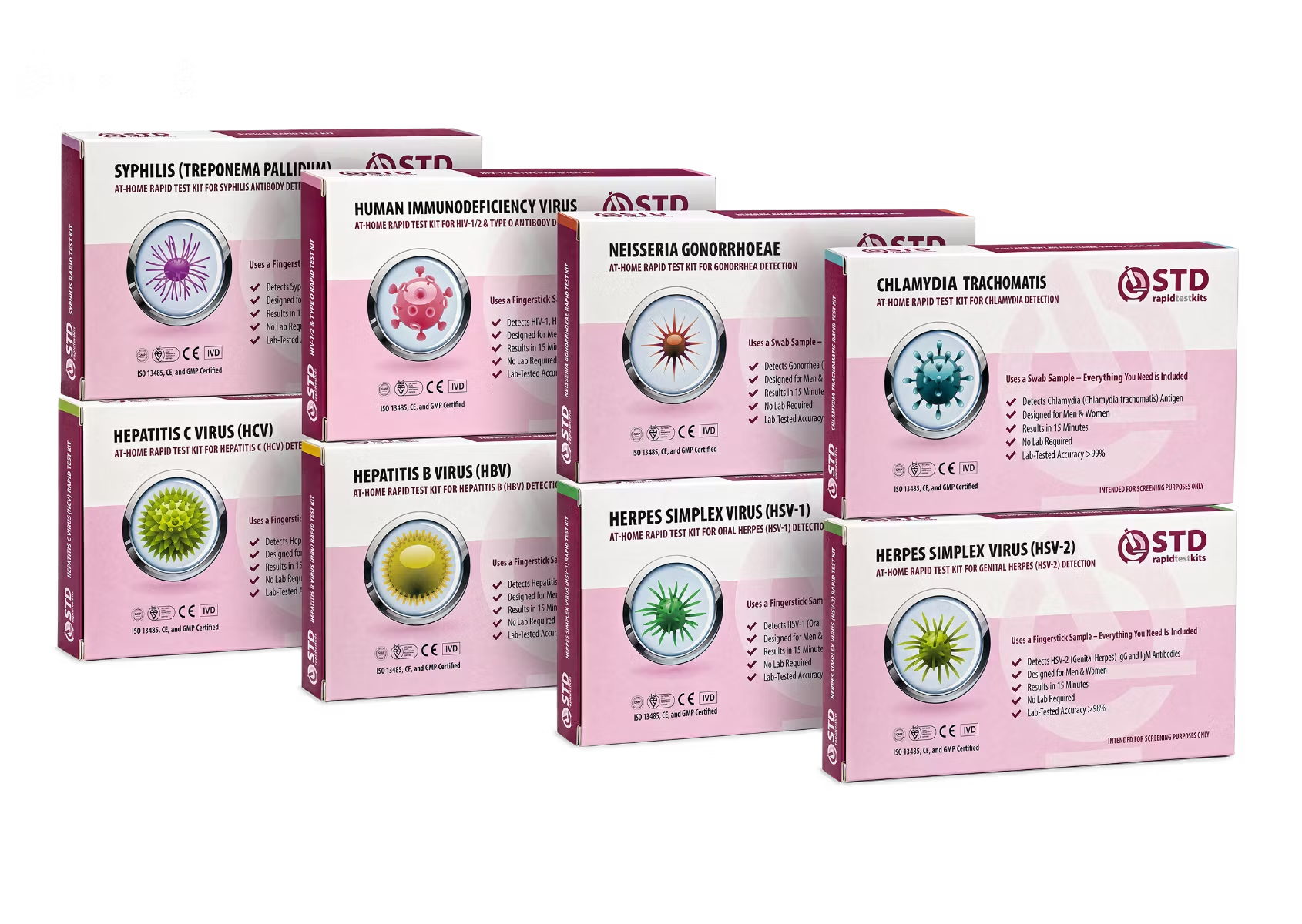
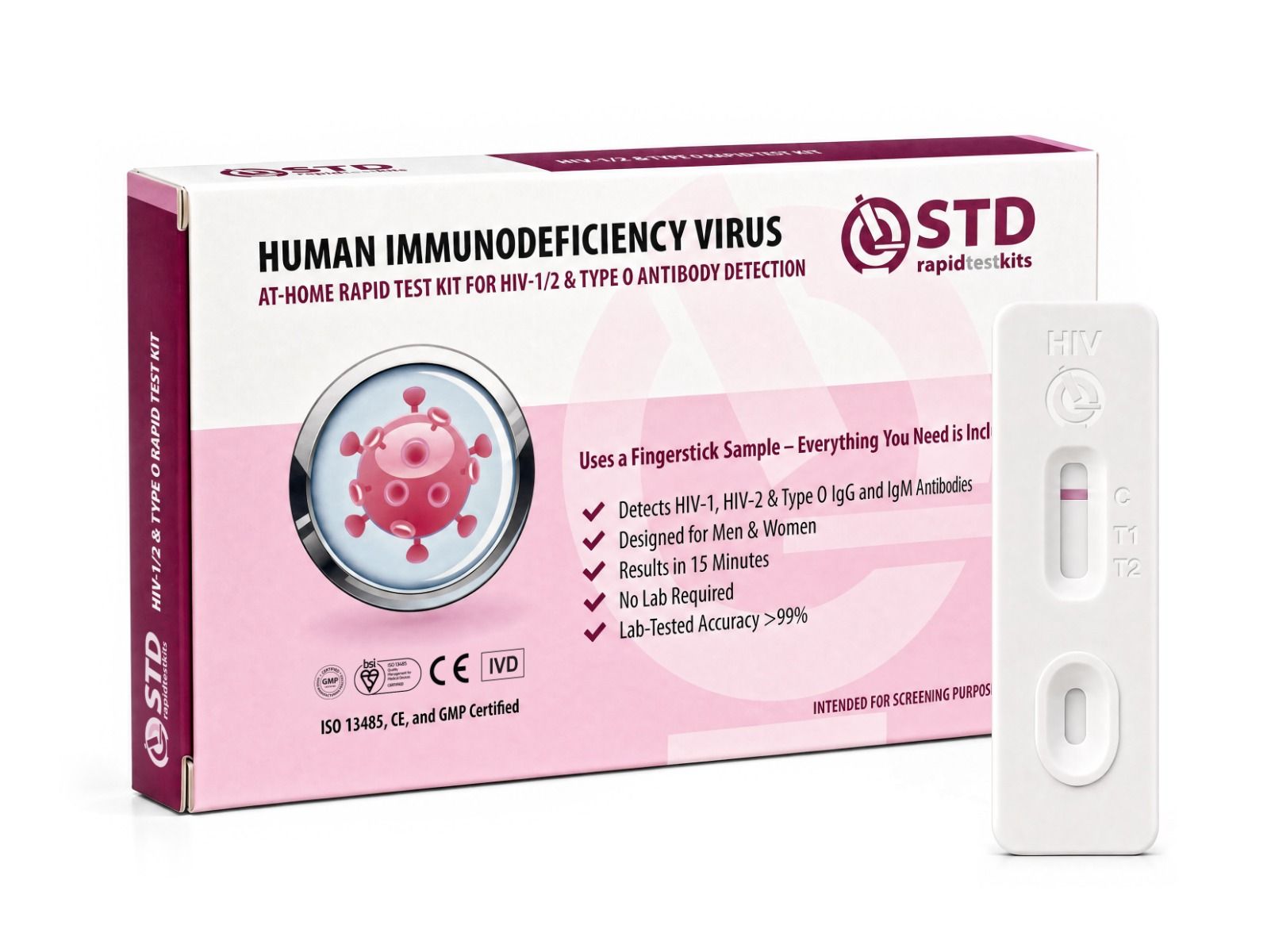
- Rapid lateral-flow kits. You collect the sample, run the test on a small cassette at home, and read the result in roughly 15 minutes. These are commonly used for HIV, syphilis, herpes (HSV-1 and HSV-2 antibody screening), hepatitis B and C, and combination panels. The chemistry is the same lateral-flow technology used in pregnancy tests and rapid COVID-19 tests, optimized for STI antibodies or antigens.
- Self-collected samples processed by a lab. You collect a sample at home and mail it to a certified laboratory, which runs a nucleic-acid amplification test (NAAT or PCR). Results typically arrive digitally in two to five days. This is the format usually used for chlamydia, gonorrhea, and trichomoniasis when ordered through a lab service.
The rapid lateral-flow kits sold here cover the at-home, results-in-minutes path. They are not the same chemistry as a lab NAAT, and the comparison is worth being precise about: lab NAAT generally has the highest analytical sensitivity, particularly in early or asymptomatic infection. Lateral-flow rapid kits trade a small amount of that sensitivity for speed, privacy, and the ability to screen at home with no appointment. For most purposes, that trade is fine. A reactive (positive) rapid result should still be confirmed with a lab test where possible, and a non-reactive result soon after exposure may need to be repeated as the window closes (CDC: Getting Tested for STIs).
Window periods: why testing too early can mislead you
Every STI has a window period, the gap between exposure and the point at which a test can reliably detect the infection. Test before the window closes and a real infection can read as a clean negative. This is the single most common reason at-home tests get blamed unfairly. The chemistry was fine. The timing was off.
The table below summarizes the windows that matter most for the infections covered by at-home kits. The figures reflect common clinical-guidance ranges drawn from CDC testing guidance and FDA-approved assay package inserts; specific timing varies by individual immune response and by the assay used. For general CDC testing guidance, see CDC: Getting Tested for STIs; the HIV-specific window periods in the rows below are drawn from the CDC HIV Testing page. Treat the "earliest reliable detection" column as a floor and the "recommended testing point" column as the value that gives the most confidence.
Window periods vary by infection and test type. Testing too early can produce a false negative. Retesting at the recommended point closes that gap.
The practical rule of thumb: if you test soon after a possible exposure and the result is non-reactive, mark the calendar and retest at the recommended point above before you call yourself in the clear. This is especially important for HIV, syphilis, and herpes, where seroconversion takes weeks.
| Infection | Test type | Sample | Earliest reliable detection | Recommended testing point |
|---|---|---|---|---|
| Chlamydia | NAAT (lab) or rapid swab (home) | Self-collected swab | About 1 to 2 weeks | 2 weeks after exposure |
| Gonorrhea | NAAT (lab) or rapid swab (home) | Self-collected swab | About 1 to 2 weeks | 2 weeks after exposure |
| Trichomoniasis (women) | NAAT (lab) or rapid swab (home) | Self-collected vaginal swab | About 1 to 2 weeks | 2 to 4 weeks after exposure |
| HIV (4th-gen Ag/Ab) | Lab antigen/antibody | Blood draw | About 18 to 45 days | 6 weeks after exposure |
| HIV (rapid antibody) | Rapid antibody (home) | Fingerstick blood | About 23 to 90 days | 12 weeks after exposure |
| Syphilis | Treponemal antibody (home or lab) | Blood | About 3 to 6 weeks | 6 to 12 weeks after exposure |
| Hepatitis B | HBsAg antigen | Blood | About 3 to 6 weeks | 6 to 12 weeks after exposure |
| Hepatitis C | Antibody screen | Blood | About 4 to 10 weeks | 12 weeks after exposure |
| Herpes (HSV-2) | Type-specific antibody | Blood | About 6 to 12 weeks | 12 to 16 weeks after exposure |
How accurate are at-home rapid tests, really?
The honest answer is more useful than the marketing one. At-home rapid lateral-flow tests are not the same chemistry as a clinic NAAT. Used inside their window and according to instructions, the well-validated rapid kits perform competitively for screening purposes, particularly for blood-based infections like HIV and syphilis where antibody titers are well-characterized. They are not a substitute for confirmatory laboratory testing after a reactive result, and they are not a replacement for clinical evaluation if symptoms persist.
Three things determine whether a home test gives you a useful answer:
- Window timing. See the previous section. This is the single biggest source of "the test was wrong" stories.
- Sample collection. A swab that did not contact the right tissue, a fingerstick that did not produce enough blood, or a buffer step skipped, all degrade accuracy. Read the instructions twice before you open the kit.
- Test technology fit for the question. A blood antibody test for HSV-2 cannot tell you whether a specific lesion you are looking at right now is herpes; it tells you whether you have ever seroconverted to HSV-2. For an active lesion of unknown cause, a clinic swab and PCR is the right tool. For "is herpes in my history?", an antibody test is appropriate.
Here is how the three main testing routes compare:
| Route | Sample collection | Test method | Result time | What it adds |
|---|---|---|---|---|
| At-home rapid kit | You, at home | Lateral-flow immunoassay | About 15 minutes | Speed, privacy, no clinic visit |
| Mail-in lab kit | You, mailed to lab | Lab NAAT or PCR | 2 to 5 days | Higher analytical sensitivity for some infections |
| Clinic visit | Clinician or self-collected at clinic | Lab NAAT, PCR, plus exam | 1 to 7 days | Confirmatory testing, treatment same visit, exam if needed |
If your at-home test comes back reactive (positive)
A positive result is not the end of anything. Most STIs are either curable with a short course of antibiotics (chlamydia, gonorrhea, syphilis, trichomoniasis) or manageable long-term with effective medication (HIV, herpes, hepatitis B and C). After a reactive home test, the path forward runs the same way regardless of which infection is involved:
- Confirm the result. For HIV and syphilis especially, a reactive rapid test should be followed by a confirmatory lab test. This is standard practice, not a sign the home test was wrong. Many telehealth clinics will order the confirmation and the prescription in the same visit.
- Reach a clinician, even briefly. Telehealth platforms can issue prescriptions for chlamydia and gonorrhea after reviewing your test result and risk factors. For HIV, syphilis, herpes, or hepatitis, you want a clinician relationship to manage treatment and follow-up testing. The visit can be 15 minutes long and remote.
- Start treatment promptly. Bacterial STIs respond quickly to the right antibiotic; the sooner you start, the lower the risk of complications and onward transmission. Antiviral therapy for HIV is most effective when started early, and same-day prescription pathways exist in most U.S. states.
- Tell partners on your own timeline. Partner notification is important for public health, but you choose how, when, and whether you do it directly. Anonymous partner-notification services exist (Tell Your Partner, Don't Spread It, and similar tools) if you want to deliver the message without disclosing your identity.
What a reactive result is not: a verdict on your worth, your future relationships, or your fertility. STIs are common, treatable, and frequently asymptomatic, which is why public-health agencies emphasize testing rather than waiting for symptoms.
Many STIs do not show signs or symptoms, which means testing is the only reliable way to know your status.
Privacy: what shows up on bills, packages, and records
For many readers the biggest barrier to testing is not the test, it is the visibility. Will the pharmacist see what you bought? Will a roommate read the box label? Will the charge appear on a shared insurance statement? These are reasonable questions, and the answers are mostly reassuring.
What at-home test kits typically look like in transit: plain outer boxes, no clinical or sexual-health branding on the exterior, no return-address that announces the contents. Billing on a credit card statement usually shows a generic merchant name rather than "STI test kit." Because the kit is purchased directly with a card and not run through insurance, there is no explanation-of-benefits statement, no claim sent to a primary care doctor, and no entry added to your medical record.
The privacy edges to be aware of:
- If you later use telehealth to confirm a positive result and pay through insurance, that telehealth visit and any prescription can generate insurance documentation. Self-pay options exist if you want to avoid this entirely; many telehealth platforms have a flat self-pay tier for STI consultations.
- Some states have public-health reporting requirements for specific infections (HIV, syphilis, gonorrhea, chlamydia). These reports are anonymized in most cases and do not appear in personal records, but the lab confirming a positive may be required to notify the state health department.
- If you order to a shared address, the package looks generic, but the recipient name on it is yours. P.O. boxes and addresses other than your home work for most shippers.
Symptoms but no provider: how to triage yourself
The hardest version of this situation is symptoms with no doctor. Burning with urination, an unfamiliar discharge, a new bump, an itch that will not settle. Symptoms in the genital area are also common from causes that are not STIs at all (yeast, bacterial vaginosis, latex allergy, friction, urinary tract infection), which is part of why a triage step matters before assuming the worst.
A practical triage:
- Note the specifics. What does it feel like? When did it start? Is it bilateral? Is there discharge, bleeding, fever, pelvic pain, lymph-node swelling? Specifics narrow the differential.
- Check the timeline against any possible exposure. If symptoms started within a few days of an unprotected encounter, an STI is on the list. If symptoms started weeks before that, an STI is less likely to be the cause, though still possible.
- Watch the trajectory. Symptoms that worsen quickly (severe pelvic pain, fever above 101°F, painful swelling, inability to urinate) need urgent care, not at-home testing. Symptoms that are stable or annoying but not escalating can be tested at home as a starting point.
- Test, then escalate if needed. An at-home rapid panel can rule a lot of things in or out within minutes. If the panel is non-reactive but symptoms persist, that is the signal to use telehealth or urgent care, not the signal to wait it out.
Some specific cases where at-home rapid testing is not the right tool: a visible active lesion of unknown cause (a clinic swab and PCR is the right diagnostic for the active lesion), suspected pelvic inflammatory disease, severe abdominal or pelvic pain, suspected pharyngeal or rectal infection (we do not sell throat or rectal swab kits, and these sites need clinic testing). For those situations, a same-day urgent care or telehealth visit is the right path, with at-home rapid kits used afterward for systemic blood-based infections like HIV or syphilis.
Doctor-free does not mean clinician-never
The premise of this guide is that you do not need a regular primary care relationship to start testing. That is true. It is also worth being clear about where a clinician relationship still adds value: confirming a positive rapid result, prescribing antibiotics for a confirmed bacterial STI, managing antiviral therapy for HIV or hepatitis B and C, ordering targeted tests that home kits do not cover (pharyngeal or rectal NAAT, for instance), and following up over time when treatment outcomes need monitoring.
The good news is that almost none of those interactions require an in-person doctor you have known for years. The American Sexual Health Association maintains a directory of testing resources by state and zip code (ASHA: Get Tested for STIs), and Planned Parenthood publishes a guide to STI testing options and confidentiality (Planned Parenthood).
The pattern that works for most readers: test at home for the immediate question, get an answer in minutes, and then loop in a clinician (telehealth or local clinic) only if the result is reactive or symptoms persist. That is privacy, speed, and clinical follow-through in the right order, without the fear of asking and without the cost of a visit you may not need.
- Telehealth platforms with self-pay tiers handle most STI consultations and prescriptions remotely.
- Public sexual-health clinics in most U.S. cities offer low-cost or free STI testing and treatment.
- Federally Qualified Health Centers operate on sliding-scale fees regardless of insurance status.
- Planned Parenthood health centers provide affordable STI testing and treatment in most states.
- State health departments often offer expedited partner therapy for partners of confirmed cases.
FAQs
- Do I really need a doctor to test for STIs?
- No. At-home rapid kits and self-collected mail-in lab kits cover most common STIs and do not require a prescription, an insurance card, or a clinic visit to use. A clinician relationship still helps if a result is reactive, if you need treatment, or if symptoms persist, but the testing step itself is something you can start on your own.
- Are at-home rapid tests as accurate as lab tests?
- Home rapid kits and lab NAATs use different chemistry and serve different needs. Labs offer higher analytical sensitivity, especially for early or low-level infection. The rapid kit delivers a result in 15 minutes at home and is well-suited to screening. The simple rule: use the rapid kit to screen; use a lab confirmation if the result is reactive or if symptoms persist despite a negative.
- How long after a possible exposure should I test?
- It depends on the infection. Chlamydia and gonorrhea typically become detectable about two weeks after exposure. HIV antibody-only rapid tests are most reliable around 12 weeks; 4th-generation lab tests close that window earlier. Syphilis, hepatitis, and herpes seroconversion can take 6 to 16 weeks depending on the infection. Testing once at the earliest detectable point and again at the recommended testing point is the safest pattern. See the window-period table above for the full breakdown.
- What if my at-home test is reactive (positive)?
- Confirm the result with a lab test where possible (especially for HIV and syphilis), reach a clinician through telehealth or a local clinic, start treatment promptly if indicated, and notify partners on your own timeline. Most STIs are either curable with a short antibiotic course or manageable long-term with effective medication. A reactive home result is the start of getting cared for, not a verdict.
- Can I get treated without a regular primary care doctor?
- Yes. Telehealth platforms can prescribe treatment for chlamydia and gonorrhea after reviewing test results. Public sexual-health clinics, Federally Qualified Health Centers, and Planned Parenthood provide low-cost or free STI care regardless of insurance status. Many state health departments offer expedited partner therapy for partners of confirmed cases. None of these require a long-standing provider relationship.
- Will an at-home kit show up on my insurance or medical record?
- When you pay out of pocket for a kit, the purchase is not run through insurance and does not generate an explanation of benefits. The kit purchase does not get added to your medical record. The privacy edge to be aware of: if you use insurance for a follow-up telehealth visit or laboratory confirmation after a reactive result, that visit can generate insurance documentation. Self-pay telehealth options exist if you want to keep the entire path off insurance.
- Are at-home tests private and discreet in shipping and billing?
- Reputable at-home test sellers ship in plain outer boxes with no clinical or sexual-health branding. Credit card billing typically shows a generic merchant name rather than the kit description. The recipient name on the package is yours, so a shared-address situation is the main thing to plan around. P.O. boxes and alternative shipping addresses work for most shippers.
- Can I use an at-home kit if I already have symptoms?
- Sometimes yes, sometimes no. At-home rapid panels can quickly screen for the systemic blood-based infections (HIV, syphilis, hepatitis) and the common bacterial swab-based infections (chlamydia, gonorrhea, trichomoniasis for women). They are not the right tool for an active visible lesion of unknown cause (a clinic swab and PCR is), for suspected pelvic inflammatory disease, or for pharyngeal or rectal infections (which need clinic testing because we do not sell throat or rectal swab kits). Severe pain, high fever, or rapidly worsening symptoms call for urgent care, not at-home testing.
- U.S. Centers for Disease Control and Prevention. Getting Tested for STIs: who should test, what tests are available, and how testing works.
- U.S. Centers for Disease Control and Prevention. HIV Testing: window periods for 4th-generation antigen/antibody tests and rapid antibody tests, and confirmatory testing pathways.
- U.S. Centers for Disease Control and Prevention. About Sexually Transmitted Infections: overview of common STIs, transmission, and reasons to test.
- American Sexual Health Association. Get Tested for STIs: testing locator, sample types, and follow-up steps after a positive result.
- Planned Parenthood. STI testing services, costs, and confidentiality guidance.
