
Published: November 2025 | Last updated: May 2026 | Editorial review and quality control: Martina N.
The moment your partner tells you they tested positive for gonorrhea, your mind probably starts racing. Do I have it? Why don't I feel anything? How did this happen? Those questions are valid, and most of them have answers. Almost all of them lead to the same practical place: get tested at the right time, get treated if needed, and coordinate care so the infection doesn't bounce between you.
This guide walks through what doctors actually recommend after a partner's gonorrhea diagnosis. The window period for testing, the symptoms that show up (and the ones that never do), the treatment that works in a single visit, and the steps that prevent reinfection. The goal here is clarity, not panic. Many people in this exact situation walk away with a negative result, a quick course of antibiotics, or both, and put the whole episode behind them within a month.
Key Takeaways
- Gonorrhea spreads through sexual contact, but exposure does not guarantee infection. The only way to know your status is a test taken at the right time after exposure.
- No symptoms does not rule out gonorrhea. Pharyngeal and rectal infections are silent in most cases, so testing is what tells you where you stand.
Exposure Does Not Automatically Mean Infection
One of the most common assumptions after a partner's positive test is that you must have it too. In reality, transmission depends on the type of sexual contact, how often it happened, and whether protection was used. Gonorrhea spreads through contact between mucous membranes (the lining of the genital tract, throat, rectum, and eyes) and infected secretions during vaginal, anal, or oral sex (CDC gonorrhea overview). Casual contact, sharing food, or touching surfaces does not transmit it.
Per-act transmission risk varies. Receptive anal sex carries higher risk than vaginal sex. Male-to-female and female-to-male vaginal transmission rates differ because of anatomical exposure patterns, and the cumulative risk climbs with repeated unprotected contact. Oral transmission is documented but generally lower, with pharyngeal infections often acquired through performing oral sex on an infected partner. Some people contract gonorrhea after a single exposure; others have repeated unprotected contact with an infected partner and never test positive. The only way to know which group you are in is a test taken at the right time.
| Exposure Type | Approximate Per-Act Risk | Notes |
|---|---|---|
| Unprotected vaginal sex | Moderate to high | Female-to-male and male-to-female rates differ; cumulative risk rises with repeated exposure |
| Unprotected anal sex (receptive) | High | Rectal infections are often asymptomatic and easy to miss without targeted testing |
| Unprotected oral sex | Lower but documented | Pharyngeal (throat) infections are usually silent; they spread onward without warning |
| Consistent correct condom use | Substantially reduced | Condoms do not eliminate risk entirely, especially when oral contact is involved |
Most Gonorrhea Infections Cause No Symptoms
Asymptomatic gonorrhea isn't unusual. In several anatomic sites, it's the norm. The CDC notes that gonorrhea often has no symptoms and that most women with the infection have none at all (CDC). Pharyngeal and rectal infections are silent the majority of the time. Symptomatic urethral infection in men is the case most likely to come with obvious warning signs, but even there a meaningful share of infections produce no symptoms.
Asymptomatic infections matter because the absence of symptoms tells the carrier nothing, and because silent carriage in the throat or rectum is exactly how gonorrhea circulates through sexual networks for months without detection. Someone carries the bacteria without realizing it, onward transmission continues during routine sexual contact, and the infection only surfaces when a partner happens to get tested. If your partner tested positive and you feel completely fine, the absence of symptoms is not evidence of the absence of infection.
Throat and rectal gonorrhea infections most often produce no symptoms at all. If your exposure included oral or anal contact, ask your provider for site-specific swab testing, not just a urine sample. A urine test will miss pharyngeal or rectal infections.
When to Test After Exposure
Modern gonorrhea tests use nucleic acid amplification (NAATs) and are far more sensitive than older culture-based methods. They can detect the bacteria earlier and more reliably. The CDC recommends testing for gonorrhea as soon as someone learns they may have been exposed; if the initial test is negative and the most recent exposure was very recent, a repeat test about two weeks later confirms the result.
The reason for the wait is the window period: the gap between when the bacteria first enter the body and when there's enough genetic material in a sample for the test to detect. For gonorrhea NAATs, that window is short compared with other STIs, often as little as a few days. Most infections become detectable within a week of exposure, which is why many providers suggest testing about 5 to 7 days after the contact in question.
If your partner's diagnosis came from a long-standing asymptomatic infection (which is common), the exposure may have occurred weeks or months earlier. In that case, the window has already passed, and testing immediately gives a reliable answer.
| Time Since Most Recent Exposure | What a NAAT Result Means | Recommended Action |
|---|---|---|
| 0 to 3 days | Too early; many infections not yet detectable | Wait, or test now and plan to retest |
| 5 to 7 days | Most infections detectable | Good window for first test |
| 10 to 14 days or longer | High reliability | A single test is usually sufficient; retest if symptoms appear later |
| Exposure was weeks or months ago | Window has already passed | Test now for a reliable result |
Symptoms to Watch For (and Why Most People Have None)
When gonorrhea does produce symptoms, they typically appear within 1 to 14 days after infection. The NHS notes that onset is usually around 2 weeks after infection, although symptoms sometimes do not appear for many months (NHS). The presentation varies by site of infection. Many symptoms get mistaken for unrelated issues: mild urethral burning gets attributed to dehydration or a urinary tract infection, a scratchy throat gets blamed on allergies, and rectal discomfort goes unmentioned or gets attributed to hemorrhoids.
If you do notice anything new in the days after a possible exposure, don't wait for it to worsen before testing. And if you notice nothing at all, don't let that delay testing either.
| Location of Infection | Symptoms (When Present) | How Often It's Asymptomatic |
|---|---|---|
| Urethra (men) | Burning during urination, white or yellow penile discharge, occasionally testicular pain | A meaningful minority of cases have no symptoms |
| Cervix (women) | Increased vaginal discharge, intermenstrual bleeding, mild pelvic discomfort | Most cases have no symptoms |
| Rectum | Anal itching, mild discharge, soreness, sometimes painful bowel movements | Most cases have no symptoms |
| Pharynx (throat) | Rarely, mild sore throat | Almost all cases have no symptoms |
What Doctors Actually Recommend After Partner Exposure
Current CDC STI treatment guidelines spell out a specific protocol when a partner has been diagnosed with gonorrhea. All sex partners within the 60 days before the index patient's symptoms or diagnosis should be evaluated, tested, and treated, regardless of whether they have symptoms themselves (CDC 2021 STI Treatment Guidelines). If the most recent sexual contact was more than 60 days before the partner's diagnosis, that one most recent partner should still be evaluated.
In practical terms, this means: get tested for gonorrhea at all anatomical sites where exposure occurred (urethral or vaginal, rectal, and pharyngeal as relevant). Add chlamydia testing at the same visit, because co-infection is common and a significant share of gonorrhea-positive patients also test positive for chlamydia. Be prepared to discuss presumptive treatment with your provider; many clinicians will start antibiotics without waiting for results when partner exposure is confirmed, especially if you have any symptoms or might not return for follow-up.
In many U.S. states, providers can also use Expedited Partner Therapy (EPT), where the diagnosed patient receives medication or a prescription to give directly to a partner without a separate clinical visit (CDC EPT clinical guidance). Availability and rules vary by state, so ask your provider what's legal where you live. If EPT is not available in your state, the fastest alternative is an urgent-care or sexual health clinic visit for your partner; same-day walk-in appointments are widely available at Planned Parenthood locations and local health departments.

Reinfection: Why Couples Pass It Back and Forth
One of the most common ways gonorrhea sticks around in a relationship is the ping-pong effect. One partner gets diagnosed and treated. The other delays testing, skips treatment because they feel fine, or resumes sex before treatment is fully complete. The treated partner is reinfected by the untreated partner, and the cycle restarts.
The CDC's guidance is straightforward. Both partners should complete treatment and wait until at least 7 days after the last dose of medication, with any symptoms fully resolved, before resuming sex (CDC treatment guidelines). Until then, abstinence or consistent condom use is what prevents the bounce-back.
It sounds obvious written out. In practice, many couples skip this step because the treated partner feels better quickly, the untreated partner feels fine the whole time, and there's no visible reason to pause. The reason is invisible bacterial transmission, which is precisely why coordinated testing and treatment, paired with a brief abstinence window, are the only reliable way out.
Where At-Home Tests Fit In
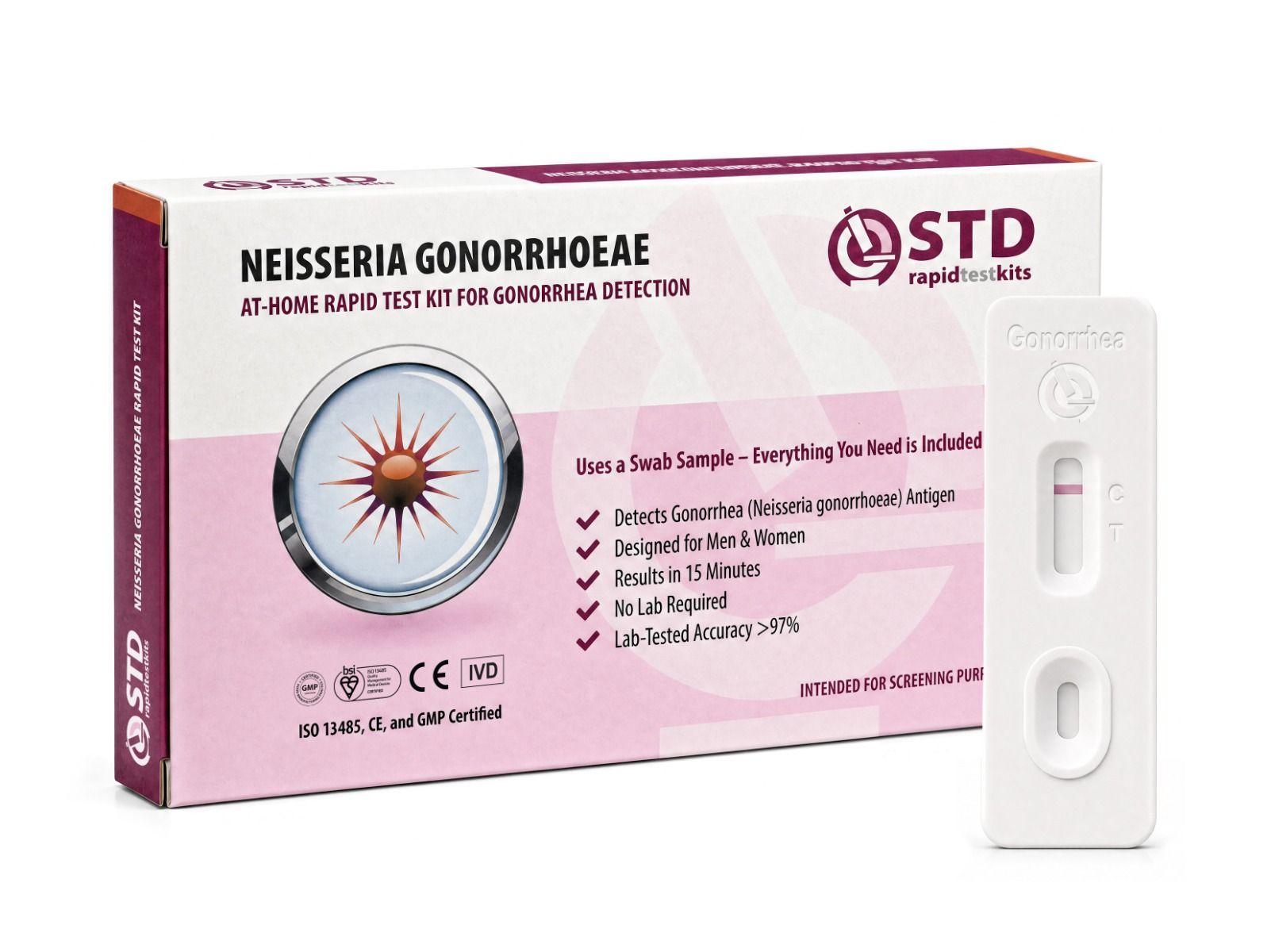
This site sells rapid at-home lateral-flow tests. They are useful for a preliminary read while you arrange a clinic appointment for confirmation and treatment. A positive at-home result still needs a lab NAAT to confirm and a clinician to prescribe the injectable antibiotic, but having a result in hand can shorten the path from worry to action and make the clinic conversation more focused.
Treatment: What Actually Happens
Gonorrhea treatment in 2026 is straightforward when current guidelines are followed. The CDC's first-line recommendation for uncomplicated urogenital, rectal, or pharyngeal gonorrhea in adults is a single 500 mg intramuscular injection of ceftriaxone, or 1 g for patients weighing 150 kg or more (CDC 2021 STI Treatment Guidelines). Oral alternatives exist for patients with severe cephalosporin allergies, but ceftriaxone is first-line because antibiotic resistance in Neisseria gonorrhoeae has narrowed the available options substantially over the past decade.
If chlamydia hasn't been ruled out at the same visit, providers usually add a 7-day course of oral doxycycline (100 mg twice daily) because chlamydia frequently rides along with gonorrhea. Most patients begin feeling better within a few days of the injection. Symptoms that were present typically resolve within 1 to 2 weeks.
A test-of-cure is not routinely recommended for uncomplicated urogenital or rectal infections after appropriate treatment, but pharyngeal infections do warrant a follow-up NAAT at 7 to 14 days because the throat is harder to clear. The CDC also recommends repeat screening at 3 months for everyone diagnosed with gonorrhea, regardless of partner status, because reinfection rates are high enough to justify the routine recheck.
Left untreated, gonorrhea can spread to the reproductive tract. In women this causes pelvic inflammatory disease (PID), which can scar the fallopian tubes and raise the risk of infertility and ectopic pregnancy. In men, untreated infection can cause epididymitis, occasionally affecting fertility. Rarely, the bacteria enter the bloodstream and cause disseminated gonococcal infection, with joint pain, skin lesions, and sometimes hospitalisation. These complications are uncommon when infections are caught and treated early, which is the entire reason the partner-notification protocol exists.
All sex partners within the 60 days preceding diagnosis should be evaluated, tested, and treated for gonorrhea. If the most recent sexual encounter was more than 60 days before diagnosis, the most recent sex partner should be evaluated.
What If Your Test Comes Back Negative?
A negative result after a partner's diagnosis is good news, but it comes with conditions. If you tested within the first few days after the most recent exposure, the result may have been a false negative because there were not yet enough bacteria in the sample for the NAAT to detect. The standard recommendation is a repeat test at about two weeks after exposure for confirmation.
If you tested outside the window period and the result is still negative, you most likely avoided infection. From there, the focus shifts to prevention. Make sure your partner has completed their treatment and waited the full 7 days afterward before you resume sex. Get screened for other STIs at the same time, especially chlamydia, which travels with gonorrhea more often than not. Some couples choose to retest together a few weeks later for peace of mind. It's not always medically necessary, but it can be reassuring after a stressful diagnosis.
A negative result within the first 3 days of exposure should be confirmed with a second test at about 2 weeks. If you tested between days 5 and 9, a single repeat at day 14 is usually enough. If you tested at day 10 or later, a single negative is reliable on its own.
The Path Forward Is Straightforward
Finding out a partner tested positive for gonorrhea can feel like a flood of unknowns. Most of those unknowns have specific, well-studied answers. Test at the right time. Treat if needed. Coordinate with your partner so you both clear the infection before resuming sex. Get screened again at 3 months because reinfection is common enough to plan for.
Whether you test at a clinic, through your primary care provider, or with a private at-home option first, the most important factor is timing the test correctly. Testing too early returns false negatives. Testing inside the right window returns answers you can act on.
Next steps after a partner's positive test
- Test at 5 to 7 days post-exposure with a site-appropriate NAAT (urine or swab depending on the exposure route).
- Treat if positive. The standard is a single intramuscular ceftriaxone injection at a clinic, plus doxycycline if chlamydia hasn't been ruled out.
- Both partners wait at least 7 days after the last dose of medication, with any symptoms fully resolved, before resuming sex.
- Rescreen at 3 months. CDC recommends this for everyone diagnosed with gonorrhea because reinfection rates are high.
Frequently Asked Questions
- If my partner tested positive for gonorrhea, does that mean I definitely have it too?
- Not necessarily. Exposure does not guarantee infection. Some people contract gonorrhea after a single contact, while others have repeated unprotected sex with an infected partner and never test positive. The only way to know your own status is a test taken at the right time.
- My partner has gonorrhea but I feel completely fine. Should I still get tested?
- Yes. Asymptomatic gonorrhea is the norm in the throat and rectum and common at every other site. Feeling fine provides no useful information about whether you are infected; only a timed test does. The CDC recommends testing all sex partners within the 60 days before the diagnosis, regardless of symptoms.
- How soon after exposure should I take a gonorrhea test?
- Most modern NAATs can detect gonorrhea within about a week of exposure, so 5 to 7 days is a reasonable starting point. If you test very early and the result is negative, repeat the test at about two weeks for confirmation. If exposure happened more than two weeks ago, a single test now is usually reliable.
- Can gonorrhea spread through oral sex?
- Yes. Throat infections can develop after oral sex with an infected partner. Pharyngeal gonorrhea is usually asymptomatic, which is part of why it spreads silently. If oral contact was part of the exposure, ask your provider for a throat swab rather than relying on a urine sample alone.
- What symptoms should I watch for?
- Common signs include burning during urination, unusual genital discharge, pelvic discomfort in women, anal itching or mild discharge in rectal infections, and (rarely) a mild sore throat. The majority of pharyngeal and rectal infections, and many cervical infections, cause no symptoms at all.
- Can my partner and I pass gonorrhea back and forth?
- Yes. This is called reinfection or the ping-pong effect, and it's one of the most common reasons gonorrhea lingers in a relationship. Preventing it requires both partners to complete treatment and avoid sex until at least 7 days after the last dose, with any symptoms fully resolved.
- What does gonorrhea treatment look like?
- The current CDC first-line treatment for uncomplicated gonorrhea is a single 500 mg intramuscular injection of ceftriaxone (1 g for patients weighing 150 kg or more). If chlamydia hasn't been ruled out, providers usually add a 7-day course of oral doxycycline. Most people feel better within a few days.
- When can we have sex again after treatment?
- Seven days after the last antibiotic dose, and only once both partners have finished treatment. Resuming before either of you completes the course is the main mechanism behind the reinfection cycle. The 7-day window also gives time for any residual symptoms to fully clear before sexual contact starts again.
Our article was constructed based on current advice from the most prominent public health and medical organizations, then translated into plain language around the questions people actually search for after a partner's diagnosis. We drew on the CDC's 2021 STI Treatment Guidelines for partner-notification and treatment protocols, the CDC's gonorrhea about-the-disease page for transmission and symptom data, the CDC's EPT clinical guidance for expedited partner therapy details, the NHS gonorrhoea overview for incubation and presentation, the Mayo Clinic for symptom descriptions, and the WHO STI fact sheet for global context on asymptomatic infection rates. Only established medical authorities informed the clinical guidance presented here.
- U.S. Centers for Disease Control and Prevention. About Gonorrhea: transmission, symptoms (including asymptomatic infections), and testing overview.
- U.S. Centers for Disease Control and Prevention. 2021 Sexually Transmitted Infections Treatment Guidelines, gonococcal infections in adolescents and adults. Source for ceftriaxone 500 mg IM first-line therapy, the 60-day partner-notification window, and the 7-day post-treatment abstinence recommendation.
- U.S. Centers for Disease Control and Prevention. Expedited Partner Therapy clinical guidance: legal status, recommended use, and outcome data for chlamydia and gonorrhea.
- NHS. Gonorrhoea overview, incubation period (around 2 weeks after infection), symptoms, and treatment guidance.
- Mayo Clinic. Gonorrhea symptoms and causes reference for adult and adolescent presentation.
- World Health Organization. Sexually transmitted infections fact sheet, global prevalence and asymptomatic carriage data.
