
Published: November 2025 | Last updated: May 2026 | Editorial review and quality control: Martina N.
A positive gonorrhea test when you swear you haven't had sex feels like a system error. You scan your memory for hookups, exposures, anything that could explain it, and you keep landing on the same shaky theory: maybe it was the toilet seat at work, or the gym, or that questionable Airbnb in Tulum. The toilet-seat excuse has been around since the 1970s, and it keeps coming back because the alternative explanations feel worse. The truth is calmer than the panic, and a lot less dramatic than the gossip.
This article walks through what gonorrhea needs to spread, why public surfaces almost never qualify, and the much more common reasons a positive result catches people off guard. You will see what counts as exposure (it is broader than most people think), why throat and rectal infections often go missed, and what to do next when your test result and your memory do not match.
Key Takeaways
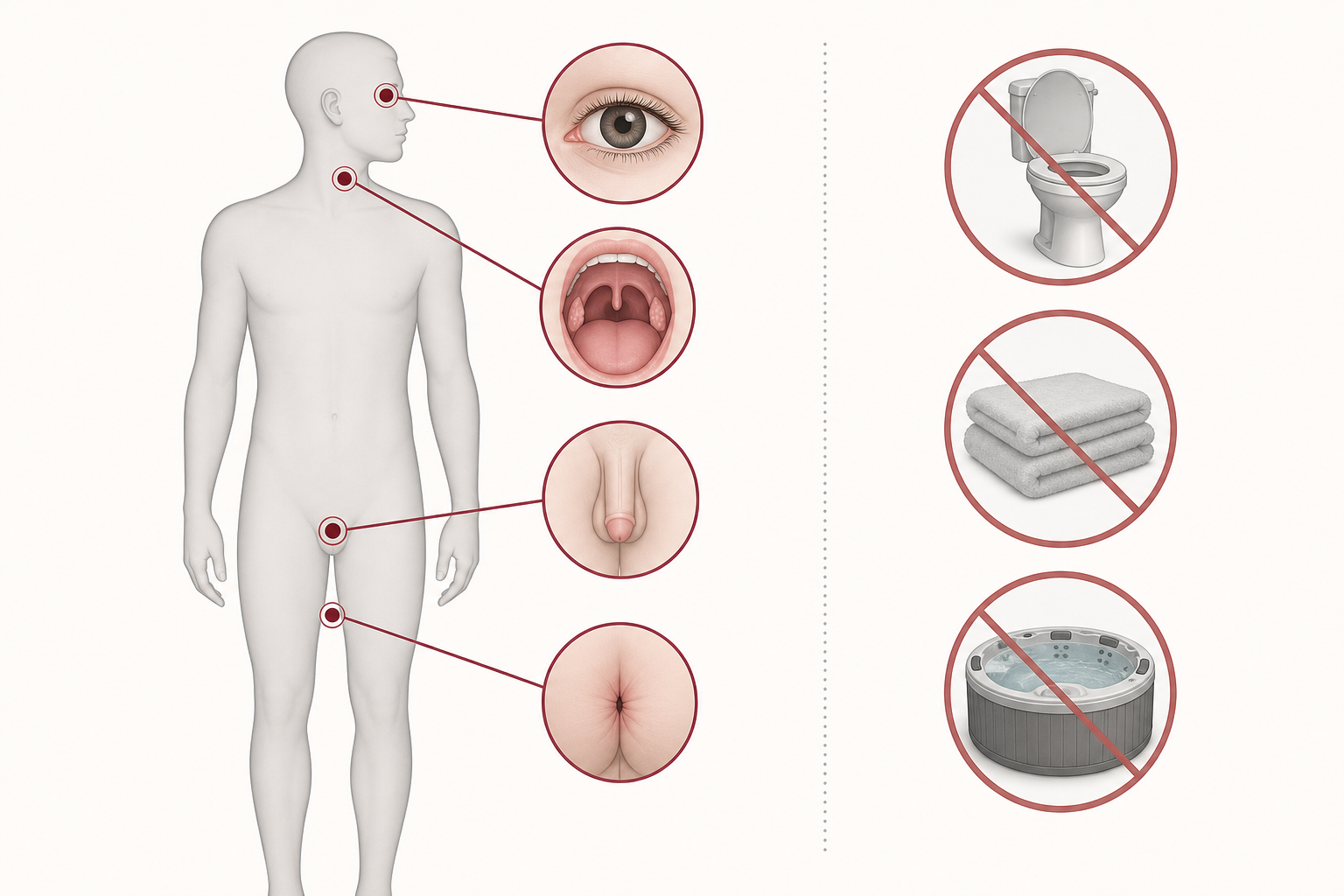
- Gonorrhea needs warm, moist mucous-membrane contact to spread. Toilet seats, towels, hot tubs, and gym benches do not provide that environment, and the bacterium dies on dry surfaces within minutes.
- A surprise positive result is far more likely to come from an exposure that did not fit your definition of sex, a partner with an undiagnosed throat or rectal infection, or a test taken too early in the window period.
Why people still blame the toilet seat
The toilet-seat defense has a long history. In 1973, a New York divorce case made tabloid headlines after a husband blamed a gas-station bathroom for the gonorrhea infection he had given his wife. He was not the first to try it, and he was not the last. The toilet seat has been offered up in courtrooms, family arguments, and worried late-night Google searches for the better part of a century. The reason it keeps showing up has very little to do with biology and almost everything to do with how we feel about sexual-health diagnoses.
Blaming an object spreads the discomfort thinner. If you have not been unfaithful, or you were not sexually active during the relevant window, or you simply do not see yourself as someone who gets an STI, a toilet seat becomes the most emotionally tolerable suspect. The problem is that this comfort comes at a cost. Delayed testing, delayed treatment, and avoidable arguments with a partner all start from the same assumption: it had to be the toilet, because anything else would mean something I do not want to face.
The myth also draws on a real intuition. Public restrooms feel grimy, and gonorrhea affects the genitals, so the two get linked even when the science does not support it. Add in the patchy sex education most adults received in school (a lot of warnings, very little detail about transmission routes) and the misinformation has rich soil to grow in.
The toilet-seat excuse for gonorrhea shows up in divorce filings, public-health bulletins, and tabloid coverage going back to at least the 1950s. Public-health educators have been trying to retire it for decades, partly because every successful airing of the myth delays both diagnosis and partner notification, sometimes by weeks.
What the science says about transmission
Gonorrhea is caused by a bacterium called Neisseria gonorrhoeae. According to the U.S. Centers for Disease Control and Prevention, you can get gonorrhea by having vaginal, anal, or oral sex without a condom with someone who has the infection. The bacterium lives on the mucous membranes that line those surfaces: warm, moist, delicately structured tissue that lets it attach and replicate. Outside that environment, it falls apart quickly.
Dry surfaces are hostile territory for N. gonorrhoeae. Older laboratory experiments that placed live cultures on hard surfaces found viability dropped within minutes, and even when researchers inoculated surfaces with high concentrations of bacteria, transmission to people who later touched those surfaces did not occur. The bacterium needs heat, moisture, and a hospitable membrane to do its work. A cold plastic toilet seat fails all three tests at once.
That does not mean the bacterium is fragile in every context. During active infection, N. gonorrhoeae moves between partners with frightening efficiency. The NHS describes the transmission routes plainly: vaginal, anal, or oral sex without a condom, plus parent-to-newborn transmission during childbirth. Even partial contact (genital-to-genital rubbing without penetration, or sharing unwashed sex toys) can move enough bacteria to start an infection. The conditions that matter are direct, sustained mucosal contact during sexual activity.
Here is how typical surface survival compares with the conditions N. gonorrhoeae actually needs:
| Surface or situation | Approximate survival of N. gonorrhoeae | Transmission risk |
|---|---|---|
| Toilet seat (cold, dry plastic or metal) | Under 1 minute | Effectively zero |
| Dry shared towel | Dies as fabric dries | Negligible |
| Hot tub or pool water (chlorinated) | Inactivated within seconds | Zero |
| Shared sex toy used internally without cleaning | Minutes to hours while moist | Real, comparable to direct contact |
| Mucous-membrane contact during sex | Active and replicating | High during active infection |
"But I didn't have sex..." when the diagnosis doesn't match the memory
Most surprise-positive gonorrhea results trace back to a definition gap, an untested partner site, or a test taken too early in the window period. None of them involves plumbing.
The definition gap is the most common. Clinicians regularly hear someone insist they have not had sex when what they mean is they have not had penis-in-vagina or penis-in-anus intercourse. Oral sex, genital-to-genital rubbing, and shared toys used between partners without cleaning all carry transmission risk; the bacteria move whenever secretions reach a mucous membrane, regardless of whether anyone involved would describe the contact as sex.
An untested partner site is the second usual explanation. A relationship can be honestly monogamous in the present and still carry an infection from before it started. Asymptomatic gonorrhea (especially in the throat or rectum) can sit undetected for months, and the CDC notes that most women with gonorrhea do not have any symptoms at all. A previous partner's reassuring "I got tested" frequently meant a urine sample only, which misses throat and rectal sites entirely.
A window-period miss is the third. A test taken too soon after exposure can read negative on a real infection, which means an earlier "I'm clear" result was technically accurate at the time but did not rule out a quietly developing infection.
- Definition gap: contact that did not fit the reader's working definition of sex (oral, manual, genital-to-genital rubbing, shared toys without cleaning).
- Untested site: a partner with an asymptomatic throat or rectal infection that a urine-only screening would have missed entirely.
- Window-period miss: a previous test taken too soon after exposure to detect the infection that was already present.
Towels, pools, hot tubs, and other shared spaces
Non-sexual transmission myths follow a predictable pattern: take something that feels intimate or grimy (a wet towel, a hot tub, a borrowed pair of underwear) and assume the discomfort of it must correspond to a real risk. The discomfort is real, but the risk almost always is not.
Pools and hot tubs dilute bacteria to the point of nonviability within seconds, and the chlorine added to public water further inactivates pathogens that depend on a stable, warm environment. Shared towels are theoretically more concerning because they retain moisture and trap material from skin, but fabric dries quickly and N. gonorrhoeae dies along with it. The World Health Organization describes sexual contact as the dominant transmission route for the major STIs, with parent-to-newborn transmission during pregnancy or childbirth as the only meaningful non-sexual route for gonorrhea.
Shared underwear, gym benches, sauna seats, and bidet attachments all sit in the same near-zero category. The bacterium would need to leave one body, survive in sufficient quantity on a surface, and then encounter another body's mucous membranes within a window measured in minutes. That sequence does not happen in real life. The only meaningful exception in this whole category is a shared sex toy used internally between partners without cleaning, which is closer to direct mucosal contact than a true surface story.
Here are the most common surface-based fears alongside what actually happens:
| Claim | Scientific reality | Transmission risk |
|---|---|---|
| Public pool or hot tub use | Chlorine inactivates pathogens within seconds; water dilutes bacterial load below the infectious threshold | Zero |
| Borrowed underwear | Bacterium dies as fabric dries; no mucosal contact during normal wear | Negligible |
| Warm toilet seat after another user | Warmth does not preserve viability long enough for transmission | Zero |
| Bidet or shared showerhead | Water flow and absence of mucosal contact block transmission | Zero |
| Touching infected fluid then your own genital skin | Risk rises only if material is introduced directly into a mucous membrane | Very low without internal contact |
When shame delays treatment
Beyond embarrassment, the more damaging consequence of the toilet-seat myth is the treatment delay it creates. A positive gonorrhea test that does not match someone's mental model of how I got here can stall for weeks while they try to write a story they can live with. During those weeks, an untreated infection continues to progress.
In men, untreated gonorrhea can cause epididymitis, which presents as testicular pain and swelling and, in rare cases, contributes to fertility issues. In women, untreated infection can ascend to the upper reproductive tract and cause pelvic inflammatory disease (PID), which the CDC links to tubal scarring, ectopic pregnancy, chronic pelvic pain, and infertility. About 1 in 8 women with a history of PID experiences difficulty getting pregnant. Disseminated gonococcal infection, where bacteria spread through the bloodstream and reach joints or skin, is uncommon but serious when it happens. None of these complications appear overnight, but the longer the bacterium has to do its work, the higher the cost of resolving it becomes.
None of that lecture changes how a confusing result feels. The intention here is practical, not alarmist: the toilet-seat narrative, however emotionally useful, has a calendar attached to it. Each week spent looking for an explanation that fits is a week the infection has to spread, both inside the body and to other partners.
About 1 in 8 women with a history of pelvic inflammatory disease experiences difficulty getting pregnant, according to the CDC. Untreated gonorrhea can ascend to the upper reproductive tract within weeks, and earlier treatment shortens that risk window. The cost of the toilet-seat story, in other words, is measured in fertility consequences that get harder to undo the longer the infection sits.
The reality of oral and asymptomatic gonorrhea
If there is one piece of biology that explains most surprise-positive gonorrhea results, it is the asymptomatic carrier rate. The CDC fact sheet states that gonorrhea often has no symptoms but can cause serious health problems even without them, and that most women with gonorrhea do not develop noticeable symptoms. The infection is not dormant; it is active and contagious. It just is not sending any signals to the person carrying it.
Oral gonorrhea is especially good at hiding. The throat tolerates the bacterium with little fanfare: occasionally a mild sore throat that resolves on its own, more often nothing at all. Someone with pharyngeal gonorrhea can transmit it through unprotected oral sex without knowing they are carrying anything. The receiving partner then develops a genital infection that, on a quick mental review, has no obvious source. The chain looks invisible because none of the people in it knew they were part of it.
The testing gap makes this worse. Standard clinic screening for gonorrhea often relies on a urine sample, which detects urogenital infection but misses throat and rectal sites entirely. Multi-site swabbing (throat, rectal, and urogenital combined) is recommended by the CDC for anyone whose sexual practices include oral or anal sex, but the recommendation is not always translated into routine care. Clinics may default to urine unless the patient specifically asks for additional sites. The result is a population of asymptomatic carriers who tested negative on the swab they were given and now genuinely believe they are not infected.
Disclosure: stdrapidtestkits.com (this site) sells the at-home rapid lateral-flow kits referenced below. The recommendation here is based on fit for the situation, not commercial benefit; we say so plainly so the reader can weigh it.

Timing, not toilets, explains gonorrhea results
Gonorrhea has two timelines worth knowing. The first is the incubation period: the gap between exposure and symptom onset. For genital gonorrhea, symptoms typically appear within about two weeks of exposure when they appear at all. Throat and rectal infections may incubate longer or never produce symptoms. The second is the window period: the time after infection before a test can reliably detect it. Most current molecular gonorrhea tests are reliable within one to two weeks of exposure, but a test taken in the first day or two can miss a real infection.
These timelines explain a lot of the "but I tested clear" confusion. Two partners can both test negative on the same day, one or both can have been recently exposed below the detection threshold, and the next test (taken at the right interval) can return a positive result that was not a new infection but a previously undetectable one. The infection did not appear out of nowhere. The test simply caught up to it.
Surfaces have no timelines of any kind. N. gonorrhoeae on a toilet seat starts dying immediately and is non-infectious within minutes. There is no incubation, no window, no later detection. If a toilet was somehow involved in transmission, the bacterium would need to have left an infected body, crossed the seat, and reached your mucous membranes in a span of time that simply does not fit how restrooms work. Surfaces are rarely the explanation.
When a positive result triggers accusations
Long-term monogamous couples are not immune to gonorrhea diagnoses, and they are often the most blindsided by them. A positive test inside a relationship that both partners believed was closed can trigger an explosion of mutual accusation, and the toilet-seat story can show up as a desperate attempt to give the result any explanation that is not betrayal. The honest answer is usually less dramatic than either partner fears.
Asymptomatic gonorrhea can predate a relationship by months or even years. A previous partner from before the current relationship started, an undiagnosed throat infection that never produced symptoms, a urine-only screening that missed the actual infection site (any of these can result in one partner carrying gonorrhea into the relationship without knowing it). Later, a routine cervical screening or a partner's confirmatory test picks it up, and the timeline looks impossible until the testing history is examined more carefully.
If you are navigating a positive result in a long-term relationship, the most useful next step is to gather facts rather than assign blame. Both partners should be tested at all three sites (urogenital, throat, rectal) regardless of sexual history, and both should be treated even if one partner's test is negative, because retransmission between partners is common.
Both partners should be tested at all three sites (urogenital, throat, rectal). A urine-only result that came back negative does not rule out asymptomatic carriage at the throat or rectum, and one partner's positive test does not, on its own, establish when the infection entered the relationship.
Common excuses vs medical evidence
The patterns clinicians hear most often in surprise-positive cases are the same ones that delay care most reliably. Putting them side by side with what the medical literature says removes some of the guesswork and, hopefully, some of the shame.
| Common statement | Why it feels true | Medical evidence |
|---|---|---|
| "I haven't had sex in over a year." | No recent intercourse feels like no recent risk | Asymptomatic infections in the throat or rectum can persist for months without symptoms |
| "It must have been the toilet seat." | Public restrooms feel grimy and intimate at the same time | N. gonorrhoeae dies on dry surfaces within minutes and does not transmit from them |
| "My partner and I are exclusive." | Trust and exclusivity feel protective | An infection can predate the relationship or come from a partner's untested site |
| "I only had oral sex; that doesn't count." | Sex education often skips non-penetrative routes | Oral transmission is well documented and frequently asymptomatic |
| "Someone else used my towel or razor." | Shared fabric feels physical and direct | The bacterium does not survive drying or surface exposure long enough to transmit |
Next steps when nothing adds up
If your test result and your memory of the last few months do not seem to fit together, the most useful work you can do is investigative, not emotional. A few questions usually get you most of the way.
Start with what sites were tested. If you have only had a urine test, a urogenital infection might show negative while a throat or rectal infection silently sits behind it. Multi-site screening (urine plus throat and rectal swabs) is the standard for anyone whose practices include oral or anal sex. Then look at the timing. A test taken too soon after exposure can return a false negative; the standard recommendation is to test or retest at least one to two weeks after a potentially exposing encounter, and to consider a follow-up test if suspicion remains and the first result was negative. Finally, re-examine the working definition of sex you have been using. Oral, manual, and partial genital contact all carry transmission risk, especially when fluids are involved.
Treatment for uncomplicated gonorrhea is straightforward once the diagnosis is made. The current CDC STI treatment guidelines recommend a single 500 mg intramuscular dose of ceftriaxone for people weighing less than 150 kg (1 g for people weighing 150 kg or more). Recent sexual partners should also be evaluated and presumptively treated, and a test of cure is specifically recommended for pharyngeal infections because the throat is harder to clear. Sexual activity should be paused for seven days after treatment to prevent reinfection.

The bottom line on gonorrhea and toilet seats
Gonorrhea has no use for plumbing. It needs warm, moist mucosal contact to spread, and it dies within minutes of leaving a body that can host it. A positive result almost always comes from one of three things: an exposure that did not fit your working definition of sex, a partner with an asymptomatic infection that predated the relationship, or a testing window that missed the bacterium the first time around. None of those answers is comfortable, and all of them are easier to act on than the toilet-seat story because they point somewhere with a clear next step.
If a positive result has you puzzled or a partner's result has put your relationship in a difficult spot, ask the questions that actually narrow the timeline: what sites were tested, when, and what does exposure mean here? Then test the sites that have not been tested, complete the treatment that is prescribed, and update the conversation you and your partner are having with the facts you now have.
You can get gonorrhea by having vaginal, anal, or oral sex with someone who has the infection. A pregnant person with gonorrhea can give the infection to their baby during childbirth.
Frequently asked questions
- Can I really get gonorrhea from a toilet seat?
- No. Neisseria gonorrhoeae needs warm, moist mucous-membrane contact to spread, and it loses viability within minutes on cold, dry surfaces. There is no documented case of toilet-seat transmission of gonorrhea, and the laboratory conditions required to even theoretically transmit it from a seat (a fresh, high-concentration deposit contacting mucous membrane within seconds) do not match how restrooms are used in real life.
- I haven't had sex in months. How did I test positive?
- Three possibilities cover most cases: an exposure your working definition of sex did not include (oral, manual, or partial genital contact), a partner with an asymptomatic infection from before your relationship that has only now become detectable, or a previous test taken inside the window period that missed an existing infection. None of these involve a surface, and all of them are more common than they sound.
- Could a shared towel, hot tub, or gym bench have transmitted it?
- Effectively no. Hot tubs and pools dilute and chlorinate the bacterium past viability, gym benches are dry and cold, and shared towels dry too quickly to keep the bacterium alive at infectious concentrations. The one near-exception is a shared sex toy used internally without cleaning between partners, which is functionally direct contact rather than a true surface story.
- Does kissing transmit gonorrhea?
- Standard kissing has low transmission risk for gonorrhea. The throat can carry asymptomatic infection, but the well-documented transmission routes are oral-to-genital and oral-to-anal contact, not mouth-to-mouth kissing. Emerging evidence suggests deep kissing may carry some risk, though transmission rates appear far lower than for oral-genital contact.
- My partner says they haven't cheated. Could the test be wrong?
- False positives on modern gonorrhea tests are uncommon, and the more useful question is what was tested and when. Asymptomatic gonorrhea can predate a relationship, sit silently in the throat or rectum, and only surface when a new test happens to catch it. Both partners should be tested at all three sites (urogenital, throat, rectal) before any timeline conclusion is drawn.
- How long can gonorrhea go undetected in the body?
- Often a long time. Many people, especially those with throat or rectal infections, have no symptoms at all, and the CDC notes that most women with gonorrhea also do not develop noticeable symptoms. An infection can persist for weeks or months without producing any signals while remaining transmissible the entire time.
- Do I need a throat or rectal test, or is a urine test enough?
- Urine testing detects urogenital infection but misses pharyngeal and rectal infection entirely. If your sexual practices include oral or anal sex, multi-site swabbing is the current recommended standard. A clinic-administered swab at each relevant site, or a multi-site at-home kit, is what catches the asymptomatic infections that urine alone overlooks.
- What's the actual treatment, and how soon does it work?
- Ceftriaxone, given as a single intramuscular injection (500 mg, or 1 g for people weighing 150 kg or more), eliminates the infection. For pharyngeal infections specifically, the CDC recommends a follow-up swab 7 to 14 days after the shot since the throat clears more slowly than genital sites. Recent partners should also be evaluated and presumptively treated, and the patient should avoid sex for seven days after the injection to prevent reinfection.
This article was built from current guidance issued by the U.S. Centers for Disease Control and Prevention, the U.K. National Health Service, and the World Health Organization, then translated into the situations readers actually find themselves in. Specific clinical claims (treatment dose, asymptomatic rates, transmission routes) link directly to the source page that supports them. Where the literature is older or imprecise, we say so plainly rather than fabricating certainty. The goal is a practical guide that respects both the science and the reader's time.
- U.S. Centers for Disease Control and Prevention. About Gonorrhea: transmission routes, symptoms, and the asymptomatic carrier rate, particularly in women and at extragenital sites.
- U.S. Centers for Disease Control and Prevention. STI Treatment Guidelines for Gonococcal Infections Among Adolescents and Adults: single-dose 500 mg ceftriaxone IM recommendation and pharyngeal test-of-cure guidance.
- U.S. Centers for Disease Control and Prevention. About Pelvic Inflammatory Disease (PID): consequences of untreated chlamydia and gonorrhea, including tubal scarring, ectopic pregnancy, and infertility.
- U.K. National Health Service. Gonorrhoea overview: transmission through vaginal, anal, and oral sex without a condom, plus parent-to-newborn transmission during childbirth.
- World Health Organization. Sexually Transmitted Infections (STIs) fact sheet: sexual contact as the dominant transmission route, asymptomatic STI burden, and global gonorrhea incidence estimates.
