
Published: August 2025 | Last updated: May 2026 | Editorial review and quality control: Martina N.
Can I have chlamydia with no symptoms?
Yes, and it is the most common scenario. The majority of women and roughly half of men with chlamydia feel nothing at all, and infections in the throat or rectum are almost always silent. The only reliable way to know is to test, which works from about 14 days after exposure onward.
Chlamydia is the most reported bacterial sexually transmitted infection in the United States, and most of the people who have it do not know. The CDC counts well over a million reported cases each year in its national surveillance summaries, and even those figures understate the real picture because so many infections are never diagnosed. The World Health Organization ranks chlamydia among the most common curable STIs worldwide and notes that most infections are undiagnosed. The infection often produces no obvious sign at all. People feel fine, get on with life, and only learn they were infected when a partner tests positive, when a routine screening flags them, or, occasionally, when complications force the issue.
If you landed here after noticing something mild, a test is the fastest way to answer the question, and most people who worry after a recent exposure turn out not to have it. The decade-long rise in reported chlamydia cases has begun to reverse: CDC provisional data for 2024 shows case counts down for the second year in a row. Under-diagnosis still keeps the infection circulating, which is why this article walks through why chlamydia hides so well, what it can quietly do over weeks or months, when to test even without symptoms, and how to handle the conversations that come after. Written for the reader who wants the facts plainly, without the panic.
Key Takeaways
- Most women and roughly half of men with chlamydia feel nothing at all; the only reliable way to know is to test.
- Untreated chlamydia can quietly damage reproductive organs even when you feel fine, so screening on a schedule matters more than waiting for a symptom.
Why Chlamydia So Often Stays Silent
Chlamydia is caused by Chlamydia trachomatis, a bacterium that infects the cells lining the cervix, urethra, rectum, and throat. It is what microbiologists call an obligate intracellular bacterium, which means it lives inside human cells rather than free in the surrounding tissue. That hiding place protects it from the body's first-line immune defenses for a while, and it explains why most early infections do not produce fever, sharp pain, or any of the cues people normally associate with being sick. The mucosal tissues it inhabits, especially in the cervix and rectum, are not richly supplied with pain-sensing nerve endings, which is another reason infections can persist there without alerting the host.
According to the CDC's About Chlamydia page, most people who have chlamydia experience no symptoms at all. The asymptomatic rate appears higher in women than in men, with site-specific infections in the rectum and throat being almost always silent. Among the people who do feel something, the symptoms are often mild and easy to attribute to something else: a small change in vaginal discharge, faint pelvic discomfort, slight burning when urinating, light bleeding after sex, or a vague sense of irritation that fades within a few days. The bacteria are still there. The infection is still progressing. The body simply has not produced a strong enough signal for the person to take action.
Site of infection matters too. Rectal chlamydia is asymptomatic in roughly four out of five cases, and pharyngeal infections from oral sex are almost always silent. Because rectal and pharyngeal swabs are not part of standard urine-based screening, infections at those sites can persist for long stretches even among people who get tested annually for genital chlamydia. Anyone who has receptive anal or oral sex should ask a clinician for site-specific swab testing, since urine testing alone misses these infections.
| Population | Likelihood of No Symptoms | Typical Symptom Onset (if any) |
|---|---|---|
| Women | Majority | 7 to 21 days post exposure |
| Men | Roughly half | 5 to 14 days post exposure |
| Rectal infections (any gender) | Up to 80% | Pain, discharge, or no signs at all |
| Throat infections (oral sex) | Over 90% | Almost always asymptomatic |
The Subtle Signs People Most Often Miss
When chlamydia does produce something noticeable, the signal is rarely dramatic. The signs below are the ones the NHS and Mayo Clinic list as the most common when symptoms are present at all. The pattern that catches people out is how easy each one is to write off: a yeast infection, hormonal cycling, a passing UTI, friction irritation, a long day. Any one of them in someone with a recent new exposure is worth a swab test, not a wait-and-see.
Possible Signs of Chlamydia (When Any Show Up at All)
Most people with chlamydia notice none of these. Having one or more does not confirm infection. Only a test can do that.
- Mild burning or stinging when urinating Common
- Unusual discharge from the vagina, penis, or rectum (often subtle in women, more noticeable in men) Common
- Light bleeding between periods or after sex Less common
- Dull pelvic ache or low-belly discomfort Less common
- Testicular tenderness or swelling Less common
- Rectal pain, discharge, or bleeding after receptive anal sex Less common
- Sore throat that lingers after oral exposure (usually no symptoms at all) Rare
- Eye redness or irritation from accidental genital-to-eye contact Rare
When Chlamydia Gets Mistaken For Something Else
One of the most common diagnostic detours is treating a chlamydia infection as a urinary tract infection. The overlap is real: both can cause burning when urinating, urgency, and pelvic discomfort. A clinician who is rushed, or a self-diagnosis that leads to a leftover course of antibiotics from a different illness, can dampen the surface symptoms without ever clearing the underlying STI. The bacteria remain, the transmission risk remains, and the person walks away thinking the problem is handled.
The two conditions differ in important ways. A UTI almost never causes unusual genital discharge or bleeding between periods, and it does not pass to a partner during sex. Chlamydia is the opposite on both counts, and a chlamydia infection that has been around for a few weeks more often shows up as pelvic ache or low-belly discomfort than as the urgency-driven burning that a UTI produces. Mild irritation, faint discharge, or post-coital spotting in someone with a recent new exposure are all worth a swab test, even when the symptom set initially looks like something more familiar. The table below summarizes how the everyday signs compare.
| Symptom | Typical UTI | Chlamydia |
|---|---|---|
| Burning when urinating | Common | Sometimes, often mild |
| Frequent urgency | Common | Less common |
| Unusual discharge | Rare | Common in men, often subtle in women |
| Pelvic ache or low-belly pain | Sometimes | Often after the infection has been around a few weeks |
| Bleeding between periods | No | Possible |
| Sexually transmitted | No | Yes |
What Silent Damage Looks Like Over Time
The most consequential thing about asymptomatic chlamydia is that the absence of symptoms does not mean the absence of harm. In people with a uterus and fallopian tubes, untreated chlamydia can ascend from the cervix into the upper reproductive tract and cause pelvic inflammatory disease, or PID. The CDC notes that women with a history of PID face higher rates of infertility, ectopic pregnancy, and chronic pelvic pain, and the risk increases the longer an underlying infection went untreated.
The lasting issue from a bout of PID is scarring inside the fallopian tubes. Scarred tubes are slower to move an egg toward the uterus, which raises the risk of an ectopic pregnancy (a medical emergency where a fertilized egg implants outside the uterus), and in more severe cases can block conception entirely. Tubal-factor infertility is one of the recognized causes of difficulty conceiving in women who have had repeated or untreated lower-genital chlamydia, and many of those women had no symptoms during the original infection.
In people with testicles, chlamydia can spread to the epididymis, the coiled tube that carries sperm from the testicle. Epididymitis is less common than PID but can still cause testicular pain, scarring, and, in some cases, fertility problems. Cases that started silently are typically diagnosed only after the inflammation becomes painful enough to drive the person to a clinic. Reactive arthritis, a sterile inflammation of joints triggered by the immune response to the infection, is another well-documented though uncommon outcome.
Beyond the reproductive system, chlamydial infection of mucosal surfaces is associated with a higher risk of acquiring or transmitting HIV. The small breaks in tissue that the inflammation produces give HIV a more efficient route across mucosa. None of this requires the person to feel sick. The damage accumulates while the infection is doing what it was always doing: living in epithelial cells, multiplying, and shedding into bodily fluids that can pass it to a partner. Feeling fine is the most common experience of an active chlamydia infection, and a long stretch of feeling fine is not evidence that nothing is happening underneath.
| Complication | Who it affects | When it usually develops | Preventable? |
|---|---|---|---|
| Pelvic inflammatory disease (PID) | Women | Weeks to months after untreated infection | Yes, with early testing and antibiotics |
| Tubal-factor infertility | Women | Often only noticed when trying to conceive | Yes, with early treatment |
| Ectopic pregnancy risk | Women | After tubal scarring is established | Reduced by clearing infection early |
| Epididymitis | Men | Usually within weeks of exposure | Yes |
| Reactive arthritis | Any gender (rare) | Weeks after infection | Yes |
How Long Can Chlamydia Hide?
Chlamydia does not run on a clean clock. When symptoms do appear in men, they typically show up within 5 to 14 days of exposure. In women they can appear within 7 to 21 days, but the more common scenario is that they never appear at all. Without antibiotics, the infection can live in the body for months or, in some cases, years. It does not "burn itself out." A small share of infections do clear spontaneously, but that share is unpredictable and you cannot tell from the outside whether yours is one of them.
Because the bacterium hides inside cells, the immune system's slow response also explains why people who test for chlamydia after a known exposure should wait until at least day 14 before testing. Testing earlier than that risks a false negative, because the bacterial load in the sample may still be below the test's detection threshold. Most rapid swab and lateral-flow tests on the home market work reliably from day 14 onward, and laboratory NAAT tests follow a similar window.
If you suspect you may have been carrying chlamydia for some time, that does not change the next step. The infection still responds to a short course of antibiotics regardless of how long it has been present. The earlier the diagnosis, the lower the chance of long-term reproductive complications, though a late diagnosis still allows full treatment. A negative result obtained before day 14 should be rechecked at the two-week mark, since the early sample may not have contained enough bacterial material to register on the test.
Most people who have chlamydia have no symptoms. If you do have symptoms, they may not appear until several weeks after you have sex with an infected partner.
How It Spreads When No One Knows
The same biology that lets chlamydia stay hidden is what makes it efficient at spreading. The infection lives in mucosal fluids and on mucous membranes, so vaginal, anal, and oral sex can all transmit it, with or without ejaculation, with or without symptoms in either partner. Skin-to-skin contact alone is generally not enough; transmission requires fluid contact between mucosal surfaces or shared sex toys that have not been cleaned or covered between partners.
Condoms used consistently and correctly substantially lower the risk of transmission. They do not eliminate it entirely, because chlamydia can shed from areas a condom does not cover, though the reduction is large and meaningful. Lubricant reduces microtears in the tissue, which lowers the chance that any STI bridges between partners during sex. The pattern that allows ongoing community spread is mostly explained by something more mundane. It is the gap between when someone becomes infectious and when they (or their partners) get tested. That gap can be weeks to months, and during it the person is contagious.
This is why partner notification, awkward as it sounds, is part of stopping the chain. If a positive test result comes in, the people you have had sex with in the previous 60 days deserve a heads-up, even if they say they feel fine. Most of them probably do, and that is the entire point. Anonymous notification services and clinic-run text systems exist for people who cannot face the conversation directly. They are imperfect though effective, and they prevent reinfection cycles where treated partners pick the infection back up from untreated ones.
Chlamydia spreads through vaginal, anal, and oral sex, and through shared sex toys that are not cleaned or covered between partners. Ejaculation is not required for transmission, and neither partner needs to have any symptoms. Condoms substantially reduce risk; they do not eliminate it.
When You Should Test, Even If You Feel Fine
The CDC's STI treatment guidelines for chlamydia recommend annual chlamydia screening for all sexually active women under 25, and for women 25 and older with risk factors such as a new partner, more than one partner in the past year, or a partner who has other partners. Men who have sex with men should be screened at least annually at all relevant sites of exposure, with more frequent screening (every 3 to 6 months) for those with newer or multiple partners. Pregnant people are screened at the first prenatal visit, with retesting in the third trimester for those at continued risk.
Outside those guidelines, anyone who has had condomless sex with a new or unfamiliar partner, anyone whose partner has tested positive for an STI, and anyone who has not been screened in over a year should consider testing. The ask is not heroic. A urine sample at a clinic, a self-collected swab at home using an at-home chlamydia test, or a bundled lateral-flow rapid panel can rule chlamydia in or out within days, and often within minutes for the rapid tests.
Timing matters as much as the choice of test. Chlamydia and gonorrhea reach reliable detection at about 14 days post-exposure. Syphilis antibody tests take longer (about 3 to 6 weeks). Fourth-generation HIV tests usually pick up an infection between 18 and 45 days, depending on the assay. The chart below shows the reliable windows side by side, so a single round of testing after a recent exposure can be timed for the most useful coverage.
Choosing Between a Clinic Visit and a Home Test
Insurance covers most clinical testing in the United States, and many state and local health departments offer free or sliding-scale screening. Clinic testing typically uses nucleic acid amplification, or NAAT, which is the most sensitive technology available for chlamydia and gonorrhea. Results take a couple of days. A clinic visit can also include a pelvic or genital exam, throat or rectal swabs for people whose exposure included those routes, and a same-day antibiotic prescription if anything turns up positive.
At-home rapid lateral-flow kits use a different chemistry: an antibody-coated test strip that detects chlamydia antigens from a self-collected genital swab. They are designed for screening, run in about 15 minutes at home, and stay private. They are not the same technology as a laboratory NAAT, and the lab is more sensitive in early or low-load infections. A positive home result is worth confirming with a clinician and starting treatment promptly. A negative home result taken inside the right window is reassuring, though not perfect. The practical version of "when should I test" is simple: whenever a new exposure has happened, whenever a partner has tested positive, or whenever it has been a year. Whichever comes first.
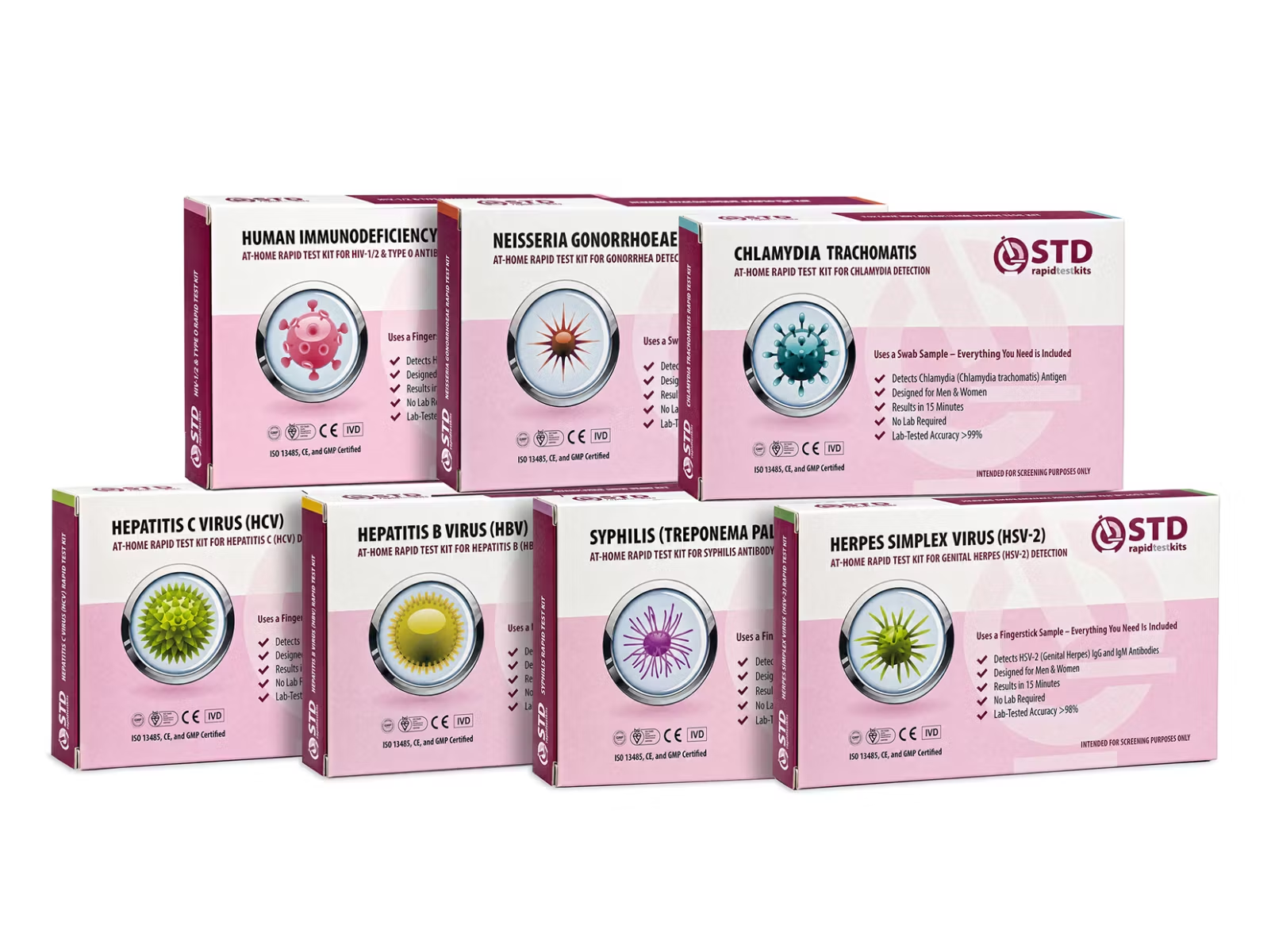
Disclosure: stdrapidtestkits.com publishes this article and sells the at-home rapid tests referenced in the banners below. Product picks are made on fit-for-purpose for the reader's concern, not commercial benefit.
Retesting After Treatment or a New Exposure
The standard course of antibiotics is doxycycline 100 mg taken twice a day for 7 days, with a single 1-gram dose of azithromycin as an alternative when adherence to a week of pills is uncertain. Most people are no longer infectious within a week of completing treatment. Per the CDC's 2021 STI treatment guidelines (the most recent comprehensive update at time of publication), a follow-up retest about 3 months after treatment is standard. The antibiotics clear the original infection reliably when taken correctly; the three-month retest is specifically aimed at catching reinfection from a partner who was never tested or treated, since reinfection from an untreated partner is the most common reason chlamydia shows up again.
If a test of cure is run before 4 weeks have passed since finishing antibiotics, you can get a false-positive result, because some tests still pick up bacterial DNA from already-dead organisms. That is why the standard guidance is to wait at least 4 weeks if a test of cure is being run, and to use the 3-month retest specifically for catching reinfection rather than for confirming the original treatment worked.
Treatment also changes the day-to-day for a stretch. No sex (oral, vaginal, or anal) for 7 days after a single-dose regimen, or until the full week of doxycycline is finished and any sexual partners have also been treated. Resuming sex too early is one of the main ways infections come back. For people in ongoing relationships, the rule of thumb is straightforward: any time both partners' status changes (a new partner introduced, a monogamy boundary changed, condomless sex outside the relationship), both partners benefit from a fresh round of testing, ideally before resuming sex so the negative result is mutual.
| Chlamydia Status | How Long It Can Persist | What You Might Notice |
|---|---|---|
| Asymptomatic, untreated | Months to years | Nothing, or subtle discharge or pelvic ache |
| Treated with antibiotics | Clears in 7 to 10 days | Mild digestive side effects possible |
| Untreated with recurring exposure | Chronic infection or reinfection | Possible PID, testicular pain, or fertility problems |
How To Tell A Partner Without The Drama
A positive result almost always comes with the question: now what do I say? Partner notification is not about assigning blame. The vast majority of chlamydia cases are passed along by people who had no idea they were carrying it. Framing the conversation around mutual care, rather than guilt, makes it easier to deliver and easier to receive.
If saying it directly is not possible, sexual health clinics can help. The NHS chlamydia guidance notes that a sexual health clinic can either help you contact your partners or contact them for you. In the United States, many state and local health departments offer the same service, and the message can be sent without naming you. These tools matter because untreated partners are the most common reason a treated person picks the infection back up within months of antibiotics.
If you are on the receiving end of one of these messages, the right move is to test, treat if needed, and decline the urge to interpret the message as an accusation. The person who sent it is doing the responsible thing and probably did not enjoy doing it.
A short, direct script tends to work better than a long explanation. Keep it brief, offer testing rather than ask for anything, and skip the apologies. A single sentence is usually enough to land. The version below is one many clinic counselors suggest:
I just got tested and came back positive for chlamydia. I had no symptoms, so I didn't catch it earlier. I wanted to let you know so you can get tested too.
Privacy and At-Home Testing
For many readers, the largest barrier to testing is not a symptom or a clinical question. It is privacy. Living with parents, sharing insurance with a spouse, being known at the only clinic in town, or simply not wanting another item on a medical record can all delay testing past the point where it would have helped. At-home rapid testing exists in part to remove that barrier.
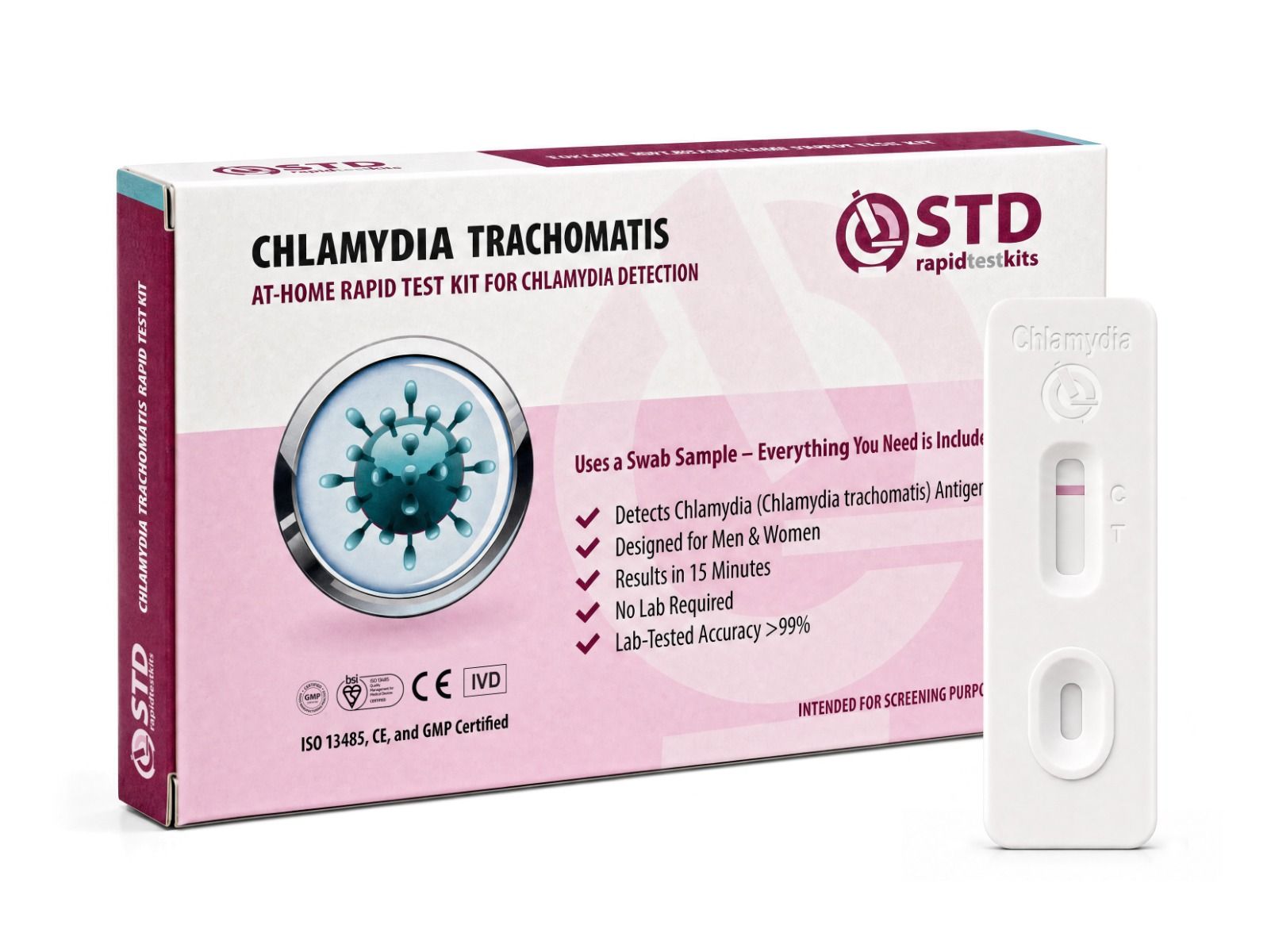
Our chlamydia rapid test is a self-collected vaginal or penile swab read on a lateral-flow cassette, similar in technology to a rapid COVID test. It ships in plain unmarked packaging, requires no clinic visit, and produces a result in about 15 minutes. Lateral-flow rapid tests are not the same technology as the laboratory NAATs clinics use; the lab gold standard is more sensitive in early or low-load infections. The home test fills the practical gap. It is fast, private, and a reasonable first screen, with the option to confirm any positive result at a clinic. A clinic visit also covers ground a home swab cannot, including throat or rectal sampling for people whose exposure included those routes, and a same-day prescription if anything turns up positive.
Cost is also worth a sentence. If at-home testing is out of reach, most state and local health departments offer free or low-cost STI screening, and many community clinics will see uninsured patients on a sliding scale.
Our test ships in plain unmarked packaging with no STI-related branding visible on the exterior. There is no clinic appointment, no shared insurance claim, and the result stays with you unless you choose to share it.
What Matters Now
Most people with chlamydia feel completely fine. That is the single fact this article is built around, and it is the reason testing matters even when nothing seems wrong. The infection is treatable in days. The complications, when they arrive, are not. The gap between "I feel fine" and "the infection is doing damage" is the window where testing changes outcomes.
If you have had condomless sex with a new partner in the last few months, if a partner has told you about a positive test, or if you simply have not been screened in over a year, this is a good week to do it. A clinic visit, a mail-in lab kit, or a rapid at-home test all work, and the right one is whichever you will actually use.
Your Next Steps
Have you had condomless sex with a new or unfamiliar partner in the past few months?
Yes: Wait until at least day 14 after the most recent exposure, then use a rapid at-home swab or book a clinic appointment.
Has a partner told you they tested positive for chlamydia or another STI?
Yes: Test regardless of symptoms. Treatment is the same whether you feel anything or not.
Did your test come back positive?
Yes: Complete the full antibiotic course (typically doxycycline 100 mg twice a day for 7 days), avoid sex for 7 days, and retest at 3 months to rule out reinfection from an untreated partner.
No: If it has been over a year since your last STI screen and no other risk factors apply, plan a routine test this year.
A quick decision flow for whether to test now and what to do after.
FAQs
- Can I have chlamydia and feel completely normal?
- Yes, and current CDC guidelines recommend annual chlamydia screening for all sexually active women under 25 precisely because most infections produce no signal at all. Most women and roughly half of men have no symptoms; rectal and throat infections are nearly always silent. People typically discover an infection through routine screening, partner notification, or, occasionally, complications. Feeling fine does not rule out chlamydia, which is why screening on a schedule matters more than waiting for a symptom.
- How long can chlamydia stay in my body without symptoms?
- Chlamydia can persist for months or years without causing noticeable symptoms. A small share of infections clear on their own, though the share is unpredictable and the infection does not run out the clock. During that time the person remains contagious to partners, and the infection can quietly contribute to reproductive damage, especially in the upper female reproductive tract. The earlier the diagnosis, the lower the long-term risk.
- How is chlamydia different from a UTI?
- Both can cause burning when urinating, urgency, and pelvic discomfort, which is why chlamydia gets mistaken for a UTI often. The differences: chlamydia frequently produces genital discharge or bleeding between periods, and it passes to a sexual partner. UTIs almost never cause discharge or inter-period bleeding and do not transmit sexually. Anyone with urinary symptoms plus a recent new sexual partner should ask for STI testing, not just a UTI workup.
- Can chlamydia really cause infertility?
- It can, especially when it is left untreated and reaches the upper reproductive tract. In women, untreated infection can scar the fallopian tubes and lead to tubal-factor infertility or ectopic pregnancy. In men, it can cause epididymitis and, in rare cases, reduced sperm transport. The risk is far lower for people who treat the infection promptly, which is the strongest argument for routine screening even without symptoms.
- Do at-home tests detect chlamydia even without symptoms?
- Yes. At-home rapid swab tests detect the bacteria themselves, not symptoms. They work whether you feel sick or not. The main caveat is timing: rapid tests work best from day 14 after exposure onward. Testing too early can produce a false negative because the bacterial load may not yet be high enough for detection. If your first home test is negative and you tested before day 14, retest at the two-week mark.
- Can I get chlamydia from oral sex?
- Yes. Chlamydia can infect the throat after oral exposure to the genitals, and pharyngeal infections are silent in the vast majority of cases. The standard at-home swab is designed for genital sampling, so a clinic-collected pharyngeal swab is the right tool when oral exposure is the main concern. We do not sell a pharyngeal swab kit, so a clinic visit is the right route for that specific test.
- Do I need antibiotics if I feel fine but tested positive?
- Yes. Antibiotic treatment is the standard regardless of whether you have symptoms, because the goal is to clear the infection and prevent both transmission and long-term complications. The first-line regimen is doxycycline 100 mg twice a day for 7 days, with a single 1-gram dose of azithromycin in selected cases. A short course of antibiotics is the simplest part of the whole process.
- Can I get chlamydia again after treatment?
- Yes. Reinfection from an untreated partner is the most common reason chlamydia comes back. The CDC recommends a follow-up test about 3 months after treatment specifically to catch this. Treatment does not produce immunity, and partners who are not also treated remain a reservoir for the infection to bounce back.
How We Sourced This Article: Our article was constructed based on current advice from the most prominent public health and medical organizations, including the CDC, WHO, NHS, and Mayo Clinic, and then molded into plain language based on the situations that people actually experience. We do not provide clinical diagnosis. For symptoms or exposures that concern you, see a licensed clinician.
- U.S. Centers for Disease Control and Prevention. Chlamydia condition pages including symptom patterns, transmission routes, screening recommendations, and pelvic inflammatory disease as a downstream complication.
- U.S. Centers for Disease Control and Prevention. STI Treatment Guidelines (2021), Chlamydial Infections: doxycycline first-line regimen, azithromycin alternative, partner management, test-of-cure timing, and 3-month retesting recommendation.
- U.S. Centers for Disease Control and Prevention. Sexually Transmitted Infections Surveillance, annual report: national case counts and recent year-over-year decline in reported chlamydia infections.
- World Health Organization. Sexually transmitted infections fact sheet: global prevalence, classification of chlamydia among the most common curable STIs, and the predominance of undiagnosed infections worldwide.
- U.K. National Health Service. Chlamydia: symptoms, testing windows, treatment, and clinic-assisted partner notification services.
- Mayo Clinic. Chlamydia trachomatis: symptoms, complications including PID, ectopic pregnancy, tubal-factor infertility and epididymitis, plus prevention guidance.
