Published: August 2025 | Last updated: May 2026 | Editorial review and quality control: Martina N.
You went in for routine testing, or you tested out of caution after a partner notification, and the result came back positive. There was no burning, no itching, no sore. The infection was there the whole time, sitting quietly. If the gap between what you felt (nothing) and what the test found (something) is throwing you off, you are not alone. Most chlamydia infections in women, and a large share in men, never produce noticeable symptoms. The same pattern shows up across HPV, early HIV, trichomoniasis, and pharyngeal gonorrhea.
This article walks through which infections most often hide, what subtle signs tend to appear when something does, and how to time follow-up testing so the result actually means what you think it means. The piece is published by stdrapidtestkits.com, which sells at-home STI testing kits; we recommend products based on fit-for-purpose for the reader's concern, not commercial benefit.
Key Takeaways
- Most women and a large share of men with chlamydia feel nothing at all, so a normal-feeling body does not rule out infection (CDC).
- Subtle signs (spotting after sex, unexplained fatigue, a sore throat that outlasts a viral cold) get attributed to other causes long before STD testing comes up.
What If It Does Not Hurt? The Problem With "Classic" STD Symptoms
Most people picture an STD as something dramatic: pain when urinating, visible sores, intense itching, unmistakable discharge. That picture comes from older public-health messaging and from the small fraction of cases that actually present that way. The reality is quieter. According to the CDC's chlamydia overview, most chlamydia infections cause no symptoms at all.
Asymptomatic does not mean inactive. The bacteria is replicating, the immune system is responding, and the infection can still be passed on or cause downstream complications such as pelvic inflammatory disease and tubal-factor infertility. The disconnect is between what the infection is doing in tissue and what the nervous system reports to consciousness. People wait for a clear signal that never comes.
When something does show up, it usually does not announce itself as "STD." The signal might be spotting between periods after sex, an unexplained week of fatigue, or a sore throat after oral sex that lingers past the usual three or four days of a viral cold. None of that points obviously at infection, and that is the practical danger of relying on symptoms to decide when to test. Clinicians commonly see patients who came in for an unrelated complaint (a Pap follow-up, a fertility workup, an ER visit for pelvic pain) and discovered an STD that had been present for months.
Most common STDs produce no signal the nervous system registers as pain or urgency. Whether to test should be driven by exposure history and elapsed time, not by how you feel right now.
Common STD Signs That Do Not Include Burning or Itching
Subtle signs do show up. They get explained away. The patterns below are the ones most often misattributed before an STD finally enters the differential.
| Symptom | Possible STD | Often Mistaken For |
|---|---|---|
| Spotting between periods or after sex | Chlamydia, gonorrhea | Hormonal fluctuation, stress, missed pill |
| Sore throat lasting beyond a viral cold | Pharyngeal gonorrhea or chlamydia, herpes | Strep, allergies, post-viral irritation |
| Lower back pain or pelvic pressure | Chlamydia, trichomoniasis, PID | UTI, period cramps, muscle strain |
| Persistent fatigue, low-grade fever, swollen lymph nodes | Acute HIV, syphilis | Burnout, viral illness, mononucleosis |
| Painless genital sore that heals on its own | Primary syphilis, herpes (mild) | Ingrown hair, shaving cut, hemorrhoid |
| Watery or thicker-than-usual discharge with mild odor | Trichomoniasis | Yeast infection, bacterial vaginosis |
Why Some STDs Stay Silent for Weeks or Months
Every STD has two timelines worth knowing: the incubation period, which is how long after exposure the body might first react, and the window period, which is how long after exposure the infection becomes detectable on a test. Those numbers do not always overlap. A test can already detect chlamydia at day 14 even though the infection might never produce symptoms. HIV has a roughly two-to-four-week period during which acute infection can produce flu-like illness, but plenty of people never notice it.
Two reasons infections stay quiet. First, the immune response keeps things contained without triggering inflammation strong enough to register as pain or itching. Second, the infection often sits in tissue with sparse pain receptors. A chlamydial infection of the cervix or rectum, for example, often produces no felt symptom even when the cervix shows visible inflammation on examination. Pharyngeal gonorrhea behaves similarly; throat tissue does not always inflame in a way that hurts.
This is why screening recommendations are based on age, exposure, and risk profile rather than on whether you feel sick. The CDC's STI testing guidance recommends annual chlamydia and gonorrhea screening for sexually active women under 25 regardless of symptoms, plus at least annual HIV testing for adults with new or multiple partners, and more frequent testing for higher-risk groups.
| STD | Often Asymptomatic? | When Symptoms Appear (if they do) |
|---|---|---|
| Chlamydia | Yes, in most women and a large share of men | 1 to 3 weeks, or never |
| Gonorrhea | Yes, especially in throat or rectum | 2 to 7 days at genital sites |
| Trichomoniasis | Yes (commonly asymptomatic) | 5 to 28 days |
| Genital herpes (HSV-2) | Yes, often the first exposure | 2 to 12 days, then dormant between outbreaks |
| HIV | Often initially silent, then chronic | 2 to 4 weeks for acute flu-like illness |
| Syphilis | Primary stage often missed | 10 to 90 days for the first sore |
| HPV | Yes, in most cases | Months to years for warts; cancers develop silently |
When an STD Mimics Something Else
A different problem: when symptoms do appear, they often look like infections people self-treat. Trichomoniasis presents like a yeast infection in many women, with itching, thicker discharge, sometimes a faint odor. People reach for an over-the-counter antifungal, get partial relief, and assume the issue is resolving when it is actually still there. The cream addresses a symptom, not the cause.
Pelvic discomfort and a frequent urge to urinate match the textbook UTI presentation, but chlamydia and gonorrhea can produce the same symptom set, especially in women. Untreated, both bacteria can move from the cervix into the upper reproductive tract and produce pelvic inflammatory disease, with longer-term consequences for fertility. A negative urine dipstick does not rule out an STD; it rules out a urinary tract infection.
Early-stage syphilis can show up as a single painless sore (called a chancre), often on the genitals but sometimes on the mouth, anus, or fingers. Because it does not hurt and disappears within three to six weeks even without treatment, it gets dismissed as a scratch, a razor bump, or a hemorrhoid. The infection then progresses into secondary syphilis weeks or months later with a rash that can look like dozens of other things, including a rash on the palms and soles that mimics a drug reaction.
Herpes follows a similar pattern. The classic outbreak (cluster of small fluid-filled vesicles, then ulceration, then healing) shows up dramatically in some people and barely registers in others. A first outbreak might present as one faint blister that never breaks, as flu-like malaise without anything visible at all, or as a tingling sensation that resolves before any sore appears.
If a topical cream, hydration, or rest is not clearing a symptom within about a week, get tested rather than waiting it out. Misidentifying trichomoniasis as yeast, syphilis as a razor bump, or chlamydia as a UTI buys time for the real infection to spread or progress.
When to Test If You Have No Obvious Symptoms
Window periods determine when a test result is reliable. Testing too early returns false negatives because the infection has not yet produced enough antigen, antibody, or DNA for the assay to detect. Testing too late lets a treatable infection progress and gives it more time to be passed on. The schedule below is calibrated to the most common at-home rapid lateral-flow tests; lab NAATs sometimes shorten the earliest detection point.
The schedule is a guide. If a clinician has given you a different timeline based on a specific exposure, follow that instead. The point is that "feeling fine" is not part of the equation; the equation is exposure plus elapsed time plus the window period of the assay you are using.
| Time Since Exposure | What Most At-Home Tests Can Detect |
|---|---|
| 0 to 5 days | Too early for most kits. Wait, unless symptoms are severe or post-assault testing is needed. |
| 6 to 13 days | Detection is possible for chlamydia and gonorrhea but not yet reliable. Plan a confirmatory retest at day 14 or later before acting on the result. |
| 2 to 4 weeks | Reliable window for chlamydia, gonorrhea, trichomoniasis. Acute HIV may be detectable on antigen-antibody combo tests. |
| 6 to 12 weeks | Best window for HIV antibody tests, syphilis, and any confirmatory retesting after a borderline early result. |
| 3 months and beyond | Final-pass HIV testing per CDC guidance for highest sensitivity. Three-month retest after chlamydia or gonorrhea treatment to catch reinfection. |
How Symptoms Hide in Unusual Places
Some STD signs do not look like STD signs at all. Swollen lymph nodes in the jaw or neck can show up during a syphilis or HIV infection. A fever with no obvious source, fatigue that lingers for weeks, joint aches, or a non-itchy rash on the trunk can all appear during secondary syphilis or acute HIV. The classic copper-red rash of secondary syphilis on the palms and soles is one of the more recognizable patterns, but it is also one of the most often missed because nobody is looking at their palms for spots.
Eye inflammation is rare but documented in gonorrhea cases, particularly when an infection moves from genital tissue to the eye through hand contact. Unexplained joint pain in a younger adult can occasionally point to disseminated gonococcal infection.
Oral herpes (HSV-1) often shows up as canker-sore-like ulcers inside the mouth or on the gum line, sometimes triggered by stress or illness rather than recent exposure. People who carry HSV-1 from childhood may have years between outbreaks, then suddenly have a flare and not connect it to herpes at all. HSV-2 outbreaks at non-genital sites are unusual but possible.
If something feels off and the standard explanations (allergies, stress, viral cold, ingrown hair) do not quite fit, including STD testing in the differential is reasonable. It does not require severe symptoms. It requires a recent or unconfirmed exposure history plus a symptom that does not resolve in the timeframe you would expect for a more common cause.
Processing a Positive Result When You Felt Fine
There is a specific kind of disorientation that hits when a test comes back positive and the body feels unchanged. The brain does not have a good place to file "sick but not feeling sick." Disbelief is common. So is guilt, particularly the worry about whether a current or past partner was exposed before testing.
Some context helps reframe the result. Asymptomatic infection is the rule for several common STDs, so the finding is about a microbe in tissue rather than a verdict on hygiene, judgment, or character. Most of these infections are also treatable. Chlamydia, gonorrhea, syphilis, and trichomoniasis are cured with antibiotics, usually a single dose or a short course. Herpes and HIV are managed long-term with medication that suppresses replication; people on effective HIV treatment with an undetectable viral load do not transmit the virus to sexual partners (the U=U principle, supported by major studies including PARTNER and HPTN 052).
Partner notification is a separate decision from the personal processing. Health departments in most U.S. states offer anonymous partner notification services, and clinicians can issue expedited partner therapy for chlamydia and gonorrhea where state law allows it.
Many people who have an STI have no symptoms. Without testing, STIs often go undiagnosed.
Do You Need to Retest? Here Is When It Matters
Post-treatment retesting at three months is CDC-recommended for chlamydia or gonorrhea, primarily to catch reinfection from an untreated partner; the antibiotics themselves are highly effective, but reinfection is common in ongoing relationships where both people did not get treated at the same time.
A separate reason to retest applies when an initial test was performed close to the exposure and may have missed an infection still inside its window period. HIV antibody tests can take up to three months to turn fully reliable after exposure, depending on the assay generation; fourth-generation antigen-antibody tests detect earlier, around four to six weeks. Syphilis can register as negative on a test taken within the first two to three weeks. If your first test was done early, schedule a confirmatory test at three to four weeks for chlamydia and gonorrhea, and at three months for HIV and syphilis.
Retesting also makes sense after any new exposure during ongoing testing cycles. A clean test from six months ago does not carry forward through a new partner.
| Retest Scenario | Recommended Timing |
|---|---|
| Post-treatment retest (chlamydia or gonorrhea) | Roughly 3 months after treatment, primarily to catch reinfection from an untreated partner. |
| Early-window confirmatory retest (chlamydia, gonorrhea) | 3 to 4 weeks after exposure if the first test was done within the first two weeks. |
| Early-window confirmatory retest (HIV, syphilis) | 3 months after exposure for highest sensitivity, even if a 4-to-6-week antigen-antibody test was already negative. |
| Routine after a new partner | Outside the relevant window period of the most likely exposure; do not assume a prior negative carries forward. |
Partner Notification When Neither of You Has Symptoms
A common pattern: someone tests positive, tells their partner, and the partner says, "I feel fine, I am probably negative." Asymptomatic transmission is exactly the issue here. Many partners of newly diagnosed individuals test positive themselves despite never noticing any change. Physical comfort and actual infection status can diverge entirely.
For HPV in particular, most cisgender men carry and transmit the virus without symptoms or any current at-home test pathway available. Our at-home HPV kit is validated for vaginal self-swab only; male partners needing screening should see a clinic. Partner notification for HPV matters less for guiding immediate testing (since options are limited) and more for awareness, vaccination decisions for unvaccinated partners through age 26 (with shared clinical decision-making through age 45 per ACIP guidance), and follow-up if a cervix or anal area becomes a future risk site.
For chlamydia, gonorrhea, and trichomoniasis, partner treatment is part of the treatment protocol. Expedited partner therapy, where the diagnosed person can deliver medication directly to a partner without that partner needing a separate clinic visit, is legal in most U.S. states and recommended by the CDC where clinically appropriate. Bringing this up with the prescribing clinician removes a significant barrier.
For chlamydia and gonorrhea, ask the prescribing clinician about expedited partner therapy (EPT). In most U.S. states, you can leave with medication for an exposed partner who has not been seen by a clinician, which closes the reinfection loop without forcing both people to schedule visits.
FAQs
- Can you have an STD with no symptoms at all?
- Yes, and for several common infections it is the most likely outcome. Most chlamydia infections in women, and a large share in men, cause no felt symptoms. HPV typically causes no symptoms in cisgender men until it produces visible warts or, much later, certain cancers. Early HIV often produces only a brief flu-like episode that is easily missed.
- How long after exposure should I wait to test if I have no symptoms?
- Window periods vary by infection. For chlamydia and gonorrhea, two weeks after exposure is generally enough time for a swab-based test to detect the infection. For HIV, an antibody test is most reliable at three months post-exposure, with fourth-generation antigen-antibody tests detecting earlier (around four to six weeks). For syphilis, allow three to six weeks before testing, with confirmation at three months if early-window risk applies.
- Could a sore throat be the only sign of an STD?
- It can be. Pharyngeal gonorrhea and chlamydia are usually asymptomatic, but when they do produce symptoms, a mild lingering sore throat is the most common presentation. If a sore throat outlasts a typical viral cold (more than seven to ten days) and you have had recent oral sex, testing is reasonable. The dedicated test for pharyngeal infections is a clinic-administered throat swab; we do not sell that. Our at-home kits screen genital and bloodstream infections from the same exposure event.
- I thought it was a yeast infection. Could it actually be something else?
- Yes. Trichomoniasis presents similarly to yeast in many women, with itching, discharge, and a faint odor. If an over-the-counter antifungal does not clear symptoms within a few days, see a clinician or test directly for trichomoniasis. Bacterial vaginosis is another non-STI cause with overlapping symptoms and is more common than people expect.
- My partner says they tested negative. Should I still test?
- If your last test was over a year ago and you have had unprotected contact since, yes. Even within a single relationship, a recent negative test does not rule out an infection acquired between that test and now, particularly if there have been new partners involved. Testing tells you about your own status, which is the only status you can act on.
- After treatment for chlamydia or gonorrhea, do I need to retest?
- Three months post-treatment is the standard CDC recommendation. The driver is partner status: if both partners were treated at the same time, the reinfection risk drops sharply, and the retest mostly serves as confirmation. If a partner was not treated, was treated later, or there has been a new partner since, the retest catches the reinfections that quietly happen between cycles.
- If symptoms disappear, am I in the clear?
- Not necessarily. Syphilis classically resolves its first-stage symptom (a painless sore) within three to six weeks even without treatment, but the infection continues internally and progresses to secondary and later stages. Herpes outbreaks come and go while the virus stays present long-term. Test rather than assume that resolution means cure.
- Are at-home rapid tests reliable for asymptomatic infections?
- Lateral-flow rapid tests detect what they are validated to detect, with sensitivity and specificity typically in the high 90s for most kits when used correctly within the appropriate window period. They are screening tools, not lab NAATs. A positive result is meaningful and worth confirming with a lab test through a clinician; a negative result close to exposure may need a follow-up test outside the window period.
You Do Not Need a Symptom to Take Sexual Health Seriously
Symptoms are not a reliable trigger for STD testing because most common STDs do not produce reliable symptoms. The real decision points are exposure history and elapsed time since that exposure, calibrated to the window period of the infection you are most concerned about.
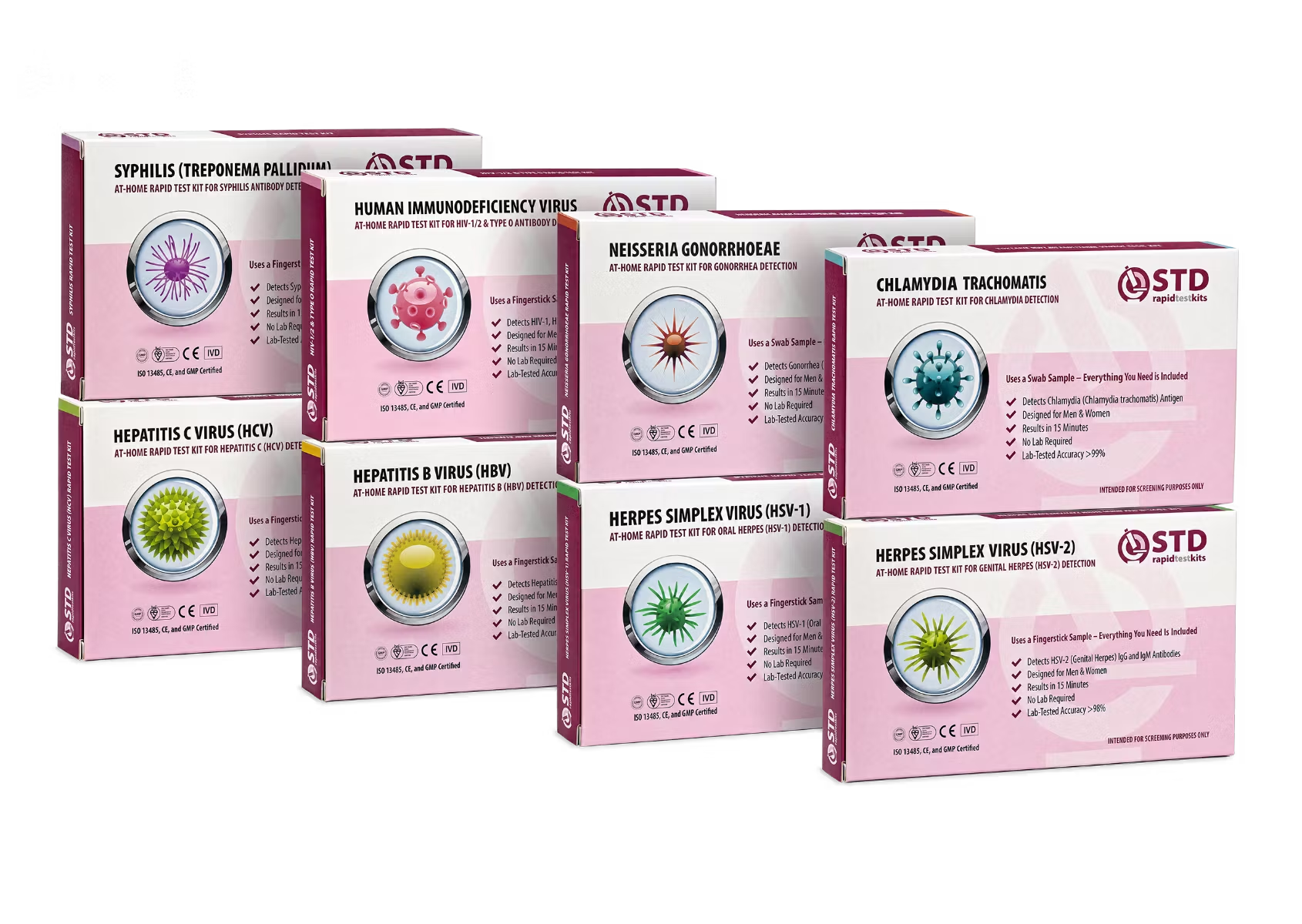
The result is the same either way: a clearer picture of your status, treatment for what is treatable, and informed decisions for yourself and any partners. A combo at-home test kit covers the most commonly silent infections in a single panel.
Recent exposure: schedule a test on a timeline that matches the relevant window period for the infection you are most worried about. Sexually active and never screened: routine testing belongs in adult care, the same way an annual physical does. Positive rapid result: confirm with a lab test through a clinician before any treatment decisions are finalized.
How we sourced this article: We summarized current guidance from the U.S. Centers for Disease Control and Prevention and the World Health Organization on asymptomatic STI prevalence, window periods, and screening recommendations. Statements about chlamydia asymptomatic rates, retesting timing, and U=U treatment as prevention are drawn directly from the CDC's published fact sheets and treatment guidelines. We do not provide clinical diagnosis; for symptoms or follow-up after a positive home test, see a licensed clinician.
- U.S. Centers for Disease Control and Prevention. About Chlamydia: clinical overview, transmission, and asymptomatic presentation.
- U.S. Centers for Disease Control and Prevention. Getting Tested for STIs: window periods and screening recommendations.
- U.S. Centers for Disease Control and Prevention. About Gonorrhea: clinical overview, transmission, and pharyngeal/rectal presentations.
- U.S. Centers for Disease Control and Prevention. HIV resource hub: basics, transmission, testing, treatment, and prevention.
- U.S. Centers for Disease Control and Prevention. About Syphilis: stages, primary chancre, and secondary manifestations.
- World Health Organization. Sexually transmitted infections (STIs) fact sheet: global prevalence, asymptomatic transmission, and screening principles.
