
Published: November 2025 | Last updated: May 2026 | Editorial review and quality control: Martina N.
Can I take the new gonorrhea pill without a test?
No. Zoliflodacin (Nuzolvence) is prescription-only and requires a confirmed positive test, usually a lab NAAT and sometimes preceded by an at-home rapid swab. Self-treating without confirmation feeds antibiotic resistance and may not clear the infection you actually have. Test first, then treat.
A new oral pill for gonorrhea is one of the biggest shifts in sexual-health care in years. On December 12, 2025, the U.S. FDA approved zoliflodacin, sold under the brand name Nuzolvence, a first-in-class oral antibiotic for gonorrhea (GARDP approval announcement). It is the first new class of antibiotic for this infection in nearly two decades, with a related oral candidate, gepotidacin, moving through the regulatory pipeline behind it. For anyone who has ever sat in a clinic waiting for the ceftriaxone shot, that sounds like progress, and it is. What has not changed is the step that comes before any prescription: an accurate diagnosis. Antibiotics, including the newer ones, only help when they are aimed at a confirmed infection. This guide covers what the new oral therapies change, what has stayed the same, and how at-home rapid testing fits if you think you have been exposed.
We publish at stdrapidtestkits.com, which sells at-home STI rapid test kits. We recommend tests based on what fits your situation, not commercial benefit, and when the right next step is a clinic NAAT or a clinician-collected throat swab, we say so plainly.
Key Takeaways
- Zoliflodacin (Nuzolvence) is prescription-only and requires a confirmed positive test before a clinician will prescribe it. It does not replace testing. For uncomplicated urogenital infections, it gives most people an oral alternative to the injection.
- More than half of gonorrhea infections cause no symptoms, so how you feel cannot stand in for a test. The reliable detection window for any test, lab NAAT or at-home rapid swab, is about 7 to 14 days after exposure.
From FDA approval to your decision: what actually changed
For years, the standard treatment for uncomplicated gonorrhea in the United States has been a single intramuscular injection of ceftriaxone, 500 mg for most adults and 1 gram for people weighing 150 kg or more. The CDC STI Treatment Guidelines have backed that approach partly because gonorrhea, caused by the bacterium Neisseria gonorrhoeae, has out-evolved nearly every oral antibiotic class tried against it. Penicillin worked in the 1940s. Tetracyclines and fluoroquinolones each had their run. Ciprofloxacin was dropped as a recommended treatment in 2007 after resistance climbed sharply in surveillance samples, and dual therapy with azithromycin was removed from CDC first-line guidance in 2020 over rising resistance.
The December 2025 approval of zoliflodacin (Nuzolvence) is the first genuinely new mechanism for treating gonorrhea in nearly twenty years. In its multinational Phase 3 trial, run by the Global Antibiotic Research and Development Partnership (GARDP), a single oral dose cured urogenital infection at rates comparable to the long-standing standard of a ceftriaxone injection. That makes it the first realistic oral option for most uncomplicated urogenital cases. Gepotidacin, an oral candidate from a different new class, has shown similar trial results and is moving through review behind it.
That sounds like a clean win, and the reality is more measured. Zoliflodacin is prescription-only and tied to clinical protocols designed to slow resistance. A provider will not write the prescription on the strength of "I think I might have gonorrhea." They want a confirmed diagnosis, ideally from a NAAT (nucleic acid amplification test), before treating. The approval is also narrow: uncomplicated urogenital infection in adults and adolescents. It does not cover pharyngeal (throat), rectal, or complicated infections, and the manufacturer has signaled a broad commercial launch in the second half of 2026, so availability will vary by region for a while. Ceftriaxone remains the CDC first-line treatment today.
- Possible exposure (with symptoms or none).
- Test and confirm with a clinic NAAT, or an at-home rapid swab followed by lab confirmation.
- Treat with the drug your provider chooses for the specific site and resistance profile of your infection.
How the new oral drugs differ from older ones
Gepotidacin belongs to a newly developed class, the triazaacenaphthylenes, that hits two essential bacterial enzymes at once: topoisomerase IV and DNA gyrase, at separate sites. Attacking two targets raises the bar for resistance, because the bacterium would need two simultaneous mutations to escape rather than one. The Phase 3 EAGLE-1 trial, which enrolled in 2021 and 2022, tested gepotidacin against a single-dose ceftriaxone injection for urogenital gonorrhea and reported non-inferior cure rates.
Zoliflodacin is a spiropyrimidinetrione, a different class again. It targets type II topoisomerase at a region distinct from where older fluoroquinolones bind, which matters because strains that resist ciprofloxacin, levofloxacin, or other fluoroquinolones can still be vulnerable to zoliflodacin. Laboratory testing has also shown activity against some ceftriaxone-resistant strains, and the trials studied a single oral dose with cure rates comparable to the standard of care at the time.
Both drugs were studied mainly for uncomplicated urogenital infection, meaning penile or vaginal sites. Both have thinner data on extragenital infection (throat and rectum), which the CDC notes is generally harder to clear. That gap matters in practice. Pharyngeal gonorrhea is common in people who have had oral exposure, and a provider may still recommend the ceftriaxone injection for those cases until more extragenital outcome data accumulates. People with a cephalosporin allergy receive gentamicin plus azithromycin as the CDC's recommended alternative.
Gepotidacin vs Zoliflodacin (Nuzolvence)
| Feature | Gepotidacin | Zoliflodacin (Nuzolvence) |
|---|---|---|
| Antibiotic class | Triazaacenaphthylene (dual-target) | Spiropyrimidinetrione (single oral dose) |
| Route | Oral | Oral |
| Strongest evidence | Uncomplicated urogenital gonorrhea (Phase 3 EAGLE-1, NAAT-confirmed) | Uncomplicated urogenital gonorrhea, including some fluoroquinolone- and ceftriaxone-resistant strains |
| Thinner evidence | Pharyngeal and rectal infection; pediatric use | Pharyngeal and rectal infection; long-term resistance surveillance |
| U.S. status (mid-2026) | Oral candidate in regulatory review for gonorrhea | FDA-approved December 2025; broad launch expected second half of 2026 |
Both are oral and both target urogenital infection; neither yet replaces ceftriaxone for throat or rectal cases.
Why testing comes first, even with a pill on the table
Here is a scenario clinics see constantly. Someone reads "new gonorrhea pill" in a headline, has had a recent risky encounter with maybe a mild symptom or maybe none, and wonders whether they can skip the test and just ask for the prescription. The honest answer is no, and the reason is worth understanding, because it explains why providers are being careful with these drugs.
The WHO estimated 82.4 million new gonorrhea infections worldwide among adults aged 15 to 49 in 2020, and a large share were silent. The CDC reports that most women with gonorrhea have no symptoms, and many infections in men are also quiet, especially in the throat or rectum, where infection often produces no signs at all (NHS gonorrhoea guidance). When symptoms do appear, they overlap with yeast infections, urinary tract infections, ordinary irritation from rough sex or a new lubricant, or strep throat. There is no reliable way to tell gonorrhea apart from those conditions on symptoms alone.
Treating without testing is also a stewardship problem. An antibiotic aimed at the wrong target pushes the bacterium toward resistance, and gonorrhea has already out-evolved every previous class deployed against it, which is one reason the CDC tracks resistance trends so closely. The new drugs are useful precisely because they work against resistant strains, and misusing them shortens their useful life, which harms not just you after a future exposure but everyone sharing the same antibiotic-resistance pressure.
Window period: how long after exposure should you test
The window period is the gap between exposure and the point when an infection becomes reliably detectable. For gonorrhea, the CDC and most diagnostic guidance put that at roughly 7 to 14 days, though detection can begin a little earlier. A test taken on day 2 has a real chance of a false negative even in someone who is infected, simply because the bacterial load has not built up enough to register.
If your anxiety is sharp and you want an early read, you can test in the first few days, but treat that result as preliminary and plan a confirmatory test at day 7 to 14. If symptoms develop in the meantime, an early negative does not rule out infection. If you stay symptom-free after a higher-risk exposure, the day-14 test is the one to trust. You can do this with an at-home gonorrhea test or a clinic NAAT; the timing is the same either way.
That timing applies to both lab NAATs and at-home rapid lateral-flow swabs, because the rate-limiting step is biology rather than test technology. The bacterium needs time to multiply to a detectable level. A lab NAAT can pick up lower bacterial loads than a rapid antigen test, which is one reason it stays the gold standard for confirmation. A pattern we hear about often: someone tests on day 4 after a hookup that felt off, sees nothing, and feels reassured, then a burning sensation at day 10 prompts a retest that comes back positive. The first test was not faulty. It was simply too early.
Gonorrhea Testing Window After Exposure
- Day 0 Exposure
Infection possible; nothing detectable yet
- Day 2 Days 0 to 2
Detection very unlikely; wait unless symptoms are severe
- Day 6 Days 3 to 6
Detection rising but unreliable; an early test needs a retest
- Day 14 Days 7 to 14
Reliable window for an actionable result
- Day 21 Day 15 and beyond
High detection; test if symptoms persist or to confirm a missed window
Detection becomes reliable around day 7 to 14; earlier negatives need a retest.
When you have no symptoms, which is most people
Most gonorrhea infections cause no symptoms at all. Studies of extragenital screening in men who have sex with men have found high silent-carriage rates in the throat and rectum, often above two-thirds of detected cases. The CDC's screening guidance reflects this: routine annual screening for sexually active women under 25, women 25 and older with risk factors, men who have sex with men (with extragenital screening every 3 to 6 months for higher-risk patterns), and pregnant people.
In practice, that means a person can be infected, infectious, and feel completely fine, passing it forward unless they test on a schedule. The cadence depends on risk profile, but the logic holds: symptoms are not a reliable signal, so scheduled screening catches infections that would otherwise stay hidden until they spread or cause complications.
Most women with gonorrhea do not have any symptoms. Untreated, gonorrhea can cause serious and permanent health problems.
At-home, mail-in lab, or clinic: which route fits
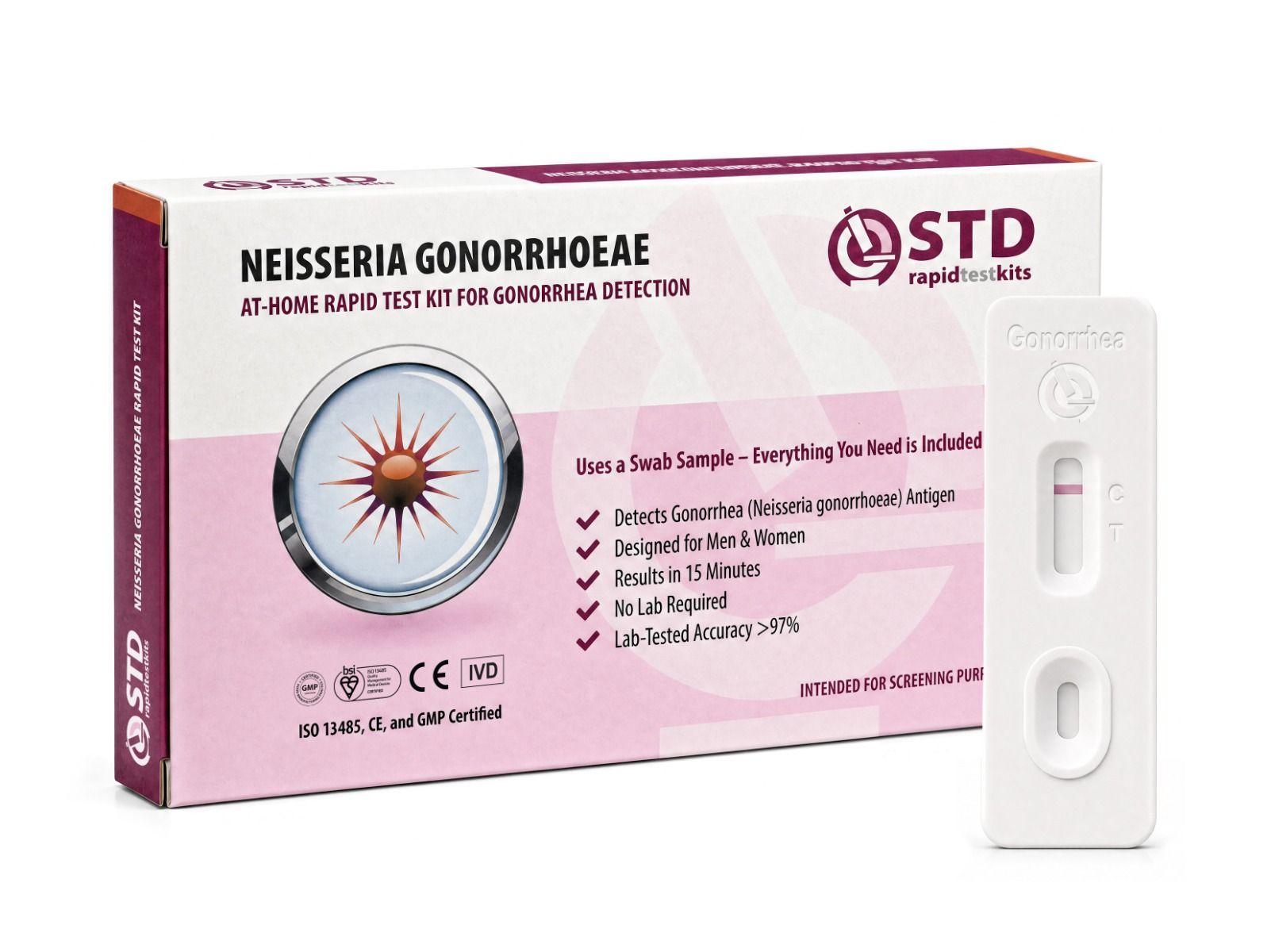
There are three realistic ways to get a gonorrhea result, and they suit different situations. For routine screening when you have no symptoms and you want privacy and speed, an at-home rapid lateral-flow swab gives you an answer in about 15 minutes with no appointment, no clinic copay, and no insurance paperwork that a policyholder might later see on an explanation of benefits. A mail-in lab service lets you collect a sample at home and ship it to a certified lab that runs the same NAAT technology a clinic uses, with results in a few days. A clinic visit is the right call when you have symptoms, when you need a throat or rectal swab, or when you want same-visit treatment. None of these is wrong; the best one depends on what you need that day.
Be clear-eyed about the trade-off. The at-home rapid test is a screening tool. It is lab-comparable for urogenital screening when used correctly after the window period, and a reactive result should always be confirmed by a clinician with a lab NAAT before treatment. It is not a substitute for clinic care when symptoms or throat and rectal exposure are in play.
At-Home Rapid vs Mail-In Lab vs Clinic
| Feature | At-home rapid swab | Mail-in lab NAAT | Clinic visit |
|---|---|---|---|
| Privacy | Highest; read at home | High; sample shipped to a lab | Lower; in-person visit |
| Speed | About 15 minutes | 1 to 3 days after the lab receives it | Same-day to several days |
| Technology | Lateral-flow antigen | NAAT (lab gold standard) | NAAT, plus an exam if needed |
| Sample sites | Genital self-swab only | Genital (urine or swab) | Genital, throat, and rectal |
| Best fit when | Routine screening, privacy, fast result | Lab-grade accuracy without a clinic trip | Symptoms, throat or rectal testing, same-visit treatment |
At-home rapid testing is a strong default for routine, symptom-free screening; clinic care covers symptoms and throat or rectal sites.
If your at-home rapid test is positive: what to do next
A test line on a rapid lateral-flow cassette is meaningful even when it is faint, and most kits count any visible test line as positive. Your next move is to contact a clinician, in person or by telehealth, to discuss confirmatory testing and a treatment plan.
Three things usually happen in that conversation. First, the clinician orders a confirmatory NAAT, the lab gold standard, on a swab or urine sample. Second, they take a sexual history to map possible exposure sites: urogenital, throat, rectum. Third, they choose treatment based on where the infection is. Urogenital infection is the best fit for the newer oral drugs, while a pharyngeal or rectal infection may still get the ceftriaxone injection, especially while extragenital data on the new drugs is still accumulating.
Telehealth services in many states can prescribe and ship treatment without an in-person visit, depending on the result and local rules. A provider may also treat for chlamydia at the same time (commonly oral doxycycline), because co-infection is common and joint coverage is often standard. After treatment, avoid sexual contact for at least 7 days, and ideally until any partners from the previous 60 days have also been tested and treated.
- Do not self-medicate with leftover antibiotics or someone else's prescription. The wrong drug can mask symptoms while leaving the infection in place.
- Do not order gray-market pills online instead of getting a confirmed diagnosis. Earlier antibiotic classes were rendered useless by exactly that pattern of misuse.
- Do not assume one drug clears every infection site. Throat and rectal infections are harder to treat and may need a different regimen.
Telling partners, and how to start the conversation
Notifying past partners is how you stop continued transmission, and it is often the hardest part of a positive result. The framing that tends to land is collaborative rather than accusatory: you are suggesting you both test, not assigning blame. Something plain works well, along the lines of, "I have been reading about gonorrhea, there is a new oral treatment that just got approved, and I would feel better if we both tested so we have real data instead of guessing." If a partner reacts badly to a basic testing request, that says more about the relationship than about the test. You never need anyone's permission to test yourself. Beyond a direct conversation, two practical paths are worth knowing about.
- Anonymous notification services. Many state and city public health departments run text or email partner-alert tools that let you notify past contacts without revealing your identity. Useful when a direct conversation is not possible or safe.
- Expedited partner therapy (EPT). Where it is allowed, your clinician can prescribe gonorrhea treatment for your partner without a separate clinic visit for them, per the <a href="https://www.cdc.gov/std/treatment-guidelines/gonorrhea-adults.htm" target="_blank" rel="noopener noreferrer">CDC's expedited partner therapy guidance</a>. Ask your provider whether EPT is available in your state. EPT depends on a confirmed test in the index case (you), which is another reason testing has to come first.
Resistance and why diagnostic stewardship matters
The reason you cannot grab any antibiotic and assume gonorrhea will clear is that N. gonorrhoeae has steadily defeated every drug class used against it. Sulfa drugs in the 1930s, penicillin through the 1940s and 50s, tetracyclines, then fluoroquinolones in the 1990s and 2000s. By the 2010s, even cephalosporin susceptibility was fraying at the edges in some countries. The CDC lists drug-resistant gonorrhea as a high-priority pathogen for new antibiotic development, and its antibiotic-resistant gonorrhea page tracks U.S. trends in detail.
Diagnostic stewardship, the habit of confirming an infection before treating it, is the main lever public-health authorities are using to extend the useful life of these new drugs. If someone takes zoliflodacin for what turns out to be bacterial vaginosis, the local gonorrhea population sees a sub-therapeutic dose of antibiotic for no reason, and resistant subpopulations get an opening. Multiply that across everyone who might self-medicate, and a drug class that took years to develop loses its lifespan quickly. Providers are therefore tightening prescribing rules even as more treatment options arrive.

Retesting after treatment: timing and reasons
The CDC's STI Treatment Guidelines recommend retesting about three months after gonorrhea treatment, even when you and your provider are confident the antibiotic worked. The reason is reinfection rather than treatment failure. Statistically, reinfection is a far bigger risk than failed clearance, which is rare with current first-line therapy. Many people resume sex before a partner has been treated, or meet a new partner, and the three-month retest catches those cases before they cause downstream harm.
Pelvic inflammatory disease (PID) is the complication people ask about most, and it deserves a real answer. Untreated gonorrhea can climb from the cervix into the upper reproductive tract within days to weeks, inflaming and scarring fallopian-tube tissue. The CDC describes PID as a common complication of untreated chlamydia and gonorrhea, and MedlinePlus notes that untreated gonorrhea can lead to PID and lasting problems with pregnancy and fertility (MedlinePlus on gonorrhea). Each episode adds to the long-term risk of ectopic pregnancy and tubal-factor infertility, which is why early detection and clearance matter well beyond the immediate infection.
For pharyngeal gonorrhea, the CDC recommends a test of cure 7 to 14 days after treatment, because the throat clears less reliably than the genital tract. If your infection was in the throat and your provider has not mentioned a test of cure, ask. The same test of cure applies in pregnancy or when the treatment regimen was not the recommended one. Beyond the three-month mark, retesting cadence follows your activity pattern: annual screening is the floor for sexually active adults under 25, and every 3 to 6 months suits people with multiple partners or other higher-risk patterns.
Retesting schedule at a glance
- Any treated gonorrhea infection: retest at 3 months, whether or not your partner was also treated.
- Pharyngeal infection, pregnancy, or a non-standard regimen: add a test of cure 7 to 14 days after treatment.
- Higher-risk patterns (multiple partners, men who have sex with men): screen every 3 to 6 months.
- All sexually active adults under 25: annual screening at minimum.
What at-home rapid testing does, and what it does not
It helps to be precise about what an at-home gonorrhea rapid test is, because the technology category shapes how you read the result.
What it is. A lateral-flow immunoassay using a self-collected genital swab. The kit detects Neisseria gonorrhoeae antigen and shows a visible test line when antigen is present, in roughly 15 minutes. It uses the same swab sample type as a lab NAAT, but the lab assay is a different and more sensitive technology.
What it is not. It is not a NAAT or a PCR test. The lab NAAT stays the diagnostic gold standard, especially for low bacterial loads, silent carriage, and suspected resistant strains. Read a rapid lateral-flow result as a fast screen that can put you and a clinician on the right path quickly, and confirm any positive with a lab NAAT before treatment.
What it cannot test. A genital swab does not detect throat or rectal gonorrhea. Pharyngeal infection needs a clinician-collected throat swab and lab NAAT, and rectal infection needs a clinician- or self-collected rectal swab and lab NAAT. We do not sell either of those at-home kits. If your concern is a sore throat after oral exposure, the right next step is a clinic visit, not a genital swab, so you do not walk away with false reassurance from the wrong test.
If you want to screen more broadly alongside gonorrhea (chlamydia, syphilis, HIV, hepatitis B, and hepatitis C), the 6-in-1 panel below combines those checks into one kit, using the same self-swab and fingerstick blood-drop approach as the single-infection tests.
Product: STD-6KIT-ATH-2024
Bottom line
The new oral pills change the experience of gonorrhea treatment. For most uncomplicated urogenital cases, the injection is no longer the only path. What they do not change is the diagnostic step that comes first: test, confirm, then treat, in that order. If you are worried after an exposure, the fastest route to certainty is usually a rapid swab at day 7 to 14, sooner if symptoms are intense, with the understanding that an early negative is not conclusive. Confirm any positive with a clinic NAAT, and let your clinician pick the right drug for your case, which for now still means ceftriaxone in many situations and the new oral options for the cases that fit them.
Gonorrhea is bacterial, in the same way strep throat is bacterial, and it has no bearing on your character. A test is not a confession. Many people delay testing out of embarrassment, but the infection is a treatable medical condition, and a result is simply the information you need to act on.
Should you test now? A quick decision guide
Do you have symptoms now, such as unusual discharge, painful urination, or a sore throat after oral exposure?
Yes: Test without waiting and contact a clinician. Symptomatic gonorrhea is usually detectable right away, and throat or rectal symptoms need a clinic swab a home kit cannot provide.
No symptoms, but has it been at least 7 days since the exposure?
Yes: Test now with an at-home rapid gonorrhea swab or a lab NAAT. You are in the reliable detection window.
Did your at-home test show any visible test line?
Yes: Treat it as positive and confirm with a clinic NAAT before any treatment, so your provider can match the drug to your infection site.
No: If you tested before day 7, retest at day 14. A later negative with no symptoms means routine screening on your usual schedule is enough.
Guidance only; a clinician can advise based on your specific situation.
FAQs
- Can I take the new gonorrhea pill without testing first?
- No. Zoliflodacin (Nuzolvence) is prescription-only, and providers require a confirmed positive test, usually a lab NAAT, before prescribing. Self-treating without a confirmed diagnosis risks treating the wrong condition, missing the real infection, and feeding antibiotic resistance. The new drug is valuable because it works against resistant strains, and misusing it shortens its useful life.
- Is zoliflodacin (Nuzolvence) available at pharmacies yet?
- The FDA approved it on December 12, 2025, but the manufacturer has signaled a broad commercial launch in the second half of 2026. Depending on when and where you read this, it may or may not be on a given pharmacy's shelf. Until it is widely available, the U.S. first-line treatment remains a single 500 mg ceftriaxone intramuscular injection given in a clinical setting.
- How accurate is an at-home rapid swab compared to a lab NAAT?
- They serve different roles. The at-home kit is a lateral-flow immunoassay, useful for fast urogenital screening at home in about 15 minutes, and it is lab-comparable when used correctly after the window period. The lab NAAT detects bacterial DNA and is more sensitive at low infection levels. Treat the rapid test as a screen: confirm a positive with a clinic NAAT, and repeat a negative if symptoms persist after a high-risk exposure.
- How soon after exposure can I test for gonorrhea?
- The reliable detection window is about 7 to 14 days after exposure. Earlier testing is possible if symptoms are sharp, but treat an early negative as preliminary and plan a confirmatory test at day 7 to 14. The biology is the same whether you use a lab NAAT or an at-home rapid swab: the bacterium needs time to multiply to a detectable level.
- I had oral sex and now have a sore throat. Will the at-home swab tell me if it is gonorrhea?
- No. Our at-home kit uses a genital self-swab and does not detect throat or rectal infection. Pharyngeal gonorrhea needs a clinician-collected throat swab processed by a lab NAAT, so for a possible throat infection after oral exposure, go to a clinic. The new oral approvals also do not yet cover pharyngeal infection, so that route still typically gets the standard ceftriaxone injection.
- Does a faint test line on the rapid swab mean I am positive?
- In most rapid lateral-flow kits, any visible test line counts as positive, even a faint one. The control line confirms the test ran correctly; the test line shows antigen was detected. Do not wait for it to darken. Treat a faint positive as a positive and move to confirmatory testing with a clinician.
- My partner tested positive. Do I need to test even if I feel fine?
- Yes. More than half of gonorrhea infections cause no symptoms, so you can be infected without any sign. The CDC recommends partner testing and treatment to prevent back-and-forth reinfection. Many states allow expedited partner therapy, where your partner's clinician can prescribe treatment for you without a separate visit, though this still depends on a confirmed test in the index case.
- When should I retest after I have been treated?
- Three months is the baseline retest date, even if your partner was also treated, because reinfection is far more common than treatment failure. For throat infections, pregnancy, or any non-standard regimen, add a test of cure 7 to 14 days after treatment, since the throat clears more slowly than urogenital sites.
- Global Antibiotic Research and Development Partnership. U.S. FDA approval of Nuzolvence (zoliflodacin), December 12, 2025. Source for the FDA approval date, brand name, and first-in-class oral antibiotic framing.
- U.S. Centers for Disease Control and Prevention. STI Treatment Guidelines: Gonococcal Infections Among Adolescents and Adults. Source for ceftriaxone 500 mg first-line dosing, alternative regimens, retesting cadence, expedited partner therapy guidance, and the pharyngeal test-of-cure recommendation.
- U.S. Centers for Disease Control and Prevention. About Gonorrhea. Source for asymptomatic-infection rates by anatomic site and an overview of complications.
- U.S. Centers for Disease Control and Prevention. Antibiotic-Resistant Gonorrhea Information for Healthcare Providers. Source for resistance trends, the historical antibiotic-class timeline, and the 2007 ciprofloxacin discontinuation.
- World Health Organization. Gonorrhoea (Neisseria gonorrhoeae infection) fact sheet. Source for the 2020 global incidence estimate of 82.4 million new infections among adults aged 15 to 49.
- U.S. Centers for Disease Control and Prevention. About Pelvic Inflammatory Disease (PID). Source for the description of PID as a common complication of untreated chlamydia and gonorrhea.
- National Health Service (UK). Gonorrhoea. Source for the point that not everyone with gonorrhoea has symptoms and that infection can affect the genitals, rectum, and throat.
- MedlinePlus (U.S. National Library of Medicine, NIH). Gonorrhea. Source for the points that gonorrhea does not always cause symptoms and that untreated infection can lead to pelvic inflammatory disease and infertility.
