STD Test Anxiety: Why the Wait Feels Brutal and How to Cope
The needle and the swab are the easy part. The waiting is what makes people lose sleep. Here is what is happening in your brain while you refresh your inbox, when results are biologically reliable, and a calm, evidence-based playbook for the days between the test and the result.




- Anxiety alone can produce real, felt sensations that mimic STI symptoms, especially in the genital, urinary, and digestive areas where nerves react strongly to stress hormones.
- Rapid at-home lateral-flow tests give results in 15 to 20 minutes, but a result is only as reliable as the window period allows; testing too early or retesting too often usually prolongs the spiral rather than ending it.
Published: September 2025 | Last updated: May 2026 | Editorial review and quality control: Martina N.
Is it normal to feel anxious, sleepless, or panicky while waiting for STD test results?
Yes. Anticipatory anxiety while awaiting STI results is a well-documented, normal response. Rapid at-home tests typically return results in 15 to 20 minutes; lab-processed tests range from same-day to about 7 days for syphilis or herpes blood work. Grounding, limiting symptom-Googling, and talking to one trusted person help most.
The physical part of an STI test takes minutes. The mental part can stretch for days. An at-home pregnancy test gives a yes-or-no answer in three minutes; sexually transmitted infection testing does not work that way. Even rapid lateral-flow tests need the right window period to be accurate, and lab-processed panels can take days to come back. Mail-in kits add shipping time on top of that. If you are reading this while pacing, refreshing email, or quietly catastrophizing about a swab you took yesterday, you are experiencing a form of STD test anxiety that is more common than the silence around it suggests.
Sexually transmitted infections are common. The U.S. Centers for Disease Control and Prevention's STI surveillance program reports millions of new infections every year, which means millions of people experience this exact waiting period. The shame and silence around it are not a measure of how rare your situation is. They are a measure of how poorly the conversation has been handled. Sexual health is health, and testing is one of the more responsible things a person can do for their body and their partners.
This guide covers what your body is actually doing while you wait, when different tests become biologically reliable, what coping strategies are supported by published research, and when the anxiety is severe enough to warrant professional mental-health support. It also addresses the parts most articles skip: guilt, relationship fear, avoidance, and the pattern where a negative result still does not feel like enough.
Key Takeaways
- Anxiety alone can produce real, felt sensations that mimic STI symptoms, especially in the genital, urinary, and digestive areas where nerves react strongly to stress hormones.
- Rapid at-home lateral-flow tests give results in 15 to 20 minutes, but a result is only as reliable as the window period allows; testing too early or retesting too often usually prolongs the spiral rather than ending it.
Why STD testing triggers so much anxiety
Sexual health testing sits at an uncomfortable intersection: a medical decision tangled up with shame, vulnerability, intimacy, and uncertainty all at once. Most people are not afraid of the swab or the fingerstick. They are afraid of what the result might mean for their identity, their relationships, and their future.
Several pressures usually pull tight at the same time. There is the fear of the unknown, a result you cannot see, controlled by a lab you cannot speed up. There is the cultural messaging that frames STIs as a moral failure, even though the World Health Organization estimates more than 1 million curable STIs are acquired every day worldwide, often inside committed relationships and often when condoms have been used correctly. And there is the loss of control: the result is out of your hands, but the anxiety is happening to you in real time.
That combination is genuinely difficult. Anxiety researchers consistently find that humans tolerate certain bad news better than they tolerate prolonged uncertainty, because uncertainty keeps the threat-detection system on. Sex is bounded by time and presence; worry has no such limits. The encounter ends, but the second-guessing does not. If you are spiraling, it can help to name what the spiral is actually about. Sometimes the answer is straightforward: a condom slipped and you do not know your partner's status. Sometimes the answer is older and deeper: a household that did not talk about sex, a previous experience that left a mark. The spiral is rarely random.
- Fear of the unknown. A result you cannot see, controlled by a lab you cannot speed up.
- Cultural moral-failure framing. STIs are still framed as personal failure even though millions of new infections occur in committed relationships every year.
- Loss of control. The result is out of your hands, but the anxiety is happening to you in real time.
The physical symptoms of test anxiety
Stress is not just emotional. The body has its own language for it, and during the post-test waiting period, that language often gets misread as evidence of infection. Clinicians use the term psychosomatic to describe genuine physical sensations triggered by stress rather than disease. They are real symptoms; they just have a different cause than the one your brain has settled on. "Somatic" simply means physical or body-based, as opposed to emotional or cognitive.
Common waiting-period sensations include burning, itching, or tingling in the genital area (frequently mistaken for early herpes or trichomoniasis), persistent fatigue, sleep disruption with racing thoughts at 3 a.m., headaches, nausea, mild gut upset, and a flu-like feeling of being generally unwell. Cortisol, the body's main stress hormone, can produce or worsen all of these on its own. Anxiety symptoms also cluster in exactly the areas a worried person is most likely to scrutinize: the genital region is densely innervated, the bladder shares neural pathways with the pelvic floor (which contracts under tension), and the digestive tract is highly sensitive to fight-or-flight signaling. Anxiety is well documented as a cause of physical symptoms; the U.S. National Library of Medicine's MedlinePlus covers the condition broadly.
Add hypervigilance and the loop closes. You feel a sensation, you check it, the act of checking heightens awareness of the area, the sensation becomes more prominent, and the search for what it could mean returns alarming possibilities. By day three, many people are convinced they have a specific infection because their body now feels like the description they read. The body has many ordinary ways of producing strange sensations; pathogens are a relatively small share of them. A sore throat the morning after a hookup is more often dry mouth, fatigue, or a viral cold than a pharyngeal infection. A red mark on the inner thigh is more often friction, an ingrown hair, or contact dermatitis than herpes. Recognizing this loop does not make the sensation less real, though it does suggest that what is being felt may be the nervous system rather than a pathogen.
Somatic symptoms anxiety can produce (often mistaken for an STI)
These sensations are physically real. The cause is the stress response, not an infection. If they persist after a clearly timed negative result, the underlying issue is usually health anxiety rather than undetected infection.
- Burning, itching, or tingling in the genital area (often mistaken for early herpes or trichomoniasis) Common
- Urinary urgency or a feeling of incomplete bladder emptying Common
- Persistent fatigue and a flu-like sense of being generally unwell Common
- Sleep disruption, with racing thoughts at 2 or 3 a.m. Common
- Nausea, appetite loss, or a nervous-stomach sensation Common
- Tension headaches, jaw clenching, or shoulder tightness Less common
- Dry mouth or a scratchy throat the morning after a worrying encounter Less common
- Skin flushing, prickly sensations, or transient red spots that appear and fade Less common
How long results take, and when they become reliable
One reason waiting feels worse than it needs to is uncertainty about how long the wait should be. Stress, lack of sleep, and panic do not delay lab processing or alter what is on the rapid-test cassette. They affect how long the wait feels and how loudly your body protests, but they do not change the biology being measured. If a result is taking longer than the lab told you to expect, that is a logistics question (call the clinic) rather than a sign that stress has interfered with the science.
There are two clocks running at the same time: the lab's turnaround clock (how fast they process a sample once they have it) and the biology clock (how long since the exposure before a test can detect anything). Both matter, and people often confuse them. Antibodies need time to develop. Bacterial loads need to reach detectable levels. Until they do, no test, no matter how sophisticated, can give you certainty. The table below summarizes both clocks for the most common infections, drawing on current CDC HIV testing guidance and broader CDC and WHO STI testing recommendations. Window periods for chlamydia, gonorrhea, syphilis, herpes, and hepatitis are drawn from the CDC STI testing overview and current WHO guidance.
| Test | When to test after exposure | Time to result |
|---|---|---|
| Chlamydia / Gonorrhea (NAAT or rapid swab) | 5 to 7 days minimum, 14+ days for highest reliability | 15 to 20 minutes (rapid) or 2 to 4 days (lab NAAT) |
| HIV (4th-generation antigen/antibody lab test) | 18 to 45 days; retest at 90 days for confirmation | 1 to 3 business days |
| HIV (rapid antibody, clinic or at-home lateral-flow) | 23 to 90 days depending on the assay | 15 to 20 minutes |
| Syphilis (RPR or treponemal antibody) | 3 to 6 weeks; 6 to 12 weeks for highest reliability | 3 to 7 business days |
| Herpes type-specific IgG (HSV-1, HSV-2) | PCR or swab from active lesions within days; antibody blood test at 12+ weeks | 3 to 7 business days |
| Hepatitis B / Hepatitis C (antibody) | 3 to 11 weeks depending on the infection | 1 to 3 business days (lab) or 15 minutes (rapid) |
| At-home rapid lateral-flow combo kit | Use only after the window period has closed for each component | About 15 minutes, read at home |
Why the wait often feels worse than the result
Psychological research consistently shows the same pattern: the period between testing and result is when patients report the most distress, regardless of personality or prior history. The brain treats unresolved threat differently from resolved threat, and the unresolved version keeps the stress response running on a loop. Worry happens alone at 2 a.m. with a phone and a search engine, with no natural stopping point.
For people with histories of medical trauma, sexual trauma, or chronic anxiety, the loop can be especially intense. Time perception stretches; a five-day wait can feel like five weeks. Memory gets filtered through fear, so past encounters get re-examined for missed signals that may or may not be there. None of that means you are losing your grip. It means an old defense system designed to keep our ancestors alive is treating an email about lab results like a saber-tooth tiger in the bushes.
STI anxiety also usually follows a recognizable arc: the exposure happens, worry starts within hours, the body produces a small sensation often unrelated, the brain interprets the sensation as evidence, searches begin, reassurance is short-lived. Each step has a place where the loop can be interrupted. The first interruption is at the search bar; the second is at the body-check; the third is at the calendar, where marking the date a test becomes biologically meaningful gives the brain a defined endpoint. Knowing what to expect helps. The UK's National Health Service notes that most STIs respond to treatment. Bacterial infections like chlamydia, gonorrhea, syphilis, and trichomoniasis are typically cleared with antibiotics, while viral infections such as HIV, herpes, hepatitis B, and hepatitis C are managed with effective ongoing care.
Three behaviors do most of the work of dragging the wait out: late-night symptom searching, repeated body-checking, and emotional isolation. Late-night searching pushes the brain toward the worst-case version of every sensation it is already scanning for. Repeated body-checking magnifies ordinary sensations and produces new ones from the sheer act of paying attention. Isolation removes the simple perspective that another trusted person can offer.
Coping strategies that actually help while you wait
There is no off-switch for test anxiety, but there are tools with reasonable evidence behind them. The goal is keeping the spiral from running the rest of your life until the result arrives, not achieving calm.
Grounding techniques work because they pull attention out of imagined futures and back into the present body. The 5-4-3-2-1 technique (name 5 things you can see, 4 you can touch, 3 you can hear, 2 you can smell, 1 you can taste) is a quick reset when you notice a panic spike. Slow paced breathing (about 6 breaths per minute, with a longer exhale than inhale) reliably reduces acute physiological arousal in clinical studies.
Limit your symptom-Googling. Internet symptom checkers and image searches are calibrated for the rare and severe; they are terrible at telling you that the rash on your inner thigh is most likely a razor bump. If you must research, give yourself a 10-minute timer and stick to authoritative sources (CDC, WHO, NHS) rather than forums and image searches. Anonymous forum threads collect worst-case stories because reassured people stop posting, which biases everything you read there.
Limit body-checks too. If you have been checking the same spot ten times a day, stop. Repeated visual inspection of the genitals, throat, or skin produces micro-irritation, raises awareness of normal sensations, and turns ordinary skin into evidence. A workable rule: two checks a day, in good light, for under thirty seconds each. If a spot looks the same as yesterday, log it and move on. If it has changed in a way you can describe in writing, that is the threshold for talking to a clinician, not for another body-scan.
Stay connected. The waiting period is when many people isolate, which is when shame works hardest on a brain. You do not have to broadcast it. One trusted friend, a therapist, or a sexual-health helpline counts. Several countries operate free confidential sexual-health phone lines for exactly this kind of situation.
Five things to do today, in order of difficulty
- Set a single 10-minute window to look up information from a trusted source (CDC, WHO, NHS), then close the tab.
- Run the 5-4-3-2-1 grounding sequence the next time you notice a panic spike.
- Move your body for 20 minutes (a walk works), which reliably lowers cortisol.
- Tell one person you trust that you are going through this; you do not have to share details.
- Decide in advance how you will respond to each possible outcome, then put the plan away until result day.

Guilt, regret, and the relationship-fear spiral
STI anxiety rarely shows up alone. It usually arrives bundled with guilt about a specific encounter, regret about a partner, fear of disclosure, or worry about a long-term relationship. Even people in monogamous partnerships sometimes spiral about exposures that happened years before they met their current partner.
A useful reframe: STIs are biological events, not moral verdicts. The same person can practice consistent safer sex for a decade, contract an STI from a partner who tested negative inside their window period, and still end up in your exact situation. A companion question that tends to produce a kinder, more accurate response than the spiral: what would you tell a close friend going through this exact situation? Almost no one would answer that question harshly. Apply the same standard to yourself.
Clinic versus at-home testing for anxious testers
People manage testing anxiety differently. Some feel reassured by an in-person clinician who can answer questions in the moment and walk through next steps. Others find clinics activating, particularly survivors of sexual or medical trauma, people with strong privacy concerns, or anyone whose nearest clinic feels unwelcoming.
At-home testing changes the variables, but it does not eliminate the wait. Rapid lateral-flow kits read at home in 15 to 20 minutes shorten the result-delivery window dramatically. Mail-in lab kits still involve a turnaround period (usually 2 to 7 days after the lab receives the sample). The advantage in either case is environmental: you are not sitting in a waiting room or worrying about who might see you walk in.
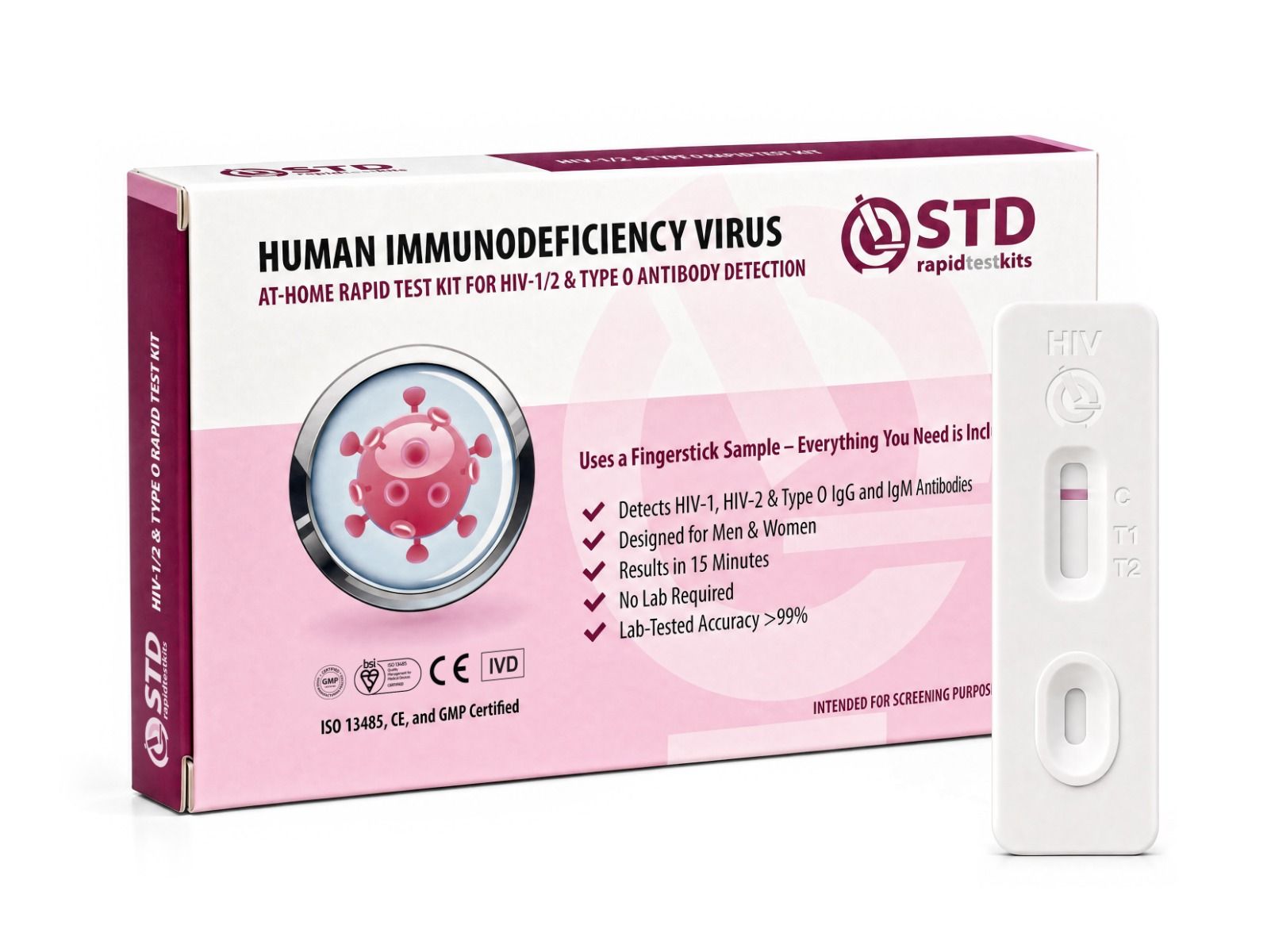
Whichever route you choose, plan the after. Pre-deciding takes some load off your future, more anxious self. stdrapidtestkits.com sells at-home STI test kits; the products called out below are the ones that fit the most common reader situations.
Plan the after: a four-question checklist
- Who will I tell first, and when?
- When and where will I read the result (not at work, not at 11 p.m.)?
- If the result is positive, what is my immediate next step (call clinic, schedule confirmatory test, look up treatment)?
- If the result is negative, what is my plan for routine retesting going forward?
When avoidance becomes its own problem
One of the most common patterns clinicians see is people who book a test, then avoid picking up the result. Or they intend to test, then keep postponing. The brain delays a perceived threat to feel safer in the short term; avoidance is what that mechanism looks like in practice. The trade-off is that the threat does not actually go away, and undiagnosed infections can progress.
If you notice you are avoiding, two practical steps tend to help. Writing your fears down in concrete sentences externalizes them and usually makes the worst-case scenario more survivable than the looping version in your head. A small accountability structure closes the second gap (a friend who texts you the morning your result is due, a partner who knows the date, a calendar reminder you cannot ignore), because the social friction of ignoring a result becomes higher than the anxiety of reading it.
This matters at a public health level too. The WHO notes that the majority of STIs are asymptomatic, which means waiting for symptoms is not a safer plan than testing.
Write your fears down in specific sentences ("if it is positive, here is what I think it would mean for my life, my relationships, my work"). Most fears lose some of their power once they are out of your head and on paper. Then recruit one person, a friend or partner, to text you on result day so the social cost of ignoring the result becomes higher than the cost of reading it.
When a negative result still does not feel like enough
For most people, a negative test taken after the correct window period brings relief that lasts. For some, the worry persists even after a clearly timed negative result, as new symptoms surface and the mind keeps generating fresh theories about what the test might have missed. The reader becomes convinced that the test missed something, that a rarer infection exists, that the lab made an error, that they are somehow uniquely unlucky.
Often this pattern is more about health anxiety than about STIs, especially in the sexual-health context where shame, secrecy, and the moral weight some upbringings attach to sex amplify the fear. At root, many people in this pattern are afraid that something is fundamentally wrong with them, and the test result is just the surface that fear has most recently settled on.
Clinicians sometimes describe this pattern as health-related obsessive thinking or illness anxiety. Reassurance does not stick: each negative result temporarily lowers anxiety, but the relief decays within hours or days, and the search for a new explanation begins. Clinicians recognize this cycle as evidence that the underlying issue is the anxiety itself rather than the infection. For people stuck in the cycle, the more useful step is usually a conversation with a clinician or therapist trained in this kind of thinking. Cognitive behavioral therapy is one of the most studied treatments for health anxiety, and many primary care providers can offer a referral.
Rumination means replaying the same scenarios over and over without learning anything new. Constructive thinking moves toward a decision or an action. If you have looped the same encounter for the third or fourth time without making progress, that is rumination. Changing channels tends to help more than thinking harder: a walk, a phone call, a piece of music, a 20-minute task with your hands.
How to talk to a partner during the wait
Whether and how to tell a partner depends on the relationship. Two patterns cover most situations.
If you are in a committed relationship, honesty is usually the easier long-term path. Most partners would rather be in the loop than discover the situation later. If it was a one-time encounter, you do not owe a hookup a running update on your emotional state. But if you have specific reason to think they could be at risk, brief honest disclosure is part of harm reduction and is supported by every major sexual-health body. You are not obligated to write an essay; a one-line message is enough.
For a committed partner: "I got tested, here is why, here is when I expect the result, and the wait is making me anxious. Could you check in with me on Friday?"
For a one-time encounter you have specific reason to flag: "Hey, just letting you know I got tested after the time we spent together. I will pass on the results when I have them."
When to seek professional mental-health support
Most waiting-period anxiety resolves once results arrive, especially if the result is reassuring or comes with a clear treatment plan. Some people find the anxiety lingers, generalizes, or escalates. That is the point at which professional support becomes the next sensible step.
Consider speaking with a clinician, therapist, or licensed counselor if you cannot sleep or eat for several days, if your fear escalates into panic attacks or compulsive symptom-checking, if you find yourself avoiding sex, intimacy, or relationships out of test-related fear, or if you feel hopeless or are having thoughts of self-harm. The last item is a same-day call to a crisis line; in the United States, the 988 Suicide and Crisis Lifeline is available 24 hours a day. Sexual-health-specific therapy exists and is worth asking for. So is trauma-informed care. You do not have to wait until you are in crisis to ask for it.
If you are having thoughts of harming yourself, please contact a crisis line immediately. In the United States, call or text 988 (Suicide and Crisis Lifeline). In the United Kingdom, call Samaritans on 116 123. Most countries operate free confidential crisis lines; an internet search for "crisis line" plus your country usually surfaces them.
Common myths that make waiting worse
A lot of waiting-period suffering is downstream of bad information that has been absorbed before the test was even taken. The corrections matter.
- Myth: only people with many partners get STIs. Incorrect. STIs are transmitted in committed and casual relationships alike, and number of partners is one risk factor among many.
- Myth: no symptoms means no infection. Incorrect. Chlamydia, HPV, and HIV can all be asymptomatic for long periods. Asymptomatic carriage is one of the main reasons screening exists.
- Myth: a positive result ends your sex life. Wrong. Most STIs are curable or manageable, and people living with herpes, HIV, or HPV maintain healthy sexual relationships every day with disclosure and standard precautions.
- Myth: you would know immediately if something was wrong. Wrong. Every STI has a window period during which a recent infection may not yet be detectable, which is why retesting is sometimes recommended.
- Myth: stress can cause an STI. Wrong. Stress can produce psychosomatic symptoms that mimic an infection, but it cannot create the bacteria or virus required for an actual STI.

Your next steps right now
Has the window period for the infection you are worried about already closed?
Yes: Use a rapid at-home kit or book a clinic visit now. A correctly timed result is the most useful thing you can have.
No: Mark the earliest reliable test date on your calendar and use the coping tools above to get to that date.
Did a rapid or initial test come back positive?
Yes: Book a confirmatory lab test through a clinician before starting any treatment. Most STIs are highly treatable; a positive result is a starting point, not a verdict.
Did you test negative after the correct window period, but the anxiety has not lifted?
Yes: Speak with a clinician or therapist about health anxiety rather than ordering another test. Repeated retesting in this pattern is itself a marker of the underlying issue.
No: Schedule routine retesting on a cadence that fits your exposure risk and partner situation, and revisit this guide if the wait gets heavy again.
A short triage for the days between today and the result. Guidance only; a clinician can advise based on your specific situation.
FAQs about STD test anxiety
- Can stress and anxiety actually cause STD-like symptoms?
- Yes. Anxiety and chronic stress reliably produce somatic (physical) symptoms including burning, tingling, fatigue, headaches, gut upset, and sleep disturbance. These are real physical sensations; the cause is the stress response, not an infection. If symptoms are accompanied by visible lesions, unusual discharge, or a known recent exposure, that is a reason to see a clinician rather than wait it out.
- How long do STD test results actually take?
- Rapid at-home lateral-flow tests give a result in 15 to 20 minutes. Clinic-based rapid HIV tests are also same-day. Lab-processed tests typically return in 1 to 3 business days for HIV antibody/antigen, 2 to 4 days for chlamydia and gonorrhea, and 3 to 7 days for syphilis or herpes blood work. If you are past 7 to 10 business days with no result, call the clinic or lab; that is a logistics issue, not a science one.
- Why do I feel like I have an STI even though my test came back negative?
- After a worrying exposure, the brain stays on high alert for a while. Stress produces real physical sensations: tingling, itching, mild burning, urinary urgency, abdominal discomfort. If you tested after the correct window period and got a clear result, the result is reliable; the sensations are usually anxiety, not infection, and tend to fade as the nervous system settles, often over a few days. If they do not fade, that is a signal to talk with a clinician about health anxiety, not to test again.
- Why do I feel guilty even though I used protection?
- Sexual shame runs deeper than logic in most people, because cultural messaging starts early and is rarely corrected. Feeling guilty after responsible, protected sex usually reflects absorbed cultural messaging more than any actual misstep on your part. The reframe that helps most people is: would you tell a close friend in this exact situation that they had failed? Almost certainly not. Apply the same standard to yourself.
- Is it normal to cry, feel sick, or lose sleep while waiting for results?
- Yes. Anticipatory anxiety in this context is well-documented. Tearfulness, nausea, appetite loss, and insomnia during this period reflect a nervous system responding to unresolved uncertainty rather than infection or personal weakness. Most of these symptoms ease within a day or two of receiving the result.
- Why does one encounter feel like such a big deal?
- Because uncertainty, intimacy, and shame are a heavy combination, even when the actual biological risk is low. The brain weighs emotional consequences alongside biological ones, and the absence of clear information amplifies both. The size of the worry is rarely proportional to the size of the actual risk. If the worry feels far larger than the risk you can actually measure, that disproportion is worth noting, and worth talking through with someone you trust, even if that is just a friend rather than a clinician.
- I am still worried after a negative test. Should I just test again?
- If your first test was taken inside the window period, yes, retesting after the window has closed is reasonable. If your first test was correctly timed and clearly negative, retesting usually does not help. Repeated testing in this pattern is one of the markers of health anxiety, and the temporary relief from each new negative result tends to decay quickly. A conversation with a clinician about anxiety is more useful at that point than another lab order.
- What if my test comes back positive?
- Then you have information you can act on, which is the entire point of testing. Most STIs are highly treatable. Bacterial infections like chlamydia, gonorrhea, and syphilis are cured with antibiotics. HIV is managed with daily medication that produces near-normal life expectancy. Herpes is managed with antiviral therapy and is a manageable condition rather than a defining one. A positive result is not a moral judgment; it is a starting point for treatment, and the resources for that treatment are well established. A positive home-test result should be confirmed at a clinic before treatment begins.
- Should I tell my partner I am getting tested?
- For ongoing relationships, yes. Most partners would rather hear it from you now than find out later. For one-time encounters, disclosure is only needed if there is a specific risk to flag, and you are not required to share your emotional state.
- When should I see a clinician instead of testing at home?
- See a clinician if you have visible symptoms that need physical examination, if your exposure included a body site (throat or rectum) that home swab kits do not cover, if you are pregnant, if you have a known immune-compromising condition, or if a home test comes back positive. Clinicians can also order lab NAAT testing, which has higher analytical sensitivity than home rapid tests, especially for asymptomatic infections.
- U.S. Centers for Disease Control and Prevention. STI prevention, testing, and surveillance overview, including annual U.S. infection volume.
- World Health Organization. Sexually transmitted infections fact sheet, including global incidence (more than 1 million new curable STIs acquired per day) and the asymptomatic-majority statement.
- U.K. National Health Service. Patient-facing guidance on sexually transmitted infections, including treatment-response framing.
- U.S. Centers for Disease Control and Prevention. HIV testing overview including window periods for rapid antibody and 4th-generation antigen/antibody assays.
- U.S. National Library of Medicine, MedlinePlus. Anxiety overview, including the physical and somatic symptoms that can mimic other medical conditions.
- 988 Suicide and Crisis Lifeline. U.S. national crisis support line referenced in the mental-health support section.