
Published: August 2025 | Last updated: May 2026 | Editorial review and quality control: Martina N.
When a partner refuses an STD test, the moment can feel like a much larger conversation than it looked on paper. You came in expecting practical logistics. You ended up somewhere harder to name. Concern. Hurt. A small alarm bell that takes a while to identify.
Most readers landing here are not trying to assign blame. They are trying to figure out one thing: whether this refusal is workable, or whether it is the early signal of a relationship that quietly asks too much of one side and too little of the other. This guide walks through the medical risk, the relationship signals to read, and the testing options you can use on your own timeline.
Key Takeaways
- Asymptomatic infections are common. Chlamydia, gonorrhea, HPV, and herpes can all transmit without visible signs, so "I feel fine" is not a substitute for screening.
- Your own negative result reflects only your body at one moment in time. Without your partner's status, exposure risk continues every time you have sex.
This Isn't Only About a Test
When someone refuses STD testing, the refusal can land like rejection. The real conversation underneath is bigger than a urine sample or a swab. Testing inside a sexual partnership is shared accountability in physical form. It is one of the simplest ways two people say "your body matters to me as much as my own."
Picture three months into a relationship. Things are good. You have stopped using condoms because you both said you were exclusive. One night you mention testing before going further. They roll their eyes. "I told you, I don't have any symptoms."
That sentence is meant to reassure, and it usually fails. CDC testing guidance notes that STIs often have no symptoms at all. Bacterial infections like chlamydia and gonorrhea can sit silently for weeks or months, and HPV is often only visible on a test result rather than on the body, especially in early stages. Someone can feel completely fine and still pass an infection to a partner. Absence of symptoms is not evidence of absence of infection. That is biology, not paranoia.
So when a partner refuses testing, the question becomes layered. Is the refusal fear? Shame? Misinformation? Or a deeper unwillingness to take mutual safety seriously? The answer to that question often shapes whether the rest of the relationship feels workable.
Asymptomatic infection means the absence of noticeable symptoms, not the absence of infection. That gap matters every time two people have unprotected sex without knowing each other's recent test status.
What Are Your Real Risks If Only One of You Tests?
Step out of the emotional swirl for a moment and look at what actually happens medically when only one partner tests. This is where a lot of people get tripped up. "I got tested. I'm negative. So we're fine." Not always.
If your partner refuses STD testing and you continue having sex, your own negative result reflects only your body at the moment the sample was taken. It does not certify your partner is infection-free. If they are unknowingly carrying something, exposure can happen the next time you sleep together. A negative test is a snapshot of one day, not a permanent clearance going forward.
| Scenario | Your Test Result | Partner Tested? | Ongoing Risk? |
|---|---|---|---|
| You test before sex, partner refuses | Negative | No | Yes, future exposure possible |
| You test after unprotected sex, partner refuses | Negative (early) | No | Yes, window period may mask infection |
| You test negative and use condoms consistently | Negative | No | Reduced but not eliminated (skin-to-skin infections still possible) |
| Both partners test after window period | Negative | Yes | Lowest risk scenario |
Why Someone Might Refuse
Before deciding whether to stay, it helps to understand what could be driving the refusal. Not to excuse it. Just to read it accurately.
For many people, STD testing is tangled up with stigma. The word "test" gets translated into "accusation." Being tested gets equated with being dirty. That framing is medically outdated and harmful, and it still lingers socially, especially in households where sex was never discussed openly.
Sometimes the refusal is avoidance. Some people would rather not know. Ignorance can feel temporarily safer than confirmation, particularly if a positive result might force a conversation about a prior partner or about a current symptom they have been ignoring.
Occasionally, refusal can signal concealment. A past infection they never disclosed. A recent encounter they do not want to explain. That possibility is painful to consider, and pretending it never happens does not protect you either. The honest question is whether your partner's refusal is rooted in fear you can work through together, or in disregard for your wellbeing.
Three common drivers of refusal
- Stigma and shame: "test" gets read as "accusation," a framing that lingers from outdated public messaging about sexual health.
- Avoidance: not knowing can feel temporarily safer than confirming something difficult, especially with a symptom already being ignored.
- Concealment: occasionally, refusal points to a past infection or a recent encounter the person does not want to explain.
Can Condoms Alone Protect You?
If you decide to stay, your next instinct may be harm reduction. "Fine. We'll just use condoms." That is a reasonable step, and it is incomplete.
The CDC describes condoms as highly effective against infections transmitted through fluids when used consistently and correctly. HIV, gonorrhea, and chlamydia all fall in that category. Infections that spread by skin-to-skin contact, such as herpes and HPV, can still pass from areas the condom does not cover. The protection is partial, not complete.
| Protection Strategy | Reduces Fluid-Based STD Risk | Reduces Skin-to-Skin STD Risk | Requires Mutual Cooperation? |
|---|---|---|---|
| Consistent condom use | High reduction | Partial reduction | Yes |
| Mutual testing + exclusivity | Very high reduction | Very high reduction | Yes |
| One-sided testing only | No reduction after exposure | No reduction after exposure | No |
Red Flag or Fear Response?
Back to that moment. You are sitting across from them. You explain that testing would make you feel safer. They get quiet. Or irritated. Or suddenly affectionate in a way that feels like deflection. Your brain starts scanning for meaning.
The behavior alone matters less than the pattern around it. Do they shut down every health conversation? Do they mock the idea of testing? Or do they admit they are scared and embarrassed and willing to keep talking?
Fear can be worked through with information and patience. Contempt is harder to repair. One reader described their partner laughing through the entire conversation about window periods and asymptomatic infections, calling her dramatic each time she tried to explain why testing mattered. The laughter was not really about science. Pay attention to how anger or ridicule shows up when you raise a safety concern, because the texture of the response says as much about the relationship as the underlying testing refusal.
There is a meaningful difference between "I'm nervous about testing, can we talk about it?" and "Drop it." The first is discomfort. The second is control. If your partner refuses STD testing and also minimizes your concerns, reframes them as distrust, or pressures you into unprotected sex anyway, the issue has stopped being about testing.
He said testing was pointless because he felt fine. When I tried to explain window periods and asymptomatic infections, he laughed and said I was being dramatic.
Trust Is Not the Same as Proof
People often say, "If you trust me, you don't need a test." It sounds romantic, and it is not medically sound. Trust is emotional. Testing is biological. They do different jobs.
You can trust someone deeply and still acknowledge that infections do not always announce themselves. You can love someone and still ask for documentation. Those two things coexist comfortably in adult relationships. The WHO STI fact sheet consistently emphasizes that asymptomatic transmission drives much of the global STI burden, which is exactly why screening matters even when no one feels sick.
Picture stopping condoms together. It feels intimate. Like a milestone. Intimacy without clarity can quietly morph into anxiety. You find yourself Googling "STD symptoms but partner refuses test" after noticing something small and ambiguous, a mild irritation or a small change in discharge, sometimes nothing at all except your own thoughts filling the uncertainty. The stress is rarely coming from distrust. It is coming from uncertainty.
| Behavior | Possible Meaning | What It Signals for the Relationship |
|---|---|---|
| "I'm scared to test but I want us safe." | Anxiety or stigma | Workable with support and education |
| "You don't trust me." | Deflection | Conversation needs deeper trust repair |
| Refuses testing and condoms | Risk disregard | Serious boundary violation |
| Agrees to condoms but not testing | Partial compromise | Short-term harm reduction possible |
| Makes you feel irrational for asking | Gaslighting | Emotional safety concern |
If You Stay, Define What That Means
Whether you stay or leave, neither choice maps cleanly onto strength or naivety. The meaning depends on what has or has not changed, and whether the pattern you are seeing is one you can live with. The decision rarely splits cleanly down a single line.
If you stay with a partner who refuses STD testing, you are consciously accepting some degree of uncertainty. The fair question is whether that uncertainty is temporary and improving, or chronic and dismissive.
Imagine you stay and insist on consistent condom use. Weeks pass. They comply without eye rolling or pressure. That trajectory suggests your boundary, even if imperfectly met, is being respected. Now imagine the opposite. They "forget" condoms. They sigh dramatically when you mention protection. They accuse you of paranoia every time you bring up health, and that pattern stops being about testing and becomes the steady erosion of a boundary.
Long-term stress over exposure risk carries its own toll. Constantly wondering whether you can catch something from a partner who will not get tested wears down intimacy. Sex stops feeling safe. People often describe pulling back from their own body during moments that used to feel connecting.
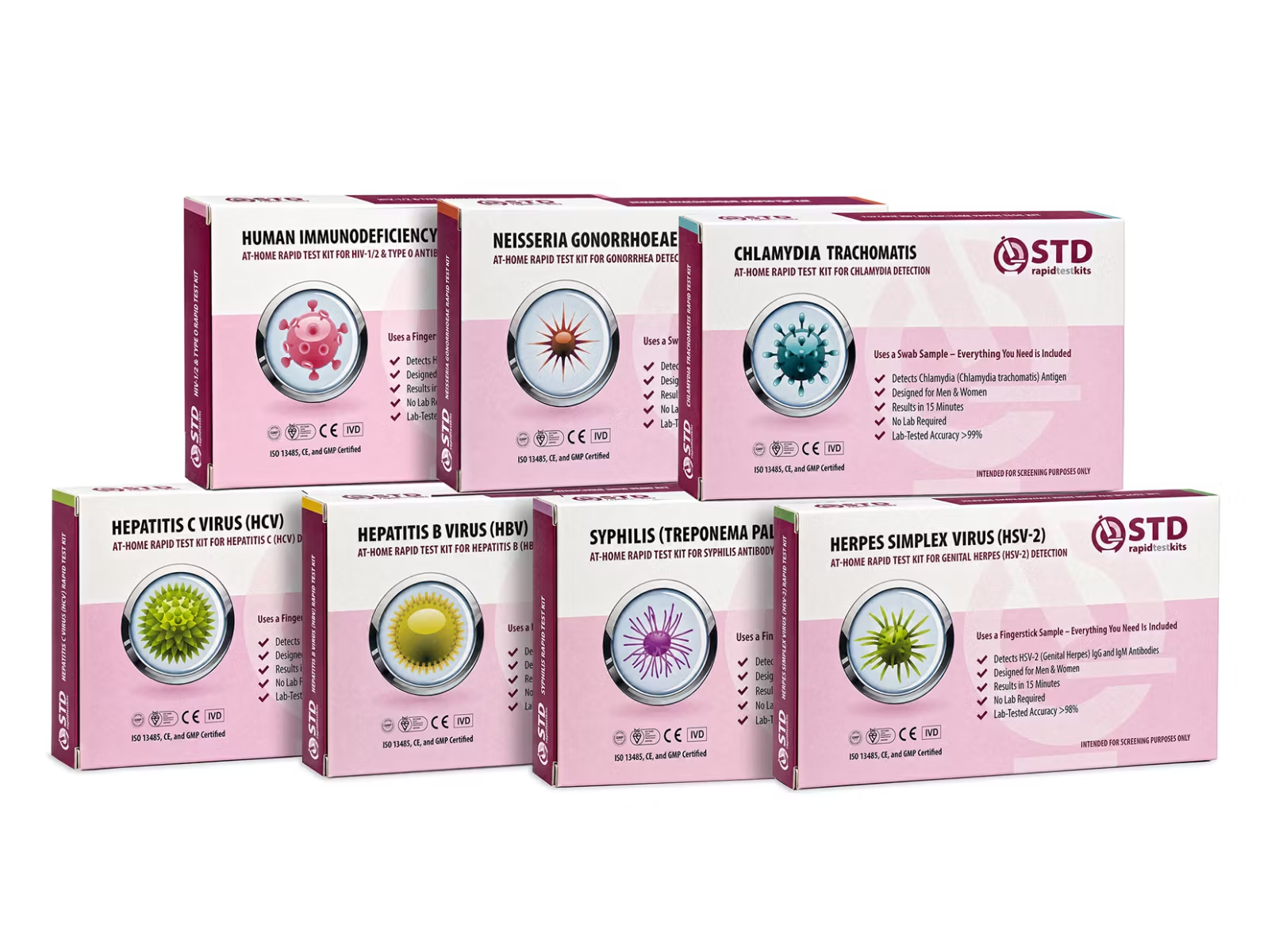
If discreet screening on your own timeline would help you anchor in facts while the conversation with your partner continues, we sell at-home rapid STI kits and the callout below is to one of our own products.
The Window Period Anxiety Loop
One of the hardest parts of staying in this situation is the mental math. If exposure happens, you start tracking days after each potential exposure, wondering whether you have waited long enough for a test to be accurate or whether symptoms would even show.
Window periods are real, and they vary by infection. Many bacterial infections like chlamydia and gonorrhea become detectable within roughly one to two weeks, while some blood-based infections such as HIV can take longer to reach full detection accuracy depending on which test is used. This is not obscure medical trivia. It directly shapes how long uncertainty lingers when only one partner tests.
| Time After Potential Exposure | What You Might Feel | Testing Reality | Emotional Impact |
|---|---|---|---|
| 0–5 days | Panic, regret, urgency | Too early for many tests to detect infection | False reassurance risk if testing immediately |
| 7–14 days | Hyper-awareness of symptoms | Many bacterial infections detectable | Moderate relief if negative |
| 3–6 weeks | Lingering background anxiety | Blood-based tests more accurate | Stress may persist if partner still untested |
| Beyond 6 weeks | Decision fatigue | High accuracy window for most screenings | Clarity possible, but only about your own status |
How to Reopen the Conversation Without a Fight
If you want to try the conversation again before making a final decision, timing matters more than wording. Do not raise it mid-argument. Do not raise it during foreplay. Pick neutral ground, like a walk or a drive or a calm Sunday afternoon when neither of you is already on edge.
Try language that centers your needs without attacking their character. "This isn't about accusing you. It's about how I feel safest in my body." Or, "I can't move forward sexually without mutual testing. It is not negotiable for me." Steady sentences land better than pleading ones.
If they respond with curiosity, there is room to grow. If they respond with anger or ridicule, that response is its own data. One reader shared her experience: "I told him I loved him, but I wouldn't have unprotected sex without testing. He sulked for two days. Then he booked an appointment." She said the appointment mattered less than the fact that he eventually chose cooperation over ego. That choice told her something useful about the future of the relationship.
"This isn't about accusing you. It's about how I feel safest in my body."
"I can't move forward sexually without mutual testing. It is not negotiable for me."
Both center your needs without naming a flaw in your partner. Use whichever fits the temperature of the conversation you are already in.
When Staying Costs More Than Leaving
There is a quieter shift that happens in some relationships. The question stops being "Can I make this work?" and becomes "Why am I the only one bending?"
If your partner refuses STD testing and months pass with no movement, no compromise, and no willingness to revisit the conversation, the silence itself says something about how shared health decisions are likely to go long-term. You may catch yourself shrinking your needs to keep the peace. You may stop bringing the topic up at all. You may start telling yourself it is "not that serious." Sexual health is not optional, and the emotional labor of carrying mutual responsibility alone gets heavy fast.
If you decide leaving is the right call, that decision is not overreaction but alignment between what you need to feel safe and what you are willing to accept long-term. One man described breaking up over this: "It wasn't that she wouldn't test. It was that she mocked me for caring. I realized I'd be negotiating my safety forever." He said the breakup hurt, and the constant anxiety stopped immediately.
It wasn't that she wouldn't test. It was that she mocked me for caring. I realized I'd be negotiating my safety forever.
The Decision Is Threshold-Based, Not Binary
Instead of asking, "Should I stay?" it can help to ask, "What would actually need to change for me to feel safe here?" That reframes the conversation from ultimatum to criteria.
If the answer is mutual testing within a reasonable timeframe, communicate it clearly. If it is consistent condom use plus future openness to testing, state it as a condition. If it is simply respect in the conversation, observe whether respect actually shows up. Staying without criteria slides into resentment over time. Staying with clearly named criteria creates a way to measure progress. When the criteria are never met, the decision often clarifies itself.
Discreet at-home testing options exist precisely because conversations like this can be complicated. Knowing your own status will not solve your partner's refusal, and it does anchor you in facts instead of fear.
FAQs
- Am I being dramatic for caring this much about STD testing?
- No. Asking for mutual health transparency before unprotected sex is informed, adult behavior. The more you understand about asymptomatic infections, the calmer and clearer the boundary tends to become. It stops feeling like a demand and starts feeling like a basic part of how you operate.
- What if they say, "You don't trust me"?
- That line gets used often, and it puts trust and testing into the same category when they answer different questions. Trust is about intentions and character. Testing answers a separate, biological question: whether any infection is present, regardless of how loyal or faithful someone is. You can trust someone's intentions deeply and still want clarity about the biology. If your partner frames a request for verification as an accusation, that reaction itself is worth paying attention to.
- They say they have never had symptoms. Should that count?
- It counts for comfort, not for certainty. Many infections, including chlamydia and gonorrhea, can sit silently for months. People can feel completely fine and still transmit something. "I feel normal" is reassuring emotionally, and it is not diagnostic.
- Is using condoms enough if they will not test?
- Condoms meaningfully lower the risk for fluid-based infections like HIV and gonorrhea when used consistently. They do not, however, resolve the underlying uncertainty that comes from not knowing your partner's baseline status. Condoms also do not cover every inch of skin, so infections such as herpes and HPV can still transmit through uncovered contact. Over time, managing that open question alone adds a layer of stress to intimacy that condoms cannot address.
- Can I just test myself regularly and leave it at that?
- You can prioritize your own testing schedule, and that is proactive. Remember that a negative result only reflects your body at the time you tested. If exposure continues, the risk timeline resets every time. Regular testing keeps you informed; it does not fix the imbalance if your partner refuses shared responsibility.
- I'm scared to bring it up again. What if they get angry?
- That fear matters. If asking for health safety triggers anger, the anger itself is information. Try framing the conversation around your own needs: "I need this to feel safe" rather than "You need to do this." If mockery or anger reappears anyway, it is worth asking why a basic care request feels confrontational in this dynamic.
- Could they be hiding something?
- Sometimes, and not always. Some people avoid testing because they are afraid of stigma, needles, or what a result might mean. Others avoid it because they do not want to confront an uncomfortable truth. The core question is less about hidden infections and more about whether their avoidance becomes your ongoing burden to carry.
- If I decide to leave, am I overreacting?
- Leaving because a partner will not respect a health boundary is not overreaction. Relationships built on shared responsibility need both people to participate in the protective basics. If that foundation is missing, walking away can be painful, and it can also be steady. Relief is often quieter than drama.
How We Sourced This Article: Our article was constructed based on current advice from the most prominent public health and medical organizations (CDC, WHO, and MedlinePlus), and then molded into simple language based on the situations that people actually experience when navigating testing decisions inside a relationship. Condom-effectiveness and asymptomatic-transmission claims are anchored to root-domain public-health pages cited inline above. Window-period figures are general clinical knowledge consistent with public-health guidance; readers should consult a clinician for guidance on the specific test and timing that fits their exposure. The narrative scenarios are illustrative composites of reader experiences and are not clinical case reports.
- U.S. Centers for Disease Control and Prevention. Overview of sexually transmitted infections, including which infections are commonly asymptomatic.
- U.S. Centers for Disease Control and Prevention. Getting tested for STIs, used for the general framing that STIs often have no symptoms.
- U.S. Centers for Disease Control and Prevention. Condom use overview, supporting the fluid- versus skin-to-skin protection distinction.
- World Health Organization. Fact sheet on sexually transmitted infections, supporting the asymptomatic-transmission claim.
- MedlinePlus (U.S. National Library of Medicine). STI test overview, used as a general reader-facing primer on what STI tests can and cannot do.
