

Published: August 2025 | Last updated: April 2026 | Editorial review and quality control: Martina N.
You stayed faithful. Your partner says they did too. Then a routine swab comes back positive, or a blister shows up, or a Pap smear flags HPV, and the floor drops out from under both of you. The first instinct is to look for a lie. The second is to interrogate your own memory. Most of the time, neither one is the right answer.
A positive STI result inside a committed, sexually exclusive relationship usually points to something quieter than betrayal. It points to an infection that was already in the building, sitting in one partner's body, untested and asymptomatic, sometimes for years. This guide walks through why that happens, what the most common silent infections actually do, and how to think about testing without turning it into an accusation.
Can you really get an STI in a faithful relationship?
Yes, and it happens more often than most people expect. Infections like HSV-2, HPV, chlamydia, and HIV can stay quiet in the body for months or years before surfacing. If neither partner had a complete panel before unprotected sex began, an old infection can show up later inside the relationship without anyone breaking a vow. Cheating sometimes plays a role too, but it is one explanation among several, not the default.
Key Takeaways
- Most chlamydia infections in women, and a substantial share in men, cause no symptoms, which lets the bacteria persist undetected through the start of a new relationship.
- Standard STI panels often skip HSV-1, HSV-2, HPV, and trichomoniasis unless the patient specifically requests them, so 'we both got tested' usually means less than couples assume.
How an STI Ends Up in a Faithful Relationship
There are roughly four ways an infection arrives inside a closed couple. None of them require a broken promise.
The first is a pre-existing, undiagnosed infection in one partner. People rarely run a complete STI panel before they stop using condoms with someone new. According to CDC chlamydia guidance, most chlamydia infections in women cause no symptoms, and a substantial share of cases in men also stay silent. A person can carry the bacteria quietly through the first months of a new relationship and only learn about it when their partner tests positive at a routine visit.
The second is a long-latency virus. HSV-2, HSV-1, HPV, and HIV can all stay in the body for years without symptoms, or with symptoms so mild they get written off as something else. The CDC's genital herpes overview notes that most people with HSV-2 either have no recognized symptoms or have very mild ones, which is exactly why the virus continues to spread inside relationships people consider safe.
The third is an incomplete or mistimed test. A standard STI panel ordered through a primary care visit often does not include HSV-1, HSV-2, HPV, or trichomoniasis unless the patient specifically asks. Screening for those infections is generally added only when the patient requests it or has symptoms. A panel run inside a window period, before antibodies or detectable antigens have developed, can also miss an active infection.
The fourth is genuine in-relationship transmission, sometimes from infidelity and sometimes from a non-sexual exposure route for things like hepatitis B or HIV. Cheating is real, and it does account for some unexpected diagnoses. It is just one explanation among four, and assuming it is the answer before any testing is done causes a lot of avoidable damage to relationships that did not actually break.
This article is published by stdrapidtestkits.com, which sells at-home STI testing kits. Product recommendations below are matched to the reader's situation, not to commercial benefit. If a clinic visit is the right next step, we say so.
Silent Infections and Their Long Tails
STIs do not all behave the same way. Some announce themselves within days. Others sit in cells, nerve roots, or cervical tissue for years. The infections most often responsible for the 'how is this even possible' diagnosis in committed couples are the ones with the longest quiet periods.
Bacterial infections like chlamydia and gonorrhea tend to be silent rather than truly dormant. The bacteria are active and replicating, and they can cause real damage, including pelvic inflammatory disease or epididymitis, even when the person feels nothing. The CDC's chlamydia resource emphasizes routine annual screening for sexually active young women specifically because chlamydia is so often missed without it.
Viral infections behave differently. HSV-2 establishes a permanent reservoir in sensory nerve cells and reactivates intermittently, sometimes with visible sores, sometimes by silent viral shedding that can still infect a partner. HPV often clears on its own within one to two years, but high-risk types can persist and cause cervical cell changes long after the original exposure. HIV has a long clinical latency period during which the virus is reproducing but symptoms are absent or unrecognized. The table below summarizes what each infection looks like in this slow, hidden mode.
| Infection | Asymptomatic? | Quiet period | When it usually surfaces |
|---|---|---|---|
| Chlamydia | Frequently in women, often in men | Weeks to months | Routine screening or partner's positive result |
| Gonorrhea | Frequently genital in women, sometimes in men | Days to weeks | Symptom flare or routine screening |
| HSV-2 (genital herpes) | Most carriers have no recognized symptoms | Months to years | First recognized outbreak, often years after exposure |
| HPV | Yes, frequently | Months to years (often clears) | Cervical screening, genital warts, or persistent high-risk type |
| HIV | Yes, during clinical latency | Years without treatment | Routine screening or seroconversion symptoms |
| Trichomoniasis | Often in women, more often in men | Weeks to months | Symptoms during a flare, or partner notification |
| Syphilis | Yes, during latent stages | Months to years | Routine screening or later-stage symptoms |
Why 'We Got Tested' Often Misses the Problem
Couples who tested before going condom-free usually feel they did the right thing. They did. Even careful testing, though, can miss what matters, and the reasons are structural rather than individual.
Panel composition is the most common issue. A typical 'full STI panel' at a primary care office often runs HIV, syphilis, chlamydia, and gonorrhea. It does not automatically include HSV-1, HSV-2, HPV, or trichomoniasis. Those tests are usually added only when the patient explicitly asks or when symptoms point to them. So a clean panel can mean clean for four infections out of seven, and the gap quietly becomes a transmission route later.
Timing matters just as much. Every test has a minimum interval between exposure and reliable detection, called the window period. Per CDC HIV testing guidance, an antigen/antibody lab test using blood from a vein can usually detect HIV 18 to 45 days after exposure. Antibody-based tests for HSV-2 take six to twelve weeks, sometimes longer, before seroconversion is consistent. A test taken too soon after a possible exposure produces a false negative, and a couple who relies on that 'all clear' may stop using condoms before the infection becomes detectable.
Then there is the question of where the sample comes from. Genital swabs detect genital infection. They do not detect throat or rectal infection, both of which are common transmission sites for chlamydia and gonorrhea. Sampling those sites is not part of routine screening unless the patient specifically requests it, so genital-only panels can miss an extragenital infection that still transmits. A reader who needs throat or rectal swab testing for that reason should plan a clinic visit, since at-home rapid kits, including ours, are not validated for those sample types.
A standard panel at most clinics covers four infections by default: HIV, syphilis, chlamydia, and gonorrhea. HSV-1, HSV-2, HPV, and trichomoniasis are typically extra, added on request. Throat and rectal sampling is also typically extra. If you are running a baseline panel for a relationship, ask explicitly for the full list and for any extragenital sampling that fits your sexual history.
When the Infection Was Already in the Room
The most common scenario behind a surprise diagnosis in a committed couple is also the least talked about. One partner picked up a quiet infection in a previous relationship, never tested for the specific pathogen, never developed symptoms strong enough to seek care, and carried it forward into the current relationship. By the time it surfaces, that previous relationship may be five, ten, or fifteen years in the past. The carrier did not lie. They did not cheat. They simply did not know.
Genital herpes is the textbook example. Per the CDC's genital herpes resource, the majority of people with HSV-2 are unaware of their infection, because the virus either does not cause recognized outbreaks or causes mild symptoms that get attributed to razor burn, yeast infection, or a single 'weird' patch of skin. The first clearly identified outbreak can happen years after the original exposure, often triggered by stress, illness, or a change in immune status. When that outbreak finally happens inside a committed relationship, it looks like new transmission. Biologically, it usually is not.
HPV follows a similar pattern. The virus can persist for years, then become detectable on a Pap smear long after the partner who originally transmitted it is out of the picture. A positive HPV result inside a long-term, exclusive relationship rarely identifies who the source was, and the partner currently sleeping next to you is often not the source at all.
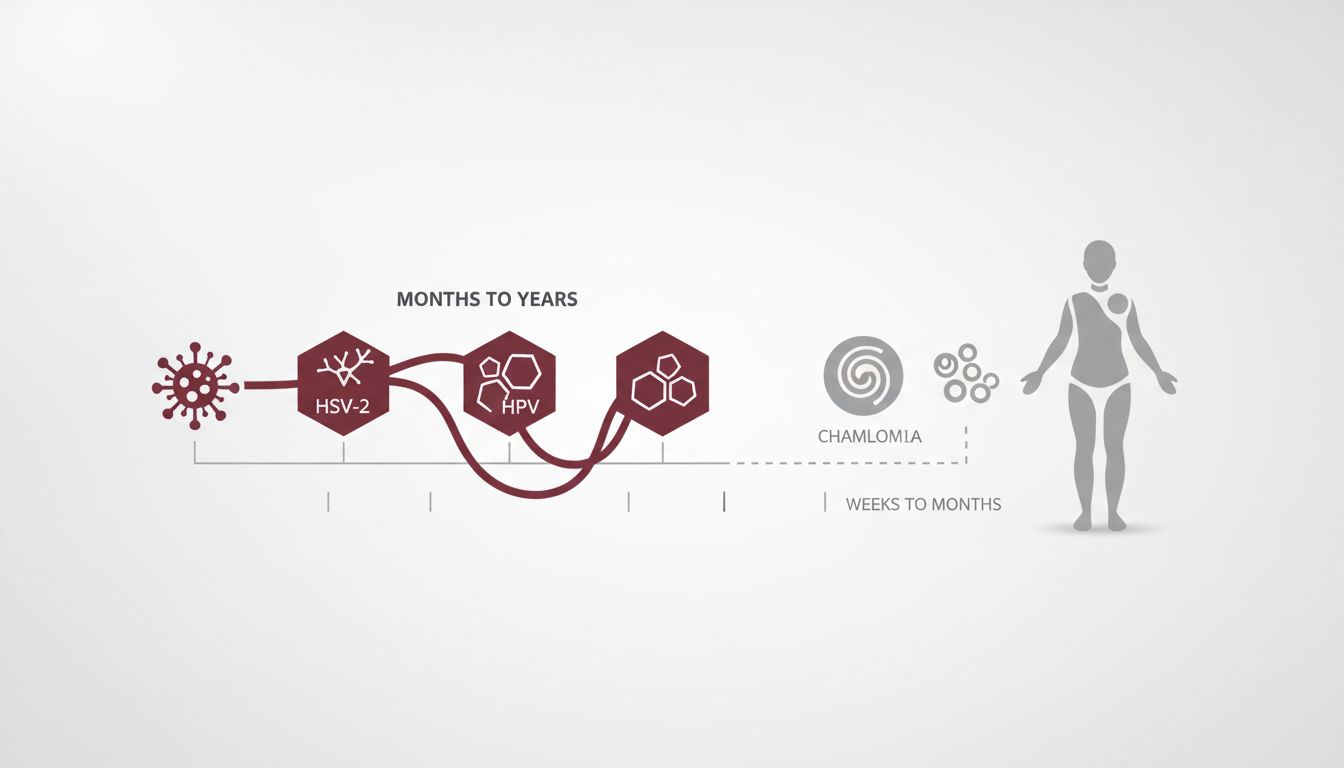
Most people who have genital herpes do not know they have it. They either have no symptoms, very mild symptoms, or symptoms they mistake for another skin condition.
Cheating Is Real, but It Is Not the Default Explanation
None of this means infidelity does not happen. It does, and infidelity is one of the ways an STI enters a 'closed' relationship. Surveys consistently find that a meaningful minority of people in committed relationships report sexual contact outside the relationship, and unprotected sex outside the relationship is the obvious mechanism for new gonorrhea, syphilis, or HIV exposure inside one.
The point is that a positive result, by itself, cannot tell you which of the four mechanisms above caused it. The test reports the presence of an infection. It does not report a date, a partner, or a reason. Jumping from result to accusation skips over the more common explanations and frequently lands on the wrong one. Couples who treat the diagnosis as a question to investigate together, rather than a verdict to defend against, tend to come out of it with a clearer answer and far less collateral damage.
That investigation usually involves a more complete repeat panel for both partners, a history of past partners and prior testing on both sides, and a clinician's read on which infection was most likely already present versus newly acquired. Some infections, like primary syphilis or acute HIV, have characteristic timelines that point to recent exposure. Others, like HPV or HSV-2, are essentially silent on timing and point nowhere in particular.
Some results carry a rough timeline. A primary syphilis chancre and a positive RPR developing within weeks of an exposure point to recent acquisition. Acute HIV infection sometimes produces flu-like symptoms two to four weeks after exposure, before antibody-only tests turn positive. Gonorrhea symptoms typically appear within two weeks. HSV-2 and HPV are the opposite: positive results in either of these can reflect exposure five, ten, or fifteen years earlier, with no biological way to date the original event. Treat the timing as a clue, not a verdict.
Reinfection, Pregnancy, and the Long Tail
Couples who have already been treated once sometimes face a second positive result a few weeks or months later, and it almost never means a fresh betrayal. The reinfection loop is a real and common pattern: if one partner gets treated for chlamydia or gonorrhea and the other is not treated at the same time, or if the couple resumes sex before treatment is fully complete, the infection ping-pongs between them. Per NHS guidance on STIs, both partners should complete treatment and abstain from sex during the treatment window, and per NHS chlamydia guidance, retesting after treatment is sometimes needed to confirm the infection has cleared. Single-partner treatment is rarely enough.
Pregnancy is the other place this matters. Untreated chlamydia and gonorrhea during pregnancy can cause serious complications, including premature birth, neonatal eye infection, and pneumonia. Untreated syphilis in pregnancy carries a high risk of congenital syphilis. Couples often assume that years of monogamy mean they are STI-free at conception. The biology does not honor that assumption. Preconception screening, even for couples who have been together for years, is a low-cost step that catches the infections most likely to harm the pregnancy. A clinician will typically order a more complete panel for someone planning to conceive than for the same person at a routine annual visit.
Infections worth confirming clear before pregnancy
- Chlamydia. Untreated maternal infection raises the risk of premature delivery, neonatal conjunctivitis, and infant pneumonia.
- Gonorrhea. Linked to neonatal eye infection (ophthalmia neonatorum) and preterm rupture of membranes when untreated.
- Syphilis. Untreated maternal syphilis carries a high risk of congenital syphilis, stillbirth, and neonatal death.
- HIV. Treatment during pregnancy reduces the risk of mother-to-child transmission to under 1 percent in most settings.
How to Talk About Testing Without Making It an Accusation
Most couples who test together after years of skipped panels expect the conversation to be awkward. It usually is, for the first thirty seconds, and then it is fine. The framing that works best treats testing as something the couple does together, not something one partner asks the other to prove.
Concrete phrases that tend to land well: 'I want us both to run a complete panel before we make any decisions about birth control.' 'My last panel was years ago and I want to know what I am working with.' 'Let's both order the same kit and open the results at the same time.' Each of those puts the focus on shared information rather than on suspicion.
Phrases that escalate without meaning to: 'Have you been tested?' (sounds like an accusation), 'I just need you to take this for me' (puts the partner on the defensive), 'I think one of us has something' (assigns blame before any data exists). The reframe is to talk about the panel as the unit, not the partner.
If a partner refuses outright, that is information. It does not automatically mean infidelity, and it does not always mean a problem. People avoid testing for many reasons: prior trauma, fear of needles, a bad clinic experience, or simple inertia. The next step is to understand the refusal, not to translate it into a verdict. An at-home option often resolves the inertia without anyone having to walk into a clinic.
The single difference between a productive testing conversation and a fight is whether you are talking about the panel or about the person. 'Let's both run a panel before our next physical' lands as care. 'I want you to get tested' lands as suspicion, even when it is not. Same intent, different result. If the topic is health information, frame it as health information.
What to Actually Test For
The right panel depends on the situation, but a few rules of thumb hold across most committed couples who never ran a complete baseline.
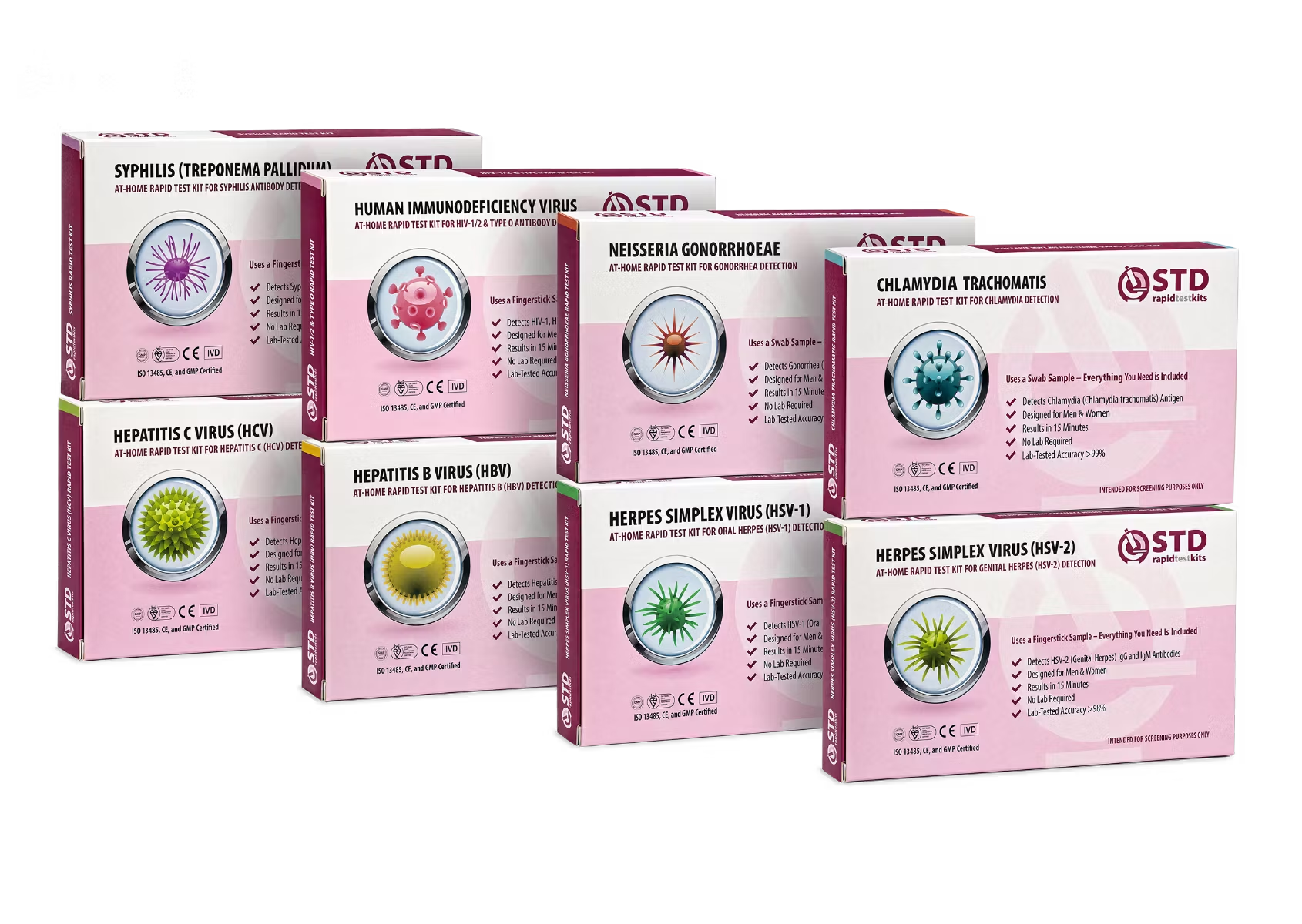
If neither partner has been screened in years, test broadly. That means HIV, syphilis, hepatitis B, hepatitis C, chlamydia, gonorrhea, and the herpes simplex viruses. Trichomoniasis and HPV are reasonable to add if either partner has female anatomy. The point of a broad first panel is to map the territory once, not to keep retesting forever.
If the concern is a specific symptom (an unexplained sore, burning during urination, unusual discharge, a bump), test for the infection most likely to cause that symptom and screen for the others that often co-occur. Chlamydia and gonorrhea are commonly co-infected, so a positive result on one almost always prompts testing the other. Genital ulcers raise the suspicion of herpes and syphilis, both of which need to be on the panel.
If the concern is preconception planning, run a fuller panel than usual. Untreated chlamydia, gonorrhea, syphilis, and HIV all have meaningful pregnancy implications, and treatment timing matters.
If the concern is a specific recent exposure, the timing of the test matters as much as the panel composition. Window periods are real, and a single test inside that window is not the final answer. Most acute exposures benefit from a baseline test now and a repeat test at the appropriate window, typically two to twelve weeks depending on the infection.
Match the panel to the situation
- Baseline (no screening in years): HIV, syphilis, hep B, hep C, chlamydia, gonorrhea, HSV-1, HSV-2; add trichomoniasis and HPV for female anatomy.
- Specific symptom: test the most likely cause, plus the infections that commonly co-occur with it (chlamydia + gonorrhea, herpes + syphilis for ulcers).
- Preconception: a fuller panel than the routine annual visit, with chlamydia, gonorrhea, syphilis, and HIV explicitly confirmed clear before conception.
- Specific recent exposure: a baseline test now and a repeat at the right window for that infection (typically 2 to 12 weeks).
Frequently asked questions
- Can I really test positive for an STI without anyone cheating?
- Yes. The most common cause of a surprise diagnosis inside a committed relationship is a pre-existing, undiagnosed infection in one partner that pre-dates the relationship. HSV-2, HPV, and chlamydia are particularly likely to behave this way because they are often silent for long periods. A positive result, on its own, does not identify when or how the infection was acquired.
- We both got tested before sleeping together unprotected. Why did this still happen?
- Three usual reasons. First, a 'full STI panel' at most clinics does not include HSV-1, HSV-2, HPV, or trichomoniasis unless specifically requested. Second, tests run inside the window period (before antibodies or detectable antigens have developed) can produce false negatives. Third, genital swabs do not detect throat or rectal infection, which is a common transmission site for chlamydia and gonorrhea.
- If my partner tests positive and I test negative, does that prove someone cheated?
- No. Different infections transmit at different per-act rates, and not every exposure produces an infection. A negative result in one partner can also reflect a test taken inside the window period, a sample type that did not match the infection site, or natural clearance of a virus like HPV. Discordant results are common, and they do not prove anything about fidelity on their own.
- How long can an STI stay silent before showing up on a test?
- It depends on the infection. Chlamydia and gonorrhea are usually detectable within a few weeks of exposure, even when the person has no symptoms. HSV-2 antibodies typically take 6 to 12 weeks to develop reliably. Per CDC HIV testing guidance, an antigen/antibody lab test using blood from a vein can usually detect HIV 18 to 45 days after exposure. HPV does not have a routine antibody test in clinical use; it is usually identified through cervical screening, sometimes years after exposure.
- Do at-home rapid STI kits actually work?
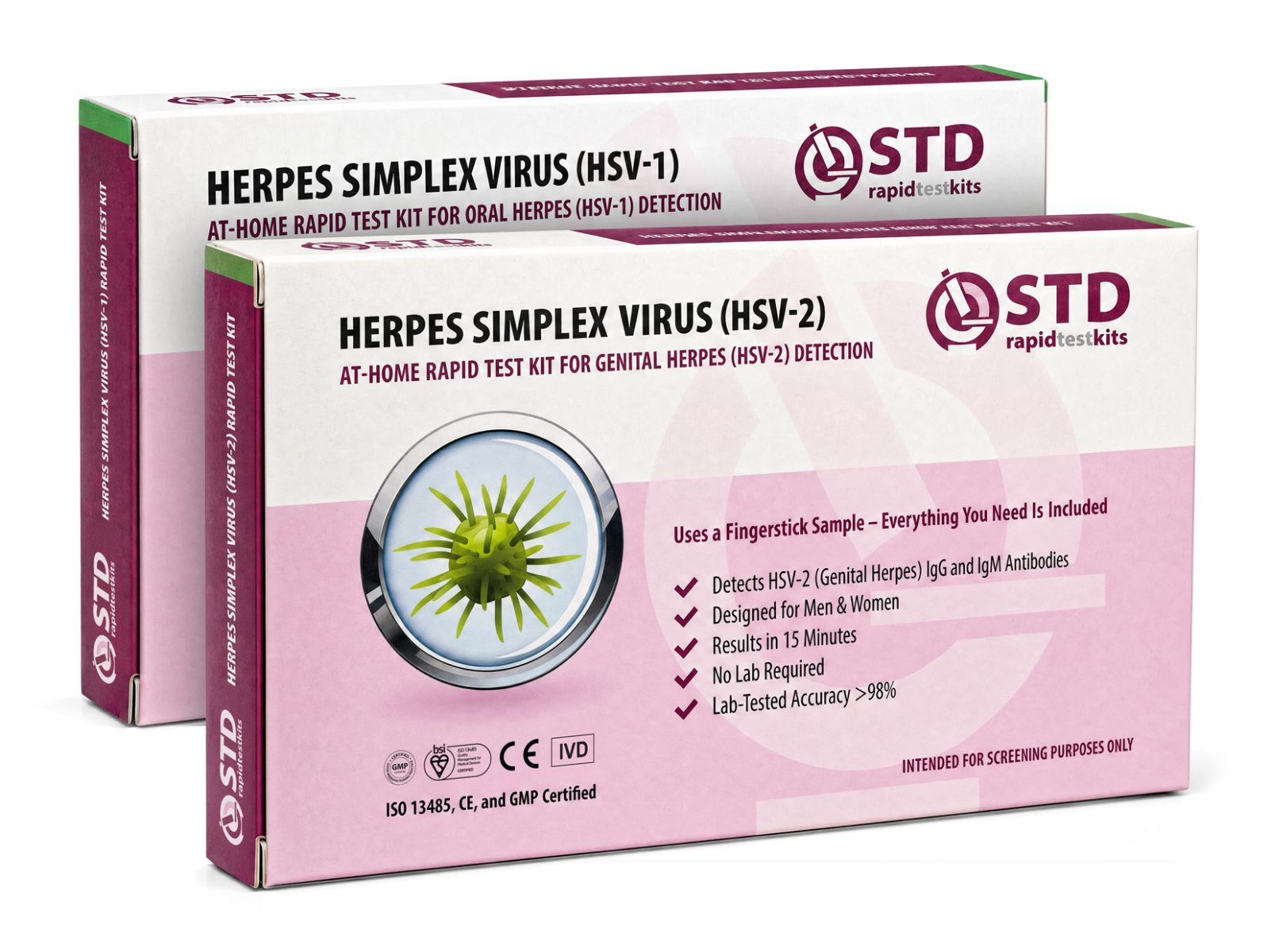
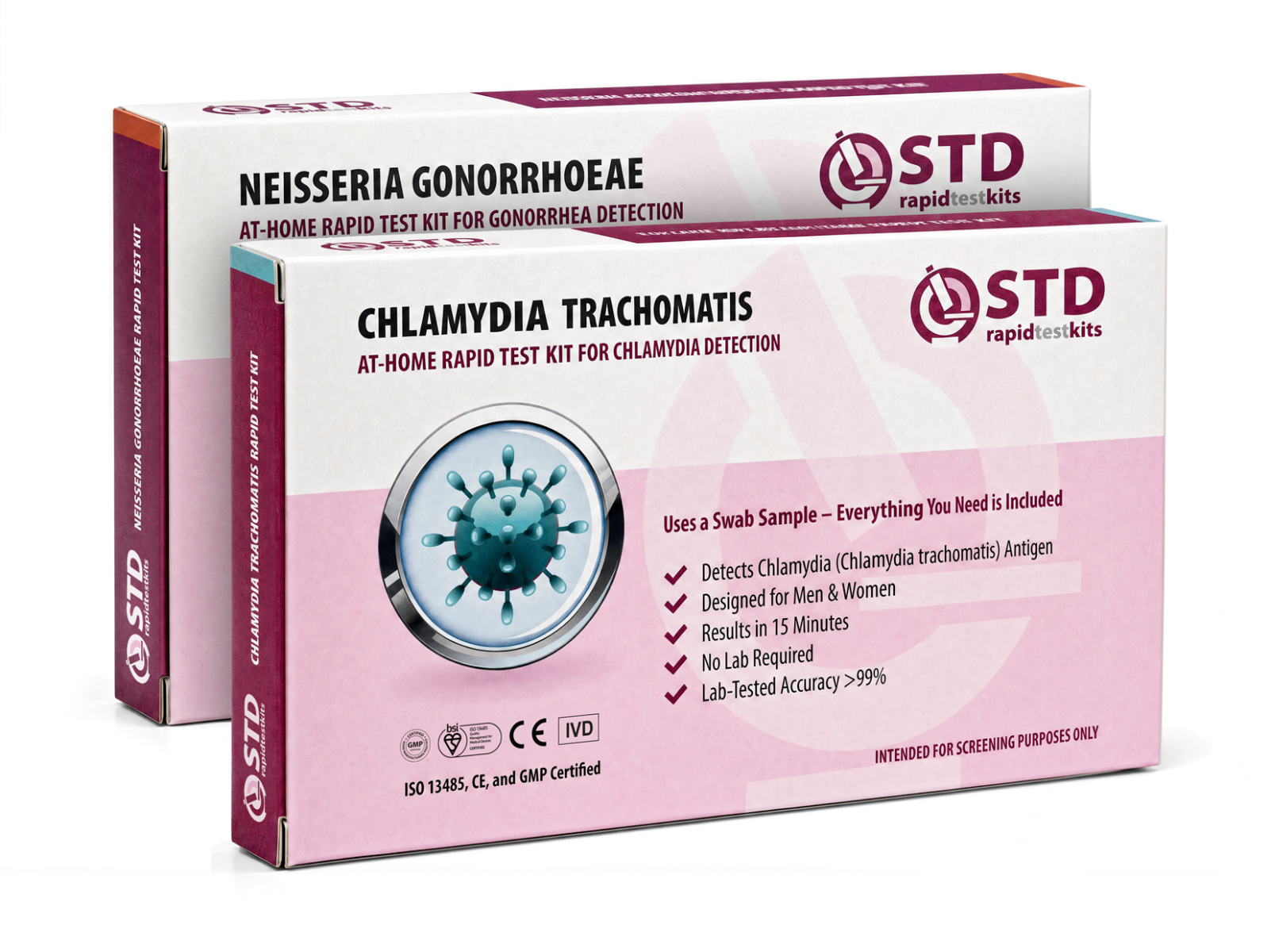
- Yes, when used correctly and at the right time. Manufacturers publish sensitivity and specificity figures on each individual product page, and exact figures vary by infection and kit. Home rapid tests are screening tools, not lab-grade NAAT or PCR, so a positive result is worth confirming with a clinician or lab NAAT. A negative result inside a window period is also not the final answer; for some infections, you should retest after the appropriate window before relying on a clean result.
- We are planning to conceive. Should we still test?
- Yes, even after years of monogamy. Untreated chlamydia, gonorrhea, syphilis, and HIV all carry meaningful pregnancy and neonatal risks, and they can be silent. Preconception screening is a low-effort step that catches the infections most likely to harm the pregnancy. Your clinician will typically order a fuller panel for someone planning to conceive than they would at a routine annual visit.
- What is the right way to ask my partner to test if we have been exclusive for years?
- Frame testing as shared information-gathering, not as suspicion of one partner. A line that works for many couples is something like, 'I'd like us to both run a baseline panel at the same time so we know where we stand for the next phase of this relationship.' Tying the request to a specific decision (preconception planning, switching off condoms, an upcoming physical) gives it a concrete reason that has nothing to do with doubting your partner.
- What if our test comes back positive and we have already been treated once before?
- A second positive result in a treated couple almost always points to an incomplete treatment cycle from the first round, not a new exposure. The usual culprits are: only one partner finished the full course, the couple resumed sex before treatment ended, or no follow-up test confirmed clearance. NHS guidance is clear that both partners should complete treatment and abstain from sex during the treatment window before resuming unprotected sex, and NHS chlamydia guidance notes that retesting after treatment is sometimes needed to confirm the infection has cleared.
- U.S. Centers for Disease Control and Prevention. About chlamydia: symptoms, screening recommendations for sexually active women under 25, and the high prevalence of asymptomatic infection.
- U.S. Centers for Disease Control and Prevention. About genital herpes: signs, symptoms, and the proportion of HSV-2 carriers who are unaware of their infection.
- U.S. Centers for Disease Control and Prevention. HIV testing overview, including the antigen/antibody lab-test detection window of 18 to 45 days after exposure and the rapid antigen/antibody window of 18 to 90 days.
- World Health Organization. Sexually transmitted infections fact sheet, used here for general STI background and global burden context.
- U.K. National Health Service. Sexually transmitted infections overview: partner notification, partner treatment, and abstinence from sex during the treatment window.
- U.S. Centers for Disease Control and Prevention. HPV overview, used here for context on long-latency cervical infection and the limits of routine screening.
- U.K. National Health Service. Chlamydia overview, including the recommendation that retesting after treatment is sometimes needed to confirm the infection has cleared, and the 4-week post-treatment retest in pregnancy.
