Published: September 2025 | Last updated: May 2026 | Editorial review and quality control: Martina N.
Genital itching with nothing visible on the skin is one of the most common reasons people end up on a symptom search at 2 a.m. The sensation feels real, but the absence of a rash, sores, or unusual discharge leaves nothing concrete to compare against. So the mind fills the gap, often with the worst possible explanation.
Most of the time, the cause is far more ordinary than a sexually transmitted infection. Friction, a new soap, a lubricant your skin disagreed with, a mild yeast imbalance, or the aftermath of shaving. The minority of cases that turn out to be an STI rarely show up as itching alone. There are usually other clues, and timing tells you more than sensation does. This guide walks through what itching without a visible rash typically means, when home testing changes the picture, and how to take the next step without spiraling.
Key Takeaways
- Itching alone, with no rash, sores, or discharge, usually points to skin irritation or mild yeast rather than a sexually transmitted infection.
- If there was a real exposure, testing at the right window (around 14 days for chlamydia and gonorrhea, longer for herpes blood tests) gives you a clearer answer than worrying does.
What Itching Without a Visible Rash Usually Means
When itching shows up with no rash, three broad categories explain almost every case. Bacterial sexually transmitted infections like chlamydia and gonorrhea. A fungal imbalance, most often candidal yeast. And non-infectious irritation, which covers friction, allergic reactions, contact dermatitis, dryness, and the aftermath of shaving or waxing.
Bacterial STIs rarely cause a visible rash. They also rarely cause itching as the only symptom. When chlamydia or gonorrhea do cause discomfort, the pattern is usually internal: burning during urination, unusual discharge, or pelvic discomfort, and the CDC notes that chlamydia often causes no symptoms at all while still risking lasting reproductive damage (CDC, About Chlamydia). That is precisely why routine screening matters more than waiting for signs.
| Condition | Typical Itch Pattern | Other Common Symptoms | Visible Rash? | When to Test |
|---|---|---|---|---|
| Chlamydia | Mild internal itch (often no itch at all) | Discharge, burning urination, pelvic discomfort, often none | Rare | Around 14 days after exposure |
| Gonorrhea | Mild genital irritation | Discharge, pain with urination | Rare | Around 14 days after exposure |
| Herpes (HSV) | Tingling or itching before sores | Blisters or ulcers within days | Common once outbreak begins | When sores appear, or up to 16 weeks for a blood test |
| Yeast Infection | Persistent external itching | Thick white discharge, redness, swelling (often mild) | Sometimes mild redness | No STI test needed unless exposure risk |
| Contact Irritation | Surface itching, often quick onset | Dryness, sensitivity after a product or activity | Usually none or faint pink | No STI test unless exposure occurred |
Is itching alone usually an STI?
Usually no. Bacterial STIs like chlamydia and gonorrhea rarely cause itching as their only symptom, and most of the time they cause no symptoms at all. Herpes can begin with tingling or itching, but it typically progresses to visible blisters within a few days. When itching shows up alone and stays that way, mild yeast or skin irritation explains the majority of cases. If there was a real exposure, testing at around 14 days for chlamydia and gonorrhea, and up to 16 weeks for HSV-2 blood antibodies, gives a reliable answer.
When Mild Yeast Doesn't Look Like Anything
Yeast infections don't always show up the way the pamphlets describe. The textbook version comes with thick white discharge, swelling, and unmistakable redness. The mild version can be just a persistent low-grade itch that feels worse at night or after sex, with no discharge, no odor, and no obvious skin change, only a vague awareness that something feels off (Mayo Clinic, Yeast Infection).
Several common things tip the balance toward yeast overgrowth: a recent course of antibiotics, hormonal shifts (including the days before a period, pregnancy, or hormonal contraception changes), high stress, diabetes, tight clothing, or staying in damp clothes too long (NHS, Thrush in Men and Women). Men can develop a candidal balanitis with similar mild itching, usually on the head of the penis, often after antibiotic use or in uncircumcised anatomy where moisture lingers. The pattern that points toward yeast rather than an STI is consistency: a steady external itch that responds to a short course of over-the-counter antifungal treatment.
The most useful single signal for mild candidal overgrowth is responsiveness to treatment. A steady low-grade external itch that clears within a few days of a standard over-the-counter antifungal course is the hallmark pattern that distinguishes mild yeast from contact irritation or an STI. If the itch returns shortly after stopping treatment, or if it never improves on the antifungal, that is the cue to step back and consider other causes rather than repeating the antifungal.
When Skin Is Just Reacting to Something Ordinary
Genital skin is some of the most reactive on the body. It is thinner, warmer, and exposed to more friction and moisture than most other regions. Small changes can set it off: a new laundry detergent, a scented body wash, a flavored lubricant, a different brand of condom, a long bike ride, hours in tight workout clothes, or a recent shave with stubble re-growing against fabric.
Contact dermatitis on the vulva or scrotum often shows up as itching with little or no visible change, especially in the first day or two. The skin barrier is irritated at a microscopic level before anything obvious appears. Once the trigger is removed and the area is given a chance to recover, the itching usually fades within a few days.
If you suspect contact irritation, try a short elimination test over 24 to 48 hours. Stop using any product introduced in the past week (body wash, laundry detergent, lubricant, scented wipes). Switch to plain cotton underwear and a fragrance-free wash. Skip sex for the same window. If the sensation eases within two days, the product or fabric was likely the culprit and you can reintroduce items one at a time to confirm.
What These Conditions Can Look Like Up Close
For most readers, the absence of a rash is exactly the problem: there's nothing visible to anchor to. But subtle skin changes can hide in plain sight, especially in areas you don't routinely examine. The figures below show the kinds of low-grade presentations that are easy to miss, using neutral anatomical locations where the visual pattern is the same as in genital skin. None of these images are graphic; they are educational reference photos of healthy versus mildly affected skin.
Testing Windows: When a Result Actually Means Something
If there has been a recent sexual exposure, a test taken too soon can miss an infection that is actually present. Each pathogen has a window period, which is the gap between when exposure happened and when the test can reliably detect it. Testing inside that window gives a false sense of safety. Waiting until the window has passed gives you an answer you can trust.
For chlamydia and gonorrhea, common guidance is to test at around 14 days after exposure. Herpes is more nuanced: a PCR or swab test on a fresh sore works as soon as a sore is present, and the CDC notes that for current blood antibody tests it can take "up to 16 weeks or more" after exposure to detect infection (CDC, Herpes Testing). HIV fourth-generation antigen/antibody tests detect most infections by about 45 days. The table below is a quick reference.
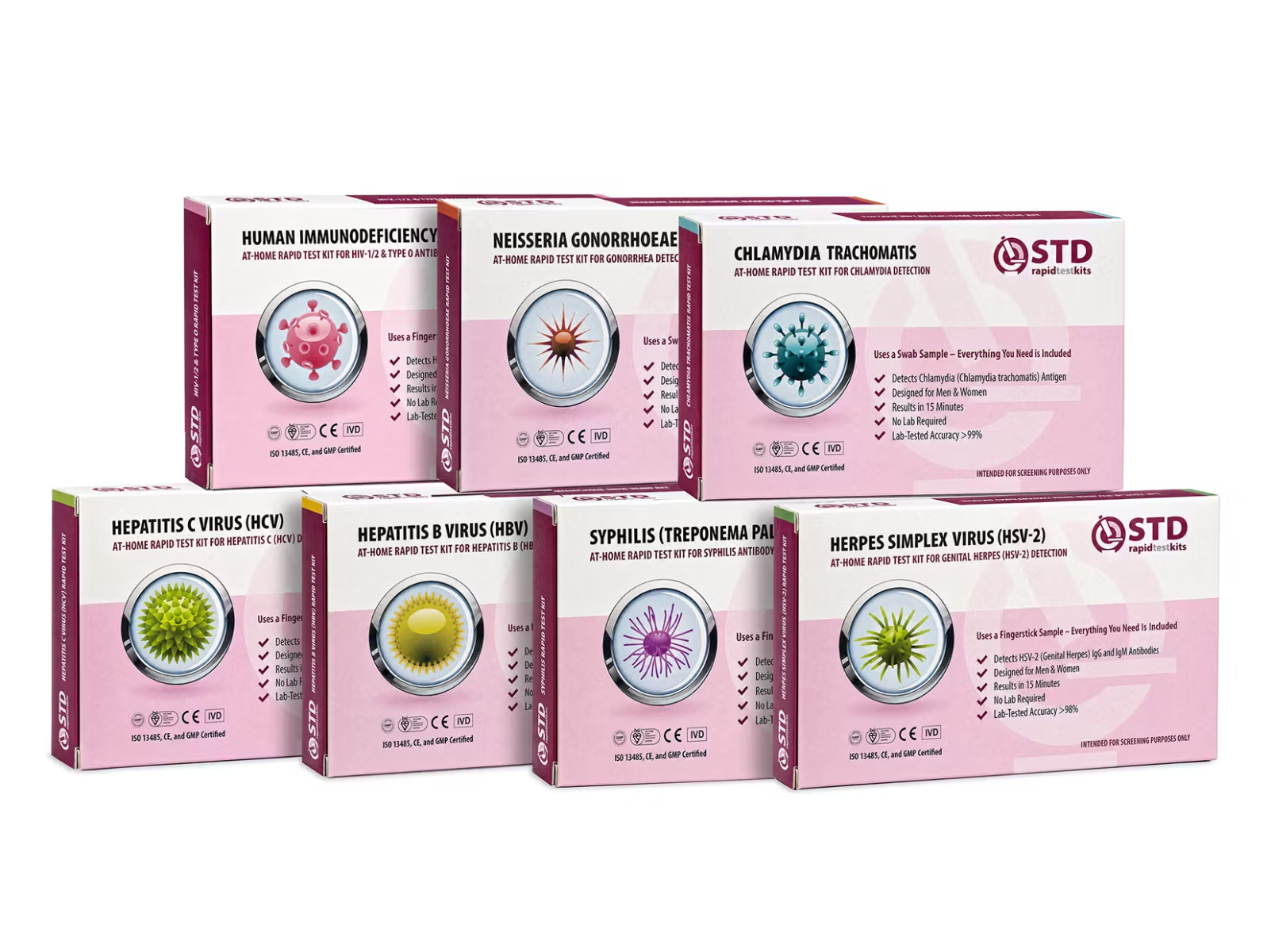
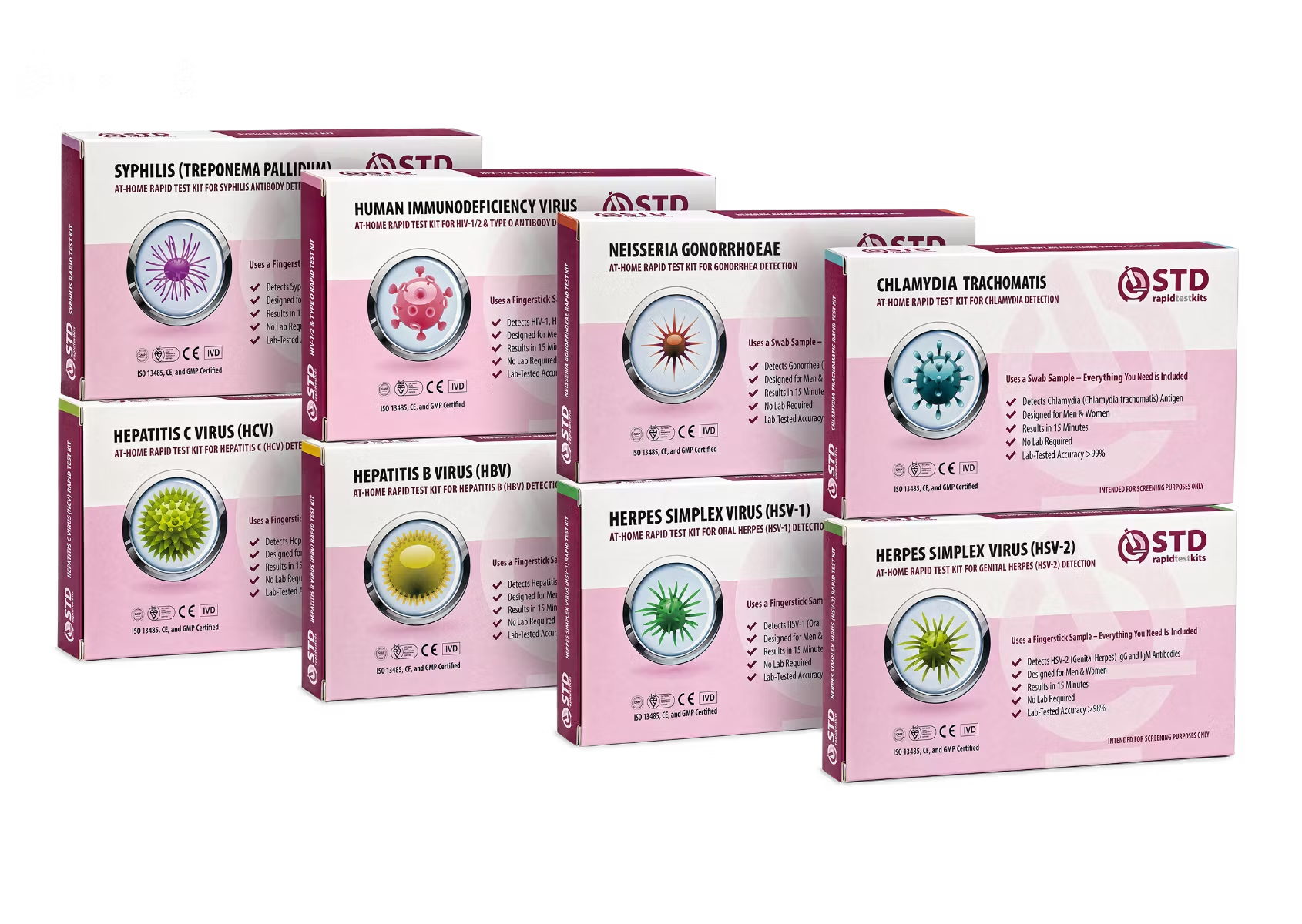
This article is published by stdrapidtestkits.com, which sells the rapid lateral-flow at-home test kits referenced below; recommendations are based on fit-for-purpose for the reader's concern.
| Infection | Earliest Detection | Best Time for an Accurate Result |
|---|---|---|
| Chlamydia | About 7 days | Around 14 days |
| Gonorrhea | About 7 days | Around 14 days |
| Herpes (HSV-2 blood) | When sores appear (swab/PCR) | Up to 16 weeks or more for blood antibody testing per CDC |
| HIV (4th-gen antigen/antibody) | About 18 days | Around 45 days |
What Timing Tells You That Sensation Alone Cannot
Timing tells you more than the intensity of the itch ever will. Sensation amplifies when you focus on it, so two people can feel the exact same level of itching and rate it completely differently. Timing, on the other hand, is concrete. When did the itching start? How does it compare to the timing of any exposure? Has it stayed the same, gotten worse, or faded?
Itching that begins within the same day as sex is almost always friction or contact irritation. Bacterial infections need days of replication before they cause noticeable symptoms in the small minority of people who become symptomatic at all. Itching that begins 3 to 7 days after a real exposure and is accompanied by discharge or burning is more suspicious. Itching that lingers for 1 to 3 weeks after an exposure with no other symptoms developing is more often skin or yeast than infection, and that window is also when bacterial-STI testing becomes reliable.
| When Itching Starts | Common Explanation | What to Watch For | Recommended Action |
|---|---|---|---|
| Within 24 hours of sex | Friction, latex sensitivity, lube reaction | Redness, dryness, surface irritation | Remove the suspected irritant and monitor for 3 to 5 days |
| 3 to 7 days after exposure | Possible bacterial STI or yeast imbalance | Discharge, burning urination, odor | Test at around 14 days if exposure was real |
| 1 to 3 weeks after exposure | STI window period reaching detectability | Persistent or worsening symptoms | Run a full panel STI test |
| Ongoing mild itch with no progression | Dryness, stress, chronic skin irritation | No new symptoms develop | Adjust skincare; optional test for peace of mind |
When the Brain Amplifies the Itch
The vulva and penis are dense with nerve endings, which makes them sensitive to small changes and equally sensitive to attention. Once a person starts checking, the sensation often gets louder, not quieter. That is not imagination. It is how the nervous system behaves under sustained focus, especially when anxiety is layered on top.
Stress also affects the skin directly. Elevated cortisol disrupts the skin barrier, which makes the area drier, more reactive, and itchier. Dry, reactive skin then feeds the cycle: every check makes the itching feel worse, every recheck reinforces the worry, and the discomfort genuinely intensifies for a while. Recognizing the loop reframes what actually helps: less checking, and a concrete next action.
If itching is mild and there was no recent high-risk exposure, try this for two days before testing: stop checking the area in mirrors, switch to plain unscented soap and cotton underwear, skip sex, hydrate well, and avoid scented or flavored products. If the itching fades, contact irritation was the likely cause. If it persists or new symptoms develop, that is the cue to test or see a clinician.
When It's Probably Not an Infection
Some patterns make infection less likely. Itching that improves within a few days of switching products, wearing cotton underwear, or simply leaving the area alone usually points to contact irritation. Itching that clears quickly with a short over-the-counter antifungal treatment usually points to yeast. Itching that comes and goes with hormonal cycles, stress, or seasonal dryness usually points to skin, not infection.
The body is also more complicated than a single symptom suggests. Hormonal shifts during pregnancy, perimenopause, and around menopause can alter vaginal pH and moisture, and the NHS specifically lists vaginal dryness and itching among the common symptoms of menopausal hormone change (NHS, Menopause Symptoms). Stress alone can heighten nerve sensitivity, and even dehydration can make skin more itch-prone.
Signs it's probably not an infection
- Clears with a 3 to 5 day over-the-counter antifungal course = most likely yeast.
- Fades within 48 hours of removing a new product or fabric = most likely contact irritation.
- Tracks with the hormonal cycle, stress, or seasonal dryness = most likely a skin response, not infection.
Clarity, Not Catastrophe
Most isolated genital itching resolves within a few days once the trigger is removed or treated. Sometimes the cause is mild yeast. Occasionally, when exposure was real, it can be an early or atypical infection. Where there has been a real exposure, a properly timed test gives an answer that guessing cannot.
If there has been a recent exposure with any real risk, give yourself the gift of a properly timed test. If there has not, give the skin a few days to recover under gentler conditions. Whichever path applies, the next step is calm, specific, and finite. You do not have to live inside the worry to be responsible about your sexual health.
If there was a real exposure within the last few weeks, schedule a test at the right window for the infection of concern (around 14 days post-exposure for chlamydia and gonorrhea, 45 days for a fourth-generation HIV test, and up to 16 weeks for an HSV-2 blood antibody result). If there was no meaningful exposure, give the area 48 hours under gentler conditions: unscented soap, cotton underwear, no scented products, no sex, plenty of water. If the itch is gone or clearly fading after that window, your skin was the answer all along.
FAQs
- Can itching really be the only symptom of an STI?
- It is possible, but it isn't the usual pattern. Most bacterial STIs cause either additional symptoms (discharge, burning during urination, pelvic discomfort) or no symptoms at all. If days have passed and nothing has escalated beyond mild itching, skin irritation or yeast is statistically more likely. If there was a real exposure, testing at the right window is still the only way to know for sure.
- I had protected sex but I'm itchy. Should I still worry?
- Condoms substantially reduce the risk of fluid-transmitted infections like chlamydia, gonorrhea, and HIV. They don't fully cover skin-to-skin infections like herpes or HPV. If the condom stayed intact and there was no direct skin contact with sores, itching that started within hours of sex is more likely friction or latex sensitivity than infection. Testing at the right window can still settle the question if you want certainty.
- Does herpes always start with itching?
- Not always. Some people feel tingling, burning, or itching in the days before an outbreak (the prodrome). The key pattern is what comes next. That sensation typically progresses to visible blisters or ulcers within a few days. Itching that lingers for a week or more without any skin changes is less likely to be an active herpes outbreak.
- Can a mild yeast infection feel like itching alone, with nothing visible?
- Yes. Try an over-the-counter antifungal for 3 to 5 days. If the itching clears, yeast was the likely cause. If it persists or you had a real sexual exposure around the same time, proper STI testing is the next step rather than another antifungal round.
- How do I know if it's irritation from shaving or lubricant?
- Look at timing and triggers. Recent shaving, a new product, a different brand of condom, or hours in tight clothing are all common triggers. Irritation usually shows up within a day and improves once the trigger is removed. Infections tend to follow biological timelines, not product timelines, so a clear cause-and-effect with a new product points strongly toward irritation.
- I tested negative but I'm still itchy. What now?
- A properly timed negative result is strong information. If the test was taken at least 14 days after exposure for chlamydia and gonorrhea and came back negative, infection is unlikely. At that point, the more useful frame is dermatology, hormonal balance, or yeast. For HIV and herpes blood tests, the window is longer, so a follow-up retest at the assay's full window can confirm the result if there is residual worry.
- When does itching actually warrant a clinic visit?
- If itching is paired with intense pain, visible sores or ulcers, unusual discharge, strong odor, fever, pelvic pain, or symptoms that worsen quickly, see a clinician promptly. Bodies usually escalate when something infectious is active. A lone mild itch that improves over a few days is very different from a cluster of evolving symptoms.
- Should I avoid sex while I'm figuring this out?
- A short pause is a reasonable choice. It gives irritated tissue a chance to recover and avoids transmitting something that hasn't been ruled out yet. Resume once symptoms resolve or once a properly timed test confirms what is actually going on.
Our article was constructed based on current advice from the most prominent public health and medical organizations, and then molded into simple language based on the situations that people actually experience. Sources include the U.S. Centers for Disease Control and Prevention (chlamydia and herpes testing pages), the U.K. National Health Service (thrush and menopause symptom pages), and the Mayo Clinic's clinical reference on yeast infection.
- U.S. Centers for Disease Control and Prevention. About Chlamydia, including the statement that chlamydia often causes no symptoms while still risking lasting reproductive harm.
- U.S. Centers for Disease Control and Prevention. Herpes Testing, source for the HSV-2 antibody window guidance of up to 16 weeks or more after exposure.
- U.S. Centers for Disease Control and Prevention. About Sexually Transmitted Infections, used for the framing that many STIs are asymptomatic and screening is the way to find them.
- Mayo Clinic. Yeast infection (vaginal) symptoms and causes, including mild presentations of vulvovaginal candidiasis.
- U.K. National Health Service. Thrush in men and women, source for common yeast triggers including antibiotic use, hormonal change, and tight clothing.
- U.K. National Health Service. Menopause symptoms, source for hormonal vaginal dryness and itching as a non-infectious cause.
