
Published: August 2025 | Last updated: May 2026 | Editorial review and quality control: Martina N.
You expected the classic signs. Thick discharge. A strong smell. Maybe a sore. Instead, you got a quiet itch that won't quit, a faint burn after sex, a discomfort no one warned you about. The Google rabbit hole begins. Most of the time, the cause turns out to be yeast or BV rather than an STI, but symptom overlap is real enough that testing is often the only way to be certain. Yeast? BV? Something worse? You're not alone, and you're not making it up. Many sexually transmitted infections in women show up exactly this way: subtle, atypical, and easy to mistake for something benign. This guide walks through what those overlapping symptoms actually mean, when testing matters most, and how to get clear answers without a clinic visit if you'd rather not start there.
Key Takeaways
- Itching and burning without discharge can come from yeast, BV, or STIs like chlamydia, trichomoniasis, and early herpes. Symptom overlap is the rule, not the exception.
- Self-diagnosis fails frequently. At-home tests give a definitive answer when timed right: chlamydia from day 14, trichomoniasis from day 7 to 14, and herpes antibody from week 3 to 12.
When the Symptoms Don't Look Like You Expect
Most people picture a textbook STI: heavy discharge, an unmistakable smell, a visible sore. The reality is messier. Many of the most common infections in women are quiet on arrival. Chlamydia, the most frequently reported bacterial STI in the U.S., often produces no symptoms at all, or shows up as a vague pelvic ache, mild burning when peeing, or spotting between periods (CDC chlamydia fact sheet). Genital herpes, when it does cause symptoms, can begin with a tingle or sensitivity that long predates a visible blister. Trichomoniasis can cause itching or burning with no odor at all.
A common scenario looks like this: a woman in her late twenties notices itching after most weekends with her partner. The first round of over-the-counter antifungal cream calms things briefly, then the itch returns. By the third recurrence, urgent care runs a full panel and the result is trichomoniasis, not yeast. According to the CDC, an estimated 2 million people in the U.S. are infected with trichomoniasis at any given time, and about 70% of them have no classic symptoms at all (CDC: About Trichomoniasis). When symptoms do appear, they are routinely mistaken for yeast or BV.
What Symptoms Can (and Can't) Tell You
If you've ever tried to diagnose yourself by Googling, you know the maddening loop. Itching could be yeast. Burning could be BV. Both could be chlamydia or trich. The truth is that symptom overlap between yeast, BV, and several STIs is significant, and clinicians routinely warn that you cannot tell them apart from symptoms alone. The table below shows why guessing fails so often.
| Condition | Common Symptoms | Discharge | Itching/Burning | Odor |
|---|---|---|---|---|
| Yeast Infection | Itching, redness, swelling, soreness | Often thick, white, clumpy | Yes | No |
| Bacterial Vaginosis (BV) | Itching or burning, mild discomfort | Thin, grayish | Sometimes | Yes (fishy, especially after sex) |
| Chlamydia | Mild pelvic pain, burning when peeing | Maybe, or none at all | Sometimes | No |
| Trichomoniasis | Itching, redness, irritation | Varies, may be frothy or absent | Yes | Sometimes |
| Genital Herpes (initial) | Tingling, itching, flu-like symptoms | No | Yes | No |
Why Testing Matters Even When You're Pretty Sure
Symptoms alone won't tell you what you have, and that's not a failure of self-awareness. It reflects how these conditions actually present. If you've treated something as yeast and it improves a little, then comes back, that pattern is itself the diagnostic signal. Recurrent symptoms after treatment, or symptoms that worsen after sex, point away from a routine yeast infection and toward an underlying STI or persistent BV.
A common pattern: someone goes through three rounds of antifungal cream before a clinician suggests a full screen, and the actual culprit turns out to be chlamydia. No discharge, just a constant low-grade burning that worsens after sex. According to Mayo Clinic, chlamydia symptoms are frequently mild or absent in women, which is why annual screening (rather than waiting for symptoms) is the standard of care for sexually active women under 25 (Mayo Clinic STD symptom overview). At-home options have made testing faster and lower-friction than the standard clinic path: a self-collected swab or fingerstick, no waiting room, results often within about 15 minutes for rapid lateral-flow tests.

How Timing Can Trick You (and Why It's Not Your Fault)
Here's a frustrating loop: you finally test, the result is negative, and yet the symptoms persist. The temptation is to question your own perception, or to write off testing as unreliable. Neither response is the right one. Different infections become detectable at different speeds, and a too-early test will miss them.
| Infection | Best Time to Test | Why Wait |
|---|---|---|
| Chlamydia | 14+ days after exposure | Earlier tests may miss the bacterial load |
| Trichomoniasis | 7 to 14 days | Needs time to grow to detectable levels |
| Herpes (no sore present) | 3 to 12 weeks (antibody test) | Body needs time to seroconvert |
| BV / Yeast | Immediately if symptoms present | Not sexually transmitted; can flare any time |
When the First Test Misses It
A negative result is reassuring, but it captures one moment in time. Consider a common pattern: a woman tests after a condom-breakage incident with a new partner and gets a clean panel. A few days later, she feels a tingle deep inside, then a burn. No sores, no discharge, no smell. Weeks pass. The itch returns and she notices a small lesion that looks almost like a paper cut near the vulva. A second blood test at the appropriate antibody window confirms HSV-2.
This isn't unusual. Herpes blood tests look for antibodies, and the body needs time to produce them, often 3 to 12 weeks after exposure (Mayo Clinic STD overview). Bacterial infections like chlamydia and trichomoniasis also need an incubation window before they reach detectable levels. If your first test was too soon and your symptoms persist, retesting at the appropriate window isn't overreacting. The diagnostic timeline simply requires a wait between exposure and detection.
If you tested negative but your body still feels off, the right move is usually to wait the full window, then test again, and to consider whether what you tested for matched what you might actually have. A herpes-only check after a vaginal-discharge concern leaves trichomoniasis on the table.
Disclosure: stdrapidtestkits.com sells the rapid lateral-flow tests linked in this article.

Reinfection, Resistance, and the Misdiagnosis Trap
One of the harder truths about recurrent vaginal symptoms is that they exist in a diagnostic gray zone. You wonder if you're overusing medication. You second-guess whether something deeper is wrong. You change your underwear, your soap, your diet. The itch keeps returning. The burn sneaks back after sex.
Two patterns drive most of these loops. The first is reinfection. If you and a partner are both infected with trichomoniasis or chlamydia, and only one of you completes treatment, the infection moves between you. According to CDC clinical guidance, partner treatment is essential for trichomoniasis specifically, and untreated partners are the most common reason for what looks like recurrence (CDC: About Trichomoniasis). BV is a separate case: CDC does not recommend partner treatment for BV, since clinical trials have not shown that treating a male partner reduces recurrence in the woman (CDC BV treatment guidelines).
The second is misdiagnosis. Many providers treat presumed yeast infections symptomatically, without a wet-mount swab or culture. When the actual cause is chlamydia, trichomoniasis, or BV, the antifungal does nothing, and the underlying infection has more time to spread. Untreated chlamydia can ascend into pelvic inflammatory disease, a leading preventable cause of fallopian-tube scarring and infertility (Mayo Clinic).
For trichomoniasis, gonorrhea, and chlamydia, partner treatment at the same time is essential to prevent ping-pong reinfection. For BV, CDC's current treatment guidelines do not recommend partner treatment, since clinical trials have not shown it reduces recurrence in the woman.
Why You're Not Dirty, Broken, or Overreacting
This part matters as much as the clinical content. If you're reading this with a knot in your stomach, embarrassed or afraid that something is wrong with you, slow down. Vaginal symptoms are common medical events, not moral indictments. BV and yeast can flare from antibiotics, hormonal shifts, or no obvious trigger at all. STIs are extraordinarily common, and the women who get them aren't careless or dirty. They're sexually active, which is the actual risk factor.
The cultural script around women's pain often pushes you to wait, to dismiss, to assume it's nothing. Some discharge is "normal." Pain with sex is "common." Odor is "nothing." When something feels off and you ask, you're often told to give it a few days. That advice is sometimes right and frequently wrong, and the cost of being wrong can be the difference between a five-day course of antibiotics and a years-long fertility complication. Trusting your own perception of your body is itself a clinical asset; that intuition has saved countless people from delayed diagnoses.
Getting answers, whatever they turn out to be, lets you stop guessing and start treating. A positive result is just information that points toward the right medication and the right next step, not a verdict on you as a person.
Most STIs are detected through routine screening rather than because someone noticed a symptom. They are among the most common medical conditions in sexually active adults, and the standard of care is testing and treatment, not shame.
When Testing from Home Is the Best Choice
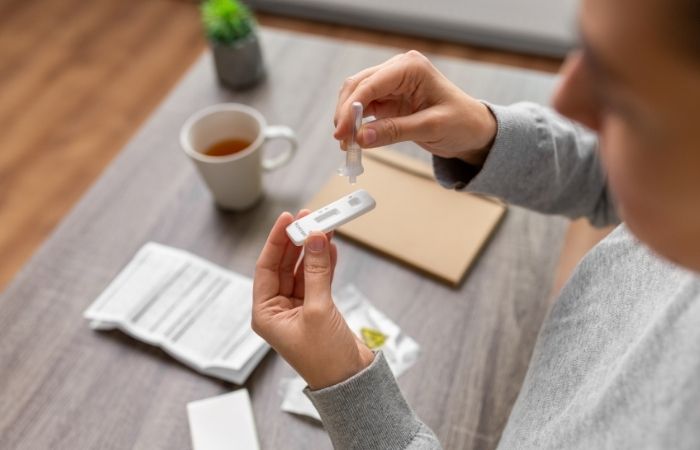
Not every reader is in a place to walk into a clinic. Schedule, location, prior bad experiences with providers, or simply a desire for privacy can all push at-home testing to the front of the list. The good news is that the at-home category has matured significantly. Modern rapid tests use lateral-flow chemistry similar to point-of-care clinic tests, and accuracy varies by infection. Check each kit's product page for its specific sensitivity and specificity figures.
What at-home rapid tests do well: they screen privately, fast, and inexpensively. A positive result on a rapid test is a signal to follow up, ideally with a provider for treatment, and sometimes with a confirmatory NAAT (nucleic acid amplification test) at a lab for high-stakes positives. They are screening tools, not lab-grade NAATs. Used as screening, they pick up infections that would otherwise go untreated for months because nothing prompted a clinic visit.
For readers who would rather not start at a clinic, a self-collected swab or fingerstick at home returns a rapid lateral-flow result in roughly 15 minutes.
How to Talk About It With a Partner
Once a result is in, or once you've decided to test, the next obstacle is often the conversation. Talking to a partner about a symptom or a positive screen feels high-stakes. Will they think less of you? Will they blame you? Will they tell someone else? Those fears are real and worth acknowledging.
The reframe that helps: testing and disclosure are acts of mutual care, not admissions of failure. A short, factual opener works better than a dramatic one. The example below shows the shape that lands well: honest, calm, and forward-looking, without assigning blame or asking for forgiveness.
STIs happen in monogamous relationships too, especially when one or both partners had prior sexual partners. BV can flare without any sex at all (CDC BV clinical guidance). The presence of a positive test isn't a verdict on the relationship or on either person. The conversation that follows doesn't have to be perfect, only honest. If you're not sure how to start, the most direct sentence that is true is usually enough.
"I noticed a symptom and decided to test for the common infections. The result was X, and I'd like us both to get tested so we can move forward with the right plan."
At-Home Relief: What Helps and What Hurts
While you wait for test results, or after a negative test that doesn't match how you feel, some comfort strategies help and some make things worse. Vaginal tissue is delicate, and many products marketed for "feminine relief" disrupt the normal microbiome.
Douching disrupts the natural lactobacillus-dominant flora and is associated with higher rates of BV (Mayo Clinic BV overview). Scented products contain fragrances that act as irritants for many people. Synthetic fabrics trap moisture, which yeast and bacteria both love. The table below maps the avoid/help split. If the symptom is new, atypical, or hasn't responded to over-the-counter treatment, don't keep guessing. Test instead. And if you're sexually active during the diagnostic limbo, use condoms; some infections, especially trichomoniasis, ping-pong easily between partners.
| Avoid these | These help |
|---|---|
| Douching (disrupts vaginal flora) | Cotton underwear (lets the area breathe) |
| Scented washes, pads, or pantyliners | Loose, breathable pants |
| Tight synthetic underwear | Unscented pH-balanced wash, if any |
| Antifungal cream for symptoms you have not had before | Cool compress and zinc-oxide barrier cream for external irritation |
| Unprotected sex while you wait for results | Condoms during the diagnostic window |
How Long Should You Wait Before Retesting?
If you tested recently and the results were clean, but you still feel off, retesting is usually the right call. The most common reasons a first test misses something are: testing within 5 to 7 days of exposure (too soon for most infections), starting antibiotic or antifungal treatment before testing, symptoms that have changed or worsened since the original negative result, or a partner who tested positive after you got your clean panel. Any one of those is a reason to retest.
The first test is one snapshot. The retest is the second angle. Together they give you a more complete picture. The simplified table below maps when to test again based on when your first test happened.
| First Test Timing | Still Have Symptoms | When to Retest |
|---|---|---|
| 0 to 7 days after exposure | Yes | Retest after day 14 |
| 10 to 14 days after exposure | Yes | Consider retesting at 4 to 6 weeks |
| 14+ days after exposure | No | Likely accurate; keep monitoring |
| After antibiotic treatment | Yes | Wait 3 weeks before retesting |
You Deserve Answers, Not Assumptions
This guide isn't only about symptoms or testing. It's about the gap between what your body is telling you and what you've been told to accept. When providers dismiss persistent discomfort, when at-home advice tells you to "wait and see" for the third week running, when you start questioning whether you're being dramatic, the right answer is almost always to test.
Saying "I'm itchy and I don't know why" is a reasonable thing to say. Saying "I want answers, not just guesses" is a reasonable thing to ask. You're allowed to be the expert on your own discomfort. You're allowed to want better than vague reassurance. And whether the answer turns out to be yeast, BV, or an STI, a clear result points you toward the right treatment instead of more guessing.
If you've been spinning in the in-between, where the results are unclear or the itch won't leave, you're not alone and you're not wrong to want certainty. A definitive answer, in your hands, in a few days, is a reasonable thing to ask for.
Most people who have trichomoniasis (about 70%) do not have any signs or symptoms. When trichomoniasis does cause symptoms, they can range from mild irritation to severe inflammation.
Common Questions
- Can you really have an STI without any discharge?
- Yes, and it's more common than people think. Chlamydia, herpes, and trichomoniasis can all cause symptoms like burning or itching without the textbook discharge. Symptom presentation varies widely between people, which is why testing is the only reliable way to differentiate.
- I have itching but no smell. Is it definitely yeast?
- Not necessarily. Yeast infections often present with itching and no odor, especially after antibiotic use or hormonal shifts. But trichomoniasis and early herpes can also start that way. If symptoms are new, recurrent, or don't fully clear with OTC antifungal treatment, a test is the only way to know.
- Does BV always come with a fishy smell?
- Often, especially after sex when vaginal pH temporarily shifts, but not always. Some people experience itching, mild discomfort, or no symptoms at all. If your nose isn't picking up anything but something still feels off, BV is still on the list of possibilities.
- Could I have chlamydia and not know it?
- Yes. Chlamydia is often called the silent infection because it can persist for months with subtle symptoms like mild pelvic pressure or irritation that's easy to mistake for a yeast infection. The CDC recommends annual screening for sexually active women under 25 and for older women with new or multiple partners.
- I tested but I still feel off. What now?
- Consider retesting. The first test may have been too early relative to your exposure date, or you may not have tested for the specific infection causing your symptoms. Window periods vary: chlamydia from 14 days, trichomoniasis from 7 to 14 days, and herpes antibody from 3 to 12 weeks. If your timing was off, the right move is to wait the full window and retest.
- Is BV an STI?
- Technically no, but it's strongly associated with sexual activity. New partners, unprotected sex, and even semen exposure can shift vaginal pH and trigger BV. So while BV isn't transmitted directly the way chlamydia is, sex is one of the most common factors in BV flare-ups.
- Should I treat the symptoms first or test first?
- If symptoms are mild, familiar, and you've had a confirmed yeast infection before, treating first can be reasonable. If the symptom pattern is new, hasn't responded to OTC treatment, or is recurring, pause and test. Treating the wrong condition delays the right treatment and lets the underlying infection persist.
- I have no idea what's going on. Where do I start?
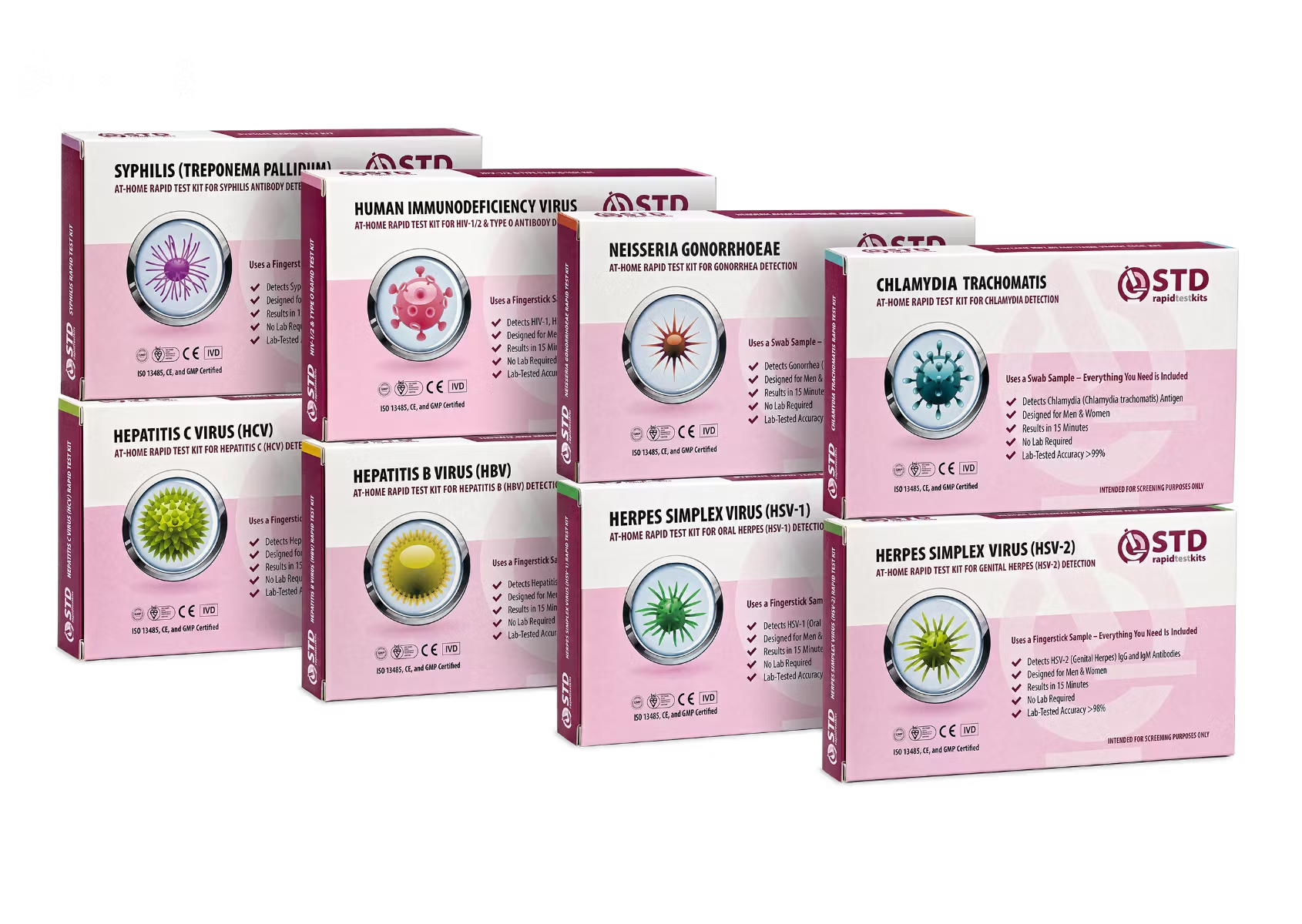
- Start with a combination test that screens for the most common infections at once: chlamydia, gonorrhea, trichomoniasis, syphilis, herpes, HIV, and hepatitis. A negative across the panel narrows the possibilities to BV, yeast, or non-infectious irritation; a positive gives you a clear treatment path. Either way, you stop guessing and start moving forward.
How we sourced this article: We combined current guidance from leading public-health and medical organizations (CDC and Mayo Clinic) with peer-reviewed clinical literature on vulvovaginal symptoms and STI screening. The illustrative scenarios in this guide are composite patterns drawn from common clinical presentations, not specific patients.
- U.S. Centers for Disease Control and Prevention. Chlamydia fact sheet: prevalence, asymptomatic presentation, and screening recommendations.
- U.S. Centers for Disease Control and Prevention. About Trichomoniasis: prevalence, the roughly 70% asymptomatic figure, and partner-treatment guidance.
- U.S. Centers for Disease Control and Prevention. Bacterial Vaginosis treatment guidelines: BV diagnosis criteria, recurrence patterns, and partner-treatment evidence.
- Mayo Clinic. Yeast Infection (Vaginal) symptom and cause overview: when symptoms suggest yeast versus other vulvovaginal conditions.
- Mayo Clinic. Sexually Transmitted Disease Symptoms in-depth: atypical and asymptomatic STI presentations, including silent chlamydia, herpes antibody timing, and PID/infertility risk.
- Mayo Clinic. Bacterial Vaginosis symptoms and causes: BV risk factors, including douching and disrupted vaginal flora.
