
Published: July 2025 | Last updated: May 2026 | Editorial review and quality control: Martina N.
The first thing most people do when a strange bump appears on their lip is reach for their phone. Is it just dry skin from cold weather? A pimple from a new lip balm? A cold sore (which, yes, usually means herpes)? Knowing the difference matters for how you care for the sore, who you might pass it to, and whether testing makes sense. This guide walks through what cold sores actually look like, what else can mimic them, when an outbreak suggests testing, and what the at-home options are.
Is every cold sore actually herpes?
Most cold sores are caused by herpes simplex virus type 1 (HSV-1); a smaller share are caused by HSV-2 spread through oral-genital contact (<a href="https://www.cdc.gov/herpes/">CDC herpes overview</a>). Not every lip bump is herpes, though. Pimples, canker sores, angular cheilitis, and chapped lips can all look similar at first. The reliable way to know is a type-specific HSV-1 antibody blood test (or a swab if you have an active sore), available through clinics or as an at-home rapid test.
Key Takeaways
- Most cold sores are HSV-1, but pimples, canker sores, angular cheilitis, and chapped lips can all look similar at first glance.
- A type-specific HSV-1 antibody blood test confirms exposure even without a visible sore, and it is reliable from roughly 12 weeks after the suspected first exposure.
When a Cold Sore Is Herpes (and Why That Is Less Alarming Than It Sounds)
Cold sores, fever blisters, herpes labialis, oral herpes: all describe the same condition caused by the same virus. The vast majority of cold sores come from herpes simplex virus type 1 (HSV-1). A smaller share are caused by HSV-2, usually acquired through oral-genital contact, per the CDC's herpes overview. (Editorial note: STD Rapid Test Kits sells the at-home HSV-1 and HSV-2 antibody kits referenced in this article; product links go to our store.)
HSV-1 is one of the most common viral infections worldwide. The World Health Organization estimates that roughly 3.8 billion people under age 50 carry HSV-1 globally, which is about two-thirds of that age group (WHO HSV fact sheet). U.S. patterns match the global picture, and most infections are acquired in childhood through ordinary household contact.
The pickup story is usually undramatic. A grandparent's kiss on the cheek, a sip from a parent's water bottle, a shared lip balm at summer camp. The virus enters through skin or mucous membrane, replicates locally, then travels up sensory nerves to the trigeminal ganglion at the base of the brain, where it stays dormant for life.
Reactivation happens periodically. The virus travels back down the same nerve to the lip and produces the familiar blister cluster. Outbreaks are not a sign that the infection is getting worse; they are triggered by stress, illness, sun exposure, fatigue, hormonal shifts, or local trauma to the lip area.
A textbook HSV-1 cold sore has a few telltale features that tend to show up in the same order each time, especially the prodromal tingle a day or two before anything visible appears.
Telltale features of an HSV-1 cold sore
- A tingling, burning, or itching sensation at the same spot 12 to 48 hours before any visible bump appears (the prodrome).
- A cluster of small fluid-filled blisters rather than a single isolated bump.
- Clear or slightly yellow fluid that crusts over within a few days.
- Recurrence in the same general spot each time.
Five Other Lip Bumps That Get Mistaken for Herpes
The mouth and lip area are exposed to weather, friction, food acids, cosmetics, and bacterial overgrowth, so plenty of unrelated conditions can produce something that looks similar at first glance. The most common conditions confused with cold sores:
- Pimples (acne vulgaris): Usually a single raised papule with a visible whitehead. Painful when pressed, drains a thick cream-colored material rather than clear fluid, and does not recur in exactly the same spot.
- Chapped lips and contact dermatitis: Dry, cracked, scaly patches without distinct bumps. Often triggered by cold air, dehydration, lip-licking, or a new ingredient in lip balm or toothpaste.
- Angular cheilitis: Red, fissured, sometimes whitish patches at the corners of the mouth, caused by yeast or bacterial overgrowth in moisture-trapping skin folds. Usually responds to antifungal cream rather than antiviral.
- Canker sores (aphthous ulcers): Small white or yellow ulcers with a red border, found inside the mouth on the inner lip, cheek, or tongue. They are not caused by a virus and are not contagious.
- Allergic reactions: Sudden swelling, redness, or hives after exposure to a new cosmetic, food, or medication. Often involves the whole lip rather than a focal cluster.
Location and pattern are the most useful distinguishing features. Herpes lesions appear on the outer vermillion border or just outside it, in clustered fluid-filled blisters that follow a predictable progression. A round white ulcer inside the mouth fits the canker sore profile better than herpes.
First Outbreak vs. Recurring Flare-Up
Not all herpes outbreaks look the same. The very first time HSV-1 reactivates symptomatically, or causes symptoms during initial infection, is usually the worst one a person will ever have.
A primary or initial outbreak can include:
- Multiple sores spread across a wider area than future flare-ups.
- Fever, body aches, and general malaise lasting several days.
- Tender swollen lymph nodes in the neck or under the jaw.
- Sores that take 2 to 3 weeks to fully heal rather than the usual 10 days that the NHS cold sores guidance describes for a recurrence.
Some people experience this primary infection as full-body flu-like illness with painful mouth sores. Others have such mild symptoms they never realize they have been exposed; the WHO notes that most people with HSV infection have no symptoms or only mild symptoms (WHO HSV fact sheet).
Recurrent outbreaks are typically much milder:
- One small cluster of blisters in the same general spot as past outbreaks.
- Healing within about 10 days.
- No fever or systemic symptoms.
- Predictable triggers such as sun, stress, illness, or a hormonal cycle.
Frequency varies enormously between individuals. Some people who carry HSV-1 never have a visible outbreak at all. Others have a flare-up every few months, especially during stressful periods. After the first year or two of carrying the virus, the immune system usually establishes better control and outbreaks become less frequent.
Primary HSV-1 outbreaks can include high fever, painful mouth ulcers extending into the inside of the mouth, swollen lymph nodes, and difficulty eating or drinking. If this is the first outbreak you have ever had and it includes systemic symptoms, antiviral medication started in the first 72 hours can meaningfully shorten symptoms. Call a clinician rather than waiting it out.
The Five Visible Stages of a Cold Sore
Cold sores follow a predictable progression. Recognizing which stage you are in helps you know how contagious the sore is and roughly how much longer it will last. The NHS notes that most cold sores clear within 10 days from first tingle to healed skin, though primary outbreaks can run two to three times longer (NHS cold sores guidance).
The following table summarizes the typical progression. Individual outbreaks vary, but most recurrences travel through these five stages in order.
| Stage | Day | What you see and feel | Contagious? |
|---|---|---|---|
| 1. Prodrome | minus 2 to 0 | Tingling, itching, or burning at the spot; no visible bump | Low and rising |
| 2. Blister | 1 to 2 | Cluster of small clear fluid-filled vesicles, 1 to 3 mm across, with red surrounding skin | Increasing |
| 3. Weeping or ulcer | 3 to 4 | Blisters break open, fluid leaks, sometimes leaves a shallow open sore | Highest |
| 4. Crusting | 5 to 8 | Yellow-brown scab forms over the sore as it dries | Decreasing |
| 5. Healing | 8 to 10+ | Scab falls off; pink or darker skin underneath fades over weeks | Low |
How Testing Actually Works
There are three meaningful ways to confirm whether a cold sore is HSV.
Swab and PCR (active sore): A clinician swabs an active blister or ulcer and sends the sample for nucleic acid amplification testing. This is the most sensitive method when there is an open lesion to sample. It also tells you whether the virus is HSV-1 or HSV-2, which matters because the long-term pattern is different (HSV-1 oral outbreaks recur less often than HSV-2 genital outbreaks). Swab testing is most useful in the first 48 to 72 hours of an outbreak; once the sore is crusting over, the virus titer drops and the swab can return false negatives. We do not sell pharyngeal or lesion swabs at home, so this option requires a clinic visit.
Type-specific antibody blood test (no active sore needed): A laboratory or rapid test that looks for IgG antibodies your immune system makes against HSV-1 or HSV-2 specifically. Antibodies typically take 12 weeks to develop after a new infection, sometimes a few weeks longer (this gap is called the window period). A type-specific blood test can confirm exposure to HSV-1 even when no sore is currently present. The limitation: a positive HSV-1 antibody result tells you that you have HSV-1 somewhere in your body but does not specify whether the infection is oral, genital, or both.
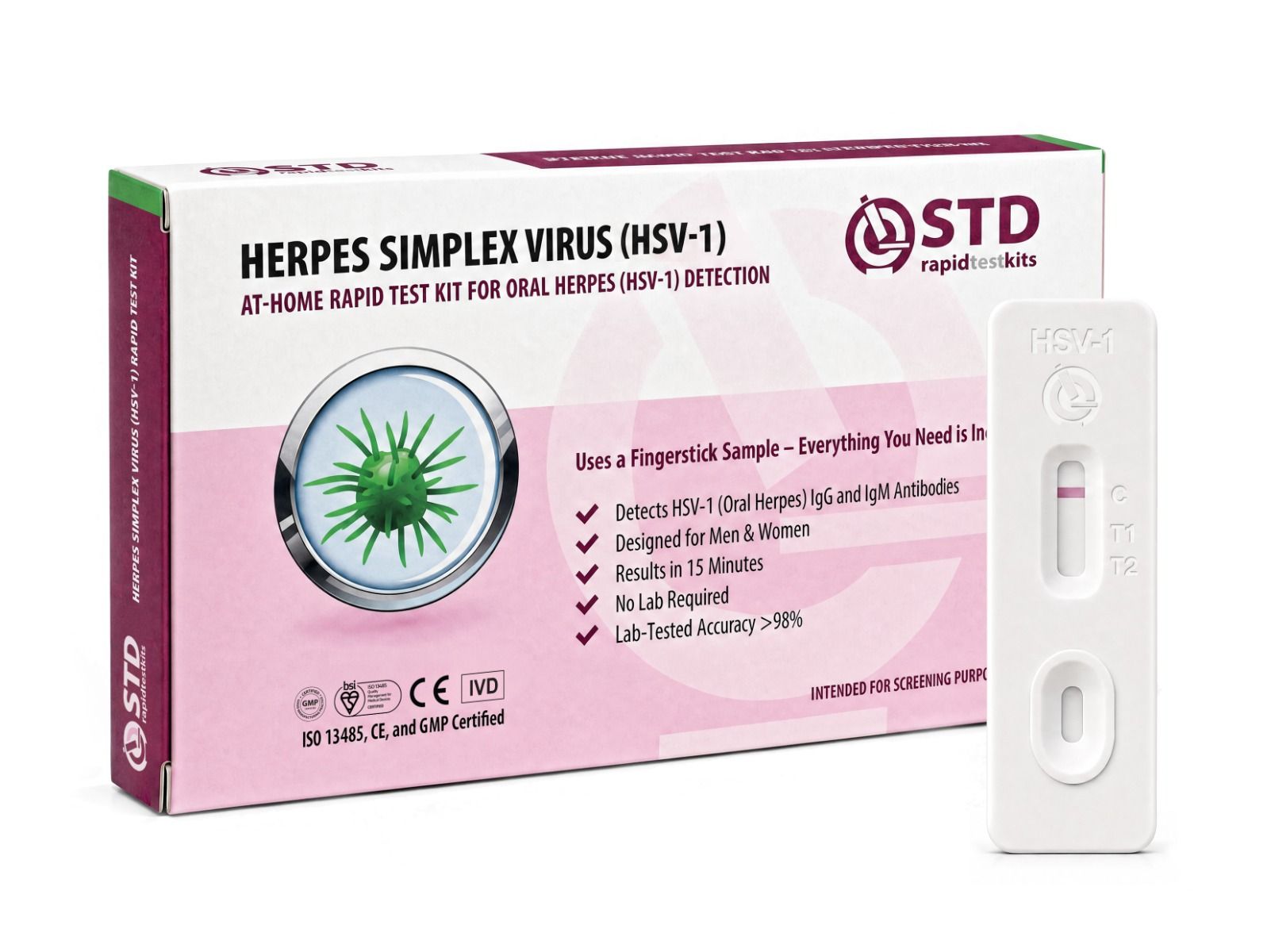
At-home rapid antibody test: A fingerstick blood sample and lateral-flow strip that detects HSV-1 or HSV-2 antibodies in about 15 minutes. Convenient, private, and useful for confirming whether a recurrent lip sore is consistent with HSV-1. The same window-period rule applies as the lab IgG test: testing too soon after the suspected exposure can miss seroconversion. For an established case (recurrent lip outbreaks for years), antibody seroconversion happened long ago and the result is reliable.
What all three tests have in common: they identify presence of the virus or antibodies, not where the virus lives. A positive HSV-1 antibody result does not prove a current cold sore is herpes, only that the person has been infected at some point. The clinical pattern, the prodromal tingle, and the location on the outer lip border are what tie a result back to a specific lesion.
Asymptomatic Viral Shedding (the Part Most People Do Not Know)
You can pass HSV-1 to another person even when you have no visible cold sore. This is called asymptomatic shedding, and it is the main reason the virus is so widespread.
Studies that have followed people with HSV-1 over time find that the virus can be detected on the lip surface on a meaningful share of days even when no sore is visible. Estimates vary by study, person, and how long ago the infection was acquired. The CDC's STI treatment guidelines note that asymptomatic shedding is most frequent in the first 12 months after acquiring the virus and continues at lower rates thereafter (CDC STI treatment guidelines). The WHO fact sheet adds that both HSV-1 and HSV-2 can transmit when no symptoms are felt or visible (WHO HSV fact sheet). Most new HSV-1 infections come from people who feel completely fine and have no idea they are contagious.
Practical implications:
- Most adults who carry HSV-1 acquired it from an asymptomatic partner or family member, not from someone with a visible sore.
- Antiviral medications (acyclovir, valacyclovir, famciclovir) reduce but do not eliminate shedding.
- Reducing transmission risk during prodrome (tingle phase) and active outbreaks is the highest-yield intervention. Between outbreaks, transmission still occurs, but at a lower rate.
- Condoms and dental dams reduce but do not eliminate transmission risk for genital contact involving an HSV-positive partner, because shedding can occur on skin not covered by the barrier.
- For non-sexual casual oral contact (kissing family members, sharing a glass of water), barriers are not practical. The reasonable precaution is awareness: pause kissing and shared utensils once you feel a tingle, until the sore has fully crusted and the crust falls off.
For oral HSV-1, the pragmatic guidance is straightforward: if you feel a tingle or see a sore, avoid kissing and do not share utensils, drinks, or lip balm until the sore has fully crusted and the crust falls off. Between outbreaks the transmission risk exists but is lower.
Both HSV-1 and HSV-2 are most contagious when sores are present but can also be transmitted when no symptoms are felt or visible.
Treatment and Outbreak Management
Cold sores cannot be cured. They can be controlled and managed effectively. Treatment falls into two categories: shortening or aborting an active outbreak, and reducing how often outbreaks happen.
Episodic antiviral therapy: Oral acyclovir, valacyclovir, or famciclovir taken at the first sign of prodrome (tingle phase) can shorten an outbreak by a day or two and sometimes prevent visible blisters from forming at all. These are prescription medications. Some people keep a small supply at home to start as soon as they feel a tingle.
Suppressive antiviral therapy: Daily low-dose oral antivirals taken continuously, regardless of symptoms. The CDC's STI treatment guidelines state that suppressive therapy reduces the frequency of genital herpes recurrences by 70% to 80% in patients who have frequent recurrences (CDC STI treatment guidelines); the same daily regimen is used for frequent oral HSV-1 recurrences. It also reduces asymptomatic shedding, though not to zero. Worth discussing with a clinician if outbreaks are disrupting daily life or if there is a non-infected partner you want to protect.
Topical antivirals: Acyclovir cream, penciclovir cream, and over-the-counter docosanol have modest benefit and can shorten outbreaks by less than a day if started very early. They are not as effective as oral therapy.
Things to avoid: picking at the scab, sharing lip products, applying steroid cream (can prolong viral shedding), and stressing about it (genuinely makes outbreaks worse). For people who have one outbreak a year, episodic treatment is usually enough. For frequent recurrences, daily suppressive therapy is the standard option.
For comfort and faster recovery while a cold sore runs its course:
- Cold compresses to reduce swelling and discomfort.
- Over-the-counter pain relief (acetaminophen or ibuprofen).
- Petroleum jelly to keep the crust from cracking and reduce viral spread.
- SPF 30+ lip balm once healed, since UV is a major reactivation trigger.
When to Call a Clinician
Most cold sores can be managed at home and do not require medical attention. There are a few situations where a phone call to a clinician (or an in-person visit) is the right move:
- A first-ever outbreak with fever, body aches, or swollen lymph nodes. The systemic component matters and antiviral treatment in the first 72 hours can meaningfully shorten symptoms.
- Sores that do not begin to crust within a week or that worsen after the first few days. Persistent or spreading sores can mean a secondary bacterial infection that needs antibiotics, or a different diagnosis entirely.
- Sores spreading near or onto the eye. HSV keratitis can cause permanent vision damage and is a same-day medical issue.
- Frequent recurrences (six or more per year, or any frequency that disrupts work and relationships). Daily suppressive therapy is worth a conversation.
- Pregnancy with a known history of HSV. Most pregnancies with maternal HSV-1 proceed without issue, but a primary outbreak near delivery has implications for delivery planning.
- Immunocompromised conditions (HIV, chemotherapy, organ transplant, high-dose immunosuppressants). HSV outbreaks in this group can be more severe and warrant earlier antiviral treatment.
Cold sores spreading to or near the eye can cause HSV keratitis, a leading infectious cause of corneal blindness. If you notice eye pain, redness, light sensitivity, or blurred vision alongside an oral outbreak, treat it as a same-day medical issue. An emergency department or ophthalmologist can confirm and start antiviral treatment immediately.
Living With HSV-1: What Changes (and What Does Not)
Roughly two-thirds of people under 50 carry HSV-1 globally per the WHO fact sheet. The virus is genuinely common and woven into ordinary life.
What does not change after a positive HSV-1 result:
- Your dating prospects, since most prospective partners statistically already carry HSV-1 themselves.
- Your work, fitness, fertility, or general health.
- Your ability to have children safely, with standard pregnancy counseling near delivery.
- Your sex life, with the same precautions during prodrome or active outbreaks that any responsible partner would take.
What does change:
- Awareness of triggers (sun, stress, illness, hormonal shifts) so you can pre-empt outbreaks.
- A small home supply of lip-friendly tools (SPF lip balm, petroleum jelly, possibly an antiviral prescription).
- Honesty with intimate partners about the diagnosis, especially around oral-genital contact, since HSV-1 transmitted to the genital area through oral sex causes genital herpes.
The cultural weight that gets attached to a herpes diagnosis is wildly disproportionate to its medical significance. A cold sore is, medically, a recurring viral skin condition that the immune system controls between flare-ups.
FAQs
- Are cold sores and herpes the same thing?
- Yes. Cold sores are the visible expression of oral herpes, almost always caused by herpes simplex virus type 1 (HSV-1). A smaller share are caused by HSV-2 spread through oral-genital contact.
- What is the difference between HSV-1 and HSV-2?
- Both are herpes simplex viruses. HSV-1 most often causes oral herpes (cold sores), while HSV-2 most often causes genital herpes. Either virus can infect either site through oral-genital contact, but HSV-1 oral infections recur more often than HSV-1 genital infections, and HSV-2 genital infections recur more often than HSV-2 oral infections.
- How long does a cold sore typically last?
- Plan for about a week and a half. The NHS expects most cold sores to clear within 10 days from first tingle to healed skin; a first-ever (primary) outbreak can run two to three times longer and sometimes brings fever or swollen lymph nodes.
- Can I spread HSV-1 even when I do not have a visible sore?
- Yes. HSV-1 can be detected on the lip on some days when no sore is visible, which is why most new infections trace back to a partner or family member who felt completely fine at the time. The CDC notes asymptomatic shedding is most frequent in the first year after acquiring the virus.
- Is a pimple on the lip the same as a cold sore?
- No. Pimples are single raised papules with a whitehead, painful when pressed, and do not recur in exactly the same spot. Cold sores form clustered fluid-filled blisters preceded by a tingling sensation and recur in the same general area each time.
- When should I see a doctor about a cold sore?
- See a clinician for a first-ever outbreak with fever, sores spreading near the eye (a medical emergency), sores not crusting within a week, frequent recurrences (six or more per year), or any cold sore during pregnancy or while immunocompromised.
- Can I test for HSV-1 at home if I have never had a visible outbreak?
- Yes. A type-specific HSV-1 antibody test detects past exposure even with no current symptoms. Wait at least 12 weeks after the suspected first exposure for the antibody response to develop. At-home rapid kits use a fingerstick blood sample and give results in about 15 minutes.
- Does a positive HSV-1 antibody test mean I have genital herpes?
- Not necessarily. A positive HSV-1 antibody result confirms HSV-1 infection somewhere in the body but does not specify oral, genital, or both. Most HSV-1 infections in the U.S. are oral and acquired in childhood. If you have never had genital symptoms, your HSV-1 is most likely an oral infection.
If You Are Still Wondering, Get Tested
If you are staring at a lip sore right now and wondering if it is herpes, the most likely answer is yes. The next most likely answer is one of the differentials covered above. The way to know for sure is to test, either by swabbing an active sore at a clinic or with a type-specific antibody blood test once enough time has passed since the suspected first exposure. An at-home rapid antibody test offers the same antibody-based answer with the privacy of testing in your own bathroom. Whatever the result, herpes is a manageable diagnosis with clear next steps.
- U.S. Centers for Disease Control and Prevention. Herpes overview, including HSV-1 vs HSV-2 distinctions, oral vs genital herpes, and transmission routes including transmission from partners without visible sores.
- World Health Organization. Global HSV-1 and HSV-2 prevalence (3.8 billion people under 50 with HSV-1), oral-to-oral transmission as primary HSV-1 route, and note that most people have no symptoms or only mild symptoms and that transmission can occur without visible symptoms.
- U.S. Centers for Disease Control and Prevention. STI Treatment Guidelines for genital herpes: episodic and suppressive antiviral regimens, the 70% to 80% reduction in recurrence frequency under suppressive therapy, and asymptomatic shedding patterns most frequent in the first 12 months after acquisition.
- National Health Service (UK). Cold sore symptoms, the typical 10-day clearing window, treatment options, and self-care guidance.
- U.S. Centers for Disease Control and Prevention. Herpes basics: symptoms, testing recommendations, and management context.
