Published: August 2025 | Last updated: May 2026 | Editorial review and quality control: Martina N.
You felt the tingle on your lip after dinner. By bedtime there was a small blister. By morning, a flood of search tabs and one looping question: is this an STD? If you've never had a cold sore before, the timing feels suspicious. The vocabulary feels heavier than the bump on your lip. And the silence around all of this makes the worry bigger than it needs to be.
This guide is the calm version: what a cold sore actually is, what it isn't, what HSV-1 means for the rest of your life and your sex life, and how to handle the next conversation with a partner. The testing options are laid out honestly so you can decide what fits your situation, without the moralizing or clickbait that usually comes attached.
Key Takeaways
- A cold sore is almost always HSV-1, a virus that roughly two-thirds of adults under 50 carry worldwide, often picked up in childhood from a relative's kiss or a shared spoon.
- A first sore appearing years after exposure is normal. Testing has a narrow useful window, and a blood test during a brand-new outbreak can come back negative even when HSV-1 is present.
What is actually happening on your lip
The textbook name for a cold sore is herpes labialis. It is caused by the herpes simplex virus, almost always type 1 (HSV-1). The cycle is predictable enough that dermatologists describe it in stages: prodrome (the tingle or itch), papule (a small bump), vesicle (a blister with clear fluid), ulcer (the blister breaks and weeps), crust (a yellow-brown scab), and healing skin underneath. Start to finish runs about 7 to 14 days for most people, per Mayo Clinic.
Once HSV-1 enters the body, it travels to a nerve cluster near your jaw called the trigeminal ganglion. It stays there for life. It is not curable. Your immune system keeps it quiet most of the time, and the virus only flares when something tips that balance: a head cold, a fever, intense stress, hormonal shifts around your period, sun exposure to the lips, dental work, or being run down. The lip is just where the nerve ends; the action is in the nerve itself.
This is why a cold sore can show up the day before a big presentation or the third day of a flu. Your body's defenses dipped, and the virus took the opening. The skin lesion is temporary; the virus that produced it lives permanently in the trigeminal ganglion. That sounds dramatic, and for most people it isn't. The vast majority of HSV-1 carriers have a few flares a year at most, and many never have one at all.
Most outbreaks move through the same stages: prodrome (tingle or itch), papule (small bump), vesicle (clear-fluid blister), ulcer (the blister breaks and weeps), crust (yellow-brown scab), then healed skin underneath. Total time runs roughly 7 to 14 days from first tingle to fully healed, with the most contagious phase being the vesicle and ulcer stages.
How common HSV-1 actually is
The numbers help. Globally, the World Health Organization estimates that about 3.8 billion people under age 50 (around 64%) have HSV-1. In the United States, surveys put adult prevalence between roughly 50% and 80% depending on age and methodology, summarized clearly by Johns Hopkins Medicine. Most carriers never connect their cold sore to the word herpes, because the word is loaded and their doctor never used it.
The route most people take into HSV-1 is childhood. A relative's kiss on the cheek. A shared juice cup at daycare. A spoon, a lip balm, a popsicle. None of that is sexual contact. None of it carries any moral weight. It is just how a common skin virus moves through close families and play groups before age 10.
If your first visible sore is happening at 28 or 35 or 47, you are not the outlier. You are the normal case. Many people carry HSV-1 for decades before their immune system slips enough to let the virus break through to the surface. Never having had a cold sore before does not mean you were uninfected. It just means your body was managing it without symptoms.
So is a cold sore an STD?
This is where the answer gets honest instead of tidy. A cold sore is caused by HSV-1. HSV-1 belongs to the herpes simplex virus family, the same family that includes HSV-2 (the virus that more typically causes genital herpes). The line between "oral skin condition" and "sexually transmitted infection" is drawn by anatomy and culture, not by the virus itself.
Here is what the CDC's information on genital herpes makes clear: HSV-1 can cause genital infection through oral-to-genital contact, and a meaningful share of new genital herpes cases are now caused by HSV-1 rather than HSV-2. So:
- If your cold sore came from a childhood kiss, the route was not sexual. The virus is, however, capable of being sexually transmitted later, through oral sex.
- If you give oral sex during an active cold sore, you can transmit HSV-1 to a partner's genitals, where it then becomes genital herpes by location.
- If your cold sore came from kissing a current or recent partner who carries HSV-1 in their mouth, that is technically sexual transmission of an oral infection. Same virus, different route in.
The clean rule of thumb: HSV-1 is a virus, not a verdict. It is sometimes sexually transmitted, frequently not, and the social weight we attach to the word "STD" is a poor map of its actual biology.
Is a cold sore an STD?
Sometimes, depending on how it was passed. A cold sore is caused by HSV-1, a virus most people pick up in childhood through non-sexual contact like a relative's kiss or a shared cup. HSV-1 can also be transmitted sexually through oral sex and can cause genital herpes that way. So the same virus is classified as an everyday skin issue when it is on the lip and as an STI when it reaches the genitals. Your cold sore alone does not tell you which route brought the virus in.
Why a first cold sore can show up years after exposure
This is the question that keeps people awake. "I have been with the same partner for eight years. We are monogamous. I have never had a cold sore in my life. Why now?" The answer is rarely the one fear suggests.
A first visible outbreak does not equal a recent infection. HSV-1 sits dormant in the trigeminal ganglion until something disrupts the immune balance. Plenty of people are seropositive for HSV-1 their entire adult lives without ever flaring. When a flare finally happens, it usually maps onto a stressor: a viral illness, a new medication, sleep deprivation, a sunburn on the lips, hormonal shifts, or a period of unusual emotional load.
Consider a common scenario: a 33-year-old in a long-term monogamous marriage feels a pinprick of pain on the lip during a high-stress job transition. Within hours, a blister forms. Two days later, low-grade fever. The lab swab confirms HSV-1. The instinct is to look outward (who did I get this from, was someone unfaithful) when the more likely explanation is inward: this person was exposed in childhood and the virus stayed silent for three decades until stress let it surface for the first time.
That is not a rare story. It is the most common one. HSV-1 follows its own biological schedule, which tends to be more patient than people expect.
HSV-1 sheds most actively from the lip during a visible cold sore, but it can also shed without a visible sore (asymptomatic shedding). Performing oral sex during an active cold sore meaningfully raises the risk of giving a partner genital HSV-1. Skipping oral sex from the first tingle until the scab has fully fallen away and the skin looks normal is the simplest precaution. Daily antiviral medication can also reduce shedding for people with frequent flares.
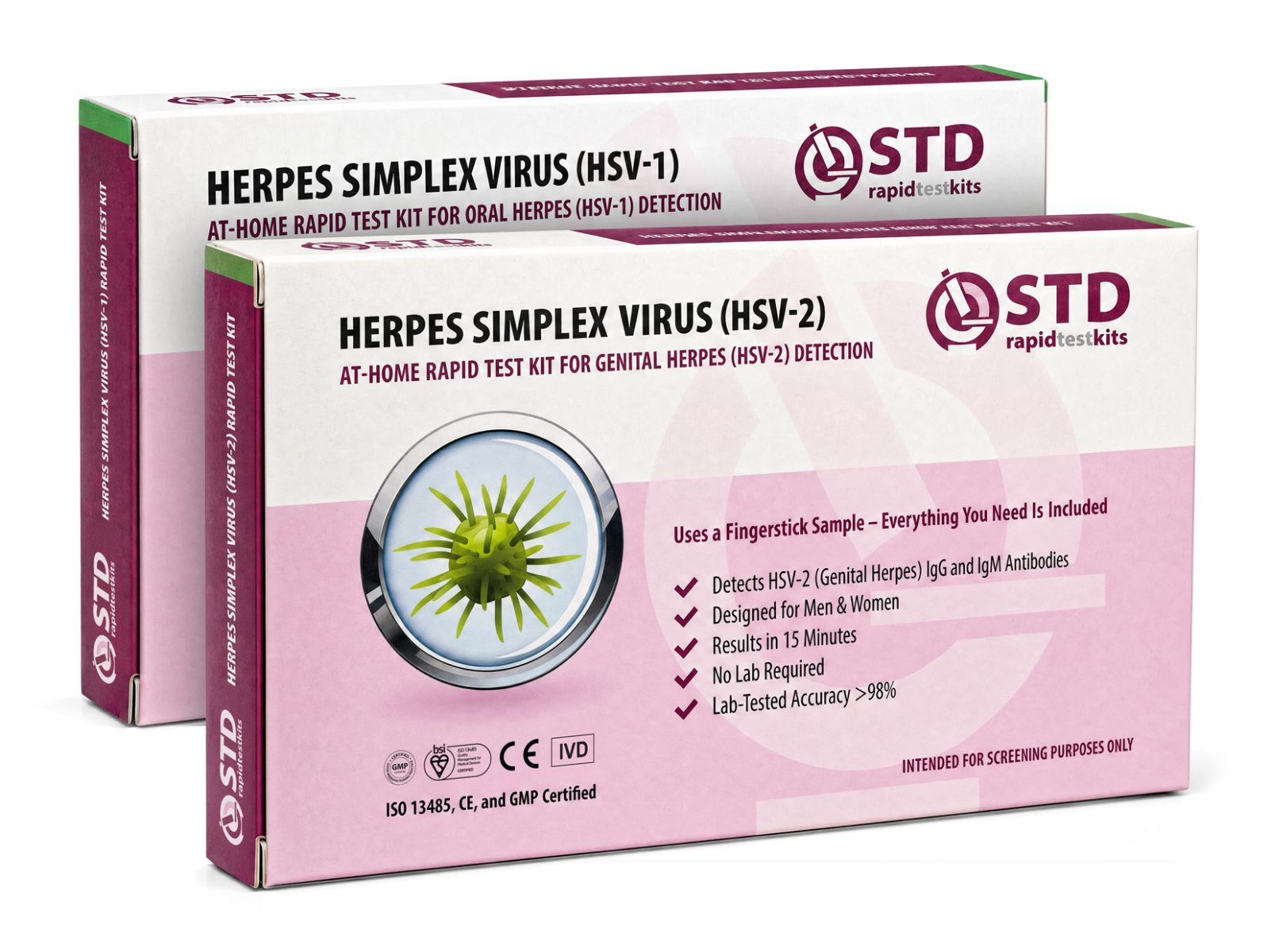
Disclosure: stdrapidtestkits.com sells the at-home herpes antibody tests referenced in this article. We recommend testing only when it fits a reader's specific situation, not as a default response to a single cold sore.
When testing actually helps, and when it doesn't
The blunt version: most people with a cold sore do not need a test. A clinician can usually diagnose herpes labialis on sight. Where testing earns its place is in narrower situations: a first-ever outbreak where you want viral confirmation, an unusual lesion that does not look like a textbook cold sore, a new partner with HSV-2, an immunocompromised partner, planning a pregnancy, or simply wanting clarity for your own peace of mind.
Two things to understand before ordering anything:
- Lesion swab tests (often viral culture or PCR) are most accurate when the sore is fresh and still wet. Once it scabs, viral yield drops and a negative result becomes unreliable. If you want lesion-level confirmation, see a clinician within the first 2 to 3 days of a visible blister.
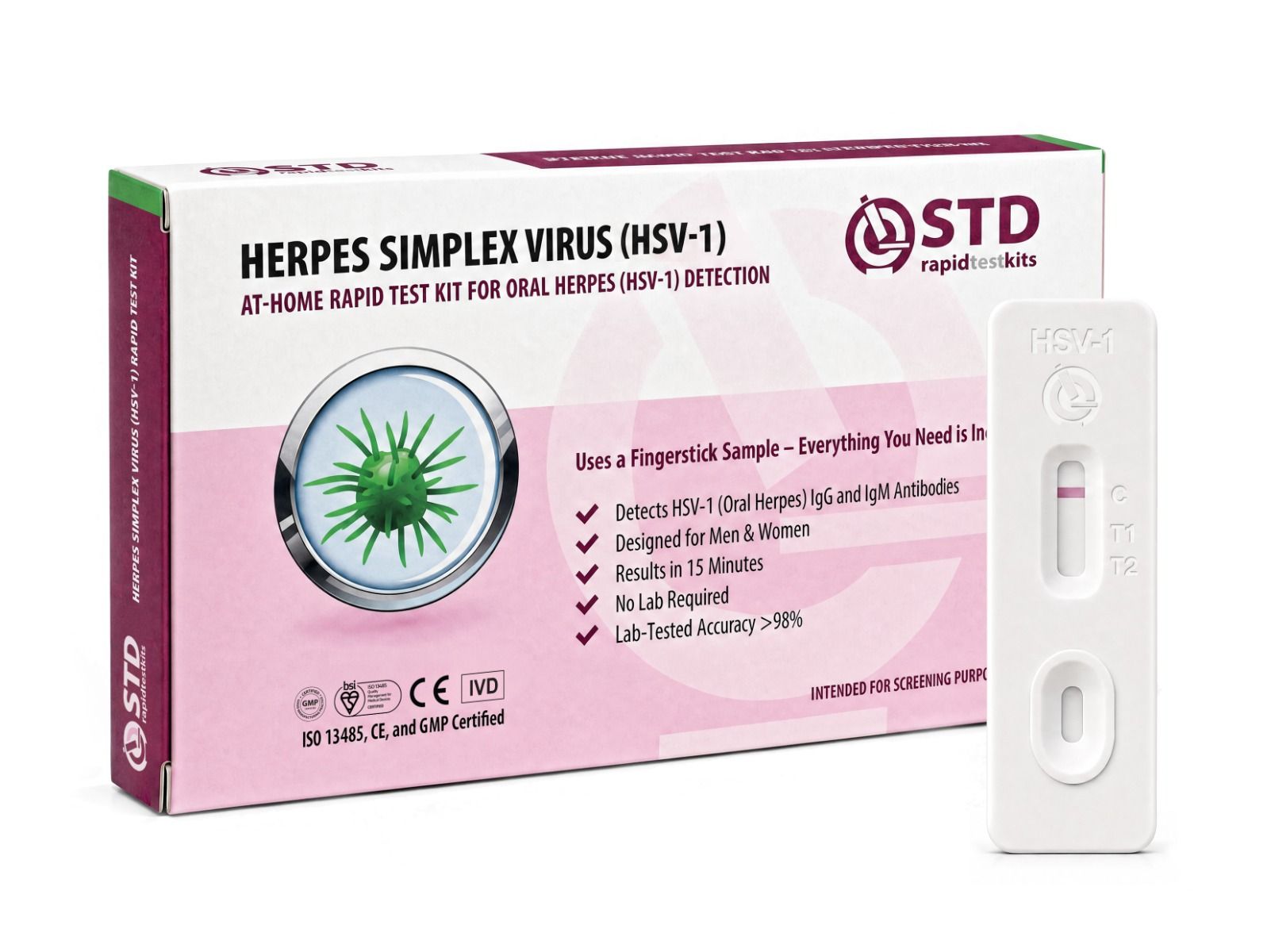
- Blood antibody tests (which is what most home rapid kits, including ours, are) tell you whether your immune system has produced antibodies to HSV-1 or HSV-2. They do not tell you when you were infected, where on the body the virus lives, or whether the sore on your lip today is connected to the test result. Antibodies can take weeks to months to appear after a true first infection, so a blood test taken during a brand-new outbreak can return falsely negative.
This is why timing matters. If your goal is to confirm whether HSV-1 is in your body at all, a blood antibody test 12 or more weeks after a suspected first exposure gives a meaningful answer. If your goal is to confirm whether the sore on your lip right now is HSV-1, the right tool is a clinic swab on a fresh lesion, not a home blood test.
For most people who already see a textbook cold sore cycle and want some kind of objective answer, the most useful path is: see a clinician this week if the lesion is still wet, or order a home blood antibody test 12 or more weeks later for confirmation that the virus is present. Anxious testing within days of a first sore tends to produce confusing results.
| Test type | Best timing | What it confirms | Where to do it |
|---|---|---|---|
| Lesion swab (viral culture or PCR) | Within 2 to 3 days of a visible blister, while the sore is still wet | Whether HSV-1 or HSV-2 is present in the active lesion right now | Clinic only |
| Blood antibody test | 12 or more weeks after a suspected first exposure | Whether your body has produced HSV-1 or HSV-2 antibodies (does not localize to lip vs genital) | Clinic or at-home rapid kit |
Talking to a partner without making it weird
If you are dating, sleeping with someone new, or in a relationship where you have never had this conversation, the disclosure question lands hard. The good news: there is no script that perfectly removes awkwardness, and there is also no script that needs to. Most partners respond better than the anxious version of you predicts.
Three notes that help:
- Disclose to enable consent, not to apologize. The reason to mention it is so the other person can make an informed decision about kissing or oral sex during a flare. That is a respect move. It is not a confession.
- Keep the framing factual. Something like: "I get cold sores once in a while. They are HSV-1, which most adults carry. I am not having a flare right now, and I will skip oral sex if one shows up." That is enough.
- Choose the moment carefully. Five minutes before clothes come off is the worst time. A casual mention earlier in the evening, or a calm message before a date, is better. The right partner will say something like "thanks for telling me" and move on.
The stigma around herpes is real but it is also disproportionate to the underlying biology. The conversation gets easier the second time you have it. By the third, it is just one more health thing you mention.
An estimated 3.8 billion people under age 50 (64%) globally have herpes simplex virus type 1 (HSV-1) infection, the main cause of oral herpes.
Managing flares without making HSV-1 your whole personality
Most carriers settle into a manageable rhythm within the first year of recognizing flares. The toolkit is short and well established by clinical guidance:
- Antivirals. Standard prescription antivirals (acyclovir, valacyclovir, famciclovir) shorten outbreaks if started at the prodrome stage. For people with frequent or severe flares, a daily suppressive dose can reduce outbreak frequency and asymptomatic shedding.
- Topical creams. Over-the-counter docosanol or prescription topical antivirals applied at the first tingle can shave a day or two off the cycle. Effectiveness drops once a blister is fully formed.
- Cold compress. A clean ice pack wrapped in cloth, held against the prodrome area for short intervals, can reduce burning and slow blister formation.
- Lip sunscreen. UV exposure is one of the most consistent triggers. SPF 30+ lip balm is a quiet game-changer for people whose flares cluster in summer or after ski trips.
- Sleep and stress. Boring but real. The flares track immune state. Most people who pay attention can predict their next one within a week.
For broader at-home management guidance, Cedars-Sinai's HSV mouth infection guide is a useful reference. Beyond the physical, give yourself room for the identity adjustment. The first outbreak often comes with a wave of "am I different now?" The honest answer is: a little, and less than you fear. You learn your triggers. You build a small kit of antivirals and lip balm. You stop catastrophizing every twinge.
What to do next
If you are reading this with a sore still on your lip, the most useful actions are small and concrete. Start an antiviral within 24 to 48 hours of the first tingle for the best benefit. Skip kissing, sharing utensils, and oral sex until the scab has fully resolved. If you want viral confirmation and the lesion is still wet, book a clinic visit this week for a swab. If you want to know whether HSV-1 is in your system more broadly, plan an antibody test 12 or more weeks later rather than rushing one now.
If you are reading this two days after the sore healed and what you actually want is a clear conversation with a partner, give yourself the rest of the day. Have it tomorrow. The right framing comes more easily when you are not panicking.
Frequently asked questions
- Can a cold sore be the first sign that I have an STD?
- A cold sore by itself is not evidence of recent sexual transmission. HSV-1 most often enters the body in childhood through non-sexual contact and can stay silent for years or decades before flaring. If you have additional symptoms in the genital area, fever, or unusual lesions elsewhere, that is a separate question worth raising with a clinician.
- What is the difference between HSV-1 and HSV-2?
- HSV-1 typically causes oral cold sores and is the more common of the two viruses worldwide. HSV-2 typically causes genital herpes. Either virus can infect either site through direct contact. HSV-1 in the genitals tends to cause fewer recurrences than HSV-2 in the same location.
- Why am I getting my first cold sore in my 30s or 40s?
- Because HSV-1 can sit dormant for decades and only flare when the immune system dips. A first visible sore at 35 is not unusual and does not mean you were recently infected. Stress, illness, hormonal shifts, sun exposure, and sleep loss are the most common triggers for a first symptomatic outbreak in adults who carried the virus silently for years.
- Can I spread HSV-1 when I do not have a visible sore?
- Yes, but less than during a visible flare. This is called asymptomatic shedding. The risk is highest during a visible outbreak from the first tingle until the scab has fully fallen away. Daily antiviral medication can reduce shedding for people who flare often.
- Should I get tested if this is my first cold sore ever?
- Testing is optional for most people. If you want viral confirmation and the lesion is still wet, see a clinician within 2 to 3 days for a swab. A home blood antibody test is more useful 12 or more weeks after a suspected first exposure, since antibodies take time to develop and a too-early blood test can come back falsely negative.
- Is a canker sore the same as a cold sore?
- No. Canker sores form on the soft tissue inside the mouth (cheek, gums, under the tongue) and are not caused by herpes simplex virus. Cold sores form on or near the lip border on keratinized skin and are caused by HSV-1 (or less commonly HSV-2). Location and the prodrome tingle are the easiest tells.
- Will I keep getting cold sores forever?
- Many people get only a handful of flares in their lifetime. Some get them once or twice a year. A small minority get them more often. Frequency tends to decrease over time. Identifying personal triggers (sun, stress, illness) and using lip sunscreen plus early antivirals usually keeps the rhythm manageable.
- How do I tell a new partner I get cold sores?
- Pick a calm moment before intimacy and keep it brief. Mention that you get cold sores, that most adults carry HSV-1, and that you skip oral sex during a flare. Most partners appreciate the transparency and move on quickly. The conversation gets easier with repetition.
- World Health Organization. Herpes simplex virus fact sheet. Global HSV-1 prevalence under age 50 and clinical overview.
- U.S. Centers for Disease Control and Prevention. About genital herpes, including HSV-1 as a cause of genital infection through oral-to-genital contact.
- Mayo Clinic. Cold sore symptoms, causes, and outbreak cycle (prodrome through healing).
- Johns Hopkins Medicine. HSV-1 and HSV-2 distinctions, prevalence, and clinical patterns.
- NHS. Cold sores: symptoms, self-care, and when to seek clinical advice.
- Cedars-Sinai. Herpes simplex virus mouth infection: home management, trigger avoidance, and clinician follow-up.
