
Published: November 2025 | Last updated: April 2026 | Editorial review and quality control: Martina N.
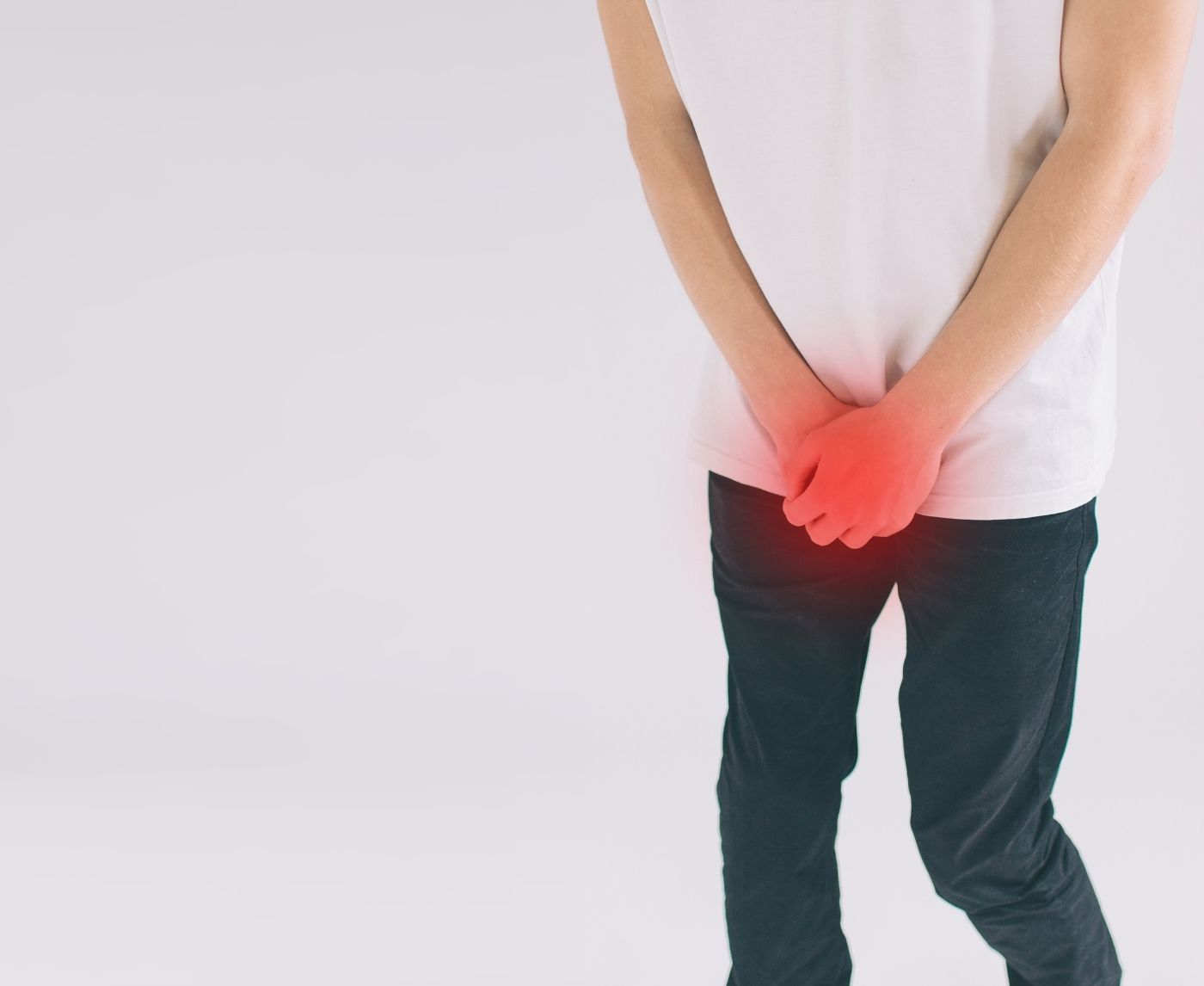
Testicle pain is one of the most Googled male health symptoms, and one of the most misread. Most aches turn out to be muscle strain, mild epididymal irritation, or a temporary infection that responds quickly to treatment. A small but important slice are time-critical emergencies. The trick is knowing which is which before you scroll for another hour at 2 a.m.
Is testicle pain normal, and when should you worry?
Brief soreness after exercise, a long bike ride, or vigorous sex is usually benign and fades within 24 to 48 hours. Pain that is sudden and severe, one-sided with swelling or nausea, or accompanied by fever, burning urination, or a high-riding testicle is not normal and needs same-day medical attention. Testicular torsion has roughly a 6-hour window before permanent damage becomes likely (<a href="https://www.mayoclinic.org/diseases-conditions/testicular-torsion/symptoms-causes/syc-20378270" target="_blank" rel="noopener">Mayo Clinic</a>). For dull, persistent aches in sexually active men, chlamydia and gonorrhea are common silent causes worth ruling out with a test.
Key Takeaways
- Sudden, severe, one-sided testicle pain (especially with nausea or a high-riding testicle) is a surgical emergency. Go to the ER immediately, do not wait.
- Dull, lingering one-sided aches in sexually active men are commonly caused by chlamydia or gonorrhea, often with no discharge, no burning, and no fever.
What Actually Causes Testicle Pain
The scrotum holds delicate machinery: the testicles, the epididymis (a coiled tube on the back of each testicle that stores sperm), the spermatic cord (carrying blood vessels and the vas deferens), and surrounding muscles and connective tissue. Pain can come from any of these structures, and sometimes from somewhere else entirely (the lower back, a hernia, even a kidney stone radiating downward).
External trauma is the cause most men expect. The reality is broader. Many of the most common causes have nothing to do with a kick, a fall, or a hard tackle. Inflammation from infection, a twist of the spermatic cord, a hernia pressing into the scrotum, fluid buildup, and even nerve irritation can all show up as testicle pain.
The table below sorts the most common culprits by what they typically feel like and how urgently they need attention.
| Condition | What it typically feels like | Urgency |
|---|---|---|
| Epididymitis (often from chlamydia or gonorrhea) | Dull ache on one side, gradual onset, tenderness behind the testicle, sometimes mild swelling | See a provider within a day or two; treatable with antibiotics |
| Testicular torsion | Sudden severe pain, often with nausea, vomiting, or a testicle that sits higher than usual | Emergency. Go to the ER immediately |
| Inguinal hernia | Dragging or pressure sensation in the groin, may bulge with coughing or lifting | Schedule evaluation; surgical repair is often needed |
| Hydrocele or varicocele | Heaviness, fullness, or a soft swelling, usually painless | Routine evaluation if size changes or pain develops |
| Strain or minor trauma | Mild soreness after exercise, sex, or impact, fades within 24 to 48 hours | Self-care, watch for worsening |
| Kidney stone or referred pain | Sharp pain that travels from the flank or lower back into the groin or testicle | Urgent care or ER if severe |
Emergency Red Flags You Should Not Ignore
Testicular torsion is the scenario where waiting costs you a testicle. The spermatic cord twists, blood flow stops, and tissue starts dying within hours. Most cases happen in adolescents and young men, but it can occur at any age, including during sleep or after exercise. According to the Mayo Clinic, the salvage rate is high if surgery happens within about 6 hours of pain onset, and drops sharply after that.
The classic signs are sudden severe one-sided pain, often with nausea or vomiting, a testicle that appears higher than the other or sits at an odd angle, and significant swelling or redness of the scrotum. Some men also report dizziness, sweating, or pain in the lower abdomen on the affected side.
If any of those signs are present, do not drive yourself if you can avoid it, do not apply ice or heat, and do not wait to see if it passes. Call emergency services or go to the nearest emergency room. In some cases a provider will attempt manual detorsion as a first step while preparing the operating room, though this does not substitute for surgical evaluation and should only be performed by a clinician. If it turns out to be epididymitis or another less urgent cause, that outcome is still better than losing a testicle to a missed torsion.
Sudden severe one-sided testicle pain. Nausea or vomiting with the pain. A testicle that suddenly sits higher or at an unusual angle. Pain that wakes you from sleep and does not ease within minutes. Significant scrotal swelling or skin discoloration. These are torsion red flags and the clock starts at the moment pain began.
How STIs Cause Testicle Pain (Often Without Other Symptoms)
Sexually transmitted infections are a far bigger driver of testicle pain than most men realize. Chlamydia and gonorrhea can travel up the urethra into the epididymis, the tube that wraps around the back of each testicle. The result is epididymitis: inflammation that produces a dull, often one-sided ache, sometimes with swelling, sometimes with nothing else at all.
The CDC's STI Treatment Guidelines list sexually transmitted chlamydia and gonorrhea among the leading causes of acute epididymitis in sexually active men (CDC STI Treatment Guidelines). Chlamydia often causes no noticeable symptoms at all (CDC). No discharge, no burning, no rash. The ache might be the only signal.
| Infection | Likelihood of testicle pain | Other signs (when present) |
|---|---|---|
| Chlamydia | Common cause of epididymitis in sexually active men | Often none. Sometimes mild discharge or burning urination |
| Gonorrhea | Common cause of epididymitis in sexually active men | Thicker discharge, urgency to urinate, painful urination |
| Mycoplasma genitalium | Less common but increasingly recognized | Often subtle, similar to chlamydia |
| Syphilis | Rarely causes testicle pain; possible in late stages | Painless sores, rash, swollen lymph nodes earlier in disease |
| HIV / Hepatitis B / Hepatitis C | Pain rarely a first symptom | Fatigue, fever, rash, flu-like illness around acute infection |
Pain After Sex, Masturbation, or a Long Bike Ride
A short period of soreness after intense sexual activity is common and usually benign. Pelvic floor muscles tense, the spermatic cord can briefly congest, and the epididymis can get mildly irritated. Most of this fades within a day or two.
The pattern that should prompt action is different: pain that does not resolve within 48 hours, pain that worsens rather than improves, pain paired with burning urination, or new tenderness when you press behind the testicle. Those features point toward inflammation or infection. The same is true of pain after a long ride on a hard saddle or a heavy lifting session: brief discomfort is normal, persistent or escalating discomfort warrants evaluation.
The timing of a symptom does not always match its cause. An ache that started after a workout might actually be early epididymitis from an infection picked up weeks earlier. The CDC notes this directly:
Acute epididymitis caused by sexually transmitted enteric organisms occurs primarily among men who are the insertive partners during anal intercourse. Sexually transmitted acute epididymitis is usually accompanied by urethritis, which is frequently asymptomatic.
Discomfort from exercise, a long bike ride, or vigorous sex should fade within 48 hours. Pain that worsens, persists past that window, or arrives with burning urination or new swelling warrants medical evaluation. Friction soreness fades. Inflammation builds.
How to Test From Home (and When It Works)
stdrapidtestkits.com sells rapid at-home STI tests, so the clinical guidance below follows CDC, Mayo Clinic, and NHS sources rather than our sales pitch.
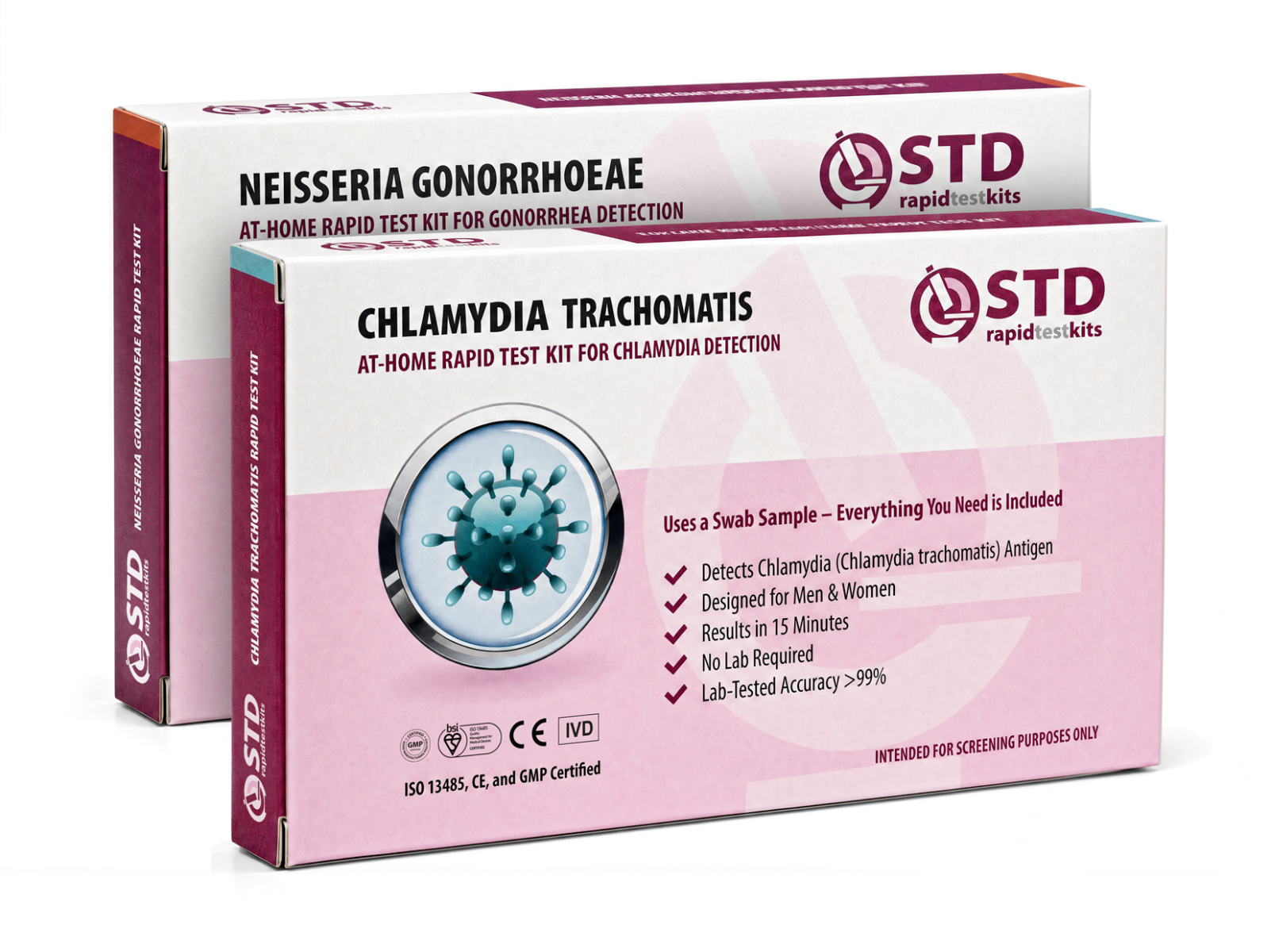
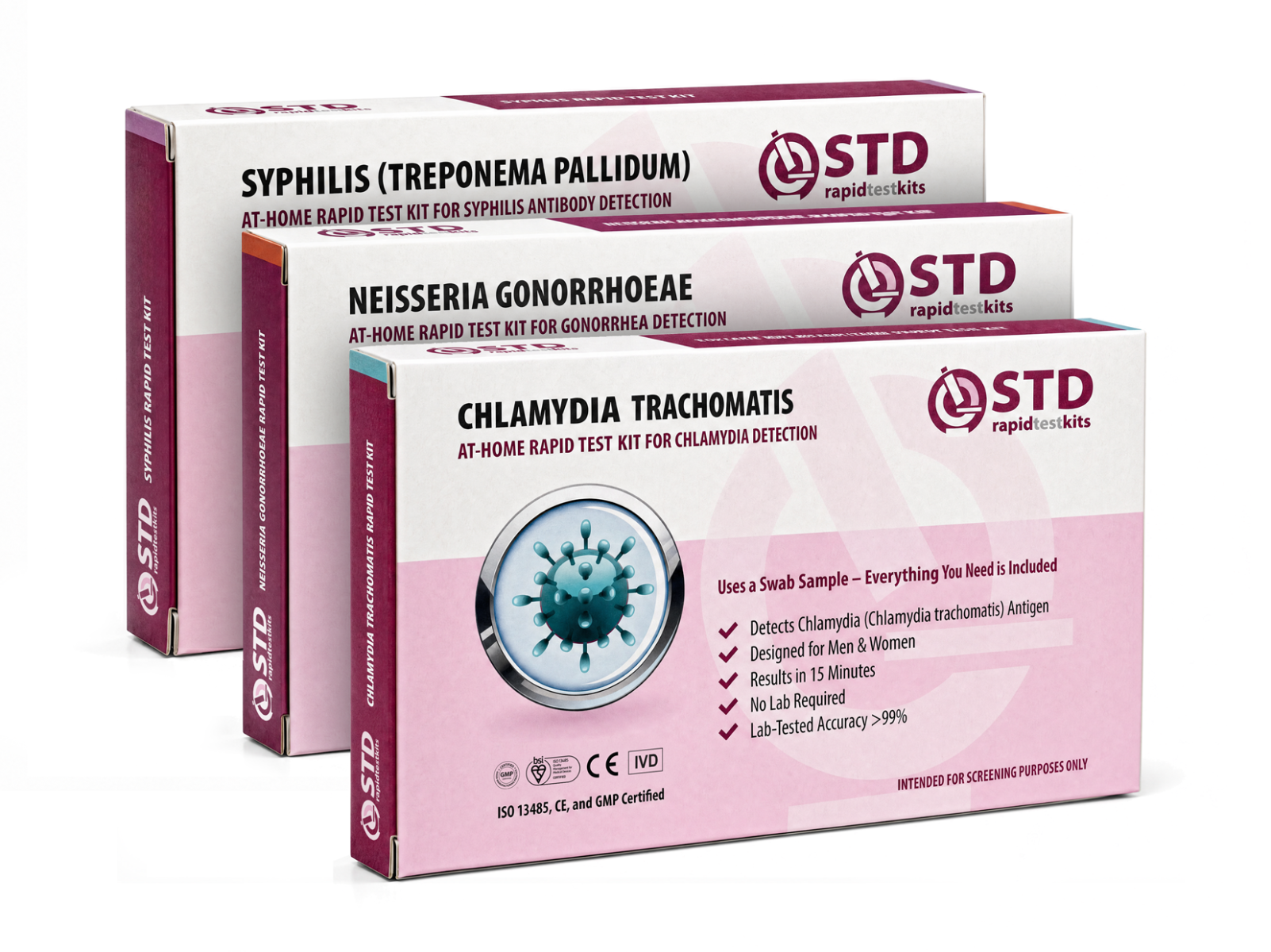
If your pain pattern fits the dull, lingering, one-sided ache typical of epididymitis, an at-home rapid test for chlamydia and gonorrhea is a fast and private way to start ruling causes in or out. Our rapid swab kits use a self-collected penile swab and read in roughly 15 to 20 minutes. They are lateral-flow tests, which means a positive result is meaningful and worth confirming with a clinician, and a negative result is most reliable when the test is taken inside the right window.
Lateral-flow rapid kits are a different technology than the lab NAAT (nucleic acid amplification test) your doctor would order. Both look for the same infections; the lab test is more sensitive and is generally considered the gold standard. The home rapid test trades some sensitivity for speed, privacy, and zero waiting room. The two are complementary screening tools.
Testing Windows: When to Test and When to Retest
Test too early and you risk a false negative, because there is not yet enough bacterial load for the assay to detect. Test too late and you may have spread the infection or developed complications in the meantime. The table below summarizes typical windows for the infections most relevant to testicle pain. Always read the data sheet that ships with your test for the exact validated window for that kit.
| Infection | Earliest detectable | Recommended testing window | Retesting |
|---|---|---|---|
| Chlamydia | About 5 to 7 days post-exposure | 14+ days post-exposure for higher confidence | Repeat in 3 months after treatment per CDC guidance |
| Gonorrhea | About 5 to 7 days post-exposure | 14+ days post-exposure | Repeat in 3 months after treatment per CDC guidance |
| Syphilis (blood antibody) | About 3 weeks post-exposure | 6 to 12 weeks post-exposure for confidence | Retest if exposure was recent and first test negative |
| HIV (rapid antibody) | About 23 to 90 days depending on assay | After 12 weeks for high confidence on antibody tests | Retest at 3 months if early test negative |
After You Test: Reading Your Result
Two practical rules sit on top of the testing-windows table. First, if you tested negative early but symptoms persist or worsen, retest after the full window passes. A single early-window negative is not the final word; a clinic NAAT is the right confirmatory step when symptoms continue. Second, if you tested positive and were treated, the CDC recommends a follow-up test about 3 months later because reinfection from an untreated partner is the most common driver of a second positive, and retesting catches it early (CDC chlamydia treatment guidelines).
Talking to a Partner Without Making It a Crisis
Bringing this up with a partner is the part most men dread. The script does not need to be dramatic. The goal is to frame testing as a shared health step rather than an accusation, which short-circuits the ping-pong reinfection cycle that happens when only one partner gets treated.
If you test positive, the CDC and many state programs offer expedited partner therapy in many jurisdictions: your provider can send treatment to a partner without a separate appointment. Ask about it.
"I've had some testicle discomfort and I'm getting tested. It would be helpful if you tested too, regardless of how I come back."
That is enough. No accusation, no diagnosis on their behalf, just a shared health step that protects both of you and prevents the ping-pong reinfection cycle.
Reducing Your Risk Going Forward
You cannot prevent every cause of testicle pain (a hernia or torsion is not something condoms or screening will stop), but you can meaningfully reduce the most common preventable cause: STI-driven epididymitis. The basics still work. Use condoms with new or non-monogamous partners. Get screened at least annually if sexually active, more often with multiple partners. Do not wait for symptoms; chlamydia and gonorrhea are largely silent in men, and the testicle ache might be your only clue.
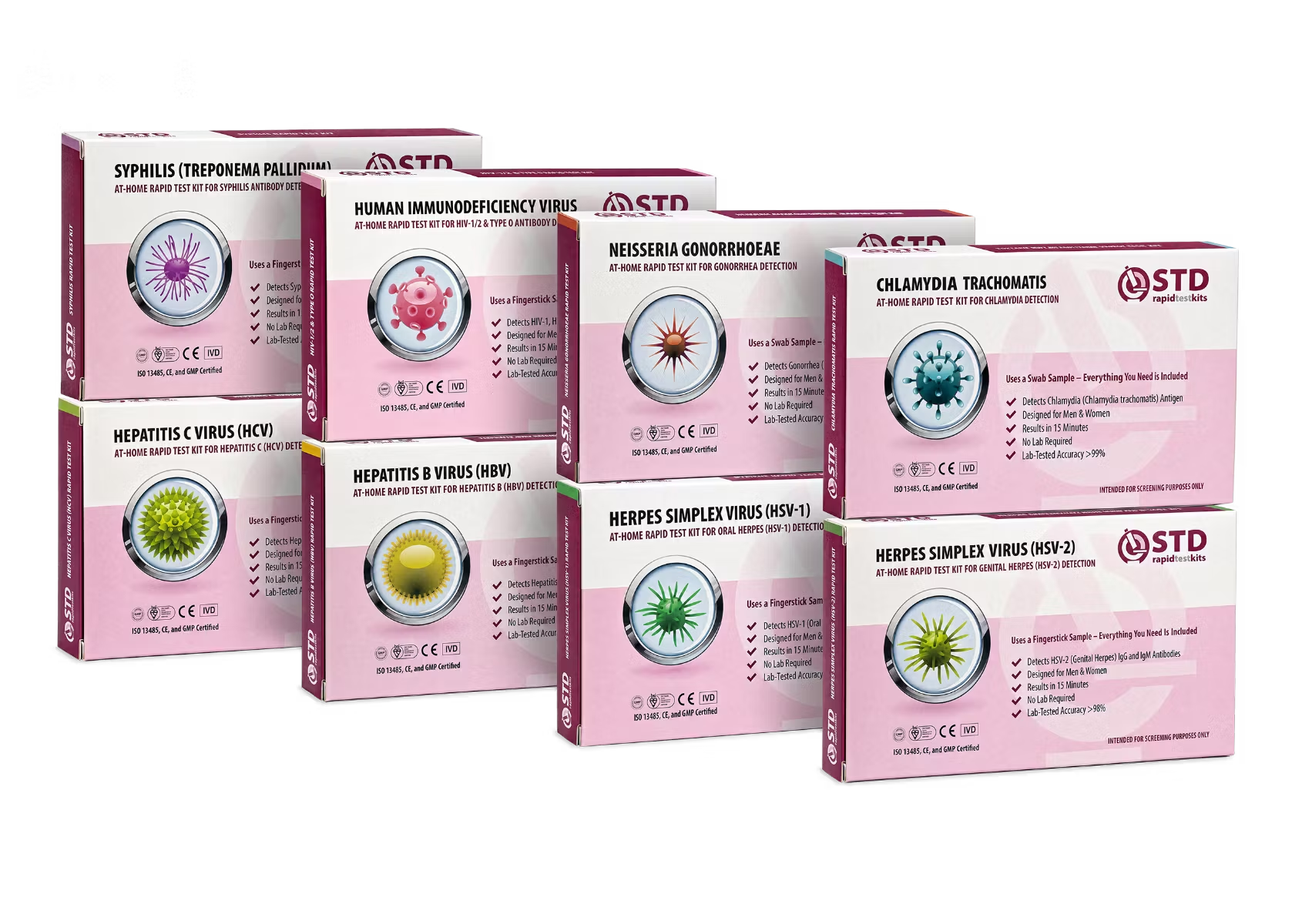
For sports and physical work, supportive underwear or a fitted athletic supporter reduces strain-related pain during running, cycling, and heavy lifting. If you have had epididymitis before, ask your provider about a follow-up test of cure, especially if symptoms partially recurred. A broader screen is reasonable when exposure history is uncertain or when more than one infection might be in play.
Frequently Asked Questions
- Can testicle pain be the only symptom of an STI?
- In a large share of chlamydia infections in men, the only sign is a dull, one-sided ache, because the infection travels up into the epididymis without triggering urethral discharge or burning urination. That ache alone is enough reason to test after unprotected sex. Many men who eventually test positive recall their first warning sign as nothing more than scrotal heaviness or a tug they almost ignored.
- How do I tell torsion from epididymitis?
- Pattern matters. Torsion is sudden, severe, often with nausea or a testicle that visibly sits higher than the other. Epididymitis builds gradually over hours or days, hurts more behind the testicle, and may improve briefly when you lift the testicle (Prehn sign). When in doubt, treat it as torsion and go to the ER. Imaging is fast, and the cost of waiting on a real torsion is permanent.
- Can rough sex or hard masturbation cause testicle pain?
- Worsening pain past 48 hours, burning urination, or new tenderness behind the testicle warrant testing or a clinic visit. Those features point to inflammation rather than mechanical irritation. Brief soreness from rough sex or hard masturbation that resolves within a day or two is generally benign and does not need workup on its own.
- Is one-sided testicle pain more concerning than pain on both sides?
- The answer depends on cause. Serious conditions like torsion, epididymitis, hernia, and varicocele all tend to be one-sided; bilateral pain more often points to muscle strain, referred back pain, or a systemic illness like mumps orchitis. Either presentation deserves evaluation if pain is severe or persistent.
- What if I have testicle pain but no visible symptoms anywhere?
- That is the most common presentation of STI-related epididymitis in men. The infection is in the urethra and traveling up the vas deferens to the epididymis without producing the classic discharge or burning. A rapid swab test for chlamydia and gonorrhea is the fastest way to rule the most likely culprits in or out.
- What does "blue balls" actually mean?
- Vasocongestion: temporary fullness and aching from prolonged arousal without orgasm. It is real, harmless, and resolves on its own within an hour or so. If your discomfort lasts longer than that, gets worse over time, or appears days after the arousal episode, it is something other than blue balls and warrants a closer look.
- Do at-home rapid STI tests actually work for testicle pain?
- For chlamydia and gonorrhea (the two infections behind most STI-driven testicle pain), home rapid tests work as a screen when used inside the validated window. Sensitivity is meaningfully lower than a lab NAAT, so a negative rapid result is best treated as a screen rather than a clearance: if symptoms persist after a negative, retest at a clinic with a NAAT before ruling STIs out. A positive rapid result is informative and worth confirming with a clinician before starting treatment.
- Could a hernia or kidney stone cause testicle pain without a lump?
- Yes. Inguinal hernias often produce a dragging or aching sensation in the scrotum that worsens with coughing or lifting before any visible bulge appears. Kidney stones can refer sharp, intermittent pain into the testicle on the same side as the stone. Both deserve a clinical exam if suspected.
- U.S. Centers for Disease Control and Prevention. Sexually Transmitted Infections Treatment Guidelines: Epididymitis. Identifies sexually transmitted chlamydia and gonorrhea among the leading causes of acute epididymitis in sexually active men.
- U.S. Centers for Disease Control and Prevention. Chlamydia: Basic information and the high frequency of asymptomatic infection.
- U.S. Centers for Disease Control and Prevention. Sexually Transmitted Infections Treatment Guidelines: Chlamydia. Includes the recommendation to retest approximately 3 months after treatment to detect reinfection.
- Mayo Clinic. Testicular torsion: symptoms, causes, and the time-critical surgical window for testicle salvage.
- Mayo Clinic. Epididymitis: symptoms, common infectious causes, and treatment.
- Mayo Clinic. Testicle pain: when to see a doctor, including the red flags that warrant immediate evaluation.
- U.K. National Health Service. Testicle pain: causes, self-care guidance, and when to seek urgent care.
- Cleveland Clinic. Testicular pain: causes, sides, diagnosis, and treatment.
