Is Black Syphilis Real? The Wartime Myth and Real STI Explained
Black Syphilis is one of the most persistent STI rumors on the internet, but no medical body recognizes it as a real disease. Here is where the wartime story came from, what real syphilis actually does to the body (a treatable infection when caught early), and how to test if you are worried about a recent exposure.




- Black Syphilis is not a recognized medical condition. It originated as a wartime rumor and never appeared in peer-reviewed clinical literature or in CDC or WHO surveillance data.
- Real syphilis is the disease worth knowing about. It is curable with a single dose of penicillin when caught early, and at-home rapid blood tests can detect it from about three to six weeks post-exposure, with a fully reliable negative result after twelve weeks.
Published: October 2025 | Last updated: May 2026 | Editorial review and quality control: Martina N.
Look up Black Syphilis online and the results split into two very different stories. One version describes a horrific, flesh-eating STI that supposedly disfigured wartime soldiers within days. The other version, the one every major public-health body accepts, is that no such disease ever existed. The condition was a rumor, not a diagnosis, and you will not find it in CDC, WHO, NHS, or peer-reviewed clinical literature.
If you landed here worried about a sore, rash, or skin change after a sexual exposure, the calmer reality is this: the cause is not Black Syphilis. It is almost certainly something else (often regular syphilis, an HSV outbreak, a yeast infection, or a non-STI skin condition), and most of those have straightforward testing paths. The sections below explain where the wartime rumor came from, what real syphilis actually does to the body, why US cases are rising, and what to do if you want to rule it out.
Key Takeaways
- Black Syphilis is not a recognized medical condition. It originated as a wartime rumor and never appeared in peer-reviewed clinical literature or in CDC or WHO surveillance data.
- Real syphilis is the disease worth knowing about. It is curable with a single dose of penicillin when caught early, and at-home rapid blood tests can detect it from about three to six weeks post-exposure, with a fully reliable negative result after twelve weeks.
What Black Syphilis Was Supposed to Be
The legend has a few consistent features. The infection was described as a sexually transmitted illness, supposedly originating in East Asia, that caused aggressive necrotic damage to the genitals far beyond what regular syphilis is capable of. Some retellings claim limbs blackened. Others claim death within days. The word “Black” in the name almost certainly refers to the color of necrotic (dead) tissue described in the stories.
What the legend does not have is documentation. No case series, no hospital record, no laboratory isolate, no peer-reviewed paper, and no public-health surveillance entry has ever supported a distinct organism or syndrome called Black Syphilis. The closest thing in real medicine is a rare complication of late untreated syphilis called gummatous syphilis (tissue-destroying granulomas of the soft tissue or bone), which is well documented (CDC syphilis fact sheet) but which behaves nothing like the rumored Black Syphilis. Gummas appear years after infection, not days, and they respond to standard antibiotic treatment.
Why the description does not match any real STI
Sexually transmitted bacteria have never been observed to cause limb loss within days of exposure. Treponema pallidum (the spirochete that causes syphilis) replicates slowly, with an estimated doubling time of around 30 hours. The first sign of infection, a painless ulcer called a chancre, typically appears about three weeks after exposure, and untreated cases progress over months to years rather than days (WHO syphilis fact sheet). A novel pathogen that bypassed every aspect of this biology and was simultaneously undocumented anywhere in clinical microbiology is not a plausible disease.
The other clue that Black Syphilis was not real is geography. Pathogens with the destructive power described in the story do not stay confined to one continent for fifty years. If a flesh-eating STI had circulated among US military personnel in Asia and then traveled home through troop rotations, it would have appeared in stateside hospitals and on the desks of medical examiners. It did not.
Is Black Syphilis a real disease?
No. Black Syphilis is a wartime urban legend, not a recognized medical condition. The CDC, WHO, and NHS do not list it as a disease, and no peer-reviewed clinical literature documents it. The rumor circulated among US military personnel during WWII, the Korean War, and the Vietnam War, and most public-health historians consider it a fabrication designed to discourage soldiers from unprotected sex with sex workers. Real syphilis (caused by the bacterium Treponema pallidum) is the disease worth taking seriously: it is real, increasingly common in the US, and curable with antibiotics when caught early.
Where the Rumor Came From
The Black Syphilis story is associated with US military personnel in the 1940s and 1950s, with renewed circulation during the Vietnam War in the 1960s and early 1970s. The rumor was most active in regions where US troops were stationed alongside large sex-worker populations: Japan, the Philippines, Korea, Thailand, and Vietnam. Soldiers passed the story along the way they passed along any cautionary tale, as a warning that the next encounter might be the one that destroys you.
The “scared straight” theory
The most widely accepted explanation among medical historians is that Black Syphilis was a deliberate or semi-deliberate invention by military chaplains, medics, and senior officers who wanted to reduce STI rates among the troops. The cold logic of the era: real syphilis statistics had failed to change behavior. A story about a flesh-eating super-version that no antibiotic could cure could reach where pamphlets could not. The story spread through informal channels (mess hall, barracks, off-duty conversation) that no official poster could reach.
The Thailand variant
A recurring sub-rumor places ongoing Black Syphilis cases in modern Thailand, sometimes linked to specific neighborhoods of Bangkok or Pattaya. Thai public-health authorities have repeatedly stated that no such disease is recognized on their soil. What does exist there, as everywhere else, is regular syphilis at rates that fluctuate with screening and sex-work policy, plus a vibrant urban folklore that picks up and reshapes wartime rumors for new generations of foreign visitors.
Why it never died
Rumors about sexually transmitted infections survive longer than rumors about other diseases for a simple reason: shame keeps people from checking. A young soldier who heard the story was unlikely to ask an army doctor to verify it on the record. The same dynamic plays out today on internet forums, where stories about untestable, untreatable STIs spread freely because asking for clarification often feels riskier than just believing. The result is a piece of folklore that has outlived several major wars and the antibiotic revolution that should have ended it.
Real Syphilis: The Disease Behind the Story
The disease that the Black Syphilis rumor borrowed its name from is regular syphilis, and it is a serious public-health problem in its own right. Syphilis is caused by Treponema pallidum, a corkscrew-shaped bacterium (spirochete) that transmits through direct contact with syphilitic sores during vaginal, anal, or oral sex. It can also pass from a pregnant person to a fetus, a route that produces congenital syphilis (CDC syphilis information).
Syphilis was nearly eliminated in the United States after penicillin became widely available in the 1940s. The disease is now back. CDC surveillance has tracked rising primary and secondary syphilis cases every year since the early 2000s, and congenital syphilis cases have multiplied since 2015 (CDC syphilis surveillance overview). The rise is one of the more pressing trends in US sexual-health epidemiology, and it is why every current clinical guideline recommends routine screening for people who are sexually active outside a known mutually-monogamous tested relationship.
Co-infection with HIV is also a real concern. Active syphilis lesions create direct portals into the bloodstream, and CDC guidance notes that the presence of genital ulcer disease (including syphilitic chancres) increases susceptibility to HIV acquisition and onward transmission (CDC syphilis fact sheet). This is one reason CDC sexual-health screening guidelines pair syphilis and HIV testing routinely; if you test for one, you should test for the other.
Unlike the rumored Black Syphilis, real syphilis behaves predictably. It moves through well-defined stages, each with its own visible signs. It is detectable on blood tests. And, critically, it is curable with a single dose of long-acting penicillin G when caught in the primary or secondary stage (WHO syphilis treatment guidance).
The Four Stages of Syphilis
Untreated syphilis progresses through four clinical stages. Knowing the order matters because the treatment is identical in the first three but the chance of permanent damage rises sharply at each transition (CDC syphilis stages).
Primary stage: the chancre
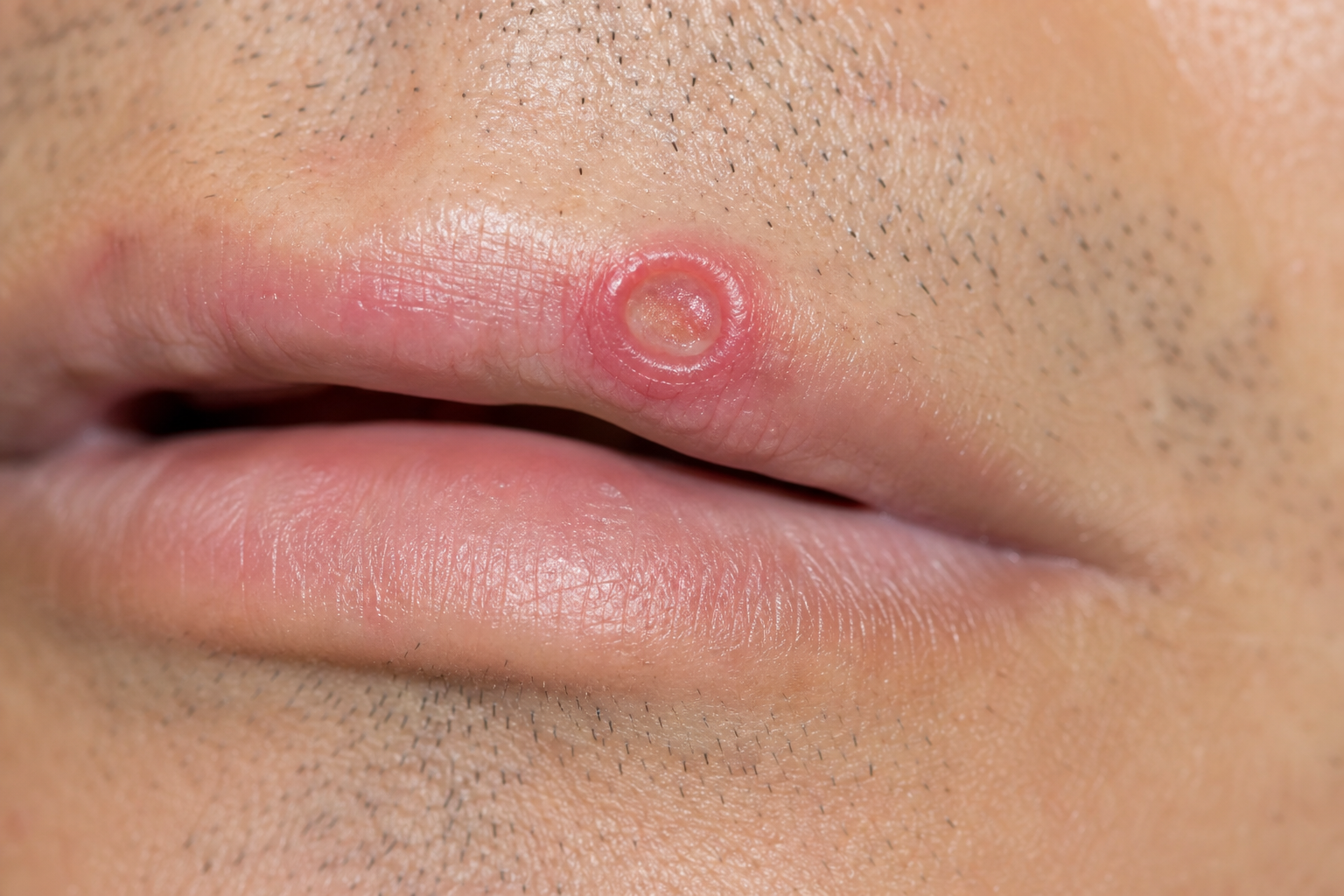
Three weeks after exposure on average, with a published range of 10 to 90 days, a single painless ulcer called a chancre appears at the site where the bacterium entered the body. That is usually the genitals, anus, or mouth depending on the type of contact. Because it does not hurt, the chancre is often dismissed or missed entirely, especially when it sits inside the vagina, rectum, or oral cavity where it is not visible. The chancre heals on its own in three to six weeks. The infection does not.
Secondary stage: rash and systemic symptoms
Four to ten weeks after the chancre heals, the bacterium has spread through the bloodstream and the immune system responds with a constellation of symptoms. The hallmark is a non-itchy rash that often involves the palms of the hands and the soles of the feet, an unusual distribution that helps distinguish secondary syphilis from most other rashes. Other features include flat warty growths in moist body folds (condyloma lata), patchy hair loss, swollen lymph nodes, low-grade fever, sore throat, and fatigue. Secondary symptoms are easy to mistake for a viral illness, which is part of why syphilis earned its old nickname, the Great Pretender.
Latent stage: silence
If secondary syphilis is not treated, the disease enters a latent phase that can last years or decades. There are no outward symptoms during latency, but blood tests remain positive and the bacterium continues to live in the body. CDC syphilis stages guidance notes that a meaningful share of people in early latency relapse back into symptomatic secondary disease at least once (CDC syphilis stages). Others stay quiet, and the underlying infection is still there; the person remains contagious for at least the first year of latency.
Tertiary stage: late complications
A substantial fraction of untreated cases eventually develop tertiary complications (CDC syphilis stages). These can affect the cardiovascular system (aneurysms of the aorta and aortic regurgitation), the central nervous system (neurosyphilis with strokes, dementia, or psychiatric symptoms), or the soft tissue and bone (gummas, the tissue-destroying lesions that are the closest real-world parallel to the Black Syphilis rumor). Tertiary syphilis can appear 10 to 30 years after the initial infection. It is the stage where antibiotics may halt progression but cannot reverse damage already done (Mayo Clinic on tertiary syphilis).
Neurosyphilis can happen at any stage
One worth-knowing detail: neurosyphilis (infection of the brain or spinal cord) does not wait for the tertiary stage. It can occur at any point after the bacterium enters the bloodstream, including during secondary syphilis. Symptoms include headache, vision changes, hearing loss, and behavioral changes. When suspected, doctors confirm with a spinal-fluid analysis and treat with intravenous penicillin rather than the single intramuscular dose used for uncomplicated cases.
Syphilis is curable with the right antibiotics. Treatment will not undo any damage the infection has already caused. It will, however, prevent further harm, so catching it early is important.
Why Syphilis Cases Are Rising
The most important fact about syphilis in 2026 is not that the Black Syphilis rumor is back. It is that real syphilis is back. After near-elimination in the United States in the 1990s, primary and secondary syphilis cases have climbed every year for over two decades, and the trend has accelerated since 2015 (CDC syphilis surveillance overview).
Several factors are driving the rise. Routine STI screening declined for several years during the early 2010s as public-health budgets were cut. Condom use among younger sexually active adults has been gradually decreasing. The wider availability of dating apps has shortened the average time between meeting a partner and having sex, which reduces the window for negotiating testing. And funding for free or low-cost STI clinics has been falling in real terms in many regions, leaving more cases undetected and untreated long enough to transmit onward (WHO global syphilis context).
The rise is not evenly distributed. Men who have sex with men account for a disproportionate share of new primary and secondary cases, but the fastest-growing demographic group is women of reproductive age, which is also why congenital syphilis has scaled in parallel. Geographic patterns track state-level investment in STI clinics: states that have cut local public-health budgets in the last decade have generally seen sharper case increases than states that maintained funding.
Congenital syphilis (transmission from a pregnant person to the fetus) is the most concerning sub-trend. Untreated congenital syphilis can cause stillbirth, neonatal death, or lifelong disability including bone deformities, deafness, and developmental delay. The CDC now recommends syphilis screening at the first prenatal visit, again at 28 weeks of pregnancy for higher-risk pregnancies, and at delivery in geographic areas with rising cases. That is a recommendation that exists because real syphilis is causing real harm, not because of any historical rumor.
US congenital syphilis cases have multiplied since 2015. Current CDC guidance recommends syphilis screening at the first prenatal visit, again at 28 weeks for higher-risk pregnancies, and at delivery in high-burden areas. If you are pregnant or planning a pregnancy, ask your provider which screening schedule applies to you.
How Syphilis Is Diagnosed
Syphilis blood testing uses two different categories of antibody test, and clinics typically run them together to avoid false positives and false negatives.
Non-treponemal tests
Tests like RPR (rapid plasma reagin) and VDRL (venereal disease research laboratory) detect antibodies that are produced in response to cellular damage from the infection. They are not specific to Treponema pallidum, which means they can produce false positives in conditions like pregnancy, certain autoimmune diseases, and some viral illnesses. Non-treponemal tests are useful because the titer (concentration) of antibody falls after successful treatment, so they are good for monitoring whether antibiotics worked and for confirming cure.
Treponemal tests
Tests like TP-PA, FTA-ABS, and most rapid lateral-flow home tests detect antibodies that specifically recognize Treponema pallidum. They are more specific than non-treponemal tests and stay positive for life in most people, even after successful treatment. Clinics typically run a non-treponemal screening test (RPR or VDRL) first, then confirm a positive result with a treponemal-specific test before treatment decisions are made (MedlinePlus on syphilis lab tests).
Direct detection at the lesion
If a visible chancre or other lesion is present, clinics can sometimes bypass antibody testing entirely. Dark-field microscopy directly visualizes the spirochete in fluid taken from the lesion, and PCR can amplify the bacterial DNA. These tests are useful in the first few weeks after exposure, before antibodies have had time to develop, but they are clinic-only procedures and require an in-person visit.
What the at-home rapid test does
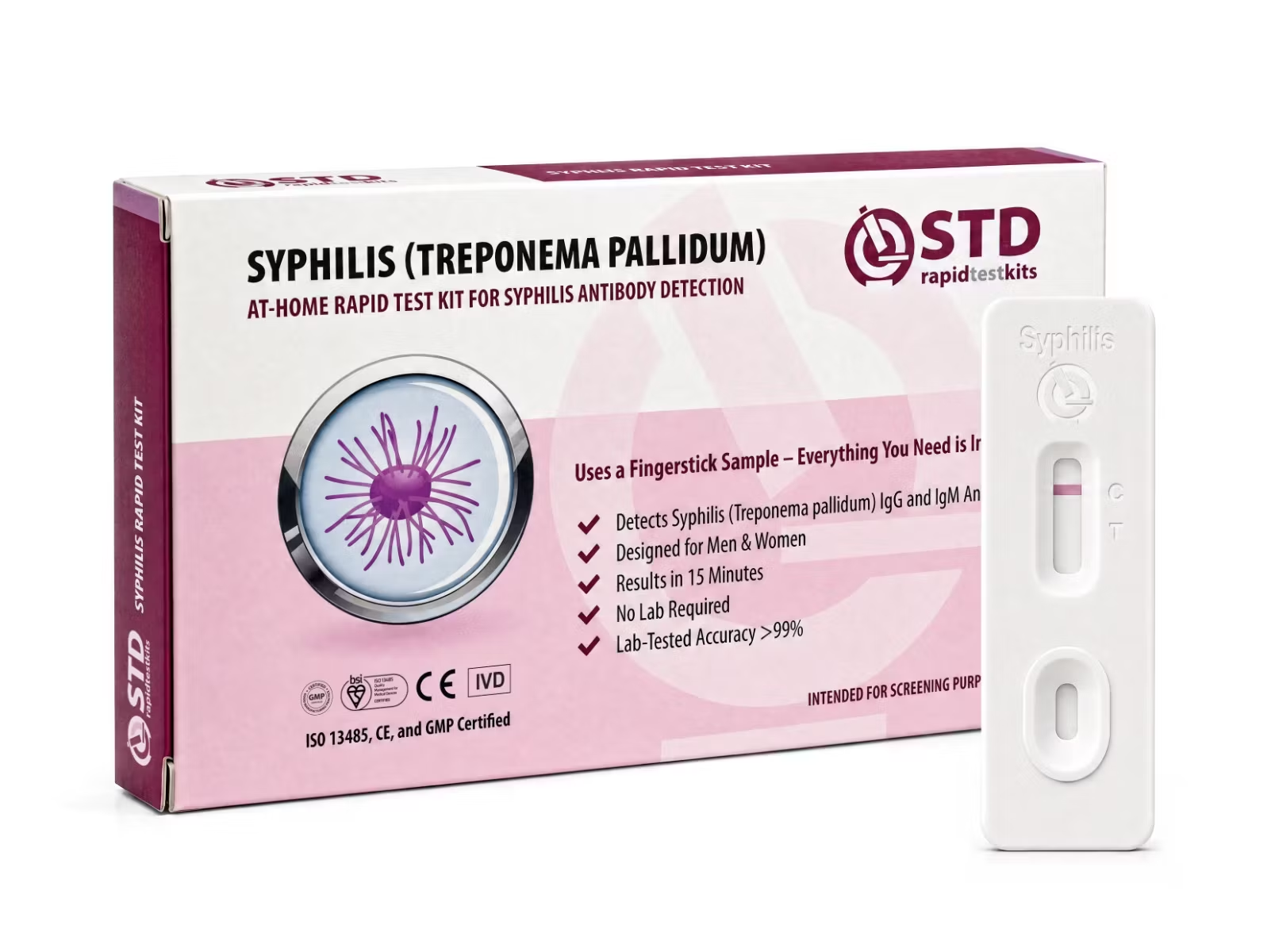
The at-home syphilis rapid test is a treponemal lateral-flow blood antibody test, performed with a fingerstick blood sample, with results visible in about 15 minutes. It detects antibodies to T. pallidum after the body has had time to seroconvert. Antibodies typically become detectable three to six weeks after exposure, and a fully reliable negative result is usually achieved by twelve weeks. As MedlinePlus on syphilis testing notes, antibodies take time to develop after exposure, which is why retesting around the twelve-week mark is recommended after a known exposure if the first test was negative. A positive at-home result is a strong signal to seek clinic confirmation and treatment. Lateral-flow rapid tests are screening tools; labs use NAAT and direct microscopy for higher analytical sensitivity, and the two are complementary, not equivalent.
Disclosure: stdrapidtestkits.com sells rapid at-home lateral-flow tests including a syphilis blood antibody kit. The editorial content above is written independently of that commercial offering, and we recommend products based on fit for the reader's concern.
| Test type | What it detects | When it turns positive | Use after treatment |
|---|---|---|---|
| Non-treponemal (RPR, VDRL) | Antibodies to cell damage from infection | Around 3 to 6 weeks after exposure | Titer falls; used to confirm cure |
| Treponemal (TP-PA, FTA-ABS, rapid home test) | Antibodies specific to T. pallidum | Around 3 to 6 weeks, occasionally up to 12 weeks | Usually stays positive for life |
| Direct (dark-field microscopy, PCR) | The Treponema pallidum spirochete itself in lesion fluid | From the moment a lesion is visible | Not applicable; lesion clears with treatment |
Prevention That Actually Works
The prevention advice for real syphilis is the same as for most bacterial STIs, and it works whether or not you believe in the Black Syphilis story.
Latex or polyurethane condoms used correctly for every act of vaginal, anal, or oral sex reduce transmission risk substantially. Condom coverage does not fully eliminate syphilis risk because the chancre can sit on skin outside the covered area (the base of the penis, the scrotum, the inner thighs, the perianal skin), and the bacterium transmits through direct skin contact with the lesion. Even so, condoms cut risk meaningfully, especially when paired with regular partner screening.
Routine testing is the second leg of prevention. The CDC recommends syphilis screening at least annually for anyone with new or multiple partners, more often for sexually active men who have sex with men, all pregnant people at first prenatal visit, and anyone with a known exposure (CDC screening recommendations). The reasoning is straightforward: primary syphilis is often invisible, and an asymptomatic infection still transmits.
A newer addition to the prevention toolkit is doxycycline post-exposure prophylaxis (doxyPEP), a single 200 mg dose of doxycycline taken within 72 hours of unprotected sex. Recent randomized trials have shown substantial reductions in bacterial STI incidence, with syphilis cases falling sharply in men who have sex with men and transgender women using doxyPEP. Recent CDC guidance (CDC STI prevention guidance) supports doxyPEP for higher-risk individuals as one part of a layered prevention approach, alongside condoms and routine testing.
The third leg is honest partner communication. Asking a partner when they last tested and for what costs under a minute and catches transmission vectors that condoms and doxyPEP alone cannot address.
Three Prevention Tiers
- Consistent correct condom use for every act of vaginal, anal, or oral sex (chancres on uncovered skin can still transmit, so layer with regular testing).
- Routine screening: at least annually for anyone with new or multiple partners, every 3 to 6 months for higher-risk situations, and according to the CDC's prenatal schedule during pregnancy.
- Doxycycline post-exposure prophylaxis (doxyPEP): a single 200 mg dose within 72 hours of unprotected sex, for individuals eligible under current CDC guidance.
When to Test After a Possible Exposure
If you have had a sexual exposure that worries you, the testing math for syphilis works like this. The visible chancre appears about three weeks after exposure on average, with a published range of 10 to 90 days. Antibody tests (the home rapid test and most clinic tests) become reliably positive about three to six weeks after exposure, although a small fraction of people will not seroconvert until twelve weeks. Below that window, both the home test and the standard clinic test can return false negatives.
Practical guidance: if you are testing after a single known exposure, wait at least six weeks before the first test, and retest at the three-month mark if symptoms develop or if you want a fully reliable negative. If you have ongoing symptoms (an unexplained sore, a palm-and-sole rash, swollen lymph nodes, unexplained fever after a recent exposure), do not wait. See a clinic now, because they can examine the lesion directly and run dark-field microscopy or PCR that detects the bacterium itself rather than the antibodies the body makes against it.
If you are testing as part of routine screening rather than after a specific exposure, you can test at any time. The CDC recommendation is annual screening for sexually active adults outside a known mutually-monogamous tested relationship, and more frequent screening (every three to six months) for higher-risk situations including men who have sex with men, people with multiple partners, and people living with HIV.
| Your Situation | What to Do |
|---|---|
| Asymptomatic, single known exposure | Wait at least 6 weeks, then take a home blood antibody test |
| First test negative at 6 weeks, want full confidence | Retest at the 12-week (3-month) mark |
| Visible sore, palm-and-sole rash, swollen lymph nodes, or unexplained fever | See a clinic now for direct lesion testing (dark-field microscopy or PCR); do not wait for the antibody window |
| No specific exposure, routine screening | Test annually outside a mutually-monogamous tested relationship; every 3 to 6 months for higher-risk situations |
Frequently Asked Questions
- Is Black Syphilis a real disease?
- No. Black Syphilis is not a recognized medical condition. The CDC, WHO, NHS, and peer-reviewed clinical literature do not list it as a disease. The rumor originated among US military personnel in the 1940s and 1950s and is most plausibly explained as wartime folklore. Real syphilis is the disease worth taking seriously, and it is treatable with antibiotics when caught early.
- Where did the Black Syphilis story come from?
- The story circulated among US military personnel during WWII, the Korean War, and the Vietnam War. Some medical historians believe it was deliberately spread by military chaplains and senior officers to discourage soldiers from unprotected sex with sex workers in regions where US troops were stationed, particularly Japan, Korea, Thailand, and Vietnam. The story survived because shame around STIs kept anyone from openly fact-checking it.
- How is real syphilis transmitted?
- Syphilis is transmitted through direct contact with a syphilitic sore (chancre) during vaginal, anal, or oral sex. It can also pass from a pregnant person to a fetus during pregnancy or delivery, causing congenital syphilis. It is not transmitted through casual contact like sharing toilet seats, food, hot tubs, or swimming pools.
- What does primary syphilis look like?
- Primary syphilis usually presents as a single, painless, round ulcer with a raised firm rolled border, called a chancre. It appears at the site of original contact (genitals, anus, or mouth) about three weeks after exposure on average. Because the chancre is painless and can be hidden inside the vagina, rectum, or oral cavity, it is often missed entirely. It heals on its own in three to six weeks, but the infection continues to progress.
- Is syphilis curable?
- Yes. Primary, secondary, and early latent syphilis are curable with a single intramuscular dose of long-acting penicillin G (benzathine penicillin G). Late latent and tertiary syphilis require three weekly doses. Antibiotics halt the infection but will not reverse damage already done in tertiary disease, which is why early detection matters. Neurosyphilis is treated with intravenous penicillin instead of the intramuscular dose.
- How long after exposure can I test for syphilis at home?
- The at-home rapid syphilis test detects antibodies to Treponema pallidum, which become detectable about three to six weeks after exposure in most people. For a fully reliable negative, wait twelve weeks. If you develop a visible chancre or a palm-and-sole rash before then, see a clinic right away. They can test the lesion directly with dark-field microscopy or PCR, without waiting for antibody seroconversion.
- Can syphilis come back after treatment?
- Treatment cures the current infection, but it does not prevent future infections. You can be re-infected if you are exposed again. Antibody tests on the treponemal side (including most rapid home tests) usually stay positive for life even after successful treatment, which is why ongoing monitoring uses non-treponemal antibody titers (RPR or VDRL) rather than treponemal tests to confirm cure.
- Should I worry about Black Syphilis if I have a strange sore?
- No, because Black Syphilis is not a real condition. But a new genital, anal, or oral sore after a sexual exposure is a real signal worth investigating. The most common culprits are primary syphilis, an HSV outbreak, chancroid, or a non-STI skin condition. A clinic visit or an at-home blood test can sort which one is in play, and most of these are easy to treat once identified.
- U.S. Centers for Disease Control and Prevention. Syphilis fact sheet covering transmission, stages, diagnosis, treatment recommendations, and screening guidance.
- World Health Organization. Global syphilis fact sheet covering epidemiology, transmission routes, and treatment guidance.
- Mayo Clinic. Patient-facing syphilis symptoms and causes page with stage-by-stage clinical descriptions including tertiary disease.
- National Health Service (UK). Syphilis condition page covering symptoms, testing approaches, and treatment.
- MedlinePlus, U.S. National Library of Medicine. Syphilis tests reference page describing the two-step screening-and-confirmation antibody test algorithm and noting that antibodies take time to develop after exposure.