
Published: September 2025 | Last updated: May 2026 | Editorial review and quality control: Martina N.
Is a syphilis test at 12 weeks accurate?
Yes. By 12 weeks (90 days) after a possible exposure, your immune system has almost always made enough antibodies for a standard blood test to detect them, so a negative result is treated as reliable for that specific encounter. Tests taken earlier than three weeks can miss a real infection and may need repeating.
For most people typing “is a 12 week syphilis test accurate” into a search bar, the question behind the question is usually simpler: am I in the clear? The short answer, supported by the U.S. Centers for Disease Control and Prevention and the World Health Organization, is yes for that specific exposure. A negative blood test at three months after a possible contact is the milestone sexual-health clinicians treat as reliable.
This guide walks through why the three-month mark became the standard, what is happening biologically during the wait, what early syphilis can look like before a test turns positive, what an untreated infection actually risks, when to test after an exposure, what to do if a result comes back positive, and the small set of situations where a doctor might still want a follow-up.
Key Takeaways
- Standard syphilis blood tests detect antibodies, not the bacterium itself. Antibodies take time to develop, which is why a test at three months is far more reliable than one at three weeks.
- Public-health guidance widely treats roughly 90 days post-exposure as the point where a negative blood test is considered reliable for that specific exposure.
Why 12 Weeks Is the Milestone for Syphilis Testing
The 12-week timeline exists because of how syphilis tests actually work. Most routine blood tests do not look for Treponema pallidum, the bacterium that causes the infection. They look for the antibodies your immune system produces in response to it, and antibodies take time to build up in the bloodstream after exposure.
That gap is called the window period. During it, a person can be infected and still test negative because the immune response has not produced enough antibodies for the test to detect. By the time three months have passed, that response is almost always strong enough for standard screening tests to register a positive result.
Public-health guidance, including the CDC syphilis overview, organizes testing recommendations around this antibody timeline. The CDC's 2024 laboratory recommendations for syphilis testing note that primary syphilis typically appears about three weeks after exposure (with an incubation range of 10 to 90 days), and that detectable antibodies may take up to two more weeks to develop. Add those windows together and 90 days covers even the longest realistic case. UK sexual-health services and U.S. clinics both treat 12 weeks as the standard point at which a negative blood test is considered reliable for that specific exposure.
Most syphilis screening uses one of two antibody chemistries.
- Non-treponemal tests (RPR and VDRL) detect antibodies the body produces against substances released by damaged cells during infection. They are useful for screening and for tracking how well treatment is working.
- Treponemal tests (TPPA, FTA-ABS, and most rapid lateral-flow home cassettes) detect antibodies specifically against Treponema pallidum. They typically stay positive for life after infection, so they confirm exposure but cannot distinguish a current from a treated past infection.
Both classes are antibody tests. Both need the immune system to have responded. That is why the window period exists for either approach.
What Happens Inside the Body After Exposure
Why 12 weeks matters becomes clearer when you look at what is happening biologically. Treponema pallidum is a corkscrew-shaped bacterium that enters through a tiny break in the skin or a mucous membrane. From there it heads for the lymph nodes and bloodstream, multiplying quietly for weeks while the immune system catches up.
Antibody tests gradually become more reliable as that response develops. By 12 weeks, standard screening catches nearly all infections in people with a healthy immune system, and the difference between a four-week result and a twelve-week result is clinically meaningful. That is why clinicians wait for the later test before drawing firm conclusions, and why clinical practice treats the 12-week mark as the conclusive milestone for a given exposure. The timeline below shows how detection climbs week by week.
Syphilis Antibody Detection by Time Since Exposure
- Week 1 1 to 2 weeks
Bacteria multiply locally; no antibody response yet, so it is too early to test.
- Week 3 3 to 4 weeks
Early antibody production may begin; reliability is low to moderate and false negatives are common.
- Week 6 6 to 8 weeks
Most infections are now detectable; reliability is high.
- Week 12 12 weeks (90 days)
Antibody response is fully developed in nearly all cases; a negative is treated as conclusive.
Detection climbs as antibodies build; by 12 weeks a negative result is treated as conclusive for that exposure.
What Early Syphilis Can Look Like Before a Test Turns Positive
One of the most disorienting parts of the testing window is that symptoms can appear before a blood test goes positive. Syphilis progresses in stages. The first stage is the primary chancre, a single painless sore that develops at the site where the bacteria entered the body. According to the NHS syphilis page, first symptoms usually take three weeks or more to appear.
The frustrating thing about a chancre is that it does not hurt. People mistake it for a razor bump, an ingrown hair, a canker sore, a heat rash or a small cut, and it can sit in places that are easy to miss: the cervix or vaginal wall, the back of the throat or tonsillar pillars, the anal canal, or under the foreskin. It heals on its own in three to six weeks even without treatment, which gives many people the false impression that whatever it was has resolved. The infection itself is still active.
If the chancre goes unnoticed or untreated, syphilis can progress to a secondary stage weeks later. Secondary syphilis classically produces a non-itchy rash on the trunk, palms or soles, sometimes with fever, swollen lymph nodes and fatigue. The visuals below show the most common presentations clinicians look for. None of these replace a blood test. If you notice any of these signs after a possible exposure, get tested even before reaching the 12-week mark, because a clinician can swab a chancre directly for a darkfield or PCR test that does not depend on antibody levels.
The reason this timing matters so much is what happens if syphilis is missed. Left untreated, the infection does not disappear when the rash fades; it moves into a latent phase and, in a minority of cases over months to years, can spread to the brain and nervous system (neurosyphilis), the eyes (ocular syphilis) or the ears (otosyphilis), per the CDC. Those late complications are largely preventable, because a single course of penicillin clears the infection in its early stages. Pinning down an accurately timed result is what keeps that simple early treatment on the table.
6 Weeks vs 12 Weeks: When Should You Test After an Exposure?
People frequently ask whether a six-week test is good enough. At six weeks, many infections are already detectable, but not every immune system responds at the same speed, so a six-week result is encouraging without being final. Some people produce detectable antibodies earlier; others take a little longer. Picture a photograph slowly coming into focus: a six-week test gives you a clear picture, and a twelve-week test gives you the sharpest image standard screening can produce.
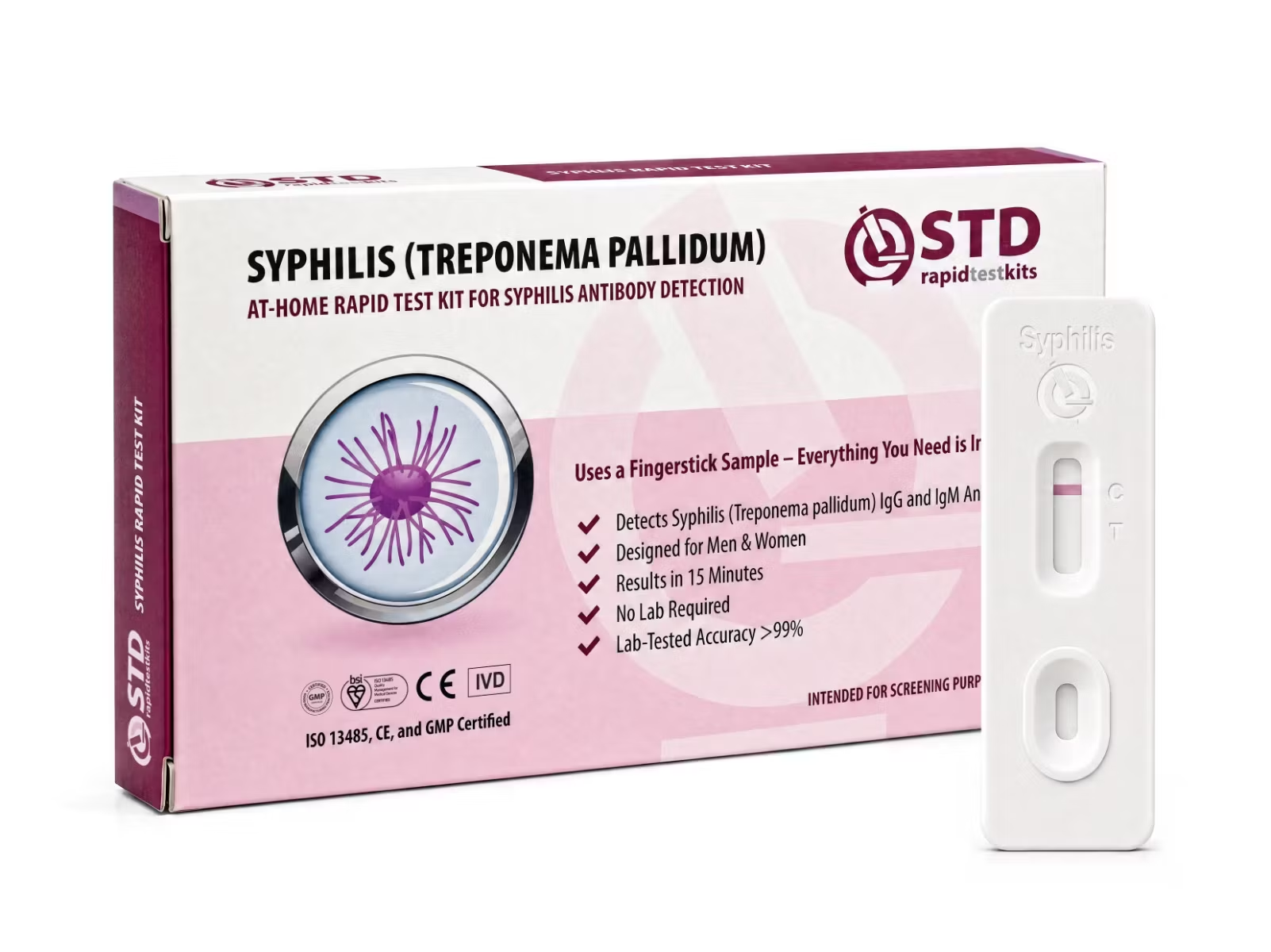
None of this means early testing is pointless. If the wait is making you anxious, a layered schedule gives you earlier reassurance without sacrificing accuracy. A first check at two to three weeks can catch an early infection, a main check at six weeks is usually accurate, and a check at twelve weeks closes the question for that exposure. A fingerstick rapid test fits this plan well, because you can run an at-home syphilis test as many times as you want without the cost or scheduling friction of repeated clinic visits.
A Practical Syphilis Testing Schedule
- 2 to 3 weeks after exposure: an optional early check. A positive result here is meaningful; a negative is not yet conclusive.
- 6 weeks: the main check. A negative is usually accurate, though the 90-day mark remains the gold standard.
- 12 weeks (90 days): the definitive check. A negative here is treated as reliable for that specific exposure.
The 90-Day Threshold and What It Means for Partners
One reason clinicians take the 12-week mark so seriously is visible in how they handle partner-notification cases. The CDC's STI treatment guidelines set a specific rule: anyone who had sexual contact with a confirmed early-syphilis case within the previous 90 days is treated presumptively for early syphilis, even when their own blood test comes back negative.
That standard shows how cautiously a negative result inside the window period is treated. Within the 90-day window, a negative is reassuring, but clinical practice does not yet treat it as enough on its own to skip treatment when there is a known infected partner.
This article is published by stdrapidtestkits.com, which sells at-home STI testing kits. We recommend products based on fit-for-purpose for the reader's concern, not commercial benefit.
Persons who have had sexual contact with a person who receives a diagnosis of primary, secondary, or early latent syphilis less than 90 days before the diagnosis should be treated presumptively for early syphilis, even if serologic test results are negative.
What Happens If Your 12-Week Test Comes Back Positive
A positive home rapid test is a screening result, not a final diagnosis. The standard next step is confirmation with a treponemal-specific lab test (such as TP-PA or FTA-ABS), which a clinician can order. Most clinics also run a non-treponemal test (RPR or VDRL) at the same time to measure the antibody titer, a number that guides treatment choice and follow-up monitoring.
Treatment for primary, secondary and early latent syphilis is straightforward: a single intramuscular injection of benzathine penicillin G. Per the CDC's STI treatment guidelines, penicillin has been the preferred therapy for every stage of syphilis for decades and clears early-stage infections in nearly all cases. Late latent syphilis or syphilis of unknown duration needs a longer course, three weekly injections totaling 7.2 million units. You may feel feverish or achy in the 24 hours after the shot. This is the Jarisch-Herxheimer reaction, an expected response as the body clears dying bacteria, and it usually passes within a day.
- Positive rapid test at home.
- Clinic confirmation with a treponemal-specific test (TP-PA or FTA-ABS).
- Non-treponemal titer (RPR or VDRL) for staging.
- Treatment with benzathine penicillin G.
- Follow-up titer checks at 3, 6 and 12 months to confirm cure.
Why a Treponemal Test Can Stay Positive for Life After Cure
The treponemal-specific antibody tests that most rapid home kits use typically stay positive for life after a syphilis infection, even after fully successful treatment. The immune system has been permanently sensitized to the bacterium, so the antibody signal remains long after the bacteria are gone.
A positive treponemal test years after treatment does not mean the infection has returned. It means your body has kept antibodies from the past exposure. This is why home rapid tests work as screening tools rather than as cure-confirmation tools. Cure is confirmed at a clinic by tracking a falling non-treponemal titer (the RPR or VDRL number) across the 3-, 6- and 12-month follow-up schedule. If you have ever been treated for syphilis and you take a rapid home test years later for any reason, expect it to come back positive, and bring the result to a clinician for context.
A treponemal-specific rapid test that stays positive years after successful treatment is normal and reflects retained antibody memory, not a new infection. Cure is confirmed at the clinic by a falling non-treponemal RPR or VDRL titer at the 3-, 6-, and 12-month follow-up checks, not by the rapid antibody test going negative.
When a 12-Week Test Might Not Be the End of the Story
For the vast majority of people, a negative 12-week test means the chapter is closed for that exposure. Medicine still leaves room for rare exceptions, and a clinician might suggest a follow-up test in specific situations. The fear that syphilis can hide from a blood test indefinitely is one of the most common worries on online forums, but the evidence does not support it. Once antibodies have developed, which is essentially universal by 12 weeks in people with a healthy immune system, modern screening tests detect them reliably. The exceptions below are real but uncommon.
- Ongoing exposure. A partner who may have been infected after the original encounter resets the clock for any new contact.
- Immune-system suppression. Certain medical conditions (such as advanced HIV) or immunosuppressive medications can slow or blunt antibody development.
- Recent antibiotic use. Antibiotics active against Treponema pallidum (penicillin, doxycycline) taken shortly after exposure can suppress bacterial growth and delay the antibody signal.
- New symptoms. A new painless sore, a non-itchy palmar or truncal rash, or unexplained swollen lymph nodes are worth flagging to a clinician even after a negative result.
- A high-risk exposure pattern. Anyone with frequent new partners or other ongoing risk factors is generally advised to test on a regular schedule rather than just after one event.
- Pregnancy. Prenatal screening protocols differ from general adult screening; talk to a clinician about timing if pregnancy is involved.
Testing From Home vs at a Clinic: Does Accuracy Change?
Another common question is whether testing at home changes the reliability of the result. In most cases, the answer depends more on timing than on location. Many at-home rapid tests use the same treponemal antibody chemistry that clinic labs use, and when they are used correctly after the window period, they provide dependable screening results. Home kits use lateral-flow strips, while labs run a sequence of screening and confirmatory tests for higher analytical sensitivity, so the two approaches are complementary rather than identical. The World Health Organization notes that rapid syphilis tests can give results in minutes, which is part of why they are useful for screening.
At-home testing also removes one barrier that the data shows is real: hesitation. For some people, privacy concerns or scheduling friction delay testing past the point where they would otherwise have gone. If discreet testing at home is what moves you from “I keep meaning to” to actually testing, the timing benefit alone is meaningful. Any positive result, at home or at a clinic, should still be confirmed with a follow-up lab test (typically an RPR plus a treponemal-specific confirmatory) before treatment decisions are made.
| Feature | At-home rapid test | Clinic lab test |
|---|---|---|
| Sample type | Fingerstick blood drop | Venous blood draw |
| Result time | About 15 minutes | Hours to a few days |
| Antibody chemistry | Treponemal lateral-flow | Treponemal plus non-treponemal in sequence |
| Privacy | Fully at home, no clinic visit | Requires a clinic appointment |
| Confirmation required | Yes, for any positive result | Built into the standard lab workflow |
Incubation Period vs Window Period: Two Timelines People Mix Up
One reason testing advice can feel contradictory online is that two different clocks often get discussed together. The incubation period is the time from infection to first symptoms (the chancre), typically three weeks but sometimes as long as 90 days. The window period is the time from infection to a detectable antibody response on a blood test, which runs up to about 12 weeks.
Those two clocks do not always move at the same pace. You can have a visible sore at 14 days while still testing negative on a blood test, because circulating antibody levels are not yet high enough for a serum test to register. When that happens, a clinician can swab the lesion directly (darkfield microscopy or PCR), which confirms infection without waiting for antibodies to build. If darkfield or PCR is not available, the usual advice is to repeat the blood test later in the window period rather than to treat the early negative as a final answer.
| Timeline Type | What It Means | Typical Range |
|---|---|---|
| Incubation period | Time from infection to first symptoms (the chancre) | Three weeks typical; range 10 to 90 days |
| Window period | Time from infection to detectable antibodies on a blood test | Up to about 12 weeks |
Protecting Partners and Preventing Reinfection
If a test comes back positive, partners from the past 90 days (for primary syphilis) or the past 6 to 12 months (for secondary or early latent syphilis) should be notified and tested. The NHS guidance on syphilis states that current and any recent sexual partners will also need to be tested and treated. Partner notification is one of the most effective public-health tools for stopping community spread and preventing reinfection.
You do not have to handle notification alone. Many local health departments run confidential partner-services programs that will contact partners on your behalf without revealing your identity, and anonymous SMS or email notification tools exist for the same purpose.
- Notify recent partners. Past 90 days for primary syphilis, past 6 to 12 months for secondary or early latent.
- Wait until your titer is falling before resuming sexual contact. A clinician confirms this at the 3-month follow-up.
- Test current and future partners before any unprotected sex.
- Consider routine screening every 3 to 6 months if you have multiple partners or other ongoing risk factors.
Practical Tips to Reduce the Chance of a False Negative
Modern syphilis tests are highly reliable when timed correctly, and a few simple habits protect that reliability. First, pay attention to timing. Testing too early is by far the most common reason a syphilis test misses a real infection, so if the date of your possible exposure is unclear, test once for early reassurance and again at the 12-week mark.
Second, when using an at-home test, follow the instructions closely. Small details like the size of the blood drop, the storage temperature, and the moment you read the result all matter. Read the result inside the window the kit specifies, because faint lines that appear after that window can mislead you.
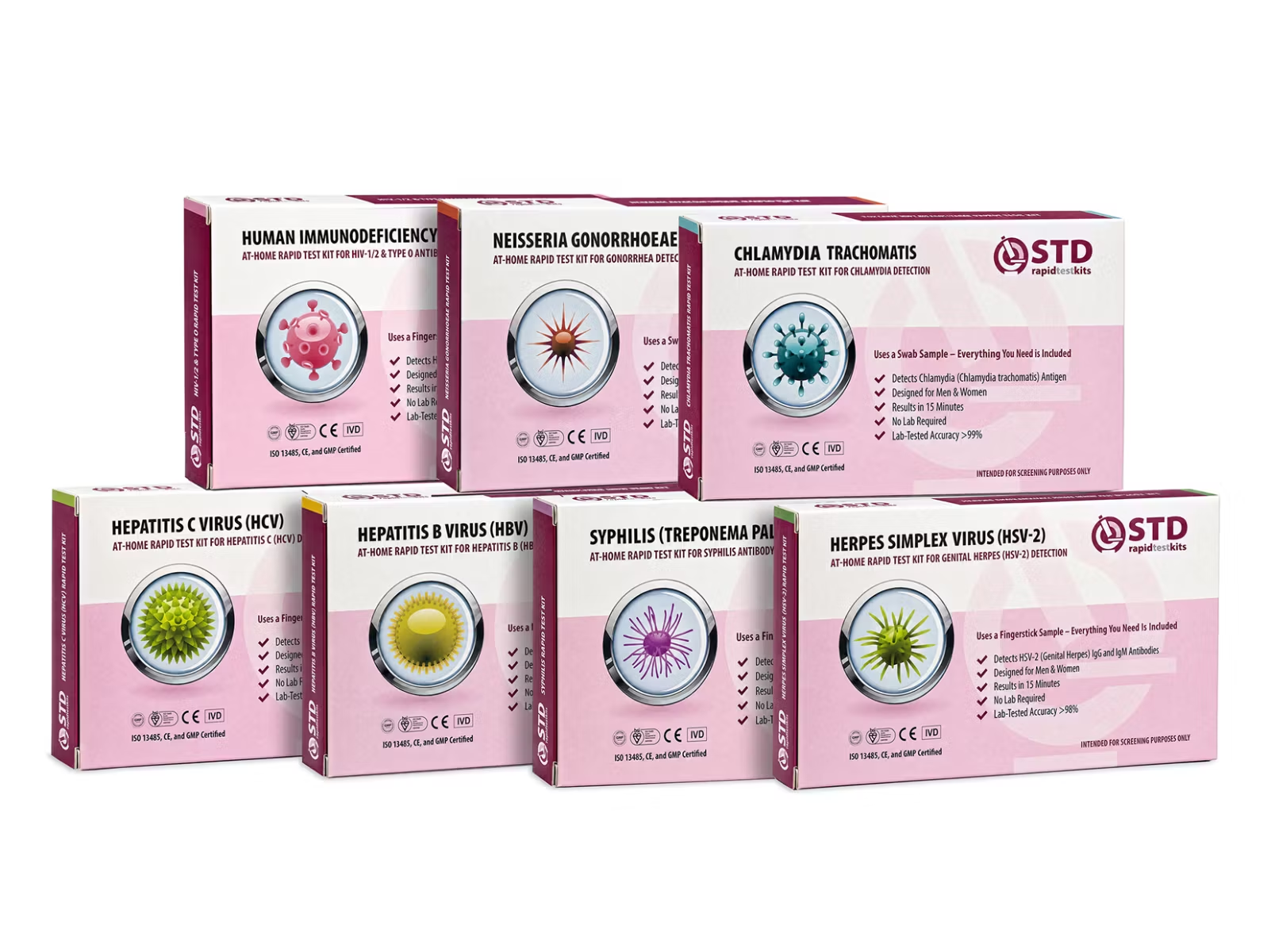
Third, think about the bigger picture. If there have been multiple partners or exposures in a short period, testing for more than one infection makes sense. Syphilis often travels with other STIs, so a single panel that screens for several common infections (chlamydia, gonorrhea, HIV, hepatitis B and hepatitis C alongside syphilis) is more useful than testing them one at a time.
You Deserve Clarity, Not Guesswork
Waiting for a final test result is mentally exhausting. Three months can feel like a long stretch when every small rash, headache or stray search result suddenly feels suspicious. The science behind syphilis testing is more reassuring than the late-night forum threads suggest: antibodies take time to appear, and by 12 weeks the great majority of infections show up on a standard blood test.
If you have reached that point and your test is negative, the major public-health authorities consider the result reliable for the exposure you were worried about. Syphilis is also one of the more straightforward STIs to treat once it is found; MedlinePlus notes it is easy to cure with antibiotics when caught early. If testing privately is what helps you take that step at all, that is a good place to start. What matters most is timing: run your test at or after the 12-week mark and you will have the reliable result clinical practice looks for.
Your Next Steps
Did a screening test, at home or at a clinic, come back positive?
Yes: Confirm it with a clinical lab test (an RPR plus a treponemal-specific confirmatory) before making any treatment decisions. Home tests are screening tools; confirmation belongs with a clinician.
Has it been at least 12 weeks since your last possible exposure?
Yes: A negative result is the milestone clinical practice treats as reliable for that specific encounter, so you can consider that exposure addressed.
No: Test now for early reassurance if you want it, then retest at or after the 12-week mark to close the window. An earlier negative is encouraging but not yet definitive.
Guidance only; a clinician can advise on your specific situation.
FAQs
- If my syphilis test is negative at 12 weeks, am I actually in the clear?
- For most people, yes. By the 12-week mark your immune system has had enough time to produce detectable antibodies if syphilis were present, so major public-health authorities treat a negative result here as reliable for that specific exposure. If there has been no new risk since then, you can move forward without re-litigating the same encounter.
- Why does so much online advice say to wait 12 weeks specifically?
- Because antibody tests detect your immune response, not the bacterium itself. Early on, the bacteria can be in the body while the immune system is still ramping up. By about three months that response is fully developed in nearly everyone, which is when standard screening tests are at their most reliable.
- I tested at 6 weeks and it was negative. Should I still worry?
- Retest at 12 weeks to close the window. A six-week negative is encouraging because many infections are detectable by then, but immune systems respond at different speeds. Pairing the six-week negative with another negative at twelve weeks makes the combination very reliable.
- Can syphilis stay hidden and suddenly show up after a negative 12-week test?
- If your test is negative at 12 weeks and there has been no new exposure since, it is very unlikely that syphilis from that earlier encounter will surface later. Once antibodies have developed, standard tests detect them. The rare exceptions involve significant immune suppression, which a clinician will know to factor in.
- Do I need to fast or stop medications before a syphilis test?
- No. Syphilis blood tests do not require fasting, at home or in a clinic, and food, drink and most everyday medications do not affect antibody levels. Just follow the timing and sample-collection instructions on the kit you are using.
- Can recent antibiotics affect my syphilis test result?
- Possibly. If you took antibiotics active against Treponema pallidum (such as penicillin or doxycycline) shortly after exposure, they may have suppressed bacterial growth before your immune system mounted a full antibody response, which can delay or weaken the signal a test detects. The test is still informative, but retesting at the 90-day mark is worth doing for certainty.
- What if I had symptoms but my test was negative?
- Timing matters. Early symptoms such as a small painless chancre can appear before antibodies are detectable. A clinician can swab a visible sore directly for darkfield microscopy or PCR, which does not rely on antibody levels. Otherwise the usual plan is to repeat the blood test later in the window period.
- After successful treatment, will I always test positive on a rapid antibody test?
- Most likely yes. Treponemal rapid tests usually stay positive for life after a syphilis infection because your immune system keeps memory antibodies against the bacterium. Cure is confirmed at a clinic by a falling RPR titer across the 3-, 6- and 12-month follow-up schedule, not by the rapid test turning negative.
- If someone does test positive, how treatable is syphilis?
- Very treatable. Early-stage syphilis is one of the more straightforward STIs to clear, typically with a single intramuscular injection of benzathine penicillin G. Late latent or unknown-duration syphilis needs three weekly injections. The earlier it is found, the simpler the treatment.
How we sourced this article: Our editorial team summarized current public-health guidance on syphilis testing windows, treatment and partner management from the CDC, WHO, NHS and MedlinePlus. We pulled the foundational timing numbers (primary syphilis appearing about three weeks after exposure with a 10 to 90 day incubation range, and antibodies developing up to two more weeks after primary infection) directly from the CDC's 2024 laboratory recommendations for syphilis testing. Treatment regimens and the 90-day partner-management rule come from the CDC's STI treatment guidelines. Where guidance bodies differ on edge cases, we defaulted to the more conservative 90-day window. We do not provide clinical diagnosis. For symptoms or test results that concern you, see a licensed clinician.
- U.S. Centers for Disease Control and Prevention. Syphilis basics covering stages, symptoms (the primary chancre) and complications of untreated infection, including neurosyphilis, ocular syphilis and otosyphilis.
- U.S. Centers for Disease Control and Prevention. STI Treatment Guidelines, syphilis section. Source for the 90-day partner-management rule and stage-based benzathine penicillin G regimens.
- U.S. Centers for Disease Control and Prevention. Laboratory Recommendations for Syphilis Testing, MMWR Recommendations and Reports, Vol. 73, RR-1, 2024. Source for the three-week primary-syphilis appearance, 10 to 90 day incubation range, and the up-to-two-weeks antibody-development window.
- World Health Organization. Syphilis fact sheet covering transmission, diagnosis (including rapid tests that return results in minutes) and benzathine penicillin treatment.
- UK National Health Service. Syphilis page covering symptom timing (first symptoms in three weeks or more) and partner notification for current and recent partners.
- MedlinePlus, U.S. National Library of Medicine (NIH). Syphilis overview covering diagnosis and tests, and the point that syphilis is easy to cure with antibiotics when caught early.
